
Scalar Metrics Tensor Gradation Rank-n Quantum Gravity Physics
In this paper, logical and novel approach in quantifying and scalarizing tensor metrics quantum gravity with rank gradation process of interactively coupled phenomena of gravity, time, space-time, quanta, and fields domains have been thoroughly analyzed mathematically. The author advances the theory of quantum gravity by integrating gravity and tensor time metrics, building on emergent theories such as Loop Quantum Gravity (LQG). LQG suggests that spacetime is quantized at the smallest scales, with gravity and spacetime geometry emerging from the quantum states of the gravitational field. This study proposes a method to quantize the gravitational field, focusing on the implications of tensor gradation and its impact on the metric structure of spacetime, explores the gradation of time tensors from rank-6 to rank-1 vectors in spacetime, bridging General Relativity (GR) and Quantum Relativity (QR). This study shows how metrics affects the time wavefunctions via Hamiltonian action differ from that those of influencing the gravitational gradients. By separating these metrics, we propose a method for the prediction of future time events on purely empirical basis. The results indicate that our approach can be enabled to reconcile the various aspects of general relativity and quantum mechanics, and finally offer a new insights into the nature of spacetime at the quantum level.
Abbreviations
GR: General Relativity; QR: Quantum Relativity; LQG: Loop Quantum Gravity; GUTs: Grand Unified Theories; LHC: Large Hadron Collider; CMBR: Cosmic Microwave Background Radiation; QFT: Quantum Field Theory; TEGS: Teknet Earth Global Symposia.
Introduction
The quest for unifying the general relativity (GR) as well as the quantum mechanics (QM) has led to various theoretical frameworks, including string theory and loop quantum gravity. However, a complete theory of quantum gravity remains elusive. Emergent theories like Loop Quantum Gravity (LQG) propose that spacetime is nothing but quantized at the smallest scales, with a suggestion that both the gravity and spacetime geometry can be emerging from the quantum states of the gravitational field as emergent properties. So, one can visualize the space –time through LQG as a network of loops, known as spin networks, where whose edges represent the quantum states of the gravitational field, while nodes represent as an interaction between these states. This discrete structure , therefore, helps us to avoid the crisis of infinities that arise in classical gravity theories. Recent researches on LQG have explored the concept of boundary maps, where the quantum states of the bulk geometry are represented as wave-functions on the boundary. This approach helps to understand the relationship between the bulk and the boundary in quantum gravity. Additionally, matrix models offer an alternative approach in to describing the quantum spacetime. The use of matrices in these models in quantifying the degrees of freedom of spacetime provides a different perspective related to quantum gravity. For example , certain solutions in matrix models suggest a quantized cosmological spacetime, where the fluctuations of these matrices can give rise to gravitational phenomena. The idea that the bulk properties of spacetime can be understood through its boundary can be treated as is a significant concept in both LQG and matrix models. This correspondence is crucial for understanding how quantum states of geometry relate to the observable phenomena. Both the LQG and matrix models suggest that spacetime and gravity might be those emergent properties which are arising from the fundamental quantum structures little bit more. Please see extensive references as listed at the end of this article that will explore further on what is the sized of the literature associated with this present paper [1, 2, 3, 4, 5, 6, 7, 8, 9, 10, 11, 12, 13, 14, 15, 16, 17, 18, 19, 20, 21, 22, 23, 24, 25, 26, 27, 28, 29, 30, 31, 32, 33, 34, 35, 36, 37, 38, 39, 40, 41, 42, 43, 44, 45, 46, 47, 48, 49, 50, 51, 52, 53, 54, 55, 56, 57, 58, 59, 60, 61, 62, 63, 64, 65, 66, 67, 68, 69, 70, 71, 72, 73, 74, 75, 76].
The author has considered advancing quantum gravity with gravity and tensor time metrics [40, 41]. Emergent theories like Loop Quantum Gravity, which states the quantization of Spacetime as discrete structure at the smallest scales, suggests that gravity and spacetime geometry emerges from the quantum states of the gravitational field as emergent properties The Aspects of Underlining Spacetime maybe a Result of: (i) mixing of the domains spatial temporal; (ii) fixing of the metrics equations with c2dt2. We propose in this paper a method to quantize the gravitational field by examining the gradation of rank tensors within a framework of metric wavefunction.
The purpose of this study is to address the fundamental issues of spacetime quantization and to explore the potential for the unified description of gravity and quantum phenomena. The gradation of time tensors from rank-6 to rank-1 vectors in spacetime presents a novel approach to unifying General Relativity (GR) and Quantum Relativity (QR). In this study we examine:
- The metrics that affect time wavefunctions through Hamiltonian action, and
- Then compares them to those influencing gravitational gradients.
- Finally, an approach of tensor gradation within a framework of metric wavefunction for expressing the existing quantum gravity and the emergent theories that are given below through highlighting unique aspects as well as common goals.
Loop Quantum Gravity (LQG) [15,22,63]
• Quantization of Spacetime: Both LQG and the tensor gradation approach propose that the spacetime is quantized at the smallest scales. For example, LQG uses spin networks to represent the discrete spacetime, while the tensor gradation approach uses the rank tensors for describing the quantum states of the metric field [62].
• Discrete Structure: LQG visualizes the spacetime as a network of loops, whereas the tensor gradation focuses on the gradation of tensor ranks for capturing the discrete nature of spacetime.
• Mathematical Framework: LQG relies heavily on the mathematical framework of spin networks and spin foams, while the tensor gradation approach uses tensor calculus as well as wavefunctionality in order to describe the quantum properties of spacetime.
String Theory [54,55]
• Fundamental Entities: String theory posits that the fundamental entities are one-dimensional strings, whose vibrations correspond to different particles. In contrast, the tensor gradation approach focuses on the quantization of the metric tensor and its gradation across the spacetime [54, 55].
• Extra Dimensions: For String theory it requires additional spatial dimensions (typically 10 or 11) for its consistency, whereas the tensor gradation approach operates within the framework of the familiar spatial and temporal matrix focusing on the quantum properties of the metric tensor.
• Unification: The aim of the String theory is to unify all the fundamental forces, including gravity, within a single framework. The tensor gradation approach primarily addresses the unification of general relativity and quantum mechanics through the quantization of the gravitational fields.
Causal Dynamical Triangulations (CDT) [16,46]
• Spacetime Discretization: CDT discretizes the spacetime by breaking it into simplexes (triangles in 2D, tetrahedra in 3D, etc.) and studies the evolution of these structures. The tensor gradation approach, on the other hand, uses the gradation of tensors to describe the discrete structure of spacetime [16, 46]. • Causality: CDT emphasizes by maintain • ing causality in the discretized spacetime, with ensuring the preservation of the causal structure of spacetime. Therefore, the tensor gradation approach does not explicitly focus on causality rather than on the quantum states of the metric tensor.
Asymptotic Safety [16]
Renormalization Group: The asymptotic safety approach uses renormalization group to study the behavior of gravity at high energies, aiming to find a fixed point where gravity remains under well-defined and finite manner. It is to be noted that the tensor gradation approach does not explicitly use the renormalization group; but focuses on the spacetime discrete nature through tensor gradation [16].
Predictive Power: Aim of both the above approaches is to provide a predictive framework for quantum gravity. i.e. Asymptotic safety seeks to make predictions based on the fixed point of the renormalization group flow, while the tensor gradation approach uses probabilistic nature of wavefunctions and tensor gradation for to predicting the spacetime events.
Emergent Spacetime Theories [53]
Fundamental Idea: The emergent spacetime theories suggest that the spacetime and gravity both emerge from the collective behavior of more fundamental entities, such as quantum states or information [53]. This is in contrast with the traditional view of spacetime as a fundamental backdrop for physical events.
Examples: Notable examples include Erik Verlinde’s entropic gravity, where gravity emerges from changes in information entropy, and the holographic principle [53], which posits that the description of a volume of space can be encoded on its boundary.
Connections to Tensor Gradation Approach
Emergence from Quantum States: The gradation of rank tensors and the quantization of the metric field approach aligns with the idea that spacetime geometry emerges from quantum states. By treating the metric tensor as a quantum field and exploring its gradation, one can provide a framework where the geometry of spacetime will be considered as a result of underlying quantum phenomena.
Discrete Structure: Both the theories of emergent spacetime and the tensor gradation approach emphasize the discrete nature of spacetime at the smallest scales. In the framework of tensor gradation, this is captured through the gradation of tensors, which reflects varying degrees of quantum fluctuations and curvature.
Wavefunctionality: The concept of metric wavefunctionality in the tensor gradation approach parallely provides the idea in emergent theories that the spacetime properties can be described in a probabilistic manner such that this wavefunctionality captures the quantum fluctuations of the metrics, on contributing to the emergent nature of the spacetime.
Specific Aspects of Emergence
Information Flow: Emergent theories often involve the flow of information as a key component. In this approach, the interaction between the time wavefunctions and the gravitational gradients both can be seen as a single form of information flow, in which the metrics governing interactions determine the emergent properties of the spacetime.
Bulk-Boundary Correspondence: The basic idea related to the bulk properties of spacetime can be understood through its boundary that signifies the emergent theories, such as the holographic principle.
Here in the tensor gradation approach, with its focus on tensor gradation as well as wavefunctionality, all these can be interpreted within this context, where the boundary conditions of the metric field influence the bulk geometry.
Implications for Quantum Gravity
The problem with ultraviolet catastrophe within the classical physics, though had been solved by Quantum Mechanics, subsequently this had encountered inconsistency with General Relativity in vacuum catastrophe by very large orders of magnitude in energy.
• Unification of GR and QM: By providing a framework that incorporates both general relativity and quantum mechanics through the quantization of the metric tensor, this gradation of the tensors approach thereby contributes to the broader goal of unifying these two pillars of modern physics. This unification is a central theme in the emergent spacetime theories.
• Predictive Power: The probabilistic nature of wavefunctions as well as use of tensor gradation in this approach offer a way of making empirical predictions about spacetime events. This aligns with the goal of emergent theories towards providing a predictive framework for understanding of the fundamental nature of spacetime.
Unique Aspects of Tensor Gradation Approach
• Tensor Gradation: The unique feature of this approach is the gradation of rank tensors, which allows varying degree of quantum fluctuations and curvature across different regions of spacetime. This provides a new perspective on the geometry of spacetime.
• Metric Wavefunctionality: By extending the concept of wavefunctionality to the metrics field, this approach incorporates quantum fluctuations of the metric, offering framework of spacetime quantization comprehensively.
• Separation of the Metrics: The approach via the distinguishing between the metrics affecting time wavefunctions and those affecting the gravitational gradient, allows for furthermore with nuanced understanding the dynamics of spacetime.
A Brief Overview of Each Section in the Article: 1. In Abstract: This section provides a concise summary of the present study .paper, highlighting the focus on the gradation of time tensors from rank-6 to rank-1 vectors in field of spacetime, and also investigating the metrics that affecting the time wavefunctions and the gravitational gradients.
2. In Introduction: It sets the stage for the study, explaining the significance of unifying General Relativity (GR) and Quantum Relativity (QR) through the gradation of time tensors. It outlines the objectives and the scope of the research.
3. In Results with Mathematical Derivations as well as Discussions and Experimental Validation: This section presents the findings of the study, detailing the process of scalarizing tensor time and gravity through matrix factorization mechanisms. It explains how the interaction of sense-fields-effect mesoscopic coupling with gravitational gradients generates gravitational fields wavefunctions. This paper provides detailed mathematical derivations to support the theoretical concepts, including tensor manipulation, metric tensor factorization, and the scalarized Lagrange equation of motion.
4. Discussions: Analyze further implications of the results, including the classical scalar equation of motion under gravitational fields and the relevance of Einstein’s Field Equations and the Schwarzschild metric. It also explores the theoretical framework’s potential impact on our understanding of spacetime. Experimental validation list proposes various experimental approaches to validate the theoretical framework, such as high-energy particle collisions, gravitational wave observations, quantum entanglement experiments, astrophysical observations, and laboratory simulations. 5. In Conclusion and Summarizing Key Takeaways of Article: Summarizes the key findings and their significance, emphasizing the potential for future research in quantum gravity and the broader implications for our understanding of the universe. 6. Potential Applications of this Research: Lists key areas where this research could have a significant impact per quantum gravity and the rank tensor gradation with several potential applications across the various fields of physics and beyond sciences. 7. References: Lists the sources cited throughout the paper, providing a foundation for the research and supporting the theoretical and experimental claims made.
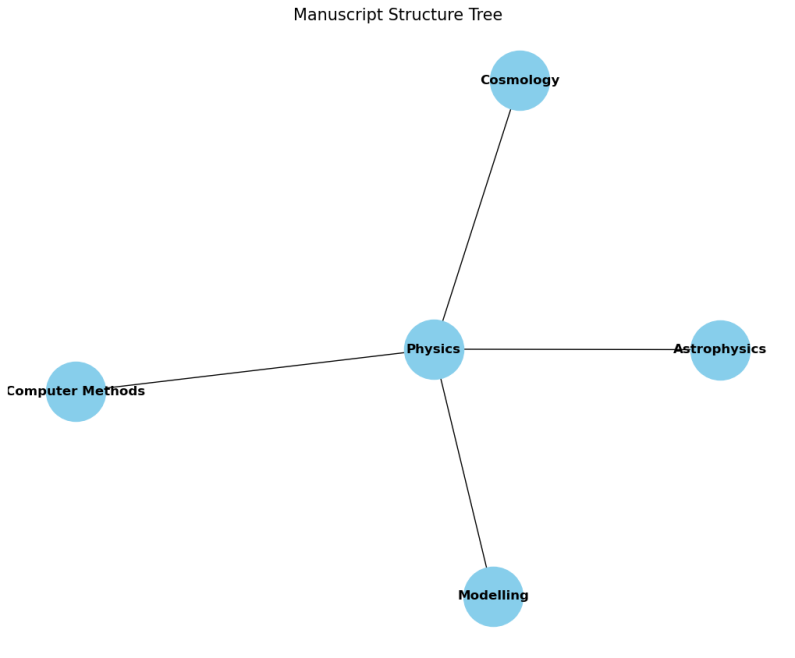
• Astrophysics: Astrophysics involves the study of celestial bodies and phenomena beyond Earth’s atmosphere. Key topics include gravitational waves, black holes, and numerical simulations. • Cosmology: Cosmology explores the origin, evolution, and structure of the universe. Important concepts include dark matter, dark energy, and cosmic microwave background radiation (CMBR). • Computer Methods: Computer methods in physics often involve simulations. These methods allow for the modeling of physical systems in a virtual environment. • Atomic & Molecular Physics: Atomic and molecular physics studies the behavior of atoms and molecules. This includes their interaction with light and their role in various processes like chemical reactions. • High Energy Physics: High-energy physics focuses on the study of fundamental particles and forces. This includes particle accelerators and the exploration of quantum fields.
• Mathematics: Mathematics in physics plays a crucial role, especially in areas like quantum gravity. It involves scalar metrics, tensor gradation, and rank-n quantum theories (Figure 1).
**Results with Mathematical Derivations, as well as Discussions and Experimental Validations**
Results: Logical approach having Quantum Gravity general analysis with idea of $g_{\mu\nu} |\Psi\rangle$, where $g_{\mu\nu} \equiv$ gravity metric; $\Psi \equiv$ wavefunction quanta was considered first. Another way was to use the metric tensor ($g_{\mu\nu}$) as a quantum field. The wavefunction ($\Psi$) of the gravitational field can be expressed as a functional of the metric tensor: $\Psi[g_{\mu\nu}]$. This wavefunction describes the probabilistic distribution of different metric configurations. Quantization of the rank tensors applying the principles of QFT (quantum field theory) [49] to the operator metric tensor, treating it as an operator with associated creation and annihilation operators to give equation metric relationship: $\hat{g}{\mu\nu} = \left[ d^3 k \left( a{\mu\nu} (k) e^{ikx} + a_{\mu\nu} ^\dagger (k) e^{-ikx} \right) \right],$ where $a_{\mu\nu} (k)$ and $da_{\mu\nu} ^\dagger (k)$ are the annihilation and creation operators, respectively. The wavefunctionality of the metric field is extended to account for tensor gradation: $\Psi \left[ g_{\mu\nu} \dots g_{\mu\nu} \right]$.
This wavefunction describes the quantum states of the metric field with varying tensor ranks, providing a comprehensive framework for spacetime quantization. However, this simple approach, even with Schwarzschild-like metric wasn't enough to quantify quantum gravity. One of the reasons addresses the question of domains. Dimensions, coordinates, and the units problem underlining spacetime maybe a result of: (i) mixing of the spatial temporal domains; (ii) fixing of the metrics equations with $c^2 dt^2$ to force-fit matching units, requiring to have constant speed of light criteria. Besides questioning of the units as well as unitarization like the $c^2 = 1$ and other constants like h/c taken as 1, incorporation of units with appropriate dimensions have posed unresolved problem to accommodate quantum with general relativity, apart from other aspects. Hence, the author had novel approach to solution by converting everything parametrically to one domain, for example, onto time domain by operator calculus algebra with general transforms, formalism of which had been already presented on many peer-reviewed publications [33, 34, 35, 36, 37, 38, 39, 40, 41, 42, 43]. This resulted eventually to the approach of Rank-n tensor time PHYSICS [41]. The concept of wavefunctionality is extended to the metric field, where the wavefunction describes probabilistic distribution of metric configurations. This framework provides a natural way to incorporate quantum fluctuations of the metric, leading to a more comprehensive understanding of spacetime dynamics.
The author has previous results with concept that the universe operates akin to a "black box," as revealed by the graphical general transform equation, where inverse transform giving four-vector time matrix interactively coupling commutes with gravity matrix analogous to Schwarzschild metrics. The following methodologies resolve problems using techniques, such as: (i) Metrics guiding time tensor collapse interactively coupled to the gravitational gradient, with their own stochastic metrics determining the scalar spacetime event matrix. (ii) For example, front-loading "quantum foam" time tensor wavefunctions which works physically interactively mathematical equivalent to curl (iii) and couple with the gravitational "vacuum bath" gradient, acting back in time event matrix sequences. (iv) Metrics gauging both create ongoing present situational states. These aspects appear in recent peer-reviewed publications [35, 36, 37, 38, 39, 40, 41, 42, 43].
**Expanded Gravity Time Matrix [41]**
Upon density configuration, $|Gw><tq| = G_{ij}$ having (i, j = 1, 2, 3, 4), the expanded gravity time matrix, $[G_{ij}]$ after normalization with unitarization, $G_{ij}$ matrix is analogous to Schwarzschild's metrics [64]. having 4x4 format to get:
$$\begin{bmatrix} G_{11} & G_{12} & G_{13} & G_{14} \\ G_{21} & G_{22} & G_{23} & G_{24} \\ G_{31} & G_{32} & G_{33} & G_{34} \\ G_{41} & G_{42} & G_{43} & G_{44} \end{bmatrix}$$
Expanded Gravity Time Matrix: Upon density configuration, $|Gw><tq| = G_{ij}|$, with (i, j = 0, 1, 2, 3), the expanded gravity time matrix $|G_{ij}|$ after normalization and unitarization is analogous to Schwarzschild's metrics in a 4x4 format:
$$\begin{bmatrix} G_{00} & G_{01} & G_{02} & G_{03} \\ G_{10} & G_{11} & G_{12} & G_{13} \\ G_{20} & G_{21} & G_{22} & G_{23} \\ G_{30} & G_{31} & G_{32} & G_{33} \end{bmatrix}$$
This matrix represents the expansion from a 2x2 matrix of the form having Helmholtz's fields of zero-point and microblackhole $\left( \begin{array}{c} \epsilon_{r,\mu\nu} \epsilon_{g,\mu\nu} \\ \epsilon_{g,\mu\nu} \epsilon_{r,\mu\nu} \end{array} \right)$, which is point PHYSICS with Iyer R, et al. [33]. The author Iyer R [40, 41, 43] has rationalized elsewhere as to why Rank2 matrix time needs extension to Rank4 tensor time to achieve unified theory that can consistently describe all the physical interactions with domains, from the quantum to the cosmic scale, and from the microscopic to the macroscopic level that current theories of physics, such as quantum mechanics, general relativity, and the standard model of particle physics will have to be advanced to novel general formalism based on a rank-4 tensor time matrix abstracting informational observables in various domains of reality having translational coordinates translated to time domain {t(x), t(y), t (z)} and a rotational coordinate {t (θ)} may thus constitute Rank 4 tensor, txyzθ, generally written as: Tμναβ with spin, rotation, revolution, and angular gauge momentum, and provide correlative proofs to characterize physical phenomena observables to quantify physical quantities of stress-energy tensor, the electromagnetic tensor, as well as the Riemann curvature tensor (Figure 2) [43].
![Figure 2: Physics Literature analogy metrics [41,43].](/fulltextimages/13736/fig_2.jpeg)
Proof of the concept Rank-4 Tensor Time Matrix [41,43]
• Rank-4 tensor time,
4 4 T S H g g p p p p x x x x µναβ µναβ µναβ µ ν α β µ ν α β ∂ ∂ = = ∂ ∂ ∂ ∂ ∂ ∂ ∂ ∂
1 gµναβ −
• Manipulating,
4 4 S H T p p p p x x x x µναβ µ ν α β µ ν α β $$ 1 = \frac {\partial^ {4} S}{\partial x ^ {\mu} \partial x ^ {\nu} \partial x ^ {\alpha} \partial x ^ {\beta}} = \frac {\partial^ {4} H}{\partial p _ {\mu} \partial p _ {\nu} \partial p _ {\alpha} \partial p} $$ • Hence: Action, { } $$ S = \int \left\{\left[ g _ {\mu \nu \alpha \beta} \right] ^ {- 1} T _ {\mu \nu \alpha \beta} \partial x ^ {\mu} \partial x ^ {\nu} \partial x ^ {\alpha} \partial x \right. $$
1 g T x x x S x µ ν α β µναβ µναβ • Hamiltonian, { }
1 g T p p p p H µναβ µναβ µ ν α β − = ∂ ∂ ∂ ∂ ∫
where p: momentum; x’s are the space-time coordinates; {μ, ν, α, β} = 0,1,2,3; and the metric gμναβ converts action derivative to appropriate domain of time [41, 43].
Since, $i\hbar \frac{d}{dt}|\Psi\rangle = \hat{H}|\Psi\rangle$ [https://en.wikipedia.org/wiki/Schr%C3%B6dinger_equation] to get the equation: $i\hbar \frac{d}{dt}\Psi(r,t) = -\frac{\hbar^2}{2m} \nabla^2\Psi(r,t) + V(r)\Psi(r,t)$
The momentum-space counterpart involves the Fourier transforms of the wave function and the potential: $i\hbar \frac{\partial}{\partial t}\bar{\Psi}(p,t) = -\frac{p^2}{2m}\bar{\Psi}(p,t) + (2\pi\hbar)^{-3/2} \int d^3 p \bar{V}(p-p')\bar{\Psi}(p,t)$
The functions $\Psi(r,t)$ and $\bar{\Psi}(p,t)$ are derived from $|\Psi(t)\rangle$ by $\Psi(r,t) = \langle r|\Psi(t)\rangle$, $\Psi(p,t) = \langle p|\Psi(t)\rangle$ where $|r\rangle$ and $|p\rangle$ do not belong to the Hilbert space itself but have well-defined inner products with all elements of that space.
Our results indicate that the immediate past metrics affecting time wavefunctions differ significantly from those affecting gravitational gradients. The gravitational gradient curling tensor time depends on the immediate future of the action that generated the time wavefunction, transforming it into a scalar spacetime event that advances the timeline. This separation of metrics allows for the empirical prediction of future time events. Schrödinger equation, which had been shown above, the momentum-space counterpart involves the Fourier transforms of the wave function and the potential.
Matching Tensor Ranks [41, 43]: To match the rank of the tensor time with that of the gravitational gradient, we use the time matrix in a compact form of the Kronecker delta and the Levi-Civita symbol: $T_{uvv} = g_E \delta_{uvv} \delta_{uvf} E + g_L \int_{uvv} L + g_P \delta_{uvf} \delta_{vf} P + g_S \delta_{uvf} \delta_{vf} S$, where $E$ is the energy, $L$ is the angular momentum, $P$ is the momentum, and $S$ is the entropy. These four fundamental informational observables characterize the physical quantifiability of any system in any domain of reality. This results in mostly rank-2 matrices, except for one rank-4 matrix, which can be related to a 4D hyperspace matrix and then flattened using IT techniques like factorizing [41, 43].
The author Iyer R [41, 43] has rationalized elsewhere as to why Rank4 matrix time needs extension to Rank6 tensor time to quantify complex phenomena that involve translational domain $\{t(x), t(y), t(z)\}$ and spherical rotations $\{t(\theta), t(\varphi), t(Y)\}$ in different realities, such as quantum entanglement, wormholes, and parallel universes; additionally, boosts, Euler rotations, and/or chirality would be addressed. Rank 6 $t_{xyz\theta\varphi}$ in Equation (6) notation, $T_{ijklm}$ in suggestive physics notation may be written as: $T_{abcdef}$ or $t_{abcdef}$. The rank-6 tensor time matrix can be used to describe the transformations of rotational parameters in different domains of reality, such as:
- Quantum Space: the domain of reality where space fields conceal time, and quantum entanglement phenomena reveal the nonlocality of time probability aspects;
- Mesoscopic Environment: the domain of reality where time coexists with entropic matter space fields, and neutrino oscillations and gravitational lensing indicate the influence of cosmic gravity;
- Astrophysical Field: the domain of reality where time is curved with space sense containment extending to infinite vacuum, and Hawking radiation reflects the quantum as well as thermal effects of black holes with the causality of negative energy.
The rank-6 tensor time matrix was written as [41, 43]: $T_{ijklm} = g_{ijklm} \frac{\partial \theta}{\partial t} \frac{\partial \phi}{\partial t} \frac{\partial \psi}{\partial t} \frac{\partial \chi}{\partial t}$, where $\theta_p$, $\phi_k$, $\psi_m$, and $\chi_n$ are the Euler angles of rotation in the i-th, k-th, m-th, and n-th domain of reality, respectively, and $t_p$, $t_k$, $t_m$, and $t_n$ are the time coordinates in the j-th, l-th, n-th, and p-th domain of reality, respectively; metric $g_{ijklm}$ converts angular velocity to appropriate time domain. A rank-6 tensor time matrix has 64 components, corresponding to the 64 possible combinations of the six indices $i, j, k, l, m$, and $n$. These equations represent the "black box" universe, where the rank-6 tensor time matrix is the key to unlock the secrets of reality [41, 43]. We can manipulate this to obtain the scalarized form by integrating over the appropriate variables to convert to parameter of action $S(\theta_i\phi_k\psi_m,\text{and}\chi_n) = \int [g_{ijklm}]^{-1} T_{ijklm} \partial_t \partial_t \partial_t \partial_t p$.
Having Euler angles expressed as a function of time R.H.S. can be evaluated to proceed to equivalent Kronecker delta Levi Civita form and then use flattening matrix factorization obtaining gaging rank of a rank-6 tensor time matrix to minimum number of rank-1 tensors written as the outer product of six vectors, one for each index like $(u_1 \otimes u_2 \otimes u_3 \otimes u_4 \otimes u_5)$ with components, for example, like $(u_1 \otimes u_2 \otimes u_3 \otimes u_4 \otimes u_5)_{ijklm} = u_1 u_2 j u_3 k u_4 u_5 m_6$ where $u_1, u_2, u_3, u_4, u_5, u_6$ are vectors (that can be added together to obtain the given tensor) [41, 43].
Applying this technique, we can obtain quantum domain space rank-6 tensor time factorizing: $T_{ijklm} = \vec{t}_1 \otimes \vec{t}_2 \otimes \vec{t}_3 \otimes \vec{t}_4 \otimes \vec{t}_5 \otimes \vec{t}_6$ in vector time multiplication. We will apply these techniques repeatedly achieving formalisms scalarizing time and the gravity metrics.
**Results of Mathematical Physics Derivations**
Scalarizing Time: After flattening of tensor to vector operator like-time matrix equates:
$$\hat{i}_{ijklm} = \vec{t}_1 \otimes \vec{t}_2 \otimes \vec{t}_3 \otimes \vec{t}_4 \otimes \vec{t}_5 = \langle \vec{t}_q \rangle, [q] \{1, 2, 3, 4, 5, 6\}$$
multiplicative vectors. Sense-fields-effect mesoscopic
coupling with gravitational gradient w G ρ
will generate gravitational fields wavefunction, € €S w g G = Ψ ρ
to energize giving momentum interactively to density time gravity Schwarzchild-like expanded Matrix, |Gw><tq| = Gij, having (i, j = 1, 2, 3, 4) producing € € q S w q g t G t = Ψ ρ ρ ρ =tqg, having t = scalar time; “qg” representing quantum gravity. Thus, scalarizing tensor time with matrix factorization mechanism-like magic square prime factorizing vacuum (earlier publication) absolute matrix to originate gravity- time matrix is possible.
We can generalize metrics technique applied to scalarize time to gravity-time metrics. Achieving that will involve the following sequences: Rank 6-time metrics, written in the general form like ˆ T ijklmn G is matrix factorizable to Rank 1 time metrics of the kind t q G ρ “bra” matrix that has capability to have interactive coupling with gravity gradient, g w G ρ “ket” matrix, similar to what was shown earlier with
Schwarzschild-like metrics analogue, to obtain configuration
of density matrix quantification gravity-time,
ˆ gt v Gµ
, that is
written to be:
$$ \left[ ^ {g t} \hat {G} _ {\mu v} \right] = \left| ^ {g} \vec {G} _ {w} \right\rangle \left\langle^ {t} \vec {G} _ {q} \right| $$
, whereby {µ, ν} = 0, 1, 2, 3;
this matrix will have a fully Euclidean type expanded matrix G G G G G G G G G G G G G G G G G G G G G G G G G G G G G G G G $$ \left[ \begin{array}{c c c c} G _ {0 0} & G _ {0 1} & G _ {0 2} & G _ {0 3} \\ G _ {1 0} & G _ {1 1} & G _ {1 2} & G _ {1 3} \\ G _ {2 0} & G _ {2 1} & G _ {2 2} & G _ {2 3} \\ G _ {3 0} & G _ {3 1} & G _ {3 2} & G _ {3 3} \end{array} \right] = \left[ \begin{array}{c c c c} G _ {0 0} & G _ {0 x} & G _ {0 y} & G _ {0 z} \\ G _ {x 0} & G _ {x x} & G _ {x y} & G _ {x z} \\ G _ {y 0} & G _ {y x} & G _ {y y} & G _ {y z} \\ G _ {z 0} & G _ {z x} & G _ {z y} & G _ {z z} \end{array} \right] $$
which represents expansion from 2x2 matrix with zero
point or origin in the matrices as G00 then Cartesian
coordinates (x, y, z) so that whole matrix has {µ, ν} = 0, x,
y, z to account for 4D type space time gravity; note that
can represent time to spatial coordinate with Minkowski
spacetime which becomes like Schwarzschild metrics {c2dt2}
00 0 0 0 00 01 02 03
x y z
0 10 11 12 13 x xx xy xz
0 20 21 22 23 y yx yy yz
of the form
0 30 31 32 33 z zx zy zz
2 2 2 2 2 2 2 2 2
2 1 sin 2 1 GM dr ds c dt r d d GM c r c r $$ = - c ^ {2} \left(1 - \frac {2 G M}{c ^ {2} r}\right) d t ^ {2} + \frac {d r ^ {2}}{1 - \frac {2 G M}{c ^ {2} r}} + r ^ {2} \left(d \theta^ {2} + \sin^ {2} \theta d \phi^ {2}\right) $$ ( )
2 , Schwarzschild K [64], Einstein A [19, 20] discussed more below.
In the 2x2 reduced matrix form it conforms consistently with Iyer R, et al. [32] point PHYSICS Helmholtz [31] decomposition 2x2 matrix fields, discussed earlier:
ˆ ˆ , ˆ ˆ
= quantifying zero point and microblackhole, which is like a point singularity within the Schwarzschild metrics above, demonstrating quantifying power characterizing compact astrophysical domain temporal spatial fields that has gravity-time incorporated, extended beyond Loop Quantum Gravity Theory [63].
v r v g v r g v v v r
µ µ µ µ µ µ ε ε ε ε ε ε ,
g, Above 4x4 matrix,
$$ \left[ ^ {g t} \hat {G} _ {\mu v} \right] = \left| ^ {g} \vec {G} _ {w} \right\rangle \left\langle^ {t} \vec {G} _ {q} \right| $$ is mesoscopic representation intermediary between astrophysical and quantum spacetime of the universe. We can think compactly in terms of schematics: Gravity metrics with time metrics will proceed to determine future event matrix, having algorithm quantifiable foregoing PHYSICS stochastically moving progressively. Similar to explanations within Introduction section on physics literature, we can utilize tensor rank gradation by matrix factorization to convert higher rank like rank6 to rank1 vector or even to rank0 scalar parameters, formalizing like techniques enunciated below, summarizing gist with schematics results, showing how rank of tensor is critical to define different domains of reality.
Quantum domain space rank-6 tensor time =
1 2 3 4 5 6 t t t t t t ⊗ ⊗ ⊗ ⊗ ⊗ υρ υρ υρ υρ υρ υρ
like monopoles Mesoscopic environment spacetime = [oscillation]{rank4, rank2] gravity-time metrics Astrophysical domain temporal spatial fields = rank2 Gij= |Gw><tq|| like gravitons Graphically this may have Plotting Schematics like:
![Figure 3: Schematic graphical representation of Rank Factorizing Domains of Reality [Rank of matrix]{scalar(0), vector(1), tensor(>1)} quanta fields operator.](/fulltextimages/13736/fig_3.png)
shows how the different domains of reality can be represented quantitatively schematically to show rank gradation with astrophysical domain representation possibly with rank 2 temporal spatial fields like Schwarzschild metrics. When we proceed to mesoscopic environment, we require oscillatory gravity-time metrics between rank4 and rank 2 spacetime which is like Kronecker delta and the Levi-Civita symbol:
$$ T _ {\mu \nu \alpha \beta} = g _ {E} \delta_ {\mu \nu} \delta_ {\alpha \beta} E + g _ {L} \in_ {\mu \nu \alpha \beta} L + g _ {P} \delta_ {\mu \alpha} \delta_ {\nu \beta} P + g _ {S} \delta_ {\mu \beta} \delta_ {\nu a} S $$
discussed above having mixed ranks of 2 and 4, capable of
incorporating energy, momentum, angular momentum and
entropy aspects that are typical of material-environment
mesoscopic systems (Figure 3). Applying transformation
with Euclidean to Riemann geometry, like indicated by the
SCHEMATIC PHYSICS below, we can effectively convert
rank4, for example, ϵ_μναβ to the rank2 equivalent. However, quantum regime requires much higher rank, i.e. rank6 tensor since entities are essentially stripped to elemental form, causing field polarization, for example, polarization with vacuum energy. Essentially this will reflect onto geometric effect having eigen translational and rotational directions pulled-out or dissociated like algebra form, possibly non- Abelian or multi-directional dimensional aspects evolving to models of the String theoretic extra-dimensionality.
Using the above tensor rank factorization techniques, these tensors may be converted to rank1 vectors, which are possibly scalarized like above time metrics.
Overall physics graphically schematically shown elsewhere [41, 43] is brought to attention here to get picture how origin of universe from “quagmire” noisy superluminal phase, that will have only imaginary spacetime, unobservable dark matter energy form having only wavefunctions that are like rank6 tensors or only random sense fields. These aspects will be considered more in the subsequent publications. Here, only schematics will be given below to illustrate that (Figure 4).
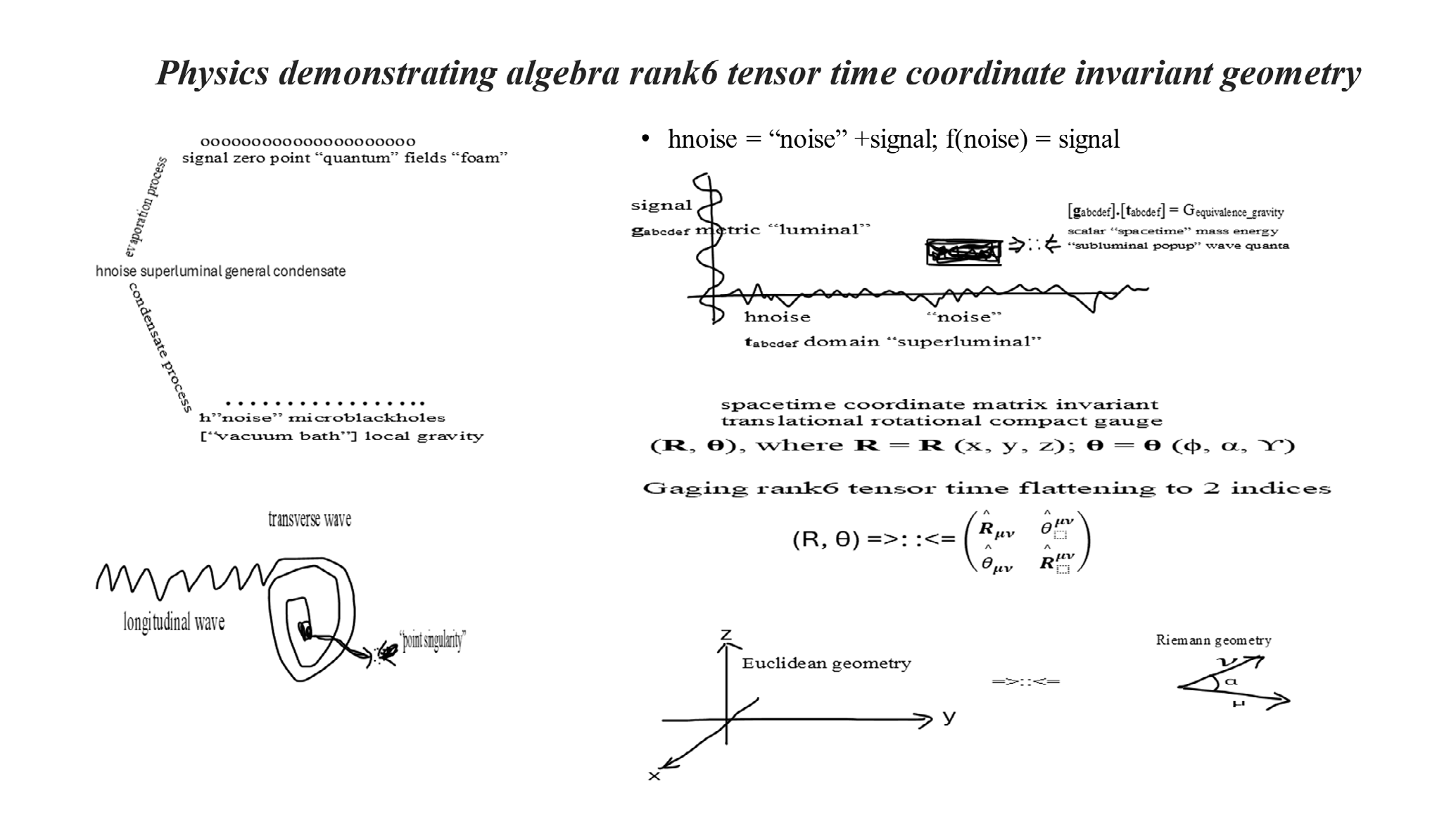
Referring to simplified schematics explaining physics picture-wise above, the following aspects may highlight key points, taking away to proceed to better understanding that.
Point “Singularity” and Faster than Light Superluminal “Quagmire” Related to Tensors: Transverse waves curled up from longitudinal waves get activated by random distortions of superluminal “quagmire” to generate zero-point- microblackhole Calibu-Yau 6-fold brane string theory like manifolds. With true and false vacuum creations, sufficient energy will be available to activate Hod-PDP mechanism originating particle spectra. Vacuum interphase having light mediating popup subluminal phase particle to matter energy signals with evaporation process stabilizing real matter universe will also have condensation process matter to entropy symmetry. Schematic flowchart picturing rank-n tensor expanding and collapsing to more stable rank2 4x4 matrix form mesoscopic scale have been sketched to depict quantum, mesoscopic, astrophysical levels. References listed below with the author’s earlier publications also having more references explain in detail these aspects further.
The faster than light speed maybe happening primarily with higher rank tensors at quantum level wavefunction occurring at superluminal phase with phenomena of entanglement superposition processes making instantaneity till wavefunction becomes collapsed to equivalent scalar parametric metric fields.
Gradation of tensors’ rank provide through sense-given domains of reality within existential spatial temporal gauge fields having going up the rank in the quantum level, while mesoscopic to astrophysical levels, the rank goes towards scalar observables. They will have consonance with Table of Realities within advanced Discontinuum PHYSICS [71], where gradation scales argumentation deeply logically considered having specific numbers. Here, mathematical algebra with matrix metrics have been quantitatively algorithmized tensors to scalars, with questions regarding measurements, physics having dark matter energy, quantum superpositions entanglements, mesoscopic existence, point singularities, blackhole, exotic systems, physics proposing multiverse, higher dimensional strings, M-theory with branes [72], wormholes, superluminal communication, operator universal matrix simulation “mind over matter” alternate universes or multiverse only touched perhaps to hint that these are developable from these formalisms, that will be the subject of further enquiry. Here, gravity-time interactive coupling aspects will be quantified further analyzed below to advance formalism towards unified PHYSICS with discretized spacetime having quantum ensembles, pointing M-branes oscillations of gravity-time, following literature enumerated earlier in Introduction of this paper.
We will proceed now to incorporate gravity into time metrics, like analysis extended to scalarize gravity gradient metrics to rank1, noting General Relativity principle of stress-tensor that quantifies mass tensor, discussed more below. Before advancing scalarization of gravity gradient, the following will have to be considered specifically contrasting with time metrics scalarization technique.
Literature Discussion Highlighting Key Aspects to Consider below: Einstein’s Field Equations describe the gravitational interaction in terms of the curvature of spacetime [20, 64]. They are given by (Figure 5):
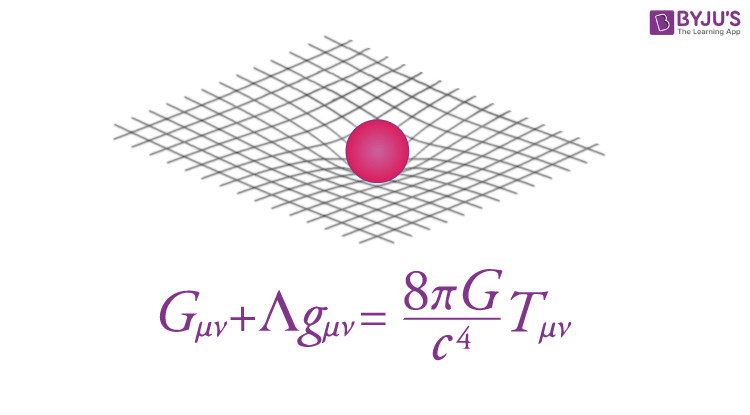
1 2 G R g R µν µν µν = − , where: Gμν the Einstein spacetime curvature tensor combines Rμν the Ricci tensor which gives curvature of spacetime on a pseudo-Riemannian manifold [20], gμν metric tensor, and R, scalar Ricci curvature. Λgμν is the curvature spacetime cosmological constant; G is the Einstein gravitational constant; Tμν is the stress-energy tensor, describing the distribution of local energy, momentum, and stress; and then c is the speed of light in vacuum. The Schwarzschild’s metric, describing gravitational field outside a spherically symmetric mass, such as non-rotating black hole is given by having Ricci-flat spacetime, Rμν = 0 (vacuum), written in calculus form:
2 2 2 2 2 2 2 2 2
2 1 sin 2 1 GM dr ds c dt r d d GM c r c r $$ ^ {2} = - c ^ {2} \left(1 - \frac {2 G M}{c ^ {2} r}\right) d t ^ {2} + \frac {d r ^ {2}}{1 - \frac {2 G M}{c ^ {2} r}} + r ^ {2} \left(d \theta^ {2} + \sin^ {2} \theta d \phi^ {2}\right) $$ ( )
2 where: s is spatial distance (distance from the center of a massive object, like a black hole or massive star); t is time coordinate (observer experienced time far away from the massive object, asymptotically flat region; for an observer at rest relative to the massive object, t is proper time measured by a clock at that location); M is mass of the central object; c is speed of light in vacuum; r is radial coordinate; {θ, ϕ} are angular coordinates; also, ds is spacetime distance; and dr is spatial distance. The author will refer to Standard PHYSICS text on General Relativity to get in-depth knowledge with extensive literature.
Gradation of Time Tensor: Rank6 to rank1 vector spacetime – General Relativity PHYSICS rank1 vector spacetime-like to rank6 time tensor – Quantum Relativity PHYSICS Metrics that affect time wavefunctions by Hamiltonian (action) via Rank6 time tensor per algorithm immediate past is different from metrics that affect gravitational gradient, since gravity is more localized phenomena stemming out of curvature of spacetime to produce unidirectional effect (these aspects will be considered more in detail at later publications). Hence, gravitational gradient that curls tensor time will depend on immediate future of the action that generated time wavefunction to make it scalar spacetime event to advance timeline. Prediction of the future events will then be highly complex, particularly metrics that decide tensor time wavefunction vary from metrics operating gravitational gradient. These scenarios are based on interpreting algorithmic equations developed by my ongoing rank-$n$ tensor time conjectures. By making the separation of the two metrics, assumed to vary independently much like separation of the space and time for solution of quantum wavefunction solutions, empirical prediction of future time event matrix is possible. Applying data statistics of possible event matric states, extreme value statistical projection as well as expectation value may help to determine event path "timeloop" and/or trajectory of most possible states of time event sequential matrix ongoing. Because of the statistical nature of quantum probabilistic wavefunctions, metric stochastics would be key to predictive determinant. These points will elaborate at later publications. Here, in this paper it suffices to mention contrast. A formalism that will help to scalarize gravity to enable measurable observables will be advanced below ensuring quantum ensembles.
Scalarizing Gravity: Like scalarizing tensor time, mass tensor $\langle \vec{m}w \rangle$, that is like stress-tensor with General Relativity interacts with gravitational fields wavefunction $\left| \Psi{kg} \right\rangle$ to produce $\langle \vec{m}w \| \Psi{kg} \rangle = m_{wg}$, having $m =$ scalar mass; "wg" will represent weight with gravity. Hence, $m_{wg}$ will be gravitational mass, while $\langle \vec{m}w \rangle =$ inertial mass from factorization of tensor mass energy like mass matrix $\dot{m}{affy} = \vec{m}1 \otimes \vec{m}_2 \otimes \vec{m}_3 \otimes \vec{m}_4 = \langle \vec{m}_w \rangle$, where $\{w\} = 1, 2, 3, 4$ representative of like foregoing analysis with a 4D toroidal space to Euclidean Cartesian coordinates. Mass tensor $\dot{m}{affy}$ will be like the General Relativity stress-energy tensor $T_{uv}$ describing distributions - local energy, momentum, and stress to create gravitational interaction in terms of the curvature of spacetime.
**Mathematics**
**Interactively Coupling Gravity-Time Metrics to Determine Action Lagrange in General**
Scalar time and scalar gravity will produce classical scalar equation of motion under gravitational fields with Lagrangian of action $S = \int L dt$, having $L = f(m_{wg} t_{qg} R)$, with $R =$ scalar 4D toroidal hyperspace coupling interactively linking with scalar gravitational mass $m_{wg}$ and scalar quantum gravity time $t_{qg}$ operator with gravitational fields. We will also illustrate how this TENSOR PHYSICS modified Quantum Gravity will show application to the Action Lagrange reducing to Classical PHYSICS mensuration. Equivalence principle that archetypes General Relativity is self-evident in these simple derivations that provide the proof conjectures utilized to develop these formalisms, from first principle of the logic underpinning mathematical physical sciences philosophies [43, 64].
Example Problem Solving Calculations: Scalarized Quantum Gravity Classical Physics General Lagrange Equation of Motion in Gravity Mathematical Physics
Simple Classical Physics Lagrange Equation of Motion in Gravity by Applying Quantum Gravity METRICS – Exemplifying:
Action Lagrange Energy, $L = f(mwg, tqg, R)$……… Quantum Gravity Gage Metrics having $R =$ scalar 4D toroidal hyperspace coupling interactively linking with scalar gravitational mass $m_{wg}$ and scalar quantum gravity time $t_{qg}$ operator with gravitational fields.
With classical physics $L = p^2/2m - P.E.$, where momentum, $p = mv$ with $m =$ classical scalar mass; $v =$ scalar classical velocity; hence, $\frac{1}{2} m v^2$ Kinetic Energy (K.E.) and Potential Energy (P.E.) $= m g h$ in gravity, where $h =$ height against gravitational pull $h = x$ in general.
Writing in the differential equation form: $L = L(m,t,R_v) = \frac{1}{2} m (dx/dt)^2 - m g x; m \neq f(x,t); t =$ classical scalar time.
• We can get force, $F = (\partial L/\partial x) = (\partial/\partial t) \left[ \frac{1}{2} m (dx/dt)^2 - m g x \right] = \frac{1}{2} m^2 (dx/dt) \left[ \partial/\partial x (dx/dt) \right] - mg$; hence, $d^2 x/dt^2 = (dx/dt) \left[ \partial/\partial x (dx/dt) \right] - g$, which on writing in velocity terms, $(dv/dt) = v(\partial/v/\partial x) - g$.
• We know that: $dv = (\partial/v/\partial t) dt + (\partial/v/\partial x) dx$; therefore, $(dv/dx) = (\partial/v/\partial t) (dt/dx) + (\partial/v/\partial x)$.
• Rewriting identity to obtain: $(\partial/v/\partial x) = \left[ (dv/dx) - \left\{ (\partial/v/\partial t) (dt/dx) \right\} \right]$.
• Substituting this onto velocity terms, we achieve: that, $(dv/dt) = v(\partial/v/\partial x) - g = v\left[ (\partial/v/\partial t) (dt/dx) \right] - g$.
• Resulting, $(dv/dt) - v\left[ (\partial/v/\partial t) (dt/dx) \right] + g = 0$; in classical physics, we can write.
• If $\lim \Delta t \to 0) (\Delta S/\Delta t) = L \to 0$, and $\left\{ (\partial/v/\partial t) (dt/dx) \right\} = (dv/dx) satisfied especially with $x = f(t)$, where $S = Lagrange action = \int L dt$, then $(dv/dt) = -g$; acceleration, $a = -g$ or $a + g = 0$ which is Equivalence Principle scalar classical physics, with equation of motion in gravity direction event. We will analyze subsequently in later publications that it will be applicable to simple pendulum harmonic motion equations.
**Experimental Validations**
To validate the theoretical framework presented, we propose the following experimental approaches [1, 4, 5, 17, 21, 65, 72].
High Energy Physics
High-Energy Particle Collisions: Conduct experiments using particle accelerators, such as the Large Hadron Collider (LHC), to observe the behavior of particles at extremely high energies. These experiments can provide insights into the interactions described by the rank-6 tensor time matrices and their scalarized forms.
Quantum Theory
Quantum Entanglement Experiments: Perform quantum entanglement experiments to test the predictions of superluminal phase transitions and entanglement superposition processes. These experiments can help verify the theoretical predictions of faster-than-light phenomena at the quantum level.
Astrophysics
• Gravitational Wave Observations: Utilize data from gravitational wave detectors, such as LIGO and Virgo, to study the effects of gravitational waves on spacetime. By analyzing the waveforms, we can infer the presence of higher-rank tensors and their influence on spacetime curvature.
• Astrophysical Observations: Observe astrophysical phenomena, such as black holes and neutron stars, to study the effects of extreme gravitational fields on spacetime [1, 21]. These observations can provide empirical data to support the theoretical models of scalarized gravity and time tensors.
Computational Simulation
Laboratory Simulations: Develop laboratory simulations using advanced computational techniques to model the behavior of rank-6 tensors and their interactions with gravitational fields. These simulations can help visualize the theoretical concepts and predict experimental outcomes.
Experimental Implications with this Approach
The tensor gradation approach within a metric wavefunction framework has several experimental implications that could be explored to test its validity and uncover new insights into quantum gravity. Here are some key experimental implications:
Astrophysics
Gravitational Wave Detections: Quantum Signatures in Gravitational Waves: Next-generation gravitational wave detectors, such as the Einstein Telescope and Cosmic Explorer, could potentially detect quantum gravitational signatures. These detectors might observe deviations from classical predictions, indicating the presence of quantum effects in gravitational waves. Primordial Gravitational Waves: The approach could provide new predictions for the power spectrum of primordial gravitational waves, which can be tested through B-mode polarization measurements of the Cosmic Microwave Background (CMB).
Gravity-Mediated Entanglement
Photon Experiments: Recent experiments have demonstrated gravity-mediated entanglement using photons, where the gravitational field’s effect on quantum particles is mimicked. These experiments showcase nonlocality, a quintessential quantum phenomenon [5, 17, 21]. Similar experiments could be designed to test the tensor gradation approach by observing entanglement patterns predicted by the theory.
Massive Particles: Future experiments could extend these principles to massive particles, providing a more direct test of quantum gravity theories, including the tensor gradation approach [25, 41, 60, 61].
High Energy Physics
High-Energy Particle Collisions-Collider Experiments: High-energy particle colliders, such as the Large Hadron Collider (LHC), could be used to probe the quantum structure of spacetime. By analyzing collision data, researchers could look for signatures of tensor gradation and deviations from standard model predictions [62, 66].
Quantum Foam: The concept of “quantum foam” could be tested by examining the behavior of particles at extremely small scales, where spacetime is expected to be highly fluctuating and discrete. Precision Measurements
Atomic & Molecular Pahysics - Atomic Clocks and Interferometry
Precision measurements using atomic clocks and interferometry could detect tiny variations in spacetime metrics predicted by the tensor gradation approach. These experiments could reveal subtle effects of quantum gravity on timekeeping and spatial measurements.
Casimir Effect: Experiments measuring the Casimir effect, which arises from quantum fluctuations in the vacuum, could be used to test predictions about the discrete nature of spacetime.
Cosmology Cosmological Observations
Dark Energy and Dark Matter: The tensor gradation approach could offer new insights into the nature of dark energy and dark matter. Observations of the large-scale structure of the universe and the behavior of galaxies could provide indirect evidence supporting the theory.
Cosmic Microwave Background (CMB): Detailed analysis of the CMB could reveal imprints of quantum gravitational effects, such as anisotropies and fluctuations predicted by the tensor gradation approach.
Conclusions
In this paper, we have explored the gradation of time tensors from rank-6 to rank-1 vectors in spacetime, providing a novel approach to unifying General Relativity (GR) and Quantum Relativity (QR). By examining the metrics that affect time wavefunctions through Hamiltonian action as well as comparing them to those influencing gravitational gradients, we have proposed a method for empirical prediction of future time events. Quantum domains might cause fields polarization to the rank6 tensor time, while mesoscopic environment would manifest rank mixing 2 and 4. Astrophysical regions would demonstrate a rank2 tensor, analogous to Schwarzschild metrics.
While the tensor gradation approach shares common goals with existing quantum gravity theories, such as the quantization of spacetime and the unification of general relativity and quantum mechanics, it offers unique insights through the gradation of rank tensors and the concept of metric wavefunctionality. These features provide a fresh perspective on the discrete structure of spacetime and the nature of gravitational interactions at the quantum level [28, 52, 59, 74].
Tensor gradation approach within a metric wavefunction framework shares many conceptual similarities with emergent spacetime theories. Both of these perspectives would in general emphasize further the non-fundamental quantized nature of spacetime and gravity, proposing that these arise from deeper quantum phenomena. By exploring the gradation of tensors and the probabilistic nature of metric fields, the current approach provides a novel and complementary perspective on the emergence of spacetime with having quantum ensembles.
Our results demonstrate that scalarizing tensor time and gravity through matrix factorization mechanisms can lead to the formation of a gravity-time matrix. This process involves the interactive sense-fields-effect mesoscopic coupling with gravitational gradients, generating gravitational fields wavefunctions. The scalarizations of tensor time and mass provides a framework for understanding the classical scalar equation of motion under gravitational fields, linking scalar gravitational mass and scalar quantum gravity time operators with gravitational fields.
We have also discussed the implications of Einstein’s Field Equations and the Schwarzschild metrics to explain the gravitational interaction in terms of spacetime curvature. The proposed many experimental approaches, including high-energy particle collisions, gravitational wave observations, quantum entanglement experiments, astrophysical observations, and laboratory simulations, aim to validate the theoretical framework of rank tensor gradation and metric wavefunctionality. The experimental implications of the tensor gradation approach are vast and varied, spanning gravitational wave detection, quantum entanglement experiments, high-energy particle collisions, precision measurements, and cosmological observations. By designing as well as conducting experiments in these areas, researchers can test the predictions of the tensor gradation approach and potentially uncover new aspects of quantum gravity.
The implications of tensor gradation extend far beyond theoretical physics, potentially influencing a wide range of scientific and technological fields. By providing a deeper understanding of the quantum structure of spacetime, tensor gradation could lead to significant advancements in quantum computing, cosmology, particle physics, metrology, and more. As research in this area progresses, we can expect to see new applications and innovations that leverage the unique properties of quantized spacetime. By combining these theoretical insights with experimental validation, we hope to provide a deeper understanding of quantum gravity and its implications for spacetime. This work lays the foundation for future research in the field, potentially leading to new discoveries and advancements in our understanding of the universe.
Gradation of Time Tensors: The paper explores the transition of time tensors from rank-6 to rank-1 vectors, aiming to bridge General Relativity (GR) and Quantum Relativity (QR). Metric Differences: It highlights the differences between metrics affecting time wavefunctions via Hamiltonian action and those influencing gravitational gradients. Scalarization Process: The process of scalarizing tensor time and gravity through matrix factorization mechanisms is detailed, leading to the formation of a gravity-time matrix. Gravitational Fields Wavefunction: The interaction of sense-fields-effect mesoscopic coupling with gravitational gradients generates gravitational fields wavefunctions. Classical Scalar Equation of Motion: The scalarization of tensor time and mass provides a framework for understanding the classical scalar equation of motion under gravitational fields. Einstein’s Field Equations: The paper discusses the implications of Einstein’s Field Equations and the Schwarzschild metric in describing gravitational interactions in terms of spacetime curvature [19, 20, 64]. Experimental Validation: Proposed experimental approaches include high-energy particle collisions, gravitational wave observations, quantum entanglement experiments, astrophysical observations, and laboratory simulations to validate the theoretical framework. Future Research: The work lays the foundation for future research in quantum gravity, potentially leading to new discoveries and advancements in our understanding of the universe.
Potential Applications of this Research
The research on quantum gravity and rank tensor gradation has several potential applications across various fields of physics and beyond. Here are some key areas where this research could have a significant impact: Fundamental Physics: • Unification of Forces: This research could contribute to the unification of the fundamental forces of nature, providing a deeper understanding of how gravity interacts with quantum mechanics [25, 26, 46, 53, 72, 75]. • Quantum Field Theory: Insights from this study could enhance quantum field theories, particularly in understanding the behavior of particles and fields at extremely high energies [25, 26, 46, 53, 72, 75].
Cosmology and Astrophysics: • Black Hole Physics: The findings could improve our understanding of black holes, including their formation, evolution, and the nature of singularities [44, 52]. • Early Universe: This research might offer new perspectives on the conditions of the early universe, potentially explaining phenomena like cosmic inflation and the Big Bang [48, 57, 68].
Gravitational Wave Astronomy: • Detection and Analysis: Enhanced models of spacetime curvature and gravitational interactions could improve the detection and analysis of gravitational waves, leading to more precise measurements of cosmic events [1, 18, 21, 60, 63].
Quantum Computing: • Algorithm Development: The mathematical frameworks and tensor manipulations developed in this research could inspire new algorithms for quantum computing, particularly in simulating complex quantum systems [50].
Material Science: • High-Energy Materials: Understanding the interactions at quantum and gravitational levels could lead to the development of new materials that can withstand extreme conditions, such as those found in space or high-energy physics experiments [56].
Theoretical and Mathematical Physics: • Advanced Models: The research provides a foundation for developing advanced theoretical models that can be used to explore new physical phenomena and validate existing theories [5, 8, 10, 14, 29, 57, 58, 59, 60, 62, 67]. • Mathematical Techniques: The tensor manipulation and factorization techniques could be applied to other areas of mathematical physics, enhancing computational methods and analytical tools.
Space Exploration: • Navigation and Propulsion: Insights into spacetime and gravitational interactions could lead to new methods for space navigation and propulsion, potentially enabling faster-than-light travel or more efficient space missions.
Technology and Engineering: • Precision Instruments: The principles derived from this research could be used to design highly precise instruments for measuring gravitational fields, time dilation, and other relativistic effects.
Potential Applications Across Listing Fields beyond of Physics
Fundamental Physics: • Unification of Theories: This research could help bridge the gap between General Relativity and Quantum Mechanics, leading to a unified theory of quantum gravity [48, 57, 68]. • Understanding Black Holes: Insights into the behavior of rank-6 tensors and their scalarized forms can improve our understanding of black hole dynamics and singularities.
Cosmology: • Early Universe: Theoretical models developed from this research could provide new perspectives on the conditions of the early universe, including the Big Bang and cosmic inflation [47, 56, 67]. • Dark Matter and Dark Energy: Exploring the interactions of higher-rank tensors might offer explanations for dark matter and dark energy phenomena.
Astrophysics: • Gravitational Waves: Enhanced models of spacetime curvature and tensor interactions can refine our understanding of gravitational wave sources and their properties. • Neutron Stars: The study of extreme gravitational fields around neutron stars could benefit from the scalarized gravity models proposed in this research.
Quantum Computing: • Quantum Algorithms: The mathematical frameworks and tensor manipulations could inspire new quantum algorithms and computational techniques.
• Simulation of Quantum Systems: Advanced simulations of quantum systems using rank-6 tensors could lead to breakthroughs in quantum computing capabilities.
Material Science:
- Condensed Matter Physics: The principles of tensor gradation and wavefunctionality might be applied to study complex materials and phase transitions at the quantum level.
- Nanotechnology: Understanding the interactions at the quantum scale can aid in the development of nanoscale devices and materials.
Theoretical and Mathematical Physics: • Higher-Dimensional Theories: The research could contribute to the development of higher-dimensional .
• Mathematical Models: New mathematical models and techniques derived from tensor gradation can be applied to various problems in theoretical physics.
Technology and Engineering:
- Advanced Sensors: Insights from quantum gravity research could lead to the development of highly sensitive sensors for detecting gravitational waves and other phenomena.
- Space Exploration: Improved understanding of spacetime and gravitational interactions can enhance navigation and propulsion systems for space missions.
Philosophy and Foundations of Physics: • Nature of Reality: This research can provide deeper insights into the nature of reality, time, and space, influencing philosophical discussions on the foundations of physics.
The concept of tensor gradation in quantum gravity has several intriguing implications for practical applications across various fields of physics and beyond. Here are some key areas where tensor gradation could have significant impact:
Quantum Computing and Information Theory
Enhanced Quantum Algorithms: Tensor gradation could lead to the development of more sophisticated quantum algorithms that leverage the discrete structure of spacetime. This might improve the efficiency and accuracy of quantum computations.
Quantum Error Correction: Understanding the gradation of tensors could help in designing better error correction codes for quantum computers, ensuring more robust and reliable quantum information processing.
Cosmology and Astrophysics
Early Universe Models: Tensor gradation can provide new insights into the behavior of the early universe, particularly during the Planck epoch where quantum gravitational effects are significant. This could lead to more accurate models of the Big Bang and subsequent cosmic evolution.
Black Hole Physics: The discrete nature of spacetime suggested by tensor gradation might offer new perspectives on black hole entropy and information paradoxes, potentially leading to a deeper understanding of black hole thermodynamics.
Particle Physics High-Energy Experiments: Tensor gradation could guide the design of experiments at particle accelerators, such as the Large Hadron Collider (LHC), to probe the quantum structure of spacetime. This might help in detecting new particles or interactions predicted by quantum gravity theories.
Unification Theories: Insights from tensor gradation could contribute to the development of grand unified theories (GUTs) that aim to unify the fundamental forces of nature, including gravity.
Metrology and Standards Precision Measurements: The discrete structure of spacetime could lead to new methods for precision measurements of fundamental constants and quantities. This might improve the accuracy of timekeeping, length measurements, and other standards in metrology.
Gravitational Wave Detection: Tensor gradation could enhance the sensitivity and resolution of gravitational wave detectors, such as LIGO and Virgo, by providing a better understanding of the quantum aspects of gravitational waves.
Technological Innovations Advanced Materials: The principles of tensor gradation might inspire the design of new materials with unique properties, such as enhanced strength, flexibility, or conductivity, by mimicking the discrete structure of spacetime at the microscopic level.
Quantum Sensors: Developing sensors based on the discrete nature of spacetime could lead to breakthroughs in detecting minute changes in gravitational fields, electromagnetic fields, or other physical phenomena.
Theoretical and Mathematical Physics Mathematical Frameworks: Tensor gradation could stimulate the development of new mathematical tools and frameworks for describing complex systems, both in physics and other disciplines. This might include advancements in differential geometry, topology, and algebra.
Simulation and Modeling: Improved models of spacetime quantization could enhance simulations of physical systems, from subatomic particles to large-scale cosmic structures, providing more accurate predictions and insights.
Acknowledgement
Engineering Inc. International Operational Teknet Earth Global has provided a platform launching wonderful ongoing projects that will be most useful to future human progress. Scientists worldwide specifically have contributed to the success of RESEARCHGATE forums as well as Virtual Google Meetings posted on YouTube as well per TEKNET EARTH GLOBAL SYMPOSIA (TEGS) website: https://www. youtube.com/channel/UCdUnenH0oEFiSxivgVqLYw that has successfully promoted peer-reviewed publications with ongoing project work. It is with great honor and gratitude that the author would be liking to thank collaborative international physicists ‘scientists starting with Dr. Emmanouil Markoulakis, Experimental Physicist with Hellenic Mediterranean University, Greece in mutually coauthored peer publications of many ansatzes breakthrough sciences to explore and successfully pursue quantum astrophysics. The author would too like to thank and be always grateful to Mr. Christopher O’Neill, IT Physicist with Cataphysics Group, Ireland for peer coauthored papers publications, professional graphics, and expert comments with collaborative evaluator feedback on the key contents, especially with TEKNET conference sessions discussing concepts and the graphics suggestions appreciatively exceptionally mutual project workouts ongoing. With highly engaging fruitful debates as well as discussions, the author extends profoundly high appreciation to project collaboratively engaging physicists Drs. Manuel Malaver, John Hodge, Emory Taylor, Wenzhong Zhang, Andreas Gimsa, Christian Wolf, Gerd Pommerenke, and other participating scientists. The author would be always indebted to many upcoming progressive outstanding journals who have promoted publications with excellent peer reviews of our papers’ articles.
Conflict of interest: The author declares that there is no conflict of interest regarding the publication of this article.
Funding Source: The author declares that the funding is done by self only.
References
-
Abbott BP, Abbott R, Abbott TD, Abernathy MR, Acernese F, et al. (2016) Observation of Gravitational Waves from a Binary Black Hole Merger. Physical Review Letters 116(6): 061102.
-
Ahmed A (2023) The Higgs Mechanism and Higgs Boson: Unveiling the Symmetry of the Universe. Phenomenology 1: 24.
-
Anderson M, Hirschmann EW, Lehner L, Liebling ST, Motl PM, et al. (2008) Simulating Binary Neutron Stars: Dynamics and Gravitational Waves. Physical Review D 77(2): 024006.
-
Aspect A, Dalibard J, Roger G (1982) Experimental Test of Bell’s Inequalities Using Time-Varying Analyzers. Physical Review Letters 49(25): 1804-1807.
-
Bassi A, Lochan K, Satin S, Singh TP, Ulbricht H (2013) Models of Wave-function Collapse, Underlying Theories, and Experimental Tests. Reviews of Modern Physics 85(2): 471-527.
-
Bednorz A (2015) Local Realism in Quantum Many Worlds. Arxiv, pp: 5.
-
Blinn C (2017) Schwarzschild Solution to Einstein’s General Relativity. Math Washington Edu, pp: 23.
-
Boas ML (2006) Mathematical Methods in the Physical Sciences. In: 3rd (Edn.), Kaye Pace, pp: 85.
-
Bourne R, Castro A, Fliss JR (2024) Spinning up the spool: Massive spinning fields in 3d quantum gravity. Journal of Physics a Mathematical and Theoretical 58(2): 025402.
-
Bousso R (2002) The holographic principle. Classical and Quantum Gravity 17(5): 997.
-
Brown HR, Timpson CG (2016) Bell on Bell’s Theorem: The Changing Face of Nonlocality. In: Bell M, Gao S (Eds.), Cambridge University Press, pp: 34.
-
Brunner N, Cavalcanti D, Pironio S, Scarani V, Wehner S (2014) Bell nonlocality. Rev Mod Phys 86: 419.
-
Carroll SM (1997) Lecture notes on general relativity. University of California, pp: 238.
-
Chaves M (2003) An Introduction to Generalized Yang- Mills Theories. Hadronic J Suppl 17(2002): 3-51.
-
Chen Q, Livine ER (2021) Loop Quantum Gravity’s Boundary Maps. Classical and Quantum Gravity 38: 15.
-
Coumbe DN, Jurkiewicz J (2015) Evidence for Asymptotic Safety from Dimensional Reduction in Causal Dynamical Triangulations. Journal of High Energy Physics 151: 19.
-
Das S, Shankaranarayanan S, Todorinov V (2022) Quantum gravitational signatures in next-generation gravitational wave detectors. Physics Letters B 835: 137511.
-
Davies PCW (1996) About time: Einstein’s unfinished revolution. Simon & Schuster Publisher, pp: 320.
-
Einstein A (1914-1917). The collected papers of albert einstein. 6: 146-200.
-
Einstein A (1920) Relativity: The Special and General Theory. Henry Holt and Company.
-
Event Horizon Telescope Collaboration (2019) First M87 Event Horizon Telescope Results. I. The Shadow of the Supermassive Black Hole. The Astrophysical Journal Letters 875(1): L1.
-
Gambini R, Pullin J (2008) Black Holes in Loop Quantum Gravity: The Complete Space-Time. Physical Review Letter Prl 101: 161301.
-
Georgescu I (2023) Nonlocality with massive particles and mesoscopic systems. Nature Reviews Physics 5: 320.
-
Ghez A (1993) The Multiplicity of T Tauri Stars in the Star Forming Regions Taurus-Auriga and Ophiuchus- Scorpius: A 2.2μm Speckle Imaging Survey. California Institute of Technology pp: 24.
-
Griffiths DJ (2004) Introduction to Quantum Mechanics 2nd (Edn.). Prentice Hall, pp: 484.
-
Gurau R, Rivasseau V (2024) Quantum Gravity and Random Tensors. Gravite Quantique 24: 1.
-
Hartle JB (2003) Gravity: An Introduction to Einstein’s General Relativity. Addison Wesley, pp: 582.
-
Hawking SW, Ellis GFR (1975) The large scale structure of space-time. Cambridge Monographs on Mathematical Physics. Cambridge University Press, pp: 391.
-
Hossenfelder S (2006) Interpretation of Quantum Field Theories with a Minimal Length Scale. Physical Review D 73: 105013.
-
Hossenfelder S (2022) Existential Physics: A Scientist’s Guide to Life’s Biggest Questions. Atlantic Books, UK, 96(4): 58-59.
-
Iyer R (2000) Absolute Genesis Fire Fifth Dimension Mathematical Physics. Engineeringinc com International Corporation, pp: 63.
-
Iyer R, O’Neill C, Malaver M (2020) Helmholtz Hamiltonian mechanics electromagnetic physics gaging charge fields having novel quantum circuitry model. Oriental Journal of Physical Sciences 5(1-2): 30- 48.
-
Iyer R, Markoulakis E (2021ts) Theory of a superluminous vacuum quanta as the fabric of Space. Physics & Astronomy International Journal 5(2): 43-53.
-
Iyer R, Malaver M (2021pg) Proof formalism general quantum density commutator matrix physics. Physical Sciences and Biophysics Journal 5(2): 000185.
-
Iyer R, O’Neill C, Malaver M, Hodge J, Zhang W, et al. (2022mg) Modeling of Gage Discontinuity Dissipative Physics, Canadian Journal of Pure and Applied Sciences 16(1): 5367-5377.
-
Iyer R (2022op) Observables physics general formalism. Physics & Astronomy International Journal. 6(1): 17-20.
-
Iyer R (2022qp) Quantum Physical Observables with Conjectural Modeling: Paradigm shifting Formalisms II: A Review. Oriental Journal of Physical Sciences 7(2).
-
Iyer R, Malaver M, Taylor E (2023te) Theoretical to Experimental Design Observables General Conjectural Modeling Transforms Measurement Instrumented PHYSICS Compendium. Research Journal of Modern Physics 2(1): 1-14.
-
Iyer R (2023at) Algorithm of Time Preliminary Theoretical Results Pointing to Space Geometry Physics Transforms. Canadian Journal of Pure and Applied Sciences 17(2): 5673-5685.
-
Iyer R (2023ai) Algorithm it Quantitative Physics Coding Quantum Astrospace Timeline. Oriental Journal of Physical Sciences 8(2).
-
Iyer R (2024qg) Quantum Gravity Time Rank-N Tensor Collapsing Expanding Scalar Sense Time Space Matrix Signal/Noise Physics Wavefunction Operator. Physical Science & Biophysics J 8(2): 000271.
-
Iyer, R. (2025). Electromagnetism Quantum PHYSICS Conservation Laws Tensor Unveiling Nonlinear Characteristics of Time. Book Chapter. (Publication in progress).
-
Iyer R. (2024rp). Rank-n Tensor PHYSICS Arithmetic Scalar Algebraic Vector Time Algorithm Matrix. Presented orally virtually July 10, 2024 at ICFAS2024 SPECIAL SESSION with 11th International Congress on Fundamental and Applied Sciences.
-
Joshi PS (2008) Gravitational Collapse and Spacetime Singularities. Cambridge Monographs on Mathematical Physics, pp: 273.
-
Lee JM (2018) Introduction to Riemannian Manifolds. Springer Verlag 176: 437.
-
Loll R (2019) Quantum Gravity from Causal Dynamical Triangulations: A Review. Classical and Quantum Gravity 37(1).
-
Loll R, Fabiano G, Frattulillo D, Wagner F (2022) Quantum Gravity in 30 Questions. High Energy Physics 316: 63.
-
Malaver M, Kasmaei H, Iyer R (2022) Magnetars and Stellar Objects: Applications in Astrophysics. Eliva Press Global Ltd, Moldova, UK, pp: 274.
-
Nieuwenhuizen PV (1981) Classical gauge fixing in quantum field theory. Phys Rev D 24: 3315.
-
Oas G (2023) Full derivation of the schwarzchild solution. EPGY Summer Institute, pp: 9.
-
Obster D (2022) Tensors and Algebras: An algebraic spacetime interpretation for tensor models. SIGMA 19: 43.
-
Penrose R (1965) Gravitational Collapse and Space-Time Singularities. Physical Review Letters 14(3):57-59.
-
Philpot C (2024) Spacetime and gravity’s emergence from eternally entangled particles. General Physics 13: 7.
-
Polchinski J (1998) String Theory Vol. 1: An Introduction to the Bosonic String. Cambridge University Press, pp: 424.
-
Polchinski J (1998) String Theory Vol. 2: Superstring Theory and Beyond. Cambridge University Press, pp: 553.
-
Randall L (2013) Higgs Discovery: The Power of Empty Space. Harper Collins Publishers, USA.
-
Randall L (2016) Dark matter and the dinosaurs: The astounding interconnectedness of the universe. Eco Publisher.
-
Randall L (2020) The Boundaries of KKLT. Fortschr Phys 68.
-
Randall L (2023) Theories Of The Brane.
-
Rham C (2024) Solving the Secrets of Gravity. In: Rham C (Ed.), Imperial College UK.
-
Rivasseau V (2011) Quantum Gravity and Renormalization: The Tensor Track. High Energy Physics, pp: 18.
-
Rosenfeld R (2017) Physics Beyond the Standard Model. High-Energy Physics, pp: 159-164.
-
Rovelli C (2018) Space and Time in Loop Quantum Gravity. General Relativity and Quantum Cosmology, pp: 7.
-
Schwarzschild K (1916) About the gravitational field of a mass point according to Einstein’s theory. Reports of the meetings of the Royal Prussian Academy of Sciences 7: 189-196.
-
Shears T (2013) Antimatter: Why the anti-world matters. Youtube.
-
Sheehy S (2017) Particle Accelerators Reimagined - with Suzie Sheehy. Youtube.
-
Singh A (2022) Quantum space, quantum time, and relativistic quantum mechanics. Quantum Stud Math Found 9: 35-53.
-
Smolin L (2014) Time reborn: From the crisis in physics to the future of the universe. Publisher Penguin/Random House.
-
Suganuma H (2022) Quantum Chromodynamics, Quark Confinement, and Chiral Symmetry Breaking: A Bridge Between Elementary Particle Physics and Nuclear Physics. Appearing in Handbook of Nuclear Physics, pp: 1-48.
-
Tawfik AN (2024) A Quantum Geometrical Approach: Quantizing GR. Gravitizing QM, pp: 58.
-
Taylor E, Iyer R (2022) Discontinuum physics leads to a table of realities for making predictions. Physics Essays 35(4): 395-397.
-
Torrome RG (2024) On The Emergence of Gravity in a Framework of Emergent Quantum Mechanics. pp: 14.
-
Watzke M (2015) NASA Telescopes Set Limits on Space- time Quantum “Foam”.
-
Weinberg S (1995) The quantum theory of fields. Vol. 1: Foundations. Cambridge University Press.
-
Weller-Davies Z (2024) Quantum gravity with dynamical wave-function collapse via a classical scalar field. ArXiv.
-
Zhang X (2023) Loop Quantum Black Hole. Universe 9(7): 313.
- Asymmetry Irreversible Heterogeneity Quantum Cosmology Grand Mathematical PHYSICS
- Early Universe: Hadronic Crystals Coherent Micro Gravitational Wave Emitters PHYSICS Part II
- The Solar System Constraint Maze: A Scientific Dead-End Revealing the Interuniversal Machine
- Assessment of Radiofrequency Radiation from 2G and 3G Mobile Phone Handsets
- Early Universe Magneto-Gravitational Coupling Genesis Physics: Part I
- Falsifiability of the Classical Law of Gravitation and Unveiling the Time-temperature Entanglement of the Universe