
Universe Center and Dark Matter
The significant part of the primordial matter of the universe remained without expansion or explosion which represents the center of the universe. According to Hubble’s law the velocity of distant galaxies is greater than the velocity of near galaxies. The objects of the solar system and stars moving around certain center with high orbital velocities near the center and gradually decrease far away from it. Then we can deduce that the galaxies are also moving around certain center (universe center) which is homogenous and isotropic. As all systems (Atom & Solar System & Galaxy), the universe center represents the most mass of universe which may be the dark matter. The orbital velocity of all celestial objects and galaxies can be determined by equation connecting the gravitational force, distance between systems, other velocities and their mass.
Abbreviations
CDM: Cold Dark Matter; ΛCDM: Lambda Cold Dark Matter.
Introduction
The beginning of the universe is believed to have occurred with the Big Bang, a massive explosion that happened approximately 13.8 billion years ago. This event marked the start of the universe’s expansion and the formation of the first stars and galaxies. The exact cause of the Big Bang is still unknown.
Our universe is everything that exists, including all matter, energy, and space. It encompasses all galaxies, stars, planets, and other celestial bodies, as well as all physical laws and constants that govern their behavior. The observable universe has a diameter of about 93 billion light-years and is not only expanding but is expanding at an accelerated rate.
The Milky Way galaxy is part of the Local Group, which it dominates along with the Andromeda Galaxy. The group is part of the Virgo Supercluster. At the largest scale, these associations are generally arranged into sheets and filaments surrounded by immense voids. Both the Local Group and the Virgo Supercluster are contained in a much larger cosmic structure named Laniakea [1, 2, 3].
Hubble’s law is the observation in physical cosmology that galaxies are moving away from Earth at speeds proportional to their distance. In other words, the farther they are, the faster they are moving away. For this purpose, the recessional velocity of a galaxy is typically determined by measuring redshift. Hubble’s law states that the velocity of recession between our galaxy and the other galaxies are directly proportional to the distance between them.
Hubble’s law is considered the first observational basis for the expansion of the universe, and today it serves as one of the pieces of evidence most often cited in support of the Big Bang model. The motion of astronomical objects due solely to this expansion is known as the Hubble law [4, 5, 6].
o v H D = (1)
v is the recessional velocity, Ho is Hubble’s constant and D is the proper distance from the galaxy to the observer According to the cosmological principle and all models that use the Friedman-Lamaitre-Robertson-Walker metric including the current version of the Lambda Cold Dark Matter (ΛCDM) model, the distribution of matter in the universe is homogeneous and isotropic this means that the universe is the same in all locations and in all directions respectively [7, 8]. ΛCDM model is a mathematical model of the big bang theory with three major components (Cosmological Constant associated with Dark Energy, postulated Cold Dark Matter CDM, Ordinary Matter). The diameter of the observable universe is nearly 93 billion light years
$$ 8. 8 \times 1 0 ^ {2 6} $$ (m) with 1012 galaxies, 1022 stars, 1078 atoms,
$$ 1. 5 \times 1 0 ^ {7 9} $$ $$ e l e c t r o n s, 1. 5 \times 1 0 ^ {7 9} $$
protons and 1088 photons. The mass of the observable universe is
$$ 2. 6 \times 1 0 ^ {5 2} \mathrm {k g} [ 9 ]. $$ According to Newton’s law of universal gravitation, the attractive force between two masses is directly proportional to the product of their masses and inversely proportional to the square of the distance along their center of masses [10, 11, 12, 13, 14, 15].
Dark matter, a component of the universe whose presence is discerned from its gravitational attraction rather than its luminosity. Dark matter’s existence was first inferred by Swiss American astronomer Zwicky F [17] who in 1933 discovered that the mass of all the stars in the Coma cluster of galaxies provided only about 1 percent of the mass needed to keep the galaxies from escaping the cluster’s gravitational pull [16]. The mass of the stars visible within a typical galaxy is only about 10 percent of that required to keep those stars orbiting the galaxy’s center [17, 18].
Physical Foundations and Astronomical Evidence
All systems in the universe from smallest (atoms) to the largest (galaxies) are consisting of center and particles or bodies moving around it in orbits. The electrons around nucleus, planets around Sun and stars around center of galaxy. The center of the system represents its most mass. The studies show that the orbital velocities of objects around the center (planets around Sun and stars around center of galaxy) increase near the center and gradually decreases far away from it. The primordial matter of the universe has large mass with spherical shape without expansion or explosion which represents the universe center and consists of fundamental constituents of the matter (quarks & electrons) consequently the universe center is unseen and can’t be detected directly, because it has no emission. The main role of this center is to collect the particles and atoms after second expansion (Inflation) to form all celestial objects and consequently the universe and maintain the spherical shape of the universe. The Mercury planet has higher orbital velocity in the solar system. Figure 1 represents the relation between orbital velocities of planets versus distance from the Sun. The orbital velocities of stars around galaxy center and consequently the orbital velocities of galaxies around center of universe will behave similarly.
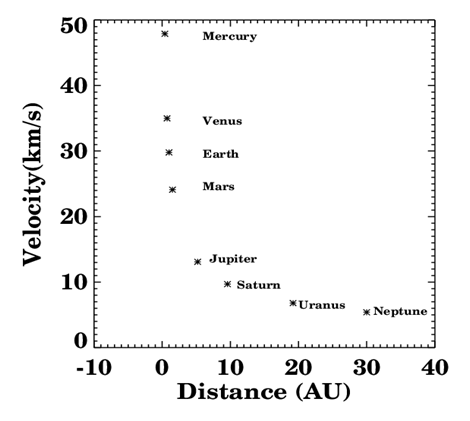
The universe is unified for all its systems and constituents, so the motion of galaxies is in orbits (orbital motion) and around itself (rotational motion) and the orbital velocities of galaxies near the center is greater than the orbital velocities far away from the center as for planets around the Sun and stars around the center of galaxy. According to the Hubble’s law the farthest galaxies are moving with large velocity because they are close to the universe center and the nearest galaxies moving with low velocity because they are far away from the universe center. The universe center is homogenous and isotropic to be consistent with the whole universe.
Results and Discussions
Gravitational Force and Orbital Velocity
The new form of gravitational force of two celestial objects with certain masses m1 and m2 and at certain distance with certain rotational and orbital velocities can be determined by the following equations.
$$ F = \frac {M \times V _ {r o t} \times V _ {o r b}}{d} $$
(2) ( ) ( ) ( ) 1 2 1 2 1 2 r r o o m m v v v v F d
$$ = \frac {\left(m _ {1} + m _ {2}\right) \times \left(v _ {r 1} + v _ {r 2}\right) \times \left(v _ {o 1} + v _ {o 2}\right)}{d} $$ (3) where M is the sum of two masses of celestial objects or galaxies
1 2 m m + rot V is the sum of two rotational velocities 1 2 r r v v + orb V is the sum of two orbital velocities 1 2 o o v v + m1 is the mass of the first celestial object or galaxy m2 is the mass of the second celestial object or galaxy
1 rv is the rotational velocity of the first celestial object or galaxy
2 rv is the rotational velocity of the second celestial object or galaxy
1 ov is the orbital velocity of the first celestial object or galaxy
2 ov is the orbital velocity of the second celestial object or galaxy d is the distance between two celestial objects or two galaxies The orbital velocities of all celestial objects and galaxies can be determined from the following equations $$ v _ {o 1} = \frac {F \times d}{\left(m _ {1} + m _ {2}\right) \times \left(v _ {r 1} + v _ {r 2}\right)} - v _ {o 2} \tag {4} $$ ( ) ( ) 1 2 1 2 1 2 o o r r F d v v m m v v × = − + × + (5) It is found that the calculated value of orbital velocity of any object of the solar system by using equations 4 & 5 is identical with known determined values as indicated in ( ) ( ) 2 1 1 2 1 2 o o r r Table 1.
| Object | Orbital velocity |
|---|---|
| Sun | 225 km/s |
| Mercury | 48 km/s |
| Venus | 35 km/s |
| Earth | 30 km/s |
| Moon | 1 km/s |
| Mars | 24 km/s |
| Jupiter | 13 km/s |
| Saturn | 9 km/s |
| Uranus | 7 km/s |
| Neptune | 5 km/s |
| Pluto | 4 km/s |
Table 1: lists the values of orbital velocity of the objects of solar system by using equations 4 & 5.
Conclusion
From Hubble’s law it is deduced that the galaxies are moving in orbits around certain center (universe center) and the orbital velocities near the center is greater than the orbital velocity far away from it. The mass of the center of atom (nuclei) and the center of solar system (Sun) represents more than 99.9 of the system mass this means that the mass of the center of the universe is tremendous and may be the dark matter. The center of the universe represents the residual of the primordial matter of the universe without expansion with spherical shape and large mass and it is homogenous and isotropic and maintain the geometrical shape of the universe to be spherical.
The orbital velocities of celestial objects and galaxies depend on the gravitational force, distance between them, other velocities and their mass.
Acknowledgment
The author would like to express his sincere appreciation and deepest gratitude to all the staff of the Open Access Journal of Astronomy (OAJA) whose contribution and support have greatly enhanced the quality, accuracy and publication of this research.
References
-
George OA (1958) The Distribution of Rich Clusters of Galaxies, The Astrophysical Journal Supplement Series 3: 211-288.
-
Hu FX, Wu GX, Song GX, Yaun QR, Okamura X (2006) Orientation of Galaxies in the Local Supercluster: A Review. Astrophysics and Space Science 302(1-4): 43- 59.
-
Nurmi P, Heinamaki P, Martinez VJ, Einasto J, Enkvist I, et al. (2011-05-09). The Sloan Great Wall. Morphology and galaxy content. The Astrophysical Journal 736(1): 51.
-
Lemaitre AG (1927) A Homogeneous Universe of Constant Mass and Increasing Radius accounting for the Radial Velocity of Extra-galactic Nebulae. Monthly Notices of the Royal Astronomical Society 91(5): 483
-
Livio M (2011) Mystery of the missing text solved. Nature 479(7372): 171-173.
-
Hubble E (1929) A relation between distance and radial velocity among extra-galactic Nebulae. Proceedings of National Academy of Sciences 15(3): 168.
-
Abdalla E, Abellan GF, Aboubrahim A (2022) Cosmology Intertwined: A Review of the Particle Physics, Astrophysics, and Cosmology Associated with the Cosmological Tensions and Anomalies. Journal of High Energy Astrophysics 34: 49-211.
-
Migkas K, Schellenberger G, Reiprich TH, Pacaud F, Ramos-Ceja ME, et al. (2020) Probing Cosmic Isotropy with a New X-Ray Galaxy Cluster Sample through the Lx-T Scaling Relation. Astronomy & Astrophysics 636: A15.
-
Eddington AS (1940) The Mass of the Universe. Nature, 145: 549.
-
Hofmann-Wellenhof B, Moritz H (2006) Physical Geodesy. In: 2nd (Edn.), Springer 17: 403.
-
Long DR (1976) Experimental examination of the gravitational inverse square law. Nature 260: 417-418.
-
Bagley CH, Luther GG (1997) Preliminary Results of a Determination of the Newtonian Constant of Gravitation: A Test of the Kuroda Hypothesis. Physical Review Letters 78: 3047-3050.
-
Iorio L (2007) A model-independent test of the spatial variations of the Newtonian gravitational constant in some extrasolar planetary systems. Monthly Notices of the Royal Astronomical Society 376(4): 1727-1730.
-
Persic MP, Salucci P, Stel F (1996) The universal rotation curve of spiral galaxies - I. The dark matter connection. Monthly Notices of the Royal Astronomical Society 281(1): 27-47.
-
Disney MJ, Romano JD, Garcia-Appado DA, West AA, Dalcanton JJ, et al. (2008) Galaxies appear simpler than expected. Nature 455: 1082-1084
-
Chandrasekhar S (2003) Newton’s Principia for the common reader. Oxford University Press, pp: 616.
-
Zwicky F (1937) On the masses of nebulae and of clusters of nebulae. Astrophysical Journal 86: 217.
-
Rubin VC, Kent W, Ford WK (1970) Rotation of Andromeda Nebula from a Spectroscopic Survey of Emission Regions. Astrophysical Journal 159: 379.
- Asymmetry Irreversible Heterogeneity Quantum Cosmology Grand Mathematical PHYSICS
- Early Universe: Hadronic Crystals Coherent Micro Gravitational Wave Emitters PHYSICS Part II
- The Solar System Constraint Maze: A Scientific Dead-End Revealing the Interuniversal Machine
- Assessment of Radiofrequency Radiation from 2G and 3G Mobile Phone Handsets
- Early Universe Magneto-Gravitational Coupling Genesis Physics: Part I
- Falsifiability of the Classical Law of Gravitation and Unveiling the Time-temperature Entanglement of the Universe