
Astronomical Contributions of the Trivandrum Observatory
Established in 1837 in the princely state of Travancore by His Highness Swathi Thirunal Rama Varma, the observatory served as the first scientific establishment of his kingdom. His vision to educate his people and popularize scientific thought made the Observatory a destination for inquisitive minds in the 19th century. Two comets were observed and their trajectories were calculated independently from the Trivandrum observatory in the year 1843 and 1844. A century later in 1941 a comet was independently observed. In 2022 the first light was achieved by the institution after a major overhaul of its facilities that was started in 2017. In 2023 the comet C/2023(ZTF) was tracked showcasing its present capabilities. Recently the comet C/2023 A3 (Tsuchinshan-ATLAS) was also tracked. Though the Observatory today is challenged by city light pollution, incessant weather conditions and technology it continues to strive as a beacon of knowledge as per the vision of its founder.
Abbreviations
ZTF: Zwicky Transient Facility; CCD: Charge Coupled Device
Introduction
Swathi Thirunal Rama Varma ascended the throne of Travancore at the age of 19 in 1829 [1, 2, 3]. In 1832 the young king met Caldecott J [4] who used to make astronomical observations using several portable instruments of his own. The Young King [2] had a good knowledge of the Hindu philosophy on astrology and its resemblance with the calculations and observations of the European astronomy intrigued the young king for a thorough investigation for correspondence between these subjects [3]. He was a visionary and was very sure that the science from the observatory would bring progress to his state.
![Figure 1: Left- Founder of Trivandrum Observatory: King of Travancore Swathi Thirunal Rama Varma. Right- First Director of Trivandrum Observatory: Caldecott J [4].](/fulltextimages/13498/fig_1.png)
His Highness Rama Varma decided to set up an observatory in the capital city of his kingdom close to his palace so that he could personally partake in astronomy. The Travancore royal family had signed a treaty in 1795 with the British Empire under which British dominance was acknowledged for protection from its enemies and later in 1805 the royal family reduced their political independence through another treaty. Hence the King persuaded Caldecott to make an official proposal, through the Resident, Colonel Stuart Fraser, for the construction of an observatory at Trivandrum. Caldecott J [4] was thus appointed as His Highness astronomer and was made the founding Director of the Trivandrum Observatory [4]. The site chosen for setting up the Observatory was the tallest hill in the city of Trivandrum, nearly 195 feet above sea level, commanding an unobstructed view of the sky on all sides. The position of the observatory was identified as with Latitude of 8° 30’ 35” N (Eight degrees, thirty minutes and thirty-five seconds) and Longitude from Greenwich 76° 59’ 45” (5 h 7 m 59 s) E [3]. Caldecott J [4] reported about the details of the Observatory building that was envisioned to be constructed in Trivandrum through the Madras Journal of Literature and Science in 1837 [4]. The observations from the observatory are reported to have started in July 1837 [5].
Caldecott J [4, 5] started making observations in July 1837, to start with using his own instruments. His personal equipment that were used immediately on the start of the observatory were: (1) An altitude and azimuth instrument, having 18 inch, and 15 inch circles, with three micrometrical microscopes to each, made by Mr. Simms (2) a thirty-inch transit instrument (3) an equatorial, by Troughton and Simms (4) a forty-six-inch refracting telescope (5) chronometers and (6) reflecting circle. A system of hourly observations throughout the day and night, of the thermometer, barometer, and hygrometer, commenced at the observatory at the same time (July 1837). In the following years, he went to Europe to furnish the institution with the best instruments available at that point of time [6]. The principal instruments procured were:
- a five-feet mural circle by Troughton and Simms,
- a five feet mural circle by Jones
- a five-feet transit instrument by Dolland.
- A transit clock by E. J. Dent; and
- Two mean time clocks by E. Wrench.
Caldecott J [4, 5] was able to obtain funding from the British Association for the Advancement of Science for conducting magnetic studies in the state of Travancore. Caldecott purchased a complete set of magnetic and meteorological instruments during his visit to London. Caldecott returned back to India in the year 1841, and a magnetic observatory was also built in the same year [6]. In 1842 another building was erected to the North-West for the mounting of an equatorial telescope, the make of which was Dolland [6].
The telescope was a 5 inch (12.7 cm) refractor with a f/16.8 focal length. The equatorial is functional as on date.
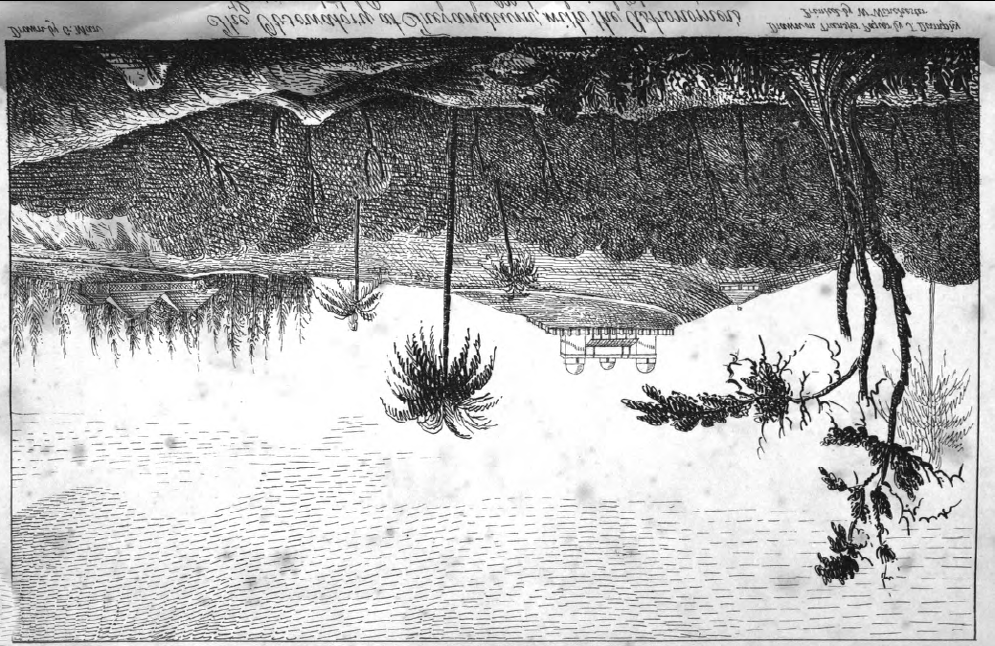
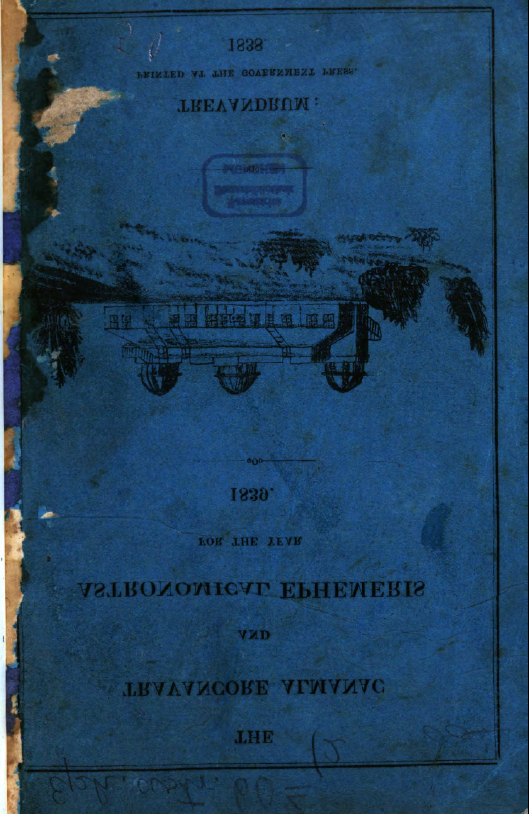
The first Astronomical Ephemeris was issued in 1838 [7]. This Ephemeris was designed more or less on the same lines as the Nautical Almanac. The second edition to this was “The Travancore Almanac and Astronomical Ephemeris” for the year 1839 printed in 1838. The cover page to this contained the sketch of the Observatory high lightening the level of patronage the institution had under the King. To facilitate the publication of the Almanac a small printing establishment was started in 1836 [7]. The small printing press was subsequently enlarged. Printing machines were got down from England and a department for printing was opened. The first Government publication was the Anglo- Vernacular Calendar of Travancore for 1015 M.E (A.D. 1839-1840). The printing establishment was also under the superintendence of Caldecott [5]. During his absence from 1838 to 1841 Sperschneider, a man of European education was employed as head assistant of the observatory [4]. The press was separated from the observatory and it became an independent establishment and it serves even today as the Government Press which publishes the Administration Report, the department reports, the statistical volume, the proceedings of the Legislature, text books for schools and the Government Gazette [8].
Astronomical Observations
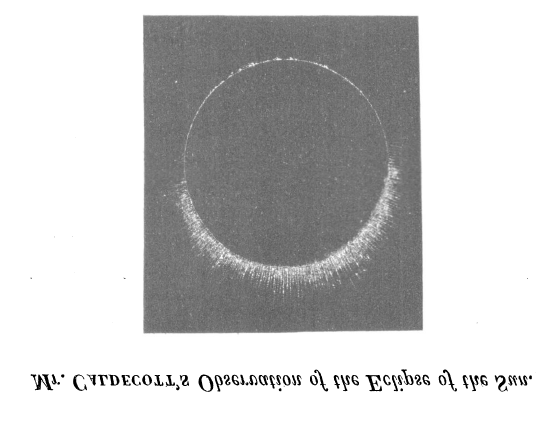
Caldecott J [8] obtained an assistant, a native trained under Taylor, astronomer at the Madras Observatory. Other native assistants belonging to Travancore were trained by him on how to use instruments and perform the usual computations for reduction. Three assistants were allotted to the Transit instrument for observing transit of stars to standardize local time, and three to each of the Mural circles. Caldecott J [8, 9] in his report entitled “Eclipse of the Sun on December 21, 1843, observed at Parratt, three miles North of the Source of the Mahè River” published in the Memoirs of the Royal Astronomical Society, provides the first astronomical sighting from the observatory made using an achromatic telescope of 30” focal length made by Troughton and Simms, a sextant and an actinometer [9].
A large mass of observations, astronomical, magnetic and meteorological was accumulated and complete copies of them were forwarded to the Royal Society of London and to the Court of Directors of the East India Company. These observations comprised the computed elements for the comets of 1843 and 1844-45 [5, 6, 7].
| Comet | Comet sighting date | Longitude of the ascending node (Ω) | Inclination of orbit (i) | Perihelion passage date and meantime |
|---|---|---|---|---|
| C/1843 D1 | 4-Mar | 3° 7’ | 35° 3’ | Feb 27.654 |
| C/1844 Y1 | 30-Dec | 118° 31’ 35” | 45° 33’ 46” | Dec 13.5606 |
Table 1: Comet observations made independently by Caldecott from Trivandrum Observatory.
In December 1846 Maharaja Swathi Thirunal passed away [8]. Vanji Pala Utharam Thirunal Marthanda Varma ascended the throne of Travancore Kingdom following this [8]. The observatory was often visited by His Highness, Vanji Pala Marthanda Varma and he used to stay at this place a few hours whenever he visited them. Highness Vanji Pala Utharam Thirunal Marthanda Varma continued the patronage for the observatory during his rule [5]. Caldecott J [4, 5, 8, 9, 10] was in charge of the Observatory till his last breath on December 17, 1849. After Caldecott’s death, the Resident, General Cullen placed Sperschineider, the Superintendent of the press, in temporary charge of the observatory establishment with the approval of the Raja of Travancore.
In 1851 the Travancore state sent an invitation to John Alan Broun, Fellow of the Royal Society, to take charge of the observatory. Broun took up the offer and joined in 1852 [9]. The longitude and latitude of the site of the observatory were re-determined during his time and the values arrived at were 76° 59’ 45” East longitude and 8° 30’ 32” North latitude of Greenwich [10]. Broun was interested in geomagnetic studies. He inspected the laws of terrestrial magnetism and the variation of meteorological elements as influenced by height in the atmosphere. This, he thought, was possible only by simultaneous observations at two stations differing in height, for the comparison and co-ordination of the laws depending on differences of height, of latitude and of longitude [11]. He established another observatory around 20 miles from the city deep inside a forest 6200 ft above sea level on top of a mountain peak named Agasthiyar. This was called the Agustia (Agasthiyar) observatory from where only magnetic and meteorological observations were made. The Agasthiyar observatory worked from1855 to 1859 and from 1864 to 1865. Broun returned to London in 1869. Situated in a remote location the Agasthiyar observatory had to be shut down soon after Broun left Trivandrum. In the Report on the Administration of the Meteorological Department of the Government of India published in the year 1900 by the Indian Metrological department it is stated that “a small mound of bricks at the summit of the Agasthiyar peak at the present time mark the site of the observatory”. Today there are no traces of this observatory which resulted in scientific productions from the Trivandrum observatory in the journal Nature as early as 1875. Though Broun made significant publications in the journal Nature there were no scientific productions on astronomy during his era at the observatory.
The works in the Trivandrum observatory became limited to magnetic and meteorological observations and slowly the institution began to fade away from the astronomical environment it had nourished during the 1840s. The Travancore administration often reported the institution of being of no public interest and advised the Sircar (Travancore Government) to close the institution. The observatory began to send rainfall data via telegram to the Shimla meteorological office located in Pune then which later became the Indian Meteorological Department [12]. The observatory thus rarely ventured into any astronomical observations after the tenure of Caldecott J [12]. In 1911 Mr. J. Stephenson, Professor of Physics at the University college of Travancore succeeded Mitchell as the Director (1911- 1920) of the Observatory [5].
During the latter part of Mr. Stephenson’s time, he had an assistant director, Mr. M. Rama Varma Raja, who was a highly enthusiastic worker in the field of astronomy. For the years 1916 to 1919 Raja published an astronomical ephemeris [5, 13].
In 1927, the work of the Observatory was divided into two sections, Astronomical and Meteorological, under the charge of the Government Astronomer -Dr. H. Subramani Iyer (1927-1941) and the Government Meteorologist - Mr. Sivaramakrishna Iyer then Director respectively [5, 13]. From that time two independent sections started functioning in the Observatory. With the creation of Astronomical Department, weekly publication of astronomical notes giving the position of the Sun, Moon and the planets for Trivandrum and details of other important celestial phenomena were started. Other important works done during that period include Celestial photography and from 1928 daily time signals were communicated by the use of a wireless set [5, 13]. Till then, the mean time clock was standardized only by the star observations with the 4-inch transit. Another change made in connection with giving accurate time to the public was the system of firing time-gun by the use of an electrical signal controlled by the clock room of the Observatory [5, 13].
In 1937 the University of Travancore was established by the Maharaja of Travancore Sri Chithirathirunal Balarama Varma [14]. On August 17, 1939 the observatory was transferred to the control of the University and it functioned as a unit of the central Institute of Research [15]. In the year 1940 the meteorological and the astronomical sections were amalgamated [12]. The observatory attended primarily to the work of astronomical observations, calendar computation and daily collection of data on rainfall. Dr. H. Subramania Iyer sighted a new comet 1941-C at the Observatory on the morning of 23rd January 1941 and communicated it to the Greenwich. By the time his cable reached the sighting was already reported from other observatories around the world. For his 23 January, observation of the comet, Subramony Iyer also was an independent discoverer, alongside J. S. Paraskevopoulos and R. Grandon [16, 17, 18]. The comet was kept under observation for a month using the 5” telescope and the orbit of the comet was computed by P. K. Kuttan Nair who was working as an assistant at the observatory [18].
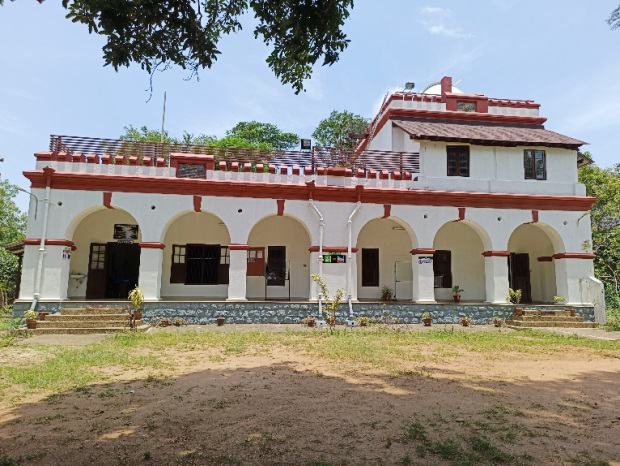
In 1951 the meteorological section of the observatory was taken over by the Government of India and a first class Indian Meteorological Department commenced operation. The astronomical section became part of the revenue department of the state government. In 1975, the observatory was returned to the University of Kerala for starting a course in weather physics. In 1986, Dr. S R Prabhakaran Nayar, Reader-in-charge of the observatory gave a new impetus on renovating and upgrading the astronomical facilities. Funding was obtained from the Kerala State Council of Science, Technology and Environment to repair the existing telescopes and to fix new photographic attachments to the telescopes. Arrival of the Halley’s comet, total lunar eclipse of 17 October 1986 and transit of the planet mercury across the solar disc on 17 November 1986 brought wide attention to the observatory. Dr. Nayar reported that over 10000 people visited the observatory during this period. The vintage 5” telescope was used extensively for star gazing purpose.
In collaboration with Kerala Sastra Sahitya Parishad and Kerala Astronomy Association the observatory conducted classes on astronomy for high school and college students. The 150th anniversary of the observatory was organized on 14 July 1987 with the then Vice-Chancellor of the University presiding over the function which was inaugurated by the then Minister for Education, Government of Kerala. As part of the celebration a lecture series titled “Allan Broun Memorial Lectures” was conducted with the first talk delivered by the then Chairman of University Grants Commission, Government of India.
Since its takeover by the University the observatory functioned as a Centre for science and astronomy popularization. After the tenure of Prof. Nayar, the observatory underwent again a period of dormancy.
Prof. K G Gopchandran revitalized the Centre by procuring an 8” and another 14” Schmidt–Cassegrain telescopes in 2017. The 8” Schmidt–Cassegrain telescope was used in manual mode for amateur star gazing. Over the years the observatory transformed to a public outreach Centre with star gazing as its mainstay. The COVID19 lockdowns put the star gazing activity also to a standstill.
Eighty years after Subramania Iyer’s sighting of a comet from the observatory, in 2023 the Observatory reported
of having tracked the comet C/2023 E3 (ZTF) under the present Director [19]. The observatory was put through administrative reforms which enabled it to achieve its first light using modern optical telescopes in 2022 [20]. New drive systems were developed in-house for the 8” telescope and automatic tracking was successfully achieved. The observatory now houses the 14” and 8” Schmidt–Cassegrain telescopes with motorized domes. The 14” telescope is Celestron make belonging to the CGE Pro telescope series.
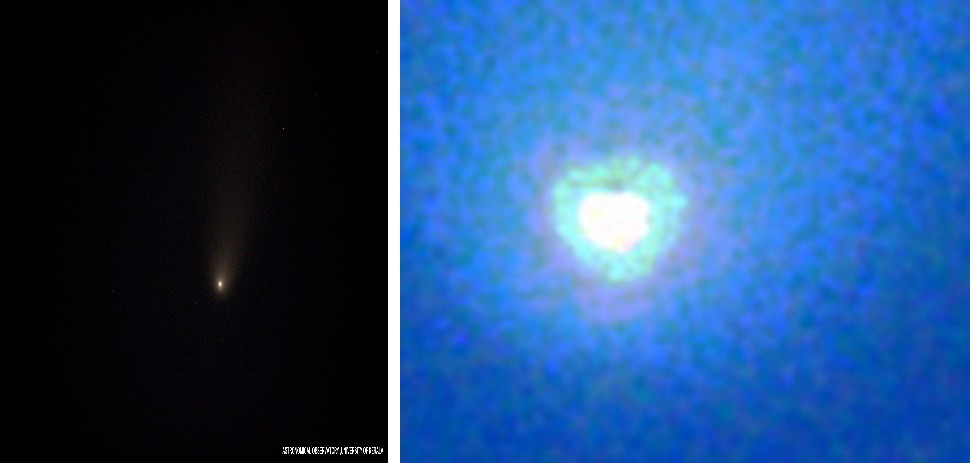
It is composed of an Equatorial GoTo type mount. The telescope has an aperture of 14” with the telescope focal ratio of f/11. The telescope is mounted inside a motorized dome with opening from 0° to 90°. The telescope is equipped with a cooled CCD with a resolution of 2592 x 1944 pixels. The 5 Mega pixel color sensor reduces image noise levels significantly. The field of view of the camera is 32.4 ft. There is also a filter wheel for the telescope with the typical UBVRI Johnson photometry set, nebula filters (OIII, Hα, and Hβ), and red, green, and blue filters. The 14” telescope which was made operation recently has added to the facilities of the observatory and has permitted the monitoring of planetary motion. More recently the comet C/2023 A3 (Tsuchinshan- ATLAS) could also be tracked. However, the sky remained overcast and provided only a window of 4 days for the observatory to track the comet using its telescopes.
(a) (b) Figure 6: 6(a) Image of Comet C2023/A3 imaged from the observatory using the 8” telescope on 16 October 2024. 6(b) The processed image shows the coma and the nucleus.
The reports on the sky image from the Indian subcontinent are limited in literature citing reasons like lack of patronage, light pollution, weather conditions etc.
Conclusions
The evolution of Trivandrum Observatory has had a different trajectory compared to its contemporaries in India. The Madras observatory established in 1786 and the observatory established at Colaba in 1826 were establishments run by the East India Company. The Madras observatory graduated to the global arena of astronomy by 1840’s. T.G. Taylor who served as the director of the Madras Observatory from 1830-1848, prepared a catalogue of 11015 stars in 1844 popularly known as the ‘Madras Catalogue’ [21].
It could be claimed to be India’s first modern astronomy institution with a legacy that is nearing 250 years now. The Madras observatory was relocated to Kodaikannal in the early 20th century with the focus of work shifting to solar physics. The observatory is now a part of Indian Institute of Astrophysics an autonomous research centre under the Government of India. Colaba observatory was started for astronomical observations and time keeping to aid British ships docking the port then-named Bombay (now Mumbai). It flourished conducting geomagnetic and meteorological observations and became well known by 1870’s. In 1900 the city of Bombay decided to change over its public transport service to electric tram. Hence the observatory was relocated to Alibagh where from it rose to global acclaim based on its geomagnetic studies. In 1971 the Colaba-Alibag Observatories were converted into an autonomous research organization called the Indian Institute of Geomagnetism. The Indian Institute of Geomagnetism currently operates ten magnetic observatories across India.
Starting as a center for astronomy, Trivandrum observatory contributed to the development of the princely state through its astronomical, geomagnetic and meteorological endeavors in its first 100 years of existence. The scientific production from the observatory published in the journal Nature in 1875 stand as a testament to the quality of science pursued by the Centre [22]. The Trivandrum almanac which was published by the princely state from the year 1839 onwards always carried report of the Observatory on its front pages up to the year 1941. History shows that Colaba and Madras Observatories grew into well- established research center’s overcoming their geographical displacements and continue their scientific productions even today though their primary research area has changed from astronomy. Trivandrum Observatory which was an institution envisioned for educational and cultural growth of the state by its princely rulers lost to its contemporaries a century after its inception when the observatory underwent multiple administrative change overs. The Travancore kingdom became part of independent India in 1949 and it was in 1956 that the state of Kerala was reorganized. In 1941 the Observatory became a part of the Indian Meteorological Department. During the next few decades the institution had no patronage being with the revenue department of the state. In 1975 the astronomical observatory was handed over to the University of Kerala to start a course in weather physics. Today the Centre continues to thrive as a science popularization venue providing the public an opportunity to star gaze whenever the sky permits.
Located in the heart of a growing city, sky scrapers and trees the observatory’s line of vision has been streamlined. Pollution from city lights mar the possibility of making any significant deep sky observation.
And an incessant rainy/overcast weather condition limit the window of opportunity for any observational astronomy to less than 90 days in a year. Amidst all these challenges the observatory stands as a beacon for space enthusiast and amateur astronomers showcasing what has been achieved over the last two centuries. In the coming years, activities of the Thanu Padmanabhan Centre of Excellence in Astronomy and Astrophysics which is shortly to commence operation in the University of Kerala is expected to provide the observatory with the impetus to reclaim in academic grandeur.
Acknowledgments
The authors would like to thank INSA, New Delhi for funding this research work under grant No. HS/RC/233 dated 04 July 2024.
Conflicts of Interest
The authors declare no conflict of interest.
References
-
Menon SP (1878) History of Travancore From the Earliest Times. Madras Higginbotham & Company, India, pp: 644.
-
The Young King (2024) A proud icon of Kerala’s music.
-
(1939) Science News a century ago. The observatory of the Rajah of Travancore, Nature 144: 952.
-
Caldecott J (1837) Description of an Observatory lately established at Trevandrum, by His Highness the Rajah of Travancore. The Madras Journal of Literature and Science 6(1): 56-60.
-
Caldecott J (1837) Hourly meteorological observations made at the equinoxes and solstices, agreeably with the suggestion of Sir John Herschel. Trevandrum Observatory, The Madras Journal of Literature and Science 6: 339-340.
-
(1937) Report of the Centenary celebrations of the Government Observatory Trivandrum. Travancore Government Press, Central Library, University of Kerala, India.
-
Aiya NV (1906) The Travancore State Manual. World Public Library Association 1: 732.
-
Caldecott J (1846) Eclipse of the Sun on December 21, 1843, observed at Parratt, three miles North of the Source of the Mahè River. Memoirs of the Royal Astronomical Society 15: 171.
-
Caldecott J (1846) Observations of the Great Comet of 1843, made at the Observatory of Trevandrum. Memoirs of the Royal Astronomical Society 15: 229.
-
Caldecott J (1845) Observations of the great comet of 1844-5. Monthly Notices of the Royal Astronomical Society 6: 215.
-
Stewart B (1875) Observations of Magnetic Declination made at Trevandrum and Agustia Malley in the Observatories of His Highness the Maharajah of Travancore, G.C.S.I In the Years 1852 to 1869. In: Broun JA (Ed.), Trevandrum Magnetical Observations, Neill and Company, London, 12: 163-165.
-
Caldecott J (2024) The Trivandrum Observatory. Met Centre Thiruvananthapuram, Ministry of Earth Sciences, India.
-
Maharaja of Travancore (1829) History of H H the Maharaja’s Observatory, Trivandrum From 1837-1937 A.D. Travancore University, India, pp: 37-54.
-
Maharaja of Travancore (1937) Sri Chithirathirunal Balarama Varma. University of Travancore, India.
-
(1949) Research in Travancore during 1939-46. Nature 163: 758.
-
Orchiston W, Drummond J, Shylaja BS (2020) Communication issues in wartime astronomy: Independent Australian, Indian, Newzeland and South African discoversies of Comet C/1941 B2 (De Kock- Paraskevopoulos). Journal of Astronomical History and Heritage 23(3): 659-674.
-
Kapoor RC (2013) On the ‘Astronomical Notes’ in Current Science about the bright comet of 1941. Current Science 105: 854-858
-
Kochhar R, Orchiston W (2017) The development of modern astronomy and emergence of astrophysics in India. The Emergence of Astrophysics in Asia pp: 705- 770
-
Jayakrishnan R, Dev LR, Aalim M (2023) Tracking of the C/2022 E3 (ZTF) from Trivandrum Observatory. Res Notes AAS 7: 44.
-
Jayakrishnan R (2023) Rejuvenation of an ancient observatory in southern India. Nature Astronomy 7: 506.
-
Salwi DM (1988) Madras Observatory: A Forgotten Page in Astronomy. Journal of the British Astronomical Association 98(4): 189-193.
-
Broun J (1875) Trevandrum Magnetic Observations. Nature 12: 186-187.
- Asymmetry Irreversible Heterogeneity Quantum Cosmology Grand Mathematical PHYSICS
- Early Universe: Hadronic Crystals Coherent Micro Gravitational Wave Emitters PHYSICS Part II
- The Solar System Constraint Maze: A Scientific Dead-End Revealing the Interuniversal Machine
- Assessment of Radiofrequency Radiation from 2G and 3G Mobile Phone Handsets
- Early Universe Magneto-Gravitational Coupling Genesis Physics: Part I
- Falsifiability of the Classical Law of Gravitation and Unveiling the Time-temperature Entanglement of the Universe