
Performance of Bread Wheat (Triticum Aestivum L.) Line Originating from Various Sources
The performance of 78 bread wheat (Triticum aestivum L.) lines, 26 from the crossing block of the National Wheat Research Block and 52 lines introduced from CIMMYT and ICARDA, were evaluated at Kulumsa (WRCoE), Adet, and Holetta Agricultural Research Centers during the 2012 main cropping season. The trial was laid out in simple lattice design with two replications. Data were collected on yield and yield parameters. The combined ANOVA showed that the main effect of environment, genotype, and genotype by environment (G x E) interactions were significantly (p
Introduction
Wheat is the most widely grown cereal crop globally and feeds 4.5 billion people in 95 developing countries [1]. The most common species grown are Triticum aestivum L. (Bread wheat) and Triticum turgidum var. durum L. (durum wheat). Bread wheat accounts for 95% of the total wheat consumed worldwide [2]. It is one of the most important cereal crops in the world. In Ethiopia, it is also one of the major cereal crop and largely grown in the southeast, central and northwest parts. Small amount is also produced in the north and south regions. Its productivity however has been very low because of lack of early maturing, drought tolerant, disease resistance, high yielding genotypes, poor soil fertility and high moisture stress [3]. On average, from 2004-2009, wheat production in Ethiopia covered 1.51 million hectares of land, and yielded 2.60 million metric tons of wheat [4]. In 2013/14, Ethiopia wheat production covered 1.61 million hectares of land and produced 3.93 million tons of wheat, almost twice the quantity produced in 2010 [5] and its rank fourth in area coverage and third in total production among cereal crops in different regions of Ethiopia. Wheat is exclusively produced under rain fed conditions, meher and belg (long and short rainy seasons), respectively. Smallholders are major producers and suppliers of bread wheat, accounting for more than 89% of the market supply. Bread wheat is one of a major cereal of choice in the country, due to its higher productivity, broader adaptation and input responsive high yielding improved varieties. This significantly increased the national wheat area from almost 0 to 60% of the area [6]. Generally wheat has an important place in nourishment of people all over the world. It is necessary to increase wheat production to remove nourishment needs of the excessive population. Borlaug and Dowswell (1997) estimated that global wheat production must increase by 40 % by 2020 to meet the rising demand for wheat grain. In order to increase total production, while the breeders develop new wheat cultivars, on the other hand these new cultivars were tested for their yield performances in the different locations. The success of a new wheat variety depends upon its yield and adaptation potential in those locations [7]. Genotype x environment interactions are of major importance, because they provide information about the effect of different environments on cultivar performance and have a key role for assessment of performance stability of the breeding materials. Increasing genetic gains in yield is possible in part from narrowing the adaptation of cultivars, thus maximizing yield in particular areas by exploiting genotype x environment interaction [8]. Breeding methods play major role in developing high yielding cultivars, resistant to disease with better quality. Yield is a complex character controlled by a large number of genes because it is affected by several yield components i.e. Plant height, hectoliter weight, 100- kernel weight. Therefore, wheat breeders have been concerned with the simultaneous improvement of more than one of these components. Yield potential (YP) is defined as the "yield of a cultivar grown in environments to which it is adapted when nutrients and water are no limiting, and when pests, diseases, weeds, lodging, and other stresses are effectively controlled" [9]. The successful process of wheat breeding is based on the knowledge of characteristics of genotypes, environment and its interaction. The ideal cultivar for high grain yield or for any other desirable traits needs to express genetic potential with low value of variance in different environmental factors of growing. Understanding causes of genotypic-environment interaction helps to establish breeding objectives identify ideal test conditions and formulate recommendations for areas of optimal cultivar adaptation [10]. The presence of genotype x environment (G x E) interaction complicates selection of superior genotypes, and understanding the effect of genotype, environment and G x E interaction is important in all stages of plant breeding [11]. The development of improved varieties of bread wheat (Triticum aestivum L.) has always remained a focal point for wheat breeders all over the world [12]. Therefore, the objective of this study is to evaluate the performance of bread wheat genotypes obtained from various sources in different wheat growing environments.
Materials and Methods
The experimental materials consisted of 78 genotypes and of which 52 were introductions from CIMMYT and ICARDA; and 26 lines developed at Wheat Regional Center of Excellence (WRCoE). In addition, three released varieties (Danda’a, Digelu and Kubsa) were used as a check. The genotypes were evaluated in a simple lattice design with two replications at Kulumsa, Adet and Holetta Agricultural Research Centers during 2012 main cropping season. Each genotype was sown with four rows of 2.5m length with 0.2m space between the rows, being plot size of 2m2. Four rows were harvested and the net harvested plot was 2m2 (2.5m x .8m). Recommended agronomic practices were applied in all sites. The seed rate was maintained at 150 Kg ha-1. The fertilizer was applied at the rate of 70kgN/ha (24kg from P2O5 and 46 from DAP) and 69kg/ha DAP. The N fertilizer in the form of Urea was applied at planting and tillering time (top dressing). But the P fertilizer was applied in the form of Diammonium phosphate during planting time. These three locations were the main variety testing site for wheat regional center Excellence a growing and these three sites (Kulumsa, Adet, Holeta,) were fall in the highland zone (2200-2750 meter above sea level).Data’s for heading date, maturity date, plant height, grain yield, thousand kernel weight and hectoliter weight were collected. To estimate significant differences among genotypes the data were subjected to statistical analysis by using AGROBASE20. Data on grain yield and yield component were recorded from each location and statistically analyzed using analysis of variance method for all location and the means were compared using LSD taste.
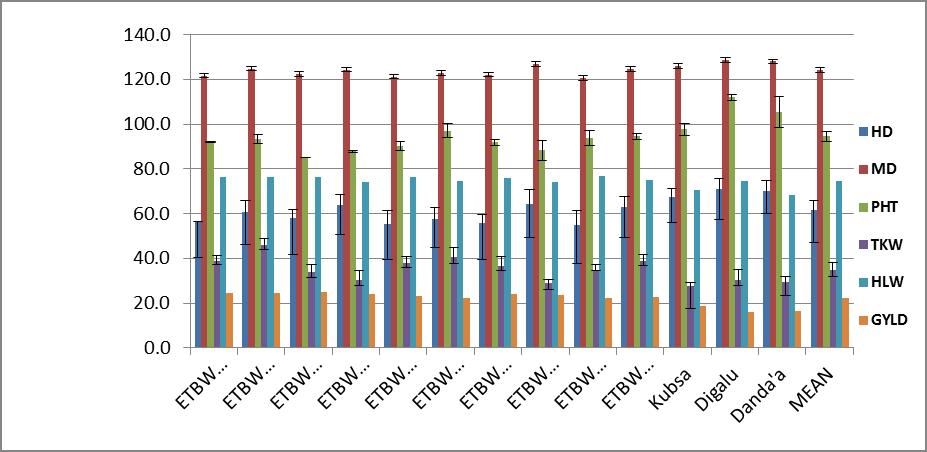
was significantly affected by environment, which explained 75.01% of the total treatment (genotype + environment + genotype by environment interactions) variation, whereas the G and GEI were significant and accounted for 9.48 and 15.5%, respectively [4]. The grain yield of the test lines ranged from 2.69-5.93t/ha, with a mean of 4.37t/ha. Genotypes ETBW6595, ETBW6596, and ETBW6597 performed better in grain yield and were found to be early in maturity. However, ETBW6598, ETBW6616 and ETBW6579 were high yielders, but late in maturity compared to the standard check. Four genotypes ETBW6600, ETBW6615, ETBW6584, and ETBW6512 were early in maturity and had intermediate grain yield. ETBW6614 and ETBW6605 performed better in hectoliter weight and TKW, indicating their plumpness in grain and high flour content (Table 1). The mean grain yields of 36 of the 78 test lines, six from local crosses, twenty-nine from CIMMYT origin, and one from ICARDA, were greater than the grand mean. Few bread wheat genotypes were significantly different from standard check of grain yield and yield related traits.
Results
The result of analysis of variance (ANOVA) for grain yield and yield related traits measured showed significant differences among the genotypes. In breeding programs, genotype x environment (G x E) interactions cause many difficulties, whereas the environmental factors such as temperature and drought stress affect the performance of genotypes. Genotype + environment (GE) interaction reduces the genetic progress in plant breeding program through minimizing the association between phenotypic and genotypic values. Multi-environment yield trails are essential in estimation of genotype by environment interaction (GEI) and identification of superior genotypes in the final selection cycles. The combined ANOVA showed that the main effect of environment, genotype, and genotype by environment (G x E) interactions were significantly (p <0.05) different for grain yield and yield related traits. Reported that the combined ANOVA analysis for grain yield of bread wheat No Name Pedgree source 1 Danda'a Breeder Seed Breeder seed 2 ETBW 6548 SERI.1B*2/3/KAUZ*2/BOW//KAUZ/4/PYN/BAU//MILAN ICARDA 3 ETBW 6549 SERI.1B*2/3/KAUZ*2/BOW//KAUZ/4/PYN/BAU//MILAN ICARDA 4 ETBW 6550 SERI.1B*2/3/KAUZ*2/BOW//KAUZ/4/PYN/BAU//MILAN ICARDA 5 ETBW 6551 SERI.1B*2/3/KAUZ*2/BOW//KAUZ/4/PYN/BAU//MILAN ICARDA 6 ETBW 6553 HAAMAM-2/3/ PYN/BAU//MILAN ICARDA 7 ETBW 6554 PASTOR-2/3/ PYN/BAU//MILAN ICARDA 8 ETBW 6555 ZOLOTARA//SHA3/SERI/3/SAMAR-12/DOLLARBIRD ICARDA 9 ETBW 6556 GOUMRIA-15/3/ PYN/BAU//MILAN ICARDA 10 ETBW 6557 FLORKWA-2/3PYN/BAW//MILAN ICARDA 11 ETBW 6558 HOOSAM-8/3/PYN/BAU//MILAN ICARDA 12 ETBW 6559 HOOSAM-8/3/PYN/BAU//MILAN ICARDA 13 ETBW 6560 HUBARA-16/3/PYN/BAU//MILAN ICARDA 14 ETBW 6561 HUBARA-16/3/PYN/BAU//MILAN ICARDA 15 ETBW 6562 SERI.1B//KAUZ/HEVO/3/AMAD/4/PYN/BAU//MILAN ICARDA 16 ETBW 6563 GIZA-164/3//PYN/BAU//MILAN ICARDA 17 ETBW 6564 HUDHUD-10/3/ PYN/BAU//MILAN/4/ANGI-2 ICARDA 18 ETBW 6565 HUDHUD-10/3/ PYN/BAU//MILAN/4/ANGI-2 ICARDA 19 ETBW 6566 HAAMA-16/3/ PYN/BAU//MILAN/4/ANGI-2 ICARDA 20 ETBW 6567 15F/HAR 1522 ETHIOPIA 21 ETBW 6568 15F/HAR 1522 ETHIOPIA 22 ETBW 6569 15F/HAR 1522 ETHIOPIA 23 ETBW 6570 15F/HAR 1522 ETHIOPIA 24 ETBW 6571 15F/HAR 1522 ETHIOPIA 25 ETBW 6572 15F/HAR 1522 ETHIOPIA 26 ETBW 6573 15F/HAR 710 ETHIOPIA 27 ETBW 6574 15F/HAR 710 ETHIOPIA 28 ETBW 6575 15F/HAR 710 ETHIOPIA
| 29 | ETBW 6576 | 15F/HAR 710 | ETHIOPIA |
|---|---|---|---|
| 30 | ETBW 6577 | 14F/HAR 1685 | ETHIOPIA |
| 31 | ETBW 6578 | 14F/HAR 1685 | ETHIOPIA |
| 32 | ETBW 6579 | 14F/HAR 1685 | ETHIOPIA |
| 33 | ETBW 6580 | 14F/HAR 1685 | ETHIOPIA |
| 34 | ETBW 6581 | GALAMA/ETBW4698 | ETHIOPIA |
| 35 | ETBW 6582 | GALAMA/ETBW4698 | ETHIOPIA |
| 36 | ETBW 6583 | GALAMA/ETBW4698 | ETHIOPIA |
| 37 | ETBW 6584 | GALAMA/ETBW4698 | ETHIOPIA |
| 38 | ETBW 6585 | GALAMA/ETBW4698 | ETHIOPIA |
| 39 | ETBW 6586 | GALAMA/ETBW4728 | ETHIOPIA |
| 40 | Digalu | breeder Seed | ETHIOPIA |
| 41 | ETBW 6587 | DIGELU/(BOW/FENGKANG15) | ETHIOPIA |
| 42 | ETBW 6588 | DIGELU/(BOW/FENGKANG15) | ETHIOPIA |
| 43 | ETBW 6589 | SIMBA/ETBW4698 | ETHIOPIA |
| 44 | ETBW 6590 | SIMBA/ETBW4698 | ETHIOPIA |
| 45 | ETBW 6591 | K6295-4A/ETBW4919 | ETHIOPIA |
| 46 | ETBW 6592 | K6295-4A/ETBW4919 | ETHIOPIA |
| 47 | ETBW 6593 | KBG-01/TOWPE | ICARDA |
| 48 | ETBW 6594 | KBG-01/TOWPE | ICARDA |
| 49 | ETBW 6595 | KS82W418/SPN/3/CHEN/AE.SQ//2*OPATA/4/FRET2 | CIMMYT |
| 50 | ETBW 6596 | KS82W418/SPN/3/CHEN/AE.SQ//2*OPATA/4/FRET2 | CIMMYT |
| 51 | ETBW 6597 | KS82W418/SPN/3/CHEN/AE.SQ//2*OPATA/4/FRET2 | CIMMYT |
| 52 | ETBW 6598 | VOROBEY | CIMMYT |
| 53 | ETBW 6599 | CROC_1/AE.SQUARROSA (205)//BORL95/3/2*MILAN/4/TIMBA | CIMMYT |
| 54 | ETBW 6600 | KS82W418/SPN/3/CHEN/AE.SQ//2*OPATA/4/FRET2 | CIMMYT |
| 55 | ETBW 6601 | PFAU/MILAN//SOVA/3/PBW65/2*SERI.1B | CIMMYT |
| 56 | ETBW 6602 | ZCL/3/PGFN//CNO67/SN64/4/SERI/5/UA2837/6/BRBT1/7/PRL/2*PASTOR | CIMMYT |
| 57 | ETBW 6603 | MILAN//PRL/2*PASTOR/4/CROC_1/AE.SQUARROSA (213)//PGO/3/BAV92 | CIMMYT |
| 58 | ETBW 6604 | CHEN/AEGILOPS SQUARROSA (TAUS)//BCN/3/BAV92/4/BERKUT | CIMMYT |
| 59 | ETBW 6605 | CHRZ//BOW/CROW/3/WBLL1/4/CROC_1/AE.SQUARROSA (213)//PGO | CIMMYT |
| 60 | ETBW 6606 | CHEN/AEGILOPS SQUARROSA (TAUS)//BCN/3/BAV92/4/BERKUT | CIMMYT |
| 61 | ETBW 6607 | CHEN/AEGILOPS SQUARROSA (TAUS)//BCN/3/BAV92/4/BERKUT | CIMMYT |
| 62 | ETBW 6608 | CHEN/AEGILOPS SQUARROSA (TAUS)//BCN/3/BAV92/4/BERKUT | CIMMYT |
| 63 | ETBW 6609 | CHEN/AEGILOPS SQUARROSA (TAUS)//BCN/3/BAV92/4/BERKUT | CIMMYT |
| 64 | ETBW 6610 | CHEN/AEGILOPS SQUARROSA (TAUS)//BCN/3/BAV92/4/BERKUT | CIMMYT |
| 65 | ETBW 6611 | CHRZ//BOW/CROW/3/WBLL1/4/CROC_1/AE.SQUARROSA (213)//PGO | CIMMYT |
| 66 | ETBW 6612 | CHRZ//BOW/CROW/3/WBLL1/4/CROC_1/AE.SQUARROSA (213)//PGO | CIMMYT |
| 67 | ETBW 6613 | CHRZ//BOW/CROW/3/WBLL1/4/CROC_1/AE.SQUARROSA (213)//PGO | CIMMYT |
| 68 | ETBW 6614 | CHRZ//BOW/CROW/3/WBLL1/4/CROC_1/AE.SQUARROSA (213)//PGO | CIMMYT |
| 69 | ETBW 6615 | SHA3/CBRD//2*WBLL1 | CIMMYT |
| 70 | ETBW 6616 | AZAR 2/4/CROC_1/AE.SQUARROSA (205)//BORL95/3/2*MILAN/5/BERKUT | CIMMYT |
| 71 | ETBW 6617 | CROC_1/AE.SQUARROSA (205)//BORL95/3/2*MILAN/4/TIMBA | CIMMYT |
| 72 | ETBW 6618 | SNB//CMH79A.955/3*CNO79/3/ATTILA/4/CHEN/AEGILOPS SQUARROSA (TAUS)//BCN/3/2*KAUZ | CIMMYT |
| 73 | ETBW 6619 | CROC_1/AE.SQUARROSA (205)//BORL95/3/2*MILAN/4/TIMBA | CIMMYT |
| 74 | ETBW 6620 | CROC_1/AE.SQUARROSA (205)//KAUZ/3/SASIA/4/TROST | CIMMYT |
| 75 | ETBW 6621 | MILAN//PRL/2*PASTOR/4/CROC_1/AE.SQUARROSA (213)//PGO/3/BAV92 | CIMMYT |
| 76 | ETBW 6622 | CHEN/AEGILOPS SQUARROSA (TAUS)//BCN/3/BAV92/4/BERKUT | CIMMYT |
| 77 | ETBW 6623 | CHRZ//BOW/CROW/3/WBLL1/4/CROC_1/AE.SQUARROSA (213)//PGO | CIMMYT |
| 78 | ETBW 6624 | CHRZ//BOW/CROW/3/WBLL1/4/CROC_1/AE.SQUARROSA (213)//PGO | CIMMYT |
| 79 | ETBW 6625 | CHEN/AEGILOPS SQUARROSA (TAUS)//BCN/3/BAV92/4/BERKUT | CIMMYT |
| 80 | ETBW 6626 | MILAN//PRL/2*PASTOR/4/CROC_1/AE.SQUARROSA (213)//PGO/3/BAV92 | CIMMYT |
| 81 | Kubsa | Breeder seed |
| C.V | DF | HD | MD | PHT | TKW | HLW | GY |
| E | 2 | 8979.811** | 44619.595** | 2899.755** | 1476.175* | 5581.521** | 693021209.0** |
| R(E) | 3 | 7.383 | 23.798 | 72.241 | 107.418 | 18.84 | 14956283.6 |
| G | 80 | 211.386** | 42.038** | 444.988** | 215.126** | 466.905* | 3867901.6* |
| GXE | 160 | 8.577** | 16.588** | 31.641** | 30.833*8 | 343.387*8 | 2823562.1** |
| Error | 240 | 4.108 | 6.353 | 22.253 | 13.214 | 17.586 | 751013.093 |
| Mean CV (%) R2 | 66.897 | 124.379 | 97.224 | 34.039 | 71.058 | 4373.508 | |
| Mean CV (%) R2 | 3.03 | 2.03 | 4.85 | 10.68 | 5.9 | 19.81 | |
| Mean CV (%) R2 | 0.09735 | 0.9843 | 0.8973 | 0.8891 | 0.9608 | 0.924 |
Table 2: Mean squares for grain yield and yield related traits of 81 (78 tested and 3 checks) bread wheat genotypes tested DF = d
Table 2: Mean squares for grain yield and yield related traits of 81 (78 tested and 3 checks) bread wheat genotypes tested DF = degree of freedom; GY = grain yield; MD =maturity date; HD =heading date; TKW = thousand kernel weight; HLW = hectoliter weight; PHT = plant height. Table 2: Mean squares for grain yield and yield related traits of 81 (78 tested and 3 checks) bread wheat genotypes tested across three locations in Ethiopia.
Source Df ss MS
Total 8747 1.03E+10 Environments 17 6.06E+09 356327264.4 Reps within Env. 18 4152118 230673.2 Genotype 242 2.28E+08 943612.7 Genotype x Env 4114 3.8E+09 924794** IPCA 1 258 3.8E+09 14739542 IPCA 2 256 651548 2545.1 IPCA 3 254 314672.8 1238.9 IPCA 4 252 278550.5 1105.4
| IPCA 5 | 250 | 168993.6 | 676 |
| IPCA 6 | 248 | 114673 | 462.4 |
| IPCA 7 | 246 | 88925.1 | 361.5 |
| IPCA 8 | 244 | 84694.2 | 347.1 |
| IPCA 9 | 242 | 46890.8 | 193.8 |
| IPCA10 | 240 | 28689.3 | 119.5 |
| IPCA11 | 238 | 6726.1 | 28.3 |
| IPCA12 | 236 | 6089 | 25.8 |
| PCA13 | 234 | 4224.8 | 18.1 |
| IPCA14 | 232 | 2846.8 | 12.3 |
| IPCA15 | 230 | 1519.7 | 6.6 |
| IPCA16 | 228 | 831.3 | 3.6 |
| IPCA17 | 226 | 675.3 | 3 |
| IPCA18 | 224 | 0 | 0 |
| Residual | 4356 | 1.68E+08 | 38662.16 |
Table 3: Partitioning of the sum of squares (SS) and mean of squares (MS) from the AMMI analysis of 78 wheat advanced Table 3: Pa
Table 3: Partitioning of the sum of squares (SS) and mean of squares (MS) from the AMMI analysis of 78 wheat advanced Table 3: Partitioning of the sum of squares (SS) and mean of squares (MS) from the AMMI analysis of 78 wheat advanced genotypes and 3 checks yield performance evaluated across 3 environments. GEI was further partitioned by principal component analysis (Table 2). AMMI analysis of 78 bread what genotypes tested in 3 environments showed that bread wheat grain yield was significantly affected by environments (E), genotypes (G) and genotype × environment interaction (GEI) indicating the presence of genetic variation and possible selection of stable entries. AMMI statistical model could be a great tool to select the most suitable and stable high yielding hybrids for specific as well as for diverse environments. In this study, AMMI model has shown that the largest proportion of the total variation in grain yield was attributed to environments.
Discussion
Highly significant differences were observed among bread wheat genotypes evaluated for heading date, maturity date, plant height, TKW, HLW and grain yield. (i.e. Highly significant differences were observed among all the studied characters). Obtained similar result and reported highly significant differences were observed among bread wheat advanced lines evaluated for all the 10 studied characters [6]. Positive and highly significant association were obtained between grain yield plot-1, number of tillers plant-1and grains spike-1at both phenotypic and genotypic levels. For grain yield ten genotypes (ETBW6595,ETBW6616, ETBW6597, ETBW6579, ETBW6596, ETBW6598, ETBW6600, ETBW6578, ETBW6615 and ETBW6625) had best performance as compared to the standard check and grand mean, in the case of hectoliter weights even genotypes (ETBW6595, ETBW6616, ETBW6597, ETBW6596, ETBW6600, ETBW6615 and ETBW6625)and for thousand kernel weight six genotypes (ETBW6595, ETBW6616, ETBW6596, ETBW6598, ETBW6600 and ETBW6625) had perform better as compared to standard check and grand mean respectively. However, five genotypes (ETBW6616, ETBW6595, ETBW6596, ETBE6660, and ETBW6625) had better performance for hectoliter weight, thousand kernel weight and grain yield as compared to the standard check and grand mean. So, these genotypes can be advanced to preliminary variety trails or other further yield trial evaluation. reported analysis of variance showed significant differences were observed among genotypes in terms the number of spikelet, harvest index, grain yield and grains weight per spike at 1% level and in terms of 1000 grain weight, chaff weight, grain weight per total plant and total plant weight at the 5% level. In case there was no significant difference among genotypes for grain number per spike [13, 14]. According to the results, all the traits showed significant difference among different wheat genotypes indicating the existence of genetic variation among genotypes of bread wheat. Results showed that the genotypes, ETBW6595, ETBW6596 and ETBW6597 were high yielder with early maturing nature and there were also four genotypes intermediate yield with early maturity. There were three genotypes that were higher in terms of grain yield, but late in maturity. Therefore, the genotypes that had high yielders with late maturity recommended for high land areas that have optimum moisture and the genotypes that had good yield but early in maturity will recommended for lowland and midland areas for moisture stress after further evaluation.
Acknowledgment
Special thanks for Ethiopian Institute of Agricultural Research (EIAR) for financially. supporting to conduct the experiment and also I would like to express my special thanks to all wheat breeding research staff members of kulumsa, Adet and Holetta Agricultural Research Centers.
References
-
Braun HJ, Atlin G, Payne T (2010) Multi-location testing as a tool to identify plant response to global climate change. Reynolds, CRP (Ed) Climate change and crop production, CABI, London, UK.
-
Randhawa HS, Muhammad A, Curtis P, John MC, Robert JG, et al. (2013) Application of molecular markers to wheat breeding in Canada. Pla Bree 132(5): 458-471.
-
Hintsa G, Abraha H, Tesfay B (2011) Genotype by environment interaction and grain yield stability of early maturing bread wheat (Triticumaestivum L.) genotypes in the drought prone areas of Tigray region, northern Ethiopia.
-
Mohamed NEM (2013) Genotype by environment interactions for grain yield in bread wheat (Triticumaestivum L) 5(7): 150-157.
-
CSA (Central Statistical Agency) (2013/14) The 2013/14 agricultural sample survey, report on area and production of crops. Addis Ababa, Ethiopia.
-
Awale D, Takele D, Mohammed S (2013) Genetic variability and traits association in bread wheat (triticumaestivum l.) genotypes. International Research Journal of Agricultural Sciences.
-
Mohammad M, Houshang N, Rahim N, Abas S (2012) Assessment of genotype × environment interaction for grain yield in bread wheat genotypes. International Journal of Agriculture and Crop Sciences pp: 1-5.
-
Mehmet A, Telat Y (2006) Adaptability Performances of Some Bread Wheat (Triticum International Journal of Science &Technology Volume1,No 2, 83-89,2006 aestivum L.) Genotypes in The Eastern Region of Turkey.
-
Evans LT (1987) Opportunities for increasing the YP of wheat. In: The Future Development of Maize and Wheat in the Third World. CIMMYT, Mexico DF pp: 79-93.
-
Panayotov I (2000) Strategy of wheat breeding in Bulgaria. Bulg J Agric Sci 6: 513-523.
-
Dhungana P, Eskridge KM, Baenziger PS, Campbell BT, Gill KS, et al. (2007) Analysis of genotype-by- environment interaction in wheat using a structural equation model and chromosome substitution lines. Crop Sci 47(2): 477-484.
-
Edwards IB (2001) Hybrid wheat. In: Bonjean AP and WJ Angus (eds.), the World Wheat Book: A History of Wheat Breeding pp: 1019-1045.
-
Helal M, Aliakbar I, Hassan K (2013) Evaluation of the yield and its components in 20 bread wheat genotypes in Moghan. International Journal of Farming and Allied Sciences.
-
Ministry of Agriculture (MoA) (2012) Ministry of Agriculture. Animal and Plant Health Regulatory Directorate. Crop variety register, Issue No. 15. Addis Ababa, Ethiopia.
- Enhancement of Vegetative Growth and Fruit Yield in Cucumber (Cucumis sativus L.) via Spiritual Blessing (Biofield) Energy Intervention
- Production of Açaí (Euterpe oleracea Mart.) under Different Agroforestry System Management Intensities in Amazonian Floodplain (Varzea) Forests
- Coffee and the Production Region: What is the Secret to the Expression "Quality"?
- Experiential Agripreneurship Training in Sub-Saharan Africa: Integrating a Business Incubator into Postgraduate Livestock Education at the University of Buea
- Advances in Agricultural High-Quality Development
- Linking Compost Residue to ABAGE in Plants - a Short Note