
Notes on the Pollination of Epiphyllum oxypetalum (CACTACEAE) by the Moth Agrius cingulata (SPHINGIDAE)
Epiphyllum oxypetalum (DC) Haw, is a species of epiphytic phanerogam belonging to the family Cactaceae, subfamily Cactoideae, tribe Hylocereeae, which is distinguished by the size of its flowers (up to 30 cm in diameter in funnel shape), fragrant, for its showy flowering, with whitish or cream-colored flowers, which ensure visibility at night.
Editorial
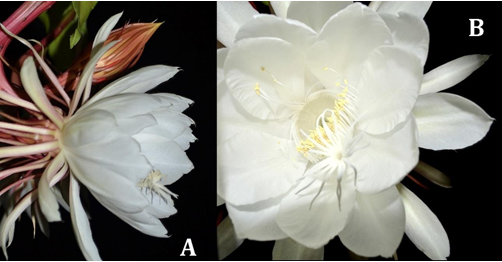
Epiphyllum oxypetalum (DC) Haw (Figure 1A & 1B), is a species of epiphytic phanerogam belonging to the family Cactaceae, subfamily Cactoideae, tribe Hylocereeae, which is distinguished by the size of its flowers (up to 30 cm in diameter in funnel shape), fragrant, for its showy flowering, with whitish or cream-colored flowers, which ensure visibility at night [1, 2] which begin to open at dusk and close again for good when the first light of dawn appears [3]. Hence it is known as “queen of the night, lady of the night, bride of the night, sweetheart of the night, night-cock, night-blooming cereus, orchid cactus, jungle cactus, and dutchman’s-pipe cactus” [4, 5].
(Colombia, Venezuela, Brazil), particularly in Asia (China, India, Malaysia, Vietnam), and Sri Lanka [6, 7]. E. oxypetalum, in addition to its ornamental value, has nutritional, spiritual value and even possesses medicinal properties [8], namely: it relieves pain, serves as a cicatrizant, anticoagulant, antibacterial, antioxidant, anti-inflammatory [4, 9] and even trials have been conducted to evaluate its anticancer activity [10]. Prajitha, et al. [5] pointed out that this species shows the presence of many chemical constituents (phenolic compound and its derivatives, flavonoids, terpenes, glycosides, saponins, among others), which confer the various pharmacological and medicinal properties mentioned above [10]. However, currently the plant is an underutilized resource as the medicinal activities are yet to be fully explored and results in this regard are expected in the future [5].
The morphological characteristics of leaves, stems, flowers and pollen have been reported by Taylor, et al. [1, 2, 11, 12] who indicate that it is an epiphytic cactus with fibrous roots. It has flat, foliaceous and lance- shaped secondary stems, which grow on thin, cylindrical, freely branched primary stems, with the ability to grow up to 6 m tall in the wild, on small rocks or in trees. Its natural habitat is tropical rainforest and temperate rainforest.
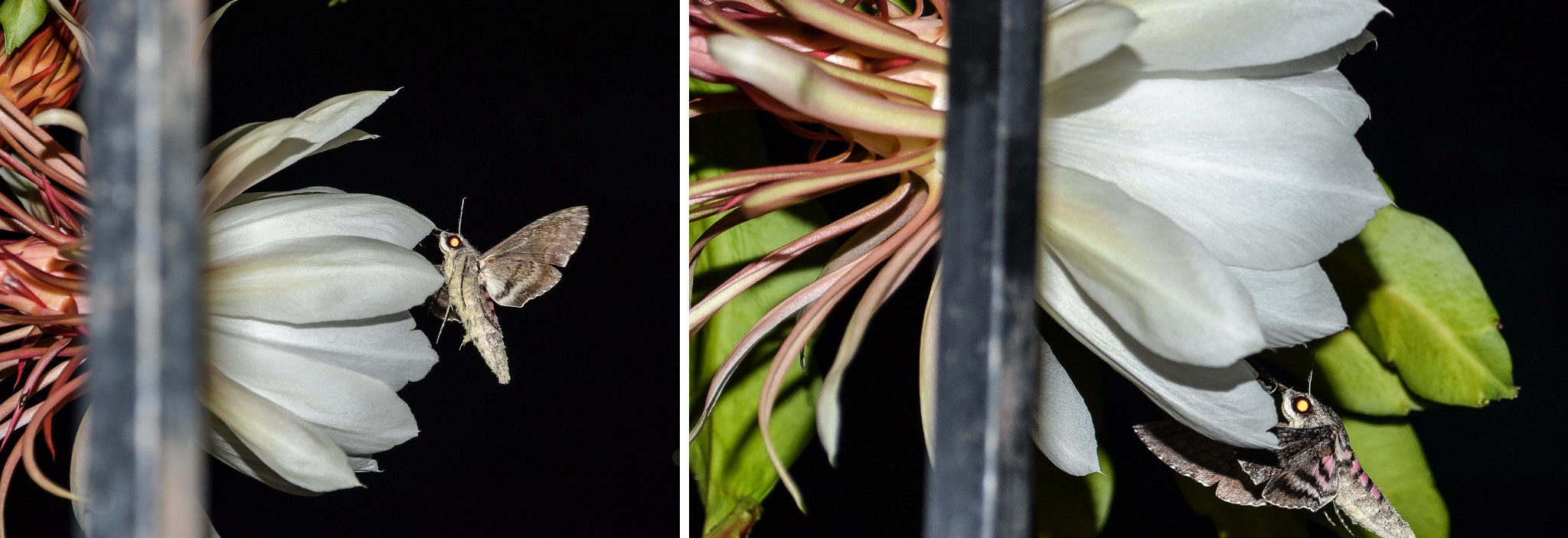
The dama de noche, as it is commonly known in Venezuela, flowers mainly between May and October. Its flowers are pollinated by nocturnal butterflies or moths of the Sphingidae family [13], which are attracted to this plant due to the colouring of its flowers and the smell they emit, which has been associated with the presence of benzyl salicylate (C14H12O3) [5]. Most sphingids have a very long proboscis and feed on nectar while hovering in front of the flower, similar to a hummingbird. Flowers adapted to this type of pollination are usually tubular, pale or white in colour, and open at night. This set of traits is a floral syndrome called sphingophily [3]. In addition, it has been observed that the flowers of E. oxypetalum can even attract bats (seed dispersers) and bees, the latter, although they pollinate diurnal flowers, arrive very early to feed on their pollen and nectar while the flower is still open, before it closes and perishes.
Although it has been indicated that E. oxypetalum is pollinated by a wide variety of organisms, as previously mentioned, mainly by moths, the information about which species pollinate it is scarce, that is why we decided to record and photograph in one of those nights where the flowering was exuberant the moth that visits it: Agrius cingulata of the family Sphingidae, which can be seen in Figure 2.
Agrius cingulata is a sphingid known to have pink basal bands on the hind wings and A2 - A6 tergites (See Figure 3) [14]. This moth has a very wide latitudinal distribution in the American continent and altitudinal distribution is between 0 and 2800 m a.s.l. [14]. In Venezuela it is considered a crop pest, as its caterpillars feed on the sweet potato Ipomoea batatas (L.) Lam. [15] this tuber species is believed to be “the vector” that allowed A. cingulata to spread as an exotic and then as an invader on the African continent and into Europe. The adult’s diet is very different from that of the caterpillar, they feed exclusively on flower nectar, especially on large flowers with deep throats, such as flowers of the genera: Ipomoea L., Convolvulus L., Lonicera L., Petunia Juss., Crinum L., Datura L., Nicotiana L. [14], among others. Accurate descriptions of species on which A. cingulata feeds in the scientific literature are scarce and in many cases speculative, therefore, it is necessary to collect as much data as possible (photographs, species, altitude, dates, times, etc.) to increase knowledge of the species that this and other sphingids pollinate [16].
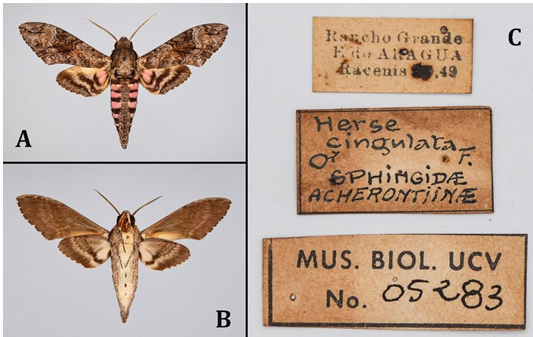
Figure 3: Agrius cingulata (Fabricius, 1775) ♂. A) dorsal view; B) ventral view; C) label data. Locality, collector and date of collection: Rancho Grande, Aragua state, Venezuela; Racenis; 22-VIII-1949. Wing expansion: 81.41 mm; body length: 43.49 mm. Specimen belonging to the Colección of the Museo de Biología de la Universidad Central de Venezuela (MBUCV).
References
-
Taylor NP (2000) Taxonomy and Phytogeography of the Cactaceae of eastern Brazil. Royal Botanic Gardens S1: 219.
-
Santos CG, Fernando-Alonso JL (2009) Colección CEPAC Cactaceae En: Santos-CG, Fernando Alonso JL, Sarmiento- TJ (Eds)Colecciones Especializadas para la Conservación CEPC. Guia Ilustrativa Jardín Botánico Celestino Mutis, Bogotá, Colombia pp: 83-117.
-
Sánchez M (2022) _Epiphyllum oxypetalum_. Disponible.
-
Mahmad A, Shaharun MS, Saad B, Dash GK (2017) _Epiphyllum oxypetalum_ Haw a lesser known medicinal plant. Indo Am J Pharm Sci 4(10): 3670-3672.
-
Prajitha P, Suresh A, Deepak VS, Faslu H (2019) A review on _Epiphyllum oxypetalum_ (DC) Haw. Asian J Res Chem Pharm Sci 7(3): 824-830.
-
Rojas Sandoval J (2020) _Epiphyllum oxypetalum_ Dutchman’s pipe cactus Disponible.
-
Devi KRS, Narayana SL, Menghani P, Georgekutty J (2018) Microscopic, pharmacognostic and phytochemical screening of _Epiphyllum oxypetalum_ (DC) Haw leaves. J Pharmacogn Phytochem 7(6): 972-980.
-
Dandekar R, Fegade B, Bhaskar VH (2015) GC-MS analysis of phytoconstituents in alcohol extract of _Epiphyllum oxypetalum_ leaves. J Pharmacogn Phytochem 4(1): 149-154.
-
Shraddha AN, Naikwade NS (2021) Anticancer activity of _Epiphyllum oxypetalum_ DC leaves extract by in vivo in vitro models. Int J Pharm Sci Res 12(8): 4229-4239.
-
Lemos RCC, Melo-de-Pinna GF deA (2011) Morpho anatomical variations during stem development in some epiphytic Cactaceae. Torrey Bot J 138: 16-25.
-
Ruiz Domínguez C, Vovides AP, Sosa V (2019) Systematic relevance of pollen morphology in tribe Hylocereeae (Cactaceae). 128: 121-140.
-
Carvajal LV (2020) The fantastic and unknown pollinators of the night: the moths.
-
Correa-Carmona Y, Vélez-Bravo AH, Wolff Echeverri MI (2015) Current status of knowledge of Sphingidae Latreille, 1802 (Lepidoptera: Bombycoidea) in Colombia. Zootaxa 3987(1): 001-073.
-
Clavijo JA, Chacín ME (1992) Sphingidae (Insecta: Lepidoptera) reported as pests of Venezuelan crops: key to the species. Bol Entomol Venez 7: 119-125.
-
Jin W (2020) Citizens recording biodiversidad. A case study of _Epiphyllum._
-
Mojorovich M (2021) Diversidad, abundancia y distribución geográfica de esfíngidos (Lepidóptera: Sphingidae), del departamento de Arequipa. Trabajo de grado para optar el Título Profesional de Biólogo. Universidad Nacional de San Agustín de Arequipa, pp: 108.
- Evaluation of Comparative Morphological and Phytochemical Studies on the Seeds Extracts of Cocos nucifera (L.) and Elaeis guineensis Jacq. (Arecaceae)
- Aborted Spores in Argentine Ferns
- Ficus middletonii Chantaras. – A New Distributional Record For Central India
- A Study on the Phytochemical, Antioxidant and Antimicrobial Activities of Ficus glumosa Delile (Moraceae)
- Paclobutrazol (PBZ) and its Metabolic Function in Agriculture: A Review
- Decalepis arayalpathra: Ethnobotany, Scientific Interventions and Prospects