
Artemisia sieversiana (Asteraceae): A Wild Sagebrush Presumably Extinct Rediscovered from Kashmir Himalaya
Artemisia sieversiana Ehrh. ex Wild., a plant belonging to the Asteraceae family, has been rediscovered in the Gurez valley of Kashmir Himalaya, India, after a hiatus of more than 50 years. This reappearance not only highlights the resilience of this species but also underscores the importance of continuous exploration and documentation of biodiversity. Understanding its habitat requirements and the reasons for its disappearance could offer valuable insights into the conservation of not only this specific species but also other endangered plants in the Himalayan region. The present study's approach, including a detailed taxonomic description, photographs showcasing diagnostic characters, and an identification key, serves as a robust method to validate our research and resolve past taxonomic uncertainties.
Introduction
Artemisia L., one of the largest genera in Asteraceae family, comprises 380 [1] to 522 taxa [2]. The genus is distributed primarily in the temperate zones of Northern hemisphere, though few species are found in the Southern hemisphere as well [2].
In India, the genus Artemisia is represented by 40 species, primarily distributed in the Himalayan region [3, 4, 5]. During our recent field surveys to document diversity of Artemisia, we collected a specimen of Artemisia from Gurez valley in Kashmir Himalaya. On detailed study of micro- and macro-morphological characters of the collected fresh plant material, and a review of taxonomic literature Mabberley DJ [1], Hooker JD [6], Ghafoor A [7], we identified these specimens as A. sieversiana Ehrh. ex Willd., a taxon previously recorded from Kashmir valley by Stewart, Kaul, et al. [3]. Certainly, the absence of a taxonomic record of A. sieversiana from the Gurez valley, as indicated by Ara, et al. [8], Dad, et al. [9] further emphasizes the significance of the current research. In the course of the present study, it was observed that the species of A. sieversiana does not grow commonly across the Kashmir Himalaya, contrary to what was reported by Stewart. This new finding challenges previous understanding and highlights the importance of updated research in botanical studies. Understanding the precise distribution of plant species is essential for accurate biodiversity assessments and conservation strategies in the region.
Materials and Methods
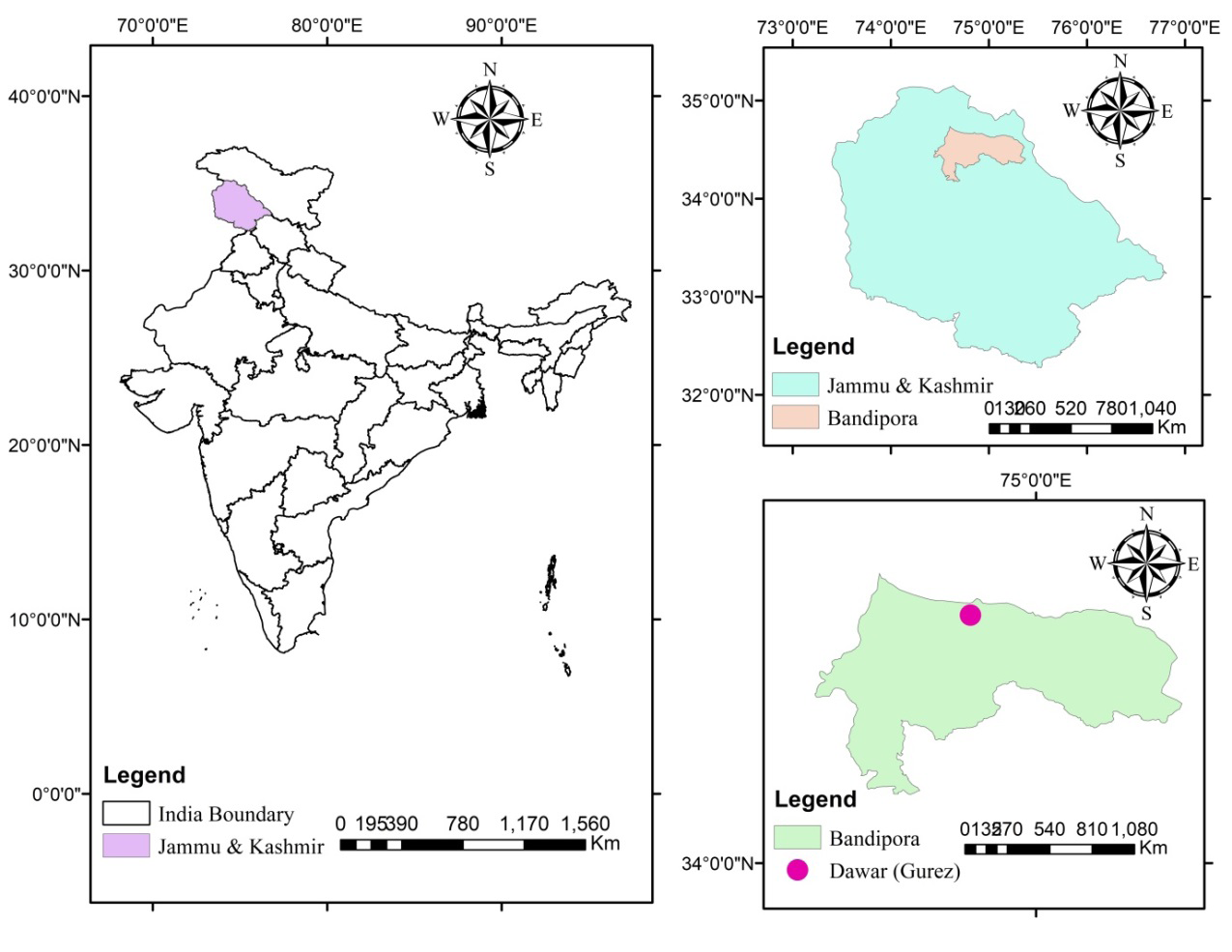
Gurez valley is located in the north-western part of the Himalaya. Plant specimens were collected from Gurez valley of Kashmir Himalaya (Figure 1). Standard taxonomic procedures were followed for collection, drying and further processing of the herbarium specimens [10]. To identify the species, the collected plant specimens were compared with the protologue [11] as well as with the type specimen (HAL0135097). High resolution images of all the Himalayan species of A. sieversiana, available at following herbaria i.e., HAL, GDC, K, PE, KASH and RRLH, were also examined (Index Herbariorum; abbreviations as in Holmgren, et al.) [12]. For studying and measuring macro- and micro-morphological characters, 20 capitula of the taxa were used. The capitula were kept in FAA solution for 24 hours and then the samples were rinsed with water, different parts of inflorescence were placed on slide and Hoyer’s solution were used for microscopic studies [13]. Finally, both ray and disc florets were dissected for detailed morphological characterization and were photographed under stereo microscope (Make: Leica S9D Germany), integrated with image processing software (LASX).
The map showing the distribution of A. sieversiana was prepared using QGIS software, version 3.20 [14]. For construction of keys to the species of subgenus Absinthium, we used Flora of China (www.floraofchina.org) and the global occurrence records for the species were obtained from Plants of the world Online [15].
Results
Taxonomic Treatment
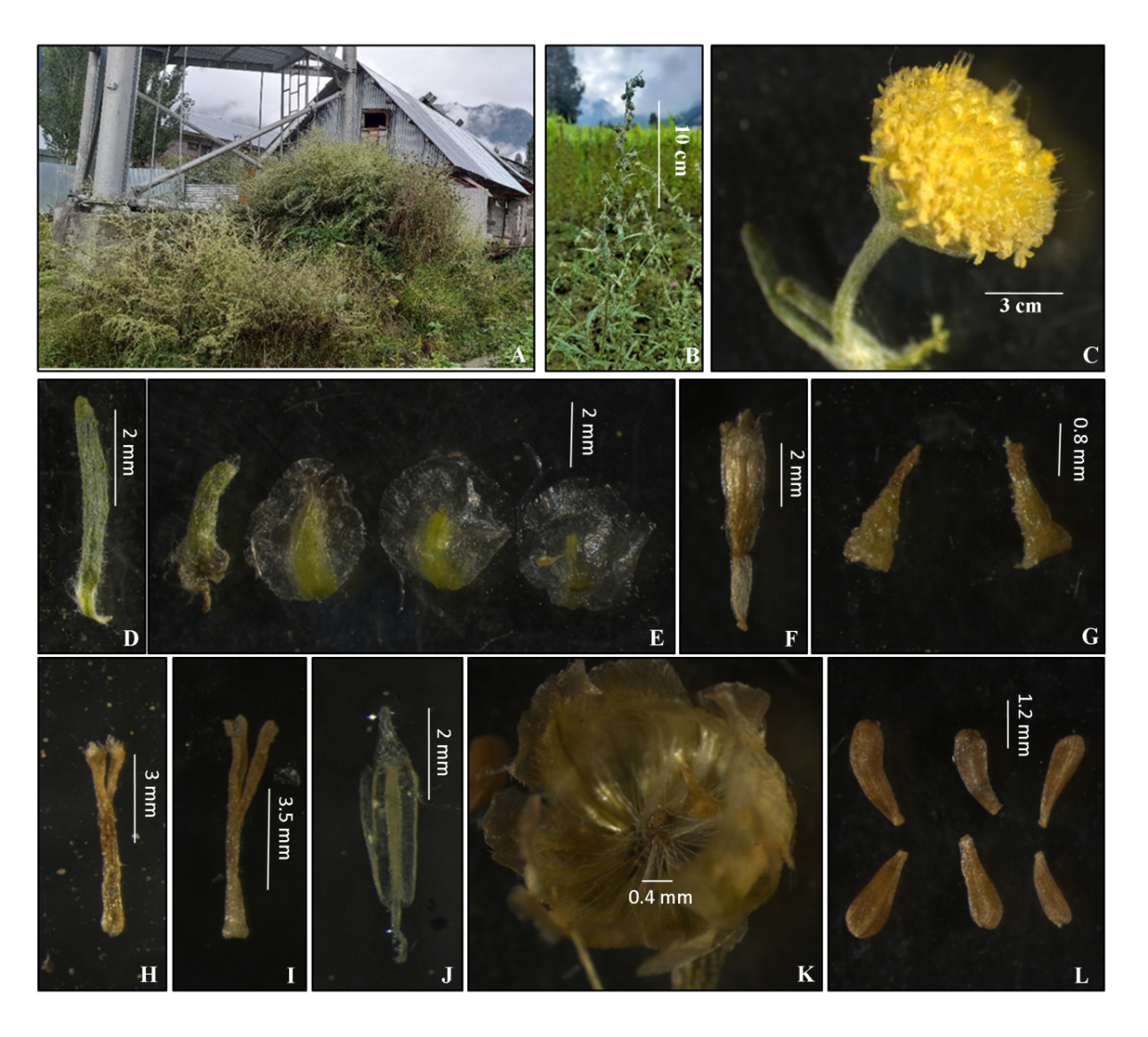
Artemisia sieversiana Ehrhart ex Willdenow, Sp. Pl. 3: 1845. 1803 (Figure 2). Herb, annual, or biennial, 60–200 cm tall, aromatic, glabrescent (to ± grey pubescent). Stem solid, grooved longitudinally, much branched. Leaves green, both on adaxial and abaxial surfaces, glabrescent to ± tomentose, apices of leaf segments obtuse to sub-obtuse, occasionally acute, lobules linear or linear-lanceolate to oblong-lanceolate. Basal leaves petiolate; ( ) 3 9 12 cm − − long, leaf blade triangular ovate, ( ) ( ) 5 8 14 4 6 8 ,2 3 cm or − − × − − pinnatisect, segments
2-3 pairs. Middle cauline leaves; petiole 3.5-8 cm long, leaf blade triangular ovate, 2-3 pinnatisect, ( ) 6 8 14 3.5 8cm − − × − , segments 2-3 pairs, lobules 3-5 x1–2 cm. Upper cauline leaves and leaf-like bracts sessile, linear, entire, ( ) 3 6 7 cm − − . Capitula globose to hemispherical, 4 6.10 4 6mm − × − , nodding, bracteole; linear, linear-lanceolate to linear- oblong, densely pubescent, apices obtuse; peduncle, 0.5- 4.15 mm, sparsely pubescent. Involucre ( ) 4 5 − -seriate, phyllaries sparsely to densely puberulent, Outermost linear–oblong, densely tomentose, hyaline appendage at the base and the tip; median phyllaries elliptic–ovate to hemispheric, hairy tomentose, hyaline margins from middle to tip, 2 4 0.4 1.6mm −× − ; inner phyllaries broadly ovate–hemispherical, broad hyaline margins, tomentose to glabrous, 1.8 4 0.3 2.5mm −× − . Florets numerous, all fertile, yellow; marginal female florets ( ) 14 16 57 − − , corolla conical, 1.3-1.5 mm, 3-4-toothed, style branches exserted with 2-2.5 mm, style 1.6-3 mm; Disc florets 55–84, corolla 5-toothed,
3 4 1.3 1.4mm −× − , cuneate, anther lobe 3-4 mm long, anther apices appendage long triangle, anther base appendage obtuse, anther filaments free, 1-1.2 mm; pistil style branch 1-1.2 mm long, hair appendages on the tip of style branches 0.1-0.5 mm long, style 3-3.3 mm long. Receptacle conical, densely long white pubescent. Achene brown, obovoid,
1.7 2.4 0.4 0.8mm − × − long, finely striated with terminal corolliform scar.
Global Distribution: Native to Russia, Mongolia, Kazakhstan, Turkmenistan, Uzbekistan Kyrgyzstan, Tajikistan, Afghanistan, Pakistan, India, China, Korean Peninsula, Japan. Phenology: Flowering from June-July; and fruiting from July- September. Distribution and Habitat: The species grow abundantly in the lower parts of Gurez valley, along the banks of river Kishenganga and around the cultivated areas.
Conservation Status: Since the species is restricted in Gurez valley of Kashmir Himalaya. The conservation status of the species is reported here as endangered for Kashmir Himalaya.
Discussion
The accuracy of biodiversity data is crucial for understanding the distribution and abundance of various species in an ecosystem [16]. However, this accuracy can be significantly hampered by biased sampling methods and it is particularly relevant when discussing Stewart’s report on Artemisia sieversiana, which stated that it to be commonly growing between 2000 to 4500 m (asl) in Kashmir. However, based on our recent extensive field surveys, the species prefer to grow between 2500 to 3600 m (asl). Additionally, in the Kashmir Himalaya, our extensive field and literature surveys have revealed that the species is restricted only to the Gurez valley. These findings contrasts with Stewart’s report, suggesting either a significant shift in the species distribution over time or it could be a typical example of biased sampling [17]. In addition, the absence of A. sieversiana in the Sonamarg area of district Ganderbal highlights a notable disparity between the findings of Kaul, et al. [3] research and the results of the present study. This suggests a potential ecological pressures, possibly induced by factors like climate change, habitat degradation, or anthropogenic activities, might have led to the disappearance of this species from the touristic place of Sonamarg [18]. Absence of the species distribution record in recent studies by Ara, et al. [8], Dad, et al. [9], Dar, et al. [19] and Dar, et al. [20], followed by its reappearance during the present study from the Gurez valley, suggest that the species A. sieversiana is restricted in Dawar part of Gurez valley, which in turn raises concerns regarding the species conservation status in Jammu and Kashmir.
Therefore, it is recommended that the species in Jammu and Kashmir need to be evaluated as endangered status and might need to be placed under legal protection, including establishment of reserves, and restrictions on human activities in ecologically overexploited habitats [21].
It is noteworthy to mention that the observations of the present study underscore the importance of updated research methods and rigorous field exploration to accurately map the distribution of plant species. Such nuanced observations contribute significantly to our understanding of plant ecology and help refine existing knowledge of biodiversity, which ultimately ensure the accuracy of ecological data and the reliability of scientific conclusions [17, 15].
The rediscovery of A. sieversiana has far-reaching implications for the field of conservation biology. It not only highlights the resilience of nature but also underscores the importance of thorough exploration and documentation of biodiversity and serves as a poignant reminder of the ongoing threats faced by many plant species worldwide i.e. Habitat destruction, climate change, and human activities continue to endanger numerous plants, pushing them toward the brink of extinction [15]. This rediscovery emphasizes the urgency of global conservation efforts, urging governments, organizations, and individuals to take immediate and decisive action to protect and preserve the global biodiversity.
Conflicts of Interest
The authors declare that there is no conflict of interest.
Acknowledgements
We are grateful to the Honorary Director, Centre for Biodiversity & Taxonomy, Department of Botany, University of Kashmir, for providing necessary facilities to carry out the work. We thank the staff and research students at Centre for Biodiversity & Taxonomy, University of Kashmir for kind assistance. The first author acknowledges Council of Scientific & Industrial Research, New Delhi, for support during the present work under the fellowship number: 09/251(0145)/2019-EMR-I. The financial support received from SERB-DST, Government of India, New Delhi under CRG/2022/006606 to Anzar A. Khuroo is greatly acknowledged. We are grateful to the Editor and reviewers for their critical comments which have improved the quality of the manuscript.
References
-
Mabberley DJ (2008) The Plant-Book: A portable dictionary of plants, their classification and uses. In: 3rd (Edn.), Cambridge University Press, USA, pp: 69.
-
Oberprieler CH, Himmelreich S, Kallersjo M, Vallès J, Watson LE, et al. (2009) Tribe Anthemideae. In: Systematics, Evolution and Biogeography of the Compositae. In: Funk VA, et al. (Eds.), American Society of Plant Taxonomists pp: 632-666.
-
Kaul MK, Bakshi SK (1984) Studies on the genus Artemisia L. in North–West Himalaya with particular reference to Kashmir. Folia Geobotanica and Phytotaxonomica 19(3): 299-316.
-
Singh P, Dash SS, Sinha BK (2019) Plants of Indian Himalayan region (An Annotated Checklist and Pictorial Guide) (Part - I). Botanical Survey of India pp: 100-103.
-
Ali L, Khuroo AA, Ganie AH, Rasool N (2023) Artemisia dracunculus subsp. ladakhensis (Asteraceae), a new subspecies from Ladakh, India. Annales of Botanici Fennici 60(1): 191-195.
-
Hooker JD (1882) The Flora of British India. In: London RL (Ed.), pp: 329.
-
Ghafoor A (2002) Flora of Pakistan. Tropicos 207: 1-172.
-
Ara S, Naqshi AR (1992) Ethnobotanical studies in the Gurais Valley. Journal of Economic and Taxonomic Botany 17(3): 657-678.
-
Dad JM, Reshi ZA (2015) Floristic composition and diversity patterns of vascular plants in mountain meadow of Gurez valley, Kashmir, India. Taiwania 60(1): 8-17.
-
Bridson D, Forman L (2000) The Herbarium Handbook. In: 3rd (Edn.), Royal Botanic Gardens Kew, Richmond, Surrey, USA, pp: 348.
-
Willdenow CL (1804) Species Plantarum. In: 4th (Edn.), Pars 3.
-
Holmgren PK, Keuken W, Schofield EK (1981) Index Herbariorum Part I. The Herbaria of the world. In: 7th (Edn.), Utrecht pp: 452.
-
Anderson LE (1954) Hoyer’s solution as a rapid permanent mounting medium for bryophytes. The Bryologist 57(3): 242-244.
-
QGIS (2021) A Free and Open Source Geographic Information System.
-
POWO (2022) Welcome to Plants of the World Online.
-
Olson DM, Dinerstein E, Powell GVN, Wikramanayake ED (2002) Conservation Biology for the Biodiversity Crisis. Conservation Biology 16(1): 1-3.
-
Troudet J, Grandcolas P, Blin A, Lebbe RV, Legendre F (2017) Taxonomic bias in biodiversity data and societal preferences. Science Report 7(9132).
-
Cousins SAO, Lindborg R (2004) Assessing changes in plant distribution patterns—indicator species versus plant functional types. Ecological Indicators 4(1): 17-27.
-
Dar GH, Khan MA, Bhagat RC (2002) Biodiversity of the Kashmir Himalaya. Anmol publication Pvt, New Delhi, India, pp: 125-177.
-
Dar GH, Khuroo AA (2020) Biodiversity of the Himalaya: Jammu and Kashmir State. Springer Nature 18: 3-26.
-
Mehta P, Bisht K, Chandra SK (2020) Diversity of threatened medicinal plants of Indian Himalayan region, Plant Biosystems- An International Journal Dealing with all Aspects of Plant Biology 155(6): 1121-1132.
- Evaluation of Comparative Morphological and Phytochemical Studies on the Seeds Extracts of Cocos nucifera (L.) and Elaeis guineensis Jacq. (Arecaceae)
- Aborted Spores in Argentine Ferns
- Ficus middletonii Chantaras. – A New Distributional Record For Central India
- A Study on the Phytochemical, Antioxidant and Antimicrobial Activities of Ficus glumosa Delile (Moraceae)
- Paclobutrazol (PBZ) and its Metabolic Function in Agriculture: A Review
- Decalepis arayalpathra: Ethnobotany, Scientific Interventions and Prospects