
Effect of Different Cultural Treatments on Branching and Yield of Groundnut (Arachis hypogea L.)
The experiment was carried out at college of agriculture, karekere, hassan agricultural farm during year June 2022 to November 2022. The objective of this investigation was to study the effects of five different treatments nipping, passing empty drums, withhold of irrigation, nipping without irrigation and remaining cultural practices done at 20,20,30,30 and 30 days after sowing on the number of branches and yield of groundnut. A randomized complete block design with four replications was used in this experiment. The data was recorded based on different treatments on above mentioned days before and after sowing. The recorded results were observed as follows: no of branches recorded were nipping, passing of empty drums, withholding of irrigation, nipping without irrigation and following usually recommended practices were 19,21,15,21 and 15 respectively. The yield obtained in different treatment plots were 46.6, 53.9, 38.4, 58.5 (failure due to heavy rain) and 38.4 Q/ha, respectively. So, by observing the above results, we can conclude that the passing empty drums method showed high branches and high yield compared to other treatments. So, this cultural treatment can be recommended to farmers for increasing both yield and branches.
Introduction
Groundnut (Arachis hypogea L.) is the sixth most important oilseed crop grown globally. It contains 26-28% protein and 48-50% oil and is a rich source of vitamins, minerals and dietary fiber.
Groundnut is grown on 27.2 million ha worldwide with a total production and productivity of 47 million mt and 1.7 mt/ha according to FAOSTAT 2020.
Cultivated groundnut (Arachis hypogaea L.) belongs to genus Arachis in subtribe Stylosanthinae of tribe Aeschynomenea of family Leguminosae. Groundnut oil is composed of mixed glycerides and contains a high proportion of unsaturated fatty acids, in particular, oleic (50-65%) and linoleic (18-30%) [1]. Groundnut is also known as earthnuts, Peanuts, jack nuts, pinders, manila nuts, goobers, goober peas, pindars, and monkey nuts; the last one is often used to mean the entire pod [2]. The cultural practice followed during the crop period is a useful factor for improving yield in groundnut.
The overarching goal was to derive integrated crop management recommendations for enhancing groundnut production globally given its nutritional and commercial significance across agricultural economies.
Materials and Methods
The present investigation entitled “Effects of different cultural treatments on branching and yield of groundnut (Arachis hypogea L.) was carried during Kharif season 2019 at the Agronomy farm of the College of Agriculture, Hassan, Karnataka, India. The best variety of groundnut was selected for this experiment. The experiment was laid out in randomized completely block design with five treatments and four replications in digged land upto 20cm depth beds having 1m×1m area and 0.5m in between the beds with spacing: 30cm×10cm. The five different treatment plots were nipping, passing of empty drums, withholding of irrigation, nipping without irrigation and following usually recommended practices. The observations were recorded on randomly selected plants for germination percentage, no of branches/plant, plant height, number of leaves per branch, no. of plants per plant and yield. The Spade, pickaxe, empty drums were used during experiment. The methods followed during experiment were nipping, passing empty drums, with hold of irrigation, nipping & withhold of irrigation.
Result and Discussion
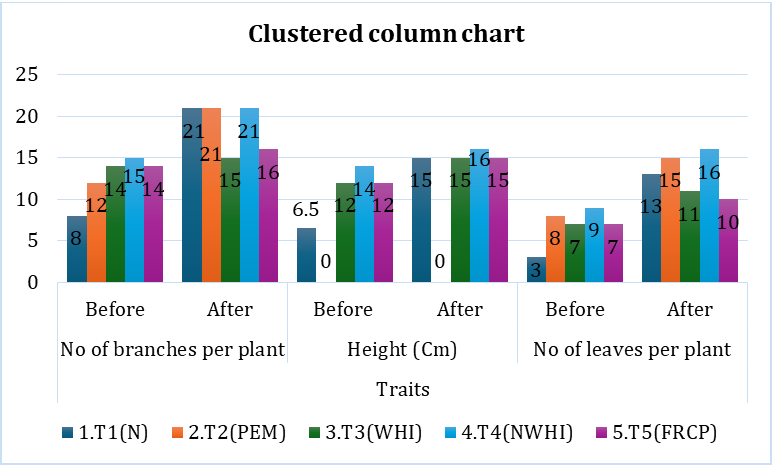
The results of different treatments nipping, passing empty drums, withholding of irrigation, with holding of irrigation, nipping without irrigation and following usually recommended practices. The data of five treatments were: (Table 1), (a) Nipping at 20 DAS, there was a increase in number of branches per plant after nipping when compared to branches per plant before nipping. Before nipping no of branches per plant recorded was 8 and after nipping it was 17-21 branches. Average height of plants observed before and after nipping was 6.5 and 15 cms, respectively. The number of leaves per plant recorded was 3 and 13, respectively. (b) Passing of empty drums at 20 DAS. No of plants for bed before and after passing of empty drums were 15.12 and 21 were number of branches recorded before and after passing of empty drums, respectively. The number of leaves recorded per plant before and after passing of empty drums were 8 and 15 respectively. (c) Withholding irrigation: The data obtained before and after withholding of irrigation upto 30 days were no of branches per plant were 14 and 15, respectively. The height of plants recorded before and after withholding irrigation were 12 and 15 cms, respectively. 7 and 11 were number of leaves per branch recorded before and after withholding of irrigation. (d) Nipping at 30 DAS without irrigation. The number of branches recorded before and after was 15 and 21, respectively. Heights of plants observed before and after were 14 and 16 cms, respectively. The no of leaves observed per branch before and after nipping at 30 days without irrigation were 9 and 16 respectively. (e) Following recommended remaining cultural practices. The no of branches per plant were 14 and 16 before and after following recommended cultural practices. There was an increase in height after practicing cultural practices. The height of plants recorded before and after practicing cultural practices were 12 and 15 cms, respectively. The number of leaves per branch obtained before and after practice of cultural practices were 7 and 10, respectively. Germination percentage recorded was 75%.
| Traits | ||||||
|---|---|---|---|---|---|---|
| Treatments | No of branches per plant | Height (Cm) | No of leaves per plant | |||
| Before | After | Before | After | Before | After | |
| 1.T1(N) | 8 | 21 | 6.5 | 15 | 3 | 13 |
| 2.T2(PEM) | 12 | 21 | - | - | 8 | 15 |
| 3.T3(WHI) | 14 | 15 | 12 | 15 | 7 | 11 |
| 4.T4(NWHI) | 15 | 21 | 14 | 16 | 9 | 16 |
| 5.T5(FRCP) | 14 | 16 | 12 | 15 | 7 | 10 |
Table 1: Table showing no of branches per plant, height and no of leaves per plant before and after different treatments: N-Nippi
(a) Nipping: The average number of branches per plant in the experimental plot due to nipping at 20 DAS is 19, and it yields about 46.6 Q/ha. (b) Passing empty drums: The average number of branches per plant due to the passing of empty drums at 20 DAS is 21 and it yields about 53.9 Q/ha. (c) Withholding of irrigation: The average number of branches per plant due of irrigation for 30 DAS is 15 and it yields about 38.4 Q/ha. (d) Nipping and withholding of irrigation: The average number of branches per plant due to nipping and stopping irrigation at 30 DAS is 21 and it yields about 58.5 Q/ha. Unfortunately we have received heavy showers during this treatment, so withholding of irrigation was failed to conduct. (e) Following of recommended cultural practices: average number of branching due to this is 15 and yields about 38.4 Q/ha.
According to the observations taken during the systematic conduction of the experiment with good maintenance of the experimental plots, we have concluded that as the branching of groundnut increases, the yield also increases, respectively. However, the extent of increase in yield and branching varies for different treatments and those differences in the yield obtained were given below:
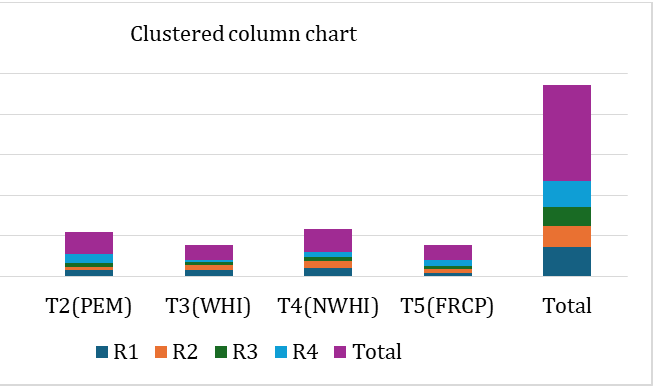
| Treatments | R 1 | R 2 | R 3 | R 4 | Total |
|---|---|---|---|---|---|
| T 1(N) | 12 | 9.2 | 13 | 13 | 46.6 |
| T 2(PEM) | 15 | 6.3 | 10 | 23 | 53.9 |
| T 3(WHI) | 16 | 11 | 6.7 | 4.5 | 38.4 |
| T 4(NWHI) | 21 | 16 | 12 | 11 | 58.5 |
| T 5(FRCP) | 8 | 8.5 | 7.5 | 14 | 38.4 |
| Total | 72 | 51 | 48 | 65 | 236 |
Table 2: ** Effect of treatments on yield of groundnut: Measurements are in Quintals per hectare.
N-Nipping, PEM-Passing empty drums, WHI-Withholding of irrigation, NWHI-Nipping and withholding of irrigation, FRCP-Following recommended cultural practices Table 2: Effect of treatments on yield of groundnut: Measurements are in Quintals per hectare.
The number of branches led to an increase in yield based on different types of treatments in different experiments were reported in findings of Shashidhar VR, et al. [3], Gowthami V, et al. [4], Nigam SN, et al. [5], Ali FM, et al. [6], Avinasha BL, et al. [7], Nagar R, et al. [8], Oppong SD, et al. [9], Thilini SPLNK, et al. [10], Gawas D, et al. [11], Magagula N, et al. [12], Sathiya K, et al. [13], Mohanty P, et al. [14], Ibrahim II, et al. [15], Yilmaz M, et al. [16], Iddrisu A, et al. [17], Singh N, et al. [18], El Naim AM, et al. [19], Seijo G, et al. [20], Maleki SJ, et al. [21], Michael CY, et al. [22], Sanders TH, et al. [23, 24], Veeramani P, et al. [25].
Summary and Conclusion
Nipping at 20 DAS is done with good maintenance of plots with irrigation. It leads to an increase in branching from 08 to 19 and increases the yield to 46.6 Q/ha. Passing of empty drums: Passing of empty drums at 20 DAS increases branching from 12 to 21 and yields about 53.9 Q/ha. With holding of irrigation: At 30 DAS leads to an increase in branching from 12 to 14 and yields about 38.4 Q/ha. Nipping and withholding of irrigation: Nipping and withholding of irrigation for 30 days increase branching from 15 to 21 and yields about 58.5 Q/ha. Practicing the usual cultural practices: Branching from 14 to 16 and yields up to 38.4 Q/ ha. Nipping and drum passing increases the branching of the ground nut and yield more. With holding irrigation and nipping along without irrigation are comparatively lesser in branching and yields less comparatively. After observing the results described above, we can conclude that passing empty drums at 20 DAS is more effective in increasing branching and groundnut yield. So, we can conclude that the branching of groundnut increases the yield. Empty drum passing is more effective in increasing the number of branches and hence leads to more yield than other treatments. This is because the branches that develop earlier, located in proximity to the ground, will be the first to start defining the number and weight of pods, and with them the sink strength. These branches will show a high partitioning coefficient, thus achieving higher yields than those with a later ontogeny [26].
References
-
Young C (1996) Peanut oil. Bailey’s Industrial Oil and Fat Products 2: 337-392.
-
Annadurai K, Angadi S, Masilamani P (2009) Agronomic management technologies for peanut production: a review. Agricultural Reviews 30(4): 235-261.
-
Shashidhar VR, Chari M, Prasad TG, Kumar MU (1986) A Physiological Analysis of the Branching Pattern in Sequential Types of Groundnut in Relation to the Fruiting Nodes and the Total Mature Pods Produced. Annals of Botany 58(6): 801-807.
-
Gowthami V, Ananda N (2017) Dry matter production, yield and yield components of groundnut (Arachis hypogaea L.) genotypes as influenced by zinc and iron through ferti-fortification. Indian Journal of Agricultural Research 51(4): 339-344.
-
Nigam SN, Jordan DL, Janila P (2018) Improving cultivation of groundnuts. In: Achieving sustainable cultivation of grain legumes In: Improving cultivation of particular grain legumes (Edn.). Burleigh Dodds Series in Agricultural Science. Burleigh Dodds Science Publishing Limited, 2: 1-25.
-
Ali FM, Ibrahim KB (2019) Effect of Sowing Methods on Growth, Yield and Yield Components of Groundnut (Arachis hypogaea L.) Varieties at Dongola-Sudan. Nile Journal for Agricultural Sciences 4(2): 39-47.
-
Avinasha BL, Srinivasan S, Sritharan N, Selvakumar T (2019) Effect of PGRs and nutrients on flowering and productivity of groundnut (Arachis hypogaea L.). Journal of Pharmacognosy and Phytochemistry 8(3): 3767- 3769.
-
Nagar R, Jat R, Mathukia R, Choudhary R, Reddy KK (2019) Effect of different phosphorus management practices on growth, yield and economics of summer groundnut (Arachis hypogaea L.). The Indian Society of Oilseeds Research 36(4): 225-228.
-
Sekyere OD, Yintii BB, Akolgo LA (2019) Assessment of Selected Landrace and Improved Groundnut (Arachis hypogaea L.) Genotypes under Stressed and Non- stressed Conditions. Journal of Experimental Agriculture International 40(1): 1-25.
-
Thilini SPLNK, Pradheeban L, Nishanthan K (2019) Effect of Different Time of Earthing up on Growth and Yield Performances of Groundnut (Arachis hypogea L.) Varieties. Journal of Dry Zone Agriculture 5(2): 16-25.
-
Gawas D, Mane AV, Burondkar MM, Kanase T, Kasture MC, et al. (2020) Yield performance of groundnut (Arachis hypogaea L.) genotypes under varying plant densities and seasons. International Journal of Chemical Studies 8(6): 2383-2387.
-
Magagula N, Mabuza MP, Zubuko N (2020) Effects of plant density and planting pattern on growth and seed yield of groundnuts [Arachis hypogaea (L.)] in the Wet Middleveld of Eswatini. Asian Plant Research Journal 3(2): 1-12.
-
Sathiya K, Hussainy SAH, Sridhar P (2020) Effect of agronomic management practices on the performance of rabi summer groundnut (Arachis hypogaea) under rice (Oryza sativa)-groundnut cropping system. Crop Research 55(3-4): 107-112.
-
Mohanty P, Pany BK, Sahu G, Mohapatra S, Nayak BK (2022) Effect of Integrated Nutrient Management on Growth, Yield Attributes, Yield and Quality Parameters of Groundnut (Arachis hypogaea) in an Acidic Upland of Odisha. Indian Journal of Ecology 49(1): 119-123.
-
Ibrahim II, Umar UM, Adeniyi TO, Adegoke IB, Nabage OHA (2021) Efficacy of intra-row spacing on the growth and yield of groundnut (Arachis hypogea (L.)) cultivars on the Jos Plateau Nigeria. Integrity Research Journals 6(3): 105-110.
-
Yilmaz M, Jordan DL (2022) Effect of plant density on yield and quality of peanut (Arachis hypogaea L.) cultivars. Turkish Journal of Field Crops 27(2): 217-223.
-
Iddrisu A, Adjei E, Asomaning SK, Santo KG, Isaac AP, et al. (2024) Effect of Variety and Plant Spacing on Growth and Yield of Groundnuts (Arachis hypogaea L.). Agricultural Sciences 15(1): 54-70.
-
Singh N, Daramola OS, Iboyi JE, Devkota P (2024) Peanut (Arachis hypogaea L.) response to low‐rate applications of selected herbicides at vegetative and reproductive growth stages. Agronomy Journal.
-
El Naim AM, Eldoma MA, Abdalla AE (2010) Effect of weeding frequencies and plant density on vegetative growth characteristic of groundnut (Arachis hypogaea L.) in North Kordofan of Sudan. International Journal of Applied Biology and Pharmaceutical Technology 1(3): 1188-1193.
-
Seijo G, Lavia GI, Fernández A, Krapovickas A, Ducasse DA, et al. (2004) Genomic relationships between the cultivated peanut (Arachis hypogaea, Leguminosae) and its close relatives revealed by double GISH. American Journal of Botany 94(12): 1963-1971.
-
Maleki SJ, Viquez O, Jacks T, Dodo H, Champagne ET, et al. (2003) The major peanut allergen, Ara h 2, functions as a trypsin inhibitor, and roasting enhances this function. The Journal of allergy and clinical immunology 112(1): 190-195.
-
Michael CY (2006) The Peanut Alergy Answer Book. Fair Winds Publishing 2(1): 233- 239.
-
Sanders TH, McMichael RW, Hendrix KW (2000) Occurrence of Resveratrol in edible peanuts. Journal of Agricultural and Food Chemistry 48(4): 1243-1246.
-
Sanders TH, Robert RW, McMichael J, Hendrix KW (2000) Occurrence of Resveratrol in edible peanuts. Journal of Agriculture Food and Chemistry 48(4): 1263-1269.
-
Veeramani P, Subrahmaniyan K (2011) Nutrient management for sustainable groundnut productivity in India–a review. International Journal of Engineering Science and Technology 3(11): 8138-8153.
-
Giayetto O, Morla FD, Fernandez EM, Cerioni GA, Kearney M, et al. (2013) Temporal Analysis of Branches Pod Production in Peanut (Arachis hypogaea) Genotypes with Different Growth Habits and Branching Patterns. Peanut Science 40(1): 8-14.
- Evaluation of Comparative Morphological and Phytochemical Studies on the Seeds Extracts of Cocos nucifera (L.) and Elaeis guineensis Jacq. (Arecaceae)
- Aborted Spores in Argentine Ferns
- Ficus middletonii Chantaras. – A New Distributional Record For Central India
- A Study on the Phytochemical, Antioxidant and Antimicrobial Activities of Ficus glumosa Delile (Moraceae)
- Paclobutrazol (PBZ) and its Metabolic Function in Agriculture: A Review
- Decalepis arayalpathra: Ethnobotany, Scientific Interventions and Prospects