
Laughter Yoga for Patients with Hypertension, India
Objective: To evaluate the effects of laughter Yoga on selected haemodynamic variable of hypertensive patients.Design: quasi experimental design.Setting: Magalir Maruthava Maiyam Veeriamplayam, Coimbatore.Sample: Forty samples diagnosed to have hypertension were selected for the study, of which 20 were assigned to the control group.Outcome measures: Haemodynamic variables namely blood pressure pulse and mean arterial pressure were measured before each session of laughter Yoga and after laughter Yoga and recorded.Intervention: laughter Yoga techniques were practiced by the patients for 20-30 minutes. It was given at one session per day for 5 days.Results: Subjects who received laughter Yoga reported significant reduction in blood pressure of 125.15/82.2.25 mm of Hg than 140.50/91.50mm of Hg in control group, pulse 79.86 than87.6 in control group, MAP of 97.79 than 108.33 in control group. There was no association between haemodynamic variable and demographic variables of age, sex and BMI.Conclusion: The results supported that the incorporation of laughter Yoga as one of the best alternative therapy to reduce hypertension.
Introduction
Nearly seventy percent of the diseases have their roots in stress. There are many ways to remove the stress. Laughter is one of the great ways to distress. Laughter harmonizes all the sense organs in a moment of total concentration. There is no human being who never wishes to laugh [1]. It is a simple form of stress busting and very effective self care tool [2]. Hypertension is one of the important causes of mortality and morbidity in the elderly in India. Nearly 60-80% of the elderly population has high blood pressure for which early identification and adequate treatment of hypertension is of prime necessity [3]. The American Accreditation Health Care Commission reports that inadequately controlled hypertension are the major factor for the higher mortality rate from heart disease. It adds on further stating that nearly one billion people worldwide have hypertension. Less than half of these people are on medication and only half of this group has their blood pressure under control with such agents. Prolonged blood pressure elevation eventually damages blood vessels through the body. The high prevalence of hypertension in the general population makes the identification and treatment of affected patients, a top priority for clinicians [4, 5]. Laughter Yoga is now recognized as one of the suitable alternative therapy in lowering hypertension. A hundred laughs a day is equal to 10minutes of morning jogging or workout on a rowing machine or 15 minutes on a stationery exercise making it an excellent aerobic workout.
Need for the Study
The prevalence of hypertension has been increasing in developing countries; and community surveys have documented that it is more prevalent among the Indians between the third and sixth decades of their life. Hypertension is a major modifiable risk factor for cardiovascular disease, which accounts for 57 and 24% of all deaths due to stroke and coronary heart disease respectively Around 5.3 lakh Indians die of hypertension related coronary disease every year and the figure is likely to double each year. It has been found in a study from Northern India that incidence of hypertension increased from 3.98 per cent in 1963 to 26.78 in 2000 among men while the incidence rate role from 6.647 per cent to 27.65 per cent among women [4, 5, 6, 7]. In this 21st century the attention is focused on alternative therapies like relaxation, meditation, laugh therapy, aroma therapy along with pharmacological management. The investigator during the clinical experience found that more number of hypertensive patients was visiting the hospital that had poor psychological well-being too. Many articles and reports provide generalized statements on the benefits of laugh therapy in various disorders. Hence forth the investigator was motivated to create empirical evidence on the efficacy of laugh therapy in hypertension and psychological well-being. This will also provide a sound scientific base principle for implementing this laugh therapy as a nursing intervention for hypertensive patient’s clients to provide a holistic care. With this motive the investigator embarked a rigorous research to test the efficacy of laugh therapy on selected haemodynamic variables and psychological well-being of hypertensive patients [8].
Statement of the Problem
Effect of Laughter yoga Therapy on Selected Haemodynamic Variables of Patients with Hypertension at, Veeriampalayam, Coimbatore.
Objectives of the Study
- To assess selected haemodynamic variables of patients with hypertension before and after laughter yoga.
- To compare the selected haemodynamic variables of hypertensive patients who receive laughter yoga with those who do not receive laughter yoga.
- To associate the selected demographic variables with changes in haemodynamic variables.
Methodology
Research Approach
Experimental research approach was adopted for the study as it was intended to assess the effectiveness of effects of laugh therapy on selected haemodynamic variable and psychological well-being of hypertensive patients
Research Design
The present study was a quasi experimental study in nature as it involves manipulation and matched control without randomization.
Study Setting
The study was conducted at Magalir Maruthuva Maiyum, Veeriampalayam Ciombatore. This rural centre is an annexure of Kovai Medical Center and Hospital, a multi-user speciality hospital in Coimbatore. The rural centre runs with an outpatient department from 9:00am to 5:00 pm and adequately equipped to treat in patients with minor ailments. About 40 patients in around Veeriampalayam, Kalapatti, and Karuparayanpalayam visit the outpatient department every day. Nearly 80 patients have been identified to have hypertension in that locality who visits the outpatient department for treatment.
Study Population
The population of the study included patients visiting the rural centre who were identified to have primary hypertension
Sample and Sample Size
Male and female patients visiting the rural centre who were identified to have primary hypertension and those who fulfill the criteria, where selected as sample. The sample size of the study was 40 patients out of which 20 patients were assigned to the control group and 20 were assigned to experimental group. The groups were matched for variables such as age and intake of antihypertensive agents.
Criteria for Sample Selection
The following were the criteria set for the selection of sample for this study. Inclusion Criteria 1. Patients who were diagnosed to have primary hypertension with the blood pressure ranging from 140-180/90-110mm of Hg.
2. Both male and female those who were above the age of
20 Exclusion Criteria 1. Patients with coexisting disease like IHD, bronchial asthma, cerebrovascular accident, tuberculosis and other respiratory infections.
2. Patients with known psychiatric illnesses.
3. Patients with either visual or hearing impairment.
Sampling Technique
The samples who met the inclusion criteria during the data collection were selected using Convenient sampling technique.
Procedure for Data collection
The data collection as planned was done for a period of one month. The formal permission to conduct the study was obtained from the medical officer of Veeriampalayam Magalir Maruthuva Maiyam. The patients were selected on the basis of selection criteria. The data was collected in the following pattern. List of clients who had primary hypertension were obtained. The investigator established good rapport with the patients and the purpose of the study was explained to the subjects to ensure their cooperation. In the control group the pretest and post test measures of the haemodynamic variables were obtained for 5 days between 10-11 A.M. which was most convenient time for all the patients. The control group was on the routine treatment during this period. In the experimental group the haemodynamic variables were measured 15-20 minutes before and after laughter yoga. Each subject received 5 session of laughter yoga therapy for 5 days. The blood pressure was measured using calibrated sphygmomanometer and stethoscope. The same sphygmomanometer and stethoscope was used for all the subjects throughout the study. The pulse was measured by palpating the left radial artery. The mean arterial pressure was measured using the derived formula. The pretest psychological well- being score was obtained on day one and the post test score was obtained on day five after the laugh therapy based on the responses to the questionnaire. During this period, the amount of anti hypertensive drugs and its half life period also was considered by the investigator recording the time of intake of the antihypertensive drug.
Results
Background Variables
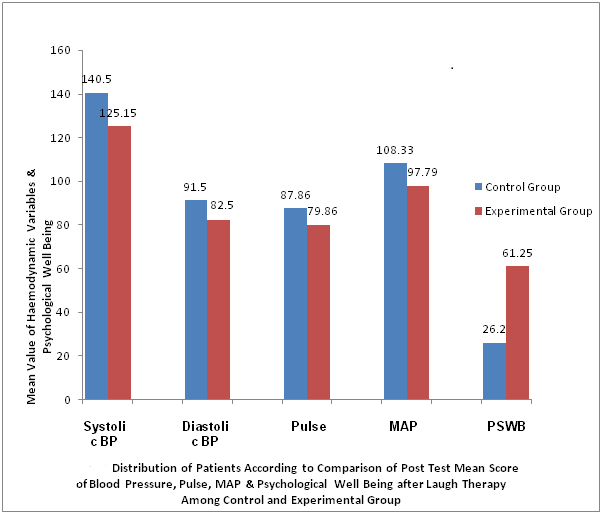
The mean pretest measures of systolic BP were 141.35 and 142.70 in control and experimental group. The ‘t’ test for the mean difference of systolic blood pressure was 0.742 at df (28) which was not significant. The mean post test measure of systolic BP was140.5, 125.5 in control and experimental group respectively. The ‘t’ test for the mean difference between systolic blood pressure of control and experimental group was 6.855 df (38) was highly significant at.01 level (Tables 1-10, Figures 1-3). The mean pretest diastolic blood pressure of control group was 92.1 and 93.1in experimental group. The mean post test diastolic blood pressure measure in control group and experimental group was91.50 and 82.25 respectively. The ‘t’ test value for the mean difference between the posttest measure of diastolic blood pressure of control and experimental group was 9.885at df (38) which was highly significant at 0.01 level. • The mean pretest pulse measure of control was an experimental group was88. 9. The mean post test pulse measure of control group was 87.86and in experimental group was 79.86. The ‘t’ value for the mean difference between posttest pulse of control and experimental group 8.145 at df (38) was highly significant at.0.1 level.
• The mean pretest mean arterial pressure of control group and experimental group was 110.03. The mean post test MAP measure of control group was 108.33 and experimental group was97.79. The ‘t’ value for the mean difference between posttest measure of MAP of control and experimental group 9.742 at d6 (38) was highly significant at 0.01 level.
• There was no significant association found in post test measures of blood pressure and psychological well- being with age, sex and body mass index in the experimental group.
| S.No. | Characteristics | Control Group N=20 | Experimental Group N=20 | ||
| S.No. | Characteristics | Frequency | Percentage | Frequency | Percentage |
| 1. | Age in years | ||||
| 1. | a) 20-40 | - | - | - | - |
| 1. | b) 41-60 | 13 | 65 | 13 | 65 |
| 2. | Sex | ||||
| 2. | a) Male | 8 | 40 | 12 | 60 |
| 3. | Marital Status | ||||
| 3. | a) Single | - | - | - | - |
| 3. | b) Married | 20 | 100 | 18 | 90 |
| 4. | Educational Status | ||||
| 4. | a) Illiterate | 16 | 80 | 13 | 65 |
| 4. | b) Primary | 4 | 20 | 7 | 35 |
| 4. | c) High School | - | - | - | - |
| 5. | Occupation | ||||
| 5. | a) Health Professional | - | - | - | - |
| 6. | Religion | ||||
| 6. | a) Hindu | 20 | 100 | 20 | 100 |
| 6. | b) Muslim | - | - | - | - |
| 6. | c) Christian | - | - | - | - |
| 7. | Income status per month in Rs. | ||||
| 7. | a) <2000 | 3 | 15 | 9 | 45 |
| 7. | b) 2001-5000 | 13 | 65 | 11 | 55 |
Table 1: Frequency and Percentage Distribution of samples with demographic variables:
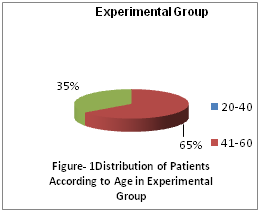
Experimental Group
60% 40% Figure-2 Distribution of Patients According to Age in Experimental Group
Figures 1 & 2: Distribution of Patients According to Age in Experimental Group.
| Characteristics | Control Group N = 20 | Experimental Group N = 20 | |||
|---|---|---|---|---|---|
| Frequency | % | Frequency | % | ||
| 1. | Record of BP (previous month record) | ||||
| 1. | a) 140-150/90-100 | 11 | 55 | 10 | 50 |
| 1. | b) 151-160/101-110 | 9 | 45 | 10 | 50 |
| 2. | Height in cm | ||||
| 2. | a) 145-150 | 6 | 30 | 3 | 15 |
| 2. | b) 151-155 | 12 | 60 | 11 | 55 |
| 3. | Weight in kg | ||||
| 3. | a) 35-45 | - | - | - | - |
| 3. | b) 46-55 | 8 | 40 | 10 | 50 |
| 4. | Body mass index | ||||
| 4. | a) >18 | - | - | - | - |
| 4. | b) 18-25 | 11 | 55 | 10 | 50 |
| 5. | Habit of Alcohol consumption(male alone) | ||||
| 5. | a) Yes | - | - | - | - |
| 5. | b) No | 8 | 100 | 12 | 100 |
| 6. | Habit of smoking (male alone) | ||||
| 6. | a) Yes | 1 | 12.5 | 2 | 10 |
| 7. | Intake of Medication | ||||
| 7. | a) Antihypertensive | 8 | 40 | 8 | 40 |
| 7. | b) Diuretics | - | - | - | - |
| 8. | Intake of contraceptive pills (female alone) | ||||
| 8. | a) Yes | - | - | - | - |
| 8. | b) No | 12 | 100 | 8 | 100 |
Table 2: Frequency and Percentage Distribution of samples with clinical variables.
| S. No. | Group | N | Mean | S.D | t' value | Level of significance |
| Systolic blood pressure | 0.742 | N.S. | ||||
| 1 | 0.742 | N.S. | Control Group | 20 | 141.35 | 7.541 |
| 2 | 0.742 | N.S. | Experimental Group | 20 | 142.7 | 3.0625 |
| Diastolic blood pressure | 0.71 | N.S. | ||||
| 1 | 0.71 | N.S. | Control Group | 20 | 92.1 | 2.198 |
| 2 | 0.71 | N.S. | Experimental Group | 20 | 93.9 | 1.9973 |
| Pulse | 0 | N.S. | ||||
| 1 | 0 | N.S. | Control Group | 20 | 88.9 | 2.6938 |
| 2 | 0 | N.S. | Experimental Group | 20 | 88.9 | 2.6938 |
| Mean Arterial Pressure | 0 | N.S. | ||||
|---|---|---|---|---|---|---|
| 1 | Control Group | 20 | 110.103 | 2.3323 | ||
| 2 | Experimental Group | 20 | 110.103 | 2.3323 |
Table 4: Description of the Pretest Measures of Haemodynamic Variables in the Control and Experimental group.
| Systolic BP Measurement | N | Mean | S.D | t' value | Level of significance |
| Pre test | 20 | 142.7 | 3.0625 | 18.42 | 0.01 |
| Post test | 20 | 125.15 | 4.9126 | 18.42 | 0.01 |
| Diastolic BP Measurement | N | Mean | S.D | t' value | Level of significance |
| Pre test | 20 | 142.07 | 3.0625 | 8.559 | 0.01 |
| Post test | 20 | 82.25 | 2.6532 | 8.559 | 0.01 |
| Pulse Measurement | N | Mean | S.D | ‘t’ value | Level of significance |
| Pre test | 20 | 88.9 | 2.6938 | 14.394 | 0.01 |
| Post test | 20 | 79.86 | 2.2110 | 14.394 | 0.01 |
| MAP Measurement | N | Mean | S.D | t' value | Level of significance |
| Pre test | 20 | 110.1030 | 2.3323 | 14.934 | 0.01 |
| Post test | 20 | 97.79 | 4.3488 | 14.934 | 0.01 |
Psychological well being
Pre test 20 27.20 3.8058 35.639 0.01 Post test 20 61.25 3.670
score N Mean S.D ‘t’ value Level of significance Table 4: Description of the pretest and posttest measures of haemodynamic variables in experimental group
| S.No. | Group | N | Mean | S.D | ‘t’ value | Level of significance |
| 1. | Systolic BP Control Group | 20 | 140.5 | 8.7268 | 6.855 | 0.01 |
| 2. | Experimental Group | 20 | 125.15 | 4.9126 | 6.855 | 0.01 |
Table 9: Description of the pretest and posttest measures of haemodynamic variables in experimental group
| S.No. | Group | N | Mean | S.D | ‘t’ value | Level of significance |
| 1. | Diastolic BP Control Group | 20 | 91.50 | 3.2363 | 9.885 | 0.01 |
| 2. | Experimental Group | 20 | 82.25 | 2.6532 | 9.885 | 0.01 |
| S.No. | Group | N | Mean | S.D | ‘t’ value | Level of significance |
| 1. | Pulse Control Group | 20 | 87.86 | 3.7953 | 8.145 | 0.01 |
| 2. | Experimental Group | 20 | 79.86 | 2.2110 | 8.145 | 0.01 |
| S.No. | Group | N | Mean | S.D | ‘t’ value | Level of significance |
| 1. | MAP Control Group | 20 | 108.33 | 2.1172 | 9.742 | 0.01 |
| 2. | Experimental Group | 20 | 97.79 | 4.3488 | 9.742 | 0.01 |
| Characteristics | Systolic BP | Diastolic BP | |||||||
| Age (in years) | N | Mean | S.D | ‘t’ value | N | Mean | S.D | ‘t’ value | Level of significance |
| 41-60 | 6 | 124.66 | 5.853 | 0.395 | 6 | 82.33 | 3.829 | 0.608 | NS |
| above 60 | 14 | 126.142 | 4.588 | 0.395 | 14 | 82.85 | 2.143 | 0.608 | NS |
Table 12: Association between posttest measures of systolic and diastolic B.P in different age group in experimental group.
| Characteristics | N | Mean | S.D | ‘t’ value | Level of significance | ||||
| Age (in years) | |||||||||
| 41-60 | 6 | 60.833 | 2.994 | 0.390 | NS | ||||
| above 60 | 14 | 61.571 | 4.164 | NS | |||||
| Characteristics | Systolic BP | Diastolic BP | |||||||
| Sex | N | Mean | S.D | ‘t’ value | N | Mean | S.D | ‘t’ value | Level of significance |
| Male | 8 | 122.75 | 4.399 | 2.485 | 8 | 80.75 | 1.488 | 3.306 | NS |
| Female | 12 | 127.66 | 4.292 | 2.485 | 12 | 84.00 | 2.486 | 3.306 | NS |
Table 13: Association between posttest measures of psychological well-being in different age group in experimental group.
| Characteristics | N | Mean | S.D | ‘t’ value | Level of significance |
| Sex | N | Mean | S.D | ‘t’ value | Level of significance |
| Male | 8 | 59.25 | 3.240 | 2.178 | N.S. |
| Female | 12 | 62.58 | 3.423 | 2.178 | N.S. |
Table 14: Association between posttest scores of psychological well-being in different gender in experimental group.
| Characteristics | Systolic BP | Diastolic BP | |||||||
| Body mass Index | N | Mean | S.D | ‘t’ value | N | Mean | S.D | ‘t’ value | Level of significance |
| 18-25 | 10 | 127.2 | 4.211 | 1.407 | 10 | 82.8 | 2.485 | 0.164 | NS |
| <25 | 10 | 124.2 | 5.266 | 1.407 | 10 | 82.6 | 2.951 | 0.164 | NS |
Table 15: Association between posttest measure of systolic and diastolic BP in different BMI in experimental group.
Discussion
The first objective was to assess the selected haemodynamic variables of patients with hypertension before and after laughter yoga. The mean score of pretest and posttest mean arterial pressure in control group was 110.13, 108.33 and 110.13, 97.79 respectively in experimental group. The second objective of the study was to compare the selected haemodynamic variables of hypertensive patients who receive laugh therapy with those who do not receive laugh therapy. In the present study the ‘t’ value for the mean difference in the post test scores of systolic blood pressure, diastolic blood pressure, pulse and MAP in control and experimental group are 6.885, 9.885, 14.8 and 9.742 respectively at (p<0.01) which is highly significant. These findings are attributed to the effect of laugh therapy. The above finding strongly implies that laugh therapy is effective in lowering blood pressure pulse and mean arterial pressure.
- The third objectives of the study were to compare the changes in psychological well-being of hypertensive patients who receive laugh therapy with those who do not receive laugh therapy. The mean post test score of psychological well being was 26.20 and 61.25 in control and experimental group. The ‘t’ test analysis showed higher level of significance as the ‘t’ value was 21.80 at (p<0.01). The mean pre test and post test score of psychological well being in experimental group was 27.20 and 61.25. The obtained ‘t’ value was 35.639 at (p<0.01) which was highly significant. The statistical evidence of the study can be strongly attributed to the effect of laugh therapy. Thus the finding implies that laugh therapy is effective in improving the psychological well being of the subjects.
- The fourth objective is to find out the association between selected demographic variable with changes in haemodynamic variables and psychological well being in the experimental group. The present study revealed that age; sex BMI had no significant influence in the haemodynamic variables and psychological well being [9, 10, 11, 12, 13].
Conclusion
Bittman neurologist, cites research which found that laughter can diminish levels of cortisol, stress hormone that are responsible for triggering elevated blood pressure, heart rate and a host of other stress related responses.. The study findings also provide the statistical evidence which clearly indicates that laugh therapy is one of the best alternative therapies used to lower blood pressure and improve the psychological well-being of hypertensive patients. Blood pressure, pulse and mean arterial pressure were significantly reduced among patients those who received laugh therapy.
References
-
Adams P (2002) Humour and love: the origination of clown therapy. Post graduate Medical Journal 78(922): 447-448.
-
Lally Steven (1991) Laugh away your stress. Prevention 78(2): 50-52.
-
Kalavathy MC, Thankappan KR, Sarma PS, Vasan RS (2000) Prevalence, awareness, treatment and control of hypertension in an elderly community based sample in Kerala, India. National Medical Journal of India 13(1): 9-15.
-
Matthews KA, Katholi CR, McCreath H, Whooley MA, Williams DR, et al. (2004) Blood pressure Reactivity to Psychological stress predicts Hypertension in the CARDIA study. Circulation 110(1): 74-8.
-
Hanson L (1993) Future goals for the treatment of Hypertension in the elderly with reference to stop hypertension. Am J Hypertens 6(3 Pt 2): 40S-43S.
-
Badoux A, Chiche J, Duchanel D, Raveau F (1994) Evaluation of well being of hypertensive subjects before and after treatment. Presse Med 23(2): 69-72.
-
Berk LS, Felten DL, Tan SA, Bittman BB, Westengard J (2001) Modulation of neuroimmone parameters, during the eustress of Humour- associated mirthful laughter. Alternative Therapy Health Medicine 7(2): 62-76.
-
Adame E, Mc Guire F (1986) Is laughter the best medicine?- A study effects of humour on perceived pain and affect. Activities, Adaptation & Aging 8(3): 157-175.
-
Chobanian AV, Bakris GL, Black HR, Cushman WC, Green LA, et al. (2003) The seventh report of the joint committee on prevention, detection, evaluation, and treatment of high blood pressure, the JNC report. Journal of American Medical Association 289(19): 2560-2572.
-
Michael Miller (2000) Laughter is good for your heart-According to University of Maryland Medical Center Study. News- Archieves, pp: 11-15.
-
Moum T, Naess S, Sorenson T, Tambs K, Holmen J (2004) Labeling life events and psychological well being. Psychological Medicine 20(3): 635-646.
-
Martin RA, Kuiper NA, Olinger LJ, Dance KA (1993) Humour, coping with stress, self concept and psychological well being. Humour: International Journal of Humour Research 6(1): 89-104.
-
Wooten P (1996) Humour: an antidote for stress. Holistic Nurs Pract 10(2): 49-56.
- Anomalous Origin of the Left Coronary System from the Right Coronary Cusp: A Rare Coronary Anomaly in a Patient Undergoing Aortic Stenosis Workup
- Optimizing the Therapeutic Potential of Sacubitril/Valsartan: The Promise of Co-Crystal Engineering
- Association between Mortality and Topography of Peripheral Arterial Disease due to Atherosclerosis Obliterans
- Mitral Valve Replacement vs Mitral Valve Repair
- Characteristics and Evolution of Patients with Heart Failure Hospitalized in the Cardiology Department of Dalal Jamm Hospital
- Distribution of Association between Basic Knowledge of Chest Pain and Myocardial Infarction (Heart Attack) and Demographic Variables: A Survey-Based Study