
SKP1-Cullin1-F-Box Complex in Chronic Inflammation-Associated Tumorigenesis
In SKP1 cullin 1 F-box protein (SCF) E3 ligase complexes, F-box proteins are main subunits responsible for substrate-recognition. F-boxes play vital roles in several cellular processes through ubiquitylation and consequent degradation of target proteins. Due to dysregulation of F-box protein-mediated proteolysis, it leads to many diseases. In this review, we give the important roles of F-box proteins and its family members in the regulation of many cellular activities.
Chronic Inflammation Vs Acute Inflammation
Numerous data are available that supports the results that chronic inflammation can lead to cancer [1, 2]. Inflammation is of two types Acute inflammatory condition and Chronic inflammatory condition [3], Acute inflammatory condition is a physiological process of body’s defensive response, it is also sometimes referred as “therapeutic inflammation” which shows anticancer properties. However, inflammation that is long-lasting can often lead to the neoplastic conditions, this is second type of inflammation known as “Chronic inflammation” [3] which often leads to stimulation of cancer growth [4], due to recent advent of molecular biology, cell signalling pathway, recombinant DNA technology, proteomic and genomics, there has been rebirth and incredible interest in the role of inflammation in cancer and other associated diseases, Also chronic inflammatory states allied with infection and irritation leads to create favourable environment that foster tumour initiation [5]. The key link between tumorigenesis and chronic inflammation is still unclear. Studies by Chang et al. have showed that UPS (ubiquitin-proteasome system)- relatedproteins [6, 7] may participate at the croseeroad between chronic inflammation and pro- tumourigenesis. For example, the anti-apoptotic factor SAG (Sensitive-to-apoptosis gene) encourages the promotion of cancer growth by its Cullin-RING E3 ubiquitin ligase activity via manipulating the balance between anti- and pro-apoptotic factors.
F-box proteins and its classification
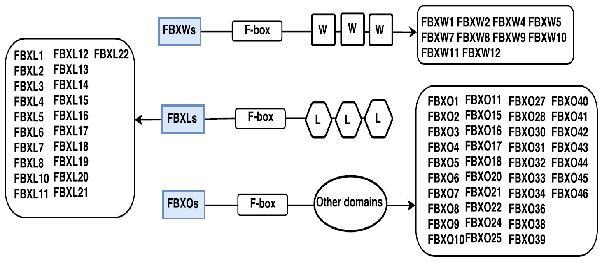
CRLs (Cullin-RING E3 ubiquitin Ligases) constitute the largest family of E3 ligases and play substantial roles in various physiological and pathological practices including tumorigenesis [8, 9]. The SCF (SKP1-Cullin1-F- Box protein, also known as CRL1) ubiquitin ligase is the best-described member of this family of E3 ligases. SKP1 interacts with a number of proteins collectively called F-box proteins, which selectively recognize and recruit the substrate proteins for poly-ubiquitylation by the E2 enzymes. In mammalian cells, the SCF ligase allies with 69 unique substrate receptors, together they are known as F- box proteins [10, 11, 12]. SCF ligases are best known for their roles in the regulation of cellular proliferation, apoptosis and differentiation. F-box proteins play a major role in substrate-recognition subunits of SCF (SKP1– cullin 1– F box protein) E3 ligase complexes, these proteins fell into three major classes on the basis of presence of specific domains for substrate recognition [13, 14], where two major classes include WD40 repeats and leucine- rich repeats, and the third common class of F-box proteins contained various other types of protein interaction domains or no recognizable domains. These classes of F- box proteins represented as FBWs, FBLs, and FBXs, respectively [15], followed by a number as an identifier (Figure 1) [16]. Some studies give clues that due to dysregulation of the expression of these proteins can cause a large number of human malignancies [17, 18], suggesting an important part in the development or progression of these cancers [19]. However, further studies are needed to explore detailed mechanisms between F-boxes network and cancer progression.
FBXL8 and CCNF
FBXL8 (it is Leucine Rich Repeat Protein 8) is a Protein Coding gene the pathways that are related to FBXL8 are Innate Immune System and MHC Class I mediated antigen processing and presentation. CCNF (Cyclin F) is also a Protein Coding gene. Interestingly, FBXL8 and CCNF are involved in similar/shared mechnistic pathways, e.g. both are related to antigen processing-ubiquitination and proteasome degradation, adaptive immune system pathway in Class I MHC mediated antigen processing and presentation etc,. Furthermore, FBXL8 encodes for cyclin family. Cyclins regulates the cell cycle transitions by binding and activating cyclin-dependent protein kinases.
Discussion and Conclusion
It is known that ubiquitin-proteasome system is invloved in several human cancers and F-box plays key component which responsible for the specificity of tetrameric SCF E3 ligase. However, current studies are limited to mainly four F-box proteins including, FBXW7, SKP2, β‑TRCP1 and β‑TRCP2 that has been studied extensively out of 69 F-box proteins. Rest of 65 members are given very less attention, their roles still need to be explored. Worth to note that SKP2 inhibitors are beginning to show their therapeutics potential in breast cancer treatment [20], By delinate the network between F-boxes and the corresponding receptors, and further targeted down steam signalling will help to understand their potential in UPS-associated diseases, e.g. chronic- inflammation associated cancers. Their physiological roles could be further explored to elucidate the molecular mechanisms by which they regulate breast cancer formation and metastasis. Clearly, it is just beginning to understand the complexity that is underlying in deregulated proteolysis by E3 ubiquitin ligases and its relation to cancer, and discovery of novel and broad methods that are needed to address the present challenges in cancer therapy Acknowledgement: This work was supported by a grant from the Ministry of Science and Technology, Taiwan (MOST105-2320-B-038-007-MY2); and Taipei Medical University, Taiwan (TMU104-AE1- B10 and 105TMU-TMUH-06).
References
-
Chang SC, Choo WQW, Toh HC, Ding JL (2015) SAG- UPS attenuates proapoptotic SARM and Noxa to confer survival advantage to early hepatocellular carcinoma. Cell Death Discov 1: 15032.
-
Chang SC, Ding JL (2015) SAG-UPS regulates malignant transformation-from chronic inflammation to pro-tumorigenesis to liver cancer. Cell Death Dis 6(10): e1941.
-
Korniluk A, Koper O, Kemona H, Dymicka-Piekarska V (1971) From inflammation to cancer. Irish Journal of Medical Science 186(1): 57-62.
-
Salem ML, Attia ZI, Galal SM (2016) Acute inflammation induces immunomodulatory effects on myeloid cells associated with anti-tumor responses in a tumor mouse model. J Adv Res 7(2): 243-253.
-
Momi N, Kaur S, Krishn SR, Batra SK (2012) Discovering the route from inflammation to pancreatic cancer. Minerva Gastroenterol Dietol 58(4): 283-297.
-
Chang SC, Ding JL (2014) Ubiquitination by SAG regulates macrophage survival/death and immune response during infection. Cell Death and Differentiation 21(9): 1388-1398.
-
Yang Y, Kitagaki J, Wang H, Hou D, Perantoni AO, et al. (2009) Targeting the ubiquitin-proteasome system for cancer therapy. Cancer Sci 100(1): 24-28.
-
Bosu DR, Kipreos ET (2008) Cullin-RING ubiquitin ligases: global regulation and activation cycles. Cell Division 3(1): 7.
-
Petroski MD, Deshaies RJ (2005) Function and regulation of cullin-RING ubiquitin ligases. Nat Rev Mol Cell Biol 6(1): 9-20.
-
Kipreos ET, Pagano M (2000) The F-box protein family. Genome Biology 1(5): reviews3002.
-
Cardozo T, Pagano M (2004) The SCF ubiquitin ligase: insights into a molecular machine. Nat Rev Mol Cell Biol 5(9): 739-751.
-
Skaar JR, Pagan JK, Pagano M (2013) Mechanisms and function of substrate recruitment by F-box proteins. Nat Rev Mol Cell Biol 14(6): 369-381.
-
Cenciarelli C, Chiaur DS, Guardavaccaro D, Parks W, Vidal M, et al. (1999) Identification of a family of human F-box proteins. Curr Biol 9(20): 1177-1179.
-
Winston JT, Koepp DM, Zhu C, Elledge SJ, Harper JW (1999) A family of mammalian F-box proteins. Curr Biol 9(20): 1180-1182.
-
Jin J, Cardozo T, Lovering RC, Elledge SJ, Pagano M, et al. (2004) Systematic analysis and nomenclature of mammalian F-box proteins. Genes & Dev 18(21): 2573-2580.
-
Skaar JR, Pagan JK, M Pagano (2014) SCF ubiquitin ligase-targeted therapies. Nat Rev Drug Discov 13(12): 889-903.
-
Heo J, Eki R, Abbas T (2016) Deregulation of F- box proteins and its consequence on cancer development, progression and metastasis. Semin Cancer Biol 36: 33-51.
-
Randle SJ, Laman H (2016) F-box protein interactions with the hallmark pathways in cancer. Seminars in Cancer Biology 36: 3-17.
-
Heo J, Eki R, Abbas T (2016) Deregulation of F- box proteins and its consequence on cancer development, progression and metastasis. Semin Cancer Biol 36: 33-51.
-
Wang Z, Fukushima H, Inuzuka H, Wan L, Liu P, et al. (2012) Skp2 is a promising therapeutic target in breast cancer. Front Oncol 1(57): 18702.
- Cancer Diagnosis from RNA Sequence of Blood Cells by Using AI
- Field Cancerization in Oral Cavity, Case Report and Review of Literature. Oncologic Program Salud Integral Hospital, Managua, Nicaragua
- Identification of B Lymphocytes in Cancer Patient’s Blood
- A Case Report of a Breast Cancer Patient Developing Pneumonitis as a Result of Abemaciclib Therapy
- Immune Checkpoint Therapeutics for Today’s Fight and Beyond
- The Amalgamated Sophomore-Gonadoblastoma