
Beta Fulltext view is in preview — article structure may vary. Browse all articles
Contents
Open Access Journal of Cancer & Oncology Research Article 2 min read

On the Dichotomous Aspect of Cancer Stem Cell

Hugwil AV
ISSN: 2578-4625  10.23880/oajco-16000123  Received: March 29, 2018  Published: April 09, 2018
  views
 16 references
 1 figure
PDF
Keywords
Dichotomous Stem Cell Soncogenic Vimentin 14-3-3 EMT/MET Prions Pritumumab

Figures
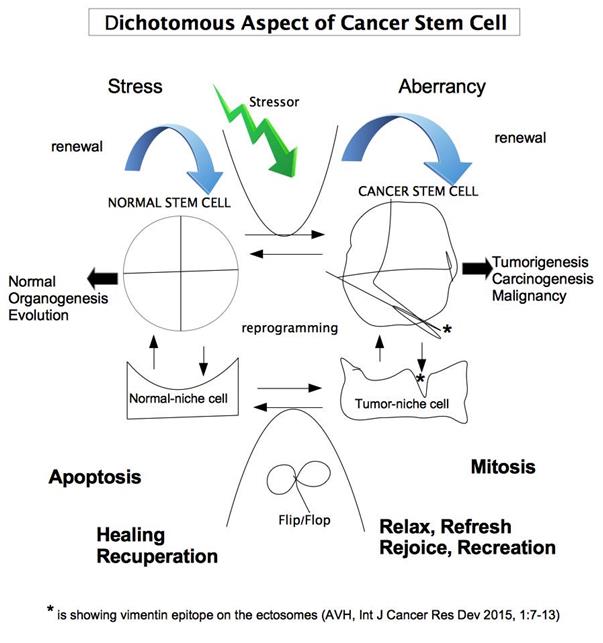
Figure 1: Cancer stem cells are etiologic cells possessing malignant traits e.g. metastasis, invasion and apoptosis resistance. These tumor traits are converted by aberrant altered- vimentin which is the crucial marker of the epithelial- mesenchymal-transition (EMT) of the CSC. During metastasis the reverse transition called the mesenchymal- epithelial-transition (MET) is necessary in order for the circulating tumor cells to colonize the metastasized niche. Reprogramming EMT to MET would be an accomplishment that could lead to cancer recuperation. I have tried to delineate the intervention between Pritumumab and psychological effects on the regulation of tumor growth based on DACSC via the PPIN of TA34 and vimentin. There are two inextricable phases in one state--- dichotomous aspect of cancer stem cell (DACSC) development. Cancer stem cells (CSC) are initiated to grow from normal stem cells (NSC). CSC and NSC are reciprocally participating in EMT/MET when CSCs provoke malignant traits such as metastasis, invasion and anti-apoptosis. Under severe stress, NSC tends to be altered and carcinogenesis during their renewal, which is greatly, influenced by the spatiotemporal architecture of stem cells and their niche cells. Conversely CSC may revert to NSC by losing their carcinogenicity and become susceptible to regular apoptosis from normalized niche, which is implemented by an appropriate condition created by immune surveillance and the autonomous mechanisms for tissue repair which is affected by mental condition in relaxation-transcendency. NSC ordinarily renews for evolutionary adaptation. Simultaneously the state of CSC can adapt to tumor niche created by chronic inflammation and defiance of regular apoptosis. Defective cells that fail the survival game are eliminated by neuro- immune surveillance system, which also initiates the mobilization of stem cells to repair the tissue-gaps epigenetical chromatin assembly/disassembly. Two co- existing phases may frequently be competing at the threshold of carcinogenesis.
Click to enlarge
Figure 1: Cancer stem cells are etiologic cells possessing malignant traits e.g. metastasis, invasion and apoptosis resistance. These tumor traits are converted by aberrant altered- vimentin which is the crucial marker of the epithelial- mesenchymal-transition (EMT) of the CSC. During metastasis the reverse transition called the mesenchymal- epithelial-transition (MET) is necessary in order for the circulating tumor cells to colonize the metastasized niche. Reprogramming EMT to MET would be an accomplishment that could lead to cancer recuperation. I have tried to delineate the intervention between Pritumumab and psychological effects on the regulation of tumor growth based on DACSC via the PPIN of TA34 and vimentin. There are two inextricable phases in one state--- dichotomous aspect of cancer stem cell (DACSC) development. Cancer stem cells (CSC) are initiated to grow from normal stem cells (NSC). CSC and NSC are reciprocally participating in EMT/MET when CSCs provoke malignant traits such as metastasis, invasion and anti-apoptosis. Under severe stress, NSC tends to be altered and carcinogenesis during their renewal, which is greatly, influenced by the spatiotemporal architecture of stem cells and their niche cells. Conversely CSC may revert to NSC by losing their carcinogenicity and become susceptible to regular apoptosis from normalized niche, which is implemented by an appropriate condition created by immune surveillance and the autonomous mechanisms for tissue repair which is affected by mental condition in relaxation-transcendency. NSC ordinarily renews for evolutionary adaptation. Simultaneously the state of CSC can adapt to tumor niche created by chronic inflammation and defiance of regular apoptosis. Defective cells that fail the survival game are eliminated by neuro- immune surveillance system, which also initiates the mobilization of stem cells to repair the tissue-gaps epigenetical chromatin assembly/disassembly. Two co- existing phases may frequently be competing at the threshold of carcinogenesis.

References

  1. Glassy MC, Hagiwara H (2009) Summary analysis of the pre-clinical and clinical results of brain tumor patients treated with pritumumab. Human Antibodies 18(4): 127-137.
  2. Hagiwara H, Aotsuka Y, Yamamoto Y, Miyahara J, Mitoh Y (2001) Determination of the antigen/epitope that is recognized by human monoclonal antibody CLN-IgG. Hum Antibodies 10(2): 77-82.
  3. Hugwil AV, Glassy MC (2017) Idiotypic antibody network regarding malignant cell regression in the brain tumor patients treated with the natural human monoclonal antibody, pritumumab. Integ Cancer Biol Res 1: 003.
  4. Hugwil AV (2013) The meaning of the anti-cancer antibody CLN-IgG (Pritumumab) generated by human x human hybridoma technology against the cyto- skeletal protein, vimentin, in the course of the treatment of malignancy. Med Hypotheses 81(3): 489-495.
  5. Lee YS, Lee JK, Bae Y, Lee BS, Kim E, et al. (2016) Suppression of 14-3-3γ-mediated surface expression of ANO1 inhibits cancer progression of glioblastoma cells. Sci Reps 6: 26413.
  6. Yang HY, Wen YY, Chen CH, Lozano G, Lee MH (2003) 14-3-3σ positively regulates p53 and suppresses tumor growth. Mol Cell Biol 23(20): 7096-7107.
  7. Liu TA, Jan YJ, Ko BS, Liang SM, Chen SC, et al. (2013) 14-3-3ε overexpression contributes to epithelial- mesenchymal transition of hepatocellular carcinoma. PLoS ONE 8(3): e57968.
  8. Osttrerova N, Petrucelli L, Farrer M, Mehta N, Choi P, et al. (1999) α-Synuclein shares physical and functional homology with 14-3-3 proteins. J Neurosci 19(14): 5782-5791.
  9. Hugwil AV (2015) Antigenicity of the tumor- associated antigen vimentin epitope on ectosomes of brain tumor cell. Int J Cancer Res Dev 1(1): 7-13.
  10. Zhang CC, Steele AD, Lindquist S, Lodish HF (2006) Prion protein is expressed on long-term repopulating hematopoietic stem cells and is important for their self-renewal. Proc Natl Acad Sci USA 103(7): 2184- 2189.
  11. Gawlik-Rzemieniewska N, Bednarek I (2016) The role of NANOG transcriptional factor in the development of malignant phenotype of cancer cells. Cancer Biol Ther 17(1): 1-10.
  12. Higashi M, Maruta N, Berstein A, Ikenaka K, Hitoshi S (2008) Mood stabilizer drugs expand the neural stem cell pool in the adult brain through activation of Notch signaling. Stem Cells 26(7): 1758-1767.
  13. Tanaka S, Shiraha H, Nakanishi Y, Shin‐Ichi Nishina, Minoru Matsubara, et al. (2012) Runt-related transcription factors reverse epithelial-mesenchymal transition in hepatocellular carcinoma. Int J Cancer 131(11): 2537-2546.
  14. Liu Z, Chen L, Zhang X, Xu X, Xing H, et al. (2014) RUNX3 regulates vimentin expression via miR-30a during epithelial-mesenchymal transition in gastric cancer cells. J Cell Mol Med 18(4): 610-623.
  15. Song W, Teng W, Shi X, Liu X, Cui Z, et al. (2017) The relationship between RUNTX3 expression, nursing strategies and nutritional status in elderly patients with advanced gastric cancer. Iran J Public Health 46(6): 762-770.
  16. Mittal S, Bjarnevik K, Im DS, Flierl A, Dong X, et al. (2017) β2-adrenoreceptor is a regulator of the α- synuclein gene during risk of Parkinson's disease. Science 357(6354): 891-898.

Cite this article

BibTeX
APA
RIS
@article{hugwil2018,
  title   = {On the Dichotomous Aspect of Cancer Stem Cell},
  author  = {Hugwil AV},
  journal = {Open Access Journal of Cancer & Oncology},
  year    = {2018},
  volume  = {2},
  number  = {2},
  doi     = {10.23880/oajco-16000123}
}
Hugwil AV (2018). On the Dichotomous Aspect of Cancer Stem Cell. Open Access Journal of Cancer & Oncology, 2(2). https://doi.org/10.23880/oajco-16000123
TY  - JOUR
TI  - On the Dichotomous Aspect of Cancer Stem Cell
AU  - Hugwil AV
JO  - Open Access Journal of Cancer & Oncology
PY  - 2018
VL  - 2
IS  - 2
DO  - 10.23880/oajco-16000123
ER  -