
Effect of Opuntia joconostle Fraction Rich in Flavonoids on Pulmonary Adenocarcinoma Cells A549
In Mexico, the use of plants has been traditionally used as an alternative treatment for various diseases, the Opuntia joconostle (xoconstle) has presented in several studies antioxidant activity, cytotoxic in cancer cells, hypoglycemic action and this because it is a very nutrient-rich fruit. The objective of this work was to evaluate the cytotoxic effect of the extract fraction of Opuntia joconostle on lung carcinoma cell line A459. The ethanolic extract of Opuntia joconostle was obtained by maceration, and then it was made preliminary phytochemical tests given positive for, alkaloids, coumarins, flavonoids, reducing sugars and phenolic compounds. Subsequently, the chemical compounds were separated by column chromatography and preparative thin layer chromatography, which fraction 8-14 was obtained. To evaluate the cytotoxic effect of the fraction on viability was evaluated in the A549 cell line. The results of the fraction presented diminishing of cell viability up to 99.9 % in lung carcinoma cells.
Silva Torres R*, Sequeda Júarez AA and Ramón-Gallegos E
Escuela Nacional de Ciencias Biológicas, Instituto Politécnico Nacional, México
Antitumorales, Escuela Nacional de Ciencias Biológicas (ENCB), Zacatenco del Instituto Politécnico Nacional (IPN), Av. Wilfrido Massieu s/n Unidad Profesional rafaelsilvatorres@hotmail.com cell viability up to 99.9 % in lung carcinoma cells.
Keywords: Opuntia joconostle; Lung cancer; Mexican Medicinal Plants
Introduction
There is a great diversity of flora and fauna species in Mexico that remain to be studied. One example is Opuntia joconostle (xoconostle). Also, since lung cancer is a disease with high incidence rate mortality and represents the third leading cause of death in the world. The number of results in basic research that used compounds of plant origin has increased and alternative therapies have been proposed aimed at cancer chemoprevention [1]. Because Investigation Paper of this, our purpose was to study a possible effect on viability. An ethanolic extract from the fruit was prepared and its chemical composition showed several secondary metabolites [2]. Our study includes the fraction obtained from Opuntia joconostle tested for treatments to the A549 cells. Therefore, there is a great interest in developing new treatments for chemotherapy or chemoprotection based in plants [3].
Methods
The fruit Opuntia joconostle (xoconostle) was collected from Otumba State of Mexico in February of 1917 and identified by a specialist of the Escuela Nacional de Ciencias Biológicas of Instituto Politecnico Nacional.
The fresh fruit (3 Kg) was fragmented and extracted with 96° ethanol at room temperature for 10 days, later the solvent was removed by reduced pressure at 40 ºC, in this way we obtained the crude extract.
The secondary metabolites of the crude extract were identified by phytochemical tests whit reagents for flavonoids, Shinoda reagent and ferric hydroxide, the tannins by jelly reagent, the alkaloids by Dragendorff, Mayer and Silicotugtic reagents, the sugars by ferric hydroxamate reagent, the cumarins by Erlich reagent and quinones by ammonium hydroxide reagent [4].
The crude extract of Opuntia joconostle was submitted to column chromatography over silica gel (Merck) using methanol-acetone 80-20 % as eluent (movil Phase). The obtained fraction 8-14 were analyzed by preparative thin layer chromatography on silica gel 60 F257 plates (Merck) silica gel plates (150 µm), using methanol-acetone 60- 40% as mobile phase and U V as revealing light in this way, we purified fraction 8-14 (1.04 g).
All reagents and solvents used were of analytical grade and were purchased from Sigma Aldrich Co. (St. Louis,Mo, USA) and Merck KGaA (Darmstad, Germany).
Cytotoxic Activity of the Fraction
Cell culture: Lung carcinoma cell line A549 was cultured in Dulbecco's Minimum Essential Medium (DMEM) containing 10 % fetal bovine serum (FBS) and 1 % penicillin/streptomycin. Cells were cultured as adherent monolayers and maintained at 37 °C in a humidified atmosphere of 5 % CO2.
Cell Exposition to Fractions of O. Joconostle
Cells were exposed to extract of O. Joconostle to 2.5, 5, 10, 20 and 40 mg/mL. Cell viability assay: Cell viability was determinate by MTT (3-[4,5-dimethylthiazol-2-yl]-2,5-iphenyltetrazolium bromide) assay [5]. Cells were harvested, counted and transferred to 96 well plates at 5,000 cells per well and incubated for 24 hours; then they were exposed to fraction of O. Joconostle and cells without exposition were used as viability control. Cells were incubated for 24 h again. In each well were added 50 μL of MTT (100 μg/μL) dissolved in culture media and the well plates were incubated at 37 °C for 4 h. Culture media was removed and 100 μL of isopropanol (pH 3) was added to each well. Optical density in each well was measured using ELISA microplate reader at 595 nm. Results were expressed as viability percentage with respect to control viability cells [6].
Results
The phytochemical analysis of the crude extract showed the presence of flavonoids, alkaloids, coumarins, sugars and flavonoids were the major constituents. A brown residue was obtained from the fraction 8-14 (yielded 0.033%) and the main constituents were flavonoids. The presence of the flavonoids was evident by the phytochemical preliminary tests.
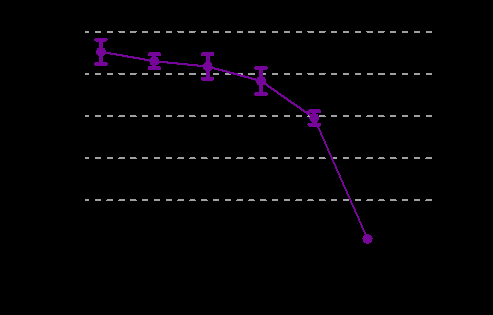
Extract of O. Joconostle showed significant inhibition of cell proliferation in cells exposed in a higher concentration than 20 mg/mL. Cells exposed to the highest concentration (40 mg/mL) showed a diminishing of cell viability up to 99.9 % (Figure 1).
Discussion
In the present study was aimed to evaluate the flavonoids content and asses the cytotoxicity in vitro lung cancer cell line A549. The phytochemical analysis showed that the main constituents of this fruit are flavonoids which are according to the reported composition of this genius [2, 6, 7, 8].
The cactus has been used for the alternative treatment of diabetes Mellitus, also has been demonstrated consortium decrease the cholesterol, serum triglycerides in healthy people and contain a significative amount of antioxidants, betaines, mainly betaine isobetaine, betanidin, and betaxanthins [9]. It was reported that Xoconostle is a source of several phytochemical compounds like fiber, phenolics, flavonoids, PUFAs and seeds that present a bioactive properties like antioxidants [10].
Among different kinds of Cancer, lung cancer is one of the most important cancer in incidence and mortality around the world [11]. Conventional treatment of lung cancer is often unsatisfactory due to cytotoxicity to normal cells and diverse adverse effects. Natural products play a tumor inhibition though different mechanism, including scavenging free radicals, inhibition of angiogenesis, apoptosis induction, prevention of cells propagation, regulation of the cell cycle, epigenetic modification and DNA repaim. Flavonoids had shown a significant growth inhibition and tumor suppression in vivo and in vitro through inhibition of growth factors in cancer cells and may be useful in cancer chemoprevention [1].
A workgroup showed that numerous plants from mangroves have potential cancer properties and between these showed activity in the inhibition of lung cancer and lung metastasis. Terminalia capatta showed a significant inhibition of proliferation and metastasis in the A549 lung cancer cell line [12]. The cytotoxicity and antimicrobial properties have been probed in Mexican medicinal plants like Guazuma ulmifolia, Justicia spicigera, Opuntia joconostle, O. leucotricha, Parkinsoniaaculeata, Phoradendron longifolium, P. serotinum, Psittacanthus calyculatus, Tecoma stans and Teucrium cubense [13]. In the present study the crude extract of Opuntia joconostle exposed to A549 cells showed a significant cytotoxicity up to 99.9 % in this lung cancer cell line. Use of natural bioactive compounds could better the current treatments for lung cancer and others.
Funding
This study was financed by Secretaría de Investigación y Posgrado, Instituto Politécnico Nacional (Mexico City) through project Determination of the cytotoxic effect of different fractions of the ethnolic extract of Opuntia joconostle in cancer, cervical and breast cancer cell lines. SIP registration 20180522.
References
-
Di Z, Gang C, Jian W, Ning L (2017). Natural Cancer Chemopreventive Reagents from Food and Herbals. Current Pharmacology Reports 3(3): 138-149.
-
Cortez-García RM, Ortiz-Moreno A, Zepeda-Vallejo LG, Necoechea-Mondragón H (2015) Effects of Cooking Methods on Phenolic Compounds in Xoconostle (Opuntia joconostle). Plant Foods Hum Nutr 70(1): 85-90.
-
Milner JA (2002) Strategies for cancer prevention: the role of diet 87(2): 265-272.
-
Domínguez XA (1973) Métodos de investigación fitoquímica. Limusa, Ciudad de México.
-
Van Meerloo J, Kaspers GJ, Cloos J (2011) Cell sensitivity assays: MTT assay. Methods Mol Bio 732: 237-245.
-
Canuto P (2010) Evaluación de las características físico-químicas de dos especies de Xoconostle (Opuntia oligacantha y joconostle) para evidenciar sus cualidades nutritivas (tesis de pregrado). Universidad Autónoma Agraria Antonia Narro. Saltillo Coahuila, México.
-
Osorio-Esquivel O, Ortiz-Moreno-Alicia, Álvarez BV, Dorantes-Álvarez L, Glusti MM (2011) Phenolics, betacyanins and antioxidant activity in Opuntia joconostle fruits. Food Research International 44(7): 2160-2168.
-
Chavez-Santoscoy RA, Gutierrez-Uribe JA, Serna- Saldívar SO (2009) Phenolic composition, antioxidant capacity and in vitro cáncer cell ctotoxicity of nine prickly pear (Opuntia spp.) Jueces. Plant Foods Hum Nutr 64(2): 146-152.
-
Zakharova N, Petrova T (1998) Relationships between the structure and antioxidant activity of certain betalains. Prikl Biokhim Mikrobiol 34(2): 182- 185.
-
Morales P, Barros L, Ramírez-Moreno E, Santos- Buelga C, Ferreira ICR (2014) Exploring xoconostle by-products as souces of bioactive compounds. Food Research International 65: 437-444.
-
Globocan (2018) International Cancer Research: Cancer Epidemiology and Genetic Database.
-
Vinod P, Niranjali D (2016) Natural Products from Mangrove Potent Inhibitors of Lung Cancer. Malaya Journal of Biosciences 3(1): 23-30.
-
Jacobo-Salcedo M, Alonso-Castro A, Salazar Olivo L, Carranzaa Alvarez C, Angel González Espindola LA, et al. (2011) Antimicrobial and Cytotoxic Effects of Mexican Plants. Nat Prod Commun 6(12): 1925-1928.
- Cancer Diagnosis from RNA Sequence of Blood Cells by Using AI
- Field Cancerization in Oral Cavity, Case Report and Review of Literature. Oncologic Program Salud Integral Hospital, Managua, Nicaragua
- Identification of B Lymphocytes in Cancer Patient’s Blood
- A Case Report of a Breast Cancer Patient Developing Pneumonitis as a Result of Abemaciclib Therapy
- Immune Checkpoint Therapeutics for Today’s Fight and Beyond
- The Amalgamated Sophomore-Gonadoblastoma