
Chemotherapy Induced Palmoplantar Hyperpigmentation
Introduction
A 60-year-old man, with unresectable adenocarcinoma of the oesophagus with feeding gastrostomy insitu was admitted in our hospital with left sided pyothorax. He was managed with intercostal tube drainage and intravenous antibiotics. Physical examination showed hyperpigmentation of palms and soles (shown in the Figure 1a and 1b below). However, he did not complain of redness, swelling, ulceration, pain, or dysesthesia over the discoloured areas. One month back he completed Capecitabine based chemotherapy along with radiotherapy for oesophageal carcinoma. His routine blood investigations were normal except for elevated total leukocyte count. So, it was concluded that it was a side effect of Capecitabine.
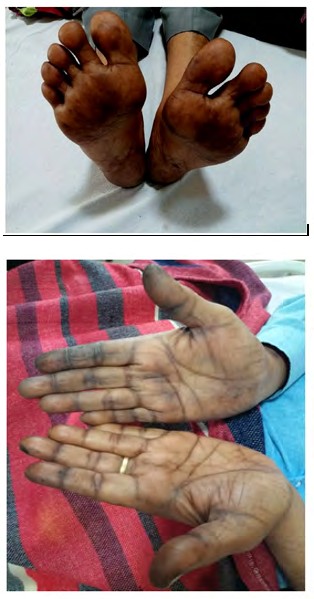
Figure 1a: Hyperpigmentation of palms.
Image Article
Figure 1b: Hyperpigmentation of soles.
Discussion
Chemotherapy has many systemic side effects, some of them warrant discontinuation of the offending agent and some others require change of chemotherapy regimen. Capecitabine is a prodrug of 5-Flurouracil used in chemotherapy regimens usually for the treatment of gastrointestinal malignancies [1]. Hand foot syndrome (HFS) occurs in 50% of patients taking Capecitabine some postulates that this may be due to mitochondrial dysfunction in keratinocytes causing this syndrome [2]. Hyperpigmentation of palms and soles also occur in patients taking this drug, some authors consider it as an early phase of HFS [3] and others argue that it is entirely a different phenomenon due to excretion of its metabolites through eccrine glands present numerously in palms and soles [4]. In our patient as he does not have any pain we continued the chemotherapy regimen after resolution of pyothorax.
References
-
Malet-Martino M, Martino R (2002) Clinical studies of three oral prodrugs of 5-fluorouracil (capecitabine, UFT, S-1). A review Oncologist 7(4): 288‐323.
-
Chen M, Chen J, Peng X, Xu Z, Shao J, et al. (2017) The contribution of keratinocytes in capecitabine-stimulated hand-foot-syndrome. Environmental toxicology and pharmacology 49: 81-88.
-
Caprez J, Rahim U, Ansari A, Lodhi MU, Rahim M (2018) Hyperpigmentation with Capecitabine: Part of Hand- Foot Syndrome or a Separate Entity?. Cureus 10(3): e2397.
-
Sanghi S, Grewal RS, Vasudevan B, Nagure A (2013) Capecitabine induced hand-foot syndrome: report of two cases. Med J Armed Forces India 69(1): 65-67.
- Cancer Diagnosis from RNA Sequence of Blood Cells by Using AI
- Field Cancerization in Oral Cavity, Case Report and Review of Literature. Oncologic Program Salud Integral Hospital, Managua, Nicaragua
- Identification of B Lymphocytes in Cancer Patient’s Blood
- A Case Report of a Breast Cancer Patient Developing Pneumonitis as a Result of Abemaciclib Therapy
- Immune Checkpoint Therapeutics for Today’s Fight and Beyond
- The Amalgamated Sophomore-Gonadoblastoma