
Phytochemical Analysis of Traditional Medicinal Plants and their Antimicrobial Activity An Experience from North East India
Introduction: Phytochemicals are non-nutritive, chemical compounds that occur naturally on plants and have diverse protective properties .Most Phytochemicals like carotenoids, flavonoids and polyphenols have antimicrobial activity and serve as a source of antimicrobial agents against human pathogens. In the present study, five indigenous plants of Assam namely Oldenlandia corymbosa, Ricinus communis, Lpomea aquatica, Xanthium strumarium, Mentha piperita were analyzed for various Phytochemicals present and their antimicrobial activity. Methods: Phytochemical screening tests was conducted for five plant species and found that extract contains a variety of Phytochemicals like saponins, tannins, flavonoids, terpenoids, glycosides and reducing sugars and among which there is higher level of precipitation for phenol and flavonoids. As they are essential source of antimicrobial agents against pathogens, their extract were tested for its antimicrobial activity by well diffusion method using Nutrient agar against human pathogenic bacteria like Staphylococcus aureus, Escherichia coli. Results: The study plant extract of Xanthium strumarium(leaves, roots) and Mentha piperita(stem) had shown a strong antimicrobial activity against Staphylococcus aureus and the plant extract of Ricinus communis(leaves ,stem, roots), Lpomea aquatica (stem)had shown antimicrobial activity against Escherichia coli. Oldenlandia corymbosa hadn’t shown antimicrobial activity for both Staphylococcus aureus and Escherichia coli. This study provided evidence to confirm the presence of various medicinally important bioactive compounds or Phytochemicals that has got biological importance and it justifies their use in the traditional medicines for the treatment of different diseases and this findings suggest that the selected plant extracts possesses antimicrobial properties that could be used for biological control of bacterial cultures and this bioactive compounds serve as a source of antimicrobial agents against human pathogens.
Introduction
North-eastern India is known for its rich biodiversity. Phytochemical are non-nutritive, chemical compounds occurs naturally on plants during metabolic processes and they have diverse proactive properties or disease preventive properties. Plants are known to produce these chemicals to protect them. While recent research demonstrates that they can also play an important role in protecting humans against diseases. Even some of these plants are in use as traditional medicine for centuries now. Most phytochemical like flavonoid, carotenoids and polyphones have anti microbial activity and serve as a source of antimicrobial agents against pathogens. The current study was focused on the following plant species Oldenlandia corymbosa, Ricinus communis, Lpomea aquatica, Xanthium strumarium, Mentha piperita. A concise detail about the study plants is provided below.
Details of the studied plants
| Oldenlandia corymbosa (Diamond flower): | A | |
|---|---|---|
| flowering plants of the genus and family Rubiaceae. It | ||
| is pantropical in its distribution and has almost | ||
| 240 species. Oldenlandia corymbosa | (Figure 1A) is |
| Ricinus communis (Castor oil plant): | The castor oil |
|---|---|
| plant (Ricinus communis) is a species of flowering | |
| plant that belongs to spurge family, Euphorbiaceae. | |
| Its seed is the castor bean. Castor is indigenous to the | |
| southeastern Mediterranean Basin, Eastern Africa, | |
| and India and is widespread throughout tropical | |
| region (Figure 1B). |
| Lpomoea aquatica is semi | |
|---|---|
| aquatic, tropical plant which grows as a vegetable for | |
| its tender shoots and leaves. It is found throughout | |
| the tropical and subtropical regions of the world, | |
| although it is not known where it originated. This | |
| plant is known in English as water spinach, river | |
| spinach |
| Xanthium | |
|---|---|
| strumarium (large, cocklebur, woolgarie bur) is a | |
| species of annual plants belonging to the | |
| Asteraceae family. It has been extensively naturalized | |
| elsewhere |
| Peppermint is | ||
|---|---|---|
| a hybrid mint. The plant, indigenous to Europe and | ||
| the Middle East and is widespread in cultivation in | ||
| many regions of the world, it is also found wild | ||
| occasionally with its parent species ( | Figure 1E). |
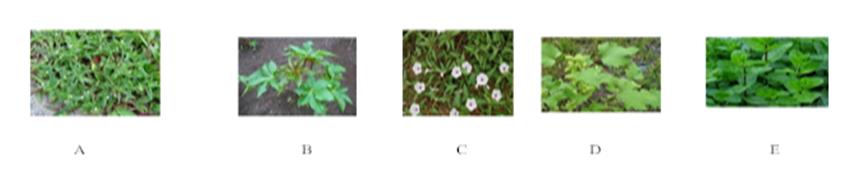
source of medicinal compounds. As of record around 20,000 plant species are in use for medicinal purposes across the globe and around 70 % of them are from Indian subcontinent. Considering the traditional use of the five selected medicinal plants species namely Oldenlandia corymbosa, Ricinus communis, Lpomea aquatica, Xanthium strumarium, Mentha piperita as medicines or as a natural remedy for curing several diseases, the present study was initiated with following objectives- A. To investigate various Phytochemical present in the selected plants particularly the phenolic and flavonoids contents. B. To compare the phytochemical present in these medicinal plants. C. To look for the antimicrobial activity of various parts of the selected plants.
Materials and Methodology
Place of work
The experiments pertaining to the study were carried out in the Department of Biotechnology, Assam down Town University, Panikhaiti, Guwahati, Assam, India.
Collection of plant materials
For the present study five native plants of north east India with known medicinal property were collected from different locations of NE India. The plant materials were washed under running water, cut into pieces; air dried and pulverized into fine powder in a mortar pestle, the powder was kept in small plastic bags with paper labeling.
Preparation of plant extracts
Water extract: The water extraction was carried out using classical method where grinded leaves material of 3 gm weighed using an electronic balance and was crushed in 100 ml of sterile water. Then the mixture was boiled at 50-60˚C for 30 minutes on water bath and it was filtered through Whitman No.1 filter paper. Then filtrate was centrifuged at 2500 rpm for 15 minutes and filtrate was stored in sterile bottles at 5˚C for further use. Ethanol extract: Ground samples (3 gm) were extracted with 100 ml of 95% ethanol on water bath at 70˚C for 2 hr. The extracted samples were centrifuged and the supernatant was transferred into 50 ml volumetric flask. The volume adjusted to 50 ml with 95% ethanol and the samples were stored at -4˚C until analysis. All water and ethanol extracts were filtered before analysis.
Phytochemical Screening Tests: Preliminary qualitative phytochemical screening were carried out for steroids (Salkowski test) , terpenoids (Salkowski test), alkaloid (Wagner’s Test), flavonoids (Alkaline reagent test, H2SO4 test and Lead acetate test), Tannins (Lead acetate test and Braymer’s test), Saponins (Forthing test), Glycosides ( Keller-Kiliani test), Coumains (NaOH test), carbohydrates ( Molisch’s , Benedict’s test and Fehling’s Test), proteins and amino acids ( Xanthoproteic test and Ninhydrin test) following the standard protocols. Antimicrobial activity of plant extracts: Antimicrobial tests for the leaves stem and roots of the studied plants were carried out against the pure cultures of Staphylococcus aureus and Escherichia coli. Bacteria were cultured overnight at 37˚C for 72 hour. Nutrient agar (20ml) was dispensed into sterile universal bottles. These were then inoculated, mixed gently and poured into sterile petridishes. After setting a number 3-cup borer (6 mm) diameter was properly sterilized by flaming and used to make 3 uniform well in each petridishes. A drop of molten nutrient agar was used to seal the base of each cup. The wells were filled with 50 of the extract concentration of 100 g/ml and allow for diffuse (45 minutes). The plates were incubated at 37˚C for 24 hours for bacteria. The zone of inhibition for the extract /fractions that showed antimicrobial activity was measured with antibiotic zone in mm. Test Microorganisms (Staphylococcus aureus, Escherichia coli): The bacterial specimens were collected from Down Town Hospital, Assam, India and then pure culture was maintained in nutrient broth and used against extract to check antimicrobial activity.
Results
Phytochemical analysis
Preliminary phytochemical analysis for leaves (L).stem(S) and roots(R) of Oldenlandia corymbosa (Oc), Ricinus communis (Rc), Lpomea aquatica (La), Xanthium strumarium (Xs), Mentha piperita (Mp) are tabulated in Table 1.
Copyright© Manash PS, et al.
Manash PS, et al. Phytochemical Analysis of Traditional Medicinal Plants and their Antimicrobial Activity: An Experience from North East India. J Pharm Res 2016, 1(1): 000104.
| Oc | Rc | La | Xs | Mp | ||||||||||||||||||||||||||||||||||||||||||
| L | S | R | L | S | R | L | S | R | L | S | R | L | S | R | ||||||||||||||||||||||||||||||||
| Steroids | ||||||||||||||||||||||||||||||||||||||||||||||
| - | - | - | - | - | - | + | - | - | - | - | - | - | - | - | ||||||||||||||||||||||||||||||||
| Terpenoids | ||||||||||||||||||||||||||||||||||||||||||||||
| - | - | - | + | - | - | + | - | - | - | - | - | - | - | - | ||||||||||||||||||||||||||||||||
| Alkaloids | ||||||||||||||||||||||||||||||||||||||||||||||
| - | - | - | - | - | - | + | + | - | ++ | + | + | + | - | + | ||||||||||||||||||||||||||||||||
| Flavonoids | ||||||||||||||||||||||||||||||||||||||||||||||
| ++ | ++ | ++ | ++ | ++ | ++ | + | ++ | + | ++ | + | + | + | + | ++ | ||||||||||||||||||||||||||||||||
| Tanins | ||||||||||||||||||||||||||||||||||||||||||||||
| ++ | ++ | ++ | ++ | ++ | ++ | + | ++ | + | ++ | + | + | + | + | + | ||||||||||||||||||||||||||||||||
| Saponins | ||||||||||||||||||||||||||||||||||||||||||||||
| ++ | ++ | ++ | ++ | ++ | ++ | ++ | ++ | ++ | ++ | ++ | ++ | ++ | ++ | ++ | ||||||||||||||||||||||||||||||||
| Glycosides | ||||||||||||||||||||||||||||||||||||||||||||||
| - | - | - | + | + | - | + | + | + | + | - | - | + | - | - | ||||||||||||||||||||||||||||||||
| Coumarins | ||||||||||||||||||||||||||||||||||||||||||||||
| - | - | - | + | + | - | - | ++ | + | ++ | ++ | + | + | + | ++ | ||||||||||||||||||||||||||||||||
| Carbohydrates | ||||||||||||||||||||||||||||||||||||||||||||||
| - | - | - | - | - | - | - | - | + | - | - | - | - | - | - |
Table 6: Table summarizing the qualitative results for phytochemicals in the studied plant parts [L: leaf; S: stem and R:
Table 1: Table summarizing the qualitative results for phytochemicals in the studied plant parts [L: leaf; S: stem and R: root]. When performed qualitative tests for phytochemicals in Oldenlandia corymbosa, Ricinus communis, Lpomea aquatica, Xanthium strumarium, Mentha piperita, a number of phytochemicals shows positive results in their specific tests. Though some were found in abundance while some in trace amount. In the present study, the phytochemical screening of five medicinal plants namely Oldenlandia corymbosa, Ricinus communis, Lpomea aquatica, Xanthium strumarium, Mentha piperita showed positive results for saponins, tannins flavonoids,terpenoids,glycosides , alkaloids, carbohydrates, steroids , coumain and protein. In Oldenlandia corymbosa, showed the phytochemicals like flavonoids, tannins, saponins, Protein, In Ricinus communis, showed the phytochemicals like saponins, tannins, Flavonoids, terpenoids, glycosides, coumarins, Protein. In Lpomea aquatica, showed the phytochemicals like steroids, terpenoids, alkaloids, flavonoids, saponins, tannins, glycosides carbohydrates, coumain and protein, In Xanthium strumarium showed the phytochemical like alkaloids, saponins, tannins, flavonoids, glycosides, coumarins , Protein, In Mentha piperita showed the phytochemical like alkaloids, saponins, tannins, flavonoids, glycosides, coumarins , Protein. Steroids were found only in leaves of Lpomea aquatica and carbohydrates were found only in stem of Lpomea aquatica.
Antimicrobial activity
Antimicrobial activity for the leaf, stem and roots of Oldenlandia corymbosa, Ricinus communis, Lpomea aquatic, Xanthium strumarium, Mentha piperita against Staphylococcus aureus and Escherichia coli are summarized in Table 2.
| Inhibition(mm) | |||||||||||||||||||
|---|---|---|---|---|---|---|---|---|---|---|---|---|---|---|---|---|---|---|---|
| Plant name | organism | media | extracts | ||||||||||||||||
| 24 hrs | 48 hrs | 72 hrs | |||||||||||||||||
| Oldenlandia corymbosa | S. aureus | leave | |||||||||||||||||
| NA | stem | absent | absent | absent | |||||||||||||||
| E. coli | root | ||||||||||||||||||
| Ricinus communis | S. aureus | absent | absent | absent | |||||||||||||||
| leave | 4 | 6 | 7 | ||||||||||||||||
| NA | |||||||||||||||||||
| stem | 3 | 4 | 6 | ||||||||||||||||
| root | 2 | 5 | 6 |
| S. aureus |
|---|
| E. coli |
|---|
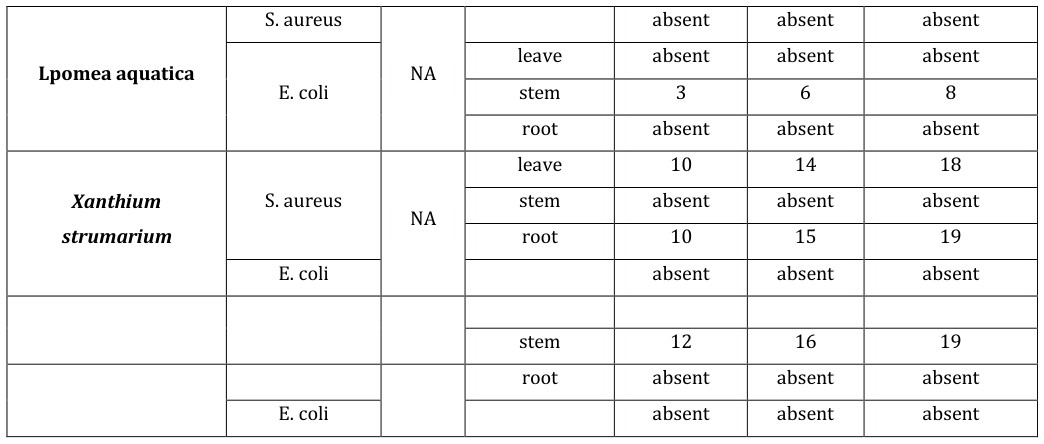
| S. aureus | NA | absent | absent | absent | ||
| Lpomea aquatica | NA | E. coli | leave | absent | absent | absent |
| Lpomea aquatica | NA | E. coli | stem | 3 | 6 | 8 |
| Lpomea aquatica | NA | E. coli | root | absent | absent | absent |
| Xanthium strumarium | S. aureus | NA | leave | 10 | 14 | 18 |
| Xanthium strumarium | S. aureus | NA | stem | absent | absent | absent |
| Xanthium strumarium | S. aureus | NA | root | 10 | 15 | 19 |
| Xanthium strumarium | E. coli | NA | absent | absent | absent | |
| stem | 12 | 16 | 19 | |||
| root | absent | absent | absent | |||
| E. coli | absent | absent | absent |
Table 10: Results for antimicrobial activity for the leaf (L), stem(s) and roots(R) of the 5 studied plants against
Present findings provide experimental evidence that the extract preparation of leaves stem and roots of Oldenlandia corymbosa, Ricinus communis, Lpomea aquatica, Xanthium strumarium, Mentha piperita that are used as a traditional remedy, possesses antimicrobial property. Similar studies on phytochemical analysis have been carried out by different groups. Presence of alkaloids, saponins, tannins, flavonoids, glycosides, coumarins, flavonoids, carbohydrates and protein were recorded in the present study. These findings are in accordance to a previous study by Yadav and Agarwala, [1] who used different methods of extraction of plant parts to produce a marked difference in the yield and time of extraction and their findings provided evidence that crude aqueous and organic solvent extracts of these tested plants contain medicinally important bioactive compound sand it justifies their use in the traditional medicines for the treatment of different diseases. In the current study leave of Oldenlandia corymbosa ,all parts (leaves,stem,roots) of Ricinus communis, stem of Lpomea aquatica, leave and stem of Xanthium strumarium, leave of Mentha piperita had shown more phytochemicals and used as the main source having medicinal value. Rajan et al. [2] investigated phytochemical analysis of the seed kernel extract of Mangifera indica Linnaeus against Shigella
| Aegle marmelos. | The therapeutic value of Aegle | |
|---|---|---|
| marmelos Correa (Rutaceae), commonly known as ‘‘Bael,’’ | ||
| has been recognized as a component of traditional | ||
| medication for the treatment of various human ailments. | ||
| The crude extracts of A. marmelos revealed the presence | ||
| of several biologically active phytochemicals with the | ||
| highest quantity of alkaloids, flavonoids, and phenols in | ||
| Pant Aparna variety. |
Satish [4] who investigated their study plant efficiency against Staphylococcus aureusand E. coli having a similar zone of inhibition to the present study. Elie K Barbour et al. [5] determined Screening of selected indigenous plants of Lebanon for antimicrobial activity. The objective of this study is to test in vitro the antimicrobial efficacy of 39 water and 39 methanol extracts derived from different parts of 27 indigenous wild plant species that have been commonly used in Lebanese folk medicine. The antimicrobial efficacy was determined using the single disk diffusion method, nine test microorganisms were used namely, Escherichia coli, Proteus sp., Pseudomonas aeruginosa, Shigella dysenteria, Salmonella enteritidis, Salmonella typhi, Staphylococcus aureus, Streptococcus faecalis, and Candida albicans. Only one water extract out of 39 derived from whole plant of Alchemilla diademata showed an antimicrobial activity against Staphylococcus aureus. The percentage of test organisms that were susceptible to 10 most efficacious methanol plant extracts (20 μl/disc) were as follows: Achillea damascene and scariosa flower, Cirsium, Centaurea ainetensis, Hieracium sp. Whole, Origanum libanoticum, Ranunculus myosuroudes , Nepata curvifloraleaf, Nepata curviflora and Verbascum leptostychum flower. The minimum inhibitory concentration (MIC) was determined on plant extracts that showed high efficacy against the test organisms. The chance to find antimicrobial activities was more apparent in methanol rather than water extracts of the same indigenous plants of Lebanon, with higher antimicrobial activities in 20 μl methanol extract-discs in comparison to that present in the 10 μl discs (P<0.05). Kubmarawa D et al. [6] proposes Preliminary phytochemical and antimicrobial screening of 50 medicinal plants from Nigeria. Ethanolic extracts of 50 plant species were screened for their antimicrobial activity against Bacillus subtilis, Escherichia coli, Staphylococcus aureus, Pseudomonas aeruginosa and Candida albicans. The results indicated that of the 50 plant extracts, 28 plant extracts inhibited the growth of one or more test pathogens. Four plant extracts showed a broad spectrum of antimicrobial activity. Phytochemical investigation revealed the presence of tannins, saponins, alkaloids, glycosides, flavonoids and essential oils. However, the discussion could not be done with respect to study findings on these selected plants as there is a paucity of data as no studies were found particularly on these unexplored plants. These findings suggest that the selected phyto extracts have antimicrobial properties and could be used for bio control of bacterial cultures.
Antimicrobial activity was confirmed by the selected plant species and the results revealed that plant extracts varied in their efficacy for inhibiting the bacterial growth against the tested pathogens.
Conclusion
In the present study, the phytochemical screening for leaves, stem and roots of Oldenlandia corymbosa, Ricinus communis, Lpomea aquatica, Xanthium strumarium, Mentha piperita showed the presence of active component like saponins, tannins, flavonoids, terpenoids, glycosides and reducing sugars from aqueous and ethanol extracts. Secondary metabolites are the classes of compounds which are known to show curative activity against several human ailments and therefore could explain the use of traditional medicinal plant for treatment of some illnesses. In conclusion, the study findings support the use of these five plants in the treatment of infectious diseases caused by resistant microorganisms. These plants can also be used to discover bioactive natural products that may serve as leads for the development of new pharmaceuticals. On the basis of the antimicrobial assay of this study Staphylococcus aureus was found greater effect in the inhibition than Escherichia coli. These findings suggest that the selected phytoextracts possesses antimicrobial properties and could be used for biocontrol of bacterial cultures. Antimicrobial activity was confirmed by the selected plant species and the results revealed that plant extracts varied in their efficacy for inhibiting the bacterial growth of the tested pathogens. Analyzing phytochemicals with antimicrobial activity in plants will provides scientists with insight into how effective these plants in terms of its medicinal value, and in understanding how and why they are effective, which can lead to development of new medicines with lesser side effects.
References
-
Yadav RNS, Agarwala M (2011) Phytochemical analysis of some medicinal plants. Journal of Phytology 3(12): 10-14.
-
Rajan S, Thirunalasundari T, Jeeva S (2011) Anti— enteric bacterial activity and phytochemical analysis of the seed kernel extract of Mangifera indica Linnaeus against Shigella dysenteriae (Shiga, corrig) Castellani and Chalmers. Asian Pacific Journal of TropicalMedicine 294-300.
-
Mujeeb F, Bajpai P, Pathak N (2014) Phytochemical Evaluation, Antimicrobial Activity, and Determination of Bioactive Components from Leaves of Aegle marmelos. Bio Med Research International pp 11.
-
Mahesh B, Satish S (2008) Antimicrobial Activity of Some Important Medicinal Plant Against Plant and Human Pathogens .World Journal of Agricultural Sciences 4(S): 839-843.
-
Barbour EK, Mohammed AS, Sagherian VK, Habre AN, Talhouk SN (2004) Screening of selected indigenous plants of Lebanon for antimicrobial activity. Journal of Ethnopharmacology Pp 1-7.
-
Kubmarawa D, Ajoku GA, Enwerem NM, Okorie DA, Preliminary phytochemical and antimicrobial screening of 50 medicinal plants from Nigeria. African Journal of Biomedical Research 6(14).
- Acido Labile or Gastro Irritant Apis and Enteric Release in Galenic Practice: An Overview
- A Study on Knowledge, Attitude and Practice of Hand Hygiene among Healthcare Professionals at a Tertiary Care Hospital, India
- Influence of Inoculum Concentration on In Vivo Incubation Period of Emmia lacerata, Pathogenesis and Management of Wilt in Pepper (Capsicum annuum L.)
- Vanilla’s Chemistry
- Marine Anti-Cancer Compounds and Adverse Effects of Global Warming on Oceans: An Overview
- Serological Investigation of Chikungunya Virus Antibody among Malaria-Suspected Febrile Patients in Some Healthcare Facilities in Rivers State