
Preparation Modification and Characterization of a Hydrogel Based on Polyacrylic and Polymetacrylic Acid as a Potential Carrier for Drug Delivery Systems
Complexes of polyacrylic acid (PAA) and polymethacrylic acid (PMA) in presence of sodium alginate (SAL) during redox polymerization of polyacids were formed. They were characterized by IR spectroscopy and viscometry. The swelling index of hydrogels based on the polymethacrylic acid-sodium alginate complex (PMA-SAL) has been found to be lower than that of polyacrylic acid-sodium alginate (PAA-SAL) complex. The hydrogels based on the complex of crosslinked polyacids with sodium alginate can be of practical interest as polymeric carriers for drugs
Introduction
The excellent biocompatibility and biodegradability of alginate make it very widely used for biomedical application and especially for drug delivery systems and tissue engineering [1, 2]. Different functions and applications of the polymer can be derived due to its possibility for easy chemical modifications. These modifications lead to obtaining of derivatives with various structures and properties [3]. The alginate forms a gel the in presence of different polyvalent metal cations because of the polymer chains cross- linking [4, 5, 6]. Polyectrolyte complexes between sodium alginate and cationic polymers were investigated for the purposes of drug delivery and tissue engineering [7]. For example, films based on sodium alginate and chitosan complexes are proposed for transdermal drug delivery [8, 9, 10]. There are numerous reports of the complexation of polysaccharides with polycarboxylic acidsin aqueous solution [11, 12, 13, 14]. Being a polysaccharide, AL must also form complexes with PAA and PMA. The goal of this work is to study the complexation of AL with PAA and PMA in aqueous media. The formation of interpolyelectrolyte complexes is a significant difference between the properties of such polymer complexes in comparison to the monomers alone. This is a prerequisite for considering such polyelectrolyte complexes as new class polymer compounds [15, 16].
Methods and Materials
Sodium alginate was purchased from Sigma Aldrich, Germany. Acrylic acid was purchased from Sigma Aldrich, Germany. Methacrylic acid was purchased from Sigma Aldrich, Germany. N,Nmethylenebisacrylamide (MBAL) from Sigma Aldrich, Germany. Ammonium persulfate (NH4)2S2O8 was purchased from Sigma Aldrich, Germany. Sodiummetabisulfite Na2S2O5 was purchased from Sigma Aldrich, Germany.
Preparation of Hydrogel
Hydrogels based on crosslinked PAA and AA were obtained by redoxpolymerization of acrylic acid (AAc) and metacrylic acid (Mac) in aqueous solutions of SAL using N,N - methylenebisacrylamide (MBAA) as a crosslinking agent and (NH4)2S2O8 + Na2S2O5 as a redoxinitiator. Reaction mixtures of the following compositions were applied: 20 ml Н2О + 1g SAL + 1 ml AAc + 0.1 gMBAA + 0.005 g (NH4)2S2O8 + 0.005 g Na2S2O5 and 20 ml Н2О + 1 g SAL + 1 mL MAc +0.1 gMBAA + 0.005 g (NH4)2S2O8 + 0.005 g Na2S2O5.
Specific Viscosity Measurements
The viscosimetric measurements were performed using an Ubbelohde capillary viscometer with thermo stating accuracy of ± 0.1°C. SAL–polyacid complexes were obtained by mixing equal volumes of 0.1% aqueous solutions of the SAL and PA at 25°С on φ = [SAL] / [PA], mass / mass ratio, where [SAL] is the mass concentration of SAL and [PA] = const = 0.01 g/dL.
Infrared Spectroscopy (IR)
Hydrogels prepared by the method described above were dried and IR spectra were measured with spectrometer Nickolet 400.
Swelling Index Determination
Hydrogels prepared by the method described above were dried and milled. The obtained powder is tableted on a tablet press. Tablets have a diameter of 8 mm and mechanical strength average 30N. To estimate swelling indices Q, tablets were placed into aqueous solutions with required pH value. The Q value was calculated by the formula Q = (m – m0)/ m0, where m and m0 are the masses of a sample swollen to the equilibrium state and an initial dry complex, respectively.
Results and Discussion
Dependences of specific viscosity ηsp of aqueous mixed solution of SAL with PAA and PMA at a constant concentration of a polyacid (PA) on the φ = [SAL]/ [PA], mass/mass ratio, where [SAL] is the mass concentration of SAL and [PA] = const = 0.01 g/dL is shown on the Figure 1.
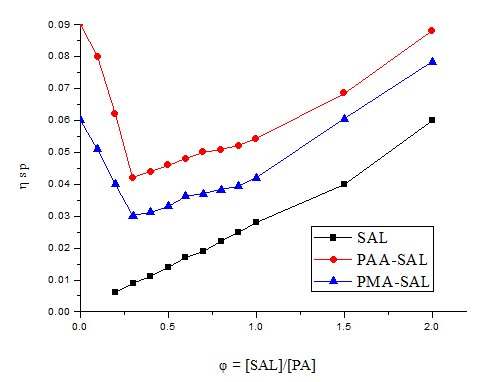
Data show that SAL forms complexes with PAA and PMA in aqueous solution. At low concentrations, the system forms true solution without gelation. The incorporation of SAL macromolecules into a solution of a free PA leads to a decrease in solution ηsp. This effect results from the formation of PA-SAL complex particles, which have a more compact conformation than initial PAA or PMA macromolecules have. The compaction of the complex particles is caused by the formation of hydrogen bonds between COOH groups of a PA and COOH groups of SAL. The value of φ that corresponds to the minimum of the ηsp(φ) dependence is in consistence with the composition of a PA/SAL complex. At this value of ϕ, the number of hydrogen bonds between COOH groups of a polyacid and COOH groups of SAL in the complex is far from maximum, because of steric hindrances. The following gradual increase in the viscosity of the system is due to the accumulation of free SAL this is confirmed by the concentration dependence of ηsp for solutions of free SAL.
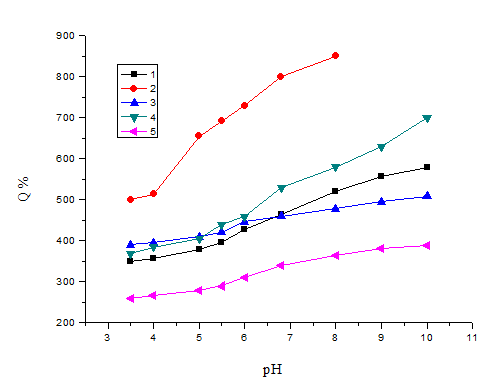
The formation of hydrogen bond between SAL, PAA and PMA can be proven also by the IR spectra of the polymers alone and the spectrum of IPC (PAA-SAL and PMA-SAL) [17]. The absorption band at 1711 cm–1, which corresponds to the stretching vibrations νC=O in free PAA, shifts to 1736 cm–1 upon its complexation with SAL. The νC=O band of free PMA visible at 1703 cm–1 shifts to 1717 cm–1 for the complex with SAL. The formation of a chemical (covalent or hydrogen) bond between the functional groups of interacting polymers increases the energy required for the excitation of stretching vibrations in a complexed functional group. Therefore, the stretching vibrations νC=O in PAA, PMA and SAL shift to the region of higher frequencies in our case. Dependences of swelling indices Q of hydrogels based on (1) free SAL and (2) PMA/SAL and (3) PAA/SAL complexes on the pH of an aqueous mediumis shown on Figure 2. The values of Q depend on pH, because SAL, PAA and PMA macromolecules contain weakly acidic groups. Тhe degree of ionization of hydrogels containing pendent carboxyl groups increases at high pH, leading to increased electrostatic repulsions between negatively-charged carboxyl groups, thus resulting in a great swelling degree in response to basic conditions. Absolute value of Q for the hydrogel of the PMA/SAL complex is lower than that for the hydrogel of free SAL. This is due to hydrophobic interactions performed during the complexation between PMA and SAL. The PAA/SAL complex is thermodynamically less stable than the PMA/SAL complex caused by the fact that the presence of CН3 groups in PMA monomer units enhances the hydrophobic interactions upon the complexation with SAL. The PAA/SAL complex swells to a greater extent at comparable value of pH. Hydrogel of the complex between crosslinked PAA and linear SAL remains sensitive to pH, but at the same time, retains its structural integrity. At pH ≈ 8 complex loses its mechanical strength form a dispersion of insoluble particles. The swelling of the hydrogel based on the complex of crosslinked PAA and SAL is of a reversible character. Upon a reduction in pH from 10 to 4 during the back titration of the hydrogel, the dependence of its swelling index Q on pH coincides with curve for the direct titration of the hydrogel. It can be concluded that the hydrogel based on crosslinked PAA and SAL is a pH sensitive structural stable system.
Conclusion
Using IR spectroscopy and viscometry, it has been shown that PAA and PMA form complexes with SAL in aqueous solutions. The complexation is realized via hydrogen bonding between nondissociated COOH groups of the polyacids and COOH groups of the polysaccharides. In the case of SAL-PMA complexation, hydrophobic interactions play an essential role in the stabilization of the complex. The PAA and PMA complexes with SAL represent hydrogels. The hydrogels based on complexes of crosslinked PAA and PMA with SAL represent systems sensitive to pH and can be used as polymeric carriers for pharmaceutically active compounds.
References
-
Stevens MM, Qanadilo HF, Langer R, Shastri VP (2004) A rapid-curing alginate gel system: Utility in periosteum-derived cartilage tissue engineering. Biomaterials 25(5): 887-894.
-
Peppas NA, Hilt JZ, Ali K, Robert L (2006) Hydrogels in biology and medicine: From molecular principles to bionanotechnology. Advanced Materials 18(11): 1345-1360.
-
Kuo CK, Ma PX (2001) Ionically crosslinked alginate hydrogels as scaffolds for tissue engineering: Part 1. Structure, gelation rate and mechanical properties. Biomaterials 22(6): 511-521.
-
Morch YA, Donati I, Strand BL, Skjak Baek G (2006) Effect of Ca2+, Ba2+ and Sr2+ on alginate microbeads. Biomacromolecules 7(5): 1471-1480.
-
Ouwerx C, Velings N, Mestdagh MM, Axelos MAV (1998) Physico-chemical properties and rheology of alginate gel beads formed with various divalent cations. Polymer Gels and Networks 6(5): 393-408.
-
Saarai A, Kasparkova V, Sedlacek T, Saha P (2013) On the development and characterisation of crosslinked sodium alginate/gelatine hydrogels. J Mech Behavior of Biomed Mat 18: 152-166.
-
Moustafine RI, Kemenova VA, Van den Mooter G (2005) Characteristics of intrpolyelectrolyte complexes of Eudragit E 100 with sodium alginate. Int J Pharm 294(1-2): 113-120.
-
Can AS, Erdal MS, Gungor S, Ozsoy Y (2013) Optimization and characterization of chitosan films for transdermal delivery of ondansetron. Molecules 18(5): 5455-5471.
-
Elmotasem H (2008) Chitosan-alginate blend film for the transdermal delivery of meloxicam. Asian J Pharm Sci 3(1): 12-29.
-
Prajapati BG, Sawant KK (2009) Polyelectrolyte complex of chitosan alginate for local drug delivery. Int J ChemTech Res 1(3): 643-648.
-
Khutoryanskii VV, Dubolazov AV, Nurkeeva ZS, Mun GA (2003) Complexation of Poly(acrylic acid) with Hydroxypropylcellulose in Aqueous Solutions. Vysokomol Soedin Ser B 45(4): 683-686.
-
Khutoryanskiy VV, Cascone MG, Lazzen L, Niccoletta B, Zauresh SN, et al. (2004) Morphological and thermal characterization of interpolymer complexes and blends based on poly(acrylic acid) and hydroxypropylcellulose. Polym Int 53(3): 307-311.
-
B YJ, Khutoryanskii VV, Mun GA, Nurkeeva ZS (2002) Polycomplexes and Film Compositions Based on Hydroxyethylcellulose and Poly(acrylic acid) as Systems for the Controlled Release of Levomycetin. Vysokomol Soedin Ser A 44(10): 1826-1832.
-
Mun GA, Nurkeeva ZS, Khutoryanskii VV, Mangazbaeva RA (2001) Interpolymer Complexes of Methylcellulose with Polycarboxylic Acids in Aqueous Solutions. Vysokomol Soedin Ser B 43(3): 552-556.
-
Kabanov VA, Zezin AB (1984) Soluble interpolymer complexes as a new class of synthetic polyelectrolytes. Pure and Appl Chem 56(3): 343- 354.
-
Zezin AB, Kabanov VA (1982) A new class of complex water- soluble polyelectrolytes. Russian Chem Rev 51(9): 833-855.
-
Meyers RA (2000) Encyclopedia of Analytical Chemistry, Tarzana, CA, USA: John Wiley & Sons, LTD, (Volume 12).
- Acido Labile or Gastro Irritant Apis and Enteric Release in Galenic Practice: An Overview
- A Study on Knowledge, Attitude and Practice of Hand Hygiene among Healthcare Professionals at a Tertiary Care Hospital, India
- Influence of Inoculum Concentration on In Vivo Incubation Period of Emmia lacerata, Pathogenesis and Management of Wilt in Pepper (Capsicum annuum L.)
- Vanilla’s Chemistry
- Marine Anti-Cancer Compounds and Adverse Effects of Global Warming on Oceans: An Overview
- Serological Investigation of Chikungunya Virus Antibody among Malaria-Suspected Febrile Patients in Some Healthcare Facilities in Rivers State