
Assessment of Pharmacist Awareness Knowledge and Attitude of Fluranizine in Rafha Saudi Arabia
Objective: This research was aimed to provide a platform for conducting assessment of knowledge and attitude of the pharmacist in Rafha city, Saudi Arabia about Flunarizine. Methods: A cross-sectional research design in which self-completed questionnaire was distributed among 50 randomly selected pharmacists in Rafha. The study was conducted during 8-week study period from March 2015 to April 2015. Results: From the 50 pharmacists participated in the study, there were 2 females (4%, n=2) and 48 males (96%, n=48).The age of participants ranged from 23 to 33 years with mean equals 26.8 years, the experience years ranged from (1.5 to 10.5) with mean equals 4.17. The first part of the questionnaire contained 10 closed ended questions. 100% of participant population choosed the (yes) answer. For the second part of a questionnaire containing 10 questions related to the beliefs and attitude of the pharmacist in consulting and dispensing fluranizine, the choices of pharmacists for answering were different. Conclusion: The findings of this unique study showed that participants had moderate knowledge about fluranizine. In summary, Pharmacists need to be more informed regarding therapeutic indications, drug interactions, dose and precautions taken about fluranizine.
Introduction
Fluranizine is a drug which belongs to the chemically heterogenous group of calcium-entry blockers [1]. Chronic treatment with fluranizine provides symptomatic relief of peripheral (arterial and venous) and cerebral circulatory disorders [2, 3]. The drug is also used to cure vestibular disorders and may be beneficial in the prophylactic treatment of migraine [4, 5, 6, 7, 8]. Ongoing studies have demonstrated the effectiveness of this compound in therapy-resistant forms of epilepsy [9]. The suggestion has been made that Flunarizine may be helpful in some cases of urinary incontinence [10]. The therapeutic effects may be due, at least in part, to its ability to inhibit the entry of calcium ions (Ca2+) into tissue cells, thereby preventing cellular intoxication due to an overload of Ca2+. In particular, the compound affects the function of vascular smooth muscle cells, endothelial cells, myocardial cells, erythrocytes and brain cells. It can be used for peripheral and cerebral vascular diseases, vestibular disorders, migraine and epilepsy. Flunarizine should be taken at nighttime starting with a low dose. It should be used with care in patients with depression or those being prescribed other agents, such as phenothiazines, concurrently, which may cause extrapyramidal side-effects. Sedatives, anti-anxiety medicines, muscle relaxants, tranquilizers and anti- seizure medicines are known to interact with Flunarizine [11]. Its common side effects on central nervous system include anxiety, depression, dizziness, drowsiness, fatigue, insomnia, sedation and vertigo. It also causes galactorrhea, menstrual irregularities, prolactin levels increased gastrointestinal, appetite, epigastric pain, heartburn, nausea, vomiting, weight gain and xerostomia. Extrapyramidal symptoms such as muscle ache, weakness and rashes may also seen with flunarizine treatment. Historically, pharmacists’ role in health care centered around dispensing medications in accordance with a prescription and providing a final check to ensure accurate delivery of medications to patients. Although they receive training in preventive care, health and wellness and patient education, pharmacists have traditionally leveraged their clinical knowledge, to review prescribed drug regimens to prevent inappropriate dosing and minimize drug interactions. Pharmacists’ roles have expanded over time to include more direct patient care, such as primary care and disease management services and their roles continue to evolve today. Counseling is an important role of the Pharmacists. Counseling encompasses many things, ranging from discussion of therapeutic specific goals (e.g., adherence, achievement of intermediate outcomes) to providing broader information on good health practices, such as weight management. As a key point of access for patients (during the medication dispensing process or otherwise), pharmacists have many opportunities for counseling patients, and can use this access to clarify or confirm patient understanding of physician-directed treatment regimens. Within many healthcare settings, targeting patients with specific conditions and co-morbidities for enhanced counseling could lead to a well-informed patient population and more coordinated care. Pharmacists can also provide education about health and wellness issues or potential risk factors for disease. With patients growing more engaged in their care, this interaction with the pharmacist could help reinforce physician messages and positive behaviors. Evidence on Education and behavioral counseling interventions are typically provided in tandem with another pharmacist services, though previous comparative studies have evaluated these interventions in isolation. Regarding medication-focused interventions, studies have shown that pharmacist counseling is linked to better medication adherence [12]. Medication management conducted by pharmacists has been shown to improve medication adherence and clinical outcomes for patients with chronic diseases such as hypertension [13]. The objective to conduct this current research is to understand the pharmacists capacity to meaningfully improve care and their extent of knowledge about specific medication like fluranizine.
Methodology
Population and Study Design
A cross sectional survey was conducted on randomly selected pharmacist from the beginning of March 2015 to the end of April 2015. First, a total of 58 pharmacists and pharmacy technician was enrolled during this period. Three pharmacists refused to answer the questionnaire, while five pharmacy technicians were excluded on the basis of lack of knowledge regarding flunarizine. Finally, 50 pharmacists participated in the study.
Data Collection
Data collection was carried out using a structured self administered questionnaire (Appendix I). The pharmacists were selected after visiting each pharmacy and inviting them to participate in the study after explaining the aims and objectives. The questionnaire was distributed randomly to the selected pharmacist.
Study Tool
The questionnaire was prepared in English language and divided in two parts:
a) First part included assessment of knowledge of pharmacists regarding Flunarizine. It comprised questions related to mechanism of action, uses, side effects and contraindications of Flunarizine.
b) The second part contained assessment of attitude of pharmacist towards Flunarizine which covered questions related to the beliefs of the pharmacists in consulting and dispensing Flunarizine.
Data Analysis
Descriptive statistics were used to analyze the data (frequency and percentages; mean ± standard deviation). Statistical analysis was performed using the XLSTAT and excel Microsoft software programs.
Results and Discussion
Flunarizine is one of the latest calcium antagonists with anti-migraine effect. Flunarizine is a non-selective calcium entry blocker with other actions, including histamine H1 receptor blocking activity. It prevents cell damage due to calcium overload by selectively blocking the entry of calcium into the cells of tissues. It inhibits the contractions of vascular smooth muscle and protects blood cells from membrane rigidity and brain cells from the effects of hypoxia. It is effective in the prophylaxis of migraine, occlusive peripheral vascular disease, vertigo of central and peripheral origin, and as an adjuvant in the therapy of epilepsy. This research was carried out to assess knowledge and attitude of the pharmacist about Flunarizine. In the beginning of the study researchers were able to gather 58 pharmacist and pharmacist technicians for conducting studies. Unfortunately, five pharmacy technicians were excluded and the questionnaire distributed to a total of 53 pharmacists. Out of these pharmacists, three were refused to participate in the study. As a result, response rate was estimated to be 94%. Out of 50 pharmacists, 2 were females (4%, n=2) and 48 were males (96%, n=48) with the age of participants ranged from 23 to 33 years with mean equals 26.8 (Table 1, Figure 1). The experience of the participants ranged from 1.5 to 10.5 years with mean equals 4.17 (Table 2, Figure 2).
| Variable | Observations | Minimum | Maximum | Mean | Std. Deviation | |
|---|---|---|---|---|---|---|
| Age | 50 | 23 | 33 | 26.82 | 2.242 |
Table 1: Description for age of participants.

| Variable | Observations | Minimum | Maximum | Mean | Std. Deviation |
| Experience years | 50 | 1.5 | 10.5 | 4.17 | 1.921 |
Table 2: Experience in years of participants.
Open Access Journal of Pharmaceutical Research

Figure 2: Histogram showing experience in years of participants. The first part of the questionnaire contains 10 questions regarding pharmacological information about drug (Appendix I). 100% of participant population chose the (yes) answer which indicates the awareness and knowledge of the pharmacists about the fluranizine. The second part of the questionnaire also contains ten questions regarding the belief and attitude of pharmacist in consulting and dispensing fluranizine (Appendix II).
The participants have different choices in giving answers (Table 3). 10-100% of the participants were strongly agreed with the questions, while 0-84% agrees and 0- 16% disagree, respectively (Table 4). On the other hand 0-20% of participants was strongly disagreeing with questions. Significant variation in answering the questions demonstrated their attitude towards consulting and dispensing fluranizine were moderate (Figure 3).
| Strongly agree | Agree | Disagree | Strongly disagree | |
| Q1 | 5 | 29 | 0 | 16 |
| Q2 | 18 | 10 | 5 | 17 |
| Q3 | 50 | 0 | 0 | 0 |
| Q4 | 6 | 42 | 2 | 0 |
| Q5 | 29 | 8 | 8 | 5 |
| Q6 | 14 | 9 | 7 | 20 |
| Q7 | 8 | 37 | 5 | 0 |
| Q8 | 15 | 28 | 7 | 0 |
| Q9 | 27 | 19 | 2 | 2 |
| Q10 | 12 | 25 | 10 | 3 |
Table 3: The number of choices for pharmacist in answering the second part of the questionnaire.
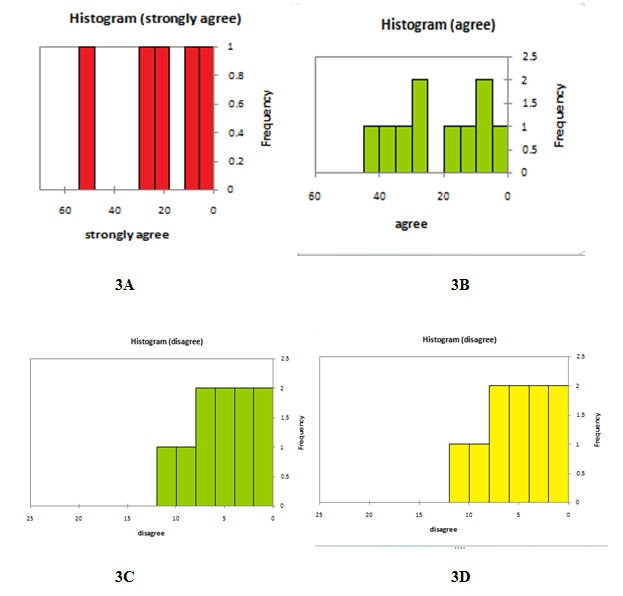
Figures 3: Frequency of each choice for the pharmacist in answering the second part of the questionnaire (3A) strongly agree (3B) agree (3C) disagree (3D) strongly disagree.
Pharmacists are the medication experts. Pharmacists dispense medications prescribed by physicians and other health practitioners and monitor patient health, they advise physicians and other health practitioners on the selection, dosages, interactions, and side effects of medications, they also counsel patients about their medications. Pharmacists must understand the use, clinical effects and composition of drugs, including their chemical, biological and physical properties. The goal of pharmacy care is to maximize positive health care outcomes and improve patients' quality of life with minimum risk. Therefore, it is necessary for the pharmacist to have a sound knowledge about different medicines.
Summary and Conclusion
This study was aimed to determine the extent of knowledge and attitudes among pharmacists about fluranizine. As a pharmacist are often the first port of call for people to get advice on health in general, as well as specific clinical conditions, pharmacists need to be well informed about the use and safety of fluranizine. This can be achieved by providing education and training to the practicing pharmacists by organizing continuing medical education programs focused on safety, potential harmful effects and rational use of medicines. A number of pharmacists participated in the study and the findings of this unique study showed that participants had moderate knowledge about fluranizine.
The Problem Facing During the Study
Some pharmacist refused to participate in the study despite explaining them the importance of the study and majority of pharmacists keep the questionnaire with them for a long time before answering it.
Recommendations for Further Study
More researches should be enrolled on the way to determine pharmacist knowledge and attitude about other specific medications.
References
-
Church J, Zsoter TT (1980) Calcium antagonistic drugs. Mechanisms of action. Cun J Physiol Pharmacol 58(3): 254-264.
-
De Cree J, Geukens H, Verhaegen H (1978) Einfluss von Flunarizin (Sibelium) auf das arterielle Blutstromverhalten. Mitn Med Wochenschr 120: 627-630.
-
Domschky K, Nelson M, Dammhayn B, Terjung E (1977) Flunarizin bei Patienten mit zerebrale und periphere Mangeldurchblutung. Multizentrische Doppelblindstudie der Bedingung. Med Welt 28(23): 1062-1064.
-
Hofferberth B (1980) Die Anwendung von Flunarizin bei Patienten mit vertebrobasilaerer Insuffizienz. Erfahrungen aus einer Pilotstudie (Vorlaeufige Mitteilung). Arzneimittelforschung 30(10): 1817- 1819.
-
Mangabeir Albernaz L, Malauasi-Garranca M, Ferreira Novo N, Rodrigues de Paiva E (1978) Flunarizine and cinnarizine as vestibular depressants. A statistical study. J Ororhinolaryngol 40(2): 92-100.
-
Amery WK (1982) Brain hypoxia in migraine: Pathophysiologic and therapeutic implications. J Cerebr Blood Flow Metab 11(2): S62-S65.
-
Amery WK (1983) Flunarizine, a calcium channel blocker: A new prophylactic drug in migraine. Headache 23(2): 70-74.
-
Declerck AG, Wauquier A (1978) Double blind study on the effectiveness of flunarizine in therapy- resistant epilepsy in mentally retarded children.
-
Palmer JH, Worth IHL, Exton Smith AN (1981) Flunarizine: A once-daily therapy for urinary incontinence. Lancet II 318(8241): 279-281.
-
Chisholm Burns MA, Kim Lee J, Spivey CA, Slack M, Herrier RN, et al. (2010) US pharmacists' effect as team members on patient care: systematic review and meta-analyses. Med Care 48(10): 923-33.
-
http://www.medicinenet.com/flunarizine- oral_capsule_tablet/page2.htm
-
Hirsch JD, Gonzales M, Rosenquist A, Miller TA, Gilmer TP, et al. (2011) Antiretroviral therapy adherence, medication use, and health care costs during 3 years of a community pharmacy medication therapy management program for Medi- Cal beneficiaries with HIV/AIDS. J Manag Care Pharm 17(3): 213-223.
-
Robinson JD, Segal R, Lopez LM, Doty RE (2010) Impact of a pharmaceutical care intervention on blood pressure control in a chain pharmacy practice. Ann Pharmacother 44(1): 88-96.
- Acido Labile or Gastro Irritant Apis and Enteric Release in Galenic Practice: An Overview
- A Study on Knowledge, Attitude and Practice of Hand Hygiene among Healthcare Professionals at a Tertiary Care Hospital, India
- Influence of Inoculum Concentration on In Vivo Incubation Period of Emmia lacerata, Pathogenesis and Management of Wilt in Pepper (Capsicum annuum L.)
- Vanilla’s Chemistry
- Marine Anti-Cancer Compounds and Adverse Effects of Global Warming on Oceans: An Overview
- Serological Investigation of Chikungunya Virus Antibody among Malaria-Suspected Febrile Patients in Some Healthcare Facilities in Rivers State