
Quality Control of Certain Herbal Preparations Used for Respiratory Disorders in The Egyptian Market
Background: Herbal medicines comprise a crucial traditional remedy in the treatment of various respiratory ailments. However, the quality control of these herbal drugs is regarded as a main obstacle for their safety and efficacy. Objectives: To assess the quality of different herbal preparations in the Egyptian market containing volatile oils used in the treatment of respiratory disorders. Methods: Four different herbal preparations were purchased from the Egyptian pharmaceutical market: formula 1, 2 in form of powder and formula 3 and 4 inform of syrup. The essential oils of different herbal products were obtained by hydro-distillation, and subjected to GC/MS analysis for quantitative estimation. Furthermore, determination of pesticides residue, aflatoxins, certain microelements, heavy metals, and microbial contaminates were carried out. Results: Fifty-four compounds were identified in formula 1, where anethole (34.15%) was the main identified compound followed by p-cymene (8.16%). In formula 2, estragole (10.81%) and caryophyllene (8.65%) followed by anethole (7.41%) were the major identified compounds from 71.27% detected ones. Seven main components were identified in the oil of formula 3, the majors components were thymol (47.84%) and anethole (34.73%). Regarding formula 4, twenty four compounds were identified where thymol (63.24%) and anethole (9.33%) were the major constituents. Results of pesticide residues and heavy metals were in accordance with the international standards. All preparations were free from pathogenic organisms. No aflatoxins were detected. Conclusion: The selected herbal preparations obey the official standards of health care.
Introduction
The use of plants, parts of plants and isolated phytochemicals for the prevention and treatment of various health ailments has been in practice from time immemorial. It is estimated that about 25% of the drugs prescribed worldwide are derived from plants and 121 such active compounds are in use. Of the total 252 drugs in WHO's essential medicine list, 11% is exclusively of plant origin. Nearly 80% of African and Asian population depends on traditional medicines for their primary healthcare [1].
Quality control for the efficacy and safety of herbal products is essential. The quality criteria for herbal drugs are based on a clear scientific definition of the raw material. Depending on the type of preparation, sensory properties, physical constants, moisture, ash content, solvent residues, and adulterations have to be checked to prove identity and purity. Microbiological contamination and foreign materials, such as heavy metals, pesticide residues, aflatoxins, and radioactivity, also need to be tested to ensure purity and efficacy of herbal medicines. To prove the constant composition of herbal preparations, appropriate analytical methods have to be applied and different concepts have to be used in order to establish relevant criteria for uniformity [2].
Respiratory tract infections continue to be a major health challenge worldwide especially due to the increasingly fast development of resistance to the drugs currently in use. Respiratory diseases can be caused by several reasons, either by the presence of microorganisms or toxins in the environment (or in the saliva or mucus) which generally attack organisms with nutritional deficiencies, weak or immunologically predisposed to suffer any these discomforts. Among the most common are the respiratory flu, tonsillitis, bronchitis, pneumonia and influenza [3, 4, 5, 6].
Essential oils have good reputations in the treatment of respiratory diseases in the traditional medicines. Because of the spread of multidrug resistant bacteria and the growing antibiotic resistance to them, many research groups have focused their research programmes on investigating the antimicrobial activities of plants and their extracts [7, 8, 9]. Essential oil of anise, bitter fennel fruit, eucalyptus, peppermint, tea and thyme are frequently used for the treatment of respiratory tract diseases. According to the Community herbal monographs of the Committee on Herbal Medicinal Products (HMPC), these oils can be applied generally based upon long- standing use [9, 10].
The present study attempts to assess the quality of different herbal preparations in the Egyptian market containing volatile oils used for the treatment of respiratory disorders to ensure their efficacy via quantitative analysis of main components and detection of different pharmacopeial constants to ensure their purity.
Experimental
Herbal Preparations
Herbal preparations used in this study were collected from different batches in the Egyptian market. The compositions of each herbal preparation are represented in Table 1.
| Each 100gm contains | ||||
|---|---|---|---|---|
| Formula 1 (Powder) Batch no. HS00679/14 HS0084/15 HS2007/15 | Salvia leaves | 10gm | ||
| Thyme leaves | 20gm | |||
| Anise fruit | 10gm | |||
| Guava leaves | 10gm | |||
| Mellisa leaves | 10gm | |||
| Fennel fruits | 20gm | |||
| Liquorice root | 20gm | |||
| Each 100gm contains | ||||
| Formula 2 (Powder) Batch no. HS 0596/14 HS 0636/14 HS0083/15 | Tillia leaves | 10gm | ||
| Guava leaves | 20gm | |||
| Pipermint leaves | 15gm | |||
| Verbascum flower | 5gm | |||
| Margoram leaves | 20gm | |||
| Fennel fruits | 10gm | |||
| Liquorice root | 10gm | |||
| Each 5ml contains | ||||
| Formula 3 (Syrup) | Guava leaf extract | 41.70mg |
| Batch no. 51471/15 51171/15 51101/15 | Thyme leaf extract | 83.33mg |
|---|---|---|
| Tilia flower extract | 83.33mg | |
| Honey | 400mg | |
| Fennel | 0.15 mg | |
| Each 100 ml contain | ||
| Formula 4 (Syrup) Batch no. 140211 140617 140812 | Grindelia extract | 0.0666 gm |
| Primula root extract | 0.333 gm | |
| Thyme extract | 0.399 gm | |
| Pimpinella root extract | 0.0666 gm | |
| Anise oil | 0.0088 gm | |
| Flora rose extract | 0.2 gm |
Table 2: The compositions of each herbal preparation with their batch number.
Authentic Reference Materials
Pesticide standards: α-HCH, β-HCH, δ-HCH, Heptachlor, Heptachlor-epoxide, Aldrin, γ-Chlordane, Dieldrin, p,p'- DDE, Endrin, o,p'-DDT, p,p'-DDD and p,p'-DDT were purchased from Chem. Service, Inc (West chester, PA), supplied by Agricultural Pesticide Committee (APC), Ministry of Agriculture, Dokki, Giza, Egypt. Aflatoxins: Aflatoxins B1, B2, G1 and G2 were supplied from Mycotoxins Central Lab. and Food Safety, National Research Center, Dokki, Giza, Egypt. Heavy metals and microelements: Metals stock standards of Cd, Cu, Fe, Pb and Zn were obtained from Merck, Darmstadt, Germany (Merck's ampoules; 1000mg).
Media for Microbiological Study
Nutrient agar, MacConkey agar and Sabouraud dextrose. All of them are reconstituted and sterilized.
Micro-organisms
Bacterial strains: Bacillus cereus, B. polymexa, B. sphaericus, B. subtilis, Micrococcus spp. and Staphylococcus epidermidis. Fungi: Aspergillus candidus, A. niger, A. versicolor, Fusarium equiseti, F. oxysporum, Mucor pusillus and Penicillum spp were all supplied by Agricultural Pesticide Committee (APC), Ministry of Agriculture, Dokki, Giza, Egypt for microbial count measurements.
Sample Preparation and Instrumentation
Determination of pesticide residues: Plant extract prepared by immersion of 2g of the dry samples in 100ml of recently boiled distilled water for 5 minutes. Each sample was analyzed by Gas chromatography (GC) Hewlett Packard (HP) serial 6890, Ramsey, Minnesota, USA. Gas Chromatography equipped with different detectors, i.e. electron capture (ECD). Analysis of the pesticides was performed on two capillary columns, HP-5 (5%-phenylmethylpolysiloxane) and DB-35 (35%- phenylmethylpolysiloxane). Nitrogen was used as a carrier gas at a flow rate of 1ml/min. The temperatures of injector and interface were 250°C and 300°C, respectively. The temperature program for GC was as follow; initial temperature was 100°C for 1 min, raised at rate of 25°C/min to 170°C, isothermal for 1 min, raised at a rate of 3°C to 230°C, then isothermal for 1 min, finally raised at a rate of 8°C, then isothermal for 5 min. The Codex quality assurance criteria were followed to determine the performance of the multi-residue method. Recoveries and limit of quantitation (LOQ) were determined on samples at spiking levels. The average recoveries ranged between 81% and 104% and quantitation limits between 0.003 and 0.043 mg/kg [11, 12]. Determination of certain microelements and heavy metals: Samples have different batch numbers of Formula 1 and 2 are collected from different pharmacies for analysis of heavy metals, using atomic absorption spectrophotometric method [12, 13]. Using wet digestion method, 1.5g of each powdered sample were digested in Kjeldahl flasks set at 100 °c till complete digestion then diluted by deionized water and transferred quantitatively to 50ml volumetric flask. Filtrate was analyzed by Thermo Elemental model: Solar M Atomic Absorption Spectrophotometer was used for all the measurements, the current; wavelength and slit bandwidth of each element was adjusted automatically by the instrument software. Determination of microbial contaminants: Eighteen samples from different batches of herbal preparations (Formula 1 and 2) were examined for determination of microbial contaminants using viable count method. Viable count method One g of each of the herbal preparations was mixed separately, with 9 ml sterile peptone water and then 10- fold serial dilutions were made. Five level-spacing 1 logarithmic unit were investigated by pipetting 1 ml from each level in a plate, 15 ml of nutrient agar (agar for bacterial count, Sabouraud dextrose agar for fungal count and MacConkey agar for pathogenic coliform count), were added. The contents were allowed to solidify and inverted plates were incubated at 37ºC, examined after 2 days for both bacterial and coliform count, while for fungal count the plates were incubated at 28ºC, examined after 7 days. Suitable dilutions were counted [14]. Determination of aflatoxins: Determination of aflatoxins was carried out on herbal preparations (Formula 1 and 2) by blending 25g sample with 5g sodium chloride and 100mL methanol: water (80:20) using a high-speed blender jar for one minute, then filtered through fluted filter paper. 10mL of the filtrate were diluted with 40mL d water, and then filtered through a glass microfiber glass syringe barrel. Pass 8ml. and subjected to HPLC analysis. Waters Binary Pump Model 1525, a Model Waters 1500 Rheodyne manual injector, a Waters 2475 Multi-Wavelength Fluorescence Detector, and a data workstation with software Breeze 2 (USA). Filtered diluted to extract (0.8gm sample equivalent) completely through an Afla Test ®-P affinity column at a rate of 1-2 drops/second. Pass 10ml d water through the column at a rate of 2drops/second, elute the affinity column by passing one mL HPLC grade methanol through the column at a rate of 1-2 drops/second, collected in a glass vial, evaporated until dryness under a stream of nitrogen (immuno-affinity chromatography) [15].
Sample was derivatized using 100 µL of trifluoracetic acid (TFA), left for 15min. 900 µL of water: acetonitrile (9:1 v/v) were added and mixed well by vortex for 30 s, then the mixture was used for HPLC analysis using reversed phase column [Phenomenex C18 (250 x 4.6mm i.d.), 5 µm from water corporation (USA)]. An isocratic system with water: methanol: acetonitrile (6:3:1). The separation was performed at an ambient temperature at a flow rate of 1.0 mL/min. The injection volume was 20 µL for both standard solutions and sample extracts. The fluorescence detector was operated at wavelength of 360 nm for excision and 440 nm for emission [15].
GC/MS for analysis of volatile oils of herbal preparations: The essential oils were separately prepared by hydro distillation of 100 gm of dried powder from herbal preparations (Formula 1 and 2) and 400ml of each syrup (Formula 3 and 4) separately for four hours. The distillate in each was dried over anhydrous sodium sulphate and kept in the refrigerator until analysis. GC/MS analysis of the essential oil was carried out on Shimadzu Model GC-17A gas chromatograph interfaced with a Shimadzu model QP-5000 mass spectrometric detector. The instrument was controlled by the Shimadzu Class-5000 Version 2.2 software containing a NIST62 (National Institute of Standards and Technology) MS library. Volatiles were separated on a DB5-MS column (30 m length, 0.25 mm inner diameter, and 0.25 μm film thickness J&W Scientific, Santa Clara, Calif.). Injections were made in the split mode (54:1), the gas chromatograph was operated under the following conditions: injector 240ºC column oven 40ºC for 3 min, then programmed at a rate of 12ºC/min to 180 ºC, kept at 180 ºC for 5 min, and finally ramped at a rate of 40 ºC/min to 240ºC and kept for 5 min. Helium carrier gas, flow rate was 0.9 mL/min. The transfer line and ion– source temperatures were adjusted at 230 and 180 ºC, respectively. The HP quadrupole mass spectrometer was operated in the electron ionization mode at 70 eV. The scan range was set at 40-500 m/z. Peaks were first de- convoluted using AMDIS software (www.amdis.net) and identified by its retention indices (RI) relative to n- alkanes (C6-C20), mass spectrum matching to NIST library database and with authentic standards when available. The volatile components were identified by comparing their relative retention times and mass fragmentation patterns with those of the database libraries (Wiley7n.1 and wiley 7 NIST05 database) as well as the published data. The percentage of each component was determined by computerized peak area measurements. A series of authentic n-alkanes was subjected to GC under the same conditions, the retention time of each n-alkane was observed and Kovats index of each constituent of the oil was calculated by using special computer program. Norway).
Results and Discussion
Detection of Pesticide Residues
Persistent organic pollutants (POPs) include organic chemicals, such as the synthetic aromatic chlorinated hydrocarbons, which are only slightly soluble in water and are persistent or stable in the presence of sunlight, moisture, air and heat. In the past, they were extensively used in agriculture as pesticides. Thirteen pesticides were studied for identification and quantification. The detected residues organochlorine pesticides included: alpha-HCH, beta-HCH, delta- HCH, heptachlor, heptachlor-epoxide, aldrin, Gama chlordane, dieldrin, p, p-DDE, endrin, o.p- DDT, p, p-DDD and p, p-DDT.
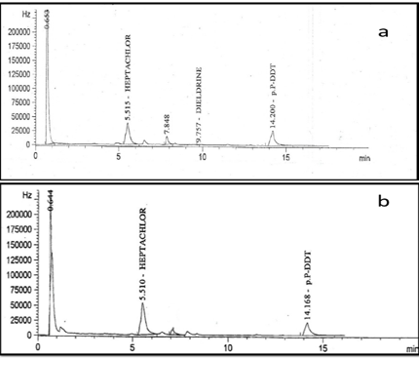
present in (Formula 1) in concentration of 0.0025, 0.001 and 0.0002 mg/kg respectively. However, (Formula 2) contained only Heptachlor and p.p-DDT in concentration of 0.003 and 0.002 mg/kg. These results are incompliance with the international standards limit as the concentration of Heptachlor, Dieldrin and p.p-DDT should not exceed 0.05, 0.05 and 0.2 respectively [12, 16, 17].
By analysis of GC chromatogram (Figures 1a & 1b), it was found that Heptachlor, Dieldrin and p.p-DDT were
Determination of Certain Microelements and Heavy Metals
Contamination of herbal materials with toxic substances can be attributed to many causes. These include environmental pollution (i.e. contaminated emissions from factories and leaded petrol and contaminated water, including runoff water, which finds its way into rivers, lakes and the sea, and some pesticides), soil composition and fertilizers. This contamination of the herbal material leads to contamination of the products during various stages of the manufacturing process [16, 17].
Samples have different batch numbers of Formula 1 and 2 are collected from different pharmacies for analysis of heavy metals. Results are tabulated in Table 2. It was found that all preparations contained Copper and Zinc. However, Cadmium and Lead are absent. Comparing the daily intake dose with the acceptable daily levels, it was concluded that the levels of Copper and Zinc did not exceed the maximum acceptable limits [18].
| Heavy metals | |||||
|---|---|---|---|---|---|
| Samples | Pb | Cd | Cu | Zn | Fe |
| Samples | Nd | Nd | 6.27 | 7.82 | 19.72 |
| Formula 1 | Nd | Nd | 6.27 | 7.82 | 19.72 |
| Formula 2 | Nd | Nd | 7.32 | 8.12 | 20.43 |
| MPL* (mg/kg) | 10 | 0 | 20 | 50 | ** |
Table 3: Concentrations of certain microelements and heavy metals of (Formula 1 and 2) (mg/kg).
Determination of Microbial Contaminants
The need for the microbial quality control of commercial herbs is well clarified and recognized. This study aimed to evaluate the commercial herbs, as for their microbial contents. In addition, this study reflected the urgent need to reassess our methods of controlling the microbial contamination of commercial herbs. Total counts were used to assess sanitary quality, organoleptic acceptability, safety and utility of various herbal products. High viable count indicates poor sanitary quality, while low total counts do not necessarily carry the opposite implication [19].
Nine samples from three different batches of Formula 1 and 2 under study were represented by (A1, A2, A3, B1, B2, B3, C1, C2 and C3) and (A1o, A2o, A3o, B1o, B2o, B3o, C1o, C2 o and C3 o) respectively. The results obtained for bacterial and fungal count of both commercial samples were presented in Table 3.
The microbiological examination included the determination of total aerobic bacterial, total fungal and coliform counts as well as qualitative tests for identification of bacteria and fungi. Regarding Formula1 samples, it was found that the bacterial count ranged from 0–1x10³ cfu/gm. Three samples out of nine were free from bacteria while fungal count ranged from 0 – 2x10² cfu/gm and six samples were free from fungi. Qualitative tests for bacteria showed that three samples had S. epidemidis, while the main fungal isolates were M pusillus, F. oxysporum and A. candidus along with presence of yeast.
| Bacterial content | Fungal content | ||||||||||||||||||||||
|---|---|---|---|---|---|---|---|---|---|---|---|---|---|---|---|---|---|---|---|---|---|---|---|
| Batch | Serial | Total count | Coliform count | Detected Bacterial | Total count | ||||||||||||||||||
| Moulds | Y | ea | st | ||||||||||||||||||||
| No. | No. | cfu/gm | cfu/gm | species | cfu/gm | ||||||||||||||||||
| 1 | 1.0 X 10 | 0 | B. polymexa | 0 | - | - | |||||||||||||||||
| A | 2 | 1.0 X 10 | 0 | Micrococc-us spp. | 1.0 X10 | M. pusillus | - | ||||||||||||||||
| 3 | 1.0 X 10 | 0 | Micrococc-us spp. | 0 | - | - | |||||||||||||||||
| 1 | 2.0 X 10 | 0 | B. subtilis | 0 | - | - | |||||||||||||||||
| F. | |||||||||||||||||||||||
| B | 2 | 0 | 0 | - | 1.0 x 10² | - | |||||||||||||||||
| Oxysporum | |||||||||||||||||||||||
| 3 | 0 | 0 | - | 0 | - | - | |||||||||||||||||
| 1 | 1.0 X10³ | 0 | S. epidermidis | 0 | - | - | |||||||||||||||||
| C | 2 | 0 | 0 | - | 2.0 X10² | A. candidu | s | + | |||||||||||||||
| 3 | 3.0 X 10 | 0 | B. subtilis | 0 | - | - | |||||||||||||||||
| 1 | 2.0 X 10 | 0 | B. subtilis | 0 | - | - | |||||||||||||||||
| Aº | 2 | 2.0 X 10 | 0 | B. subtilis | 1.0 X 10 | A. niger | - | ||||||||||||||||
| 3 | 4.0 X 10 | 0 | S. epidermidis | 0 | - | - | |||||||||||||||||
| 1 | 1.0 X 10 | 0 | B. sphaericus | 0 | - | - | |||||||||||||||||
| Bº | 2 | 1.0 X 10 | 0 | S. epidermidis | 0 | - | - | ||||||||||||||||
| 3 | 1.0 X 10 | 0 | B. subtilis | 0 | - | - | |||||||||||||||||
| 1 | 1.0 X 10² | 0 | B. subtilis | 1.0 X 10 | A | .versicolo | r | - | |||||||||||||||
| Cº | 2 | 1.0 X 10 | 0 | S.epidermidis | 0 | - | - | ||||||||||||||||
| 3 | 3.0 X 10 | 0 | B. cereus | 1.0 X10³ | F. equiseti | + |
Table 4: Microbial contents of different batches of Formula 1 and 2.
Determination of Aflatoxins
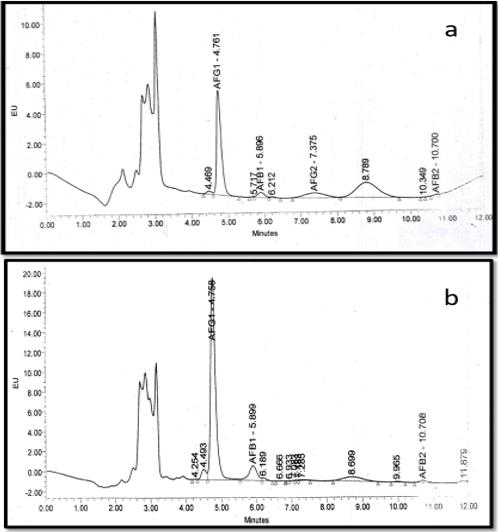
Aflatoxins are a naturally occurring toxic metabolite produced by certain fungi (Aspergillus flavis and A. Parasiticus) However, A. flavis is common and widespread. These mycotoxins could produce hepatocarcinoma as a result of aflatoxicosis when given in very low doses for laboratory animals. Consequently, the exposure of humans of these aflatoxins has dangerous adverse reactions [20]. Conditions like increasing moisture content; high temperature and insect damage Tests for aflatoxins are designed to detect the possible presence of aflatoxins B1, B2, G1 and G2, which are highly toxic contaminants in any material of plant origin. HPLC chromatograms of aflatoxins in Formula 1 and 2 were presented in Figures 2a and 2b. It was concluded that the total concentration of aflatoxins in herbal preparations (Formula 1 and 2) is (0.52 μg/kg) and (1.63 μg/kg) respectively which is much lower than the acceptable limits.
of natural products are major factors for mould infestation and toxin production.
GC/MS Analysis of Essential Oils of Different Herbal Preparations
Essential oils of four herbal preparations (Formula 1, 2, 3 and 4) were subjected to GC/MS analysis. Physical characters, yield %, total number of identified compounds and % of identified compounds in each herbal preparation was presented in Table 4 (Figure 3).
| Sample | Color of oil | Yield % | Total no. of identified compounds | % of identified compounds |
| Formula 1 | Pale yellow | 2.4 | 54 | 78.34 |
| Formula 2 | Pale yellow | 2.1 | 43 | 77.13 |
| Formula 3 | Dark yellow | 1.8 | 24 | 81.9 |
| Formula 4 | Straw yellow | 1.6 | 8 | 97.34 |
Table 5: Physical characters, yield %, total number of identified compounds and % of identified compounds of herbal Table 4: Phys
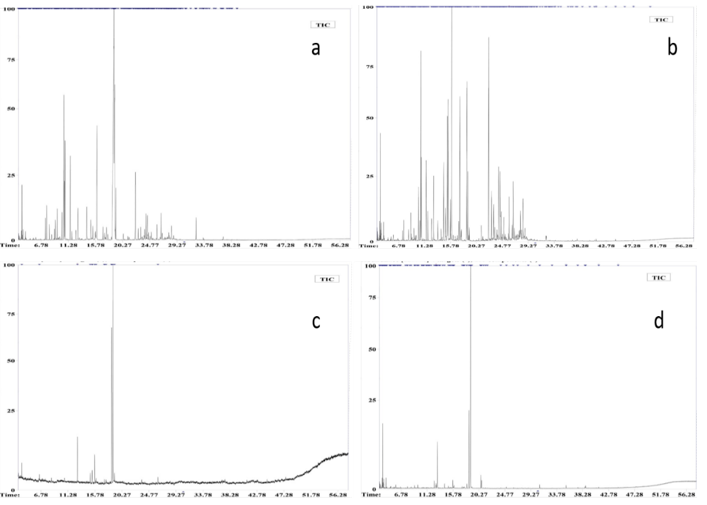
Concerning Formula 3, seven main components were identified representing (97.34%) of the total detected compounds, the major components were thymol (47.84%) and anethole (34.73%) followed by linalool (6.25%) and α-terpineol (4.38%). All the compounds representing oxygenated monoterpenes. Twenty-four compounds were identified representing (81.9%) of the total detected compounds in formula 4. Thymol (63.24%) was the major component followed by anethole (9.33%) with monoterpenes and oxygenated monoterpenes representing (0.12%) and (78.76%) respectively. Identified components in the essential oil of each herbal preparation with their Kovat index and relative abundance are presented in Table 5.
| Kovat’s index (RI) | Rel. abundance* (%) | |||||||||||||||||||
|---|---|---|---|---|---|---|---|---|---|---|---|---|---|---|---|---|---|---|---|---|
| Identified Compounds | ||||||||||||||||||||
| Cal. | Reported | Formula 1 | Formula 2 | Formula 3 | Formula 4 | |||||||||||||||
| Furfural | 828 | 831 | -- | -- | -- | 0.17 | ||||||||||||||
| Chromor | 860 | 861.7 | 0.07 | -- | -- | 0.33 | ||||||||||||||
| Xylol | 843 | 850 | 0.01 | 0.14 | -- | -- | ||||||||||||||
| Camphene | 941 | 946 | 0.35 | -- | -- | -- | ||||||||||||||
| Almond oil | 947 | 956 | 0.13 | 0.25 | -- | -- | ||||||||||||||
| Sabinen | 968 | 971 | -- | 0.59 | -- | -- | ||||||||||||||
| Morillol | 977 | 982 | 0.51 | 0.09 | -- | 0.34 | ||||||||||||||
| Myrcene | 988 | 990 | 0.72 | -- | -- | -- | ||||||||||||||
| Fellandrene | 1003 | 1005 | 0.08 | 0.13 | -- | -- | ||||||||||||||
| Carene | 1009 | 1009 | 0.03 | -- | -- | -- |
| Terpilene | 1015 | 1019 | 0.7 | -- | -- | -- |
|---|---|---|---|---|---|---|
| p-cymene | 1024 | 1025 | 8.16 | -- | -- | -- |
| Carvene | 1028 | 1035 | 2.08 | 6.01 | -- | -- |
| Menthone | 1129 | 1129 | -- | 1.04 | -- | -- |
| Cineole | 1030 | 1030 | -- | 1.8 | -- | -- |
| Eucalyptol | 1031 | 1031 | 3.21 | -- | -- | -- |
| Ocimene | 1046 | 1046 | 0.03 | -- | -- | -- |
| Hyacinthin | 1045 | 1045 | 0.02 | 0.04 | -- | -- |
| Moselene | 1060 | 1062 | -- | 1.95 | -- | -- |
| α –pinene | 1060 | 1063 | 3.38 | 0.27 | -- | -- |
| Continental oil | 1071 | 1071.6 | -- | -- | -- | 0.07 |
| Fenchone | 1089 | 1089 | 0.32 | -- | -- | 0.86 |
| Linalool | 1100 | 1100 | 0.97 | -- | 6.25 | 0.52 |
| Chrysanthone | 1107 | 1124 | 0.07 | -- | -- | -- |
| Cymol | 1111 | 1113 | -- | 0.48 | -- | 0.11 |
| Thyjon | 1117 | 1117 | 0.03 | -- | 1.6 | -- |
| Bornanone | 1140 | 1143 | 1.18 | -- | -- | 0.59 |
| Estragol | 1158 | 1158 | 6.96 | 10.81 | -- | 0.15 |
| Menthol | 1175 | 1174 | -- | 5.08 | -- | -- |
| Pinanone | 1176 | 1176 | 0.04 | -- | -- | -- |
| Borneol | 1178 | 1178 | 1.77 | -- | -- | 0.25 |
| Camphor | 1168 | 1168 | 0.08 | 0.1 | 1.46 | 0.2 |
| Terpineol | 1179 | 1179 | 0.48 | 4.92 | 4.38 | 1.1 |
| Cymene | 1186 | 1186 | 0.05 | -- | -- | 0.12 |
| α -Terpinoel | 1194 | 1193 | -- | 1.16 | -- | -- |
| Carveol | 1230 | 1229 | -- | 0.2 | -- | -- |
| Neral | 1240 | 1240 | 0.11 | -- | -- | -- |
| Cartegine | 1252 | 1252 | 0.22 | -- | -- | -- |
| Carvone | 1256 | 1256 | 0.59 | -- | -- | 0.2 |
| Bergamol | 1257 | 1256 | -- | 5.81 | -- | -- |
| Pipretone | 1258 | 1258 | 0.03 | 0.27 | -- | 0.39 |
| Agallaiene | 1280 | 1292 | -- | 0.39 | -- | -- |
| Citeral | 1286 | 1197 | 0.13 | -- | -- | -- |
| Anethole | 1298 | 1199 | 34.15 | 7.41 | 34.73 | 9.33 |
| cymenol | 1307 | 1299 | -- | -- | 1.08 | -- |
| Thymol | 1310 | 1297.6 | 1.42 | 2.21 | 47.84 | 63.24 |
| Eugenol | 1336 | 1335 | -- | -- | -- | 1.67 |
| Carvacrol | 1358 | 1297.6 | 3.11 | 0.34 | -- | 0.15 |
| Prunolide | 1366 | 1365 | -- | -- | -- | 0.97 |
| Ylangene | 1376 | 1370.9 | 0.02 | -- | -- | -- |
| Copaene | 1380 | 1392 | 0.1 | -- | -- | -- |
| Lutein | 1407 | 1407 | 0.01 | -- | -- | -- |
| Virdiflorene | 1419 | 1492 | 0.02 | -- | -- | -- |
| Caryophyllene | 1426 | 1440 | 3.15 | 8.65 | -- | -- |
| Calrene | 1435 | 1427.7 | 0.02 | 0.05 | -- | -- |
| Alloaromadendrene | 1440 | 1415 | -- | 1.53 | -- | -- |
| Humulene | 1461 | 1459 | 0.36 | 0.96 | -- | -- |
| Guaiene | 1480 | 1423 | -- | 0.04 | -- | -- |
| Muurolenne | 1483 | 1486 | 0.18 | 2.53 | -- | -- |
| Curcumene | 1487 | 1474 | -- | 0.19 | -- | -- |
| Eudesmene | 1495 | 1483 | 0.87 | -- | -- | -- |
| Selinene | 1504 | 1491.6 | 0.82 | 2.39 | -- | -- |
| Longipinene | 1509 | 1353 | 0.02 | -- | -- | -- |
| Bisabolene | 1500 | 1501.2 | 0.23 | 0.75 | -- | -- |
| Cadinine | 1522 | 1563 | 0.12 | 0.21 | -- | -- |
| Calamenene | 1530 | 1516 | -- | 0.93 | -- | -- |
| Patchoulene | 1536 | 1464 | 0.03 | -- | -- | -- |
| Globulol | 1569 | 1568 | -- | 1.5 | -- | -- |
| Persicol | 1579 | 1578 | -- | -- | -- | 0.09 |
| Viridiflorol | 1601 | 1594 | 0.23 | 2.17 | -- | -- |
| Ledol | 1613 | 1568 | -- | 0.18 | -- | -- |
| Globulol | 1623 | 1642 | -- | 0.24 | -- | -- |
| Guaiene | 1637 | 1423 | 0.12 | 0.33 | -- | -- |
| Cadinol | 1655 | 1646 | 0.09 | -- | -- | -- |
| Torreyol | 1656 | 1646 | -- | 1.07 | -- | -- |
| Camphor-juniper | 1667 | 1675 | 0.64 | 1.87 | -- | -- |
| Ascarboil | 1773 | 1693 | -- | -- | -- | 0.51 |
| Ethyl palmatate | 1990 | 1991 | -- | -- | -- | 0.36 |
| Epimanool | 2063 | 1970 | 0.11 | -- | -- | -- |
| Staric acid | 2135 | 2133 | 0.01 | 0.05 | -- | -- |
| Mandenol | 2168 | 2155 | -- | -- | -- | 0.18 |
| Total identified | 78.34 | 77.13 | 97.34 | 81.9 |
Conclusion
This study was done to check the quality, safety of certain herbal formulations in the Egyptian market. The results assured that these herbal products are effective and safe when compared to the international standards. This study recommends to screen and investigate other products for safety and efficacy.
References
-
**Pesticide standards:** α-HCH, β-HCH, δ-HCH, Heptachlor, Heptachlor-epoxide, Aldrin, γ-Chlordane, Dieldrin, p,p'- DDE, Endrin, o,p'-DDT, p,p'-DDD and p,p'-DDT were purchased from Chem. Service, Inc (West chester, PA), supplied by Agricultural Pesticide Committee (APC), Ministry of Agriculture, Dokki, Giza, Egypt. **Aflatoxins:** Aflatoxins B1, B2, G1 and G2 were supplied from Mycotoxins Central Lab. and Food Safety, National Research Center, Dokki, Giza, Egypt. **Heavy metals and microelements:** Metals stock standards of Cd, Cu, Fe, Pb and Zn were obtained from Merck, Darmstadt, Germany (Merck's ampoules; 1000mg).
- Acido Labile or Gastro Irritant Apis and Enteric Release in Galenic Practice: An Overview
- A Study on Knowledge, Attitude and Practice of Hand Hygiene among Healthcare Professionals at a Tertiary Care Hospital, India
- Influence of Inoculum Concentration on In Vivo Incubation Period of Emmia lacerata, Pathogenesis and Management of Wilt in Pepper (Capsicum annuum L.)
- Vanilla’s Chemistry
- Marine Anti-Cancer Compounds and Adverse Effects of Global Warming on Oceans: An Overview
- Serological Investigation of Chikungunya Virus Antibody among Malaria-Suspected Febrile Patients in Some Healthcare Facilities in Rivers State