
Pharmaceutical Formulation Analysis Based on Ion Selective Electrode Determination using Drug of Levamisole and its Application
In this work ion-selective electrode is much simpler, more rapid and more economic than various other analytical methods. Four novel levamisole ion selective electrodes were fabricated, characterized and used for determination of levamisole in pharmaceutical formulations. The proposed sensors incorporated levamisole ammonium reineckate or levamisole potassium tetraiodomercurate ion pair complexes as electroactive materials in PVC matrix membrane and dioctylphthalate or o-nitrophenyloctyl ether as solvent mediators. The sensors exhibited fast and stable near Nernstian cationic response of 57±0.1 mV and 39 ± 0.5 mV/ concentration decade of levamisole in the concentration range of 1.0× 10⁻⁶ -1.0× 10⁻¹ M, receptively. The lower limit of detection was 0.21± 0.7 ppm. It was found that sensor based on ammonium renickate as ionic counter and o- nitrophenyloctyl ether was the best and was used throughout this investigation in pH range.
Introduction
Levamisole is a synthetic imidazothiazole derivative that has been widely used in treatment of worm Pharmaceutical Formulation Analysis Based on Ion Selective Electrode Determination using Drug of Levamisole and its Application infestations in both humans and animals. As an anthelmintic, it probably works by targeting the nematode nicotinergic acetylcholine receptor. As an immunomodulator, it appears that Levamisole is an immunostimulant which has been shown to increase NK cells and activated Tumor -cells in patients receiving [1, 2].
In recent years, the development and application of ion selective electrodes have been widely used in pharmaceutical analysis because these sensors offer the advantage of simple design, low cost, adequate selectivity, J Pharm Res
low detection limit, high accuracy, fast response time, wide concentration range, applicability to colored and turbid solutions and possible interfacing with automated and computerized systems [3, 4, 5, 6]. Such pharmaceutical substance - sensitive sensors can be constructed by incorporating an appropriate ion exchangers or ionic carriers and solvents mediator into a poly (vinyl chloride) PVC membrane matrix [7].
In the present work, the accumulated knowledge and experience with conventional ion selective electrodes we used for drug determination with a sensor having good analytical properties with respect to sensitivity, selectivity, response time, Nernstian slope and lifetime in aqueous samples. The study describes construction and electrochemical evaluation of a novel poly (vinyl chloride) matrix membrane selective sensor for levamisole. The sensor is based on the incorporation of ion pair complexes such as ammonium reineckate and potassium tetraiodomercurate as an ionic carriers and dioctylphthalate or o-nitrophenyloctyl ether as a solvent mediator. The proposed sensors were characterized and used to determine the drug in pure powders and pharmaceutical preparations. The sensors were also successfully used as indicator electrode for the titration of levamisole with silver ions.
Levamisole (6S)-6-Phenyl-2,3,5,6-tetrahydroimidazo [2,1-b]thiazole hydrochloride is a broad spectrum anthelmintic. It is widely used for the control of gastro- intestinal parasites in cattle, sheep and pigs. It is normally administered by pour-on or by direct subcutaneous or intramuscularly injection. Various methods have been reported for the determination of levamisole including gas chromatography (GC) [8, 9], mass spectrometry [10, 11, 12], high-performance liquid chromatography (HPLC) [13, 14, 15, 16, 17] liquid chromatography (LC) [18] and immunobiosensor which has been used for detection of levamisole residues in meat and milk. This assay was shown to have good sensitivity but required additional validation for tissue and milk matrices [19]. In the literature survey no potentiometric methods have yet been reported for the determination of levamisole.
Experimental
Chemicals and Reagents
Pure Levamisole HCl was obtained from Pharmasweds (Saudi). Dosage forms containing levamoisole (Katrex tablet 40 mg/tablet and Katrex syrup 40 mg/5ml) were provided from local stores. High molecular weight poly (vinyl chloride) PVC was purchased from sigma (St. Louis, MO), ammonium reineckate NH4[(Cr(NH3)2(SCN)4], potassium tetraiodomercurate (K2HgI4), dioctylphthalate (DOP) and o-nitorpheyloctyl ether (NPOE) were obtained from Aldrich (Milwaukee, WI, USA). Tetrahydrofuran (THF) was obtained from BDH (Pook, England) and freshly distilled before use. All other reagents were of highest purity available and used without further purification. All standard solutions and buffers were prepared with deionized water.
Equipment
All potentiometric measurements were carried out with a pH millivoltmeter (Orion model 720) at 25± 1˚C using the developed levamisole membrane sensors in conjunction with a double junction Ag /AgCl reference electrode (Orion model 90-02) containing (10 % w/v) KNO3 in the outer compartment. The following cell was used: Ag/AgCl / KCl (10-2M) / test solution/ PVC membrane/internal filling solution /AgCl /Ag. A combination Ross glass pH electrode (Orion model 81-02) was used for all pH-measurements. The potential reading of stirred 10-2-10-6 M levamisole HCl were measured and recorded after stabilization to ± 0.1mV.
Preparation of Levamisole Ion-Pair Complex and Sensor Construction
Plasticized PVC membrane sensor was prepared as previously described [20, 21, 22, 23, 24]. A 20 ml aliquot of 10-2 M levamisole HCl was carefully transferred to 100 ml beaker followed by 40 ml of 10-2 M of the ionic counter solutions (ammonium reineckate or potassium tetraiodomercurate). Pink or yellow precipitate of levamisole ammonium reineckate or levamisole potassium tetraiodomercurate ion pair complexes was obtained. After stirring, the precipitates were filtered off, washed with distilled water, dried at room temperature for 24 hour, ground to a fine powder and verified by the elemental analysis. The results of the elemental analysis of the ion pair complex show C: H: N: Metal ratio of [34.42:3.65:21.4:9.96] compared to [34.41:3.63:21.41:9.94] indicating the formation of levamisole ammonium reineckate ion pair 1:1 molar ratio, [(C11H13N2S)][Cr(NH3)2(SCN)4]. The second ion pair calculated ratio is [23.61:2.32:5:17.93] and found ratio is [23.59:2.33:5.01:17.95] indicating the formation of 2:1 levamisole potassium tetraiodomercurate ion pair [(C10H13N3)2][HgI4] (Figure 1). The results are comparable with previously reported results [25].
An l0 mg portion of levamisole-ammonium reineckate or levamisole tetraiodomercurate ion pair complexes was thoroughly mixed in a glass Petri dish (5 cm diameter) with 450 mg of DOP or NPOE, 190 mg PVC and 5 ml THF. The resulting clear mixture was covered with filter paper and left to stand overnight to allow slow evaporation of the solvent at room temperature. Transparent disks (10 mm diameter) were sectioned and glued onto PVC tubing (3 cm lengths, 8 mm internal diameter) by THF. The electrode body was filled with an internal reference solution of an equal volume of 10-2 M KCl and 10-2 Mof levamisole solution. An Ag/AgCl internal reference (3 mm diameter) was immersed in the internal reference solution. The sensors were conditioned before use by soaking overnight in 10-3 M of levamisole and stored in the same solution when not in use. The detection limit, linear range, and selectivity coefficients were determined as in references [26].
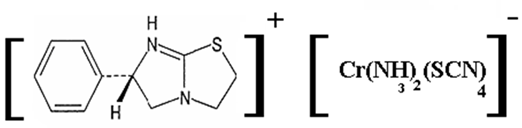
Levamisole ammonium reineckate ion pair
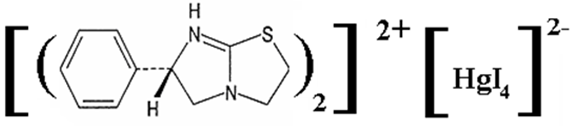
Levamisole teteiodomercurateion pair Figure 1: Levamisole ion-pair complexes.
Results and Discussion
Linear response range, sensitivity, lower and higher detection limits are obtained by calibrating the sensor using a wide concentration range. Other important characteristics, principally selectivity and some time- dependent properties, like response speed, signal stability and lifetime, require special measurements. In particular, the response speed has a great effect in determining the sensor stability in batch measurements. Moreover; evaluation of this property is a prerequisite of paramount importance for determining correct calibration parameters. All EMFs measured in calibration should ideally be equilibrium or, at least, stationary state values. The time necessary to reach such conditions is determined.
Effect of pH and Response Time
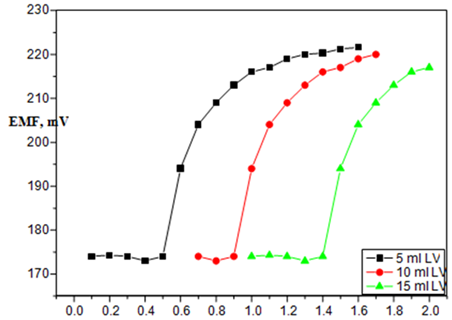
Potential variation over the pH was Measuring the range 2-10 for 10-5 and 10-4 M levamisole solutions evaluate the influence of pH on the response of the proposed sensor. The pH was adjusted using 0.1N hydrochloric acid or sodium hydroxide. The obtained data reveal a stable response over the pH range 3-6 (Figure 2). No significant change in the membrane potential was noticed by more than ±1 mV. Acetate buffer of pH 4 was used throughout all measurements as a background electrolyte. The dynamic response time, is the time, which elapses between the instant at which an ion-selective electrode and a reference electrode (ISE cell) are brought into contact with a sample solution (or at which the activity of the ion of interest in a solution is changed [27] and the first instant at which the emf/time slope (ΔE/Δt) becomes equal to a limiting value on the basis of the experimental conditions and/or requirements concerning the accuracy. In this study, the practical response time is recorded by changing the drug concentration from 10-2 to 10-6 M. The actual potential versus time is shown in Figure 3. It can be seen, in all concentration ranges the fabricated sensors reached their equilibrium response in a very short time (<10 s).
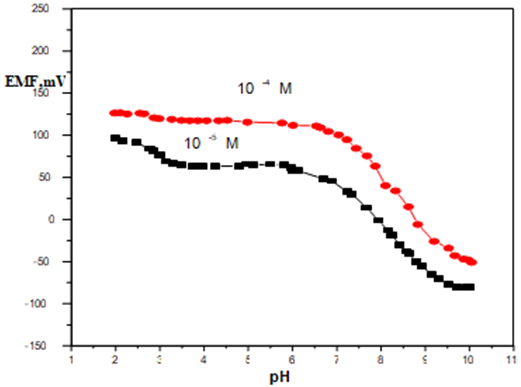
-NPOE membrane sensor
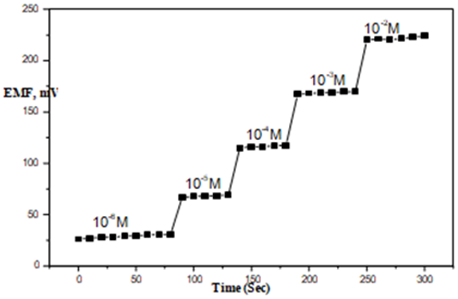
Characteristics of the Sensors and its Response
The amount of lipophilic salt should be sufficient to obtain reasonable ionic exchange sites at the gel layer/test solution interface, which is responsible for the membrane potential. Also the amount of plasticizer should be such that a membrane with good physical properties is produced, which at the same time efficiently act as a solvent mediator for the ion-exchangers lipophilic salts [28, 29]. Levamisole PVC membrane sensors based on two ion pairs and incorporating two plasticizers (levamisole reineckate, o-NPOE (sensor I) or DOP (sensor, II) and levamisole tetraiodomercurate, o-NPOE (sensors III) or DOP (sensors IV) were prepared and characterized.
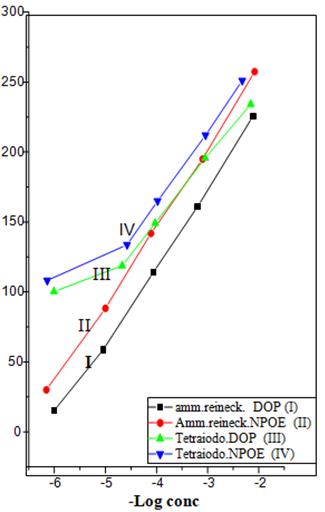
Several membrane compositions were investigated in which the ion-exchanger percentage ranged from 1.0- 10.0%. The best performances were obtained by using a composition of 1.5 wt. % ion pair, 33.8 wt. % PVC and 64.7wt % plasticizer. The above optimum composition was used to prepare membrane sensors for all further investigations. General performance characteristics of the sensors are presented in Table 1 and represented graphically in Figure 4.
It can be seen from the results by plotting the concentrations against the corresponding e.m.f. values, the linear response range covers 1.0×10⁻⁶- 1.0×10⁻¹M and the lower detection limit is 9 x 10⁻⁷ M with sensors I and II. The slope of the linear range is 57 ± 0.1 mV per concentration decade. The calibration plot of sensors III and IV show linear response for concentration range of 1.0×10⁻⁵ to 1.0×10⁻¹ M and the lower limit of detection is 1.0× 10⁻⁵ M. The slope of the curve is 30±0.5 mV per decade. The repeatability of the potential reading for sensor I was examined by subsequent measurements of 1.0 × 10⁻³ M of levamisole solution immediately after measuring the first set of solution at 1.0 × 10⁻⁴ M of levamisole solution. The standard deviations of measuring emf for 5 replicate measurements obtained are 0.2 mV for the solution of 1.0×10⁻⁴ M and 0.1 mV for the solution of 1.0 × 10⁻³ M. This means that the repeatability of potential response of the sensor is good. The response properties of the proposed sensor do not change after the use of the electrode for two months.
Potentiometric Selectivity
The most important characteristic of any sensor is the selectivity is, which defines the extent to which it may be used to estimate the particular ionic species in real samples to be selective over all other ions likely to be present in actual samples along with determined species.
The separate solutions method was used to evaluate the selectivities of the sensors. The potentiometric selectivity Where Zi: charge of the primary molar gas, constant, T: absolute temperature and F: Faraday’s constant (96487 cal mole-1). The results are summarized in Table 2. Inorganic cations, such Na+, K+, Ca2+, Mg2+, etc. and some organic compounds tested, do not interfere. Excipients such as corn starch, magnesium stearate, lactose, etc. in levamisole formulations do not interfere with the determination of levamisole since they have smaller selectivity coefficients values.
pot B leva k , coefficients (log ) were experimentally determined in which the cell potential was measured for the same concentration (ai =aj = 1.0 × 10⁻³ M) of the primary ion solution and interfering ion separately. The obtained cell potential for interfering ions and analyte ion ΔEj and ΔEi, respectively are inserted into the following equation to calculate the selectivity coefficient, log Ki,jpot [30].
$$ = \frac {\left(\Delta E _ {\mathrm {j}} - \Delta E\right)}{2 . 3 0 3 \mathrm {F}} $$ F )Z E E ( K log i i j pot ij
2.303RT
| Parameter | Levamisole amm. Reineckate | Levamisole | ||||||||||||
|---|---|---|---|---|---|---|---|---|---|---|---|---|---|---|
| tetraiodomercurate | ||||||||||||||
| DOP(I) | o-NPOE(II) | DOP(III) | o- NPOE(IV) | |||||||||||
| Slope, (mV decade-1) | 54.5±0. 2 | 57±0.2 | 36± 0.1 | 39± 0.1 | ||||||||||
| Correlation coefficient, (r) | 0.999 | 0.998 | 0.9985 | 0.996 | ||||||||||
| Intercept, (mV) | 337 | 370 | 303 | 326 | ||||||||||
| Linear range, (M) | 1x10⁻⁶-10-1 | 2x10⁻⁶-10-1 | 3.16x10⁻⁵ -10-1 | 2.50x10⁻⁵-10-1 | ||||||||||
| Detection limit, (ppm) | 0.24 | 0.21 | 2.4 | 2.4 | ||||||||||
| pH range | 03-Jun | 03-Jun | 3 – 6 | 3 – 6 | ||||||||||
| Response time, (sec) | 15 | 10 | 30 | 30 |
- Table 1: Performance characteristics of levamisole membrane sensor. a, Relative standard deviation for five measurements pot
- B leva k
- ,
- Interferent, B
- Na+
- 1.6x 10⁻⁴
- Cu++
- 7.29 x 10⁻³
- Mg++
- 7.21 x 10⁻³
- Li+
- 6.96 x 10⁻³
- Ni++
- 6.61 x 10⁻³
- Cl-
- 7.24 x 10⁻³
- K+
- 7.48 x 10⁻³
- Ca++
- 5.30 x 10⁻³
- Hg++
- 2.05 x 10⁻³
- Ag+
- 6.18 x 10⁻³
- Citrate
- 3.94 x 10⁻³
- Glucose
- 6.56 x 10⁻³
- Fructose
- 7.50 x 10⁻³
- Stearate
- 2.7x10⁻³
- Maltose
- 6.86 x 10⁻³
Table 2: Selectivity coefficients of levamisole membrane
The investigated sensor was proved to be useful in the potentiometric determination of levamisole in pure samples were determined using standard method (atomic absorption spectrometry) (AAS) (Table 3). These results were compared with those obtained from proposed method by applying F- and t-tests. The calculated F-values were found to be in the range 1.02–3.15 which are lower than the tabulated value (6.39 at 95% confidence limit and 5 degree of freedom) while, the t-values were found in the range 0.25–1.82, which are lower than the tabulated value at 99.9% confidence limit and 5 degree of freedom . This means that the present methods are of comparable precision to that of the AAS method and there is no significant difference between the mean values obtained by both methods.
| Parameter | Taken/mg | Found/mg | Mean recovery, % | RSDa% | ||||||||||
|---|---|---|---|---|---|---|---|---|---|---|---|---|---|---|
| 1) Potentiometric Titration | 1.2 | 1.22 | 101.6 | 0.01 | ||||||||||
| 2.4 | 2.39 | 99.6 | 0.07 | |||||||||||
| 3.6 | 3.58 | 99.4 | 0.63 | |||||||||||
| 2) Standard addition | ||||||||||||||
| Katrex40 mg/tablet | 40 | 40.2 | 100.5 | 0.05 | ||||||||||
| Katrex, 40 mg/5ml | 40 | 40.2 | 100.5 | 0.03 | ||||||||||
| 3) Atomic absorption | ||||||||||||||
| Katrex 40 mg/tablet | 40 | 40.4 | 101 | 0.01 | ||||||||||
| Katrex, 40 mg/5ml | 40 | 40.4 | 101 | 0.02 |
Conclusions
Ion-selective electrodes are much simpler, more rapid and more economic than various other analytical methods. Four novel levamisole ion selective electrodes were fabricated, characterized and used for determination of levamisole in pharmaceutical formulations. The proposed sensors incorporated levamisole ammonium reineckate or levamisole potassium tetraiodomercurate ion pair complexes as electroactive materials in PVC matrix membrane and dioctylphthalate or o-nitrophenyloctyl ether as solvent mediators. The sensors exhibited fast and stable near Nernstian cationic response of 57±0.1 mV and 39 ± 0.5 mV/ concentration decade of levamisole in the concentration range of 1.0× 10⁻⁶ -1.0× 10⁻¹ M, receptively. The lower limit of detection was 0.21± 0.7 ppm. It was found that sensor based on ammonium renickate as ionic counter and o- nitrophenyloctyl ether was the best and was used throughout this investigation in pH range.
The sensor displayed a good selectivity for levamisole with respect to number of common foreign inorganic, organic species, excepients and the fillers added to the pharmaceutical preparations. The sensors were successfully applied for the determination of levamisole in its tablets and syrups. It is also used as indicator electrode in the titration of levamisole with AgNO3.
References
-
Culetto E, Baylis HA, Richmond JE, Jones AK, Fleming JT, et al. (2004) The Caenorhabditis elegans unc-63 gene encodes a levamisole-sensitive nicotinic acetylcholine receptor alpha subunit. J Biol Chem 279(41): 42476-4283.
-
Rayes D, Flamini M, Hernando G, Bouzat C (2007) Activation of single nicotinic receptor channels from Caenorhabditis elegans muscle. Mol Pharmacol 71(5): 1407-1415.
-
Zhang ZZ, Cosofert VV (1990) New developments in pharmaceutical analysis with membrane sensors. Sel Electrode Rev 12(1): 13-35.
-
Cosofert VV, Buck RP (1993) Recent Advances in Pharmaceutical Analysis with Potentiometric Membrane Sensors. Crit Rev Anal Chem 24(1): 1-58.
-
Shamsipur M, Alali FJ, Haghgoo S (2002) Preparation of a cimetidine ion-selective electrode and its application to pharmaceutical analysis. J Pham Biomed Anal 27(6): 867-872
-
Stefan RI, Baiulescu GE, Abouenein HY (1997) Ion- Selective membrane electrodes in pharmaceutical analysis. Crit Rev Anal Chem 27(4): 307-321.
-
Cosofert VV (1982) Membrane Electrode in drugs Substances Analysis. Pergamon Press, Oxford.
-
Woestenborghs R, Michielsen J, Heykants J (1981) Determination of levamisole in plasma and animal tissues by gas chromatography with thermionic specific detection. J Chromatogr 224(1): 25-32.
-
Schenck FJ, Podhorniak LV, Wagner R (1988) A highly sensitive gas chromatographic determination of levamisole in milk. Food Addit Contamin 15(4): 411- 414.
-
Stout SJ, daCunha AR, Tondreau RE, Boyd JE (1988) Confirmation of levamisole residues in cattle and swine livers by capillary gas chromatography- electron impact mass spectrometry. J Assoc Off Anal Chem 71(6): 11501153.
-
Alvinerie M, Galtier P, Escoula GJ (1981) Ion-pair high-performance liquid chromatographic assay of levamisole in biological fluids. Chromatogr 233(2): 445-448.
-
Österdahl BG, Johnsson H, Nordlander I (1985) Rapid Extrelut column method for determination of levamisole in milk using high-performance liquid chromatography. J Chromatogr 337(1): 151-155.
-
Garcıa JJ, Diew MJ, Sierra M, Terán MT (1990) Determination of Levamisole by HPLC in Plasma Samples in the Presence of Heparin and Pentobarbital. J Liq Chromatogr 13(4): 743-749.
-
Wyhowski de Bukanski B, Degroodt JM, Beernaert H (1991) Determination of levamisole and thiabendazole in meat by HPLC and photodiode array detection. Z Lebensm Unters Forsch 193(6): 545-547.
-
Vandamme ThF, Demoustier M, Rollmann B (1995) Quantitation of levamisole in plasma using high performance liquid chromatography. Eur J Drug Metab Pharmacokinet 20(2): 145-149.
-
Cannavan A, Blanchflower WJ, Kennedy DG (1995) Determination of levamisole in animal tissues using liquid chromatography–thermospray mass spectrometry. Analyst 120(2): 331-333.
-
Chappell CG, Creaser CS, Stygall JW, Shepherd MJ (1992) On‐line high‐performance liquid chromatographic/gas chromatographic/tandem ion trap mass spectrometric determination of levamisole in milk. Biol Mass Spectrom 21(12): 688-692.
-
De Ruyck H, Van Renterghem R, De Ridder H, De Brabander D (2000) Determination of anthelmintic residues in milk by high performance liquid chromatography. Food Control 11(3): 165-173.
-
Crooks SRH, McCarney B, Traynor IM, Thompson CS, Floyd S, et al. (2003) Detection of levamisole residues in bovine liver and milk by immunobiosensor. Analytica Chimica Acta 483: 181-186.
-
Hassan SSM, Marzouk SAM (1994) A novel ferroin membrane sensor for potentiometric determination of iron. Talanata 41(6): 891-899.
-
Hassan SSM, Elmasslany MAF (1985) Microdetermination of mercury using silver and copper ion selective electrodes with silver- dithiooxamide and copper-diethyldithiocarbamate loaded polyurethane foams. Mickrochimo Acta 111(1- 2): 123-131.
-
Hassan SSM, Mahmed WH (1995) PVC matrix membrane electrodes based on cobalt and nickel phenanthroline complexes for selective determination of cobalt(II) and nickel(II) ions. Mikrochim Acta 117(3-4): 121-128.
-
Hassan SSM, Mahmoud WH, Othman AHM (1997) A novel potassium ion membrane sensor based on rifamycin neutral ionophore. Talanta 44(6): 1087- 1094.
-
Hassan SSM, Tadros FS (1984) Liquid and poly(vinyl chloride) atropine-reineckate membrane electrodes for determination of atropine. Anal Chem 56(3): 542- 546.
-
Issa YM, Ibrahim H, Shoukry AF, Mohamed SK (1995) Indirect atomic absorption and atomic emission spectrometric determination of antazoline, hydralazine and amiloride hydrochlorides and quinine sulphate. Mikrochim Acta 118(3-4): 257-263.
-
Bakker E, Pretsch E, Buehlmann P (2000) Selectivity of Potentiometric Ion Sensors. Anal Chem 72(6): 1127-1133.
-
Guilbault GG, Durst RA, Frant MS, Freiser H, Hansen EH, et al. (1976) Recommendations for Nomenclature of ion-selectiveelectrodes. Int Union Pure Appl Chem 48: 127-132.
-
Buck RP, Linder E (1994) Recomendations for nomenclature of ion-selective electrodes. Int Unoin Pure Appl Chem 66: 2527-2536.
-
Abdel-Ghani NT, Rizk MS, El Nasher RM (2000) Salbutamol plastic membrane electrodes based on individual and mixed ion-exchangers of salbutamolium phosphotungstate and phosphomolybdate. Analyst 125(6): 1129-1133.
-
Rosatzin T, Bakker E, Suzuki K, Wsimon S (1993) Lipophilic and immobilized anionic additives in solvent polymeric membranes of cation-selective chemical sensors. Anal Chem Acta 28(2): 197-208.
-
Miller JC, Miller JJ (1984) Statistics for Analytical Chemistry. Ellis Horwood Limited, Chichester, UK, pp: 1-90.
- Acido Labile or Gastro Irritant Apis and Enteric Release in Galenic Practice: An Overview
- A Study on Knowledge, Attitude and Practice of Hand Hygiene among Healthcare Professionals at a Tertiary Care Hospital, India
- Influence of Inoculum Concentration on In Vivo Incubation Period of Emmia lacerata, Pathogenesis and Management of Wilt in Pepper (Capsicum annuum L.)
- Vanilla’s Chemistry
- Marine Anti-Cancer Compounds and Adverse Effects of Global Warming on Oceans: An Overview
- Serological Investigation of Chikungunya Virus Antibody among Malaria-Suspected Febrile Patients in Some Healthcare Facilities in Rivers State