
Trametes Versicolor and Dictyophora Indusiata Champions of Medicinal Mushrooms
Overall, studies both on the chemistry and pharmacology of rametes versicolor and Dictyophora indusiata extracts and compounds are increasing in recent years and show therapeutic potential for various pathologies. The purpose of this review was to investigate the biological activities of polysaccharide extracts prepared from fruiting bodies of Trametes versicolor and Dictyophora indusiata.
Introduction
Mushrooms have been valued throughout the world both as food and medicine; mushrooms possess high contents of qualitative protein, crude fibre, minerals and vitamins [1, 2, 3]. With the development of methods for the artificial cultivation of mushrooms, several mushrooms are now cultivated at a commercial scale and many of them have been developed as supplemental foods [4]. Apart from their nutritional potentials, mushrooms are also sources of physiologically beneficial bioactive substances that promote good health [5, 6]. They produce a wide range of secondary metabolites with high therapeutic value [7]. Health promoting properties, e.g. antioxidant, antimicrobial, Antiviral, anticancer, cholesterol lowering and immunostimulatory effects, have been reported for some species of mushrooms [8, 9, 10, 11, 12, 13, 14]. Both fruiting bodies and the mycelium contain compounds with wide ranging antioxidant and antimicrobial activities [15, 16, 17, 18]. As sources of antioxidants, edible mushrooms are desirable since they are safe to eat and known not to place additional stress on the body [6]. Mushrooms need antibacterial and antifungal compounds to survive in their natural environment. Hence, they are rich sources of natural antibiotics [19].
Mushroom Polysaccharides
Mushrooms, whether belong to the class Basidiomycetes or Ascomycetes, are considered precious food resources that widely distributed all over the world. For more than 2000 years, mushrooms have been greatly consumed due to their nutritional and medicinal values [20, 21]. In eastern Asia, a wide variety of bioactive compounds have been isolated from various medicinal mushrooms, and these compounds have been widely used and extensively studied. Polysaccharides, lectins, alkaloids and terpenoids have been reported among the important bioactive compounds [22, 23]. Among these bioactive compounds, polysaccharides are considered the main bioactive component for many mushroom species. The diverse activities displayed by polysaccharides return to their unique structure and properties. These activities include antitumor, antioxidative, immunomodulatory, hepatoprotective, antiviral and hypoglycemic as well as anti-inflammatory effects [22, 23]. The polysaccharides compositions are directly related to their pharmaceutical activities, and increasing research attention has been directed to the structure-activity relationship [24, 25]. Studying the various polysaccharides synthetic pathways as well as their regulatory mechanisms is of great importance in order to produce biologically and chemically uniform polysaccharides, hence obtaining reliable results. The polysaccharides biosynthetic pathways involve several steps starting with the synthesis of sugar precursors, followed by the assembly of repeating monosaccharide building units, and finally ending with the polymerization process [26, 27].
Recently, many studies have addressed the structures as well as the numerous bioactivities of mushroom polysaccharides. Here, we review the various biological activities of the glucan polysaccharides isolated from Trametes versicolor and Dictyophora indusiata mushrooms.
Trametes versicolor (Turkey Tail)
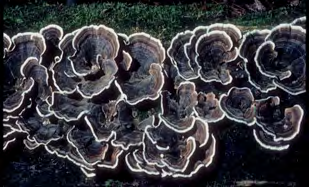
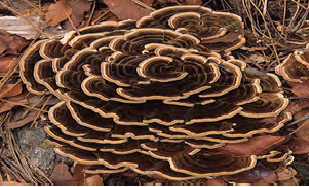
Trametes versicolor which is also known as Polyporus versicolor, Coriolus versicolor and Turkey tail belongs to the Basidiomycetes (Figures 1 & 2). It is a common traditional medicinal polypore mushroom that spreads throughout the world and grows on tree trunks [28, 29]. Many bioactive substances are isolated from this mushroom, such as polysaccharopeptide (PSP), amino acids, proteins, as well as other various compounds. PSP is considered the most biologically active compound that can be isolated from both mycelium or fermentation broth of Trametes versicolor [30].
Various strains of T. versicolor and different culture conditions greatly affect the produced polysaccharides properties including the structures and molecular weights [31, 32]. In China PSP used form is mostly produced from the ‘COV-1 strain’ [33], while in Japan the polysaccharide K (PSK) form is the most common and it is produced from the ‘CM- 101’ strain. Up to date, nearly thirteen types of T. versicolor based drugs and one T. versicolor based health products are used in different commercial and clinical products and they are authorized by the China State Food and Drug Administration (SFDA) [34]. These products include: Coriolus versicolor Gantai granules, Gansukang capsules, Polystictus Glycopeptide capsules, Posaverptidum capsules as well as other products.
As it was mentioned that PSP is the main active compound isolated can be obtained from the mycelium or fermentation broth of C. versicolor. The molecular weight of PSP significantly differs with different batches. Its molecular weight ranges from 36 kDa in the mycelium to 45 kDa in the fermentation broth. While its molecular weight in the fruiting body is about 75 kDa [34].
The extracellular PSP are mainly glucans without peptide where D-glucose content is about 99.2% of its structure. Its structure contains β (1–3) in the main chain and β (1–6) in the branches of the polysaccharide structure. However, the intracellular PSP from mycelium is formed of a glycopeptide with covalently linked peptides [35], its main monosaccharide compositions are glucose, mannose with β (1–4)-β (1–3) or β (1–4)-β (1–6) linked glucose backbone. The polysaccharide content is found to be 30–60%, while the protein content represents 10–30% [36, 37]. PSK is a proteoglycan that consists of a β-glucan with β-(1,4) linked glucose backbone and β-(1,3) and β-(1,6) linked side chains. Its molecular weight is about 100 kDa [38].
Antitumor and Immunity Enhancement Effects
Currently, the bioactive glucans and proteoglycans isolated from variable mushroom sources are considered among the most promising sources of immunoceuticals, this is due to their ability to augment different pathways of host immunity. The experiments proved that PSP and PSK have potent effect on many pathways exist in the immune system. PSK can restore a proper immune response in cancer patients moreover it improves the immunosuppressive state. It was also reported that PSK is a Toll-like receptors agonist, especially in TLR2 and TLR4 mediated signaling pathways.
In a similar way, PSP is found to stimulate the expression of TLR4 and TRAF6 (its downstream signaling molecule) [39]. PSP also enhances the natural killer cells (NK cells) activity in tumor immunity [40]. It activates complement system and promotes antibody formation by activating T lymphocytes, B lymphocytes and macrophages [41]. Additionally, PSP plays an important role in declining the tumor resulting immune cell function as well as decreasing the adverse side effects related to the cancer treatment including pain, fatigue and vomiting.
As the studies show that PSK and PSP major biologically active component are β-glucans, which have different structures from various sources. TLR-2, TLR-4, TLR -6 and complement receptor (CR3) are found to be immune receptors for β-glucans, where β-Glucans is responsible for the activation of some immune cells that express these receptors, these include: natural killer cells, neutrophils, monocytes, macrophages and dendritic cells. Consequently, both the innate and adaptive responses will be modulated by β-glucans either directly or indirectly [42].
Antihepatopathy Effect
Furthermore, PSP has been used in China as a traditional medicine for treating hepatitis [41]. It has been found that PSP reduces the serum level of ALT and AST and it also increase the negative conversion rate of HBVDNA, HBeAg, and HBsAg. In consequence, the combination of PSP with other hepatoprotective drugs such as, Mujimixture, Xinganbao capsule, Yiganle particles, as well as multivitamins, leads to better treatment comparing to the results of any single drug treatment [41, 42, 43].
Antioxidant Effect
Animal studies also show that PSP is able to scavenge free radicals in liver injured mice (induced by CCl4). PSP increases the activity of antioxidant enzymes and glutathione (GSH) that result in acceleration of the free radicals scavenging by reducing the nitric oxide synthase (NOS) activity and reducing the nitric oxide (NO) content. Thus, enhancing the antioxidant capacity of the body [44]. Moreover, PSP itself shows an antioxidation activity, however its free radicals scavenging ability is still less than vitamin C [34]. A synergistic effect on eliminating free radicals in liver injury is also noticed when PSP is combined with vitamin E [44].
Antihyperlipidemia Effect
PSP can also be used in treatment of hyperlipidaemia (high levels of some or all serum lipids and Lipoproteins including low density lipoproteins, cholesterol and triglycerides) as it reduces the lipid level [45, 46]. Antihyperlipidemia drugs such as statins and fibrate are highly effective, however they increase the risk of myopathyandrhabdomyolysis. Clinical
trials showed that the administration of PSP reduced the lipid levels significantly 240 patients [45]. PSP also reduces the levels of total cholesterol, low density lipoprotein and triglyceride, it also increases the high density lipoprotein in hyperlipidaemia mouse model. Recently, PSP has been identified to have antiatherosclerosis effect by controlling serum lipid level [34].
Toxicity and Teratogenicity of PSP
The acute toxicity tests results have shown that PSP oral administration tolerance dose (LD50) is 20 g·kg-1 while intravenous injection LD50 is 300.36 mg·kg-1 in mice. Indicating that PSP exhibits minimum acute toxicity. On the other side, the chronic toxicity tests have demonstrated that there is no visible chronic toxicity when PSP oral doses used in rat and monkey are increased 200 times and 100 times that of the clinical dose [29]. And interestingly, no mutagenic nor teratogenic effects are noticed in the used animal models [47].
Dictyophora Indusiata
Dictyophora indusiata (Vent.) Fisch. is an edible and medicinal mushroom that belongs to the family Phallaceae of the Agaricomycetes class (phylum Basidiomycetes) of fungi. In recent taxonomic literature, the synonym Phallus indusiata Vent. is the accepted name for the fungus though nearly all the scientific literature so far is available under the name entry of Dictyophora indusiata. As a saprophytic fungus, it grows in well‐rotted woody trunk or rich soil of tropical Africa, Asia, Australia and the Americas, Figure 3. Its food and medicinal value are however much appreciated in the far eastern countries such as China where it grows on the wet roots of bamboo groves and in forests. Its common local names mainly in China and Japan include bamboo mushrooms, bamboo pith, long net stinkhorn, crinoline and stinkhorn basket, but perhaps the names most vividly associated with the morphologically distinctive feature of the fungus are bridal veil fungus, veiled lady or queen of the mushrooms [48].
Dictyophora indusiata and many other Dictyophora mushrooms distribute widely around the world. Dictyophora indusiata (Vent.) Desv. (Phallus indusiatus Vent.) is an edible mushroom that is considered a good delicacy by the Chinese. The species is also known as “Veiled Lady Mushroom” and belongs to the family of Phallaceae Corda. The fruiting body begins as an “egg” stage, from which the phallic-looking basidioma emerges over the course of just a few hours. Like other edible mushrooms, Dictyophora indusiata sourced both from the wild and commercial sources has nutritional value and its protein, carbohydrates, and dietary fibre contents have been extensively studied [49, 50]. Likewise, the amino acids, vitamins and inorganic elements composition of Dictyophora indusiata have been reported [51].
Antioxidant and Antimicrobial Effect
The antioxidant property of methanolic extract from Dictyophora indusiata had been reported by Mau, et al. [52] due to the presence of water soluble phenolics in Water Extract. Trung Kien Nguyen, et al. [53] showed that Dictyophora indusiata extracts have excellent DPPH scavenging and chelating activity on the ferrous ions compared with positive control. Therefore, the experimental results suggested that methanol and hot-water extracts of Dictyophora indusiata fruiting bodies might be used for natural sources of antioxidant and anti-inflammatory agents. The antioxidant and antimicrobial properties of hot water extract (WE) obtained from Dictyophora indusiata were investigated by Oyetayo, et al. [17]. The free radical scavenging ability of Dictyophora indusiata Water Extract on DPPH was 97.35% at 2 mg/ml concentration. The reducing power of WE was moderate (1.22 at 2 mg/ml). Similarly, the WE displayed average scavenging effect on hydroxyl radical (52.28% at 2 mg/ml) and superoxide anion scavenging effect (48.64% at 2 mg/ml). Antimicrobial assay revealed that Water Extract from Dictyophora indusiata can inhibit both bacteria and fungi used as indicators for antimicrobial effect at concentration of 200 mg/ml. The results suggest that Dictyophora indusiata Water Extract possess good antioxidant and antimicrobial properties [17].
Dictyophora indusiata Polysaccharide
Owing to the outstanding healthy benefits, various bioactive substances from Dictyophora indusiata, including polysaccharide, amino acid, vitamin and protein, have been studied in recent years [54]. The superior health benefits of Dictyophora indusiata have attracted people’s attention. Modern studies suggested that Dictyophora indusiata polysaccharide is verified to own many biologically activities such as anticancer, antitumor, anti-proliferative and neuroprotection effect [55]. Nevertheless, there is little about the anti-hyperlipidemic effects of Dictyophora indusiata polysaccharides [56]. Polysaccharide is one of the most important substances reported throughout years, many studies reported that Dictyophora indusiata polysaccharides (DIP) shows antioxidant, anti-tumor and immunostimulatory activities [49, 54, 57, 56]. Therefore Water Extract from Dictyophora indusiata hold promise as a good source of bioactive for biopharmaceutical exploitation.
![Figure 3: Its food and medicinal value are however much appreciated in the far eastern countries such as China where it grows on the wet roots of bamboo groves and in forests. Its common local names mainly in China and Japan include bamboo mushrooms, bamboo pith, long net stinkhorn, crinoline and stinkhorn basket, but perhaps the names most vividly associated with the morphologically distinctive feature of the fungus are bridal veil fungus, veiled lady or queen of the mushrooms [48].](/fulltextimages/4871/fig_3.png)
Conclusion
As a conclusion, the PSP importance as a drug depends mainly on its glucans and proteoglycans. Thus, more effort should be focused on discovering other active ingredients in PSP and PSK beside β-glucan and the covalently linked peptide. Also, the quality of the active components should be standardized in order to get reliable studies performed on PSP and PSK. Further researches and clinical trials have to be carried out to confirm Trametes versicolor and Dictyophora indusiata as sources of bioactive compounds responsible for antioxidant and antimicrobial and other biological agents in their extracts.
References
-
Elkhateeb WA, Daba GM, Thomas PW, Wen TC (2019) Medicinal mushrooms as a new source of natural therapeutic bioactive compounds. Egyptian Pharmaceutical Journal 18(2): 88-101.
-
Okhuoya JA, Okogbo FO (1990) Induction of edible sclerotia of Plerotus tuberregium (Fr.) Singer in the Laboratory. Ann Appl Biol 117(2): 295-298.
-
Sivrikay H, Bacak L, Saracbasi A, Toroğlu I, Eroğlu H (2002) Trace elements in Pleurotus sajorcaju cultivated on chemithermomechanical pulp for bioleaching. Food Chemistry 79(2): 173-176.
-
Miles PG, Chang ST (2004) Mushrooms: Cultivation, Nutritional Value, Medicinal Effect, and Environmental Impact. 2nd (Edn.), CRC Press, pp: 1-477.
-
Sagakami H, Aohi T, Simpson A, Tanuma S (1991) Induction of immunopotentiation activity by a protein- bound polysaccharide, PSK(review). Anticancer Research 11(2): 993-999.
-
Wasser SP, Weis AL (1999) Medicinal properties of substances occurring in higher basidiomycetes mushrooms: current perspectives (review). Internernational Journal of Medical Mushrooms 1: 47- 50.
-
Demain AL (1999) Pharmaceutically active secondary metabolites of microorganisms. Applied Microbiological Biotechnology 52(4): 455-463.
-
Mau JL, Chang CN, Huang SJ, Chen CC (2004) Antioxidant properties of methanolic extracts from Grifola frondosa, Morchella esculenta and Termitomyces albuminosus mycelia. Food Chemistry 87(1): 111-118.
-
Miuzino T (1999) The extraction and development of antitumor active polysaccharides from medicinal mushrooms in Japan (Review). International Journal of Medical Mushrooms 1: 9-30.
-
Elkhateeb WA, Daba GM, Sheir D, El-Dein AN, Fayad W, et al. (2019) GC-MS analysis and in-vitro hypocholesterolemic, anti-rotavirus, anti-human colon carcinoma activities of the crude extract of a Japanese Ganoderma spp. Egyptian Pharmaceutical Journal 18(2): 102-110.
-
Elkhateeb WA, Daba GM, Elmahdy M, Thomas PW, Wen TC, et al. (2019) Antiviral Potential of Mushrooms in the Light of their Biological Active Compounds. ARC Journal of Pharmaceutical Sciences 5(2): 45-49.
-
Elkhateeb WA, Zaghlol GM, El-Garawani IM, Ahmed EF, Rateb ME, et al. (2018) Ganoderma applanatum secondary metabolites induced apoptosis through different pathways: In vivo and in vitro anticancer studies. Biomed Pharmacothe 101: 264-277.
-
Elkhateeb WA, El-Hagrassi AM, Fayad W, El-Manawaty MA (2018) Cytotoxicity and hypoglycemic effect of the Japanese Jelly mushroom Auricularia auricula- judae. Chemistry Research Journal 3(4): 123-133.
-
Elkhateeb WA, Daba GM, El-Dein AN, Sheir DH, Fayad W, et al. (2020) Insights into the in vitro hypocholesterolemic, antioxidant, anti-rotavirus, and anti-colon cancer, activities of the methanolic extracts of a Japanese lichen, Candelariella vitellina, and a Japanese mushroom, Ganoderma applanatum. Egyptian Pharmaceutical Journal.
-
Barros L, Calhelha RC, Vaz JA, Ferreira ICFR, Baptista P, et al. (2007) Antimicrobial activity and bioactive compounds of Portuguese wild edible mushrooms methanolic extracts. Euro Food Research Technology 225: 151-156.
-
Kitzberger CS, Smânia JrA, Pedrosa RC, Ferreira SR (2007) Antioxidant and antimicrobial activities of shiitake (Lentinula edodes) extracts obtained by organic solvents and supercritical fluids. J Food Engineering 80(2): 631-638.
-
Oyetayo VO, Dong CH, Yao YJ (2009) Antioxidant and antimicrobial properties of aqueous extract from Dictyophora indusiata. The Open Mycology Journal 3(1): 20-26.
-
Ferreira ICFR, Baptista P, Vilas-Boas M, Barros L (2007) Free-radical scavenging capacity and reducing power of wild edible mushrooms from northeast Portugal: individual cap and stipe activity. Food Chemistry 100(4): 1511-1516.
-
Lindequist U, Niedermeyer TH, Julich WD (2005) The pharmacological potential of mushrooms-Review. Evidence-based complementary and alternative medicine 2(3): 285-299.
-
He X, Wang X, Fang J, Chang Y, Ning N, et al. (2017) Polysaccharides in Grifola frondosa mushroom and their health promoting properties: A review. Int J Biol Macromol 101: 910-921.
-
Xu X, Yan H, Tang J, Chen J, Zhang X (2014) Polysaccharides in Lentinus edodes: isolation, structure, immunomodulating activity and future prospective. Crit Rev Food Sci Nutr 54(4): 474-487.
-
Ferreira IC, Heleno SA, Reis FS, Stojkovic D, Queiroz MJ, et al. (2015) Chemical features of Ganoderma polysaccharides with antioxidant, antitumor and antimicrobial activities. Phytochemistry 114: 38-55.
-
Yan JK, Wang WQ, Wu JY (2014) Recent advances in Cordyceps sinensis polysaccharides: Mycelial fermentation, isolation, structure, and bioactivities: A review. J Functional Foods 6: 33-47.
-
Lo TCT, Chang CA, Chiu KH, Tsay PK, Jen JF (2011) Correlation evaluation of antioxidant properties on the monosaccharide components and glycosyl linkages of polysaccharide with different measuring methods. Carbohydrate polymers 86(1): 320-327.
-
Li Z, Nie K, Wang Z, Luo D (2016) Quantitative structure activity relationship models for the antioxidant activity of polysaccharides. PloS One 11(9): e0163536.
-
Zhou H, Bi P, Wu X, Huang F, Yang H (2014) Improved polysaccharide production in submerged culture of Ganoderma lucidum by the addition of coixenolide. Appl Biochem Biotechnol 172(3): 1497-1505.
-
Zhu ZY, Liu XC, Dong FY, Guo MZ, Wang XT, et al. (2016) Influence of fermentation conditions on polysaccharide production and the activities of enzymes involved in the polysaccharide synthesis of Cordyceps militaris. Appl Microbiol Biotechnol 100(9): 3909-3921.
-
Wasser S (2002) Medicinal mushrooms as a source of antitumor and immunomodulating polysaccharides. Appl Microbiol Biotechnol 60(3): 258-274.
-
Chang Y, Zhang M, Jiang Y, Liu Y, Luo H, et al. (2017) Preclinical and clinical studies of Coriolus versicolor polysaccharopeptide as an immunotherapeutic in China. Discov Med 23(127): 207-219.
-
Cui J, Chisti Y (2003) Polysaccharopeptides of Coriolus versicolor: physiological activity, uses, and production. Biotechnol Adv 21(2): 109-122.
-
Arteiro JM, Martins MR, Salvador C, Candeias MF, Karmali A, et al. (2012) Protein–polysaccharides of Trametes versicolor: production and biological activities. Medicinal Chemistry Research 21(6): 937-943.
-
Jiang S, Jiang X (2002) Molecular weight and distribution of PSP determined by high performance gel chromatography. Jiangsu Pharm Clin Res 2: 17-19.
-
Chu KK, Ho SS, Chow AH (2002) Coriolus versicolor: a medicinal mushroom with promising immunotherapeutic values. J Clin Pharmacol 42(9): 976-984.
-
Dou H, Chang Y, Zhang L (2019) Coriolus versicolor polysaccharopeptide as an immunotherapeutic in China. Prog Mol Biol Transl Sci 163: 361-381.
-
Yang Q, Jong S, Li X, Zhou J, Chen R, et al. (1992) Antitumor and Immunomodulating Activities of the Polysaccharide- Peptide (Psp) of Coriolus-Versicolor. Eos-Rivista di Immunologia Ed Immunofarmacologia 12: 29-34.
-
Wang F, Hao L, Jia S, Wang Q, Zhang X, et al. (2014) A Review of Research on Polysaccharide from Coriolus versicolor. Proceedings of the 2012 International Conference on Applied Biotechnology (ICAB 2012) 249: 393-399.
-
Huong LM, Thu HP, Thuy NT, Ha TT, Thi HT, et al. (2011) Preparation and antitumor-promoting activity of curcumin encapsulated by 1, 3-β-glucan isolated from Vietnam medicinal mushroom Hericium erinaceum. Chemistry Letters 40(8): 846-848.
-
Kobayashi H, Matsunaga K, Oguchi Y (1995) Antimetastatic effects of PSK (Krestin), a protein-bound polysaccharide obtained from basidiomycetes: an overview. Cancer Epidemiol Biomarkers Prev 4(3): 275- 281.
-
Wang Z, Dong B, Feng Z, Yu S, Bao Y (2015) A study on immunomodulatory mechanism of Polysaccharopeptide mediated by TLR4 signaling pathway. BMC immunology 16: 34.
-
Zeng J, Li Z, Wang X (2008) Traditional Chinese medicine with chemotherapy treatment on advanced colorectal carcinoma: reported of 30 cases. Journal Jiangxi Univ Tradit Chin Med 20: 39-41.
-
Zhang W, Xing L, Wang Y, Wang Y (1994) Clinical observation on Oriental Coriolus versicolor in the treatment of viral hepatitis. Shanghai Journal of Traditional Chinese Medicine 9: 35-36.
-
Chan GCF, Chan WK, Sze DMY (2009) The effects of β-glucan on human immune and cancer cells. J Hematol Oncol 2: 25.
-
Chen S (2013) Clinical observation of Yiganle particles in treating drug-induced hepatitis. Jilin Medical Journal 17: 3359-3360.
-
Sun S, Tang W, Zhang H, Guan S, Zhao J (2008) Study on protective effect of PSPs on liver injury. Chin J Mod Med 9: 1217-1220.
-
Rao G, Tang X (2007) Clinical observation of versicolor intracellular polysaccharide in the treatment hyperlipidemia. Chongqing Medical journal, pp: 1306- 1307.
-
Liu Y, Li J (2004) Etiology and treatment of hyperlipidemia. Modern Medicine & Health 7: 522-523.
-
Cheng F, Leung PC (2008) General review of polysaccharopeptides (PSP) from C. versicolor: Pharmacological and clinical studies. Cancer Therapy 6: 117-130
-
Habtemariam S (2019) The Chemistry, Pharmacology and Therapeutic Potential of the Edible Mushroom Dictyophora indusiata (Vent ex. Pers.) Fischer (Synn. Phallus indusiatus). Biomedicines 7(4): 98.
-
Ker YB, Chen KC, Peng CC, Hsieh CL, Peng RY (2011) Structural characteristics and antioxidative capability of the soluble polysaccharides present in Dictyophora indusiata (Vent. Ex Pers.) Fish Phallaceae. Evidence- based Complementary and Alternative Medicine, pp: 1-9.
-
Sitinjak RR (2017) The Nutritional Content of the Mushroom Phallus indusiatus Vent., which Grows in the Cocoa Plantation, Gaperta‐Ujung, Medan. Pharmaceutical Chemistry 9: 44-47.
-
Ouyang S, Luo Y, Liu M, Fan J, Guo X, et al. (1998) Analysis of amino acids, vitamins and inorganic elements in Dictyophora indusiata. Hunan Yi Ke Da Xue Xue Bao 23(6): 535-536.
-
Mau JL, Lin HC, Song SF (2002) Antioxidant properties of several specialty mushrooms. Food Research Intern 35(6): 519-526.
-
Trung Kien Nguyen, Do Bin Shin, Kyung Rim Lee, Pyung Gyun Shin, et al. (2013) Antioxidant and anti- inflammatory activities of fruiting bodies of Dictyophora indusiata. Journal of Mushroom 11(4): 269-277.
-
Wang Y, Shi X, Yin J, Nie S (2018) Bioactive polysaccharide from edible Dictyophora spp.: Extraction, purification, structural features and bioactivities. Bioactive carbohydrates and dietary fibre 14: 25-32.
-
Yu WX, Lin CQ, Zhao Q, Lin XJ, Dong XL (2017) Neuroprotection against hydrogen peroxide-induced toxicity by Dictyophora echinovolvata polysaccharide via inhibiting the mitochondria-dependent apoptotic pathway. Biomed Pharmacother 88: 569-573.
-
Wang Y, Lai L, Teng L, Li Y, Cheng J, et al. (2019) Mechanism of the anti-inflammatory activity by a polysaccharide from Dictyophora indusiata in lipopolysaccharide- stimulated macrophages. Int J Biol Macromol 126: 1158- 1166.
-
Liu X, Chen Y, Wu L, Wu X, Huang Y, et al. (2017) Optimization of polysaccharides extraction from Dictyophora indusiata and determination of its antioxidant activity. Int J Biol Macromol 103: 175-181.
- Acido Labile or Gastro Irritant Apis and Enteric Release in Galenic Practice: An Overview
- A Study on Knowledge, Attitude and Practice of Hand Hygiene among Healthcare Professionals at a Tertiary Care Hospital, India
- Influence of Inoculum Concentration on In Vivo Incubation Period of Emmia lacerata, Pathogenesis and Management of Wilt in Pepper (Capsicum annuum L.)
- Vanilla’s Chemistry
- Marine Anti-Cancer Compounds and Adverse Effects of Global Warming on Oceans: An Overview
- Serological Investigation of Chikungunya Virus Antibody among Malaria-Suspected Febrile Patients in Some Healthcare Facilities in Rivers State