
Effects of Consciousness Energy Healing Treatment on the Improvement of Relative Oral Bioavailability of Low Bioavailable Resveratrol in Male Sprague Dawley Rats
Resveratrol is a natural polyphenol compound found in some plants and fruits that believed to be effective in improving overall health. The biological activity of resveratrol is limited by its poor absorption and first-pass metabolism that lead to having very low plasma concentrations following oral administration. Therefore, the current study was performed to determine the effects of the Trivedi Effect®-Energy of Consciousness Treatment for about 3 minutes by a renowned Biofield Energy Healer, Dahryn Trivedi, on resveratrol and rats through the measurement of plasma concentrations after a single oral dose administration of resveratrol. The test item, resveratrol was divided into two parts. One part was denoted as the control, while the other part was defined as the Biofield Energy Treated sample. Additionally, one group of animals also received Biofield Energy Treatment under similar conditions. The Biofield Energy Healer who was located in the USA, while the test samples and animals were located in the research laboratory in India. Resveratrol oral formulations were administrated by oral gavage at a dose of 100 mg/kg in groups viz. G1 (untreated resveratrol), G2 (Biofield Treated resveratrol) and G3 (Biofield Treated animals received untreated resveratrol) group. The results showed that maximum concentration (Cmax) of resveratrol was significantly increased by 185.98% and 108.82% in the G2 and G3 groups, respectively, compared with the G1 group. The relative oral exposure (AUC0 –t) of resveratrol was increased by 148.02% in the G2 group and decreased by 4.34% in G3, as compared to the G1 group. The time to reach peak concentration (Tmax) of resveratrol was significantly increased by 168% in the group G2 and 68% in the group G3 compared to the group G1. The oral bioavailability (F) of resveratrol was significantly increased by 147.75% in the G2 group and slightly decreased by 4.49% in the G3 group compared to the untreated resveratrol group. These data demonstrated an improved oral bioavailability of Biofield Energy Treated resveratrol might be helpful to prevent/cure many diseases. Hence, Biofield Energy Treatment could be considered as an innovative strategy that opens new avenues to overcome poorly absorbed nutraceuticals/pharmaceuticals and can also improve the therapeutic performance of orally bioactive molecules.
Introduction
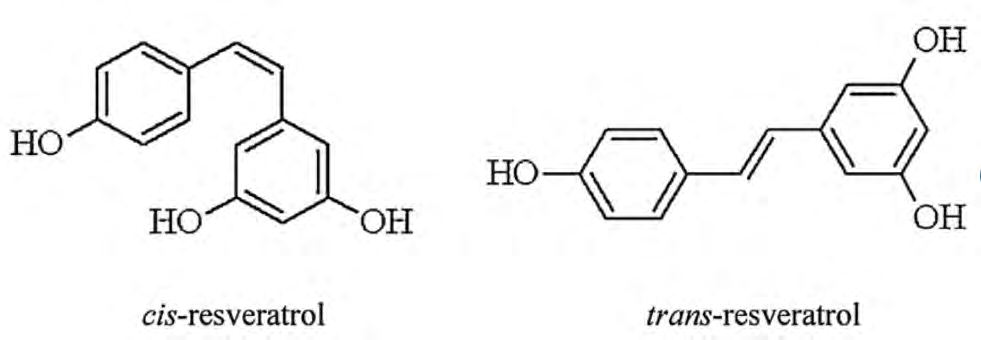
Resveratrol (3,5,4′-Trihydroxystilbene), a natural polyphenol found in some plants and fruits, has been used as traditional medicine for years against a wide range of biological activities. The isometric cis- and trans-forms of resveratrol is due to the double bond present in the structure (Figure 1). However, a more predominant and stable natural form of resveratrol is trans-isomer. Some commonly used plants of human diets that contain a high concentration of resveratrol are blueberries (Vaccinium spp.), blackberries (Morus spp.), and peanuts (Arachis hypogaea) [1, 2]. In addition, a red wine made from grapes (Vitaceae) is considered a rich source of resveratrol in the Mediterranean diet, particularly from the skin, seeds, petioles, and woody parts [3]. Due to this reason, most parts of the grape plants are used for red wine production during concentration, which made it a richer source of resveratrol as compared with the white wine [4, 5]. Due to its significant natural biological importance, such as strong ant-oxidative potential, antitumor, and cardiovascular properties, resveratrol can be consumed via. natural products or in the form of nutraceuticals. Among these wide pharmacological properties, some major extensively studies have been reported in humans and animal models, both in vitro and in vivo as an anticancer agent, a platelet anti-aggregation agent, and an antioxidant, as well as its anti-aging, anti-fertility, anti- inflammatory, anti-allergenic, and so forth activities [6, 7, 8, 9, 10, 11, 12, 13]. Due to its unique physiochemical property, its mechanism of action and the issue of bioavailability play an important role in its biological action. Literature suggested that resveratrol bioavailability was determined by its rapid elimination via metabolism pathways that affect its absorption process. Besides, the low oral bioavailability of resveratrol (less than 1%) is due to the rapid first-pass metabolism; glucuronide and sulfate conjugates, which are the major metabolites reported in plasma [14]. Clinical studies data of resveratrol pharmacokinetic parameters led to questions concerning whether high oral doses of resveratrol can achieve sufficient plasma concentration of resveratrol required to achieve the desirable activities like chemopreventive action [15]. Various traditional techniques has been reported in order to improve the bioavailability of compounds such as the use of co-solvents, amorphous forms, use of precipitation inhibitors, pH alteration, the addition of surfactants, chemical modification of drug, etc. In addition, some methods such as modification in the dielectric constant of solvent, hydrotropy, micronization, application of ultrasonic waves, etc. were reported [16]. Authors have used complementary approach, i.e., Biofield Energy Treatment to resveratrol and animals in order to evaluate the alteration in bioavailability after treatment.
The human Biofield Energy, subtle electromagnetic energy around the human body has a significant capacity for various clinical benefits [17]. Various clinical reports suggested the significant use of energy medicine and its healing capacity, which is well demarcated by the National Center for Complementary and Integrative Health (NCCIH) in order to promote wellness [18]. Biofield Energy Treatment leads to receive the energy by the object and respond in a useful way, while the Trivedi Effect® has been reported with the significant discovery in both living organisms and nonliving materials. The Trivedi Effect® has been described with significant transformation in the physicochemical properties of metals, ceramics, polymers, and chemicals, improved overall productivity, yield and quality by several folds of agricultural crops, altered antimicrobial characteristics of pathogenic microbes at genetic level, improved activity of pharmaceuticals and nutraceutical compounds, livestock, etc [19, 20, 21, 22, 23, 24, 25, 26, 27, 28, 29, 30].
Recently, it has been reported in the literature that the Trivedi Effect® has the significant capability to alter the physio-chemical and thermal properties of various pharmaceuticals, nutraceuticals, and organic compounds through the possible interference of neutrinos [28, 31]. The Trivedi Effect®-Consciousness Energy Treatment would be a useful approach for the enhancement of the bioavailability of pharmaceuticals and nutraceuticals. The present study was planned to evaluate the Trivedi Effect®-Consciousness
Energy Treatment on the test item (resveratrol), and test system (rat) through the estimation of resveratrol in plasma concentration after a single dose of oral administration of resveratrol in rat.
Materials and Methods
Chemicals and Reagents
Resveratrol chloride and telmisartan were purchased from TCI, Japan, and Sigma (St. Louis, MO, USA), respectively. The reagents used for sample preparation and bioanalysis included acetonitrile (HPLC Grade, Merck), methanol (HPLC Grade, Merck), water (Milli-Q), and formic acid (LC-MS Grade, Fluka). USP grade nitrogen was used as the curtain gas, and collision gas for LC-MS/MS were supplied from air compressor (Anesta Iwata, Japan), polypropylene tubes (Tarsons, India), class-A, measuring cylinders and volumetric flasks (Borosil, Germany) and membrane filters, 0.22 μm and 0.45 µm (Millipore) were used during the study. All other reagents and solvents were of analytical grade available from India.
Energy of Consciousness Treatment Strategies
The test item, resveratrol, was divided into two parts. One part was considered as the control group, while the other part was defined as the Biofield Energy Treated group. The test item in Biofield Treated group was subjected to the Trivedi Effect®- Energy of Consciousness Treatment for about 3 minutes by a renowned Biofield Energy Healer, Dahryn Trivedi, USA. Additionally, one group of animals also received the Biofield Energy Treatment per se by the same Biofield Energy Healer under similar experimental conditions. The Biofield Energy Healer who was located in the USA, while the test samples and animals were located in the research laboratory in India. This Biofield Energy Treatment was provided for approximately 3 minutes through the Biofield Energy Healer’s unique Energy Transmission process (the Trivedi Effect®), administered to the test sample and animals. Similarly, the control test sample was subjected to “sham” healer for 3 minutes, under similar laboratory conditions without having any awareness about the Biofield Energy Treatment. Further, the Biofield Energy Treated and untreated test items were kept in similar sealed conditions and used for the study as per design.
In Vivo Pharmacokinetics Study
Animals: Male Sprague-Dawley (SD) rats (body weight 230 - 270 gm) were procured from Liveon Biosciences, Bangalore, India. Animals were housed in polycarbonate cage. For maintenance of animals, standard conditions such as temperature and humidity were maintained at 22 ± 3°C and
40% to 70%, respectively, and illumination was controlled to give a sequence of 12 hours light and 12 hours dark cycle. The temperature and humidity were recorded by autocontrolled data logger system. All the animals were provided laboratory rodent diet (Vetcare India Pvt. Ltd., Bengaluru). Reverse osmosis water treated with ultraviolet light was provided ad libitum. The experiments using animals in this investigation were performed in accordance with the guidelines provided by the Committee for the Purpose of Control and Supervision of Experiments on Animals (CPCSEA) as published in The Gazette of India, January 7, 2010 and protocol approved by the Institutional (GVK Bio) Animal Ethics Committee (IAEC approval number: B-011).
Experimental Design: Rats were divided into three groups (n = 3): group 1 (Gr. 1) – per oral (p.o.) dosing of untreated resveratrol, group 2 (Gr. 2) – per oral (p.o.) dosing of Biofield Energy Treated resveratrol and group 3 (Gr. 3) – per oral (p.o.) dosing of untreated resveratrol in biofield energy treated animals. All animals were received per oral dose at 100 mg/ kg of resveratrol solution formulation. The dose (100 mg/ kg) of the test item was chosen based on the preliminary experiments performed in our laboratory and observed the quantifiable concentration of this analyte in rat plasma.
Formulation Preparation
The solution formulations of the test item was prepared in 40% w/v 2-Hydroxypropyl-β-cyclodextrin in distilled water. All formulations were prepared freshly prior to dosing. The dose volume for per oral route was 10 mL/kg.
Pharmacokinetic Studies
The solution of resveratrol chloride formulations were freshly prepared for per oral dosing. All rats were fasted overnight and the fasting continued up to 4 hours post dosing with free access to drinking water. The oral test formulation was administered at 100 mg/kg dose through oral gavage using an 18G stainless steel intubation cannula. The dosing volume administered was 10 mL/kg. Blood samples (~120 µL) were collected from the jugular vein catheter of three rats from each group at each time point [pre-dose, 0.25, 0.5, 1, 2, 4, 8, 12, and 24 hours (p.o.)]. Samples were collected into labeled micro centrifuge tubes, containing 20% w/v K2EDTA as an anticoagulant. Plasma samples were separated from the blood by centrifugation at 2500 g for 10 min at 4 ± 2°C and stored below -40°C (Thermo Scientific, USA) deep freezer until bioanalysis.
LC-MS/MS Analysis
Analysis of rat plasma samples was performed using API 4500 Applied Biosystem-Sciex LC/MS/MS (Concord, Ontario, Canada) triple quadruple mass analyzer system with an interface connected to a Shimadzu UFLC system (Shimadzu Corp., Japan). The optimum operating parameters were determined by electro spray ionization (ESI) interface in negative ion mode. Generic mass spectrometry parameters of the analyte were developed and used for the analysis. These parameters were the declustering potential range (-80), collision energy range (-34), collision cell exit potential range (-8), curtain gas (30 arbitrary units), collisionally activated dissociation gas (10), ionspray voltage (-4500 V), source temperature (550°C), and ion source gas 1 and gas 2 (50 and 55, respectively arbitrary units each). Interface heaters were kept on for the analyte. The analyte was detected by positive ion spray in the multiple reaction monitoring mode (MRM) mode using predetermined parent/product mass transition ion pairs. The parameters of the selected MRM monitoring transitions for the [M - H]- precursor ion to selected product ion (m/z) were optimized with 226.90/142.90 (resveratrol), and 515.30/286.70 (telmisartan as an internal standard. The whole system was controlled by Analyst Classic 1.5® software (Applied-Biosystem-Sciex, Concord, Canada). Stock solutions of resveratrol and telmisartan (internal standard, IS) were prepared in methanol at approximately 9.999 mg/ mL and 0.98 mg/mL, respectively, and subsequently diluted which were used for the bioanalysis.
The extraction procedure for plasma samples or the spiked in to plasma calibration standards were identical. A 50 µL sample of either study sample or spiked calibration standard was added to individual pre-labeled micro- centrifuge tubes. A 50 µL sample of either study sample or spiked calibration standard/quality control samples were added to individual wells of 96 well plate with 500 µL capacity. 200 µL of internal standard (IS) prepared in acetonitrile (ACN) was added to the samples in deep well plate except for blank, where 200 µL of ACN was added and vortexed for 5 minutes. Samples were centrifuged for 10 minutes at a speed of 4000 rpm (3220 g) at 4°C. Following centrifugation, 120 µL of supernatant was transferred into 1000 µL capacity deep well plate and mixed with 120 µL of methanol: water, 50:50 v/v. The plate was kept in the auto- sampler for the LC-MS/MS analysis.
A Shimadzu LC-20AD LC system (Shimadzu Corp., Japan) was connected to a SIL -20 AC HT auto-sampler (Shimadzu Corp., Japan). The supernatant were injected (15 µL) onto a 50 x 4.6 mm (3.5 µm) Waters, X-Bridge, C18 HPLC column (Waters, Massachusetts, Ireland). Analytes were eluted using a gradient elution program with a mobile phase consists of 10 mM ammonium acetate in water (pump A) with methanol (pump B) at a flow rate of 1.0 mL/min. The column temperature was at 40°C and the sample temperature was at 15°C. The following linear gradient was employed for the separation: 95% A for 0.01 min, 60% A at 0. 5 min, 30% A at 1.0 min, 15% A at 2.0 min, and hold to 3.2 min, 95% A at 3.3 min and hold to 5.0 min. The resveratrol and telmisartan elution times were approximately 1.69 and 2.22 min, respectively. Peak integration, regression and calculation of analytes concentration were computed using Analyst Classic (Version 1.5) software. The calibration curve was performed by linear curve fit of the peak area ratio (analyte/internal standard) as a function of the concentration in the respective matrix. A weighting of 1/x2 (where x is the concentration of a given calibration standard level) was found to be optimal. The lower limit of quantification (LLOQ) in rat plasma was 1.02 ng/mL for resveratrol. Analysis of resveratrol in plasma (1.04 – 1038.96 ng/mL) showed a repeatability (relative standard deviation-RSD%) of 1.5% to 8.47% and accuracy of 100.18% to 108.81%.
Pharmacokinetic Analysis
The pharmacokinetic parameters of resveratrol were obtained by noncompartmental analysis module in Phoenix WinNonlin® (Version 7.0) (Pharsight, Mountain View, CA). The areas under the concentration time curve (AUC0-t and AUC0-∞) were calculated by linear trapezoidal rule. The terminal elimination rate constant (kel) was determined by regression analysis of the linear terminal portion of the log plasma concentration-time curve. The terminal half-life (T1/2) was estimated at 0.693/ke. The apparent oral clearance (CL/F) were calculated for per oral dose divided by AUC, respectively. Peak resveratrol concentrations (Cmax) and the times when they occurred (_t_max) were derived directly from the data. The relative oral bioavailability (Fr) was estimated by AUCtreated/AUCcontrol.
Statistical Analysis
All mean values are presented with their standard deviation (mean± S.D.). Data were analyzed for statistically significant differences using analysis of variance followed by the two-sided unpaired Student’s t-_test. Differences were considered to be significant at a level of _p < 0.05.
Results and Discussions
In vivo Effects of Biofield Energy Treatment on Resveratrol Pharmacokinetics in Rats
The mean pharmacokinetic parameters and profiles of resveratrol in the rat plasma after a single oral dose of administration of solution formulations in three different groups are summarized in Table 1.
| Parameter | Gr. 1 (Untreated Resveratrol) | Gr. 2 (Biofield Energy Treated Resveratrol) | Gr. 3 (Biofield Treated Rats + Untreated Resveratrol) |
|---|---|---|---|
| C (ng/mL) max | 56.22 ± 22.78 | 160.78 ± 172.18 | 117.40 ± 64.68 |
| T (hr) max | 0.25 ± 0.00 | 0.67 ± 0.29 | 0.42 ± 0.14 |
| AUC (ng.hr/mL) 0-t | 111.35 ± 43.49 | 276.17 ± 243.22 | 106.52 ± 36.60 |
| MRT (hr) | 6.10 ± 3.33 | 4.22 ± 1.64 | 4.38 ± 1.44 |
| K ( hr-1) el | 0.09 ± 0.05 | 0.09 ± 0.01 | 0.08 ± 0.06 |
| K ( hr-1) a | 0.30 ± 0.28 | 0.34 ± 0.21 | 0.31 ± 0.15 |
| Fr (%) | 100 | 247.75 | 95.66 |
Table 1: Pharmacokinetic parameters of resveratrol after p.o. administration at 100 mg/kg body weight to Sprague Dawley male rats
Table 1: Pharmacokinetic parameters of resveratrol after p.o. administration at 100 mg/kg body weight to Sprague Dawley male rats. (Mean ± SD; n=3). The data are expressed as mean values. p.o.: per oral; Cmax, peak concentration; Tmax, time to reach peak concentration; AUC, area under the plasma concentration–time curve; Kel, elimination rate constant; Ka, absorption rate constant, MRT, mean residence time; MAT, mean absorption time; Fr: Relative oral Bioavailability.
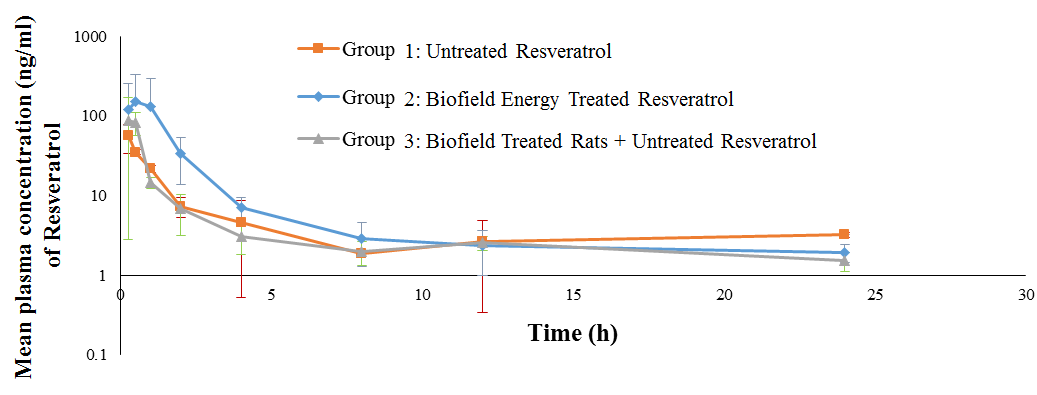
The pharmacokinetic parameters were studied after oral administration resveratrol at a dose of 100 mg/kg body weight to Sprague Dawley male rats (Table 1). The maximum plasma concentration (Cmax) of resveratrol was significantly increased by 185.98% and 108.82% in the G2 and G3 groups, respectively, compared with the G1 group. The comparative mean plasma concentration vs. time profiles of resveratrol after per oral administration to Sprague Dawley rats is shown in Figure 2. The results showed that resveratrol had an oral exposure (AUC0–t) of 111.35 ng/mL in control (untreated) group G1. After the Biofield Energy Treatment by a renowned Biofield Energy Healer, Dahryn Trivedi, the relative oral exposure (AUC0–t) of resveratrol was increased by 148.02% in G2 group and decreased by 4.34% in G3, as compared to the G1 group. The time to reach peak concentration (Tmax) of resveratrol was significantly increased by 168% in the G2 group and 68% in the G3 group compared to the group G1. The mean residence time (MRT) of resveratrol was decreased by 30.82% in the G2 group and 28.2% in the G3 group as compared to G1. The oral relative bioavailability (Fr) of resveratrol was significantly increased by 147.75% in the G2 group and slightly decreased by 4.49% in the G3 group compared to the untreated resveratrol, G1 (Table 1).
Due to its different physicochemical properties such as molecular weight, number of hydrogen bond donor and acceptor, rotatable bond, clogP, and polar surface area, resveratrol has poor bio-membrane permeability. The poor oral bioavailability considerably less than 1% would attribute to different metabolic issue, such as very short half-life in rat liver microsomes [14, 32]. Furthermore, poor oral bioavailability is due to the first-pass metabolism in the intestine, while increased dose and repeated dose escalation would not affect bioavailabity [33, 34]. However, the results showed that the Biofield Energy Treated resveratrol and the Biofield Energy Treated animals per se significantly altered the rate and extent of oral absorption of resveratrol. The altered absorption may be due to the alteration of the specific surface area of the resveratrol formulation, or the stability of the resveratrol formulation in the gastrointestinal tract or due to the altered resveratrol metabolism pathways.
The Biofield Energy Treatment has a significant impact on altering the physicochemical properties of various nutraceutical and pharmaceutical compounds through possible mediation of neutrinos [31]. Previous experimental results showed that the Trivedi Effect® significantly altered the bioavailability of nutraceutical compounds [35, 36]. Primary pharmacokinetic parameters, i.e., oral plasma clearance and the volume of distribution of resveratrol in the Biofield Energy Treated groups was increased in Biofield Energy Treated animals per se. A large volume of distribution is desirable for vascular or extracellular targets [37, 38]. The maximum plasma concentration (Cmax) of resveratrol was significantly increased in the group G2 and G3, respectively, compared with the G1 group. Similarly, Tmax of resveratrol was increased in in G2 and G3 groups compared to G1. The oral exposure/ bioavailability (F) of resveratrol was significantly increased in the G2 group compared to the untreated resveratrol. The significant alteration of pharmacokinetic parameters of resveratrol in the Biofield Energy Treated group might be translated into altering the therapeutic performance in various disease conditions. The Biofield Energy Treated resveratrol could be useful as an anticancer agent, a platelet anti-aggregation agent, and an antioxidant, as well as its anti- aging, anti-fertility, anti-inflammatory, anti-allergenic, and so forth activities [6, 7, 8, 9, 10]. Biofield Treated resveratrol can also be useful for the reduction of cardiovascular risk, minimize the incidence of arterial hypertension, heart failure, and ischemic cardiac disease, and improve insulin sensitivity by minimizing the plasma glycemia levels and obesity in rodent models [39, 40, 41, 42].
Conclusions
The Biofield Energy Treatment significantly increased the maximum concentration (Cmax) of resveratrol by 185.98% and 108.82% in the G2 and G3 groups, respectively, compared with the G1 group. The relative oral exposure (AUC0–t) of resveratrol was increased by 148.02% in G2 group and slightly decreased by 4.34% in G3, as compared to the G1 group. The time to reach peak concentration (Tmax) of resveratrol was significantly increased by 168% in the G2 group and 68% in the G3 group compared to the group G1. The mean residence time (MRT) of resveratrol was decreased by 30.82% in the G2 group and 28.2% in the G3 group as compared to G1. The oral relative bioavailability (Fr) of resveratrol was significantly increased by 147.75% in the G2 group compared to the untreated resveratrol. These data demonstrated an improved oral bioavailability of Biofield Energy Treated resveratrol might be helpful to prevent/cure many diseases. Hence, Biofield Energy Treatment could be considered as an innovative strategy that opens new avenues to overcome poorly absorbed nutraceuticals/pharmaceuticals and can also improve the therapeutic performance of orally active molecules. The Biofield Energy Treated resveratrol could be beneficial as an anticancer agent, a platelet anti-aggregation agent, and an antioxidant, as well as its anti-aging, anti-fertility, anti-inflammatory, anti-allergenic, and so forth activities. Biofield Energy Treated resveratrol can also be useful for the reduction of cardiovascular risk, minimize the incidence of arterial hypertension, heart failure, and ischemic cardiac disease, improve insulin sensitivity by minimizing the plasma glycemia levels and obesity in rodent models.
Acknowledgements
Authors are grateful to GVK Bioscience, Trivedi Science, Trivedi Global, Inc., and Trivedi Master Wellness for their support throughout the work.
References
-
Langcake P (1981) Disease resistance of Vitis spp. and the production of the stress metabolites resveratrol, epsilon-viniferin, alpha-viniferin and pterostilbene. Physiol Plant Pathol 18(2): 213-226.
-
Gambini J, López-Grueso R, Olaso-González G, Inglés M, Abdelazid K, et al. (2013) Resveratrol: distribution, properties and perspectives. Rev Esp Geriatr Gerontol 48(2): 79-88.
-
Kraft TE, Parisotto D, Schempp C, Efferth T (2009) Fighting cancer with red wine? Molecular mechanisms of resveratrol. Crit Rev Food Sci Nutr 49(9): 782-799.
-
Renaud S, de Lorgeril M (1992) Wine, alcohol, platelets, and the French paradox for coronary heart disease. Lancet 339(8808): 1523-1526.
-
Jang M, Cai L, Udeani GO, Slowing KV, Thomas CF, et al. (1997) Cancer Chemopreventive Activity of Resveratrol, a Natural Product Derived from Grapes. Science 275(5297): 218-220.
-
Aggarwal BB, Bhardwaj A, Aggarwal RS, Seeram NP, Shishodia S, et al. (2004) Role of resveratrol in prevention and therapy of cancer: Preclinical and clinical studies. Anticancer Res 24(5A): 2783-2840.
-
Delmas D, Aires V, Limagne E, Dutartre P, Mazué F, et al. (2011) Transport, stability, and biological activity of resveratrol. Ann N Y Acad Sci 1215: 48-59.
-
Marques FZ, Markus MA, Morris BJ (2009) Resveratrol: cellular actions of a potent natural chemical that confers a diversity of health benefits. Int J Biochem Cell Biol 41(11): 2125-2128.
-
Paul S, Rimando AM, Lee HJ, Ji Y, Reddy BS, et al. (2009) Anti-inflammatory action of pterostilbene is mediated through the p38 mitogen-activated protein kinase pathway in colon cancer cells. Cancer Prev Res 2(7): 650-657.
-
Pervaiz S, Holme AL (2009) Resveratrol: its biologic targets and functional activity. Antioxid Redox Signal 11(11): 2851-2897.
-
Bishayee A (2009) Cancer prevention and treatment with resveratrol: from rodent studies to clinical trials. Cancer Prev Res 2(5): 409-418.
-
De Santi C, Pietrabissa A, Spisni R, Mosca F, Pacifici GM (2000) Sulphation of resveratrol, a natural product present in grapes and wine, in the human liver and duodenum. Xenobiotica 30(6): 609-617.
-
Rimando AM, Suh N (2008) Biological/chemopreventive activity of stilbenes and their effect on colon cancer. Planta Med 74(13): 1635-1643.
-
Walle T (2011) Bioavailability of resveratrol. Ann N Y Acad Sci 1215: 9-15.
-
Brown VA, Patel KR, Viskaduraki M, Crowell JA, Perloff M, et al. (2010) Repeat dose study of the cancer chemopreventive agent resveratrol in healthy volunteers: safety, pharmacokinetics and effect on the insulin-like growth factor axis. Cancer Res 70(22): 9003-9011.
-
Kansara H, Panola R, Mishra A (2015) Techniques used to Enhance Bioavailability of BCS Class II Drugs: A Review. Int J Drug Dev & Res 7 (1): 82-93.
-
Rubik B, Muehsam D, Hammerschlag R, Jain S (2015) Biofield science and healing: history, terminology, and concepts. Glob Adv Health Med 4(Suppl): 8-14.
-
Barnes PM, Bloom B, Nahin RL (2008) Complementary and alternative medicine use among adults and children: United States, 2007. Natl Health Stat Report 12: 1-23.
-
Branton A, Trivedi MK, Trivedi D, Nayak G, Jana S (2019) Consciousness energy healing treatment influenced the physicochemical properties of zinc. Nov Tech Nutri Food Sci 4(3): 330-336.
-
Trivedi D, Trivedi MK, Branton A, Nayak G, Jana S (2018) Impact of consciousness energy healing treatment on the physicochemical and thermal properties of silver oxide. Journal of Advanced Pharmaceutical Science and Technology 1(4): 13-24.
-
Branton A, Trivedi MK, Nayak G, Trivedi D, Jana S (2018) Evaluation of the effect of biofield energy treatment on physicochemical and thermal properties of hydroxypropyl _β_-cyclodextrin. J Pharmaceu Pharmacol 6(1): 5.
-
Trivedi MK, Branton A, Trivedi D, Nayak G, Sethi KK, et al. (2016) Determination of isotopic abundance ratio of biofield energy treated 1,4-dichlorobenzene using gas chromatography-mass spectrometry (GC-MS). Modern Chemistry 4(3): 30-37.
-
Trivedi MK, Branton A, Trivedi D, Nayak G, Gangwar M, et al. (2015) Agronomic characteristics, growth analysis, and yield response of biofield treated mustard, cowpea, horse gram, and groundnuts. International Journal of Genetics and Genomics 3(6): 74-80.
-
Trivedi MK, Branton A, Trivedi D, Nayak G, Mondal SC, Jana S (2015) Evaluation of plant growth, yield and yield attributes of biofield energy treated mustard (_Brassica juncea_) and chick pea (_Cicer arietinum_) seeds. Agriculture, Forestry and Fisheries 4(6): 291-295.
-
Trivedi MK, Branton A, Trivedi D, Shettigar H, Nayak G, et al. (2015) Antibiogram typing of biofield treated multidrug resistant strains of _Staphylococcus species_. American Journal of Life Sciences 3(5): 369-374.
-
Trivedi MK, Branton A, Trivedi D, Shettigar H, Nayak G, et al. (2015) Antibiogram, biochemical reactions and genotyping characterization of biofield treated _Staphylococcus aureus_. American Journal of BioScience 3(6): 212-220.
-
Trivedi MK, Branton A, Trivedi D, Nayak G, Mondal SC, et al. (2015) Antimicrobial sensitivity, biochemical characteristics and biotyping of _Staphylococcus_ _saprophyticus_: An impact of biofield energy treatment. J Women’s Health Care 4: 271.
-
Nayak G, Trivedi MK, Branton A, Trivedi D, Jana S (2018) Consciousness energy healing treatment: Impact on physicochemical and thermal properties of silver sulfadiazine. Journal of advanced pharmaceutical science and technology 2: 1-13.
-
Nayak G, Trivedi MK, Branton A, Trivedi D, Jana S (2018) Impact of Consciousness energy healing treatment on the physicochemical and thermal properties of vitamin D3 (cholecalciferol). Food Sci Nutr Technol 3(5): 000162.
-
Trivedi MK, Branton A, Trivedi D, Nayak G, Mondal SC, et al. (2015) Effect of biofield treated energized water on the growth and health status in chicken (_Gallus gallus_ _domesticus_). Poult Fish Wildl Sci 3: 140.
-
Trivedi MK, Mohan TRR (2016) Biofield energy signals, energy transmission and neutrinos. American Journal of Modern Physics 5(6): 172-176.
-
Das S, Lin HS, Ho PC, Ng KY (2008) The impact of aqueous solubility and dose on the pharmacokinetic profiles of resveratrol. Pharm Res 25(11): 2593-2600.
-
Nunes T, Almeida L, Rocha JF, Falcão A, Fernandes-Lopes C, et al. (2009) Pharmacokinetics of trans-resveratrol following repeated administration in healthy elderly and young subjects. J Clin Pharmacol 49(12): 1477-1482.
-
Marier JF, Vachon P, Gritsas A, Zhang J, Moreau JP, et al. (2002) Metabolism and disposition of resveratrol in rats: extent of absorption, glucuronidation, and enterohepatic recirculation evidenced by a linked-rat model. J Pharmacol Exp Ther 302(1): 369-373.
-
Branton A, Jana S (2017) The influence of energy of consciousness healing treatment on low bioavailable resveratrol in male _Sprague Dawley_ rats. International Journal of Clinical and Developmental Anatomy 3(3): 9-15.
-
Branton A, Jana S (2017) The use of novel and unique biofield energy healing treatment for the improvement of poorly bioavailable compound, berberine in male _Sprague Dawley_ rats. American Journal of Clinical and Experimental Medicine 5(4): 138-144.
-
Malcolm Rowland, Tozer TM (2011) Clinical Pharmacokinetics and Pharmacodynamics, Concepts and Applications. 4th (Edn.), Baltimore MD: Lippincott Williams & Wilkins.
-
Dasgupta A, Krasowski MD (2020) Pharmacokinetics and therapeutic drug monitoring. Therapeutic Drug Monitoring Data. Elsevier pp: 1-17.
-
Das DK, Maulik N (2006) Resveratrol in cardioprotection: a therapeutic promise of alternative medicine. Mol Interv 6(1): 36-47.
-
Bonnefont-Rousselot D (2016) Resveratrol and Cardiovascular Diseases. Nutrients 8(5): 250.
-
Li H, Xia N, Förstermann U (2012) Cardiovascular effects and molecular targets of resveratrol. Nitric Oxide 26(2): 102-110.
-
Jing YH, Chen KH, Yang SH, Kuo PC, Chen JK (2010) Resveratrol ameliorates vasculopathy in STZ-induced diabetic rats: role of AGE-RAGE signalling. Diabetes Metab Res Rev 26(3): 212-222.
- Acido Labile or Gastro Irritant Apis and Enteric Release in Galenic Practice: An Overview
- A Study on Knowledge, Attitude and Practice of Hand Hygiene among Healthcare Professionals at a Tertiary Care Hospital, India
- Influence of Inoculum Concentration on In Vivo Incubation Period of Emmia lacerata, Pathogenesis and Management of Wilt in Pepper (Capsicum annuum L.)
- Vanilla’s Chemistry
- Marine Anti-Cancer Compounds and Adverse Effects of Global Warming on Oceans: An Overview
- Serological Investigation of Chikungunya Virus Antibody among Malaria-Suspected Febrile Patients in Some Healthcare Facilities in Rivers State