
Therapeutic Values of Ganoderma Oregonense and Ganoderma Pfeifferi, Mushrooms: A Review
Lichens are found on every landform and have a history of use as food, medicine, dyes, livestock feed and other fields. The pharmaceutical potential of lichens is high and several companies are now attempting to commercialise these unique agents. The secondary metabolites that lichen produces have a wide range of biological functions, including antibacterial, antiviral, antitumor, antioxidant, antiherpes, allelochemical, insecticidal, and allergenic effect. The purpose of this review was to systematically evaluate the literature on the biologically active secondary metabolites of lichen.
Introduction
Mushrooms as higher Basidiomycetes and Ascomycetes contain secondary metabolites in their fruit bodies, cultured mycelium, and cultured broth. Mushrooms have been used in many sides of human activity for many years [1, 2, 3, 4, 5, 6, 7, 8, 9, 10, 11, 12, 13, 14, 15]. Some of these mushrooms have been called medicinal mushrooms due to their various morphological, physiological, and ecological characteristics that are also responsible for their diversity [16, 17, 18, 19, 20]. Applications of mushrooms as food and medicinal values are gained mush focus recently by researchers. Some mushrooms and other fruiting bodies of filamentous fungi are edible or wild non edible and provide a good source of different secondary metabolites having important effects and used as medicine [21, 22, 23, 24, 25]. Mushrooms have rich nutritional value with high content of proteins, vitamins, minerals, fibers, trace elements and low/no calories and cholesterol. They provide the people with an additional vegetable of high quality, and enrich the diet, which can be of direct benefit to the human health and fitness. The extractable bioactive compounds from medicinal mushrooms would enhance human’s immune systems and improve their quality of life. Mushrooms possess powerful different biological activities that promise to aid in human fight against diseases. Phenolics, flavonoids, glycosides, polysaccharides, tocopherols, ergothioneine, carotenoids, and ascorbic acid are among the most common antioxidant compounds found in both wild and cultivated mushrooms.
Mushrooms are also rich sources of antioxidant vitamins. The ascorbic acid content of certain species of wild edible mushrooms was found to be higher than in some fruits and vegetables [26, 27, 28, 29, 30, 31, 32, 33, 34]. Ganoderma is a historical fungus that used for promoting health and longevity in China, Japan, and other Asian countries. It is a large, dark mushroom with a glossy exterior and a woody texture [35]. Mushrooms in general and Ganoderma mushrooms especially have long tradition in Asia, and recently they began to be consumed in Europe as well. Among hundreds of Ganoderma species, only a few of them are studied, like Ganoderma lucidum and Ganoderma applanatum. Whereas the chemistry and bioactivitie of other Ganoderma species especially of European and Africa origin still remain unknown [9, 10, 36, 37]. This review will focus on Ganoderma oregonense and Ganoderma pfeifferi. Metal composition of both species shows high concentrations of biogenic metals. Many chemical composition of the isolated extracts of Ganoderma oregonense and Ganoderma pfeifferi, shows that these species are rich in triterpenes. These compounds are found to be carriers of the Antioxidant, Antiviral and Antimicrobial activities and others. Overall results indicate that these two Ganoderma species have strong potential to be used for medicinal purposes.
Ganoderma Oregonense Mushroom Description and Ecology
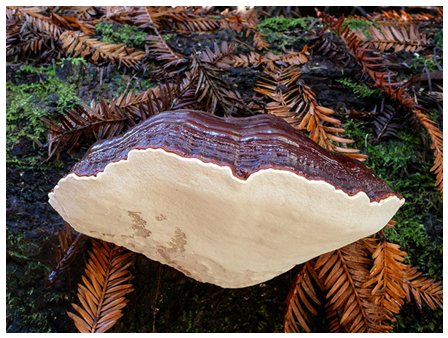
Ganoderma oregonense mushroom belonging to Phylum: Basidiomycota - Class: Agaricomycetes - Order: Polyporales - Family: Ganodermataceae. Ganoderma oregonense is a medium sized to very large polypore cap fruiting body, found on the wood of conifers in the Pacific Northwest and California. Like other species of Ganoderma it has a brown-bruising pore surface Figure 1. Until recently the very similar Ganoderma tsugae was thought to coexist with Ganoderma oregonense in the Pacific Northwest. Ganoderma polychromum shares the range of Ganoderma oregonense it features brown flesh and grows on the wood of hardwoods.
Ecology: Habitat: Solitary on standing dead conifer trees and on conifer stumps and logs; common, fruiting from fall through mid-winter, widely distributed. Edibility Inedible. Saprobic and sometimes parasitic; growing alone or in groups on decaying conifer logs and stumps, or from the wounds of injured, living trees; causing a white rot; annual; fall through spring; distributed in the Pacific Northwest and California. Cap: 10–50+ cm across; 5–15+ cm deep; more or less semicircular in outline, or irregularly kidney-shaped; surface with a lacquered-looking outer crust; brownish red or reddish brown overall, with or without a few paler zones; bald. Pore Surface: Whitish to pale brownish when young, becoming medium brown with age; bruising darker brown; with 2–4 circular pores per mm; tubes 1–3 cm deep. Stem: Usually absent; when present lateral and stubby, lacquered, brownish red to reddish brown. Flesh: Tough but not woody; whitish to creamy; without melanoid bands or concentric growth zones. Odor and Taste: Not distinctive. Spore Print: Reddish brown [38, 39].
Ganoderma Oregonense Biological Activities
Ganoderma contains a wide variety of bioactive molecules. The major bioactive components were triterpenoids, steroids, sesquiterpenoids, and benzenoid derivatives [40]. Kim, et al. [41] reported that two new meroterpene derivatives (1 and 2), together with three known compounds (3–5) were isolated from the culture broth of fungus Ganoderma oregonense (Two new compounds (1 and 2) and three known (3–5) meroterpenoids) and all chemical structures of compounds 1–5 were determined using spectroscopic methods. Compounds (3–5 meroterpenoids) were identified as ganocapenoid D, applanatumol U, and chizhine E, respectively. All compounds were tested for 2,2′-azinobis(3-ethylbenzothiazoline-6-sulfonic acid) (ABTS) and 1,1-diphenyl-2- picrylhydrazyl (DPPH) radical scavenging efficacy. Compound 1 exhibited significant antioxidant activities with IC50 values of 31.2 and 65.4 μM in the ABTS and DPPH radical scavenging activities, respectively. Meroterpenoids in general and from Ganoderma oregonense especially have attracted more attention for chemists and pharmacologists, duo to their promising bioactivities such as such as anti-cancer, BACE1 inhibitors, anti-inflammation, and lipid-lowering effect [42].
The crude polysaccharides of selenium-enriched Ganoderma oregonense mycelium had strong antioxidant activity in vitro, and the resistance of crude polysaccharide was found by correlation analysis. Oxidation activity has a significant positive correlation with selenium content and selenium enrichment rate. It shows that selenium polysaccharide has good prospects for development and utilization in the fields of food and medicine [43].
Ganoderma Pfeifferi Mushroom Description and Ecology
Ganoderma pfeifferi mushroom belonging to Phylum: Basidiomycota - Class: Agaricomycetes - Order: Polyporales - Family: Ganodermataceae. Ganoderma pfeifferi is a rare European wood-inhabiting species. Ganoderma pfeifferi is an uncommon find in southern England and very rare in Scotland and Wales. Description and Ecology; Fruit body is Perennial; growing to 30cm across and 5 to 12cm thick, broadly attached nearly always low down on the trunk of a mature tree. Upper surface is copper-red or purple, crust. Fertile surface: The lower (fertile) surface is covered in roundish pale cream pores spaced 4 to 5 per mm. The pores turn darker cream and then ochre with irregular brown spots when fully mature. Tubes and Pores: The chocolate brown tube layer is up to 2cm thick. Tubes terminate in small roundish pores that are just perceptible to the naked eye; they are white when the fruit body is young, turning cream and eventually ochre with age or when bruised. The flesh above the pore layer is chestnut brown (Figure 2).
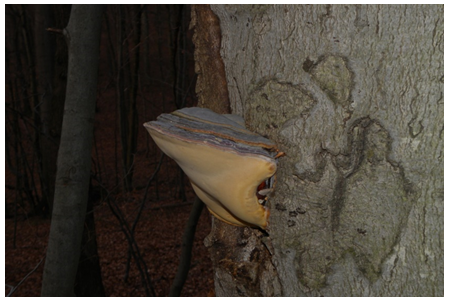
Spores: Ellipsoidal to ovoid with one end flattened, twin walled, 9-12 x 6-9µm; inner wall ornamented with many spiny warts. Spore print: Chocolate brown. Odour/taste: The pore surface is sweet-smelling, somewhat like honey or, so some say, like beeswax; taste not distinctive. Habitat & Ecological role Mostly on Fagus (beeches) and occasionally Quercus; very rarely on other hardwood trees, nearly always near the base of the trunk. Season: This perennial bracket fungus releases spores in summer and autumn. Similar species: Ganoderma resinaceum and Ganoderma applanatum [32].
Ganoderma Pfeifferi Biological Activities
Ganoderma pfeifferi Bres., a weak parasitic and later saprophytic basidiomycete, is a fungus only found in Europe, living preferentially on Fagus sp. and some other deciduous trees. Mothana, et al. [44] reported that two new farnesyl hydroquinones named ganomycin A (1) and ganomycin B (2) were isolated from Ganoderma pfeifferi, and their structures were elucidated by spectroscopic methods. Both carboxylic acids exhibit antimicrobial activity against several Gram- positive and Gram-negative bacteria [44]. Ganodermadiol, lucidadiol and applanoxidic acid G were isolated as first triterpenes from the European Basidiomycete Ganoderma pfeifferi. The compounds show antiviral activity against influenza virus type A and HSV type 1 [45].
Ganoderma pfeifferi Bres., is less investigated by researches. The occurrence of this parasitic basidiomycete is limited to Europe. Previous studies reported that the extracts and some isolated compounds from Ganoderma pfeifferi have antimicrobial, cytotoxic, anticancer and antiviral activities [46]. The antimicrobial activities of the dichloromethane extract are mainly caused by the meroterpenoids ganomycin A and B [44]. The antimicrobial activity of the ethanol extract is caused by the phenolic derivatives 2,4,5-trihydroxybenzaldehyde and 2,5-hydroxybenzoic acid [46].
Two farnesyl hydroquinones were isolated from the fruiting bodies of Ganoderma pfeifferi, farnesyl hydroquinone (1) and the new compound ganomycin K (2), (5S)-3-[(E)-7,8-dihydroxy-4,8-dimethylnon-3-enyl]-5-(2,5- dihydroxyphenyl)-furan-2(5H)- one. The structures of 1 and 2 were determined on the basis of mass spectrometric and NMR spectroscopic evidence. The antibacterial activity of the isolated compounds was studied by Niedermeyer, et al. [47].
Four sterols and 10 triterpenes were isolated from the fruiting bodies of Ganoderma pfeifferi, including the three new triterpenes 3,7,11-trioxo-5α-lanosta-8,24-diene-26-al (lucialdehyde D, 1), 5α-lanosta-8,24-diene-26-hydroxy-3,7- dione (Ganoderone A, 2), and 5α-lanosta-8-ene-24,25-epoxy- 26-hydroxy-3,7-dione (Ganoderone C, 3). The structures of 1−3 were determined on the basis of spectroscopic evidence. Antibacterial, antifungal, and antiviral activity were studied for some of the isolated compounds. Ganoderone A (2), lucialdehyde B (4), and ergosta-7, 22-dien-3β-ol (7) were found to exhibit potent inhibitory activity against herpes simplex virus [48]. List of natural compounds isolated form Ganoderma pfeifferi, and their biological activities and sources represented in Table 1.
| S. No | Compound name | Biological Activities | Source | Ref. |
|---|---|---|---|---|
| 1 | Lucialdehyde D | Anti-HIV | Ganoderma pfeifferi | Swapank, et al. [49] |
| 2 | Ganoderone A | Anti-HSV | Ganoderma pfeifferi | Swapank, et al. [49] |
| 3 | Ganoderone C | Anti-H1N1 | Ganoderma pfeifferi | Swapank, et al. [49] |
| 4 | Lucialdehyde B | Anti- HSV | Ganoderma pfeifferi | Naowarat, et al. [50] |
| 5 | Ergosta-7,22- dien-3α-ol | Anti- HSV | Ganoderma pfeifferi | Naowarat, et al. [50] |
Table 1: List of natural compounds, their biological
activities and sources.
Conclusion
Ganoderma is the genus from order Aphyllophorales with more than 300 species. Ganoderma contains various compound that showed many biological activities e.g. enhancer of immune system, antitumor, antimicrobial, anti-inflammatory, antioxidant and acetyl cholinesterase inhibitory action. These bioactive compounds related to the triterpenoids and polysaccharides classes. Proteins, lipids, phenols, sterols, and others, are also recorded. Over the past two decades, the Ganoderma industry has developed greatly and today offers thousands of products to the markets [35, 36]. Ganoderma is currently an important source in the pharmaceutical industry and is one of the most promising projects in the world of food and medicine, which is being highlighted these days. Many studies conducted on Ganoderma oregonense and Ganoderma pfeifferi are represented in the current review and showed that these mushrooms exhibit the potential as a vital therapeutic potential. However, more studies for profound exploration are still required. Ganoderma oregonense and Ganoderma pfeifferi exerted some vital biological activities such as antioxidant, antiviral and antimicrobial. Further investigation is needed to explain the different mechanisms of action of these wild mushrooms and their potential values. The current review recommends further exploration to get a full profile of the active components obtained from these species.
References
-
Elkhateeb WA, Daba GM, Thomas PW, Wen TC (2019) Medicinal mushrooms as a new source of natural therapeutic bioactive compounds. Egypt Pharmaceu J 18(2): 88-101.
-
Elkhateeb WA, Daba GM, Elnahas M, Thomas P, Emam M (2020) Metabolic profile and skin-related bioactivities of _Cerioporus squamosus_ hydromethanolic extract. Biodiversitas J Biological Div 21(10): 4732-4740.
-
Elkhateeb WA, Daba G (2020) The endless nutritional and pharmaceutical benefits of the Himalayan gold, Cordyceps; Current knowledge and prospective potentials. Biofarmasi Journal of Natural Product Biochemistry 18(2): 70-77.
-
Elkhateeb WA, Daba GM (2020) Termitomyces Marvel Medicinal Mushroom Having a Unique Life Cycle. Open Access Journal of Pharmaceutical Research 4(1): 1-4.
-
Daba GM, Elkhateeb W, ELDien AN, Fadl E, Elhagrasi A, et al. (2020) Therapeutic potentials of n-hexane extracts of the three medicinal mushrooms regarding their anti- colon cancer, antioxidant, and hypocholesterolemic capabilities. Biodiversitas Journal of Biological Diversity 21(6): 1-10.
-
Elkhateeb WA (2020) What Medicinal Mushroom Can Do? Chem Res J 5(1): 106-118.
-
Elkhateeb WA, Daba GM, Elmahdy EM, Thomas PW, Wen TC, et al. (2019) Antiviral potential of mushrooms in the light of their biological active compounds. ARC J Pharmac Sci 5(2): 45-49.
-
El-Hagrassi A, Daba G, Elkhateeb W, Ahmed E, El-Dein AN, et al. (2020) In vitro bioactive potential and chemical analysis of the n-hexane extract of the medicinal mushroom, _Cordyceps militaris._ Malays J Microbiol 16(1): 40-48.
-
Elkhateeb WA, Daba GM, El-Dein AN, Sheir DH, Fayad W, et al. (2020) Insights into the in-vitro hypocholesterolemic, antioxidant, antirotavirus, and anticolon cancer activities of the methanolic extracts of a Japanese lichen, Candelariella vitellina, and a Japanese mushroom, Ganoderma applanatum. Egyptian Pharmaceutical Journal 19(1): 67-73.
-
Elkhateeb WA, Zaghlol GM, El-Garawani IM, Ahmed EF, Rateb ME, et al. (2018) Ganoderma applanatum secondary metabolites induced apoptosis through different pathways: In vivo and in vitro anticancer studies. Biomedicine & Pharmacotherapy 101: 264-277.
-
Elkhateeb WA, Elnahas MO, Thomas PW, Daba GM (2019) To Heal or Not to Heal? Medicinal Mushrooms Wound Healing Capacities. ARC Journal of Pharmaceutical Sciences 5(4): 28-35.
-
Elkhateeb WA, Daba GM, Elnahas MO, Thomas PW (2019) Anticoagulant capacities of some medicinal mushrooms. ARC J Pharma Sci 5(4): 1-9.
-
Elkhateeb W, Elnahas MO, Paul W, Daba GM (2020) Fomes fomentarius and Polyporus squamosus models of marvel medicinal mushrooms. Biomed Res Rev 3(1): 119.
-
Elkhateeb WA, Daba GM (2021) Mycotherapy of the Good and the Tasty Medicinal Mushrooms Lentinus, Pleurotus, and Tremella. J Pharmaceutics and Pharmacology Research 4(2): 1-6.
-
Elkhateeb WA, Daba GM (2021) The Fascinating Bird’s Nest Mushroom, Secondary Metabolites and Biological Activities. International Journal of Pharma Research and Health Sciences 9 (1): 3265-3269.
-
Elkhateeb WA, Daba GM, Gaziea SM (2021) The Anti- Nemic Potential of Mushroom against Plant-Parasitic Nematodes, Open Access Journal of Microbiology & Biotechnology 6(1): 1-6.
-
Elkhateeb WA, Elnahas MO, Thomas PW, Daba GM (2020) Trametes Versicolor and Dictyophora Indusiata Champions of Medicinal Mushrooms. Open Access Journal of Pharmaceutical Research 4(1): 1-7.
-
Elkhateeb WA, Daba G (2020) The endless nutritional and pharmaceutical benefits of the Himalayan gold, Cordyceps; Current knowledge and prospective potentials. Biofarmasi Journal of Natural Product Biochemistry 18(2): 1-10.
-
Daba GM, Elkhateeb W, ELDien AN, Fadl E, Elhagrasi A, et al. (2020) Therapeutic potentials of n-hexane extracts of the three medicinal mushrooms regarding their anti- colon cancer, antioxidant, and hypocholesterolemic capabilities. Biodiversitas Journal of Biological Diversity 21(6): 1-10.
-
Thomas PW, Elkhateeb WA, Daba GM (2020) Chaga (Inonotus obliquus): a medical marvel but a conservation dilemma?. Sydowia 72: 123-130.
-
Thomas P, Elkhateeb WA, Daba GM (2021) Industrial Applications of Truffles and Truffle-like Fungi. In Advances in Macrofungi, pp: 82-88.
-
Elkhateeb W, Thomas P, Elnahas M, Daba G (2021) Hypogeous and Epigeous Mushrooms in Human Health. In Advances in Macrofungi, pp: 7-19.
-
Elkhateeb W, Elnahas M, Daba G (2021) Infrequent Current and Potential Applications of Mushrooms. Advances in Macrofungi, pp: 70-81.
-
Elkhateeb WA, El Ghwas DE, Gundoju NR, Somasekhar T, Akram M, et al. (2021) Chicken of the Woods Laetiporus sulphureus and Schizophyllum Commune Treasure of Medicinal Mushrooms. Open Access Journal of Microbiology & Biotechnology 6(3): 1-7.
-
Elkhateeb WA, Daba GM (2021) Highlights on Unique Orange Pore Cap Mushroom Favolaschia Sp. and Beech Orange Mushroom Cyttaria sp. and Their Biological Activities. Open Access Journal of Pharmaceutical Research 5(3): 1-6.
-
Elkhateeb WA, Daba GM (2021) Highlights on the Wood Blue-Leg Mushroom Clitocybe Nuda and Blue-Milk Mushroom Lactarius Indigo Ecology and Biological Activities. Open Access Journal of Pharmaceutical Research 5(3): 1-6.
-
Elkhateeb WA, Daba GM (2021) Highlights on the Golden Mushroom Cantharellus cibarius and unique Shaggy ink cap Mushroom Coprinus comatus and Smoky Bracket Mushroom Bjerkandera adusta Ecology and Biological Activities. Open Access Journal of Mycology & Mycological Sciences 4(2): 1-8.
-
Thomas PW, Elkhateeb WA, Daba G (2019) Truffle and truffle-like fungi from continental Africa. Acta mycologica 54(2): 1-15.
-
ALKolaibe AG, Elkhateeb WA, Elnahas MO, El-Manawaty M, Deng CY, et al. (2021) Wound Healing, Anti-pancreatic Cancer, and α-amylase Inhibitory Potentials of the Edible Mushroom, Metacordyceps neogunnii. Research Journal of Pharmacy and Technology 14(10): 5249-5253.
-
Elkhateeb WA, Daba GM (2021) The coral mushrooms Ramaria and Clavaria. Studies in Fungi 6(1): 495-506.
-
Elkhateeb WA, Daba GM (2022) Medicinal mushroom: What should we know?. International Journal of Pharmaceutical Chemistry and Analysis 9(1): 1-19.
-
Elkhateeb WA, Daba GM (2022) The wild non edible mushrooms, what should we know so far?. International Journal of Advanced Biochemistry Research 6(1): 43-50.
-
Waktola G, Temesgen T (2018) Application of mushroom as food and medicine. Advances in Biotechnology and Microbiology 11(4): 1-4.
-
Kirk PM, Cannon PF, Minter DW, Stalpers AJA (2008) The Dictionary of the Fungi. 10th (Edn.), UK CABI.
-
El Mansy SM (2019) Ganoderma: The mushroom of immortality. Microbial Biosystems 4(1): 45-57.
-
Hapuarachchi KK, Elkhateeb WA, Karunarathna SC, Cheng CR, Bandara AR, et al. (2018) Current status of global Ganoderma cultivation, products, industry and market. Mycosphere 9(5): 1025-1052.
-
Yalcin OU, Sarikurkcu C, Cengiz M, Gungor H, Ćavar Zeljković S (2020) Ganoderma carnosum and Ganoderma pfeifferi: Metal concentration, phenolic content, and biological activity. Mycologia 112(1): 1-8.
-
Desjardin DE, Wood MG, Stevens FA (2015) California mushrooms: The comprehensive identification guide. Timber press 31(113): 2-3.
-
Ginns J (2017) Polypores of British Columbia (Fungi: Basidiomycota). Technical Report-Ministry of Forests Lands and Natural Resource Operations British Columbia 104.
-
Baby S, Johnson AJ, Govindan B (2016) Secondary metabolites from Ganoderma. Phytochemistry 114: 66- 101.
-
Kim JY, Woo E, Ha LS, Kim YH, Lee IK, et al. (2020) Oregonensins A and B, new meroterpenoids from the culture broth of Ganoderma oregonense and their antioxidant activity. The Journal of Antibiotics 73(2): 112-115.
-
Zhao M, Tang Y, Xie J, Zhao Z, Cui H (2021) Meroterpenoids produced by fungi: Occurrence, structural diversity, biological activities, and their molecular targets. European Journal of Medicinal Chemistry 209: 112860.
-
Xin JI, Chuan X, Wen-li H, Zu-qin C, Ping L, et al. (2020) Optimization of selenium-enriched conditions of Ganoderma oregonense mycelia and antioxidant activity of selenium polysaccharide. Natural product research and development 32(1): 1-10.
-
Mothana RA, Jansen R, Jülich WD, Lindequist U (2000) Ganomycins A and B, new antimicrobial farnesyl hydroquinones from the basidiomycete Ganoderma pfeifferi. Journal of natural products 63(3): 416-418.
-
Mothana RA, Ali NA, Jansen R, Wegner U, Mentel R, et al. (2003) Antiviral lanostanoid triterpenes from the fungus Ganoderma pfeifferi. Fitoterapia 74(1-2): 177-180.
-
Al-Fatimi M (2001) Isolierung und Charakterisierung antibiotisch wirksamer Verbindungen aus Ganoderma pfeifferi Bres. und aus Podaxis pistillaris (L.: Pers.) Morse. Ph.D. Thesis University of Greifswald Greifswald Germany.
-
Niedermeyer TH, Jira T, Lalk M, Lindequist U (2013) Isolation of farnesylhydroquinones from the basidiomycete Ganoderma pfeifferi. Natural products and bioprospecting 3(4): 137-140.
-
Niedermeyer TH, Lindequist U, Mentel R, Gördes D, Schmidt E, et al. (2005) Antiviral Terpenoid constituents of Ganoderma pfeifferi. Journal of Natural Products 68(12): 1728-1731.
-
Swapank C, Kadufu L, Nielm A, Mansukch B, Monroee W (1995) Isolation and structural elucidation of pentacyclic triterpenoids from Maprounea Africana. Journal of Natural Products 58(1): 1-9.
-
Naowarat K, Patoomratana T, Manat P, Vichai R, Pawinee P, et al. (2013) Cytotoxic, Antitopoisomerase IIα, and Anti-HIV-1 Activities of Triterpenoids Isolated from Leaves and Twigs of Gardenia carinata. Journal of Natural Products 76(4): 530-537.
- Acido Labile or Gastro Irritant Apis and Enteric Release in Galenic Practice: An Overview
- A Study on Knowledge, Attitude and Practice of Hand Hygiene among Healthcare Professionals at a Tertiary Care Hospital, India
- Influence of Inoculum Concentration on In Vivo Incubation Period of Emmia lacerata, Pathogenesis and Management of Wilt in Pepper (Capsicum annuum L.)
- Vanilla’s Chemistry
- Marine Anti-Cancer Compounds and Adverse Effects of Global Warming on Oceans: An Overview
- Serological Investigation of Chikungunya Virus Antibody among Malaria-Suspected Febrile Patients in Some Healthcare Facilities in Rivers State