
Sentence Schemes: A Fregean Approach to Language Analysis
Sentence schemes provide a general tool for the philosophical analysis of natural language. Sentence schemes distinguish between linguistic expressions, what they express, and what they refer to, and provide general characterizations thereof not only for the main categories of linguistic expressions: names, predicates, quantifiers, modal words, and sentences, etc., but also for the distinctions between different levels that the sentences with these expressions have. The paper sets up a general frame work of sentence schemes and illustrates their philosophical significance by analyzing Frege’ and Kripke's theories of names and the Gettier problem.
Sentence Schemes
First we propose the following basic scheme 0:
| (Language) | Sentence : part of sentence / part of sentence |
| (Sense) | Thought : part of thought / part of thought |
| (Reference) | Truth-value : part of truth-value / part of truth-value |
Table 2: Scheme 0.
This scheme has two points as same as Frege’s. One is to keep the distinction between the two levels of language and what the language expresses, while the other with the truth value holding the central position. Now we need to explain the difference between the two schemes.
A sentence had constitutive parts, including not only proper names and concept words, but also other words such as quantifiers, numbers, modal words, ect. Correspondingly what a sentence expresses has constitutive parts too. “Part of thought” is an expression by Frege, and “part of truth value” not. I use the letter phrase since object and concept are all involved with truth value by Frege. So this scheme is consistent with that of Frege’s.
It is obvious that the sentence scheme 0 is not a concrete scheme, but only a model for concrete schemes, as it shows only that a sentence has parts, but does not show what they are. So some syntactical points have to be explained first.
The slash “/” is a sign for composition. On the linguistic level, it is the combination of expressions into a sentence. Correspondingly, on the level of sense, it is the sign for a combination of senses of parts of a sentence into the sense of a sentence, while on the level of reference that for a composition of references of parts of a sentence into the reference of a sentence. A difference between the different levels within a sentence can be shown just through doubling the slash, for instance:
| (Language) | Sentence : part of sentence // part of sentence / part of sentence |
| (Sense) | Thought : part of thought // part of thought / part of thought |
| (Reference) | Truth-value : part of truth-value // part of truth-value / part of truth-value |
Table 1: Scheme 0*.
| Sentence : part of sentence / part of sentenc, part of sentence | |
|---|---|
| (Language) | |
| (Sense) | Thought : part of thought / part of thought, part of thought |
| (Reference) | Truth-value : part of truth-value/ part of truth-value, part of truth-value |
Table 3: Scheme 0**.
The comma is a sign signifying that its two parts are side by side. The difference between the comma and the slash consists in that the letter combines its two parts into a sentence, while the former does not, combining its two parts only as side by side. That the scheme 0 is only a model for sentence schemes shows that our sentence schemes are constructible. Based on the above explication, we can construct the following schemes:
| sentence : predicate / proper name | |
|---|---|
| (Language) | (Sense) |
| (Sense) | thought : part of thought / part of thought |
| (Reference) | truth-value : concept / object |
Table 4: Scheme 1.
| (Language) | sentence : modal word // sub-sentence |
| (Sense) | thought : part of thought / part of thought |
| (Reference) | truth-value : possibility // thought expressed by sub-sentence |
Table 5: Scheme 3.
| (Language) | sentence : cognitive word // proper name, sub-sentence |
| (Sense) | thought : part of thought // part of thought, thought of sub-sentence |
| (Reference) | truth-value : cognitive state // object, thought expressed by sub-sentence |
Table 6: Scheme 4.
A simple explication is needed. First, Scheme 1 is about simple sentences which are composed of proper names and predicates. Scheme 2 is about sentences with quantifiers. Scheme 3 is about sentences with modal words, and scheme 4 about sentences with cognitive words. Second, the order of parts of sentence is not the order in natural language and it does not matter if it is changed, for instance, ‘proper name / predicate’ in scheme 1, since their difference still remains by the slash. Third, the ‘cognitive word’ means an expression in the sense of knowledge. I prefer to it because I can also construct a sentence scheme with the ‘assertive word’ for sentences with such words as ‘justify’, ‘verify’, etc., as it will be shown in section 4. It could also be changed to another familiar expression ‘propositional attitude word’, including the assertive words, if one would like. Finally, all terms in the schemes have only their intuitive or literal meaning. For instance, ‘possibility’ can be understood by philosophers in the sense of their ordinary use or by logicians in the sense of possible world. An explication for the use of each scheme will be given in the next section.
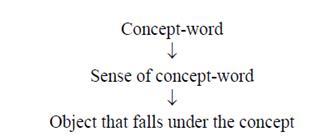
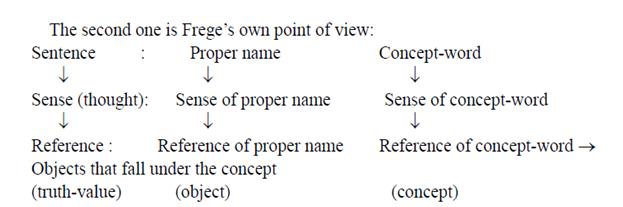
The Explication of Sentence Schemes
It was emphasized above that the sentence schemes have sentence as the central element and truth value as their core. The four schemes constructed in the previous section provide means to analyze four types of sentences in general. In these schemes, the level of reference is quite clear, as it shows clearly not only the reference of the sentence, but also that of its each part, therefore the truth condition is provided. In contrast, level of sense is not explained explicitly, as we can see only what the sense of the sentence is, but not that of its parts, because “part of thought” does not show exactly what it is. Comparing the level of reference and sense, we can understand better that the sentence schemes are mainly for the explanations of the truth value, therefore of truth of sentence. Now we can explain the schemes one by one in a simple way.
In scheme 1, the truth condition of a simple sentence is such that the object referred to by the proper name exists and it falls under the concept referred to by the predicate; otherwise it is false. Take “Aristotle is a philosopher” and “Shakespear is a philosopher” as an example. Their truth depends upon the following conditions: there is a person named Aristotle or Shakespear and he belongs to the set of philosophers. So the former is true and letter false. Besides that, as mentioned above, in the scheme a proper name can be added with the comma. For instance, “Yao Ming is taller than Jodan”. In this sentence, “is taller” is a predicate, while “Yao Ming” and “Jodan” are names, and its truth condition is the same. There can be one object falling under a concept, or two or more objects falling under a concept. So the difference between proper names and predicates is important, just as the slash (and comma) in the scheme shows.
In scheme 2, the truth condition of a sentence with a quantifier depends upon how individuals in the domain referred to by the quantifier fall under the concept referred to by the predicate, or in other words, upon the correspondence of the concept referred to by the predicate to the individuals in the domain referred to by the quantifier. Quantifiers are significant in language because they make explicit restrictions on predicates. Consider the sentence ‘Philosophers are smart’. Everyone understands its sense. But one cannot answer immediately when asked if it is true or not. The reason is that its truth condition is not clear. If we say ‘All philosophers are smart’, that is, some restriction being made by a universal quantifier to ‘philosophers’, then one can judge if it is true or false. From this example, we see the importance of quantifiers on the one hand, and it is also clear, on the other, that scheme 2 is to be used for quantified sentence in general, but not for the sentence with a concrete quantifier, as it does not show what quantifier there is in it. It was said above that our sentence scheme is constructible. Based on scheme 2, it is easy to build the following schemes with concrete quantifiers:
(Language) sentence : universal quantifier / predicate (Sense) thought : part of thought / part of thought
| (Language) | sentence : existential quantifier / predicate |
| (Sense) | thought : part of thought / part of thought |
| (Reference) | truth-value : at least one individual in the domain / concept |
Table 7: Scheme 2.1.
In scheme 2.2, the truth of a sentence with a universal quantifier is such that all individuals in the domain referred to by the universal quantifier fall under the concept referred to by the predicate; otherwise it is false. And in scheme 2.2, the truth of a sentence with an existential quantifier is such that at least one individual in the domain referred to by the existential quantifier falls under the concept referred to by the predicate; otherwise it is false.
In scheme 3, the truth condition of a sentence with a modal word depends upon how the reference of the sub- sentence falls under the possibilities expressed by the modal word. Frege’s theory of indirect reference is helpful for understanding such truth conditions. The reference of the sub-sentence is not the usual reference of a sentence but only its indirect reference. That is to say, the reference of the sub-sentence is the thought expressed by it. As scheme 2 is only for sentences with quantifiers in general, scheme 3 is only for sentences with modal words in general. Now based on the way in which we build scheme 2.1 and 2.2, we could also build schemes for sentences with different modal words, getting to know their truth conditions2. A sentence with the modal word for necessity is true if and only if the thought expressed by the sub- sentence falls under all possibilities referred to by the modal word. A sentence with the modal word for possibility is true if the thought expressed by the sub- sentence falls under at least one possibility referred to by the modal word. Take ‘it is necessary that 8 is larger than 7’ as an example. The sub-sentence is ‘8 is larger than 7’, and ‘necessary’ is an assertion of the thought expressed by the sub-sentence. The whole sentence is true if and only if the thought expressed by the sub-sentence falls under all possibilities, that is to say, it is not possible that 8 is not larger than 7.
In scheme 4, the truth condition of a sentence with a cognitive word is such that both the object referred to by the proper name and the thought referred to by the sub- sentence fall under the cognitive state referred to by the cognitive word. For example, in the sentence ‘Johan knows that the earth is round’, the sub-sentence is ‘the
2One can do that as a practice. A note, the reference of ‘necessary’ is ‘all possibilities’, and the reference of ‘possibility’ is ‘at least one possibility’.
earth is round’. The whole sentence is true if and only if the object referred to by ‘Johan’ and the thought of the sub-sentence fall under the cognitive state (or the concept) referred to by the cognitive word ‘know’, that is to say, there is a person called ‘Johan’ and he knows that the earth is round.
It is an advantage of our sentence schemes that there are two levels showing what the language expresses and refers to, i.e., one for sense and another for reference, so that the sentence schemes can offer more interpretations about sentences. It is well known in modern logic that the syntax and semantics of a formal language are strictly separated. These two aspects roughly correspond to the level of language and the level of reference in our sentence schemes, but the level of sense in our sentence schemes is missed in modern logic. It is clear that in the above explanation our theory of truth conditions is generally explained on modern logic, while our discussion involved in the level of sense is beyond modern logic. It is also well known in philosophy of language that sense or meaning have to be taken into consideration. So the level of sense in our sentence schemes can help. For example, in the discussion of proper names, some people pay more attention to how the sense of a proper name comes into being, while neglecting the connection between a proper name and a sentence holding its occurrence. Some people hold that a proper name has only a reference but no sense, confusing the level of reference and that of sense. In the contrast, according to our sentence schemes a sentence has a sense, therefore its parts, including the name occurring in it, must have sense too, otherwise the sense of the sentence would not be complete. It is also clear that the sense is related with thought and that the reference is related with truth-value.
Comparing schemes 1 and 2 with schemes 3 and 4, we can see further the importance of taking sense into consideration. Schemes 1 and 2 contain only the slash and the truth conditions of such sentences do not involve senses. It seems that sense is irrelevant here. But it is not true. Take the discussion about the bearer of truth as an example. According to sentence schemes, it is right to see sentences as truth bearers, as truth belongs to the level of reference and sentences belong to the level of language. It is also reasonable to take propositions as truth bearers, because propositions must belong to the level of sense. That is to say, both sentences and propositions can be seen as truth bearers, but the interpretations for each must be different, since they belong to different levels. Schemes 3 and 4 contain the double slash and involve sub-sentences. Dealing with the truth of such a sentence, one has to consider the thought of its sub-sentence, which belongs to the level of sense. Using the sentence schemes in dealing with issues of philosophy of language, we will have one more level. Hence more resources will be available for discussions. The sentence schemes will help philosophers to understand the level of reference better, recognizing deeper the important roles logic plays in philosophy of language, while they will help logicians not to simply neglect the level of sense, recognizing better that the involvement of sense in different linguistic levels might make effects on the truth of sentences.
Now we will further illustrate the use of sentence schemes in philosophy of language by a few examples.
A first example concerns compositionality. The principle of compositionality of reference holds that the truth-value of a sentence does not change if a part of the sentence is replaced with an expression that has the same reference. This principle is not valid in modal contexts. Consider the following sentences: (1) 8 is larger than 7. (2) The number of planets is larger than 7. (3) It is necessary that 8 is larger than 7. (4) It is necessary that the number of planets is larger than 7.
It is clear to see a difference here by the modal words, which (3) and (4) have, but (1) and (2) do not. It is also clear that the first three sentences are true and the last one false. Frege takes both ‘the number of planets’ and ‘8’ as proper names, having different senses but the same reference, therefore their substitution will not change the truth of the sentence. According to the sentence scheme 1, Frege’s theory is right and clear as well: their senses belong to one level, while their references to another. The reference of a proper name does influence the reference of a sentence, hence both (1) and (2) are true, since the reference of ‘the number of planets’ is same as that of ‘8’ But the senses of two proper names can be different, though their references are same. Therefore two sentences might have different thoughts, though their truth values are same. This is just what (1) and (2) show.
It is not the same for (3) and (4): they have different senses and different truth values as well. The senses and references of ‘the number of planets’ and ‘8’ do not change, neither do the senses and references of ‘ 8 is larger than 7’ and ‘The number of planets is larger than 7’.But the two sentences do have some change, as they are restricted by the modal expression ‘it is necessary’. Therefore they are not independent sentences any more, but only sub-sentences, i.e., they are only parts of a sentence as a whole. According to scheme 3, the sense of a sub-sentence is a part of the sense of the whole sentence, but its truth value is its thought but not the truth-value in the general sense. On the level of reference, it is the sense of the sub-sentence, not the truth value, that falls under the possibilities referred by ‘necessary’. Although (1) and (2) have the same truth value, they have different senses. Just because of their different senses, they turn (3) and (4) into sentences with different truth values: (3) is true and (4) false, as they are restricted by the modal word ‘necessary’. Hence it is not the truth value of the sub- sentence, but its sense that leads the truth value of a sentence with a modal word to change. To go a step further, the change can be seen also to be involved with the difference between the sense of ‘the number of planets’ and that of ‘8’. Then the change is due to the difference between the proper name and the definite description.
Rigid and Non-rigid Descriptions
Frege uses the term ‘proper name’ for names and all expressions with a definite article, taking both proper names and descriptions in our sense as proper names. According to him a proper name has a sense, but might or might not have a reference. Kripke makes a distinction between rigid and non-rigid designators, taking proper name and definite descriptions as fundamentally different. According to him proper names are rigid designators and have only reference but no sense, and the reference of a proper name cannot be determined by its sense. With this difference in mind, let us analyze the following two passages from Frege and Kripke: [Frege] If we found ‘a=a’ and ‘a=b’ to have different cognitive values, the explanation is that for the purpose of acquiring knowledge, the sense of the sentence, viz., the thought expressed by it, is no less relevant than its reference, i.e., its truth value. If now a=b, then indeed the reference of ‘b’ is the same as that of ‘a’. In spite of this, the sense of ‘b’ may differ from the sense of ‘a’, and thereby the thought expressed by ‘a=b’ will differ from that expressed by ‘a=a’. In that case the two sentences do not have the same cognitive value3. [Kripke] Let ‘R1’ and ‘R2’ be the two rigid designators which flank the identity sign. Then ‘R1 = R2’ is necessary if true. The references of ‘R1’ and ‘R2’, respectively, may well be fixed by non-rigid designators ‘D1’ and ‘D2’, in the Hesperus and
3 Frege G. On Sense and Reference, in The Frege Reader. Ed. by M. Beaney. Blackwell, 1997. p.171.
Phosphorus cases these have the form ‘the heavenly body in such-and-such position in the sky in the evening (morning)’. Then although ‘R1 = R2’ is necessary, ‘D1 = D2’ may well be continent, and this is often what leads to erroneous view that ‘R1 = R2’ might turned out otherwise4.
For Frege, ‘a’ and ‘b’ here are two different proper names, referring to the same object, so they have the same reference but different senses. According to scheme 1, the two sentences ‘a=a’ and ‘a=b’ have different senses but might have the same reference. In term of Frege’s famous example: ‘The morning star is the morning star’, and ‘The morning star is the evening star’. Both of the two sentences are true, but they express different thoughts.
Kripke considers two cases. The first case concerns with two rigid designators and the second one with two non-rigid designators. So his discussion is different from that of Frege’s. Let us rewrite Kripke’s argument in the following five steps: (1) Phosphorus is Hesperus (R1 = R2). (2) It is necessary that Phosphorus is Hesperus (‘R1=R2’ is necessary). (3) It is not necessary that Phosphorus is Hesperus (‘R1=R2’ is not necessary). (4) The heavenly body in such-and-such position in the sky in the morning is the heavenly body in such-and-such position in the sky in the evening (D1 = D2). (5) It is not necessary that the heavenly body in such-and- such position in the sky in the morning is the heavenly body in such-and-such position in the sky in the evening (‘D1=D2’ is not necessary).
The above five sentences are not in Kripke's order of argument, but in the order of using rigid and non-rigid designators. It is obvious that (1) and (4), corresponding respectively to ‘R1=R2’ and ‘D1=D2’, contain no modal words, while (2), (3) and (5) contain the modal word ‘necessary’, amounting to put (1) and (4) under the restriction of the modal word. The result is that (5) is taken by Kripke to be an explanation of the error in (3), since (4) is taken to be an understanding of (1). It is well known that the contexts of (1) and (4) are called extensional, while those of (2), (3) and (5) intensional. Then the error occurring here is due to failing to recognize the difference between proper names and descriptions and the one between intensional and extensional contexts. Now let’s discuss Kripke’ view with help of sentence schemes.
4Kripke S.: Naming and Necessity, pp.143-144. Basil Blackwell, 1990.
Firstly, Kripke does not say much about (1) and (4). These two sentences have no modal words and are used as premises in the argument. Therefore their truth conditions can be explained by way of sentence scheme 1 and it is quite understandable they belong to Frege’s discussion and that they are neglected in Kripke’ discussion.
Secondly, Kripke accepts (2) and (5) as true. The sub- sentence in (2) contains only proper names and is said to be ‘necessary’, while the sub-sentence in (5) contains only descriptions and is said to be ‘not necessary’. It is obvious that the proper names and descriptions refer to the same object, but the truth values of (2) and (5) are totally different. It shows that proper names and descriptions have great distinctions in a modal context, so that it is of great importance to distinct between them. Therefore Kripke is right in emphasizing the distinction between rigid and non-rigid designators.
Thirdly, Kripke does not agree with (3). Literally (3) is not consistent with (2). Then it is false, since (2) is true. So it is not possible for Kripke to agree with (3), since he agrees with (2). It is worthy to note that Kripke explains the error in (3) by (5). Because ‘the heavenly body in such-and-such position in the sky in the morning’ and ‘the heavenly body in such-and-such position in the sky in the evening’ correspond to ‘Phosphorus’ and ‘Hesperus’ respectively, it follows that (4) is equivalent with (1). The two non-rigid designators are different ways of presenting `Phosphorus' and `Hesperus', so that (5) is equivalent with (3). Therefore intuitively Kripke is right in his argument.
The problem is, however, not so simple from the view of our sentence schemes. By scheme 3, (2) means that the identity of the objects referred to by the two proper names falls under the possibilities referred to by the modal word. And according to the reference of ‘necessity’, the truth of (2) depends upon the following condition: the sense of ‘Phosphorus is Hesperus’, i.e., the instance that Phosphorus is Hesperus, falls under all possibilities. This condition is met since ‘Phosphorus’ and ‘Hesperus’ are rigid designators. So Kripke agrees with (2).
Now by scheme 3, the truth of (5) depends upon how the identity of the two objects referred to by the two non- rigid designators falls under the possibilities. To be more concrete, if (5) were a positive sentence, its truth would require that the identity showed by the sub-sentence falls under all possibilities. But this requirement could not be met because the two name-referring terms in the sub- sentence are definite descriptions, that is, non-rigid designators. This is just what (5) shows, as it is negative. So Kripke is right to agree with (5).
In Kripke’s view, the error in (3) is due to (5), as the proper names in (3) are understood as descriptions. Then the error is finally in two respects. One is related with the distinctions between names and descriptions, the other with the distinction between the extensional and intensional contexts. Therefore Kripke insists on the difference between rigid and non-rigid designators in order to get rid of the problems to she truth of sentence, which their confusion might bring about.
Kripke is correct in emphasizing the distinction between proper names and descriptions. His terms ‘rigid’ and ‘non-rigid designators’ can be used to express the distinction. But his argument is not without problem. What is problematic comes mainly from his examples. Literally the proper names ‘Phosphorus’ and ‘Hesperus’ do not have the senses as the descriptions ‘the heavenly body in such-and-such position in the sky in the morning’ and ‘the heavenly body in such-and-such position in the sky in the evening’ have. But the two names are given practically for the occurrence of the planet in the sky in the morning or in the evening. It is the way in which the names are given that makes the names seem to have some descriptive meaning, referring to the morning star and the evening star. ‘Phosphorus’ and ‘Hesperus’ are seen as not different from proper names, just because of the fact that they not only have no descriptive meaning literally, but also they all have the capital form as proper names have. In this sense Kripke is of course right to see them as proper names. But by saying that the two names refer to Venus, which is definitely a proper name, Kripke sounds to associate some descriptive meaning with them. For instance he criticizes Ruth Barcan Marcus by using Quine’s words:
Quine replies as follows, ‘We may tag the planet Venus, some fine evening, with the proper name “Hesperus”. We way tag the same planet again, some day before sunrise, with the proper name “Phosphorus”. When we discover that we have tagged the same planet twice our discovery is empirical. And not because the proper names were descriptions’5.
Quine distinguishes empirical discovery and what the two names express. In doing so Quine uses ‘proper name’ and ‘description’, so it is possible that `Phosphorus' is taken by him both as a proper name and as a description. Neglecting how Quine might interpret it further or
5 Kripke, S.: Naming and Necessity. Basil Blackwell, 1990, p.100.
criticize other’s ideas by it, at least ‘Phosphorus’ seems possible to have something to do with descriptions. Kripke does agree with Quine's comment. Therefore he has realized that such a name as ‘Phosphorus’ might be seen as both as a proper name and as a description. Otherwise it might be the case that he just quotes Quine’s words without realizing the above point.
It happens very often in ordinary life that a name is given due to a definite state, a phenomenon, or a sight, etc.. It is possible for a name literally to have a descriptive meaning in one language, but to fail to have it when it is translated into another language. Or it is possible for a name literally not to have a descriptive meaning in one language, but to have it when it is translated into another language. Take ‘Dartmouth’ as an example, which is well known in the discussion about proper names. Literally ‘mouth’ does have a descriptive meaning, though the geographic situation has changed in the place of Dartmouth and there the mouth of the river cannot be seen any more. But in its Chinese translation the character of proper name remains, while that of descriptions disappears. In comparison, literally ‘Phosphorus’ perhaps does not have a descriptive meaning, but its Chinese translation does have one. It is true that these changes are involved with the differences between languages, but it is a fact that some names stem from describing some places or situations. I will not deal with this issue further, as it is not the aim of the present paper. But the problem ‘Phosphorus’ goes with has to be dealt with because Kripke uses it to criticize Frege. So our discussion does concern the difference between two languages, as Frege is a German and uses another language.
Frege was probably the first philosopher who used ‘Phosphorus’ and ‘Hesperus’ to discuss proper names. It is Frege who makes the two names so famous in philosophical discussions, even if he is not the first one to use them. The German words are ‘Morgenstern’ and ‘Abendstern’ which are combined from ‘Morgen (morning), ‘Abend’ (evening) and ‘Stern’ (star). The two German words not only are proper names, but also have characters of description, literally having the meaning such as the star in the morning or the star in the evening. In Frege’s way, Kripke’s five sentences can be expressed as follows, with ‘morning star’ and ‘evening star’ for ‘Morgenstern’ and ‘Abendstern’ respectively: (1) The morning star is the evening star (R1=R2). (2) It is necessary that the morning star is the evening star (‘R1=R2’ is necessary). (3) It is not necessary that the morning star is the evening star (‘R1=R2’ is not necessary).
(4) The heavenly body in such-and-such position in the sky in the morning is the heavenly body in such-and such position in the sky in the evening (D1=D2). (5) It is not necessary that the heavenly body in such-and- such position in the sky in the morning is the heavenly body in such-and-such position in the sky in the evening (‘D1=D2’ is not necessary).
To compare Frege’s way and Kripke’s way of expressing the idea in question, it is obvious that changes have taken place not in (4’) and (5’), but in (1’) through (3’). A difference is such that Frege discusses directly ‘the morning star’ and ‘the evening star’, taking them to be proper names, while Kripke starts directly with ‘Phosphorus’ and ‘Hesperus’, seeing them as rigid designators. Just because the two names Frege uses have some literal meanings, Frege is right to say that ‘The morning star is the evening star’ extends our knowledge than ‘The morning star is the morning star’, and he is also right to say that one might know the morning star but not know the evening star. But it is not the case for Kripke. He has the right to use the terms ‘Phosphorus’ and ‘Hesperus’, calling them rigid designators, and he is right too to maintain the distinction between rigid and non- rigid designators. But he neglects the difference between the terms that he uses and that Frege uses, therefore he misses the problem this difference might lead to, which does some harm to his explanation about non-rigid designators.
My question is the following: what does Kripke mean when he says ‘have the form “the heavenly body in such- and-such position in the sky in the evening (morning)”’? I see his saying as belonging to (4) and provide two possible understandings for it. One is to take it as linguistic expression, i.e., a description. Another is as the situation expressed by the description. Now (4) is the form that (1) has, but is (4’) the form that (1’) has? Presumably the ‘Phosphorus’ and ‘Hesperus’ by Kripke can be taken as rigid designators, having no descriptive meanings literally, so (4) provides an explanation for them or designate their objects in terms of descriptions. Do the ‘morning star’ and the ‘evening star’ used by Frege need (4) to show what they mean, since they do have some descriptive meanings literally? Even Kripke is right to see (5) as the root of the mistake of (3), still one cannot help ask, would it be possible for (5’) to be the root of the mistake of (3’)? To be more concrete, does (1’) literally not have the meaning of (4’)? I take the opposite view. From (1’) to (3’), both ‘morning star’ and ‘evening star’ have a descriptive character, being natural not only for their expression but also for our understanding. So (4’) can be taken as paraphrase for (1’) rather than as the form that (1’) has. It is clear that the change in (4’) is only literal and can be understood without appealing to anything different from the literals. For instance, a ‘star’ means a planet, which naturally is in the sky; ‘morning’ means the time before or at the sunrise. So their combination, the ‘moring star’, shows what (4’) does. The only difference between (1’) and (4’) consists in that the terms are proper names in the former but descriptions in the letter. Just because the proper names in (1’) have the descriptive character, holding the expressive form similar with (4’), it is not necessary for them to be understood in term of (4’). In contrast, the difference between (1) and (4) consists in that the corresponding terms are proper names in (1) and descriptions in (4), and furthermore the proper names in (1) do not have descriptive characters, holding an expressive form that is different from that of (4). As a result, (4) can be taken as an understanding of (1), so the root of a great mistake buried in the relationship between proper names and descriptions has been dug out by Kripke. Whether Kripke is right or not, or whether there are some people who think in this way or not, at least it is not the way in which Frege states his theory of proper names. To show the problem here more clearly, let’s reconstruct the following sentences in the way in which Kripke works: (1’’) Phosphorus is Hesperus (R1=R2). (2’’) It is necessary that Phosphorus is Hesperus (‘R1=R2’ is necessary). (3’’) It is not necessary that Phosphorus is Hesperus (‘R1=R2’ is not necessary). (4’’) The morning star is the evening star (?). (5’’) It is not necessary that the morning star is the evening star (?).
The only difference of these sentences from those (1) to (5) is that the non-rigid designators in (4) and (5) are replaced by the terms ‘the morning star’ and ‘the evening star’. The first question I want to ask is if they are consistent with Kripke’s view, that is, if the terms ‘the morning star’ and ‘the evening star’ ‘have the form “the heavenly body in such-and-such position in the sky in the evening (morning)”’? As said above, ‘the morning star’ has both the similar meaning and form with ‘the heavenly body in such-and-such position in the sky in the morning’. At least their literal meanings cannot be denied as more or less the same, even if their forms would be seen as different to some extent. Hence (4’’) can be seen as providing an explanation for (1’’), as (4) can be seen as providing one for (1). Then a problem appears. The two question marks in (4’’) and (5’’) show that we do not know whether ‘the morning star’ and ‘the evening star’ here should be taken as rigid or non-rigid designators. If they were non-rigid designators, i.e., ‘D1=D2’, then (4’’)
would show that ‘“D1=D2” is not necessary’. This would be consistent with Kripke’ view, but then ‘the morning star’ and ‘the evening star’ could not be rigid designators. But they are indeed names, therefore rigid designators by themselves. So it would not be consistent with the fact. If they were rigid designators, i.e., ‘R1=R2’, then (4’’) would show that ‘“R1=R2” is not necessary’. That would be the same with (3’’), but a contradiction to (2’’). This result is exactly what Kripke criticizes, as he supports (2’’) and opposes (3’’).
The difficulty seems to lie in the ways in which Frege and Kripke deals with proper names and descriptions. Frege does not distinguish exactly between proper names and descriptions, paying great attention only to the distinction between their sense and reference. Kripke does not agree with Frege. He holds that Frege’s theory might make one to think that ‘a proper name is not a rigid designator and is synonymous with the description which replaces it’6, while he keeps insistent requirement on the distinction between rigid and non-rigid designators. But in Kripke's argument, probably due to the translation of Frege's terms, an example that is not problematic by Frege does give rise to problems.
According to our sentence scheme 1, such problems do not exist. All the terms, whether ‘Venus’, ‘Phosphorus’, ‘Hesperus’, which can be seen as proper names by everyone, or ‘the morning star’ and ‘the evening star’, which can be seen as proper names by someone and as descriptions by some other, belong to the level of language, holding the position of a proper name. On the level of sense they are different with each other. But on the level of reference, they have the same object. Take (1) and (4) as example. The sense of (1) is related with the sense of what the proper names or descriptions occurring in it, that is, with what they express. But the truth of (1) is related to the objects referred to by the proper names or descriptions in it, for instance, the objects must exist and fall under the concept (or the relation) expressed by its predicate. The same is true for (4), since the same explanation can also be given to ‘The heavenly body in such-and-such position in the sky in the morning’ and ‘The heavenly body in such-and-such position in the sky in the evening’.
According to scheme 3, the problems do not exist either. This is because at the level of reference it is the senses of proper names or descriptions and of the predicate that falls under the possibilities referred to by the modal word ‘necessary’. That is to say, what is here
6Kripke, S.: Naming and Necessity. Basil Blackwell, 1990, p.58.
involved in the connection with the truth value is not the object referred to by the proper name or description in the sub-sentence, but the senses expressed by them. Take (3) for example. It simply denies that the sense of the sub- sentence ‘Phosphorus is Hesperus’ falls under all possibilities. The result is the same if the sub-sentence in (3) is replaced by (4). In other words, the same is true for (5), i.e. ‘It is not necessary that the heavenly body in such- and-such position in the sky in the morning is the heavenly body in such-and-such position in the sky in the evening’, which exactly denies that the sense of its sub- sentence falls under all possibilities. Of course someone might say that a proper name has a reference but no sense. However it has nothing to do with our sentence scheme, by which we always consider names in a sentence as Frege does. As part of a sentence, a proper name might have no reference, but it must have a sense. If the proper name in a sentence has no object, still we can understand it, though its truth cannot be determined. If a proper name had no sense, the sentence in which the name occurs would not have sense either, or the sense of the whole sentence would not be complete. How shall we then understand such a sentence?
A simple comparison can also be made by way of our sentence schemes between Frege’s view and the view from Kripke’s causal theory of reference. It is in my view not reasonable to criticize Frege’s theory about proper names from Kripke’s theory. If the discussion were to deal with whether a proper name has a sense, how it gets its sense, and whether the sense of a proper name has some relation with the way in which the name is originally given, etc., Kripke’s theory would be reasonable, at least to some extent, which maintains that a proper name has only reference but no sense. But his theory is not correct from the point of view of analyzing and understanding sentences. A sentence is objective, as one can read it and hear from it. The sense of a sentence is objective, for one can understand it, paraphrase it, and translate it into another language. The truth condition of a sentence is also objective, since one can come to realize it. On the contrary, one cannot understand a sentence that has no sense. If the sense of a sentence were not objective people would not have a common understanding for it. Then there would be no communication among people through sentences. Since a proper name is part of a sentence, it must have sense, otherwise the sense of sentence would not be complete. How could one understand the sense of a sentence without understanding the sense of its parts, for instance the sense of the proper name occurring in it? The trouble consists probably in the connection of the sense of a proper name with its reference. And it is easy and also possible for one to take its sense as its reference.
However, so long as a sentence is taken to have a sense, the proper name occurring in it cannot be treated as having no sense, no matter what sense it is. In one word, it is very clear from the view of our sentence schemes that a sentence has sense. Therefore its parts must have sense as well, because they cannot be leer.
With this point of view in mind we can recognize that the level of sense is distinct from the one of reference, even if the sense of a proper name is to be understood as the reference. Take (a) ‘Aristotle is a philosopher’ as an example. According to scheme 1, the sense of ‘Aristotle’ is in included in the sense of the sentence. One can ask: ‘What does it mean by this sentence?’ ‘What does it mean by “philosopher” in it?’ or ‘What does it mean by “Aristotle” in it?’ Are these not natural questions? Is the last one not for the sense of ‘Aristotle’? Some people perhaps might say that the last question is not natural at all, since one usually asks ‘Who is Aristotle?’ or ‘Whom does it refer to by “Aristotle”?’ It is true that the direct relation of the word ‘who(m)’ with the expression ‘refer to’ looks to show that the question is about the reference of ‘Aristotle’ instead of its sense. But the word ‘refer’ and its relation with names in use show nothing but a conventional way in which we use language. That is to say, ‘refer’ is a word by which we deal with sense of names, no more than ‘mean’ is the word by which we deal with the sense of words in general; and ‘who(m)’ is a word showing only some particularity of names , no more than ‘where’ showing only some particularity of places, or ‘what’ showing its relation with anything. Or I think we can explain the point in another way, if we have to accept the ordinary use of language. The ‘reference’ in the sentence schemes is different from the reference we talk about in daily life. It can be understood in the sense of semantic value. That is why we call ‘reference’ a level, on which one can see what language expresses. If reference had to be uses to show the sense of names according to the convention of language, still we would keep the third level, calling it for instance ‘Bedeutung’ in Frege’s term or just ‘semantic value’, then our sentence schemes would remain the same and the only change would be the name of the third level. The key point is how to treat our understanding of a sentence. Following Frege, I insist on that the sense a name is necessary for the sense of the sentence in which the name occurs.
Keeping the difference between sense and reference in mind, we can deal further with the difference between sense and reference of names. It is natural that to understand a name means to know whom it refers to. But an understanding of a reference of a name is indeed related with some sense. For instance we know that ‘Aristotle’ refers to the father of logic. What we know is exactly a sense of the name ‘Aristotle’ and it can be expressed as (b) ‘Aristotle is the father of logic’, which is a sentence again. That is to say, we express our understanding of the name ‘Aristotle’ in term of a predicate. The ‘Aristotle’ in (b) needs to have a further understanding, if (b) is not related with (a) above. If related, for instance, so (b) is an understanding of the name ‘Aristotle’ in (a), then (a) can be taken to be true. If there is no (b), then some other understanding of ‘Aristotle’ in (a) is needed, for instance, (c) ‘Aristotle is the writer of Metaphysics’, by which we can also judge if (a) is true. So Frege’s theory has nothing to do with how an object gets its name. Nor does he care much about if the sense of a name determines its reference. He pays great attention only to make a distinction between the two levels of sense and reference, and based on this distinction, he points out how to deal with the relation between the references of name and sentence, with the aim to determine the truth value of the sentence. That is why he tolerates variations of the sense of a proper name under the condition that its reference remains the same.
Kripke's critique on Frege’ theory in question is based mainly on two points. First, proper names and definite descriptions should be distinguished. Second, the reference of a proper name cannot be determined by its sense. The first point is no doubt correct. Frege himself also realizes the distinction7. That he does not distinguish proper names and descriptions is simply because it is not necessary, since his discussion is based on an extensional two valued logic and its aim is mainly to provide a view on the basic syntax of sentences, hence affording an explanation of what language expresses. Just as our sentence schemes show, the core of Frege’s discussion is the sentence and truth value. In order to meet the requirement of such syntax and truth value it is necessary to realize what expressions can be seen as proper names syntactically, but not necessary to distinguish an actual name from a description, since they both can play the role of referring an object. Frege's logic of quantification is extensional, and there is no need to make a distinction between proper names and definite descriptions. But it does not hold for Kripke, since his discussion is based on modal logic, which is not extensional but intentional, and which has some difference from Frege’s logic. Kripke has to distinguish rigid and non-rigid designators because the occurrence of a non-rigid designator in a modal sentence will have some effect on its truth value, thus changing the validity of some principles for first order logic. I think
7For instance Frege calls ‘Aristotle’ ‘ an actual proper name’. (Cf. G. Frege. On Sense and Reference, in The Frege Reader. p. fn..) Kripke is fully right to insist on the distinction between rigid and non-rigid designators, and he is also reasonable to believe his own point of view and to discuss the issues in question on the base of it. He could also be right if he would critically say that Frege’s theory about proper names is suitable only for extensional contexts but not for intentional ones, i.e., not suitable for the sentences with modal words. But the fact is that he criticizes Frege’s theory itself. Furthermore the example he uses in his critique is not exactly the same with that Frege uses. Just as pointed out above, the result is that there is no problem with Frege’s example, whether the ‘morning star’ in it is regarded as a proper name or description, but there are indeed some problems with Kripke’s example, as his does not make a clear distinction between non-rigid designators and descriptions, or in other words he does not show clearly what a distinction there is between them.
Kripke's critique on Frege is important in the sense that it puts Frege’s theory of proper names into a more broad perspective, involving and showing some more complicated problems in connection with proper names. Based on sentence schemes we can have a better view about the different levels and structures of sentences, therefore having a better analysis of the problems themselves and of the discussions about them as well.
Gettier Problem
Edmund Gettier wrote in 1963 in a very short paper8 about the question of the definition of knowledge, which is called Gettier problem, Gettier paradox or Gettier example in literature. Based on Plato’s Theatetus, Gattier problem puts forward a definition of knowledge in the traditional sense, constructs an analysis of it and then provides some counter examples for it, showing finally that the traditional definition of knowledge is problematic. Since Gattier problem is almost a common sense, we shall not discuss it in detail, but only take it as another example. We shall analyze its analysis of definition, one of its counter examples and its refutation to it, aiming definitely to show the use and significance of our sentence scheme. First we formulate these to be analyzed as follows: [Analysis of definition] a knows p if and only if (A) p is true, (B) a belives p, and
8Gettier, E.L.: Is Justified True Belief Knowledge?, Analysis 23. 6, June 1963.
(C) a is justified in believing p. [A counter example or Gattier’s case] (1) m and s have applied for a job w. (2) m believes that s will get the job w, and m knows that there are ten coins in the pocket of s. (3) Hence m is justified in believing p: The man who will get the job w has ten coins in his pocket (B’). (4) The result is that m gets the job w, and m happens to have ten coins in his pocket. (5) Therefore, p is true (A’). (6) And m is justified in believing p (C’). [Refutation] The three conditions (A), (B) and (C) are satisfied but m does not know (4). Therefore the traditional definition of knowledge is problematic.
There are various discussions about the Gettier problem and many similar cases are constructed as counter examples in literature, bringing about different views and results. No agreement has been reached on the question and many valuable problems are to be discussed further. Here what I want to do is to point out some problems involved in the above analysis of definition, the counter example and its refutation, showing and explaining the complicatedness that might come into being because of the use of cognitive words such as ‘know’ and ‘believe’.
Let us examine the three conditions in the definition of knowledge. (A) is simple, having only the assertion ‘is true’ of p. (B) is a cognitive sentence, the truth of which is as below: the object that ‘a’ refers to exists and this object and the thought of p fall under the cognitive state that ‘belief’ refers to. (C) is a bit complicated and can be reformulated as below: (C*) It is justified that a believes p.
Now it is clear that this is a sentence containing a cognitive sentence as its sub-sentence. The word ‘justified’ is a sort of assertion. As said above, if we see it as different from the cognitive words, we can construct the following sentence scheme for such a sentence as below:
| sentence : assertive word // sub-sentence | |
|---|---|
| (Sense) | Thought : part of thought // part of thought |
| (Reference) | truth-value : state of assertion // though expressed by sub-sentence |
Table 8: Scheme 5.
The expression “it is justified that” is similar to the modal expression ‘it is necessary that’, as sentence scheme 5 is similar to the scheme 39, both containing a sub-sentence. That the assertive expression is combined with a sub-sentence shows clearly that such an expression involves intensional context. It seems easy how to understand such sentences due to the similarity they have with modal sentences, about which we have explained above. But it is in fact not so simple as far as (C*) is concerned. It is true that (C*) is an assertive sentence. But the sub-sentence occurring in it is not a simple sentence, instead it is a cognitive sentence. That is to say, having another sub-sentence, this sub-sentence itself is an intensional sentence, being involved in intensional context already. As a result (C*) contains iterated sub- sentences and is therefore involved in iterated intensional contexts. Then the truth condition of (C*) is very complicated. Now let us turn to the counter example. We can analyze it in the following steps: Step 1: Consider the proposition p in it, as it is the core sentence. It occurs in (3), i.e., ‘the man who will get the job w has ten coins in his pocket’. It is clear that this is a sentence that contains a definite description, as the expression ‘the man who will get the job w’ shows. Step 2: Consider (2), which seems very important, as p follows from it. There are two cognitive words in (2): ‘know’ and ‘believe’. Hence the inference from (2) to (3) is very complicated, much more complicated than we think generally10. Intuitively, the cognitive states expressed by the two cognitive words are different. The truth conditions of these sentences are different and hence
9It is clear that the assertive words are more or less similar to the cognitive words. One the one hand, they can be used as transitive verbs, for instance ‘a asserts p’. In this sense one could construct a sentence scheme for them similar to scheme 4 above. On the other hand, the cognitive words can also be used in the way we are talking about the assertive words here, for instance ‘it is known that’. In this sense one could construct a sentence scheme for cognitive words similar to the scheme 5 as well. It is significant that by doing so one could see better how our sentence schemes are constructible. And furthermore it might help one to realize that the modal expressions are fundamentally different from other expressions, whether cognitive or assertive, because they are not verbs in the usual sense at all, while the other expressions are verbs factually. This is a great difference that I want to point out, without going into detail.
10Different cognitive words express different cognitive states. Logical systems for them also show the difference.
For example, in the standard epistemic logic of knowledge, Kp --> p is a theorem. But Bp --> p is not a theorem in the standard epistemic logic of belief. It says that p is true when one believes that p. This statement is obviously problematic.
inferences related with them also different. Therefore it is not trivial to infer p from (2). Step 3: Consider (3). It contains p but it is not equivalent with p because of the two expressions ‘believing that’ and ‘is justified in’ occurring in it. The expression ‘is justified’ involves more complicated context as pointed above. And the expression ‘believing that p’ is obviously different from ‘p’. Then the inference from (2) to ‘p’ is different from that from (2) to ‘believing p’. If the inference were from (2) to ‘p’, there would be a question whether the inference is valid or not, i.e., whether p follows from believing p. The letter inference is usually excluded by a logical system and even intuitively we can see its invalidity. If the inference were from (2) to ‘believing p’, then we see in fact that (3) shows only ‘believing p’ but not ‘p’, let alone the complicated situation due to its two cognitive words. Therefore (3) is indeed ambiguous. Step 4: Consider (5). It is an assertion of p. Now it is clear that if the inference in (3) is valid, we cannot get p. Thus the assertion (5) is ungrounded. If the assertion (5) were inferred from (3), then it would depend on an invalid inference. Therefore (5) is problematic because of the problem in (3).
Finally let us consider Gettier’s refutation. The sentences in the counter example that correspond to conditions (A), (B) and (C) are (5), (3) and (6) respectively. The key point of the refutation is as below: (4) is the case, but m does not know (4); hence m does not know p. Literally there is an implicit premise here that (4) is equivalent with p. Even if there were no such problems with p as mentioned above, still one has to consider if (4) is really equivalent with p. Namely, is the sentence ‘m will get the job w and there are ten coins in the pocket of m’ equivalent with the sentence ‘the man who will get the job w has ten coins in his pocket’? Based on the above discussion, we can say definitely that the two sentences are equivalent in an extensional context. Namely, they have different senses but they have the same truth value. The situation will however be changed in an intensional context. Just because of the difference between their senses, the truth value of the two sentences in an intentional context will be different even if the cognitive words occurring in them are same. The reason is as follows: ‘m’ is a proper name while ‘the man who will get the job w’ is a description; their equivalent substitution depends upon the contexts in that they occur and the results will be different as the contexts change.
Moreover, the sentence (4) cannot be equivalent to p due to the future tense in (4). Hence ‘m knows (4)’ is distinguished from ‘m knows p’. Therefore the expression ‘m does not know (4)’ mentioned in refutation is not a refutation to the expression ‘s knows p’ in the original definition, even if there were not any problems at all in the counter example.
In addition to the problems mentioned above there is another problem in the counter example that is relevant to inference. Assuming the equivalence of (4) to p and all the premises, still we can see the following inference in it: (1*) s gets w and there are ten coins in the pocket of s. (2*) there is a person who gets w and there are ten coins in the pocket of that person. (3*) m gets w and there are 10 coins in the pocket of m. This inference is valid. What the counter example contains however is not this inference but the following one: (1’) s gets w and there are ten coins in the pocket of s. (2’) the man who gets w has ten coins in his pocket. (3’) m gets w and there are ten coins in the pocket of m.
This inference is not valid because (2’) does not follow from (1’). By the analysis of definite description, (2’) can be transformed into (2’’) There is at least one man who gets w, and there is at most one man who gets w, and there are ten coins in the pocket of that man.
One can infer that there is at least one man who gets w from that s gets w. Therefore it is valid to infer (2*) from (1*). But “there is at most one man who gets w” cannot be inferred from “s gets w”. Hence the inference from (1’) to (2’) is not valid.
To sum up, there are many problems in Gettier problem, not only in its analysis of definition, but also in its counter example and refutation, which as a whole make the issue extremely complicated. It seems natural that an agreement can hardly be reached and a satisfying solution can seldom be achieved in the discussions about it due to so many problems. Our analysis through sentence schemes above can make the problems in question much more explicit, including the difference between proper names and descriptions, the difference between the linguistic level with an assertive or cognitive word and that without it, and the difference between the linguistic level with a single assertive or cognitive word and that with multiple ones, etc. For instance (C) involves a case that is seen more clearly in term of (C*): there are two sub-sentences in (C), one is restricted by the assertive word ‘justified’ and the other by ‘believing’. That is why we say that (C) involves not only an intensional context, but also a more complicated case. By the way, cognitive words themselves also lead to such complicated cases. For example, ‘Johan knows that Peter believes the number of planets is larger than 7’. Surely intensional contexts and sentences are not limited to such cases and can be more complicated. Using our sentence schemes, I believe one can give analysis to such sentences. In a word, one might not solve the problems in question by way of our sentence schemes, but it is true that they are very helpful in philosophical discussion and research.
- Noentarion: Toward a New Ontological Category for Non Biological Agency in the Postmodern Age
- The Place of Wittgenstein’s Tractatus in the History of Philosophy
- Digital Hermeneutics Embodied in Brian Kim Stefans’ “The Dreamlife of Letters,” and Memory: Analog to Flash Interface in the Light of Ecofeminism
- Using C-Tables to Teach Class Logic
- The Ideology of Education’s Postponed Fantasies: Deepenings on a Pressing Problematic
- Phantasia and Perceptual Realism in Aristotle