
Political Power and Neocolonialism of Vaccines: The Exercise of the Word and the Human Act
This paper analyzes the situation generated by the unequal distribution of vaccines that -at the international level- has occurred in the framework of the epidemic generated by COVID-19. For this, the concepts of «act» and «word» derived from the theoretical-political theses of Hannah Arendt (1993) are used, with which it was sought to evidence the situation of neocolonialism of vaccines derived from this situation, from the philosophical deconstruction to raise the urgent consequence of neocolonialism in health, which allowed us to infer how Human Rights are not the central axis of the national and state discourses or praxis of the government systems of countries with more stable and stronger economies, since the decisions and behaviors reflect the interests of the main actors of the National States that have economic support for the large-scale purchase of vaccines against COVID-19. Which in turn are the protagonists of a sociopolitical phenomenon that can be categorized as global health neocolonialism, which is presented as a phenomenon of neocolonialism that began with the confidentiality agreements signed between the States of the countries and the pharmaceutical corporations, inside or outside COVAX in the year 2020. Concluding that the massive purchase of vaccines was subject to an exclusivity character to acquire the batches,where some factors of discrimination or non-inclusion are revealed, affirming that COVAX did not comply with the purpose for what was initially created.
Introduction
From the year 2020, the “lebenswelt” (way of life) [1], A large part of the world population was affected by COVID-19, a disease caused by the SARS-CoV-2 virus and its different variants. Its appearance modified the customs and forms that obeyed the parameters of normality established and historically constructed. What caused each culture, State and Nation to take prevention measures, planning and public health policies in the face of the imminent threat of Perspective the pathogen [2]. However, the empowered official voice that manifested itself worldwide, through the different media, institutional and political networks, was that of Doctor Tedros Adhanom Gebreyesus; Director of the World Health Organization (hereinafter WHO) [3]. Who with his statements and pronouncements marked the rhythm of the recommendations and concerns of the health organizations that were dedicated to investigating and intervening in the presence of the virus.
The results of the investigations on SARS-CoV-2 have been beneficial or favorable depending on the criteria with which they are evaluated, but it is clear that COVID-19 came to alter the normality of life in every way: economic, political, social, educational, health among others [4]. Likewise, the anxiety caused was not only due to the events that were taking place on the planet, but also to the fact that eventualities such as speeches, behaviors and actions that each nation with its systems and government representatives- assumed or gave the case they stopped assuming [5]. Faced with the multiple vicissitudes that the global spread of the virus produced, the possible decisions, behaviors and paths assumed by the different political regimes were different, since these ranged from the mandatory use of the mask to the rational and anticipated massive purchase of biologicals, to prevent mortality or minimize the harmful effects of the Coronavirus on their populations. The alteration of daily life at a personal, family, sociopolitical and economic level [6]. They led governments to rely on normative decisions [decrees, laws, administrative resolutions] that -from their ideological belief- are justified to elicit compliance by citizens while mitigating the impact of discourses focused on structural conditions. of poverty, social and economic inequality that were evident during the pandemic, triggering feelings of resistance and disapproval of the normative measures from which it is perceived that principles such as tolerance, solidarity and cooperation are violated, raising questions regarding compliance of authority in crisis situations [7].
Starting from the analytical view of Moscovici [8], the dissemination and spread of information regarding COVID -19 was not clear enough, which determined a distant relationship between the government and the citizenry, causing an increase in both the feeling of uncertainty and the decrease in the perception of self-efficacy or the feeling of that it is possible to move forward in the midst of adversity. Without considering that the COVID-19 pandemic is part of a social fact of great impact, not only because of the numerous direct and indirect victims it leaves, but also because of the fear generated from the limitations in social interactions which, from the protocols of self-care and social distancing, changes were caused in the ways of working, studying, among others, with the risk that fear would be the trigger for indifference and apathy that will lead to a decrease in social cohesion, strengthening an authoritarian attitude.
At that historical moment, some countries were in a proven capacity to purchase the necessary quantities of vaccines, in view of which it was to be expected that the reaction of the WHO to the excessive purchases of vaccines by some countries led to realities of profound inequality or disparity that would affect the attention of public systems [9] whose objective was to preserve the health status of the demography as it was their duty to safeguard or protect. In such a way that, faced with this scenario, the opinions of important figures issued warnings.
An example of this was the already mentioned director of the WHO, who predicted a critical periodicity: …[W]here countries prioritize vaccinating their own populations over those of other countries—it leaves the world vulnerable to an even longer pandemic, given that the WHO estimates that the coronavirus pandemic will only end when 70% of the population global is immune. It is predicted that 500 million would need to be vaccinated in the Americas region to control the pandemic, although the forecasts were before the rise of variants such as Delta and Omicron. (Adhanom Gebreyesus, cited by WHO, 2022) [10].
In this same sense, it should be emphasized that certain public opinions issued judgment matrices based on what was expressed by Adhanom Gebreyesus, who predicted a world scenario marked by the aforementioned causes of inequity. Which led to the fact that public gazes were no longer focused on the whipping or whipping of the so-called COVID-19 [11, 12]. Thus, the combination of the multiple ravages of the coronavirus and the erroneous decisions of the States of certain governments patented a reality: a new neocolonialism.
Neocolonialism of Vaccines and the Exercise of Political Power
Neocolonialism, in the contemporary world, has adopted other dimensions, other characteristics and actors [13]. Well, it has acquired new meanings, coming from an unusual complexity that originated with the global situation of the pandemic, where its dimensions lead the analytical gaze both to the field of health and the global health of all the inhabitants of the planet. However, with a world of countries in a framework of capitalism and changing global complexity in its forms of expression, it is now based on other instrumental mechanisms referring to disparity and social inequity that are decanted in the event of global distribution.
A marked inequality can be perceived as a result of the emphasis placed by various nations that -with their particular economic capacities- promoted the purchase of sufficient doses and vaccines to protect their populations from the eventuality of contagion. This human-state event also produced a phenomenon in the state of defenselessness that arose from countries with limited economic situations, which could not protect themselves. In this sense, Haiti and Mali were possible extreme cases to consider for study. This situation is an example of how inhumanity threatens the human lives of the most affected populations.
Through the analysis carried out, it is inferred how human rights -among them, the right to life- are not the central axis or priority of the national or state discourses or praxis of the government systems of countries with more stable economies [14], nations of the so-called First World, which have been able to operate with a number greater than enough to prevent the spread of the disease.
Therefore, it was determined that fundamental human rights were disrupted if it was intended, using the expressions of Adhanom Gebreyesus, to specify “immunized balloons” or “massive herds”. This purpose does not obey state priorities because human rights are not fundamental in themselves. Which was observed in that there were decisions devoid of personal senses of solidarity, dignity, common sense or respect for the planetary modus vivendi, ignoring what was proposed by the United Nations when they indicate that human rights are indivisible, therefore there is no room for exclusion. of individuals and collectivities and the privilege of one over the other [15].
The power of national autonomy -understood as the ability to make their own government decisions in search of compliance by citizens- rests historically on a previous thought of the modern age. Therefore, this autonomy has persisted with its own policies and processes that drag to date such as statism or bureaucracy, which serve as justification for the oratory and actions of regimes contrary to the principles upheld by the WHO. Therefore, the emergence of this phenomenon of neocolonialist, now redirected to global public health, is questionable. Where the particularistic decisions of some heads of state who ignored the recommendations of the WHO caused disparity and imbalance in distribution, generating inequity in the supply of vaccines to counteract the coronavirus. In such a way that it is not fortuitous that the WHO has repeatedly mentioned it in its speeches and documents. Well, it can be reiterated that this is how “vaccine nationalisms” arose, an expression proposed by Director Adhanom Gebreyesus himself. As of August 2020, the WHO warned of this possibility. By then, certain countries showed a particular aligned interest in the series of vaccines that were in the experimental phase.
Because they were being publicized at the wrong time, showing evidence that their guidelines, which were pointing off the radar of the then newly created global vaccine system, named COVAX [16]. Therefore, this “vested interest” -to use Jacinto Benavente’s expression- would translate into a guideline and a practice to be followed by various world powers [17]. About which the most emblematic example was the United States.
In this way, COVAX emerged as a global platform created in April 2020 by the WHO, which aims to manufacture, develop and equitably distribute biological vaccine products [18]. This has been in charge not only of the WHO, but with the participation of France with public-private alliances they create the World Vaccine Alliance, apart from being a mechanism created to coordinate these purposes [19], This global mechanism -it is worth mentioning- fulfilled its functions throughout almost the entire year; under penalty of national interests that intervened to hinder their functions at some point.
At that time, it was public knowledge that the first country to apply the first doses was the United Kingdom, despite the fact that Prime Minister Boris Johnson had denied months before the effectiveness of the biological. Given the scope of the disease in some countries and the epidemic peaks reached, I am correcting its position regarding the virological scourge for December 2020 [20]. Little by little, the United States and France began to replicate particularistic national interests, not hiding their claims to watch over, protect and ensure the first massive orders of anti-COVID-19 vaccines [21]. By January 15, 2021, more than three-quarters of the mass vaccines were directed and contingents had entered developed countries with high economic resources. For low- income countries, only 11% of the world’s population had access to the first dose for the least amount [22].
Faced with this situation, the Director of the WHO: Adhanom Gebreyesus, had no choice but to issue a global warning and concern, about the limitations not only being localized to vaccines: there were “brief moments” of “unprecedented crisis” regarding the production area of masks or ventilators sufficient for certain [23] regional or national spaces [it is worth remembering how India was a massive focus of the pandemic and crisis]. Likewise, he warned that so that this unfortunate episode would not happen again, measures should be taken jointly by the countries so as not to generate abysmal inequalities in the global distribution of antiviral biologicals, thus preventing the unnecessary prolongation of a pandemic that can be avoided becoming a catastrophic endemic.
Thus, it became clear that the development and power of the States is not enough to mitigate the pandemic. Therefore, it is necessary to consider economic and sociopolitical resilience from the relationship between countries. In this sense, the director of the WHO pointed out: While there is a desire among leaders to protect their own people first, the response to this pandemic must be collective. This is not charity, we have learned the hard way that the fastest way to end this pandemic and reopen economies is to start by protecting the most at-risk populations everywhere, rather than the entire population of just a few countries (cited by UN News, 2020)
In this way, it is evident that the inequity and social inequality of the distribution of vaccines could be prevented since 2020, avoiding the phenomenon of disparity, which is what aggravated the problem to the point that -even by April 2022- it had an index of significant global impact.
Premeditated Intent and Neocolonialism
It was identified that the premeditated intentionality of some countries prevailed [United States, France, United Kingdom] in which the scope of the purchase of vaccines depended on the purchasing capacity of each country. Against which it was sought to obtain the necessary doses to immunize, being able to even buy them by contract, ignoring the warrants and moderate claims of the WHO. As noted, this was not an isolated event: such guidance was observed as early as 2020. In relation to which Chase Harrison was able to concisely express this relationship when he stated that the purchase of vaccines for covid-19 depended on the existing value factor, stating that the gaining of vaccines is topic to the actual purchase value of the same , which -as a National State- do not have the powers or the political will to specify the cancellation of the necessary doses to prevent [22].
This reference illustrates the aforementioned scenario, which, added to the negligence of certain governments for the effective acquisition of retroviral biologicals, fuels and stirs up the degrees of inequity that have spilled over global population health, an affirmation that does not include the depth of the specificities of the problems that characterize each country.
Obviously, each Nation has its particular problems, which reflect specificities in the health policies and systems that characterize them and differentiate them from each other. These differences are due, to a greater or lesser extent, to the terrible or regular health policies applied for decades by the rulers of the day with a lack of political will towards this area. In other words, the will of the various political regimes has ignored or neglected key areas for general prevention planning against the virus. Demonstrating its drive by proportionally entering any nation that tried to stay out of the health recommendations of world organizations.
Therefore, there was no intention or political will of some rulers to avoid higher costs to the population of a given territory with regard to decisions on public and state health policies. Since the concretion of this preventive political will of certain Western national States would be fruitful and beneficial if they had reacted promptly and acted on time, I place the populations involved in that state of disaffection.
The decisions and behaviors reflect the interests of the main actors of the Nation States - the Western countries more than anything - that have economic support for the large-scale purchase of vaccines against COVID-19. These are the protagonists of a sociopolitical phenomenon that can be categorized as «global health neocolonialism», a situation that is still sustained by the gap between social or common welfare, the network of interests of the ruling State and the national population to which the huge shipments of vaccines purchased by their regimes are destined for it.
This has been, without a doubt, a socio-global phenomenon created and generated by the political subjects that stage it since the end of 2020 when the first biological systems of the different approved vaccines appear because they are experimentally suitable for being applied to the first groups humans. In this regard, the Government of the United Kingdom, despite having been reluctant at the beginning, was the one who raised the objective of combating, reducing or immunizing the harmful effects against the health of the world population by acquiring them, rationality prevailing in the process. Where the date that this phenomenon of neocolonialism begins can be estimated due to the confidentiality agreements signed between the States of the countries and the pharmaceutical corporations, inside or outside COVAX, when some retroviral that had approved the phases were publicly disclosed. experimentation positives.
Although some nations reacted late, despite the primary positive results in August 2020, others showed both negligence and temporary political will and intention to prevent endemic human disaster situations [e.g., India]. In any case, other national States subordinated to their created or economic interests that prevailed over the common sense of common welfare [24] of humanity. The truth is that the prioritization of these variables of interest over dimensioned the health and health vulnerability of certain societies -particularly poor ones- that were premeditatedly subjected to forced mortality or, in any case, to a series of avoidable ailments.
So, exposing the national health conditions of some societies unable to buy vaccines make them vulnerable in a way contrary to the recognized parameters of well-being and dignity. This points to actors of the stature of the presidents of Brazil; Jair Bolsonaro and Mexico; Andrés Manuel López Obrador, who openly disdained temporarily and did not prioritize decisions in the face of the proposed health scenarios, subjecting their populations to situations that -at the time- were avoidable health-wise [25].
In relation to the aforementioned, there is evidence of how the health systems of some countries, despite the turbulence caused by the appearance of SARS-CoV-2, have returned to normal channels. As each regime, through its primary actors, has in its power the authority and decision- making that its acts and autonomous words entail, the power of the industrialized powers of presidents must be emphasized in terms of autonomy of thought and political action that they embody (representing the political wills for the most part) a priori.
Of course, there are other ways of thinking, saying and acting that resize the way of governing and managing their social and health policies; characterizing them. The predicted modes or ways of behaving politically in the areas of health-health; these other forms or modes connote Words and Acts of the autonomous leaders that can be the target of more philosophical analytical-interpretive perspectives that will be detailed.
Arendt and the Unpostponable Consequence of Neocolonialism in Health
Generally, political nationalisms are unstoppable historical-contemporary eventualities, and “the effects” of the pandemic-endemic of the aforementioned virus are not unrelated to the new phenomenology of health, because although vaccines are not unrelated to this complex process of public policies of a Nation, the revelations or reflections of the eventualities worthy of being analyzed under the optical prism of Hannah Arendt are not alien either [26, 27].
The pandemic-endemic has generated a phenomenology of events with their own conjunctures. In context, to the extent that it covered its dark trajectory during 2020, it put public policies in tension, not only because of the consequences of morbidity and mortality. Since it was also relevant to the perception of risks and threats and the projections of the sanitary and epidemiological problem in order to acquire the necessary vaccines; Most of the health policies collapsed according to what was investigated. For this reason, it is important to highlight that those who would assume the political-sanitary decisions, at the time, were in charge of the main political authorities, so that the purchases of the vaccines are acts and decisions that start from their will, and from the role The preponderant role played by the number of state decisions that -represent or subjectively agglutinate- the political intentions of those who voted for this leader.
Having clarified what has been stated, it is necessary to resort to the philosophical deconstruction of the philosopher H, Arentd through words and actions. As Comesaña Santalices and Cure de Montiel pointed out to us that, in H, Arndt, the act and the word are two ways and means in which we as human beings represent ourselves before others and those others with us, which is executed in the development of relationships and human coexistence, And this is what produces human conflicts, for the same reason as freedoms.
In such a way that speech and action are especially human manifestations of the exercise of life, just as life begins with birth and ends with death, which leads us to affirm that the act and the word are the form of insertion in the human world and our representation to validate who we are, showing the unique and personal individual identity [28].
In such a way that while the vital course of human beings, from the word and the act, they develop; guidelines are formed that distinguish us at birth and death in the life of each human being, that vital passage of national political subjects does not escape what is proposed, in a given case, because they also belong -they- to the spectrum or dimension of the urgent. In such a way that the dimension of impostponability is affirmative, when inquiring about the existence of the word and the act.
According to H, Arentd (1993, 2002), the word connotes or denotes a communicative mode that is not reduced to it. Then the act, on the other hand, does not cease to be a way of concretizing the human, as long as it is understood that the phenomenon of human impostponability goes through a spectrum of endless consequences -according to the word and the act- that they flow into incommensurables without abandoning the interaction of humans itself. This means that the actions of subjects or national leaders such as Emmanuel Macron -looked at concretely from the analytical angle of the thinker -are revelations of achievements that gain meaning in the complexity of a process rooted in the autonomous individuation that delegated a collective-, but that loses ground in the materiality of discursive ethics, of applied ethics [29] and of current bioethics when said political leaders accept those political priorities directed at the territorial populations that they exercise under their mandatory authority.
As we can see, according to what has been stated, it can be interpreted that both the word and the actions of the national subjects or political actors of the State lose meaning in relation to the common well-being of the human, and instead the referential frames of a series of well-defined interests that safeguard the population, only that this act is not always a correct indication that provides concrete substance to the human rights of each human being, given the case of conglomerates of people outside the limits of the nation that are examine.
As a product of these words and actions, together with their political decisions, these leaders reveal the validity and validity of Arendt’s philosophical approach [27], every time it allows reviewing the meanings that cannot be postponed between what that word and that act represents or is. If we start from this focal premise, the decisions of these leaders are less humane if they only perceive with meaning the population of a country, but not those who are not citizens within its territory, which also exempts those who are French, although it is not find within the Welsh space. In such a way that the Cartesian doubt or that allows questioning this word or act violates the vital course of some European compatriots.
Likewise, so that the acts that actors like Boris Johnson decide or assume represent modes of interpretation always loaded with biases or subjective substrata that only validate the imperative socio-political character of a State in the hands of a leader and those who accompany him, but not by this rests on contents of applied ethics or global bioethics whatever its current; It would certainly be more sensible or common sense to work on decisions that allow safeguarding or providing some protection to countries that border it, for example, the United States). If you look from Latin America, for example, Chile with Sebastián Piñera at the head of his presidential term, did a commendable job of leading effective and efficient massive vaccination programs and plans that earned him the ephemeral respect of other nations that are understood as developed or with locations in the OECD. Now, if Chile is a case worthy of evaluation, the speech and the act of going ahead with urgent and effective vaccinations before other governments of the day grant analytical certainty to our revisionist approach, as well as reveal the philosophical antithesis of the concretion undertaken by Jair Bolsonaro in Brazil. However, the fact that the word was congruent with his speech and the precautionary acts of sanitary health in favor of the life of Chileans implies a sociopolitical act - of word and act - that cannot always be focused under the revealing purposes of what which connotes humanity for Arentd. Piñera also prevented himself by being one of the pioneers in reserving and subsidizing biologicals against COVID-19, even though his words and actions are prudent, it does not mean that they are consistent with the sense of general human well-being or that they are postponed. This led him to also act in a national particularistic manner.
In contrast to Bolivia, for example, while their vital life passed in the second half of the year 2020 was another. For the first half of 2021, the differential situation between the two nations was significant. Chile had reached almost 48% of the population vaccinated with the first dose and 39.4% with the second dose. In contrast, Bolivia -for the same date- barely exceeded 7% of those vaccinated with the first doses, and could not reach 2.5% with completed doses. It should be noted that these last two countries were helped to finance the purchase of vaccines [30]. Likewise, similar data arises with its neighboring country Ecuador when its Minister of Health warned that planning was needed because there was no defined vaccination plan of any kind for the same month of May 2021, when Lenin Moreno was president. Their vaccination values were alarming: only 9.8% of vaccinated had the first dose. It did not even reach 2.4% with doses completed for its entire population. The group of low- and middle-income countries are financed, and they do not have to pay for the vaccines. The doses for these countries are financed by the GAVI COVAX Advance Market Commitment (AMC) program, which raises funds through official development assistance, the private sector and philanthropy. Vaccine purchases for financed countries come from COVAX, not from money paid into the system by self-financed countries. That said, the facility’s goal is to use money from self-financing countries and Gavi COMAX AMC to negotiate better prices and incentivize manufacturers to increase production capacity. Among the Latin American countries, there were five countries financed [31]. As of the date of this investigation, the COVAX distribution mechanism still seeks to subsidize and fill the deficit –rather gap- of vaccines in nations that by far have not managed to achieve herd immunity. This is corroborated in Figure 1 emphasizing the cases of both Bolivia and Ecuador.
Special emphasis is placed on the fact that the political actors in turn through their “nationalist” words, decisions and acts reveal merely socio-political concretions with respect to health care policy; but that under the analytic-critical lens raised means or configures a disrespect that violates the fundamental rights of other nations to be able to effectively and quickly acquire the amount of retroviral sufficient to at least approach the expected 70% of population vaccination -or herd immunization - as established by the parameters of the World Health Organization.
Faced with this, it is necessary to infer from the assertion of Comesaña Santalices and Cure de Montiel that the word without act is a sign or the manifest incompleteness of human beings [28]. By virtue of Arentd’s thought, an act without the conjugated accompaniment of the discursive word tends not to complete what it means to be and to be in the now at the discretion of both. In such a way that it translates into an unfinished present that has no culmination or concretion without the duality of the two predicted forms of human expression. Thus, it is possible to infer that such decisions, translated into the weight of words and actions, carry out and reveal the full breach of fundamental human rights, entail an unfinished present or a human-ontological incompleteness that obtains substantial support in the realization of the purchase of retroviral that accompanied by the channels of discursive expression (the word) but in the underlying substratum of the human does not complete its completion of the ontological act.
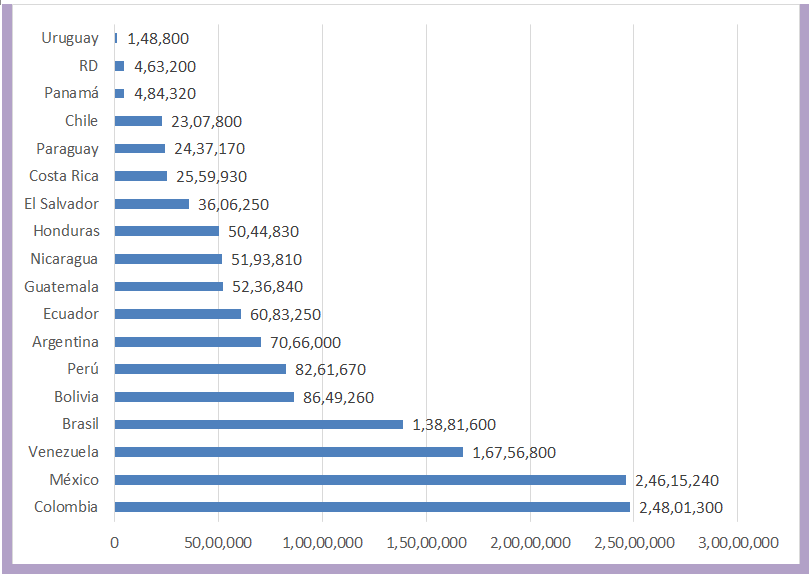
Source: Own elaboration based on data published by the Pan American Health Organization in 2022. Figure 1: Number of COVID-19 vaccines delivered to Latin American countries by the COVAX system (May, 2022)
Conclusion
To address this problem raised about neocolonialism’s such as that of vaccines, political regimes and the social inequity that this produced, there are various forms of interpretive-analytical analysis. One of them has been the contributions of the human condition of Hannah Arentd (1993, 2002). In her text with the same name, the author proposes, through precise categories such as the word and the act, events of a social nature.
Regarding the problem described, certain rulers of the day with their political regimes accepted nationalist and effective decisions that sought to stop the ravages of the Coronavirus in their countries, without this meaning a human act in itself in the extensive Arentdian sense, since the condition of sociopolitical subjects is not restricted to the specific borders of a nation as if a national State could warn, control or contain a virus with decisive positions that favor the country, but harm so many others.
The word and the act expressed by the human beings who directed certain countries allocated considerable resources to this purpose, also revealing the dark interests that govern them. A priori they are distinguished by being the leaders in charge of a nation, in the practice of Real Politick they respond to other interests not conditioned to humanity or, for example, to the preservation of known fundamental human rights.
In such a way that certain main actors leaned in favor of national prioritization, a phenomenology that was sponsored and promoted by the political regimes of the day, be it the United States, Chile and many others, they involved words and acts that elucidate or hint at forms of modern or postmodern domination that would undermine or controvert the equity and social parity of the global distribution of anti-COVID-19 vaccines, harming the public health policies of others.
Consequently, the act of prioritizing the shelter and protection of some national demographics means and connotes that some countries with better resources effectively acquire biological ones at the time, but that it also assists or calls for the impostponability of human acts -discordant with the human rights- highlighted by the immeasurable consequences of the acts. The decisions of certain government systems implied putting at risk or depleting necessary retroviral biologicals to other territories in order to achieve, at all costs, the distant herd immunization two years ago.
It can be inferred that weighty decisions such as those of D. Trump, J. Biden, E. Macron, and S. Piñera reduced the possibilities of acquiring vaccines from other political regimes that are less likely to cancel them or reserve them with a stipulated advance payment. in the purchase contract at the given time, which the WHO had been expressing with great concern. The massive and excessive purchase of the first anti-COVID-19 biologicals established a character of exclusivity, subordinating the human condition to the voracity of supply and demand for the different vaccines that would be released on the global market through the COVAX mechanism. This concern of those who are coordinating the WHO is perceived, for sure, the state of vulnerability and lack of protection of nations with limited resources that are not able to quickly access the COVAX distribution mechanism.
The mere fact that the massive purchase of vaccines was subject to an exclusivity character by and for some government systems empowered to acquire the batches reveals factors of discrimination or non-inclusion with regard to certain countries - with scarce or medium resources - marginalizing them beforehand. [e.g., Bolivia, Ecuador]. Thus, COVAX did not fully fulfill that purpose for which it was created. On the contrary, in specific cases, some countries were discarded -without the tacit intention of causing damage- as a result of the same unequal international distribution that occurred, skewing and violating the universal declarations of fundamental human rights against all generations. as indicated by our analytical-interpretive and philosophical criteria.
References
-
Schutz A (1984) Appraisals and Developments. Boston: Kluwer Academic Publishers.
-
Kaffure EV, Pellegrini P, Navas AJ (2021) La pandemia de COVID-19 y un nuevo orden mundial. Bogotá: Ediciones Universidad Cooperativa de Colombia.
-
WHO (2017) La Asamblea Mundial de la Salud elige al Dr. Tedros Adhanom Ghebreyesus nuevo Director General de la OMS.
-
Mercola J, Cummins R (2021) Toda la verdad sobre el COVID-19: La historia detrás del gran reinicio. Montpelier: Florida Health Publishing.
-
Avalos F (2022) Explicando la Pandemia de Covid-19. Sevilla: Universo de Letras.
-
Martín-Corral D (2022) Viviendo en una sociedad enferma: Una historia sobre naturaleza, comportamiento humano, salud y espiritualidad. Madrid: Libros.com.
-
López-López W, Velandia-Morales A, Alzate M (2020) Derechos humanos en el marco del COVID-19, una mirada desde la psicología. Reflexiones hacia la postpandemia. En En Psicología en contextos de COVID-19, desafíos poscuarentena en Colombia. Bogotá: Asociación Colombiana de Facultades de Psicología. pp: 251-260.
-
Moscovici S (1976) La Psychanalyse: son image et publique. París: Presses Universitaires de France.
-
López GJ (2021) Coronavirus. Anatomía de Una Pandemia. Mexico D.F.: Almuzara.
-
WHO (2022) COVAX: colaboración para un acceso equitativo mundial a las vacunas contra la COVID-19.
-
ONU (2020) La OMS advierte sobre los riesgos del nacionalismo de las vacunas contra el COVID-19.
-
ONU (2020) El acaparamiento nacional de vacunas contra el COVID-19 puede generar otra crisis de suministro.
-
Zea L (1971) Latinoamerica: emancipacion y neocolonialismo: Ensayos. Madrid: Editorial Tiempo Nuevo.
-
Velasco GA (2021) Los desafíos de la pandemia al paradigma liberal tecno-científico neocolonialista y las sabidurías indígenas. Encuentros. Revista De Ciencias Humanas, Teoría Social Y Pensamiento Crítico 14: 107- 120.
-
Sabucedo JM, Alzate M, Domenico H (2020) COVID-19 and the metaphor of war. International Journal of Social Psychology 35: 618-6226.
-
WHO (2022) COVAX: colaboración para un acceso equitativo mundial a las vacunas contra la COVID-19.
-
Benavente J (1907) Los intereses creados. Teatro Lara, Madrid, España.
-
UNAM (2021) Derecho y política ante la pandemia: reacciones y transformaciones. Madrid: Universidad Nacional Autonoma de Madrid.
-
COVAX (2020) Covid-19 Vaccines Global Access. Alianza Mundial para las Vacunas y la Inmunización Paris: GAVI- CEPI-OMS, pp: 1-3.
-
Reino Unido se convierte en el primer país en autorizar la vacuna contra la COVID de Pfizer. Euronews.
-
Pacheco MG (2021) La pandemia de covid-19 y el balance de poder mundial. Política y Cultura pp: 33-62.
-
Harrison C (2022) Qué es COVAX y qué significa para América Latina? As-coa.org, pp: 1-4.
-
BBC (2021) Vacuna contra el coronavirus: la OMS advierte que el mundo está al borde de un “fracaso moral catastrófico”. BBC News Mundo.
-
Vargas C (2019) La construcción del sentido común por parte del Gobierno Nacional de Colombia favorecedor del proceso de paz con las Farc-ep (2012-2016). Bogotá: Universidad Catolica de Colombia.
-
Vargas C, Cazzato S (2022) The fragility of power through the analytical approach of political personalism and the disdain for common sense (Case: Mexico). Revista Cuestiones Politicas 40(72): 745-759.
-
Arendt H (1993) La Condición Humana. Barcelona: Paidós.
-
Arendt H (2002) La Vida del Espíritu. Barcelona: Paidós.
-
Comesaña SG, Cure de Montiel M (2006) El pensamiento como actividad según Hannah Arendt. Utopía y Praxis Latinoamericana 11(35): 11-30.
-
Cazzato S (1999) La materialidad e la ética discursiva según E Dussel. Utopía y Praxis latinoamericana, pp: 79- 84.
-
Our World in Data.
-
GAVI (2021) The Gavi COVAX Advance Market Commitment Summit. pp: 1-2.
- The Place of Wittgenstein’s Tractatus in the History of Philosophy
- Digital Hermeneutics Embodied in Brian Kim Stefans’ “The Dreamlife of Letters,” and Memory: Analog to Flash Interface in the Light of Ecofeminism
- Using C-Tables to Teach Class Logic
- The Ideology of Education’s Postponed Fantasies: Deepenings on a Pressing Problematic
- Phantasia and Perceptual Realism in Aristotle
- The Pleasures of Solitude