
Abracadabra: Until the Word is Gone
Language, speech and word are undergoing catastrophic changes in the context of modern history. The multilingual world has created a catastrophe for all elements of language, where they are gradually losing their original meaning. The historical territories of languages are dispersed and disintegrate into many fragments, putting them in danger of extinction. However, art becomes the new territory for their Renaissance. The art world provides its environment for the complete rebirth of the word and language. Furthermore, it allows the subsequent acquisition of an entirely new corporeality and constructs a new metalanguage for the “dialogue” between people. The works of contemporary artists such as Erik Bulatov, Sergei Katran, Lena Herzog, Eyal Sivan, Yegor Astapchenko, Jaak Sooaar, Aleksei Kruglov, Dmitriy Prigov, Sharon Bloom of absolutely different nationalities will help us to trace the main strategies for preserving all the components of our communication - language, speech and words. And the main ideas of such scholars as Juri Lotman, Jean-Jacques Rousseau, Gaston Bachelard, and Michel Jouvet will help us understand the trends of their changes.
Introduction
Language and speech are inseparable from the very history of the humanity and the imagery nature of human mind. Their illusionary structure has made it possible for humans to express themself, to look into mysteries of their soul, while discovering the forms and situations that are the underbelly of our life, its other side. As J. Lotman claimed, “the notions of Word, Text, Sign, Language are ground-laying for many models of culture and are, among others, its universals” [1]. The measures of words hide our desires, intentions, and hopes. In the fabrics of language, routes and communications are visible, the matter of reality is reflected, full of named objects, events, problems, their sign relations, contexts and references. In the folds of tonalities of our speech, worlds unfold of the unfulfilled possibilities, which are rendered Essay in the fairy-tale question formulas: “Mirror, mirror on the wall…” However, all these structures – language, speech, and word – are undergoing catastrophic changes in the context of modern history. It is in their power to strike minds and hearts, push the boundaries, create new meanings. But their ethereal essence is becoming insufficient for the 21st century human. Language has turned out to be not only a self-identification marker, but also a stigma of national or cultural-historical affiliation. The most common way of such self-determination is the territorial one. Often an artist lives in an area while writing in a language uncommon for it, thus belonging to a different culture. Witold Gombrowicz long resided in Argentina, then in France, yet he is a Polish writer. Paul Celan is not a French poet, Adam Mickiewicz is not a Russian one, nor is James Joyce Italian, French or Swiss prosaist. Such polychromatism was typical of the
20th century, though the tendency of the new millennium is communicational unification and reduction of language diversity up to just the few which the majority will speak. The hypothetical perspective of language evolution has already led to a disastrous divide between neighbouring, brotherly nations. The colonial or military territory seizure, as the one that broke out in Europe in 2022, where the language of authority is that of the other ethnicity, results in the clash of two mutually unintelligible, irreconcilable cultures “Language is the best intermediary for friendship and harmony.” - Desiderius Erasmus
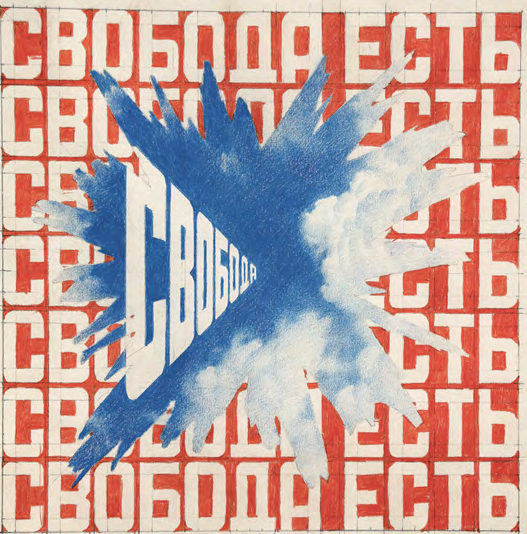
Word, as the main component of any language, being practically in a near-death state, is looking for new forms to escape its selfhood and become something bigger. In Erik Bulatov’s Freedom is Freedom II, the artist dematerializes the word freedom filled with solar energy and virtually introduces the viewer into the space beyond the plane, allowing them to experience and comprehend the presence of freed states. A great verse can have a great influence on the soul of a language. It awakens images that had been effaced, at the same time that it confirms the unforeseeable nature of speech. And if we render speech unforeseeable, is this not an apprenticeship to freedom? [2]. Maintaining the qualities of fine art while possessing a special semantic status, the textual construction floats as it also dissolves in the topography of the transfigured picture-like reality. Word merges the speaker with the message into a new unity, a perfect world of human consciousness with the metaphysical energy of art [3]. Word here is granted the magical function of building links between the existence of culture and the personal existence of the viewer and allows for sensing, as the artist put it, “the source of life”, its “radiant depth”. Through immersing word into inner dimensions of the painting, Erik Bulatov turns it into a missionary, a messenger, an intermediary between our consciousness and the outer world, breaking the barriers that divide the viewer from the piece of art, making the former turn into a part of the artistic scenario (Figure 1).
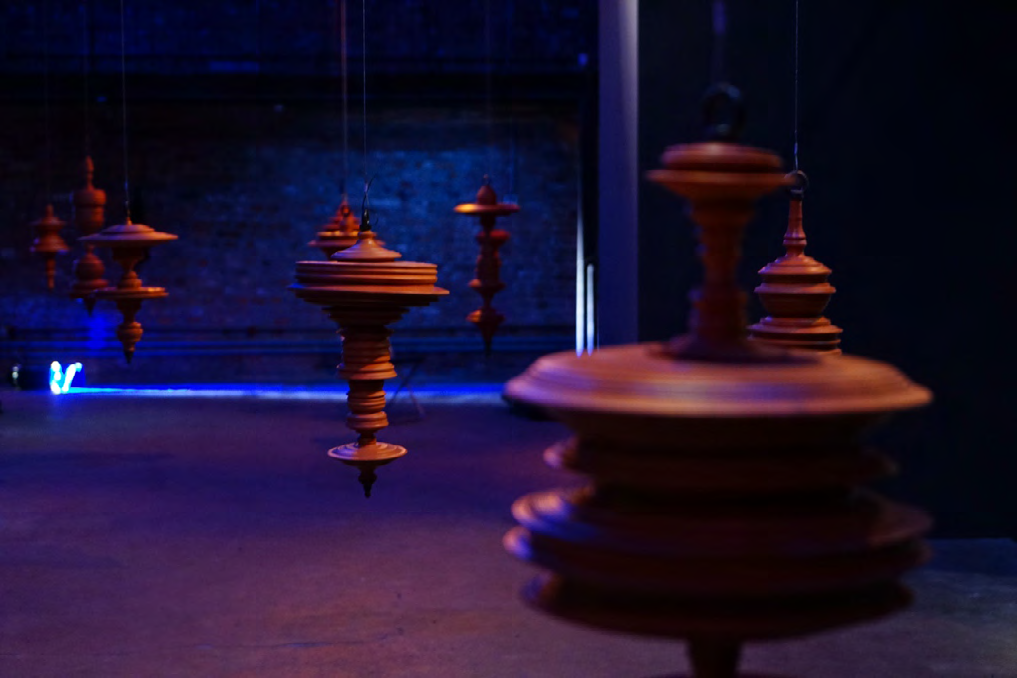
In the multi-language world, word is gradually losing the meaning it has in traditional semiotics: one channel - one language – one structure. In the new reality semiotics is oriented towards generation of meaning, requiring multi- dimensional models for defining it. In other words, such untranslatable notions as “mono no aware” (jap. 物の哀れ) - “an empathy toward things”, or (the Portuguese) “cafune” - “the expression of love through fondling someones hair” are fragile fragments of cultures, which under unwary care or without properly minding the language specificity may turn into archaeological monuments, buried in pursuit of language unification. “Only upon acquiring, to the possible grade of perfection, the initial material, that is, the mother tongue, may one, to the same possible grade of perfection acquire a foreign language, but not sooner.” - F.M. Dostoevsky Word becomes archaic, essentially hollow, and if one could blow an air stream through it, aeolian sound would be coming out of it, until the word is gone. Michael Krauss [4] noted in his LSA presentation that “statistics on language viability are very hard to come by” and in many respects that continues to be the case 20 years later. The Russian artist Sergei Katran in his work Until the Word is gone recorded the word “art” on a dictation machine pronounced in 125 world languages including dead ones, with the assistance of the famous linguist-polyglot Willy Melnikov. These recording were then sent to an audio player on a PC and captured in form of graphics rendered by equalizer. Afterwards the images were processed with a special program, where the artist marked up the size of words, constructed a common form and then prepared it for transferring to a pottery atelier: “A word produced with clay always has an accent, it always follows the logic of the material. The parts that go against it die. Yet slowly, the sculpture-words, having passed through oven heat, acquire solidity and strength. They become new signs that interpret words”, Sergei Katran explains. It is the clay, a material that follows its own rules, the potter’s logic, that reveals to the world, aided by new sound analysing technologies, another word form and defines its corporeality. The vessels, terracotta sculptures manufactured in an ancient technique, which refer to the dawn of culture and civilization, hang in the air thus creating a media-poetical, nonverbal art space, where each object is valuable in itself and autonomous, yet together they give birth to a symphony composed of a single word. The paradoxical harmony of word and image, their unexpected accordance presents us with a conceptualization of sound. The artist, as he focuses our attention on the way the sound of words is visually constructed, endows the construction with tangible fragility, a possibility of crashing into pieces only leaving behind potsherds (Figure 2).
However, losing particular words is only a part of the global “demolition syndrome”, under which nations leave their languages behind, just like bees abandon their hives. It is not just words, but languages that disappear. Every two weeks we lose one more. The language diversity is diminishing at unprecedented speed, that is, the diversity of tools of self-knowledge. Of the 7000 languages left on earth, the majority of the population of the planet speaks only 30. The estimations predict that by the end of the century, at least half of the languages will go extinct of the ones now spoken. In an attempt at drawing attention to the problem, the UN General Assembly and UNESCO pronounced 2022- 2032 the “International decade of indigenous languages” [5]. The reality is such that the struggle of modern nations is mainly towards proclaiming its linguistical dominant. Language shift processes are activated, a generational split is introduced. A native language is transferred from the older generation to the younger in the manner recessive genes are, so for the latter the prevailing language is the one introduced from outside. The middle generation gets caught in the semilingualism situation, as it is called in linguistics, in which they have almost forgotten their native language while the new one they have not really learned.
The Lena Herzog’s project Last Whispers. Oratorio for Vanishing Voices, Collapsing Universes and a Falling Tree curated by Silvia Burini is a profound spatial visual-acoustic composition, where through sounds of nature and the cosmic frequencies of dying stars, protrude recordings of speech, spells and ritualistic chants in endangered languages. As we are drowning in the noise of our own voices pronounced in languages of dominating cultures, we are surrounded by a massive ocean of silence. It is in the silence that the mass extinction of languages, nations, souls takes place, for the silence is precisely the form that we dissolve in. It isn’t just words that melt into it, but cultures: they are buried under a thick layer of quietness, where not even whisper is heard (Figure 3).
“Death and life are in the power of the tongue, and those who love it and indulge it will eat its fruit.” Old Testament, Proverbs 18:21
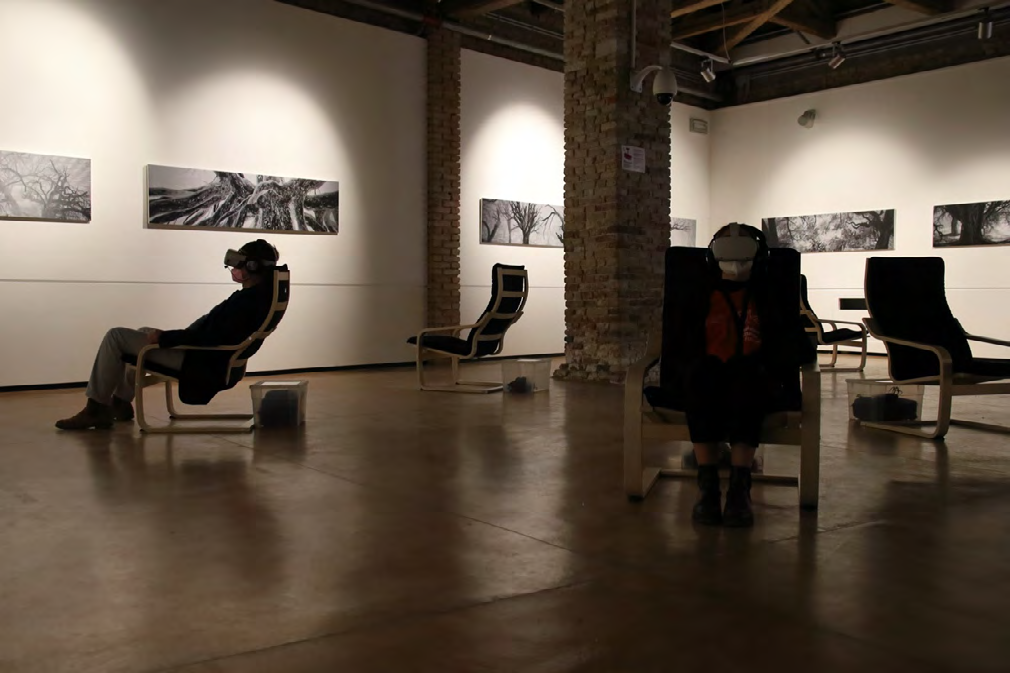
Figure 3: Lena Herzog, Last Whispers. Oratorio for Vanishing Voices, Collapsing Universes and a Falling Tree, 2022, immersive exhibition, author curtsey, Zattere Cultural Flow Zone, Venice, Italy Curator Silvia Burini, Maria Gatti Racah, Giulia Gelmi, Anastasia Kozachenko-Stravinsky The loss of languages and particular words leads to fading of their function. The communication tool is no longer in power to build dialogue and resolve conflicts of people living on the same or neighbouring territories. Only the territory of art becomes the field where discussion may actually take place. Such hypothetical dialogue is exemplified in the Israeli Eyal Sivan’s Common state. Potential conversation (2012). The apocalyptic resolution of the Arab-Israeli conflict of «two states for two peoples» led to escalation of violence and constant repressions from both sides. The artist, in turn, proposes a cinematographic reunion of Palestinian Arabs and Israeli jews filmed separately. Here, on cinematic film, in the political safe-space, law experts, artists, Ashkenazi
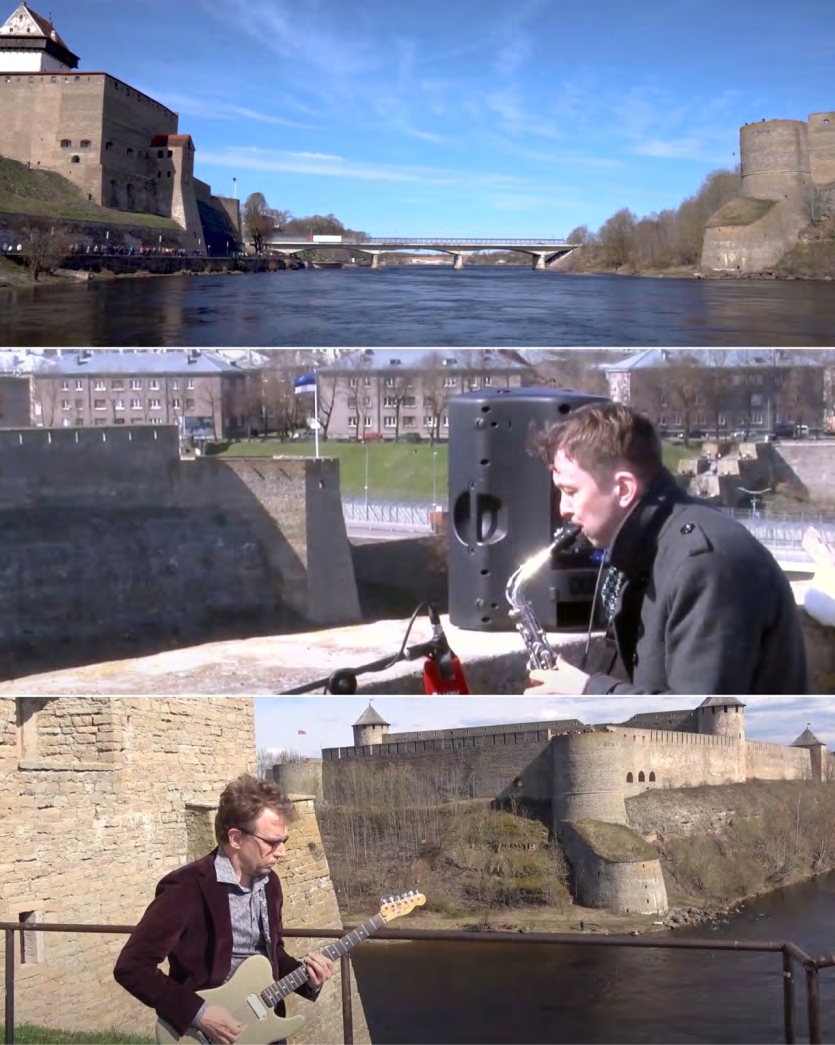
and Sephardi jews, Palestinian Arabs talk about a common state. Their speech becomes a helpless tool incapable of performing its primary function: people cannot be genuinely understood and heard, because in today’s reality this discussion is impossible. Another option of such dialogue is proposed by modern musicians, who utilise musical speech as the main tool. Two jazzmen, outstanding within their own countries - Jaak Sooäär and Aleksei Kruglov - carried out a truly visual-acoustic communication act by playing a performance, concert above the river Narva. Each of them was on the territory of his country - in Narva and Ivangorod fortresses, facing each other. The musicians’ reunion above the river was a symbol of that even under the circumstances of disagreement and closed borders, when the two countries are at the highest peak of mutual hatred, there may still be dialogue between people. The artists overcome obstacles with their heartfelt co-creativity by using the apparatus that doesn’t require words, yet will be understood by practically anyone on the planet (Figure 4).
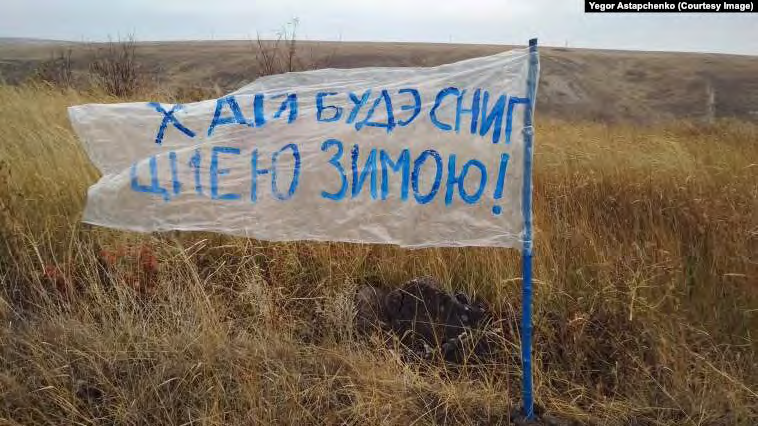
Yet another way of dialogue was given birth by nature and represented in the work Language of limestone spaces by the artist Yegor Astapchenko. On the project the author writes phrases on cellophane wrap in Surzhyk - a linguistic blend of Ukrainian and Russian. The inscriptions use Russian spelling, no Ukrainian letters, because the language is purely oral. The artist erects transparent flags-mottos along a road in Divnogorye, which speak to the viewer in the language of the space, the one that its inhabitants speak. The people of the territory can communicate both in traditional Russian, and using a post-Ukrainian dialect. Vocabulary varies according to the mood, to who they’re speaking with. Locals may use both Russian and Ukrainian versions of a word in the same sentence. The phenomenon, on the course of its development, leads to language locking itself up as if into a self-sufficient immanent sphere, while losing connection both with the human, and the truth (Figure 5).
“You can never understand one language until you understand at least two.” - Geoffrey Willans
At this point a rebirth of word, language is needed in order for it to gain a completely new corporeality, new forms of existence, and build a new metalanguage for “dialogue”. This requires a total death and then reincarnation. A sacred ritual of mortification of language or, more precisely, of its molecules – the alphabet, language progenitor, – is carried out by Dmitriy Prigov in his poetry: Alphabet 5 (1983), Alphabet 27 (to kill a human) (1985), Alphabet 37 (funereal) (1985), Alphabet 44 (of annihilation) (1985), Alphabet 57 (memorial) (1985), Alphabet 72 (of the dead) (1993), Alphabet 87 (of mortals and mortality) (1997), and also five alphabets authorially named Little coffins (51, 52, 53, 54, 55), in which he buried his poems in advance by crafting “little coffin books”, to write new ones straight away. Alphabet, as a language principle of arrangement par excellence, is a springboard for free flight in the space of letters and words. Prigov brings the idea of the written text being a sacred centre of meaning to the point of absurdity. Through death, one of the primary metaphors, deceases not only the traditional author, but the text itself, the word, to later go through the complete rebirth cycle. According to Stephen Hawking’s research and the latest discoveries of physics Nobel laureates, the big bang, which gave birth to the universe 13.8 billion years ago, also marked the end of existence of the previous stage of reality. The bang practically entails the death of the previous world and, simultaneously, the birth of the new one, that is, ours. D. Prigov’s ritual of alphabet mortification is similar to the universal bang. It draws us closer to the rebirth of speech, which is necessary for the search of new forms of dialogue between people, since the previous attempt is now exhausted.
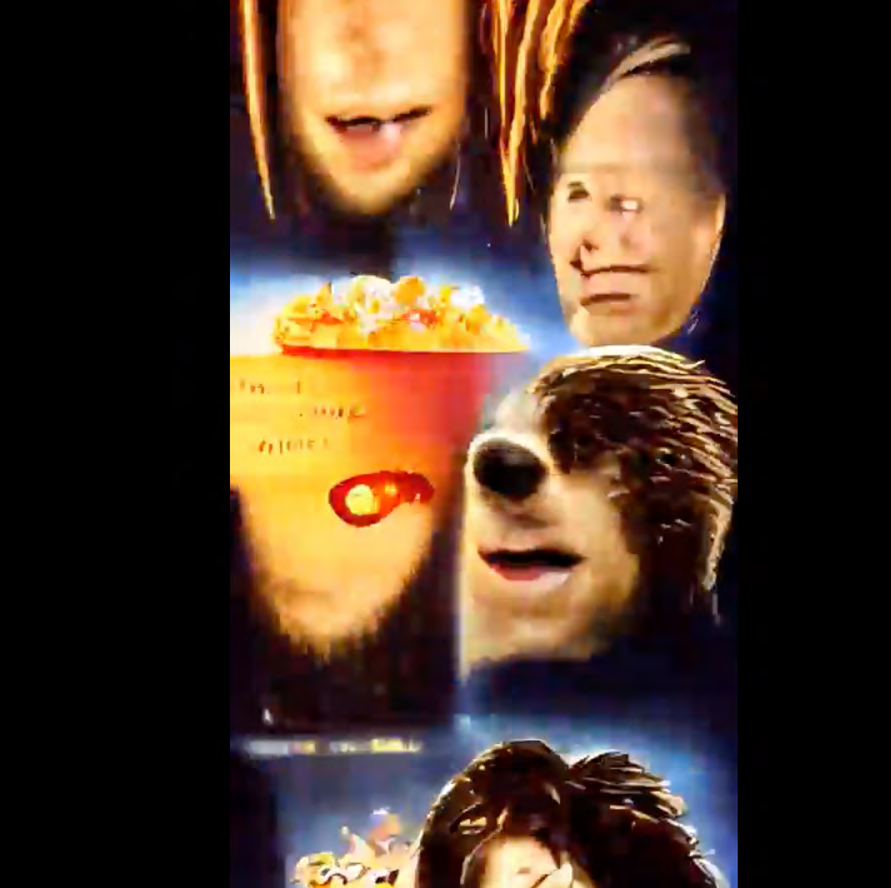
We will have to go back to universal proto-language for this incarnation. It is the inarticulate language that children speak before they learn to actually do so; expressive and sonorous, clear to breast-feeders who “may teach us this tongue; they comprehend everything their nurslings say, they answer to them, hold much consistent conversations; and even though they utter words, these are purely in vain; children grasp not the meaning of a word, but its intonation” [6]. We may call this language magical, absolutely meaningless, as it seems; a language that has been created to disappear; a language of abracadabra. This magical formula was first mentioned in the end of the 2nd century AD in the didactic medical poem De Medicina Praecepta by Sammonicus, the doctor of the emperor Septimius Severus, as a treatment for hay fever. One was supposed to use the word in the following manner: one wrote it on a plaque in column 11 times, while each time cutting off the last letter, which resulted in a triangle. The letters of the magical word would slowly melt. In course of their decay, appears the magic of timeless culture; of utopias, hopes and dreams, always wakeful in the dark. The word ruined, language as Palmira, requires persistently that it is gradually brought back to our world. But having entered the haunted area it acquires a dreamer-like corporeality, loses its outlines, similar to the way Sharon Bloom in her work Ifriend’s dreams awakens the lumens of the entropic layers of our subconsciousness, revealing hope for a new beginning. The illusions, painted by video-technology, are echoed with a piercing resonance in the immersive video- installation of the artist, in which an artificial intelligence upon a conversation with a viewer constructs their dream by means of an archive of photographic evidences and captured moments. While examining words that have acquired a completely new corporeality, at times inconsistent with their etymological meaning, the viewer suddenly finds themself not before a composition, but inside of it. To enter the world of Morpheus, we need to transform to Hugues la Sceve ¬ the hero of Michel Jouvet, who wrote down fifteen-hundredth dreams in six year and sought out their eyes and ears, ebbs and flows [7]. The words then present themselves as a magical object, a mysterious entity, that allows one to enter the inner dimensions of its inner paradoxical, magical space (Figure 6).
This reality of dreams, filled with digital consciousness, becomes the only and the genuine presence of human in the world. The only possible territory for dialogue where language and word no longer matter, because they’ve reincarnated as a perfect tool – speech, a purely individualistic phenomenon, in words of F. de Saussure, multiform by nature, capable of existing within concord of other areas from physiology to psychology, from reality to magic, from equilibrium to entropy [8].
“The limits of my language mean the limits of my world.” - Ludwig Wittgenstein
References
-
Juri L (1992) Word and Language in culture of Renessance. Estonia 3(1): 216-223.
-
Gaston B (2014) The Poetics of Space. Penguin Books pp: 304.
-
Vitaly P (2014) Reshetka I oblako [Grid and Cloud]. Iskusstvo pp: 78-89.
-
Michael EK (1992) The World’s Languages in Crisis. Language 68(1): 4-10.
-
UNESCO (2010) UNESCO Atlas of the World’s Languages in Danger.
-
Rousseau JJ (1913) Emile, or On Education. Saint- Petersburg, Russia, pp: 42.
-
Michel J (2008) The Castle of Dreams. The MIT Press pp: 336.
-
Ferdinand DS (2004) Course in General Linguistics. Literary Theory: An Anthology, Blackwell. In: Rivkin J and Ryan M (Eds.), Oxford, UK pp: 137-177.
- The Place of Wittgenstein’s Tractatus in the History of Philosophy
- Digital Hermeneutics Embodied in Brian Kim Stefans’ “The Dreamlife of Letters,” and Memory: Analog to Flash Interface in the Light of Ecofeminism
- Using C-Tables to Teach Class Logic
- The Ideology of Education’s Postponed Fantasies: Deepenings on a Pressing Problematic
- Phantasia and Perceptual Realism in Aristotle
- The Pleasures of Solitude