
War and Power Politics in the Service of Higher Ends
At the start of Early Modernity, the notion of raison d’état (reason of state) became a central issue in European politics. By means of that notion politicians and intellectuals reflected upon the legitimacy of violent and unethical means in the service of higher ends. Due, among others, to the nature of modern warfare, the role of the state acquired new significance in human affairs. Therefore, many philosophers and politicians argued that politics might be fundamentally different from other human activities and might require a special rationality and morality. Also, thus my hypothesis, the discourse and history of the raison d’état is throughout history characterized by some recurring themes, such as the consolidation of governmental power. In this study, I want to explore how the raison d’état, in various strengths, has been instrumentalised in the political doctrine of Richelieu and Louis XIII as well in the political ideas of Putin and his ideological right-hand Dugin. It will be discussed how in both political systems; sovereignty is considered to be an undifferentiated body of legitimate power with a firm basis in Christian-Stoic natural law. The stoic ideal of indifference (apatheia) is an important reference in the reason of state rhetoric since the individual is supposed to be prepared to sacrifice his life for the preservation of the State. The common good should be the objective of each person in the society. I will analyse to what extent Putin and Dugin, in defending their war politics, use similar arguments as cardinal Richelieu. By reflecting on the intellectual discourse about the nature and purposes of the State itself, and the element of justice and higher values in the public discourse, it can be analysed how the raison d’état operates in a political doctrine.
Introduction
While visiting Paris during an official state visit in 1717, tsar Peter the Great requested to visit la Chapelle de la Sorbonne. After standing a moment in silence before the marble tomb of Cardinal Richelieu, the Russian tsar uttered humbly.
Great man, if you were alive today, I would shortly give you half my empire on condition you would teach me to govern the other half [1]. Cardinal Richelieu not only inspired tsar Peter the Great of Russia, but also contemporary politicians or political thinkers like Henry Kissinger or Alexander Dugin, the right-hand of Putin. It is, therefore, not without reason that Cardinal Richelieu’s actions as first minister under Louis XIII from 1624 to 1642 have been vigorously debated by historians, political philosophers, theologians, and biographers throughout the ages.
In this paper I will not engage in a moral examination of Richelieu’s actions, but rather it will be explored how the raison d’état, in various strengths, has operated in the political doctrine of Richelieu and Louis XIII; and how this political doctrine inspired the political ideas of Putin and his ideological right-hand Dugin. Although, the notion of raison d’état (reason of state) already became a central issue in European politics at the start of early modernity, it was Armand Jean du Plessis (1585-1642)-better known as cardinal Richelieu — who in his writings systematically reflected upon the legitimacy of violent and ‘immoral’ means in the service of higher ends. The result was a sophisticated body of thought on raison d’état.
Furthermore, when Bismarck or more recently Dugin argued that power politics and warfare are fundamentally different from other human activities and require a special rationality and morality, they were, knowingly or unknowingly, referring to Richelieu’s understanding of the notion of raison d’état. To have a better understanding of the contemporary relevance of the issue of raison d’état, I will focus on these aspects of Richelieu’s life and legacy:
- How the discourse of raison d’état legitimized warfare and power politics, and how it consequently changed the nature of (early) modern warfare as well as military ethics; and how the rhetoric of reason of state influenced society itself and its support for a war in the service of higher ends?
- In which way the stoic ideal of apatheia promoted an indifference not only towards one’s suffering but also towards the suffering of others, and how this even resulted in extreme forms of violence under the pretext of a higher cause?
Probably, for many cardinals Richelieu was a kind of patriot that contributed to the secularization (laicisation) of French foreign policy, and even of French national identity itself. Nevertheless, I will propose the thesis that the early modern discourse about raison d’état was essentially about power politics and warfare in the service of higher ends. However, this kind of early modern warfare does not refer to a religious war, like a medieval crusade, or an apocalyptic final battle between good and evil.
Since the religious wars ravaged the countryside of France, ruined cities and killed tens of thousands during the second half of the 16th century, a paradigm-shift occurred. The idea or thought that God wanted or even caused this bloodshed could not be upheld anymore after this traumatic episode. Before the Religious Wars, God was claimed for being the cause of one’s victory or the reason for the defeat of the heretic, but how could early modern man believe that God Himself wanted or willed the essentially undecided bloody civil wars between Protestants and Catholics that ruined Central Europe? Therefore, it was the role of the state - as an entity on its own - that acquired new significance in human affairs.
The first section of this article will describe and analyse the basic background factors - political and ideological - which determined in large measure the fundamental categories within which Cardinal Richelieu approached the concept of la raison d’état. In the second part, I will explore Richelieu’s strategy in action. Upon becoming First Minister, Richelieu’s responsibilities for policy decision and their outcome – such as bloody proxy wars in Germany and their impact upon the nation - forced him to justify his acts more comprehensively to his king, Louis XIII, and to his opponents. It will be analysed which elements of justice and higher values Richelieu introduced; and what their relevance was to his massive program of state-building, which was accompanied by his doctrine of la raison d’état.
The third section of this study will explore whether Putin and Dugin use similar arguments as cardinal Richelieu in defending their actions. However, I will also examine how Dugin developed his own casuistry with which he justifies questionable but also so-called necessary acts of government. For this reason, the only valid method of studying the contemporary discourse about reason of state is to examine the way the problem is handled in this given period, that is, the ways in which statesmen, like Putin, and philosophers, like Dugin, understand the issue in a particular time and place. Furthermore, I will compare Putin’s strategy in action with Richelieu’s strategy in action, and in doing so, I will argue that Putin’s strategy has been inspired by the ideas of Dugin.
Raison D’état and the Legitimization of Warfare and Power Politics
There are still many historians who regard Richelieu as merely a man of power without scruples, a Machiavellian statesman in Cardinal’s clothing. In reality, things are much more complex, since he was also a man of higher principle. Evidence concerning the religious nature and higher ends of the French state in the early 17th century is found not only in how the French monarchy functioned and the writings of Richelieu and others, but also, more importantly, in the lives and ideals of the Cardinal and other men who were devoted to the serving Louis XIII. Richelieu himself, for example, was convinced that his religious beliefs were in no way compromised by his policies for the good of the French state.
The foundations of French absolutism and the notion of la raison d’état had already been laid immediately following the Wars of Religion with the development of the concept of divine-right sovereignty, but it was Richelieu who proposed new solutions and gave them a new rationality.
If we want to analyse the place of la raison d’état in French thought and practice during the ministry of Richelieu, it is essential to have a better understanding of the political and ideological factors that influenced and shaped this concept. In this section, I will describe and reflect, therefore, on the philosophical tools with which Cardinal Richelieu and his generation approached and addressed the concept of reason of state.
Although France would change into an impersonal and bureaucratic state during the seventeenth century, personalized power remained central to the system and this kind of government even increased in importance as the ‘Age of Absolutism’ advanced [2]. The Bourbon monarchy could be characterized by a profound personalization of power, since the king held all public authority, and all acts of government were either done by him in person or by others in his name. Following the philosopher Bodin, sovereignty was indivisible according to Richelieu and this would result in the idea that all officials, also the Cardinal, merely exercised authority as a temporary delegation, since all rights to rule remained in the hands of the king [3]. It was believed that Louis XIII embodied superior virtues and the king also set the ideals toward which his subjects should strive. As the symbol and personification of the state itself, the king identified himself with its values and purposes. This perception strengthened the view that the state was a significant reality in the life of the French people and that it “possessed a value and ethic of its own [4]. To be more precise, the word ‘state’- état - in early modern France signified the human community at large, a living organism characterized by unique French values.
The fact of living under a common sovereign in a realm with a distinct set of laws, a shared national language and the establishment of French literature, institutions, and traditions contributed to a sense of pride in the French heritage. All these factors were placed on a ‘high intellectual plane’ by being infused with a sense of religious values and purposes [5]. Especially since Edmond Richer wrote a biography about Jeanne d’Arc in 1630 calling her la Pucelle d’Orléans (The Maid of Orléans). This work effectively combined the ancient tradition of a crusading monarchy with the concept of national patriotism [6].
In the late sixteenth and early seventeenth centuries, this French cultural patriotism was even more strengthened by the revival of Roman Stoicism. Many scholars, while they remained loyal to the essential Christian doctrines, integrated Stoic morality in their political thought [7]. Suited to this purpose, this pagan and secular philosophy provided a lay ethic and a noble sentiment of virtuous patriotism which French thinkers merged with their thought concerning the state. A fusion of these precepts can be found in the works of Guillaume du Vair (1556-1621), who was a contemporary of Cardinal Richelieu and a so-called Christian Stoic. As a jurist, an academic and a man of action, he supported the position of the politiques during the uprisings of the Catholic League and Du Vair forced his fellow Frenchmen to remain loyal to their king. In his Exhortation a la vie civile he argued that all Christians, while withstanding the harsh realities of civil strife, are obliged to endure the difficulties of life in a period of social conflicts [8]. All capable men should actively contribute all their resources to the preservation of the nation, the “most precious thing on earth, and willingly assume the risk of failure [9]. In fact, here Du Vair presents stoic indifference or apatheia towards one’s own life and suffering as one of the most important Christian values and as a key patriotic virtue.
In his Traité de la constance, he placed this ideal in the words of a dying soldier who encouraged his countrymen to remember that they are French, to go down with their weapons in hand, and to sacrifice all for the defence of France and the preservation of the patrie [10].
Within this historical context, there were both substantive and ideological factors and arguments which defined the discourse about la raison d’état, and combined these factors also acquired new meaning in the life of the French people. Much more crucial, however, for Richelieu’s political doctrine was the conviction that a strong monarchy was the only instrument that could maintain order among the rebellious people of France. Like many other rational and educated Frenchmen, Richelieu was haunted by the memory of the anarchy and bloodshed during the Wars of Religion. Therefore, the French people were willing to submit to increased royal power and to support the view that loyalty to the state should supersede all others. This belief that only a strong monarchy was capable in establishing order and stability was strengthened by the doctrine of ‘divine right sovereignty [11].
According to Jean Duvergier, who later became a pamphleteer of Cardinal Richelieu [12], divine right sovereignty implied that the subject should always obey the highest authority - the state and its ruler, since “every man who lives in organized society under the rule of a king has become part of the community and is obliged to act, suffer, live, and die for the state [13]. If France is threatened with war or civil strife, the individual should be sacrificed for the state’s preservation, since the good of the nation is the aim of each of its parts and the common good the objective of each individual in the community [14].
Jean Bodin (1530-1596) defined the concept of royal sovereignty as an undifferentiated body of legitimate power that was found in all nation states. As fundamental as the authority of the father over his family members, that of the king over his subjects was a fact of nature with a firm basis in natural law. The nature of the nation’s constitution was determined by the locus of sovereignty in the state, and in the French monarchy it was held solely by the king. Therefore, royal sovereignty was indivisible and absolute since the king alone held all governmental power and was subject to no human limitation. This ‘Bodinian’ understanding of divine right sovereignty provided the fundamental theoretical framework from which la raison d’état was developed [15]. Nevertheless, there were tensions between this theoretical and political ideal of divine right sovereignty and the definition of policy that was effective in meeting the demands of political necessity.
In the end, it was Richelieu who implemented this program of state-building, which resulted into the expansion of the king’s authority to make law and tax at will. Moreover, because of his supposed superior knowledge of government and his responsibility to God alone, all measures of the monarch were considered to be just. In short, la raison d’état became a political doctrine that the monarch could freely apply for the general good [16]. And from this perspective, it was in the interest of the nation to tolerate a Huguenot minority instead of pursuing a so-called ‘one country, one religion’ policy. Cardinal Richelieu reasoned accordingly when he was accused of placing the interests of the state above those of Catholicism by arguing that he was the servant of the common good and of a king that was endowed with superior knowledge of government [17]. Henceforth, Richelieu developed a convincing apology for his politics and during this process he became more than ever aware of the so-called central issue of la raison d’état: the legitimacy of violent and immoral means in the service of higher ends [18].
Nevertheless, Cardinal Richelieu realized the crucial role of religious motivation in the politics of the period, and his own convictions also caused him to be strongly motivated by religious principle [19]. Therefore, the Cardinal felt vulnerable when his opponents portrayed the Habsburgs as the defenders of Catholicism against assaults by the French.
In 1625, Richelieu asked Fancan to write a pamphlet to answer the polemical attacks on his policies. Fancan’s Miroir du temps passé [20] would be the first of a series of officially inspired defences of French politics, and of course the Cardinal played a part in determining its content [21]. Fancan argued that ultramontanism – the promotion of supreme papal authority in matters of religion and governance – is dangerous to the state and argued that religion should not assume priority over patriotism or political interests. According to him, a French citizen should be “a good Christian, Catholic Frenchman, and good patriot, who lives and dies in the Church and under the obedience of our king [22]. The main purpose of this pamphlet, however, was not to define the place of religion in human affairs but to reject the use of religious sentiments by the ultamontanists, who were trying to restrict French independence and were promoting the Spanish in their efforts to establish an ‘universal monarchy [23]. In essence, Fancan and Richelieu argued from the standpoint of political necessity and, hence, the just nature of the policies that were necessary for preserving the integrity of the French nation.
Richelieu’s Reason of State
In countering the argument of his critics that French policy was aiding the Protestants and seriously compromising the Catholic cause, Cardinal Richelieu turned to Père Joseph, Bérulle and Ferrier. The result was the tract Catholique d’estat (1625), the most important justification for his policies. In this work the Cardinal addresses the relations between politics and morals, and he argues that affairs of state, especially those of a Catholic monarchy, are possessed of a special nature and significance of their own. According to him both the state and the Church have some common qualities, such as divine ordination and similar higher purposes and values, but at the same time each is limited to its own sphere, and each participates in exclusive activities according to the nature of its mission. For Richelieu the state is endowed with special qualities which set it apart from ordinary human affairs. The state has his own scale of values, and it functions according to a unique standard of justice [24].
In the dedicatory epistle of the Catholique d’estat, which was a eulogy of Louis XIII, the divinity of the kings, their inspiration from God, and the necessity of obedience by the subjects are being emphasized [25]. It is described how.
God is more present in the actions of kings than other men because he guides all others through them. It is a glory above the thoughts and speech of mortals that kings are the most glorious instruments of divine Providence in the government of the world… In your rule, Sire, you have nothing above you but God alone. There is no power on earth to which you must render an account for the government of your state [26].
Some could conclude that the will and the force of the king are portrayed as being more important than religious values, however, one should keep into mind that because of divine right sovereignty, kings were allowed to conduct their affairs according to a ‘special standard of justice [27]. Therefore, in another passage of Catholique d’estat it is described how obeying and loving the king of France is a true act of religion [28].
Here we encounter the main theme of the treatise, associating the king and the state with God and the highest religious values. A Christian citizen of France was bound to revere both God and the king because this was required by his faith. Therefore, the author concluded that “the enemies of our kings are the enemies of God; they should therefore be ours. And we are not upright men if we do not regard them as our enemies [29]. The more this political doctrine was being promoted in French society, the more the French subjects considered royal policy to be just because it was the work of the divinely authorized and inspired king. By referring to St. Thomas it was implied that a war is just when it is ordered by a sovereign monarch, and when his intention is right, the war is for a just cause. Therefore, if the intentions and actions of the monarch were just, the logical consequence of this kind of reasoning was complete submission to the king. Since the state has his own morality, justice, and rationality, it is not to subjects to judge the decisions or acts of war of the king. The French kings, because of the nature of their authority and obligations, enjoy a certain autonomy under God, and therefore, they may justifiably engage in practices that are not directly subject to judgement by scholars, judges, or other subjects. The reasoning is as follows in the tract Catholique d’estat.
The true Catholic of state and politique, that is, an upright, god-fearing man who is not limited, factious Catholic and a traitor to his country, obeys the law of God without examining the actions of kings. He knows that the power of states is from heaven. If wars occur to punish the universe. Subjects may not censor nor judge in order to determine the justice or injustice of the arms of their kings; their role is merely obedience and fidelity. The laws of the state differ from those of the casuists.
Kings generally make war to bring peace to their subjects and security to their states. In such times as these, the only way to succeed is not to experience the contempt of our neighbours because of weakness. If we do not threaten them, they will boldly advance; if we do not raise our hands, they will never lower theirs. This is why those who decry war often decry peace and destroy their own security when they criticize action. The remedy for this is for everyone to remain in his vocation without encroaching upon those to which he was not called. On this depends all order among men in all elements of society [30].
In these passages of the work, we encounter the essence of Richelieu’s position when he had to defend himself against his critics. True Christian subjects should submit to the will of God and the policies of the monarch as a matter of faith. Every Frenchman regardless from his convictions should remain in his station and abstain from criticizing the decisions of his king which were beyond his comprehension. These critical remarks were especially aimed at the theologians, who - having neither the responsibilities nor the experience of government - were completely ignorant of the ‘mysteries of the state [31].
Essentially, Richelieu’s theory of just government was built on his concept of the rights, nature, and purposes of the French state. Louis XIII and Cardinal Richelieu, the prime minister, claimed to have an exclusive knowledge of the state and, therefore, governed according to the special justice to ‘divinely established monarchies [32]. If their policies were considered to be immoral by theologians, this was because only the king, his prime minister and entourage truly understood the matters of government. Because of their supreme knowledge, more than others, the monarch and his First Minister were aware of the proper measures with which to guide the state toward its higher objectives [33].
In short, the true faith requires subjects to love their king, to support the state and to sacrifice their lives if necessary. The concept Catholique d’estat therefore distinguishes a true citizen of France from a former Ligueur or enemy of the state. The basic position of Richelieu was that a loyal Catholic should also be a loyal subject; and a Christian statesman, such as Richelieu, should be loyal to both the Church and the French state.
The Habsburg Challenge and La Raison D’é’tat
When Cardinal Richelieu became Louis XIII’s First Minister in 1624, the strategic outlook of France, which was locked in the heart of war-torn Europe, appeared rather hopeless. France was surrounded on all sides by Habsburg territories: from the Spanish Netherlands in the north, possessions of the Austrian Habsburgs in the east, to Habsburg Spain in the southwest. Therefore, Richelieu had to develop a strategy that would allow France to break out of its constricted geopolitical situation, which is visualized on the first map.
His grand strategy, according to Rehman, could be compared to a kind of three-stage rocket [34]:
- First, France and its weakened army were not (yet) ready to engage in a direct confrontation with the battle- hardened Habsburg armies, “and as a result the king and his entourage would also never support an open war with Spain and/or Austria. In an effort to buy time for France and to weaken the Habsburgs, the Cardinal financially supported a league of militarily capable proxies. He was also convinced that during time the financial and strategic situation of France would improve [35].
- Secondly, Richelieu argued that France’s geographic location at the heart of the European chessboard and its seeming state of encirclement could, in the long run, be beneficial to France. As is put forward by Kenneth Boulding: “great powers with extended economic and military interests must frequently grapple with two major challenges: First, they offer many points for enemies to threaten and attack, and second, their capacity to project military strength is eroded the further the contested zone is from the core of their power [36].
- Thirdly, Richelieu knew that France should prevent at all costs a “multifront campaign” against the combined military might of Habsburg Spain and Habsburg Austria. Through continuous diplomacy, he therefore sought to prevent a formalized military alliance between the two dynastic branches [37]. At the same time he tried to bring about internal frictions within both Spain and the Holy Roman Empire. For this reason, “the Cardinal supported secessionist movements in Portugal and Catalonia, and he secretly cultivated the resentment of prince-electors in Germany that wanted to have more autonomy [38] Figure 1.
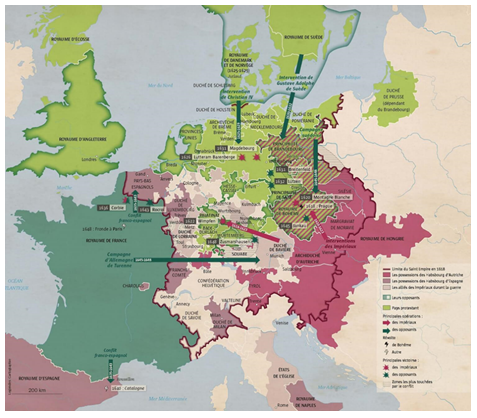
During the first years of his ministry however, Richelieu relied on the power of reason and dialectical discussion, rather than force of arms, but this drastically changed in 1636, after both the Austrian emperor and the king of Spain declared war on France. Richelieu suddenly faced a war waged on “an unprecedented scale, on multiple fronts, and against the combined force of both dynastic branches of the Habsburgs [39].
To make matters worse, France was invaded by a Habsburg army that quickly moved deeper into French territory. “A stronghold was taken, and there was no sizable interposing military force in between them and Paris, barely ninety kilometres away. Richelieu believed that he had failed and intended to offer his resignation to the king. Nevertheless, Louis XIII did not accept Richelieu’s resignation, because he knew very well that Richelieu was the only person who had the strategic insights to turn a defeat into a Habsburg withdrawal [40]. Père Joseph was sent to persuade Richelieu to keep the position of First Minister. In the meantime, the king initiated a mass recruitment by calling up every man capable of bearing arms to assist him in expelling the much- hated Habsburg forces from French territory [41] Figure 2.
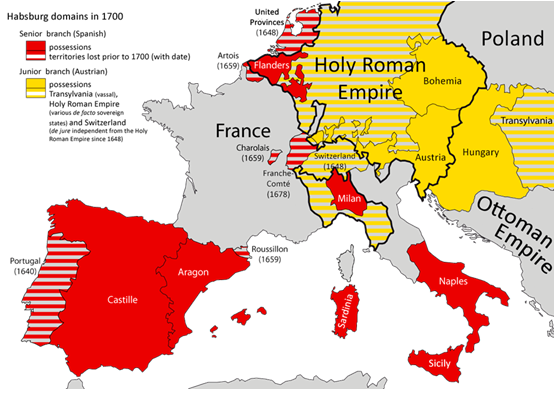
Although the Habsburg forces already withdrew to the Holy Roman Empire because their supply lines were overextended, “the campaign did succeed in ‘galvanizing’ French public sentiment and, henceforth, the French people were more than ever before united in support of Richelieu’s war policies [42].” Furthermore, in 1640 Spain was engulfed by its internal tensions, as Richelieu had predicted, “with both Catalonia and Portugal rebelling against their Habsburg overlords and allying with France. Spain only succeeded in recapturing Catalonia twelve years later in 1652, but in the case of Portugal the divorce proved more permanent [43].
Neo-Stoicism and la raison d’é’tat
Support for Richelieu’s policies coincided with the growth of popular neo-stoicism. As a result, the virtues celebrated by Roman stoics such as Seneca-self-discipline, obedience, rationality and apatheia or indifference toward one’s own fate, became part of a growing chauvinist movement in France. This spread of neo-stoicism was a natural reaction to decades of violence and disruption, and, therefore, neo- stoicism was more than just an abstract theory. It was also a philosophy of action that advocated ‘patriotism and public service [44].
Furthermore, for raison d’état theorists, the monarchy was not only the most effective form of government, it was the also most natural form of government. According to this view the king was the metaphysical embodiment of the French state, and therefore, as described by Richelieu and his writers, the king was so divinely “animated by the power of reason,” that “the interests of the state” had replaced the “passions of his soul [45]. This view is a perfect example of how the (neo-) stoic virtue of indifference (apatheia) was being integrated in the discourse on reason of state, and defined as being the highest royal and Christian virtue.
All the king’s personal interests as a human being have been replaced by the so-called ‘rationality’ of the monarch, since he is, according to this neo-stoic standpoint, totally preoccupied by the interests of the state, la raison d’état. Since the state has his own ‘reason’ or ‘rationality’ independent from God, the king should act according to this rationality. To be more concise, the king and ‘his’ raison d’état is the incarnation of God’s Guiding Principle in society, but at the same time God has given the state its own raison and the liberty to act according to its own purpose in the physical world. Although raison d’état as an independent political rationale or nature operates independently from God, it is also related to God on a metaphysical level. Ultimately, it is the king who is the mediator between la raison d’état and God, and, henceforth, only he is infused by God with this purer and higher form of reason, which allows him to pursue a more pragmatic foreign policy. Since the monarch is the metaphysical embodiment of the State and, therefore, la raison d’état itself, he is also not disturbed by the irrational passions and concerns of the common man [46]. Richelieu has explained this in one of his diplomatic letters.
“…man’s salvation occurs ultimately in the next world … states have no being after this world. Their salvation is either in the present or non-existent. Hence the punishments that are necessary to their survival may not be postponed but must be immediate [47].
Therefore, raison d’état theorists were also elitists, convinced that the arcana imperii (mysteries of state) could only be mastered by the king and his Prime Minister, and entrusted to a select few. All this caused the raison d’état theorists to support the idea that the state and the king enjoyed a sphere of competence that was independent from religious determinations and in which the good of the state was the sole criterion. Hence, Richelieu and other absolutists regarded many elements of royal policy as self-justifying.
Moreover, they also believed that the religious nature and purposes of the state remained intact, even if the king would resort to immoral measures when the survival of the French state was at stake. It was argued that there are two standards of justice, one universal, the other practical and necessary, and sometimes circumstances require the ruler to break his word and resort to violence [48].
For Richelieu this all-encompassing concept of authority provided the foundation of his political doctrine. According to his views, the social and institutional organization of society is a kind of mosaic of units, and each unit possesses his own rights and privileges. An individual should be indifferent toward his own well-being and only be concerned with the good of his family, the city, the Church, the state, or, to put it differently, the common good.
Richelieu also argued that it was essential to all rulers or statesmen of Christian states to govern according to a higher law. This knowledge of the Divine law could only be mastered by becoming indifferent to earthly wisdom. “In a word, the statesman must be faithful to God, the state, men, and then himself [49]. And the main objective of his mission was to establish God’s reign on earth, and this task was fulfilled by his raison.
However, the Divine law could not be observed when the fate of the state was at stake. Richelieu even carried this concept of indifference toward Christian moral values, such as charity, into the sensitive area of war for the ‘national good [50]. “War,” Richelieu wrote, “is sometimes inevitable and necessary for such purposes as to regain lost territory, avenge an insult, protect one’s allies, stem the progress and pride of a conqueror, and to forestall ills that threaten and cannot otherwise be met [51].
Richelieu’s Raison D’état Explains Putin
One of the main objectives of this paper is countering the idea that Putin is longing for the restoration of the USSR, because this would imply a denial of Dugin’s and Putin’s dream to restore the Russian monarchy. In 2014, John Dunlap already wrote that Dugin is a “dangerous Russian fascist [52] and in 2016 Paul Ratner referred to him as “the most dangerous philosopher in the world [53]. Many historians and military strategists, however, analyse the war of Russia against the Ukraine through a Cold War perspective, because they falsely think that the Russian dictator is somehow a communist. Often, by referring to Putin’s declaration that the collapse of the Soviet Union was the “greatest geopolitical catastrophe of the twentieth-century [54]. With this statement, however, the Kremlin did not promote a return to Lenin’s or Stalin’s Soviet-Union, but it was rather a grieving for the loss of Russian territories and for the loss of Moscow’s control over Eastern-Europe. Putin does not want to return to the USSR, he and his right-hand Dugin want the creation of a “Novorossiya-a New Russia-a traditionalist, conservative, reactionary, revanchist order to act against modernity itself [55]. Therefore, the Cold War is an inadequate model for what we now face. For Dugin Russia is not the Soviet Union anymore and Putin is not just a president. In fact, both men wish to establish a new Russian empire, a new Rome, with Putin as its tsar.
This political ideology and the ideological or financial support of far-right figures such as Marine Le Pen in France, Nigel Farage in Britain, and Trump in the United States, the annexation of Crimea and parts of Georgia, and now the war in Ukraine, don’t make sense if we simply understand Putin as just another Russian dictator. Putin’s state policies, which are inspired by the ideas of Dugin, do have logic and their own ‘rationality’ within his own world view. Beatrice de Graaf explains it as follows: “Putin is fighting for a holy Russian nation and is acting consistently and intrinsically logically in this [56], and in a podcast on Dutch radio (EO, 26 February): “Putin’s ideological goal is to reunite the Slavic peoples into the holy Russian nation, of which he sees himself as the embodiment and Kyiv as the cradle.” Both Putin and Dugin often refer to tsar Peter the Great (1672- 1725), and De Graaf, therefore, argues that this has to do with the fact that Peter the Great believed in the Enlightenment and opened the windows to Europe for the Russians. She refers to the first two terms of Putin as president, when he still emphasised the connection between the Russian and Ukrainian peoples based on a shared religious - Orthodox- Christian - history. However, although tsar Peter the Great modernized the Russian navy and promoted modern arts, architecture, and science in Russia, he also wanted to introduce Richelieu’s political doctrine of la raison d’état and his concept of absolute royal power in Russia. Maybe this early modern political view does not sound modern to us, but the introduction of royal absolutism in 18th century Russia – a country with a medieval feudal system – also implied an effort to end feudal rule and the centralisation of power [57].
Therefore, it is not surprising that Dugin in his [58] Foundations of Geopolitics and The Fourth Political Theory often refers to Richelieu’s understanding of la raison d’état to legitimize violent and immoral means in the service of higher ends.
Furthermore, from the French nationalist and modern reason of state theorist Alain de Benoist Dugin derived his nationalistic ideology of “Eurasianism [59]. In 1997, Dugin already presented this grand political vision of Russia as a Eurasian empire in his book Foundations of Geopolitics, which is required reading for students at the Military Academy of the General Staff of the Armed Forces of the Russian Federation. In this book Dugin describes a grand strategy for the establishment of a reborn Orthodox Tsarist state surpassing the borders and spheres of influence as they existed before 1989 Figure 3.
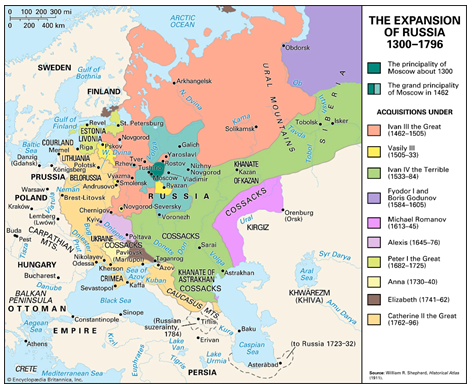
This new tsarist Russia will extend from “Dublin to Vladivostok,” and it is not built on communist principles, but on nationalist or tsarist ones. In his Foundations of Geopolitics, Dugin also describes how Ukraine as a state has no geopolitical meaning: “It has no particular cultural import or universal significance, no geographic uniqueness, no ethnic exclusiveness,” and, therefore, Russia must solve “the Ukrainian problem [60].
Within this ideological framework, Dugin describes the United States, Great Britain, and the NATO alliance as fundamentally “Atlantean” thalassocracies - maritime nations defined by individualism and “rootless cosmopolitanism”; while the continent spanning Russian Federation and her future allies as “Eurasian” tellurocracies - land-empires rooted in a “ethnic” nationalism [61]. As in the political doctrine of Richelieu, ‘Eurasianism’ is founded on a natural hierarchical order which is guided by the principle that the “nation is everything; the individual is nothing [62]. The individual should be indifferent toward his own interests and be prepared to sacrifice his life, if necessary, for the good of the state. “In principle, Eurasia and our space, the heartland Russia,” writes Dugin, “remain the staging area of a new anti- bourgeois, anti-American revolution… the refusal to allow liberal values to dominate us [63].
Dugin’s strategic vision spans the entire world, but several objectives can be seen as contemporary concerns for western powers. In his Foundation of Geopolitics: The Geopolitical Future of Russia it is described how Moscow should create three major alliances: the Moscow-Berlin Axis, the Moscow-Tokyo Axis, and the Moscow-Tehran Axis. The Moscow-Berlin Axis focuses on the separation of former- Soviet states in Europe from the European Union and NATO.
The Moscow-Tokyo Axis seeks to weaken and ‘control’ China. The Moscow-Tehran Axis aims to influence the Islamic world, especially Turkey.
The Moscow-Berlin Axis is aiming at pushing the United Kingdom and France away from Europe, increasing engagement with Germany, and absorbing the rest of Europe into a “European Empire” that acts as a western extension of Eurasia [64]. Dugin also wants to destabilize the UK by supporting “separatist tendencies” in Scotland, Ireland, and Wales [65].
The Moscow-Tokyo Axis refers to an alliance with India and Japan, because of their strategic positionings, their varied resources, and growing dissent between the Indians, Japanese and the Americans [66]. Dugin sees China as a threat, because it increasingly expands into former Soviet Central Asia.
The Moscow-Tehran Axis seeks an alliance with Iran, Syria and Libya, because these possible strategic partners could be used against Turkey [67].
Under the pseudonym Spengler, David Goldman describes in his article in the Asian Times how there are many similarities between Richelieu’s war strategies during the Thirty Years’ War in Germany and Putin’s war tactics in Ukraine [68]. Although, initially, France did poorly in its war on the Habsburg allies in the Holy Roman Empire, France slowly ruined its enemies during the Thirty Years’ War. This was quite an accomplishment when we consider that half of the world population, in Europe and their colonies, were ruled by the Austro-Spanish Habsburgs. After the horrors of the war, the Palatinate and Pomerania were almost left without people.
Also, Russia has done poorly in its war on Ukraine. It has endured many losses and did not achieve a quick victory. Moreover, Putin has succeeded only in uniting the whole of the West against it. Nevertheless, Spengler argues, Richelieu believed that a quick victory should not always be a strategic objective, since time is the ultimate weapon [69]. In his book The Grey Eminence (1941), Aldous Huxley described the life, policies, and Christian indifference of Père Joseph, the right- hand of Richelieu. Huxley included many historical accurate anecdotes, and one is on how in some occasions war itself is the objective.
“In a memorandum on the affairs of Germany, which he wrote in January 1631 for the instruction of the King, Father Joseph insisted that French policy should be directed to the systematic exploitation of time as the deadliest of all weapons in the Bourbons’ armoury. To this end, the negotiations which (on behalf of the Cardinal) had begun at Ratisbon were to be continued, unremittingly.
While the imperial Diet was in session, there had poured into Ratisbon, from every corner of Germany, an unending stream of supplicants… Among these supplicants was a group of delegates from Pomerania. Humbly, but nonetheless insistently, they begged the Emperor and the Electors to consider the lamentable state of their province… Very many had died, and those who survived were eating grass and roots — yes, and young children and the sick and even the newly buried dead.
And yet here (Père Joseph) was, pursuing, patiently and with consummate skill, a policy which could only increase the sufferings of the poor he had promised to serve. With full knowledge of what had already happened in Pomerania, he continued to advocate a course of action that must positively guarantee the spread of cannibalism to other provinces [70].
According to Spengler Putin will leave Ukraine in the same way as Richelieu left Pomerania, and, like the Cardinal, he exploits time as the ‘deadliest of all weapons.’ Ukraine was, as already stated by Dugin, of no real significance before the war began. As Russian artillery destroys Ukraine’s cities, many Ukrainians flee, and large parts of Ukraine will fall into ruin. From this perspective, the Kremlin’s objective is to ruin Ukraine utterly, “depopulate it and eliminate the possibility that Ukraine might become a venue for Western weapons pointed at Russia [71].
Strategic objectives change if the war itself is Putin’s objective, just as it was Père Joseph’s objective at Ratisbon in 1631 [72]. At that time the Protestant cause in Germany was on the verge of collapse and Imperial victory was close, but, nonetheless, the war continued. Père Joseph convinced Austria’s ally, Maximilian I of Bavaria, to switch sides, and meanwhile, King Gustavus Adolphus of Sweden had landed in Pomerania, with financial support of France. The Swedes ravaged Central Europe and fought the Austrian Empire to exhaustion in 1635. Then Richelieu declared war on Spain, the early modern superpower of Europe [73].
Maybe, therefore, we should not understand Putin as just another autocrat, since he believes that he is a new Peter the Great, a tsar who is the metaphysical embodiment of the Russian state. Much like the early modern raison d’état theorists, Putin, Dugin and their entourage support the idea that the state and its ruler enjoy a sphere of competence that is independent from religious determinations and in which the good of the state is the sole criterion. This perspective suddenly crystalizes Dugin’s statement in The Fourth Political Theory: “… everything is to be cleansed off… science, values, philosophy, art, society, modes, patterns, ‘truths,’ understanding of Being, time and space. All is dead with (Western) Modernity. So it should end. We are going to end it [74, 75, 76, 77, 78, 79, 80, 81].
Conclusion and Final Remarks
In this paper I have explained how Richelieu’s political doctrine of raison d’état legitimized warfare and power politics, and how it consequently changed the nature of (early) modern warfare, military ethics, and society itself. However, Richelieu’s quest for order cannot be dissociated from his own experiences growing up in war-torn France, and, also, the Cardinal was a product of a historical context marked by a sophisticated discourse on state-building. Furthermore, the popularity of neo-stoicism, as has been argued, was a natural reaction to decades of violence and disruption. These neo- stoic virtues, such as indifference, could be easily integrated into the raison d’état discourse, since it was a philosophy of action that emphasized patriotism and public service.
Although, it is true that French intellectuals from the medieval era till modern times already viewed the French monarchy as predestined for European leadership and as a role model for other European monarchies, the idea that French dominance was the natural “order of things,” was something new.
Before the 17th century or Early Modernity God was considered to be the cause and the foundation of reality. He was the underlying cause of reality and of our own existence, but these medieval conceptions of God and reality were something very different from what early modern people understood by those terms. No longer was God the given cause of reality, from now one the human subject himself had to relate him- or herself to reality. God became a matter of faith, our object of worship, and also the emerging nation state became an idealised cause in itself. Although the French monarchy was willed by God and sanctioned by Him, it was the monarch, as representative of God on earth, who had to execute God’s will. Within this (early) modern context, war and power politics in the service of higher ends were about the nature and purposes of the State itself. In this ‘new’ natural order obeying the only true Catholic king of France became - much like the subject’s relationship to God - a matter of faithful obedience.
Secondly, in early modernity sovereignty was considered to be an undifferentiated body of legitimate power with a firm basis in Christian-Stoic natural law. After the revival of classical stoic thought, indifference (apatheia) as a stoic virtue became an important reference in the reason of state rhetoric since the individual was supposed to be prepared to sacrifice his life for the preservation of the State. Furthermore, since the French monarch is executing God’s will, the outcome of his decisions can’t be classified as morally evil. In the same way as the classical stoics believed that every rational decision is ultimately founded in Universal Reason or Cosmic Law, Christian stoics believed that every decision with a just or right intention is essentially founded in God’s will. From this perspective a just war is not about the consequences or the outcome - such as the most gruesome war crimes - of the king’s decision-making, but about a just intention which is founded in God’s will. Not unsurprisingly, this reason of state discourse resulted in a total indifference towards human suffering. In fact, not only his subjects, but even the king himself should be indifferent towards his personal well- being, because as the personalisation of the State itself he should only be concerned with the well-being of the nation.
Furthermore, as has been exemplified through the writings of Richelieu, the state itself can’t be held accountable for its actions before God. Unlike human persons, who have to answer for their actions before God in the afterlife, the state only has to fulfill its purpose in this material or physical reality. Consequently, although metaphysically sanctioned and willed by God, the French State can be indifferent towards God and His Divine Law. Within this context, Richelieu argued that politics are fundamentally different from other human activities and require a special rationality and morality. This implies that everything the statesman does for the benefit of the State can be considered to be a matter of the raison d’état, and for these things, which aren’t part of the Heavenly realm, one can’t be held accountable before God. Therefore, since the monarch is the metaphysical embodiment of the State and even la raison d’état itself, he is allowed to pursue a more pragmatic foreign policy.
Much like the early modern raison d’état theorists, Putin, Dugin and their entourage also support the idea that the state and its ruler enjoy a sphere of competence that is independent from religious determinations and in which the good of the state is the sole criterion. In both reason of state discourses, the use of violent and immoral means in the service of higher ends – that is the state itself and the ruler who is the metaphysical embodiment of the nation – are being legitimized.
References
-
Mousnier R (1972) Histoire et Mythe. In: Richelieu AA (Eds.), Hachette, Paris, pp: 246.
-
Church WF (1972) Richelieu and Reason of State. Princeton University Press, New Jersey, USA, pp: 18-19.
-
Mousnier R (1946) La Venalité des offices sous Henri IV et Louis XIII. Kaugard, Rouen, pp: 75-79.
-
Church WF (1972) Richelieu and Reason of State. Princeton University Press, New Jersey, USA, pp: 19.
-
Schneider RA (2019) Dignified Retreat: Writers and Intellectuals in the Age of Richelieu. Oxford University Press, London, pp: 187-190.
-
Richer E (2005) Histoire de la pucelle d’Orléans: la première histoire en date de Jeanne d’Arc, 1625-1630. In: Dunand PH (Eds.), 2 Vols, (Paris, 1911); Françoise Michaud-Fréjaville, ‘Personne, personnage: Jeanne d Arc en France au XVIIe siècle,’ in Cahiers de Recherches Médiévales (XIIe-XVe s.), 12 spécial (2005), p. 245; Link: https://journals.openedition.org/crm/736?file=1.
-
Baldwin G (2001) Individual and Self in the Late Renaissance. in The Historical Journal 44(2): 341-364.
-
Exhortation a la vie civile, 1594, p. 250; Printed with: Guillaume du Vair, Traité de la constance et consolation és calamitez publiques. In: Flach J, Funck-Bretano F (Eds.), 1915, Geoff Baldwin, Individual and Self in the Late Renaissance. Paris, France, pp: 349.
-
Guillaume du Vair, Traité de la constance, pp: 252.
-
Exhortation a la vie civile, p. 238; The word patrie is often used in the works of Richelieu, and the use of this term should be understood as a general acceptance of the concept of the fatherland as applied to the ‘realm at large.’ See: Robert A. Schneider, Dignified Retreat: Writers and Intellectuals in the Age of Richelieu, pp: 188.
-
William FC (1972) Richelieu and Reason of State, pp: 563.
-
Bergin J (1997) The Rise of Richelieu. Manchester University Press, Manchester, pp: 110.
-
Duvergier J (1609) Royal question and its decision, Paris, pp: 34.
-
Jean Duvergier, Question royalle et sa decision, Paris (1609), see also: William F. Church, Richelieu and Reason of State, pp. 22-23.
-
Grimm D (2015) Bodin’s Significance for the Concept of Sovereignty. Columbia University, New York, pp. 13-32.
-
William FC (1972) Richelieu and Reason of State, pp: 36- 38.
-
William FC (1972) Richelieu and Reason of State, pp: 44- 45.
-
William FC (1972) Richelieu and Reason of State, pp: 44- 46.
-
Schneider RA (2019) Dignified Retreat: Writers and Intellectuals in the Age of Richelieu, pp: 19-21.
-
William FC (1911) Richelieu and Reason of State, pp: 86- 89.
-
Fagniez G (1911) ‘Fancan and Richelieu,’ in Historical Review, CVII, pp: 63-72.
-
Fancan FL (1625) Mirror of the past, looking back to the present. To all good Religious Fathers, and true non- passionate Catholics.
-
William FC (1972) Richelieu and Reason of State, pp. 126-127.
-
Fancan FL (1628) Mirror of time passing, pp: 48.
-
William FC (1972) Richelieu and Reason of State, pp: 127.
-
Seung HLMI (2012) ‘The Political Laicization in the Early Modern France: From the Religious Wars to the Rise of Reason of State’, in the Korean Review of French History, pp: 93-116.
-
De Franceschi SH (2001) The French genesis of state Catholicism and its outcome at the beginning of the ministerial of Richelieu: The Zealous Catholics Put To The Test By The Santarelli Affair And The Closing Of The Controversy Around The Temporal Pontifical Power (1626-1627),’ in Directory-Bulletin of the Society for the History of France, pp: 19-63.
-
William FC (1972) Richelieu and Reason of State, pp: 128-129.
-
Ferrier J (1625) Catholique d’estat or Political discourse of the Alliances of the Very Christian King against the calumnies of the enemies of his Estate, Paris, pp: 85-86.
-
William FC (1972) Richelieu and Reason of State, pp: 131.
-
Ferrier J (1625) Catholique d’estat or Political discourse of the Alliances of the Very Christian King against the calumnies of the enemies of his Estate, Paris, pp: 92.
-
Ferrier J (1625) Catholique d’estat or Political discourse of the Alliances of the Very Christian King against the calumnies of the enemies of his Estate, Paris, pp: 94.
-
Ferrier J (1625) Catholique d’estat or Political discourse of the Alliances of the Very Christian King against the calumnies of the enemies of his Estate, Paris, pp: 96-97.
-
Rehman I (2017) ‘Raison d’Etat: Richelieu’s Grand Strategy During the Thirty Years’ War,’ 2(3): 47.
-
Ernst HK (1955) ‘Mysteries of State: An Absolutist Concept and Its Late Mediaeval Origins,’ in Harvard Theological Review 48(1): 65-91.
-
William FC (1972) Richelieu and Reason of State, pp: 138-139.
-
Hildesheimer F (1994) ‘The Political Testament of Richelieu or the Terrestrial Reign of Reason,’ in Annuaire- Bulletin de la Société de l’Histoire de France, Editions de Boccard, Paris, pp: 17-34.
-
Rehman I (2019) ‘Raison d’Etat: Richelieu’s Grand Strategy During the Thirty Years’ War 2(3): 38-75.
-
Rehman I (2019) ‘Raison d’Etat: Richelieu’s Grand Strategy During the Thirty Years’ War, 2(3): 48.
-
Rehman I (2019) Raison d’Etat: Richelieu’s Grand Strategy During the Thirty Years’ War 2(3): 50-51.
-
Boulding K (1962) Conflict and Defense: A General Theory, Harper, New York, pp: 244-245.
-
Rehman I (2019) Raison d’Etat: Richelieu’s Grand Strategy During the Thirty Years’ War 2(3): 51-52.
-
Ibid, The Emperor was chosen by the prince-electors (Kurfürsten). This institution emerges sometime in the first half of the 13th century.
-
Rehman I (2019) Raison d’Etat: Richelieu’s Grand Strategy During the Thirty Years’ War 2(3): 63.
-
Rehman I, ‘Raison d’Etat: Richelieu’s Grand Strategy During the Thirty Years’ War, pp: 63
-
Blanchard JV (2011) Eminence: Cardinal Richelieu and the Rise of France, Walker Publishing, New York, pp: 163.
-
Rehman I (2019) Raison d’Etat: Richelieu’s Grand Strategy During the Thirty Years’ War 2(3): 63-64.
-
Rehman I (2019) Raison d’Etat: Richelieu’s Grand Strategy During the Thirty Years’ War 2(3): 69.
-
Oestrich G (1982) Neostoicism and the Early Modern State. Cambridge University Press, pp: 29.
-
Rehman I (2019) Raison d’Etat: Richelieu’s Grand Strategy During the Thirty Years’ War 2(3): 47.
-
Sutcliffe FE (1959) Guez de Balzac et Son Temps: Litterature et Politique Presses Universitaires de France, Paris, pp: 231.
-
Hildesheimer F (1994) Le Testament Politique de Richelieu, pp: 17-34.
-
Armand JP, Richelieu CD (1853) Lettres, Instructions Diplomatiques du Cardinal de Richelieu, Paris Avenel, pp: 665-66.
-
William FC (1973) Richelieu and Reason of State. Princeton Legacy Library, pp: 53-54.
-
William FC (1973) Richelieu and Reason of State. Princeton Legacy Library, pp: 494.
-
William FC (1973) Richelieu and Reason of State. Princeton Legacy Library, pp: 497-501.
-
William FC (1688) Richelieu and Reason of State, pp: 501.
-
Armand JP (1688) Political Testament, published by Arnaud Teyssier, Paris, pp: 381-382.
-
Dunlap JB (2004) Aleksandr Dugin’s Foundations of Geopolitics. Heldref Publications.
-
Rather P (2016) The Most Dangerous Philosopher in the World. The Past.
-
Osborn A, Ostroukh A (2021) Putin rues Soviet collapse as demise of ‘historical Russia. Reuters.
-
Ed Simon (2022) The Would-Be Czar’s Dark Prophet.
-
Graaf B (2022) Historians Beatrice de Graaf and Niels Drost interpret Putin’s references to the past; Putin’s motive? The radical ideology of a holy Russian nation.
-
Zorin A (2022) Why Putin Needs Peter the Great. Russia Matters.
-
Dugin A (1997) The Foundations of Geopolitics: The Geopolitical Future of Russia, Arktos Media, Landon, pp: 675.
-
Ed Simon (2022) The Would-Be Czar’s Dark Prophet.
-
Dunlap J (2018) The Foundations of Aleksandr Dugin’s Geopolitics: Montage Fascism and Eurasianism as Blowback, Electronic Theses and Dissertations. 1516.
-
Fellows GS (2018) The Foundations of Aleksandr Dugin’s Geopolitics: Montage Fascism and Eurasianism as Blowback. pp: 3-7.
-
John Dunlap in his article Aleksandr Dugin’s Foundations of Geopolitics; Aleksandr Dugin, The Foundations of Geopolitics: The Geopolitical Future of Russia, pp: 257.
-
Sibley R (2014) The expansionist behind Putin. Ottowa Citizen.
-
John Dunlap, Aleksandr Dugin’s Foundations of Geopolitics; Aleksandr Dugin, The Foundations of Geopolitics, p. 369, see also: pp. 139,216; Grant S. Fellows, The Foundations of Aleksandr Dugin’s Geopolitics, pp: 220-221.
-
Nelson CA (2020) Putin’s Playbook: #Reviewing Dugin’s Foundations of Geopolitics. The Strategy Bridge.
-
Chace A. Nelson, Putin’s Playbook; John Dunlap, Aleksandr Dugin’s Foundations of Geopolitics; Grant S. Fellows, The Foundations of Aleksandr Dugin’s Geopolitics, pp: 38-39, 160, 172-175, 220-222.
-
Nelson CA Putin’s Playbook; John Dunlap, Aleksandr Dugin’s Foundations of Geopolitics; Grant S. Fellows, The Foundations of Aleksandr Dugin’s Geopolitics, pp: 53, 88,115-118,220-222.
-
Spengler DG (2022) ‘Cardinal Richelieu explains Vladimir Putin. AsiaTimes.
-
Spengler DG (2022) ‘Cardinal Richelieu explains Vladimir Putin. AsiaTimes.
-
Huxley A (1941) Grey Eminence: A Study in Religion and Politics. Vintage Classics, Penguin Random House, UK, pp: 195-198.
-
Spengler DG (2022) Cardinal Richelieu foresees Russia’s victory in Ukraine. AsiaTimes.
-
Spengler DG (2022) ‘Cardinal Richelieu explains Vladimir Putin. AsiaTimes.
-
Rehman I (2019) Raison d’Etat: Richelieu’s Grand Strategy during the Thirty Years’ War. Texas National Security Review 2(3): 63-69.
-
Ed Simon (2022) Putin’s Rasputin. Milken Institute Review.
- Noentarion: Toward a New Ontological Category for Non Biological Agency in the Postmodern Age
- The Place of Wittgenstein’s Tractatus in the History of Philosophy
- Digital Hermeneutics Embodied in Brian Kim Stefans’ “The Dreamlife of Letters,” and Memory: Analog to Flash Interface in the Light of Ecofeminism
- Using C-Tables to Teach Class Logic
- The Ideology of Education’s Postponed Fantasies: Deepenings on a Pressing Problematic
- Phantasia and Perceptual Realism in Aristotle