
Exploring Gender Equality: A Comparative Study of Contemporary Feminism, Islamic Perspectives, and Feminism in Sufism
This comparative study delves into the concepts of contemporary feminism and Islamic perspectives on gender equality and women’s rights, aiming to identify similarities, differences, and areas of convergence between the two frameworks globally. Drawing on a diverse range of feminist theories and Islamic sources, the study analyses key concepts, principles, and practices related to gender equality, women’s rights, and empowerment. Additionally, the article explores the inclusion of feminist perspectives from Sufism, further enriching the discourse on gender dynamics. By examining the intersections and tensions between these frameworks, the study contributes to a deeper understanding of the complexities surrounding gender equality discourse and ongoing conversations on women’s rights within diverse cultural and religious contexts. Objectives of the Study: To do a comparative study and explore the contemporary concepts and Islamic perspectives on gender equality with incorporation of feminist ideals within Sufism.
Introduction
In today’s global discourse on gender equality and women’s rights, two influential perspectives emerge: contemporary feminism and Islamic beliefs. While feminism advocates for women’s equality and empowerment, Islamic perspectives on gender roles and rights are influenced by religious teachings and cultural traditions.
Despite Western media often portraying Muslim women as victims of oppressive Islamic laws, there exists a rich tradition of feminist activism within the Middle East dating back to the early 20th century [1]. This often surprises Western feminists, highlighting the complexity of gender dynamics within Islamic contexts.
This research paper seeks to compare contemporary feminist theories with Islamic perspectives on gender equality and women’s rights. By examining similarities, differences, and areas of overlap between these frameworks, we aim to deepen our understanding of how diverse cultures and ideologies approach these issues.
Our study has two primary objectives: first, to explore key concepts in contemporary feminism and Islamic perspectives on gender equality; and second, to analyze how these concepts influence global discussions about women’s rights. Through a comprehensive review of literature and secondary sources, we aim to illuminate the nuances of gender equality discourse and contribute to ongoing dialogues on women’s rights advocacy.
Islamic feminism emerges as a significant aspect of this discourse, challenging traditional interpretations of Islamic texts to promote equality, equity, and empowerment within an Islamic context [2]. However, interpreting the Qur’an through a feminist lens poses challenges, particularly due to the gendered nature of the Arabic language in which the Qur’an was revealed [3]. Despite these challenges, Islamic feminists argue against patriarchal interpretations of religious texts and emphasize the Qur’an’s egalitarian principles.
One contentious issue within Islamic discourse is the interpretation of creation narratives. While the Qur’an emphasizes the equality of all humankind, patriarchal interpretations of Islamic teachings often reflect biblical narratives that prioritize men [4]. However, scholars like Wadu and Mermer [3, 5] argue that the Qur’an’s creation narrative does not inherently favor men over women, challenging patriarchal interpretations. Prophet Muhammad (peace be upon him) said: “The best of you are those who are best to their wives.” (Sunan Ibn Majah) “ Whoever does righteousness, whether male or female, while he is a believer - We will surely cause him to live a good life, and We will surely give them their reward [in the Hereafter] according to the best of what they used to do.” (Quran 16:97) Additionally, debates surrounding women’s rights to inheritance and leadership within Islamic contexts further highlight the complexities of gender dynamics in Islam. Proponents of gender justice within Islam argue for equal rights for men and women based on Qur’anic principles [6, 7]. However, inherited traditions and patriarchal interpretations continue to influence gender relations within Muslim communities [8]. In Islamic jurisprudence, women have the right to own and manage their own wealth independently. The concept of “mahr” (dower) is a fundamental part of Islamic marriage contracts, where the groom gives a gift or financial sum to the bride as a symbol of his commitment and obligation towards her. The concept of “nafaqah” (maintenance) in Shariah law obligates husbands to provide financial support to their wives for their basic needs, including food, clothing, and shelter, regardless of whether the wife has her own wealth or income.
Thus emphasizing on the importance of treating women with kindness, respect, and honor in Islam, both within the context of marriage and in society at large. They underscore the principles of mutual love, compassion, and equity that are inherent in Islamic teachings regarding gender relations. Indeed, the Muslim men and Muslim women, the believing men and believing women, the obedient men and obedient women, the truthful men and truthful women, the patient men and patient women, the humble men and humble women, the charitable men and charitable women, the fasting men and fasting women, the men who guard their private parts and the women who do so, and the men who remember Allah often and the women who do so - for them Allah has prepared forgiveness and a great reward.” (Surah Al-Ahzab (33:35) The complexities of gender dynamics within Islam are multifaceted and shaped by cultural, historical, and religious factors. While some Muslim leaders advocate for gender equality within Islamic frameworks, others perpetuate patriarchal norms justified in the name of Islam [1].
In this context, the term “feminism” encompasses critical awareness of structural marginalization of women and efforts to transform gender power relations to achieve gender justice and human equality [1]. However, debates on feminism, gender, and women’s rights in Islam are often ideologically charged, reflecting broader civilizational polemics between the Islamic world and the West [1].
By examining the complexities of gender dynamics within Islam and comparing them with contemporary feminist theories, this research aims to contribute to a nuanced understanding of gender equality discourse within diverse cultural and religious contexts.
The single mother is, of course, Maryam, Mother of Jesus .ﺎﻤﮭﯿﻠﻋ مﻼﺴﻟاHer femininity is expressed in the story of a woman with great confidence in her Lord. She gave a lesson to her uncle—a prophet—when he asked her where she got fruit that was out of season by responding, “...Indeed it is from God, God provides for whom He wills.”And her uncle listened carefully, returned to his Lord, and requested offspring. His prayer was answered when his wife, a woman who had passed her fertile years, became pregnant with Prophet Yahya .ﮫﯿﻠﻋ مﻼﺴﻟاThe mother of Jesus was very young (13 or 14 according to Christian scholars) and the mother of Yahya was very old (in her 80s according to Christian sources and God knows best)—the Qur’an presents them both as women of faith and confidence in their Lord [9].
The story of Maryam (may God be pleased with her) is one of struggle and difficulty. We are with her when she gives birth to Prophet ‘Isa .ﮫﯿﻠﻋ مﻼﺴﻟاWe watch as, alone and in agony, she is sent comfort from God in the form of angels and a tree full of fruit. We see her return to her people who are, not surprisingly, shocked. She does not run away or hide but rather relies on a miracle from the One who gave her this gift: the infant in her arms speaks. She has great courage on every step of this journey, and we also see her commitment to the path that Allah gave her.
We see a courageous, confident, and committed woman. The Divine is a blend of the masculinity (jalali) and feminity (jamali). In contemporary feminist discourse, the concept of veiling (pardha) in Islam is often portrayed as a symbol of oppression against women. However, a closer examination of Islamic teachings reveals that veiling is not exclusive to women and is equally important for both genders. Moreover, Islam emphasizes the principle of no force or compulsion in matters of faith, thereby debunking the misconception of oppression associated with the practice of veiling.
Islam categorically rejects any form of compulsion or force in matters of faith. The practice of veiling is a personal choice and should not be imposed on individuals against their will. Islam upholds the principle of free will and encourages individuals to follow religious practices out of sincere belief and conviction.
“Tell the believing men to lower their gaze and guard their private parts. That is purer for them. Indeed, Allah is Acquainted with what they do. And tell the believing women to lower their gaze and guard their private parts and not expose their adornment except that which [necessarily] appears thereof and to wrap [a portion of] their headcovers over their chests and not expose their adornment except to their husbands, their fathers, their husbands’ fathers, their sons, their husbands’ sons, their brothers, their brothers’ sons, their sisters’ sons, their women, that which their right hands possess, or those male attendants having no physical desire, or children who are not yet aware of the private aspects of women.” (Surah An-Nur (24:30-31)) Modern feminism advocates for women’s autonomy and freedom of choice in areas such as reproductive rights, marriage, and career decisions, which may be perceived as conflicting with certain Islamic principles that prioritize familial and communal values over individual autonomy, particularly in the context of familial relations and societal expectations. However, Islam recognizes the importance of individual autonomy and free will within the framework of divine guidance. While Islam emphasizes familial and communal values, it also upholds the principle of personal agency and accountability. Individuals, including women, have the right to make informed decisions about their lives, including matters of marriage, education, and career, as stated in the Quran: “There shall be no compulsion in [acceptance of] the religion.” (Quran 2:256) This verse underscores the principle of free will in Islam and emphasizes the right of individuals, including women, to make choices in accordance with their own beliefs and values.
In the realm of modern feminism, the promotion of sexual liberation and the freedom of sexual expression is a prominent theme, often challenging traditional norms surrounding modesty and sexuality. This concept may appear contradictory to Islamic teachings, which prioritize modesty, chastity, and adherence to specific guidelines for interpersonal interactions, including dress codes and codes of conduct between genders.
From an Islamic perspective, modesty and chastity are upheld as essential values for both men and women. While Islam acknowledges the natural human inclination towards sexuality, it emphasizes the importance of maintaining boundaries and adhering to moral guidelines in interpersonal relationships. The Quran instructs believers, “Say to the believing men that they should lower their gaze and guard their modesty” (Quran 24:30), underscoring the significance of modest behavior and respectful conduct in interactions between genders.
This perspective highlights the compatibility of Islamic teachings with the principles of modesty and self-restraint, even in the face of contemporary movements advocating for sexual liberation and freedom of expression. By emphasizing the importance of upholding moral values and respecting boundaries in interpersonal relationships, Islam offers a nuanced approach to navigating issues of sexuality within a framework of spiritual guidance and ethical conduct.
Sufism, while derived from certain Islamic concepts, is an independent spiritual tradition that extends beyond conventional Islamic teachings. It is essential to note that Sufism is not considered an authentic source for understanding Islam. For a comprehensive understanding of Islam, the primary and authentic references are the Qur’an and Hadith.
Sufi Wisdom on Gender Equality: Sufism, the mystical dimension of Islam, emphasizes the oneness of humanity and the Divine. Central to Sufi teachings is the concept of love and compassion, principles that inherently advocate for equality and justice. Many Sufi saints and scholars have highlighted the importance of recognizing and honouring the rights of women.
Rumi’s Universal Love
“Woman is a beam of the divine Light. She is not the being whom sensual desires takes as its object. She is Creator, it should be said. She is not a creature. Great Fatima- ul- Zehra (Means of Fatima the Radiant, Brightest Star, Star of Venus, The Evening Star), the daughter of the Prophet, is the secret in Sufism. She is the Hujjat of Ali (JJ). In other words, she establishes the esoteric sense of his knowledge and guides those who attain to it. Through her perfume, we breathe paradise. Though she was his daughter, the Prophet called her “Um Abi’ha” (mother of her father). What mystery was the Prophet hinting at by this statement? While Fatima Zahra ( Salam -ullah – alleha ) was the prophets daughter. The spiritual Fatima Al-Batool ( the divine virgin) her house is the living Ka’ba.” by Rumi.
According to the profound insights of Rumi, womanhood transcends mere physical existence and, instead, emerges as a luminous beam of divine Light. In this ethereal perspective, women are not merely the objects of sensual desires but are revered as creators, embodying a sacred essence that goes beyond the conventional understanding of being a mere creature. Within the profound teachings of Sufism, womanhood emerges as a radiant beam of divine light, surpassing the limitations imposed by mere physical existence. In this ethereal perspective, women are not confined to being the objects of sensual desires but are revered as creators, embodying a sacred essence that goes beyond conventional definitions of being a mere creature. The reference to Great Fatima-ul-Zehra, often symbolically identified as the Radiant, Brightest Star, Star of Venus, and The Evening Star, holds a central role in Sufi mysticism, revealing the spiritual significance assigned to womanhood.
Fatima-ul-Zehra, revered in Sufi traditions, is considered the secret in Sufism, embodying esoteric wisdom and divine knowledge. As the Hujjat of Ali (JJ), she upholds the esoteric sense of his knowledge and guides those who attain to it. Her spiritual significance transcends societal roles, positioning her as a beacon of divine wisdom and enlightenment.
The mystical teachings draw from the profound connection between Rumi and other Sufi saints, emphasizing the transformative qualities inherent in womanhood. In a metaphorical sense, women are not just earthly beings; they are carriers of divine light, contributing to the spiritual elevation of human existence.
The use of metaphorical language in describing Fatima’s perfume serves to symbolize the divine essence emanating from her being. This fragrant symbolism represents the spiritual elevation she brings, filling the air with the transcendent aroma of paradise. Through this imagery, womanhood becomes a conduit for spiritual enlightenment, embodying divine qualities that enrich the human experience.
Despite her earthly relationships, Fatima Zahra is elevated to the status of spiritual Fatima Al-Batool, the divine virgin. Her dwelling is likened to the living Ka’ba, signifying a sacred sanctuary where the divine presence resides. This metaphor reinforces the sacredness of womanhood, portraying women as vessels of divine light and wisdom.
In essence, the Sufi perspective on womanhood invites us to transcend societal norms and recognize the spiritual and divine aspects inherent in women. It encourages us to view women not merely through societal roles but as carriers of divine qualities, serving as guiding forces that illuminate the path to spiritual enlightenment and divine knowledge.” Ibn Arabi’s concept of divine feminine: Ibn Arabi, a medieval Sufi philosopher, introduced the concept of the “Divine Feminine” to articulate the nurturing and compassionate attributes of the Divine. This perspective invites a re- evaluation of societal views on women, recognizing their inherent connection to divine qualities. Ibn Arabi’s teachings underline the importance of acknowledging and upholding women’s rights as an essential component of a just and harmonious society. Sufi saints’ advocacy for women’s dignity: Various Sufi saints and scholars have advocated for the dignity and rights of women, challenging patriarchal norms. Their teachings emphasize the spiritual equality of men and women, envisioning a society where women are active participants in all spheres of life. Sufis, recognizing the profound essence of mysticism in Islam, have designated the celebrated mystic woman Rabia Basri (died 801 A.D.) as an emblematic figure representing the initial blossoming of mystical thought within the Islamic tradition.
Rabia’s life was marked by an all-encompassing love and yearning for God, and a well-known anecdote vividly captures the quintessential Sufi ethos. In this tale, Rabia is discovered in motion, sprinting with a fire torch held in one hand and a pail of water in the other. When questioned about the meaning behind her actions, Rabia’s response encapsulates the heart of Sufi philosophy. She declares, “I am going to burn paradise with the fire and dampen the fires of Hell with this water so that people love God for the sake of God and not for want of paradise or the fear of Hell.” This powerful metaphorical act serves as a profound expression of Rabia’s devotion to God and her rejection of a transactional relationship with the divine. The fire symbolizes the desire to burn away the allure of paradise, emphasizing the need to transcend material incentives. Simultaneously, the water represents the intention to quench the flames of Hell, emphasizing a move away from the fear-driven approach to spirituality. Rabia’s actions convey a transformative message – a call to love God unconditionally, liberated from the allure of rewards or the dread of punishment.
This anecdote echoes the core Sufi principle of ‘ishq’ or divine love, emphasizing the elevation of spiritual consciousness above external motivators. By seeking a profound connection with the divine for the sake of pure love, Rabia challenges the conventional understanding of religious practices driven by the pursuit of paradise or the avoidance of punishment.
In embracing Rabia Basri as a representative of early Islamic mysticism, Sufis honor her commitment to a love- based spiritual journey. Her symbolic act becomes a timeless beacon, inviting individuals to embark on a path where the pure, unadulterated love for God becomes the guiding force, eclipsing the transient allure of rewards and the fear of retribution. Rabia’s legacy endures as an inspiration for those on the Sufi path, beckoning them to kindle the flame of divine love within and extinguish the flames of ego-driven desires, paving the way for a transcendent connection with the Divine.
In navigating the intricate tapestry of Islam and feminism, a contemporary perspective emerges through the lens of Sufi wisdom, where justice, compassion, and equality form the foundational principles. This reimagining seeks to harmonize Islamic values with feminist ideals, challenging patriarchal interpretations and promoting inclusivity, all while championing the core tenets of both traditions.
Reconciling islamic principles with feminist values: The intersection of Islamic principles with feminist values becomes a terrain of shared ground within Sufi teachings. Central to this reconciliation is the recognition that gender equality aligns with the core tenets of justice and compassion present in Sufi wisdom. By emphasizing the inherent dignity of all individuals, irrespective of gender, Sufi-inspired feminism paves the way for a nuanced understanding of Islamic values that resonates with the pursuit of gender equality.
Sufi teachings emphasize universal love, encouraging an interpretation of Islamic principles that acknowledges the equal worth and potential of men and women. Recognizing women’s rights as an integral facet of divine justice becomes a bridge that connects feminist goals with the ethical foundation of Islam. This approach fosters a space where the empowerment of women is seen not as a departure from Islamic values but as a natural extension of its inherent principles.
Challenging patriarchal interpretations: Sufi wisdom stands as a powerful challenger to patriarchal interpretations deeply embedded in traditional Islamic teachings. By delving into the egalitarian spirit of Sufi thought, this reimagining of feminism confronts and dismantles oppressive structures that perpetuate gender-based inequalities. The Sufi- inspired feminist approach calls for a critical examination of established interpretations, urging a reinterpretation of religious texts that aligns with the principles of justice and equality. This re-evaluation extends beyond scriptural interpretations to challenge cultural practices that have perpetuated gender disparities. Sufi-inspired feminism embarks on a journey to unearth the authentic teachings of Islam, devoid of patriarchal distortions, thereby fostering an environment where women can exercise their rights without impediments.
Promoting inclusivity and spiritual equality: In the realm of Sufi feminism, inclusivity becomes a guiding principle, breaking down barriers that limit women’s active participation in both spiritual and worldly affairs. This perspective envisions a society where women’s inherent worth is recognized, paving the way for their meaningful contribution to societal progress without the constraints imposed by gender norms.
Sufi teachings emphasize the spiritual equality of all individuals, transcending gender distinctions. This ethos promotes an inclusive vision where women are encouraged to explore their spiritual potential, participate in religious discourse, and contribute to community development. By dismantling societal barriers that impede women’s progress, Sufi-inspired feminism fosters an environment where women can engage in all aspects of life, contributing to the betterment of society.
I have tried to take the concepts that have been mentioned above and have developed the insight through mathematics.
We can attempt a conceptual representation: Let: I: Intricacy of the tapestry, representing the complexity of the relationship between Islam and feminism. P: Perspective, a variable that captures the evolving viewpoint. S: Sufi wisdom, acting as a lens through which the contemporary perspective is viewed. J, C, E: Justice, compassion, and equality, forming the foundational principles. R: Reimagining, a transformative process seeking alignment between Islamic values and feminist ideals. H: Harmonization, the degree to which Islamic values and feminist ideals are brought into alignment. D: Patriarchal interpretations, a factor challenging the harmonization process. I: Inclusivity, the extent to which the reimagining promotes inclusiveness. T: Championing core tenets, a measure of adherence to the fundamental principles of both traditions.
The paragraph can be conceptualized as follows:
This representation suggests a flow from the intricacies of the relationship between Islam and feminism (I) to the emergence of a contemporary perspective (P), which is viewed through the lens of Sufi wisdom (S). The foundational principles of justice, compassion, and equality (J,C,E) form the basis for a transformative process of reimagining (R), seeking harmonization (H) between Islamic values and feminist ideals. The process challenges patriarchal interpretations (D), promotes inclusivity (I), and champions the core tenets of both traditions (T).
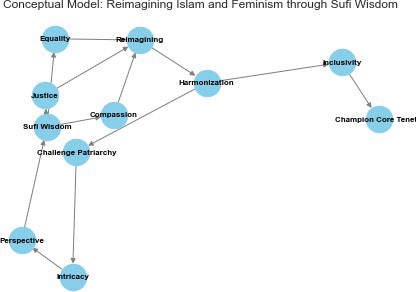
The Python code above generates a simplified abstract representation of a conceptual model aiming to depict the interrelationships between various ideas related to reimagining Islam and feminism through the lens of Sufi wisdom. Let’s break down the interpretation:
Nodes and Relationships
The model comprises nodes representing key concepts such as “Intricacy,” “Perspective,” “Sufi Wisdom,” “Justice,” “Compassion,” “Equality,” “Reimagining,” “Harmonization,” “Challenge Patriarchy,” “Inclusivity,” and “Champion Core Tenets.” Relationships between these nodes are represented by directed edges, indicating the flow or influence from one concept to another.
Flow of Concepts
The model suggests a logical flow of concepts. It starts with understanding the “Intricacy” of the relationship between Islam and feminism, leading to the development of a specific “Perspective.” This perspective is then influenced by “Sufi Wisdom,” which, in turn, contributes to the core principles of “Justice,” “Compassion,” and “Equality.” The amalgamation of these principles leads to the overarching idea of “Reimagining” the relationship between Islam and feminism. The process involves “Harmonization” of Islamic values with feminist ideals, which further leads to the “Challenge of Patriarchy” and the promotion of “Inclusivity.” The ultimate goal is to “Champion Core Tenets” that align with both Islamic and feminist traditions.
Visualization
The code uses the Network X library to create a directed graph where nodes are positioned in a layout for better visualization. The visual representation helps convey the logical connections between concepts and highlights the flow of ideas.
Simplification and Symbolism
It’s essential to note that the model is a simplification for conceptual purposes. Real-world concepts like justice, compassion, and equality are intricate and multifaceted, not fully captured in a graph. The abstract model symbolically represents the logical progression of thoughts and ideas as they relate to reimagining the relationship between Islam and feminism, incorporating Sufi wisdom.
In summary, the conceptual model provides a visual representation of the interconnected concepts involved in the complex task of reimagining the relationship between Islam and feminism, guided by the principles of Sufi wisdom [10, 11].
In conclusion, reimagining feminism in Islam through the lens of Sufi wisdom offers a transformative vision that aligns with the fundamental principles of justice, compassion, and equality. This intersection provides a holistic framework that honours the rich tradition of Islam while actively challenging and reshaping structures that perpetuate gender-based inequalities. Through this nuanced approach, Sufi-inspired feminism becomes a beacon for a more just, compassionate, and inclusive future within the Islamic context.
Conclusion
Based on the insights gathered from the contemporary discourse on women’s roles in society and the Islamic perspective, it is evident that a nuanced understanding of gender dynamics is essential. The question of women’s role in society, as framed by Western thought, often revolves around comparisons with men and the pursuit of parity based on predefined standards. However, this approach overlooks the inherent strengths and contributions that women possess, as well as the unique perspective they bring to various aspects of life. In contrast, the Islamic perspective offers a more balanced and holistic view of gender roles, emphasizing equality without discrimination and acknowledging the diverse talents and capabilities of both men and women. Instead of striving to replicate what men have, Muslim
women are encouraged to reflect on their spiritual and religious resources, drawing inspiration from the Qur’an and the legacy of exemplary women throughout history. This approach fosters a sense of agency, commitment, and service that transcends the limitations of modern societal expectations.
In conclusion, by embracing their unique strengths and contributions, Muslim women can play a vital role in shaping their communities and societies for the better. Rather than merely demanding parity with men based on external standards, they can leverage their inherent qualities to bring about positive change and uphold the principles of equality and justice as enshrined in Islam. This holistic approach to gender dynamics not only empowers women but also fosters a more inclusive and equitable society for all.
References
-
Darraj SM (2003) Islam and feminism: An analysis of historical and contemporary perspectives. Journal of Feminist Studies in Religion 19(1): 69-89.
-
Saadallah R (2004) Islamic feminism: A new perspective. Journal of Muslim Minority Affairs 24(2): 299-310.
-
Webb G (2001) Qur’an and Woman: Rereading The Sacred Text From a Woman’s Perspective. By Amina Wadud. Oxford University Press, New York, pp: 118. Journal of Law and Religion 15: 519-523.
-
Hassan R (1999) Feminist theology and Qur’anic hermeneutics: A critical analysis of feminist interpretations of Qur’an 4:34. Journal of Islamic Studies 10(1): 47-70.
-
Mermer M (2005) Feminism and Islamic gender discourse: A critical analysis. Journal of Muslim Minority Affairs 25(1): 121-139.
-
Sultan B (2005) The book of Sultan Bahoo. In: Ahmad N (Ed.), Research and Social Development Organization.
-
Ibn A (1993) Fusus al-Hikam. In: Nicholson RA (Ed.), Dar Al Kotob Al Ilmiyah.
-
Stowasser BF (1997) Women in the Qur’an, traditions, and interpretation. Oxford University Press, New York.
-
Woodward M, Umar MS, Rohmaniyah I, Yahya M (2013) Salafi Violence and Sufi Tolerance? Rethinking Conventional Wisdom. Perspectives on Terrorism 7(6): 58-78.
-
Eaton RM (1974) Sufi Folk Literature and the Expansion of Indian Islam. History of Religions 14(2): 117-127.
-
Le Gall D (2010) Review Article: Recent Thinking on Sufis and Saints in the Lives of Muslim Societies, Past and Present. International Journal of Middle East Studies 42(4): 673-687.
- The Place of Wittgenstein’s Tractatus in the History of Philosophy
- Digital Hermeneutics Embodied in Brian Kim Stefans’ “The Dreamlife of Letters,” and Memory: Analog to Flash Interface in the Light of Ecofeminism
- Using C-Tables to Teach Class Logic
- The Ideology of Education’s Postponed Fantasies: Deepenings on a Pressing Problematic
- Phantasia and Perceptual Realism in Aristotle
- The Pleasures of Solitude