
On the Rationality of Propaganda
In this article I set forth a theory of propaganda explaining what it is, how it relates to marketing, and the nature and types of ideology. I discuss the criteria by which we can judge the rationality or deceitfulness of propaganda. I defend the view that while propaganda can be perfectly rational, it rarely is, and I explain why that is the case. I finish by explaining why the question of the rationality or deceitfulness of propaganda is different from the question of the morality of propaganda. I give two quick examples of how an ethicist might argue that deceptive propaganda might be ethical to use, and perfectly rational propaganda might be immoral to use. I conclude with the notion that the question of the ethics of marketing and propaganda is complex, and should be handled in a separate paper.
What is Propaganda?
Propaganda studies as an academic discipline started during WWI. During this period (1914-1918), the Central Powers and the Allies all developed national propaganda agencies1. After the war, propaganda studies took off, with thousands of books on the subject published by 1935. The central role propaganda played in buttressing public support for the Nazi and Soviet regimes, and the use made of it by all sides during WWII and in the Cold War, aroused intense interest in the subject. But with the demise of the Soviet empire in the late 1980s, work in propaganda studies waned.
However, with the recent increasingly authoritarian turn in Russia and China, both regimes are utilizing large propaganda machines to influence public opinion in their own countries, as well as other countries—especially the Perspective ones they consider adversaries. This has put the subject at the forefront again.
In this essay, I want to lay out a coherent, clear, concise but comprehensive theory of propaganda. In doing this, I will explore the similarities and differences between my account and those of some other scholars. By “comprehensive” I mean that I will answer the central questions:
- What exactly is propaganda?
- How does propaganda relate to marketing?
- Is propaganda always concerned with politics?
- Does propaganda always aim at propagating an ideology?
- What does “ideology” mean here, anyway?
- Is propaganda inherently deceitful or mendacious?
- Is propaganda more dangerous in a democracy or an authoritarian regime?
- Is employing deceitful propaganda always unethical or immoral?
Even mentioning the word “propaganda” opens the door to controversy and confusion. As the eminent scholar of film propaganda Richard Taylor puts the challenge:
The term ‘propaganda’ has for various reasons been devalued in its usage. In particular, it has come to have pejorative connotations, so that the word itself is often used for ‘propaganda’ purposes. ‘Propaganda’ becomes what the enemy engages in, while one’s own ‘propaganda’ parades under the disguise of ‘information’ or ‘publicity.’ It therefore ceases to be a useful concept. But, if ‘propaganda’ is to be a useful concept, if it is to be distinguished from ‘information’ and ‘publicity,’ it must first of all be divested of these associations. It must provide a value-free definition of a recognizably distinct activity2.
Let’s start with the basic question: what is propaganda? As Douglas Walton (among many others) have rightly noted, the term originated from an agency of the Catholic Church, the “Congregation for the Propagation of the Faith”3. Thus, propaganda meant something intended to propagate, to spread more widely, the Catholic religion, in other words, to increase the number of adherents to it. By extension, then “propaganda” is a tool to get people to support some belief or system of beliefs. Quoting Taylor again here, “Where ‘propagation’ is the action, there ‘propaganda’ is the activity”4. More precisely, propaganda is the technique of using persuasion to spread support for a person, party, cause, or ideology, and act accordingly (meaning act in certain ways or follow certain practices).
Here we would do well to contrast propaganda as a technique of persuading people to accept, comply with, or support something with two other methods of techniques of obtaining compliance: power and purchase. Power—a technique of compliance we share with other species of animals—is the use of force, threat of force, or theft to get others to comply with one’s demands. For example, if a country’s ruler wants the citizens to not oppose his or her rule, that ruler can use force to stop all popular resistance— as is common in a police state.
By “purchase” I mean the use of trade—the exchange of things of value—to get others to comply with one’s wishes. As Adam Smith observed, unlike the use of power, animals generally don’t engage in trade—you don’t see dogs trading bones after careful deliberation. For example, the rulers of a country will quite often try to buy the support of the citizenry by giving them “free” things such as rent vouchers, food stamps, or other subsidies, and try to buy the support of
2 Richard Taylor Propaganda: Soviet Russia and Nazi Germany (2nd ed.). London: I. B. Taurus & Co. Reprint: New York: St. Martin’s Press, (2009): p.7.
3 Douglas Walton “What is Propaganda, and What Exactly is Wrong with It?” Public Affairs Quarterly, Vol. (14): 383-413, (1997), p. 383.
4 Richard Taylor op. cit., p.7 businesses, farmers, labor unions, or other groups by giving them subsidies as well. A classic illustration of this has been explored by historian Gotz Aly in his superb book Hitler’s Beneficiaries: Plunder, Racial War, and the Nazi Welfare State5. Aly shows in meticulous detail how the Nazi regime rewarded its supporters with money and material goods stolen from the Jews they exploited and murdered, and later with goods plundered from the countries the Wehrmacht conquered6.
Now, persuasion, unlike the use of power but similar to the use of trade, is something generally unique to our species. The obvious reason is that we typically use natural language to persuade others: we argue, cajole, and beg in speech. We commonly use the term “rhetoric” to refer to the use of language to persuade others. Yes, some criminals refer to a gun as a “persuader,” but it is meant ironically. If you use a gun to rob me, you haven’t persuaded me that you deserve my money, you’ve just forced me to give it to you. Similarly, it would be an ironical use of language to say of paying someone to help you move that you “persuaded” him by a “monetary argument.” Lindley Fraser put this point nicely:
The central element in propagandistic inducements, as opposed to compulsion on the one side and payment, or bribery, on the other is that they depend on ‘communication’ rather than concrete penalties or rewards. To affect a donkey’s behavior by whipping is not propaganda, nor is plying it with carrots. But if its owner shouts at it in a threatening manner, or tries to coax it with winning words or noised, then the word begins to become appropriate7.
Here we should make a few points. First, rhetoric as we define it is different for the myriad of other uses of language, such as instructive speech, performative speech, recreational speech, or abusive speech. Instructive speech aims only at informing other people. A lecture on (say) quantum theory is hardly aimed at persuading the listeners to do or support anything, but instead merely to inform the listeners about an area of science. Performative speech aims at carrying out some action. When a minister says, “I now pronounce you man and wife,” he or she is not trying to get people to support or do something, but is doing something for them—marrying them. Recreational speech—such as reciting poetry or doing stand-up comedy—is typically only meant to entertain, not
5 Gotz Aly Hitler’s Beneficiaries: Plunder, Racial War, and the Nazi Welfare State. New York: Henry Holt & Co., (2008).
6 For an extended discussion of Aly’s book, see Gary James Jason, “Buying Genocide, Part I,” Liberty, (July 14, 2017); “Buying Genocide, Part II,” Liberty, (August 14, 2017); and “Buying Genocide, Part III,” Liberty, (September 26, 2017).
7 Lindley Fraser, Propaganda. London: Oxford University Press, (1957): p. 3
convince people to do or believe something8. And abusive speech—such as cursing at someone driving past you on the freeway—is meant typically only to insult them, not get them to believe or behave in a certain way.
Second, rhetoric is persuasive speech in a very broad sense of the term “speech.” Rhetoric can use any symbolic means of messaging besides purely verbal messaging, such as: architecture; art; badges/medals/emblems; caps/hats; cartoons; charts; coinage/currency; dance/ballet; daggers/ knives/swords/lances/batons; figurines/sculpture; film; flags; gestures/salutes; graphs; insignia; monuments; music; parades; pictures/photographs; postage stamps; post cards; posters; tables; tombstones/grave-markers; toys; uniforms; video clips; or other means. A poster or other picture, for example, can convey a persuasive message more effectively than any verbal statement of it can. Consider the Italian postcard featured below (Figure 1). It was produced during WWII to commemorate a Japanese Imperial Navy victory over the British Royal Navy, and it conveys forcefully the message that the Japanese Navy is invincible, and so the public should support the Axis alliance. Notice that the enormous samurai warrior is crushing two British battleships, with the Nazi flag, the Japanese Imperial flag, and the Italian fascist state flag behind him 9.
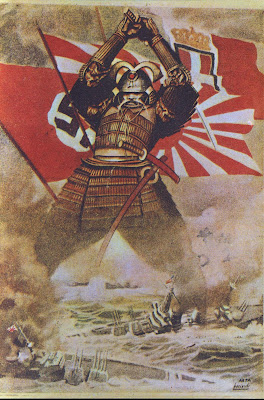
We should add that the classic silent films The Birth of a Nation and Battleship Potemkin are universally recognized as powerful works of propaganda. Finally, even emblems and insignia can be effective at persuasive messaging.
A third point concerns the types of rhetoric. If rhetoric as a genus (so to say) is the persuasive use of language, what are
8 Of course, poetry and comedy routines can be employed as a medium of propaganda. The point here is that they can be and usually are used for purely performance purposes.
9 E. M. Sanchez-Saavedra “Wartime Japanese Postcards,” Yesterday’s Papers (John-Adcock.blogsot.com), (August 31, 2012).
the major species of it? Consider this passage from Walton:
It does seem to be the case, descriptively speaking, that one of the main means used in propaganda to get an audience to act in a certain way is to use persuasive arguments targeted at their commitments, to get them to accept or to adopt a favorable attitude to certain propositions they may have doubts about. Propaganda is in this respect comparable to the discourse of commercial ads, of the kind used on television. The purpose of the ad seems to be to get the viewers to buy more product. If you talk to representatives of the advertising firms that make these ads, and suggest to them that the ads should use rational persuasion to convince the viewers that the product is good, or is better than those of the competition, they will dismiss this account of the purpose of commercial advertisements as both naïve and too narrow. Sometimes the ads are evidently designed to rationally convince the potential buyer that the product has certain good or useful features, or is a good buy. But more often the strategy of the ad is simply to draw attention to the brand, or to generate a favorable ambiance associated with the brand, by using visual images to arouse emotions10.
I would suggest that this passage is correct in some ways, but incorrect or misleading in other ways. It confounds quite disparate points—points that should be disaggregated. Walton is correct to recognize the close similarity between marketing and (political) propaganda. In fact, they are two major types or species of rhetoric. Rhetoric is messaging aimed at persuading the audience to accept or do something. Marketing is rhetoric intended to get the audience to buy products (i.e., goods of services), while political propaganda is rhetoric intended to get the audience to support a political figure, cause, party or ideology, and act according—donate money, attend rallies, show up to vote, and so on.
Parenthetically, we should observe that marketing and political propaganda are surely not the only species of rhetoric. To begin with, there are various causes besides political causes. Besides political propaganda, there is religious propaganda, i.e., rhetoric intended to get the audience to accept or support some religious figure, cause, or ideology, and act accordingly—attend church, donate money, and so on. (As noted at the outset of this article, this is where the term “propaganda” originated). There is economic propaganda—rhetoric intended to get the audience to support some economic system (for example, socialist propaganda), and act in furtherance of that system. There is social propaganda—rhetoric intended to get the audience to support some social policy (for example, propaganda in support of legalizing polygamy), and act in furtherance of same.
10 Douglas Walton op. cit., p. 395-6
We should also add that propaganda for an ideology can take the form of a brief message. But advocating for an entire ideology usually requires an extended message, typically a full book. Consider as examples two classics of economic propaganda, one by the canonical communists Karl Marx and Frederick Engels, and the other by Milton Friedman, the famous exponent of what is called neo-liberalism (i.e., free market capitalism relatively unconstrained by extensive regulations). In 1848, Marx and Engels published a book directed at the general public, often called The Communist Manifesto, that was both an explanation and a defense of communism, as well as a call for action11. More recently, in 1980, Nobel Laureate Milton Friedman wrote a book also directed at the general public, that was both an explanation and a defense of neo-liberalism, and a call for action. (The book was turned into a ten-part TV series that was aired on public television)12.
Moreover, besides the sorts of what we might call “institutional” rhetoric—rhetoric intended to get the audience to support some institution (a political system, an economic system, a religious system, or a social system), there is what we might call “personal enhancement marketing”: rhetoric intended to get the audience to support the speaker or some other particular person. For examples, a candidate for a job might try to get a hiring committee to select the candidate rather than another for the position. And a person might try to convince his lover that he is worth marrying. Change this to- We can summarize this as follows: Rhetoric
- Marketing
- Institutional propaganda: • Political propaganda; • Religious propaganda; • Economic propaganda; • Social propaganda;
- Personal enhancement marketing Finally, Walton correctly notes that rhetoric can have specific goals or general ones.
In marketing, a company will typically try to sell specific products, of course. But often it will try to “sell the brand,” meaning run advertising intended to make people think more positively about the company itself, and the value of the company’s product line—and thus be more likely to purchase the products that the company
11 Karl Marx and Frederick Engels. Manifesto of the Communist Party, Marx/Engels Internet Archive (2000) (originally published in 1848). https://www.marxists.org/archive/marx/works/1848/communist- maniesto.
12 The book: Friedman, Milton and Friedman, Rose. Free to Choose: A Personal Statement. New York: Harcourt, 1980. The TV series: Friedman, Milton. Free to Choose. PBS TV series, 1980. https://www. freetochoosenetwork/programs/free_to_choose/index_80.php.
offers. It is common in business to distinguish between sales, aimed at the specific acquisition of new customers, and advertising, aimed at the general enhancement of the public’s view of the brand. For example, Ford Motor Company for years ran a short ad (a “spot ad”) simply saying that “At Ford, quality is job one!” This ad (first aired in 1987) was intended to overcome the public perception of Ford automobiles as being shoddily built, a perception that grew out of the Ford Pinto lawsuits of the late 1970s.
Note that this sort of advertising to support company’s brand is a variety of what is often called “public relations”— meaning the management of the communication between the company (or governmental or other institution, or even a single individual) and the general public.
Similarly, in political propaganda, a political group will often run ads promoting a particular candidate in an election or a specific law being voted on in a legislature (or in a venue in which people get to vote directly on laws). But often, political propaganda aims at promoting a party or political ideology. Religious propaganda can be used to promote a specific religious policy (for example, allowing priests to marry) or for a religion (such as Roman Catholicism). Economic propaganda can be used to promote a specific economic policy (say, tax cuts) or for a general ideology (e.g., laissez-faire economics). Social propaganda can be used to promote a specific social policy (for example, a ban on polygamy) or for a general ideology (such as the patriarchal nuclear family structure)13.
Even with what we called personal enhancement marketing, one can use it to promote a specific action (getting a particular job) or a general one (getting people to view someone as an exceptionally good person). However, returning to the Walton passage, what is incorrect is its implication that in attempting to sell a product a company will typically use an argument to promote specific sales of its products, whereas to promote its brand it will use visual ads to arouse emotions. There are four problems with this. First, it seems to me that whether a producer tries to offer a full, logically powerful and factually accurate argument that demonstrates the superiority of its product over all others is determined by whether it has such an argument, and the cost of advertising it in the various venues. As I will argue below, often the producer can’t formulate any such argument. And it is equally true that if it could offer an argument for the superiority of its product line, i.e., its brand, it would. But
13 “Social ideology” is in fact a broad category.” It includes ideologies about educational structure, family structure, and military structure.
again, I will argue that often the producer can’t.
Second, arguments can be presented by visual images. Pictures can be very compressed enthymemes. Looking at the earlier example of the Italian postcard celebrating the Japanese victory over a British fleet, you could interpret it as arguing: “The Japanese Imperial Naval ships decisively defeated the British Royal Naval vessels; this shows that the Japanese Navy is superior; thus, they will continue to win14. “ But—as I will point out below—it is possible to interpret pictures in other ways. Third, if the advertising medium is television, it would be expensive to (say) spend five minutes explaining why either a specific product or a product line (or even the company itself) is superior. The cost of advertising usually constrains how much time the advertiser wants to spend. Fourth, words as well as images can arouse emotions. Consider the anger a person might feel after being called a vile name, or the grief parents would feel upon being told that their child is terminally ill. We have now answered the first four questions. In sum, my view here is similar to that of Luckert and Bachrach:
The term propaganda …refers to the dissemination of information, whether truthful, partially truthful, or blatantly false, that aims to shape public opinion and behavior. Propaganda simplifies complicated issues or ideology for mass consumption, is always biased, and is geared to achieving a particular end. In contrast with the ideal of an educator, who aims to foster independent judgment and thinking., the practitioner of propaganda does not aim to encourage deliberation by presenting a variety of viewpoints and leaving it up to the audience to determine which perspective is correct. The propagandist transmits only information geared to strengthen his or her case and consciously omits contrary information. Propaganda generally uses symbolism whether in written, musical, cinematic, or other visual forms, and aims to channel complex emotions towards a desired goal. It is often employed by governmental and private organization to promote their causes and institutions and denigrate their opponents and is linked to both advertising and public relations15.
Let us turn to the next question. We say that political propaganda (like consumer marketing, other forms of
14 For an excellent treatment of visual argumentation, see Thomas Hollihan and Kevin Baaske, Arguments & Arguing: The Products and Process of Human Decision-Making, Long Grove, IL: Waveland Press, Inc., (2016), Chapter 10.
15 Steve Luckert and Susan Bachrach op. cit., p. 2.
propaganda, and personal enhancement marketing) can be aimed at promoting a specific person or policy, or party, but it can also be aimed at promoting an ideology, what does the term “ideology” mean here?
What is an Ideology?
An ideology is sometimes simply defined as interconnected system of ideas or beliefs. However, this won’t do: the definition is much too broad. After all, evolutionary theory and the theory of electromagnetism are both interconnected bodies of ideas, but they can hardly be called ideologies. A true ideology has two other features. First, an ideology is a nexus of beliefs about some human institution, that is, about an area of collective human action. We have seen earlier that there are four major types of ideology: political; economic; social; and religious. Ideologies are thus mental models that enable people to make choices in social contexts, i.e., in social interactions. A system of ideas like quantum theory can’t do this.
Second, an ideology includes values or axiological beliefs along with factual beliefs. Taylor, I believe, is on to this point when he says, “’Propaganda is concerned with the transmission of ideas and/or values from one person, or group of persons, to another”16. My disagreement is just this: in transmitting an ideology, we are of necessity transmitting values as well as ideas. Again, quantum theory can hardly be called an ideology. Without these axiological beliefs, there would be no connection between ‘is’ and ‘ought,’ that is, no way to derive actions from facts. Thus, these values function as bridge principles that allow people to derive choices from factual beliefs. For example, the ideology of free market capitalism holds the theoretical belief that competition among self-interested business owners will result in lower prices and more products that people want, and (crucially) the value belief that widespread material prosperity is good for society—a principle that some people would reject.
Some philosophers have held that people adopt their ideologies from psychological or emotional reasons, as opposed to epistemic ones. In fact, some philosophers have held that ideologies are webs of false beliefs or even myths promulgated to allow those in power to retain their power. But in my view, this is muddled. It confuses how a person originally gets his ideological worldview, with how justified his ideological beliefs are. There are a number of possible scenarios here. A person might acquire his ideology in a given area as a young child from his or her society’s mediating structures
16 Richard Taylor op. cit., p. 7
(family, church, school, friendship circles, social clubs, sports teams, or such like) by naïve acceptance, and never acquire any (or much) reasonable evidence for any of those beliefs. This case would be one in which the person was indoctrinated as a child and never examined his or her beliefs. For example, a person might be raised as a Coptic Christian, practice the faith conscientiously, but never examine any of its tenets.
On the other hand, a person might as an adult adopt an ideology he or she had not hitherto believed through, say, study in college. This case would be one in which the person came to study a subject as an adult and by careful study of all the ideologies in a given domain, selected the one he or she felt is the one most justified by data and experience. For example, a working-class college student might undertake the study of economies and after considerable study adopt the ideology of liberal economics (i.e., “free market economics”), even though his or her background would suggest the student might have more likely adopted socialist ideology. But then again, a person might acquire his or her ideology in a given area as a young child from his or her society’s mediating structures by naïve acceptance, and only later in life acquire evidence for it after examining its tenets. For example, a person might be raised as a Lutheran, practicing the faith, but only as an adult learn reasons for its tenets. Yet again, a person may acquire an ideology as an adult, having never had one previously in that domain, but never learn much about it. For example, a child raised in a family of no religious convictions or practices might as a college student suddenly convert to a religion on the basis of emotions, and never examine the evidence for its tenets.
One last clarification. Note that I have left it open just how political parties and political ideologies fit together. It seems to me that a pre-existing ideology might be developed by an influential thinker or group of thinkers, and then parties are formed by people who want to enact policies and laws informed by or aimed at implementing that ideology. Perhaps an example would be the natural rights ideology developed by Locke and others, and the crafting and adoption of the U.S. Constitution. On the other hand, a group of individuals who form a coalition of people with various but similar motives and may then establish a political party, and only then work to craft a coherent ideology to use as a tool to get their party members elected, i.e., to achieve political control. Perhaps an example of this was the original formation of the Nazi Party (the NSDAP), followed by the working out of a coherent ideology that helped get them followers.
In either situation, the political ideology is not a passive system of ideas but a system of ideas and values used as a tool for increasing and structuring political governance.
In fine, promoting a brand is intended to make the audience more inclined to purchase that company’s products in the future. Promoting a political ideology is similarly intended to get the audience to support politicians and policies of that persuasion in the future. Promoting an economic ideology is intended to get the audience to support politicians and policies of that persuasion in the future. Promoting a social ideology is intended to get the audience to support politicians and policies of that persuasion in the future. Finally, promoting a religious ideology is intended to get the audience to support the clerics and practices of that persuasion in the future.
Differences between this Account and Others
The account of the definition of propaganda I have sketched above differs from some other common accounts. I want to review a number of these, and explain why I reject them. I put my own view in bold print.
Propaganda need not be effective
We should note here an issue raised by Richard Taylor and another eminent propaganda scholar, Jacques Ellul. Ellul holds that if a message fails to persuade the audience, it isn’t really propaganda: “Ineffective propaganda is no propaganda”17. But as Taylor rightly notes, it is hard to measure how successful a piece of propaganda is to begin with, and anyway, how does it change what the propagandist is doing if he or she fails? Is a sales pitch not a sales pitch if the customer doesn’t buy the product? Hardly18.
In truth, the question of how effective a given piece of propaganda is can be tricky. Even in marketing, where it is sometimes possible to measure how much sales increased after an ad campaign is run, it is hard to measure how much the increased sales were due to the ad, as opposed to (say) customer word-of-mouth. Manipulation of Emotion is not an Essential (Defining) Feature of Propaganda An important issue in how we define the term “propaganda” is whether it is of the essence of propaganda that it manipulates the emotions of the audience. The answer is that propaganda (and marketing) often does often
17 Jacques Ellul, Propaganda: The Formation of Men’s Attitudes, New York: Random House, (1973).
18 Richard Taylor, op. cit., p. 11.
involve arousing emotions, but that does not as such define propaganda. To begin with, some speech that is clearly not propaganda can aim at arousing emotion. For example, a tragic play such as Romeo and Juliet will be written in a way that makes the audience fell sorrow for the characters. But the play is only a recreational use of language, not a case of propaganda. That is, the play arouses the audience’s emotions to entertain, not to persuade. Again, a documentary can arouse emotions while being only informative. Ken Burn’s documentary on the Dust Bowl—a particularly rough period for the American Southwestern farmers—fills the audience with pity and admiration for the farmers (Burns 2012)19. But the documentary of meant only to inform the audience about a disastrous period of American history, not to persuade the audience to do or support anything. Then again, some propaganda speech clearly is not aimed at arousing emotion. A government-run public service announcement (“PSA”) targeting high-school students, urging them to stay in school, might cite statistics about how much more high-school graduates earn and how much lower their unemployment is compared to high-school dropouts. The PSA isn’t attempting to arouse emotions, but is trying to persuade the audience to so something: stay in school. The PSA attempts to persuade students by appealing to the students’ desire to earn more, i.e., their values, but not their emotions. In sum, attempting to arouse emotions is neither a necessary nor a sufficient condition for a message to be propaganda.
Propaganda is not Necessarily Dialogue in Structure
Walton holds that propaganda always has the form of a dialogue, with the “speaker” (i.e., the propagandist) sending a message to the respondent— “generally a mass audience”20. Now, that propaganda (and marketing) are messages sent by a person or group to some target audience is obviously true. But it is misleading, I believe, to portray propaganda as being always or even most of the time a true “dialogue.” Consider a common type of American political propaganda: “bumper stickers”21. It is common to see stickers on car bumpers simply displaying the name of the candidate favored (presumably) by the car owner:
19 Ken Burns, director. The Dust Bowl. Florentine Films, WETA-TV, (2012).
20 Douglas Walton op. cit., p. 396.
21 Discussed in Robert Cialdini Influence: The Psychology of Persuasion, New York: HarperCollins Publishers (2006).
“Jones/Snark 2028.” These bumper stickers are printed by the Jones election managers to distribute to his followers. The managers know that many voters only decide for whom to vote when in the voting booth, and they often vote for the most familiar name. So, by getting Jones supporters to post his name on their cars, the managers increase the number of votes. Now, is this a dialogue? Not really. It isn’t even a statement. It is just issuing the message “Vote for Jones!” to random viewers to increase Jones’ name recognition. (This is exploiting the psychological mechanism the eminent psychologist Robert Cialdini calls “familiarity”)22. I don’t deny that occasionally a propaganda exchange amounts to a dialogue. For example, in a recent paper I examine how a propagandistic documentary can be effectively rebutted by counter-propaganda in other documentaries23. I just say that it isn’t even common, much less definitive, of all propaganda messages. From my perspective, the proper unit of analysis in propaganda theory is not the dialogue, but the message.
Message Content is not always an Argument
Walton holds that “The content of the proponent’s message is an argument, expressed in a verbal discuss and/ or in other means of altering convictions that are not verbal in nature.” Walton is thus saying that the argument can be verbal or pictorial24. (Walton doesn’t state whether he means single or multiple arguments, so I will take it that he means both), But can’t propaganda messages be other kinds of speech acts? Consider repetition—held by may propaganda theorists to be the key to effective propaganda—is it not just repeating the same statement in virtually the same words without ever presenting any evidence? To repeat “Wheaties—the breakfast of champions!” or “The Aryans are the master race” is not to argue at all. Again, can’t propaganda take the form of a single exhortation? To say “Long live the King!” or “Deutschland Uber Alles!” is not even to make a statement, much less a complete argument. Can’t questions be propaganda messages as well? “How long will we tolerate being humiliated?” or “When will we achieve our rightful place among the powers of the world?” are questions directed at the audience intended to make them think, but
22 For a detailed exposition of psychological mechanisms and how they are exploited by marketers and propagandists, see Cialdini op. cit.
23 Gary James Jason “Fighting Fire with Fire I: Using Film to Counter Film Propaganda,” Propaganda: Journal of Communication Studies, Vol. 3, No.2 (July 2023): 95-123.
24 Douglas Walton op. cit., p. 397.
put forward no arguments at all. And pictures, posters, statues and so on are difficult to interpret verbally. Consider a Nazi election poster from the early 1930s, showing merely a picture of Hitler’s face and the name “Hitler” underneath. Is this really an argument? If so, what are the premises? Or is it a disguised statement: “Hitler is the best choice for leader”? I suspect that the most appropriate interpretation is that it is a disguised imperative: “Vote for Hitler!”
The Rationality of the Reasoning is a Legitimate Issue in Evaluating Propaganda
Walton holds that, “The goal of propaganda is to make a mass audience in a certain direction, and its success or failure as argumentation used in a context of discourse should be judged in relation to how well (or badly) it performs in fulfilling this purpose. If methods of logical reasoning are useful for this purpose, then they should be used in propaganda, otherwise not.” He later adds, “Because the central purpose if propaganda is to get results, propaganda as a socially organized activity is justified by the results it is supposed to achieve (both normatively, and in fact…)”25.
But this seems to me to dismiss the study of what makes propaganda rational to begin with, and trivializes the ethical issues of the use of propaganda. Clearly, there are three quite separate and legitimate questions in the study of propaganda. First, what makes propaganda effective, and how do we determine how effective it is in a given situation? Second, what makes propaganda rational or irrational, and are there degrees of irrationality? Third, what makes propaganda ethical or unethical? Is it merely (as Walton seems to suggest) just a matter of the consequences— “the ends justify the means”?
Let me take up the question of the rationality of propaganda
Can Propaganda be Rational?
Perhaps the best way to explain the topic of the rationality of propaganda would be to ask what characterizes fully autonomous and rational choice. Economists have traditionally modelled rational choice as a six-step process. First, the decision-maker begins by framing the decision quest accurately. Second, the decision-maker identifies his or her options. Third, the decision-maker gets clear on his or her criteria of choice, i.e., his or her goals. Fourth, the decision- maker ranks those goals—in other words, prioritizes what he or she finds desirable. Fifth, the decision-maker determines
25 Douglas Walton op. cit., p. 398.
how much each choice satisfies each goal. This is often called determining the costs and benefits of each option. Finally, the decision-maker chooses the best overall option26.
All of this presupposes that the decision-maker is a mentally-competent adult, and is free from coercion. The most natural definition of irrational rhetoric—be it marketing or propaganda—would be messaging which defeats or blocks this model. There are six criteria that I would suggest are needed for the propaganda to be rational. The first three characterize the content of the message, the second three the context of the messaging. First, the message should be evidence-based. The message should offer reasons relevant to the decision (usually, about the costs and benefits of the options). This means that the message should not consist of mere repetition. Of course, much advertising and political propaganda consists precisely of mere repetition, as was noted by Le Bon back in 1895: Affirmation, however, has no real influence unless it be constantly repeatedly, and so far as possible in the same terms. It was Napoleon, I believe, who said that there is only one figure in rhetoric of serious importance, namely repetition. The thing affirmed comes by repetition to fix itself in the mind in such a way that it is accepted in the end as a demonstrate truth. The influence of repetition on crowds is comprehensible when the power is seen which it exercises on the most enlightened minds. The power is due to the fact that the repeated statement is embedded in the long run in those profound regions of our unconscious selves in which the motives of our actions are forged. At the end of a certain time, we have forgotten who the author of the repeated assertion is, and we finish by believing it. To this circumstance is due the astounding power of advertisements. When we have read a hundred, a thousand, times that X’s chocolate is the best, we imagine we have heard said in many quarters, and we end by acquiring the certitude that such is the fact. When we have read a thousand times that Y’s flour has cured the most illustrious persons of the most of the most obstinate maladies, we are tempted at last to try it when suffering from an illness of a similar kind. If we always read in the same papers that A is an errant scamp and B a most honest man, we finish by being convinced that this is the truth, unless, indeed, we are given to reading another paper of the contrary opinion, in which the two qualifications are reversed. Affirmation and
26 This model of rational choice is of “decision-making under certainty,” i.e., where the decision-maker doesn’t have to factor in the probabilities of various states of nature, is admittedly the simplest case in decision theory. But it serves as a plausible model for our discussion.
repetition are alone powerful enough to combat each other27.
Second, the message should be truthful—meaning “the truth, the whole truth, and nothing but the truth” as is demanded of witnesses in the American courtroom. One of the biggest reasons people generally distrust propaganda is that is so often involves lies—often of the most egregious sort. One thinks here of the Nazi films and newsreels at the outset of the 1939 invasion of Poland, in which they portrayed the Polish people as being the true aggressors. Third, the message should be broadly logical. The evidence given should logically support the claim being made. For example, as Cialdini notes, for years the Magellan Fund ran an ad claiming that its fund had a higher average rate of return than did the Fortune 500 index28. But this was a faulty analogy, because while the Fortune 500 stock index contains only very large company stocks, the Magellan Fund contained many smaller company stocks. Small company stocks do have higher rates of return on investment, but they also have more risk—because small companies go out of business at a higher rate than do large ones.
Fourth, the propaganda should be rightly targeted, meaning directed at mentally competent adults. Thus, for example, if a school allows for grade-school teachers to put up political posters im their classroom, this would be deceitful propaganda. Similarly, political posters put up in common areas of an Alzheimer’s assisted care facility would be deceitful. It is worth pointing out here that U.S. common law conforms with this principle. Contracts with minors are generally unenforceable, since minors are not viewed as having the same grasp of the law as adults29. And contracts with adults held to be “non compos mentis” (not mentally competent) are again generally unenforceable.
Fifth, the propaganda should be transparent, that is, it should be made clear to people that someone is trying to persuade them of something. Marketers often try to make their advertising subliminal, i.e., below the level of conscious perception. Consider product placement ads. An action hero in a movie will fight villains to save innocent people—and at the end of the film, the hero may pick up a bottle of cola with the brand name clearly visible. The audience is unaware of it, but they are being subjected to advertising. The cola
27 Gustave Le Bon The Crowd: A Study of the Popular Mind, Mineola, New York: Dover Publications, Inc. (2002): pp. 77-79.
28 Cialdini op. cit.
29 However, in most states, the law does not allow minors to void contracts for basic necessities such as food and clothing.
company will have paid several million dollars to the film’s producers to have it be their cola brand the audience sees, because the audience will associate their admiration of the action-hero with that brand of cola.
Similarly, political propaganda can be subliminal— indeed, Goebbels himself said that the most effective propaganda is disguised propaganda. One example of this was the film Robert and Bertram (1939). This was one of the five major feature films the Nazis made to ramp up anti- Semitism during 1939-1940. The movie was on the surface just a musical comedy, however, in reality, it subtly but systematically put forward virulently anti-Semitic images30.
My position regarding transparency is subtly different from some other propaganda theorists. Taylor quotes F. E. Lumley that “Propaganda is promotion which is veiled in one way or another…”, building the idea of lack of transparency as defining of all propaganda31. Taylor also quotes W. Albig who had a similar view, and holds in addition that marketing cannot be propaganda because its origin is always clear32. Taylor says that this is too narrow a definition, since most Nazi and Soviet film propaganda was transparent, but still propaganda. Taylor also says that this confuses the nature of propaganda with what makes it effective—noting as I did above that Goebbels thought concealed propaganda was the most effective.
I agree with Taylor that Lumley’s attempt to define all propaganda as being concealed rules out most of what we rightly call propaganda. But I disagree even more with Albig: marketing is very similar to propaganda, exploiting the same psychological mechanisms, the difference being only that marketing aims at persuading an audience to buy a product or feel favorably about a product line, whereas political propaganda aims at persuading an audience to support a political figure, cause, party, or ideology, and act accordingly. Furthermore, as I noted above, a fairly large amount of advertising is in fact subliminal. And I don’t believe that propaganda is always more powerful if it is disguised—I think that that is more of a rough generalization.
Sixth, the propaganda should not involve coercion. For example, if a political parry stages rallies at which members wear uniforms, carry weapons, and engage it violent attacks on spectators who oppose the party, it is using coercion, so
30 For an analysis of the anti-Semitic messaging of this movie, see Gary James Jason, “Selling Genocide I: The Earlier Films,” Reason Papers: A Journal of Interdisciplinary Normative Studies 38 (1) (2016): 127-157
31 Frederick E. Lumley The Propaganda Menace, London: The Century Co., (1933), p. 44.
32 William Albig Public Opinion, New York: McGraw-Hill Book Co. (1939), p. 287.
the rallies form a sort of deceptive propaganda.
So, under this account of propaganda, propaganda can be range from the perfectly rational to the utterly irrational on six different scales. Let us look briefly at two propaganda films from WWII that illustrate this point.
Consider first the notorious Nazi anti-Semitic film The Eternal Jew (1940)33. The film had three broad goals: portraying Jewish ghetto life in a very negative way; portraying various Jewish religious rituals negatively; and attacking what were presented as Jewish values. It was a profoundly sophistical film from all the six criteria discussed above. Certainly, it put forward numerous wild claims without any proof—such as that the Jews are “a race of parasites,” and that Judaism “makes cheating and usuary a divine duty”— all of which are outrageous falsehoods. Moreover, the film argues that because the Jewish people have moved around Europe, they are “rootless”—illogically ignoring the fact that Jews were often targeted with violence precisely to make them move.
Add to this that the film was shown routinely to German children, at Hitler Youth meetings, especially—so it was wrongfully targeted. (I will explain below that the subjection of children to extensive indoctrination is common in any police state). And the film was presented as an honest, investigative documentary disguising its propagandistic nature. Finally, Hitler Youth and SS concentration camp personnel were forced to view it repeatedly. The Eternal Jew is widely recognized as one of the most deceitful pieces of propaganda film ever produced. After the war, the film’s director, Fritz Hippler, faced charges at the Nuremburg Trials for his role in creating it, and was convicted. He served two years in prison. Ironically, however, after serving his sentence, he found work making German documentary films! By way of contrast, consider another WWII propaganda film, Teamwork (1947). This film was produced by the U.S. Army Signal Corps at the end of WWII. Some background here would be useful. WWII was (I would suggest) one of only three “existential” wars—wars in which the very existence of a country is threatened—that the U.S. ever fought. The other two were the War for Independence and the Civil War. And WWII was the first war in which the medium of cinema was
33 I analyze this film in Gary James Jason “Selling Genocide II: The Later Films,” Reason Papers: A Journal of Interdisciplinary Normative Studies 39 (1) (2017).
employed by the government as a tool of propaganda. During the war, the number of Americans in uniform surged from 1.8 million in 1941 to 12.2 million in 1945, and during that 4-year period 16 million men served in uniform—which was a third of all men 15 years of age and older living at the time34. About 10% of the Army consisted of African-American men.
During the war, the U.S. War Department increasingly realized the need to integrate the armed forces. To further this goal, he War Department produced a number of short documentary-style propaganda films that publicized the profound contributions made by blacks in the Armed Forces, starting with the The Negro Soldier (1944)35—a tribute to the role Blacks played in the nation’s defense;
Wings for the Man (1945)36—a tribute to the Tuskegee Airmen; Rolling to the Rhine (1945)37 —a tribute to the Blacks who served in the truck-driving logistical corps that supplied the Allied troops from Normandy until the end of the war (the “Red Ball Express”); The Negro Sailor (1946)38— a tribute to the role Black sailors played in the U.S. Navy; and Teamwork (1947)39. In fact, the Armed Forces were ordered to desegregate in 1948—becoming the first major U.S. institution to desegregate since the infamous 1896 Supreme Court ruling Plessy v. Ferguson that legalized segregation by race—a decision that was only finally overturned in 195440.
Teamwork was a tribute to how well Black and White soldiers worked together during the war. The film opens with one Nazi officer telling an audience of other Nazi officers that the tactic of “divide and conquer” will be easy to use against America, because it is a “mongrel” nation. The officer in charge says the Nazis can play off protestants against Catholics, Jews against Gentiles, business owners against workers, and—especially—White against Blacks. He says that Nazi agents are working to make Whites and Blacks hate each other.
But then the film shows the Allied landing at Normandy, with all those different subgroups fighting alongside each other. We can see Black and White troops hit the beach
34 Department of Veterans Affairs “VA Fact Sheet,” (2003).
35 Stuart Heisler, director The Negro Soldier. U.S. Signal Corps. 43 min. (1944).
36 First Motion Picture Unit Wings for the Man. U.S. Army Air Forces. 10 min. (1945).
37 Army Pictorial Service, U.S. Signal Corps Rolling to the Rhine. U.S. War Department, 9 mins. (1945).
38 Levin, Henry, director The Negro Sailor Columbia Pictures. 27 min. (1946).
39 Moss, Carlton, director. Teamwork, U.S. Signal Corps. 16 mins. (1947).
40 in Brown v. Board of Education.
together. And the film continues in the same vein, showing Black and White troops working together in moving supplies, clearing mine fields, constructing landing strips, laying a pipeline, fighting in the air as well as on the ground. And we see men of both races sharing a field hospital.
This film was effective propaganda. It very likely helped persuade top leaders that the ranks of the military should be racially integrated—the military being the first major American institution to do so. But is the film irrational in any way? I think not. In presenting many cases in which Black and White soldiers worked and fought together side by side, the film was surely evidence-based—and the evidence was clearly historically truthful. And this evidence of their being able to work together well, along with the idea that keeping them segregated would make it easy for our enemies to undermine morale, certainly provided logical support for the claim that the segregation of the races in the military should end. Furthermore, this film was shown mainly to troops and some general audiences, so it was not wrongly targeted. And the film is transparent, from its title to its content. To be fair, in being shown to troops, it may have been coercive (depending upon whether attendance was mandatory). However, it was effective while being mainly rational.
In short, under the theory of propaganda outlined in this paper, rhetorical messages generally, and political propaganda in particular, can vary in rationality from the completely reasonable to the thoroughly deceptive, on six different dimensions. But why is it now so commonly believed today that all propaganda is perforce sophistical? I will argue that it is precisely because it is so often in fact sophistical that we assume it must be so. I turn now to explaining this claim.
Why is Propaganda Typically Irrational?
I want to explain and justify the claim that irrational propaganda is ubiquitous in a three-step process. First, I will explain why irrational marketing is so common in a liberal democracy; second, why irrational political propaganda is so common in a liberal democracy; and third, I will finish by talking about political propaganda in an authoritarian regime. Let’s start with product and brand marketing in a liberal democracy—using the U.S. as an example. In such a politico- economic system, much of the marketing (the advertising and sales) is fully or mainly rational. Wal-Mart often runs ads suggesting that it has the lowest overall pricing. Best Buy often features computer bundles with all the features listed prominently with the total prices for each. Ralph’s supermarket may advertise the sale prices of various cuts of meat or other items. However, most ads contain a large amount of irrationality—almost always, a lack of evidence for key claims (such as the ad for a well-known breakfast cereal: “Wheaties! Breakfast of Champions!”) or illogicality (such as ads for animal shelters that tell a sad story about and show a picture of a mistreated dog, but gives the readers no evidence how much of the money donated is actually spent to help the animals).
However, we should note that outright falsehoods are rare in American consumer advertising, because of Federal and State “truth-in-advertising” laws. Any ad for any consumer product cannot contain any material falsehoods. For example, a company that makes breakfast cereal cannot advertise that a cup of the cereal contains 100% of the recommended minimum daily requirement of vitamins unless it really did. Why is there so much irrational advertising? I would suggest four reasons for the prevalence of such ads.
Start with the fact that in our consumer economy, there is often little real product differentiation. Of the perhaps 3,000 different brands and models of tennis shoes, the vast majority are roughly the same appearance and quality. So, there are typically no truly logical reason that a company can offer to the consumer to make that consumers choose the company’s product. The company—if it is to survive market competition—will have to use deceptive marketing. It will, for example, pay a famous athlete to wear its tennis shoes on the field.
Moreover, the psychological mechanisms that marketers manipulate and exploit are well understood by marketers, but not widely understood by consumers41. Knowledge is power, and marketers skilled in the use of irrational persuasion are easily able to manipulate consumers. The consumer is in an “unequal adversarial relationship” with the marketer—the asymmetry of knowledge gives the marketer the edge.
Then again, there is simple pleonexia: the desire for ever more profits motivates marketers to sell the products by any means necessary, and if irrational, manipulative ads work well, the marketers will use them. Finally, there is the ease of use. The simple fact is that we are all easy creatures to manipulate. We all have emotions that are wide and deep. We all have psychological mechanisms that readily can be used against us. Next consider political propaganda in a liberal
41 For a survey of some of the most common irrational ads used in American marketing, see Gary James Jason, The Critical Thinking Book, Ontario, Canada: Broadview Press (2022): Chapter 17.
democracy, again, looking at the U.S. as an example. In a free political system, you have the propaganda from the contending political candidates, parties and ideologies in full swing, especially during elections. Is political propaganda in a liberal democracy less deceptive than is consumer marketing? I would suggest the contrary: in a liberal democracy such as the U.S., political propaganda is in fact routinely more deceptive than is commercial marketing. Why? Because the four reasons for the prevalence of irrational marketing are the same for irrational political propaganda, and there are three additional ones. Consider the first reason for the prevalence of irrational marketing, lack of product differentiation. This clearly apply as well to political propaganda. In American politics, there is often little actual difference in the political choices the candidates actually make, as opposed to what they focus on in their speeches or what personalities they have. For example, in the last several election cycles in the U.S., all major candidates: opposed additional free trade agreements; opposed major immigration reform; supported increases in military spending; identified China as America’s chief geopolitical foe; supported protectionism for American businesses, farmers, and organized labor; and so on. I do not say that these are good or bad polices, only that there was no variation in opinion about them.
Again, there is clearly an unequal adversarial relationship in political propaganda. American “campaign handlers”—the people who specializing in running political campaigns—are well-versed in manipulating emotions and psychological mechanisms. Ordinary voters are not. What about pleonexia? Well, is the American political system devoid of or indifferent to money? Hardly. Virtually no American who has ever held elective office in the American political system has lost money in so doing. On the contrary, most Americans who have held elective office wind up sooner or later being personally wealthier than they were before serving in office. Finally, voters’ emotions and psychological mechanisms are as easy to manipulate as are consumer’ by marketers. In fact, marketers can easily adapt to “selling” political candidates. The most famous instance of this was the presidential run by General Dwight Eisenhower in 1952. Eisenhower was well-known to Americans as the Allied Supreme Commander during WWII. But when he was chosen to be the Republican candidate, he faced an obvious problem: he had never run for any elective office in his life before. He solved the problem simply by hiring a Madison-Avenue advertising firm to run his campaign. He was elected in a landslide. But I would suggest that there are three additional reasons for the prevalence of irrational political propaganda in a liberal democracy. First is the existence of “true believers” among campaign activists. Nobody will lay down his or her life for (say) increased sales of tennis shoes, no matter what their compensation is. But many political activists are so committed to the candidate or the cause that they will die— or kill—for him or it. A classic case of this was Chuck Colson, close advisor to President Richard Nixon. Colson, who was later sent to prison for his role in Nixon’s Watergate crimes, famously said that he would walk over his grandmother’s face if it would help Nixon. Such an agent would have absolutely no scruples about using the most deceitful propaganda to further his or her cause. A second reason for deceptive political propaganda not generally present in marketing is political power—something Henry Kissinger liked to call “the ultimate aphrodisiac.” Political power is an additional motive for using whatever deceitful propaganda the propagandist deems expedient. Third, and quite different from the case of marketing, at least in the U.S., there are no “truth-in-propaganda” laws. Political propaganda can legally contain any amount of deliberate material falsehoods—any distortions of opponents’ positions, any misstatements of history, any attributions of base motives to the opponent, or any allegations of illegality the propagandist desires. Moreover, American law makes it virtually impossible for candidates to sue other candidates, newspapers, or citizens, for slander or libel.
Finally, let’s consider political propaganda in an authoritarian or totalitarian regime. It is bound to be even more voluminous and deceitful than in a liberal democracy.
Now let’s consider political propaganda in an authoritarian or totalitarian regime42. It is bound to be even more voluminous and deceitful than in a liberal democracy.
Why is it bound to be more voluminous than in a liberal democracy? Because an authoritarian regime by definition deprives its citizens of their basic freedoms. This is likely to
42 The question of consumer marketing in an authoritarian regime is I think basically simple to address. It depends upon whether the authoritarian regime has a fairly free consumer market to begin with. In the most recent communist regimes—such as Mao Tse Tung’s China, Fidel Castro’s Cuba, and Josef Stalin’s Soviet Union—virtually no private business existed outside the monopolistic socialized state enterprises, so there was little marketing as such. On the other hand, in authoritarian regimes with relatively free consumer markets—such as Hitler’s Germany, Mussolini’s Italy, and Putin’s Russia—there is much the same consumer marketing as there in a liberal democracy.
cause fear, anger, and despair. By its nature, the authoritarian regime will employ coercion—that is why a common synonym for “authoritarian regime” is “police state.” But it will also employ propaganda in massive amounts—it will typically set up a propaganda machine in the form of a department or ministry of propaganda.
The classic example here is the Nazi Ministry of propaganda. Given the grandiose title “Ministry of Public Enlightenment and Propaganda,” it was headed by Joseph Goebbels, the Nazi Party’s director of propaganda 43. The Ministry started in 1933 with 350 employees serving in 5 departments. By 1939, its budget had increased more than 10-fold, and it had 2,000 employees in seventeen departments including: administration and law; broadcasting; press; film; theater; music and art; and security (against counterpropaganda). In contrast, while liberal democratic governments surely do produce propaganda, they rarely if ever have ministries of propaganda with dozens of departments and thousands of employees. Let us turn to the point that the propaganda produced by a totalitarian regime is invariably more deceitful, more sophistical, than that of a liberal democracy. I think that this is true for two major reasons. First, a totalitarian regime puts a major emphasis on the indoctrination of its children. It will typically form or take over pre-existing children’s organizations (e.g., eliminate Boy Scouts and force all boys to join the Hitler Youth). It will use school curricula as propaganda media, as well as children’s books and even toys. Yes, even a liberal democracy will do some amount of this—in the U.S., many schools still require students to recite the Pledge of Allegiance before classes start for the day. But the difference in degree is so large that it amounts to a difference in kind.
Second, for a liberal democracy to actually be a liberal democracy, it must allow freedom of speech. This means that any piece or line of propaganda put out by any governmental or private organization can be rebutted publicly by others of an opposing perspective. This means that the impact of deceptive propaganda can be muted or countered by other propaganda. But in an authoritarian regime, the is generally no freedom of speech. So, if the government puts out even the most duplicitous and deceptive propaganda, nobody is able
43 For an excellent survey of the scope and efficiency of the Nazi propaganda machine, see Steve Luckert and Susan Bachrach op. cit.
to rebut it. Simply put, in a totalitarian state, the propaganda is apt to be more deceitful because there is no check on or counter to the government—and the government knows this.
Conclusion: The Rationality of Propaganda versus the Ethics of Propaganda
In this article, I have: defined what propaganda is; how it is related to marketing; how it can be used to promote a particular person or policy, or then again, a general ideology; what ‘ideology’ means in this regard; what makes propaganda irrational; and why, even though propaganda can be fully rational, it is typically irrational. But what about the ethics of propaganda? Is it always immoral to resort to deceptive, irrational propaganda?
Here I will have to wait until a subsequent article, because the issue of the ethics of propaganda is quite distinct from the rationality there of, and is a more complex question. The reason why the question is more complex is that the ethics of marketing and propaganda is an issue in applied ethics, and the “dirty little secret” of applied ethics is that there is no ethical theory that has won universal acceptance. In this regard, applied ethics quite different from, say, applied physics. In applied physics, one takes a universally accepted body of physical science and applies it to some new area. William Harvey applied the science of hydraulics to study the flow of blood in animals in 1638. But there is no one ethical theory that is viewed by all moral philosophers as being without problems. Consider a first case. Suppose a government is desperate to get its citizens to start getting vaccinated in the face of a rapidly spreading epidemic, so it runs on television public service announcements that overstate the death rate of the disease by a large amount, and overstate the efficacy of the vaccine by a large factor as well. This would make the messages untruthful, hence unreasonable. But if we believe in a naïve hedonist act utilitarian view—i.e., that we morally evaluate whether any particular act is good if and only if it maximizes pleasure for all people affected— we might well hold that this messaging is ethical. This is because under this moral theory, any case irrational propaganda would be ethical if it increased pleasure for everyone. And since this advertising would scare more people into getting vaccinated, hence preventing painful sickness and death, it would increase the happiness of those affected. Indeed, it is a common instinct in ordinary politics in a democracy for people to view a politician from the opposing party as being so dangerous that any amount of distortion of his views is reasonable, if it keeps him from winning the election, and thus again would maximize happiness. Conversely, there might well be times when perfectly rational propaganda would be unethical under this theory. Consider a second case. We might imagine a country where the vast majority of a country are poor, but historically have looked down upon and hated a tiny minority ethnic group for centuries, occasionally engaging in violence against that ethnic group. By focusing their contempt upon that minority, the majority do not feel so miserable about their own lowly economic conditions. Now imagine the government of this country is trying to end this ethnic prejudice and animosity by running perfectly reasonable propaganda. Is it not possible that this propaganda could cause the dominant group to become aware of their own economic inferiority, and feel regret and despair? If so, you could say that since this perfectly rational propaganda was in fact making the populace feel psychologically uncomfortable, the propaganda is unethical on utilitarian grounds. I do not mean to say that the utilitarian has no reply to these cases. A “rule” utilitarian could reply to the first case that while in some unusual particular cases, irrational propaganda may increase net happiness, but as a general rule, irrational propaganda will surely cause more unhappiness than will rational propaganda. Again, to the second example, and “ideal” utilitarian— one who holds that there are other things desirable than just pleasure—might reply that while the knowledge that that the minority ethnic group are not despicable and inferior might cause some emotional pain for the majority, the knowledge that causes this pain has intrinsic value all its own. I believe this point is made, however: the question about the morality of propaganda is different from and more complicated than the question of when it is deceptive. I will pursue the topic of the ethics of propaganda in a follow-up article.
References
-
Albig W (1939) Public Opinion. McGraw-Hill Book Co, New York, 205(1): 486.
-
Aly G (2008) Hitler’s Beneficiaries: Plunder, Racial War, and the Nazi Welfare State. Scribd, New York, pp: 616.
-
Army Pictorial Service, US Signal Corps (1945) Rolling to the Rhine. US War Department.
-
Burns K (2012) Producers: Dayton Duncan, Ken Burns, Julie Dunfey, Production companies: Florentine Fils, The Dust Bowl Director, WETA-TV.
-
Cialdini R (2006) Influence: The Psychology of Persuasion. HarperCollins Publishers, New York.
-
Department of Veteran’s Affairs (2003) VA Fact Sheet.
-
Ellul J (1973) Propaganda: The Formation of Men’s Attitudes. New York: Random House. Vintage Books, United States, pp: 320.
-
First Motion Picture Unit (1945) Wings for the Man. US Army Air Forces.
-
Fraser L (1957) Propaganda. Oxford University Press, London.
-
Friedman M, Friedman R (1980) Free to Choose: A Personal Statement. New York: Harcourt Brace Jovanovich, pp: 338.
-
Heisler S (1944) The Negro Soldier. US Signal Corps.
-
Hippler F director (1940) The Eternal Jew. Director: Fritz Hippler; Producer: Deutsche Filmherstellun.
-
Hollihan T, Baaske K (2016) Arguments & Arguing: The Products and Process of Human Decision Making. 4th (Edn.), Waveland Press, pp: 371.
-
Le Bon G (2002) The Crowd: A Study of the Popular Mind. International Relations & Security Network pp: 94.
-
Levin H (1946) The Negro Sailor. Columbia Pictures.
-
Luckert S, Bachrach S (2009) State of Deception: The Power of Nazi Propaganda. The United States Holocaust Memorial Museum, Washington, DC.
-
Marlin R (2013) Propaganda and the Ethics of Persuasion. 2nd(Edn.), Broadview Press, Canada, pp: 392.
-
Marx Karl, Engels Frederick (2000) Manifesto of the Communist Party. Marx/Engels Internet Archive 1: 98- 137.
-
Moss C (1947) Producer: U.S. Teamwork Director: Signal Corps.
-
Sanchez-Saavedra EM (2012) “Wartime Japanese Postcards.” In Yesterday’s Papers.
-
Stanley J (2015) How Propaganda Works. Princeton University Press, Princeton.
-
Taylor R (1998) Film Propaganda: Soviet Russia and Nazi Germany 2nd(Edn.), I.B. Taurus & Co, London.
-
Walton D (1997) What is Propaganda and What Exactly is Wrong with It? In Public Affairs 11(14): 383-413.
- The Place of Wittgenstein’s Tractatus in the History of Philosophy
- Digital Hermeneutics Embodied in Brian Kim Stefans’ “The Dreamlife of Letters,” and Memory: Analog to Flash Interface in the Light of Ecofeminism
- Using C-Tables to Teach Class Logic
- The Ideology of Education’s Postponed Fantasies: Deepenings on a Pressing Problematic
- Phantasia and Perceptual Realism in Aristotle
- The Pleasures of Solitude