
Measles Vaccine in Kano, Northern Nigeria: Past, Present and Future
Rubeola, the primary agent for measles, is extremely contagious and has contributed significantly to the disruption of the health system in northern Nigeria—Kano state, specifically. Because this virus is infectious and only reacts well to medical support rather than specific antiviral treatment, it is exceedingly complicated and difficult to treat. Consequently, before the development of a vaccine, measles caused a great deal of mortality. Despite the introduction of systematic vaccination programs throughout Africa, particularly in Nigeria, Kano with no exception, no area has been declared measles-free. Deliberate coverage tactics, on one hand, have shown to be effective, in order to reach every part of the community. This is done regionally, compared to 9% when handled locally. This strategy achieved 95% coverage. Nevertheless, parents in Kano worry about their children’s safety and are caught between misinformation and worries. As a result, the health organization has a responsibility to guarantee that parents and guardians receive sufficient information about the benefits of early and regular vaccination.
Abbreviations
MMR: Measle, Mumps and Rubella; UNICEF: United Nations International Children’s Emergency Fund; WHO: World Health organisation; M&RP: Measles and Rubella Partnership; CDC: Centers for Disease Control and Prevention; GAVI: Global Alliance for Vaccines and Immunization; UHC: Universal Health Coverage; EOCPE: Emergency Operational Center on Polio Eradication; NPHCDA: National Primary Health Care Development Agency; LGA: Local Government Area; NPHCDA: National Primary Health Care Development Agency.
Introduction
The highly contagious Rubeola virus is the source of measles, an illness that spread through air contact. It is an acute viral infection that frequently results in fatalities and serious consequences. The virus is highly complex and challenging to treat because of its contagiousness; supportive care rather than targeted antiviral therapy is the only option. Therefore, prior to the development of any preventive measures, measles caused more than 2.5 million deaths [1]. The result was the development of the very effective routine immunization known as the Measles, Mumps, and Rubella
(MMR) vaccine. However, as of December 2021, no nation in Africa has achieved measles eradication [2]. Thus, measles continues to be a major cause of mortality and disability in African nations. When smallpox struck the country heavily in 1956, Nigerians started immunizing their children. According to World Health Organization, the National Immunization Program was expanded in 1979 to fight dangerous childhood diseases, and it was successful in preventing 57 million lives between 2000 and 2022. However, 86% of children received the first dose of the measles vaccine in 2019. This percentage declined to 0.3% in 2023 [3].
Measles is still a second to third major public health concern in many countries, particularly among children, despite the global immunization campaign. This is because many people lack access to healthcare, expanded immunization programs are becoming less widespread, and both higher and lower levels of government are no longer funding these programs. Consequently, at every stage of the healthcare system, there is an urgent need for the management and participation of medical and non- medical staff [4]. The American Red Cross, the United Nations Foundation, the CDC, GAVI, the vaccine alliances Bill and Melinda French Gates Foundation, UNICEF, and WHO are leading the Immunization Agenda 2030 Measles and Rubella Partnership (M&RP) to archive the IA2030. This is an international campaign to spearhead and organize efforts to eradicate the measles worldwide. Began in 2001 with a strong focus on measles and rubella. Ensuring that no kid dies from measles or is born with congenital rubella syndrome is the goal of the rekindled collaboration. The group prioritized its work in several African nations, including Kenya, Nigeria, Somalia, and many more with grave cases [5].
Measles situation in a local context
One of the 36 states in northern Nigeria, Kano state has an estimated 20’131 km2 territory. As per Doris, the National Bureau has certified that it is the second largest state in terms of population after Lagos [6]. It was the most populous state in Nigeria as per the National Census of 2006. (Figures 1 & 2.
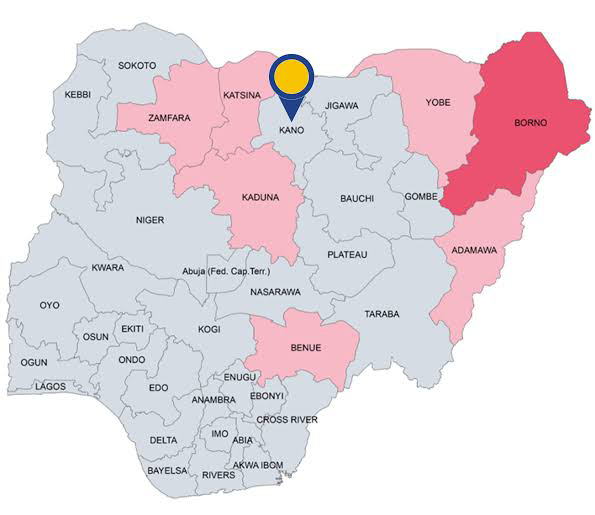
![Figure 2: Kano state map [6].](/fulltextimages/13073/fig_2.png)
Although the measles vaccination was initially administered in 1966, Nigeria included it into their regular immunization program for children as young as nine months old in 1978 [3]. Even with that advance, over 2000 cases of measles in 2019 (Table 1) and cholera cases in 2018 were among the most catastrophic outbreaks Kano state has witnessed in recent years [7]. Muhammad, et al. [8] reported 132 measles epidemic investigations that included measles IgM testing conducted in Karaye, Kano state, Nigeria. Results showed that none of the cohort’s individuals had received a prior vaccination. Though every country has its own unique approach to achieving Universal Health Coverage (UHC) and deciding what to cover based on the needs of the population and available resources, however, Nigeria, especially the Northern provinces, needs very systematic coverage tactics of immunization due to the country’s constantly growing population.
Consider the approach used, which appears to be rather promising, by the Emergency Operational Center on Polio Eradication (EOCPE) Kano State Office from 2008 to 2014.
There was a regional immunization program. Kano Central had a total vaccination coverage of 92%, Kano North had a total coverage of 91%, and Kano South had a total coverage of 104%. Over the course of the analysis, 95% of the children received vaccinations on average [9]. This implies that it is impossible to overstate the importance of creating new tactics, increasing vaccination frequency at fixed centers, and expanding the number of fixed centers to reach the nooks and crannies of the low-coverage areas in the local government’s target population.
Nas and his research team [10] conducted retrospective analysis on the measles occurrence in Kumbotso Local Government Area and revealed a finding that defies the previously held opinion. They extracted and examined 327 measles cases in total. Out of this, only nine percent (9%, 31 cases) had received all of the recommended vaccinations. Given that the majority of the individuals in the survey had not received a measles vaccination in the past, the researchers concluded their study with an urgent appeal to the health authorities to increase routine measles vaccination.
Due to reputable reports on probable cases of measles in the state, Kano state targeted 2.7 million children between the ages of nine and fifteen months for the measles vaccination slated for October to November 2019 [11]. This information was made public in late 2019. This came about as a result of the previous measles campaign that ended in November 2017 and fell short of the 95% nationwide coverage goal for children under five. The 484 political wards of the 44 local governments under the National Primary Health Care Development Agency (NPHCDA) witnessed a staggered implementation of the vaccination campaign.
| Diseases | 2015 | 2016 | 2017 | 2018 | 2019 |
|---|---|---|---|---|---|
| Measles | 0 | 11 | 0 | 0 | 2164 |
| LG affected | 0 | 5 | 0 | 0 | 42 |
| % of LG affected | 0% | 11.30% | 0% | 0% | 95% |
Table 1: Measles outbreaks in Kano State [12].
From the recent outbreak in March 2024 and challenges
The Kano Municipal Local Government Council has verified that there is a measles outbreak in certain areas of the Local Government Area (LGA). Sharada, Madatai, and Gandun Albasa were among the afflicted locations suspected in the council report. Nevertheless, the council demanded an immediate action to limit the illness, which had previously been referred for isolation to Murtala Muhammad Specialist Hospital in Kano [13].
The Nigerian Centre for Disease Control and Prevention, in coordination with other health officials, are advising parents and caregivers to make sure their children take the MMR vaccine in light of the concerning outbreak in Kano state. Fighting the widespread falsehood that these life-saving vaccines are dangerous, which leaves most parents divided between misgivings and concerns for their children’s safety, it’s not the first obstacle in Kano State’s epidemic preparedness efforts. In order to ensure that no child experiences the agony of the epidemic, the health body reorganized a camping group in various villages to raise vaccine awareness. This also prompted health officials to stay watchful and closely monitor the situation in order to implement necessary measures to control the spread of disease and upcoming outbreak [14].
Conclusion
In conclusion, Kano state still experiences periodic outbreaks of measles, particularly in children, despite significant advancements in vaccination. Routine vaccination campaigns should focus on educating and eradicating fear in order to get parents to take their children for routine vaccinations, rather than attempting mass vaccination campaigns in local government areas (LGAs), which have proven to yield less than favorable results.
References
-
Krawiec C, Hinson JW (2023) Rubeola (Measles). In: StatPearls. Treasure Island, Fin Land.
-
National Center of Disease Control (2023) Measles Situation Report.
-
World Health Organization (2024) Routine Immunization.
-
Medicins San Frontiers (2024) Management of Measles Epidemic. 2013th (Edn.), pp: 315.
-
Minta AA, Ferrari M, Antoni S, Portnoy A, Sbarra A, et al. (2023) Progress Toward Measles Elimination Worldwide, 2000-2002. Morbidity and Mortal Weekly Report 72(46): 1262-1268.
-
Doris DS (2022) Nigeria: Cities with largest population statista.
-
(2020) Kano State Epidemic Preparedness Funding Health and Disease Control.
-
Muhammad BL, Bala H, Bawa M (2013) Measles Outbreak Investigation in Karaye, Kano state, Nigeria, March 2013. Pan American Journal Conference Proceedings.
-
Bello Z, Yusuf MA, Abdulkarim IA (2022) Measles Immunization Coverage in Kano State. Gombe Journal of Geography and Environmental Studies.
-
Nas FS, Ali M, Yahaya A (2018) Retrospective study on Incidence of Measles in Kumbotso, Kano Northern Nigeria. Virology and Immunology Journal 2(6): 1-6.
-
Vanguard Media Limited (2019) Kano state target 2.7million children in measles campaign.
-
(2024) NCDC Measles Situation Report, Serial Number 03, Data as at March 31st 2024. Relief Web.
-
Bello B (2024) Kano Records Measles outbreak-Official. Vanguard Media Limited.
-
Salihu S (2013) Kano state Battle: Gaps and challenges amid Diphtheria’s Toll. National Center of Disease Control.
- Update on Malariology and Malaria Vaccines
- Addressing Vaccine Hesitancy in the Age of Measles Resurgence: A Mini-Review
- Exploring Barriers and Facilitators of Group Antenatal Care Implementation in Kaduna State, Nigeria: A Qualitative Evaluation
- The Role of IL-11 in Regenerative Medicine and Tissue Engineering
- New Prediction of Mortality rate of Covid -19 According to WHO Estimation
- Potentiality of Mushrooms as Edible Vaccines