
Antero Inferior Iliac Spine Fracture in Athletic Boy: A Case Report
Avulsion fractures of the processes of the Antero Inferior Iliac Spine are rare in daily medical practice. The clinical case of a 14-year-old male patient was presented, a high-performance baseball athlete less than 15 years of age, who during a training race from home to first base felt strong pain in the left inguinal region that caused absolute functional impotence. He was treated in the orthopedic guard corps and an X-ray of the pelvis bone, ECOSOMA and CT was performed, diagnosing a fracture due to pulling of the Antero Inferior Iliac Spine. The injury was treated conservatively with rest, knee in semi-flexion and the administration of NSAIDs orally; consolidation of the fracture was achieved after two months. He underwent physiotherapy rehabilitation for another two months. Six months after the injury occurred, the patient achieved his incorporation back to daily sports practice without loss of sports performance.
Introduction
Avulsion fractures of the pelvic processes and specifically that of the Antero Inferior Iliac Spine (IAIS) is a rare trauma in daily medical practice. This injury occurs more frequently in sports that involve forced extension mechanisms such as football, rugby and martial arts [1, 2]. During the practice of physical activities, whether recreational or sports, the avulsion fracture of the EIAI can occur as a result of an abrupt and strong contraction of the muscle tendon junction of the rectus femoris muscle, one of the components of the quadriceps muscle that, when interacting on this process, not yet definitively fused to the pelvis, produces a tear or fracture of this anatomical structure [3]. They have a higher incidence in young sports patients, typically between 15 and
30 years of age, and predominate in males [4]. The objective of this article is to present a clinical case of a 14-year-old adolescent who presented this injury while playing baseball and to present the procedures that were carried out to reach the diagnosis as well as the treatment applied to cure it.
Clinical Case
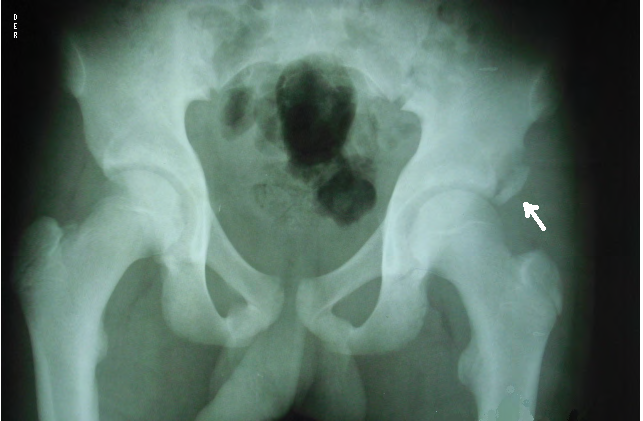
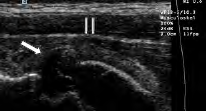
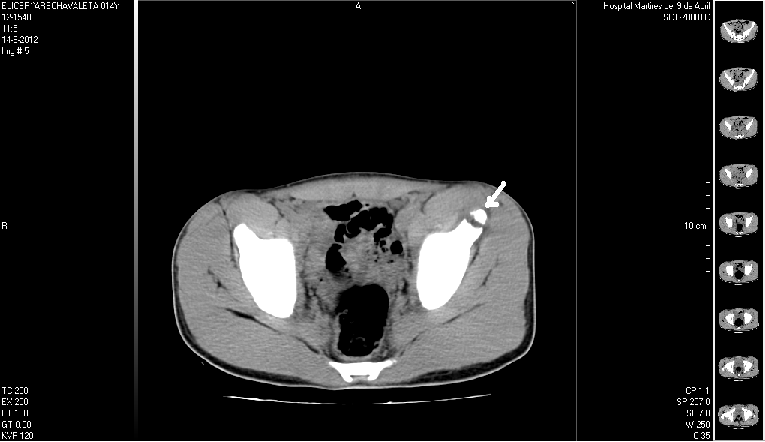
14-year-old male patient, black race, baseball athlete of the under 15 category, who while training in his sports area, in a race from home plate to first base, felt strong pain in the left inguinal region, which prevented him from completing the exercise he was doing, assisted by his teacher and teammates, he was brought on a stretcher to the hospital guard body. In the physical examination carried out, a patient was observed in a forced supine position with semi-flexion of the hip and left knee, who complained of intense pain in the inguinal region, which increased with the mobilization of the left hip, it was found discreet inflammation of the upper third of the thigh and exquisite pain increased when palpating the middle third of the left inguinal crease, there was no evidence of hematoma or ecchymosis in the explored region. A bony pelvic X-ray was performed urgently (Figure 1) showing a fracture due to the EIAI. With the diagnosis made, the patient was admitted with the indications of absolute rest with semiflexion of the hip and left knee, as well as the administration of NSAIDs orally. 24 hours later, an ECOSOME was performed (Figure 2) where the bone continuity solution was observed with a hematoma around the lesion, given the scientific interest of the case, a pelvic CT scan was performed where the findings in the previous ones were corroborated exams (Figure 3).
Conservative treatment of the injury is decided by means of absolute rest with the limb in semi-flexion of the hip and knee, use of NSAIDs and cryotherapy according to the intensity of the pain. 72 hours after the conservative treatment of the lesion was decided, he was discharged with follow-up at home. Two months later, evidence of fracture healing was found and progressive partial support and simple flexion-extension exercises of the knee and hip of the affected limb were indicated. Four months after the injury, he began walking without crutches and, given the evidence of atrophy of the quadriceps muscle of the affected limb of one centimeter in circumference, an energetic program of rehabilitation of the quadriceps muscle was undertaken in the physiotherapy department, which culminated in the sixth month after it occurred the injury. The patient returned to sports practice under the strict supervision of his teacher with progressive loads of physical activity, finding himself at the peak of sports faculties and without any discomfort.
Discussion
In the last decades, the practice of competitive sport in children and adolescents has steadily increased. The time and intensity of physical activity has increased. This has led to an increase in the incidence of sports-related acute and subacute musculoskeletal injuries in children and adolescents [5]. Adolescents are in the process of skeletal maturation, and muscles, tendons and ligaments are able to resist more force than bone because the weakest structure is the growth plate or physis [6]. Injuries to the pelvic processes typically occur in growing adolescents who participate in sports activities [5, 6]. Avulsion fractures of the EIAI are less common than other pelvic avulsions [1, 2], with an incidence of 14.8-22.1% of the set of avulsion fractures in the pelvis in young athletes. They are more frequent in men between 14 and 23 years of age, and are associated with trauma, overuse of the hip or sudden contractions of the rectus femoris muscle [1, 5]. The case presented agrees with the above, as it is a 14-year-old adolescent who was doing a race in which sudden contractions of the muscles of the lower limbs oc.
Authors consulted state that sports such as soccer, rugby and American football contribute a good amount of these injuries (1.7), as well as martial arts [1], however, no report was found in the reviewed literature in baseball players with this type of injury. They are generally produced by a sudden and violent contraction of the muscle inserted in the involved process [7, 8]. The most common avulsion fractures in the pelvis occur in the ischial tuberosity, followed by the anterior superior iliac spine, then the anteroinferior iliac spine, with less frequent avulsions of the lesser trochanter and iliac crest being less frequent [7]. However in other studies with a cohort of patients with apophyseal avulsion fracture it has been found that the most frequently injured process was the anteroinferior iliac spine [5, 6, 9]. The case presented undertook a run from home plate to first base and the violent contraction of the rectus femoris muscle of the quadriceps in a skeletally immature pelvis caused the EIAI to be torn off. Clinically, these injuries manifest with pain in the groin or in the anterior region of the hip when the patient performs forced flexion or sustained flexion movements, and is aggravated in certain sports activities [4]. In the case presented, the patient felt severe pain in the left inguinal region, which prevented him from continuing the career he was doing.
The diagnosis of these fractures has improved with advances in imaging tests. Techniques such as ultrasounds, computed tomography or magnetic resonance imaging have allowed its better evaluation and management [6, 8]. In the patient studied, the diagnosis was made by the bone pelvic X-ray where a fracture of the EIAI was observed due to pulling, which was corroborated by the ECOSOMA and the pelvic CT. The therapeutic success of these injuries depends on a correct diagnosis, and adequate treatment and rehabilitation [6, 8]. The traumatic avulsion of the EIAI has a good response to conservative treatment [4, 8]. Which is consistent with the case presented clinical. Conclusions Avulsion fracture of the anterior inferior iliac spine is a rare injury but should be taken into account when intense pain appears in the inguinal region when performing an activity or sports practice. A timely diagnosis helps to achieve full recovery of the patient.
References
-
Matellanes Palacios C, Estrems Díaz V, Diranzo García J, Moratalla De Gracia R, Hernández Ferrando L, et al. (2018) Choque extraarticular de cadera secundario a consolidación viciosa tras fractura-avulsión de la espina ilíaca antero inferior: A propósito de un caso. Revista Española de Cirugía Osteoarticular 53(275): 126-130.
-
Patrick Carton DF (2016) Anterior Inferior Iliac Spine (AIIS) and Sobspine Hip Impingement. Muscles, Ligaments and Tendons Journal 6(3): 324-336.
-
Atalar H, Kayaoğlu E, Yavuz OY, Selek H, Uraş I (2007) Avulsion fracture of the anterior inferior iliacspine. Ulus Travma Acil Cerrahi Derg 13(4): 322-325.
-
Galeano NA, Guinea NS, Molinero JG, Bárez MG (2018) Atrapamientos y choques extraarticulares de la cadera: revisión de la literatura. Radiología 60(2): 105-118.
-
Hernán Guzmán P (2012) Lesiones deportivas en niños y adolescentes. Rev Med Clin Condes 23(3): 267-273.
-
Segura D, Mínguez M, Pino L (2016) Lesiones óseas por tracción: a propósito de un caso. Osteoarticular 51(268): 180-187.
-
Brunicardi Hurtado RA, Delgado Montañez LF (2016) Fractura de pelvis en niños. Repert Med Cir 25(3): 173- 173
-
Álvarez Zallo N, Andueza Sola J, García Blanco L, Ruiz Goikoetxea M, Brun Sánchez M, et al. (2016) Fractura- avulsión de la espina iliaca anterosuperior en un adolescente deportista. A propósito de un caso. Acta Pediatr Esp. 74(2): e37-e40.
-
Schuett DJ, Bomar JD, Pennock AT (2015) Pelvic apophyseal avulsion fractures: a retrospective review of 228 cases. J Pediatr Orthop 35(6): 617-623.
- Origin, Evolution, and Functional Impact of Short Insertion- Deletion Variants in Human Genomes: A Review
- Harnessing Molecular Glues for Next-Generation Vaccine, Cancer and Cardiovascular Disease Drug Development: A Comprehensive Review
- Lateral Cervical Epidermal Inclusion Cyst in a Paediatric Patient: A Rare Case Report
- Malarial Plasmodium Falciparum with Hepatitis B and C Virus Infections among Blood Donors in Ife Central Local Government Area, Ile Ife, Osun State, Nigeria
- Withanolides and Withaferin A- What’s next in Ashwagandha Research
- Designing of Dual Pulse Photoacoustic Tomography for Imaging of Drug-Response and Tumor Growth