
Creative Contributions of the Methods of a Biomimetic Inventive Design of Novel Medical Drainage Materials Derived From Polyvinyl Alcohol Foam with Air Cavities Bioinspired by Avian Skeleton and Feather Rachises
Traditional drainage materials used in a surgical treatment or in wound management are not good enough in both the effectiveness and efficiency because they may cause infection due to their characteristics. Therefore, a novel drainage material should be essential and designed to solve the problem. Avian skeleton and feather rachises may be good reference objects to mimic in designing a novel drainage material because its good cell structure which support a bird to fly safe and efficient. The term “nature-Bioinspired” is associated with a sequence of efforts to understand, synthesize and imitate any natural object or phenomenon either in a tangible or intangible form, which allows us to obtain improved insights into nature. Such inspirations can come through materials, processes, or designs. In this study, a new medical matrix derived from polyvinyl alcohol foam with air cavities inspired by avian skeleton and feather rachises for drainage medical treatments was designed, prepared, and characterized. Establishment of biomimetic biomedical inventive principles and a bio-inspired design-thinking method for innovative design of biomimetic medical devices and biomaterials were achieved. Also, the medical device (MD) unified problem-driven bioinspired evaluating approach was established to guide biomimetic design of biomaterials and the corresponding medical devices for various clinic applications.
Introduction
To solve the problems of occurring infection in a traditional surgery or in a wound care, designs of new medical devices with high-support drainage materials could have to be developed and applied to new treatment procedures instead of the traditional ones. Selections of suitable materials for biomedical and clinical applications such as polyvinyl alcohol, polyelectrolyte, polycarboxybetaine, polysulfobetaine, polyurethane, polynorbornene, polyester, polymethacrylate, natural polymer, and polymeric resins could be substantially considered and further employed [1, 2, 3, 4, 5, 6]. The surface modification could be considered to change the surface characteristic and microenvironment of materials for specific clinical demands [7, 8]. High permeability of protecting medical matrix such as polyurethane matrix or non-woven matrix could be employed for the clinical application of masks. However, polyurethane or non-woven medical matrix showed poor tissue anti-adhesion property, which would be a clinical risk for wound managements. In contrast, polyvinyl alcohol showed good results of clinical applications because of its good cell structure tissue anti- adhesion property and high permeability no matter whether the matrix is in dry state or in wet state [9, 10, 11, 12, 13, 14].
Bioinspired solutions for the delivery of drugs and therapeutics would also be considered. With a strong focus on therapeutic and diagnostic applications, the characteristics and effectiveness’s of bioinspired materials for medical or regenerative applications examines the inspirations from natural materials and their interpretations as modern biomaterials [15, 16]. Further, a evaluation of bioinspired design is necessary. The concept of fingerprint region such as the 1450 - 500 cm-1 range of an infrared spectrum called the fingerprint region would be useful to identify the new materials because this region of the spectrum (like a human fingerprint) is almost unique for any given compound [17]. Apart from the significant differences in the fingerprint region, there were no other big striking differences, and each difference could be identified from its spectrum. Similarly, the different spectrums could be considered to establish fingerprint evaluation system for specific identification.
In this study, a novel medical drainage material with supporting matrix and/or struts made of polyvinyl alcohol foam with air cavities inspired by avian skeleton and feather rachises for drainage medical treatment was designed. For the traditional clinical applications of drainage medical materials, the physico-chemical properties such as hygroscopicity and structural stability were limited, therefore the medical drainage material with highly porous structure would be fabricated via a designed forming process.
Also, the microstructures and thermal properties of the drainage medical materials are important. A series of drainage medical materials were prepared by using various manufacturing procedures such as traditional foaming process and bioimmic foaming process. The drainage medical materials with different microstructures were obtained. The resulting polymeric drainage medical materials would be studied and characterized by Fourier transform infrared spectroscopy (FTIR), thermo-gravimetric analysis (TGA), and scanning electron microscope (SEM) to obtain the information of identifications, thermal stabilities, and microstructures.
Lastly medical device (MD) unified problem-driven bioinspired evaluating approach was applied to evaluate effectiveness and efficacy of the new drainage medical device.
Experimental
Materials
Commercial polyvinyl alcohol (BF-17) with averaged polymerization degree of 1700 and hydrolysis degree of 98.5– 99.2 mol % were obtained from Chang-Chun Petrochemical Co., Ltd, Taiwan [8].
Preparation of Polyvinyl Alcohol Foam (PVAF) by Using two Traditional Foaming Process and a Super Clean Bioimmic Air-Foaming Process
Polyvinyl alcohol foam (PVAF) is synthesized with polyvinyl alcohol (PVA) and formaldehyde [8, 9, 10, 11, 12, 13, 14]. A novel polyvinyl alcohol foam (PVAF) with fully open cells and channels was designed by using a super clean bioimmic air- foaming process [8, 9, 10, 11, 12, 13, 14]. Two traditional foaming process of polyvinyl alcohol foam, starch-foaming process and air- assisted starch-foaming process were employed to prepare the corresponding control samples as listed in Table 1.
| Traditional designs | Bioimmic design | ||
|---|---|---|---|
| Starch foaming process | Air-assisted starch foaming process | Super-clean air-foaming process | |
| Addition of starch | +a) | + a) | - a) |
| Introduction of air | - a) | + a) | + a) |
| Resulting soft medical drainage material | SF-PVAFb) | ASF-PVAFc) | SCAF AF-PVAFd |
Table 1: Design and preparation of a series of new soft medical drainage materials.
a)”+”means the procedure was employed and “-” means the procedure was not employed. b)SF-PVAF: Starch foaming polyvinyl alcohol foam as a soft medical drainage material c) ASF-PVAF: Air-assisted starch foaming polyvinyl alcohol foam as a soft medical drainage material d) SCAF-PVAF: Super-clean air- foaming polyvinyl alcohol foam as a soft medical drainage material Table 1: Design and preparation of a series of new soft medical drainage materials.
For preparing traditional designs of soft medical drainage materials by using starch-foaming process [8], a dispersion of 1 g of starch in 10 mL of water was first added to 50 mL of an aqueous solution containing 10 g of PVA. The resulting mixture was heated up to 95oC (above gel point of starch) for 45 min while being stirred to obtain a pasty mixed solution. The mixed solution was then cooled to 85oC and 50 mL of an aqueous mixture containing 90 mL of 24 wt % formaldehyde solution and 5 mL of 50 wt % sulfuric acid was added and stirred. The starch-foaming PVA (SF- PVAF) was obtained. Each of the above reaction solutions was finally introduced to a hard plastic rectangular vessel with a dimension of 15 cmx20 cm and 5 cm in height. These vessels were then put in a temperature-controlled oven to carry out the acetalization reaction at 60oC for 8 hours. The resulting samples of porous PVF foam were washed thoroughly with water to remove the remaining sulfuric acid and formaldehyde. In order to investigate the effect of the air contents by using air-assisted starch foaming process, the air was introduced into the a pasty mixed solution and vigorous stirred before the next step of acetalization reaction. An air- assisted starch foaming polyvinyl alcohol foam ASF-PVAF was obtained [8]. Furthermore, the bioimmic design of soft medical drainage material could be prepared without starch [9, 10, 11, 12, 13, 14]. A series of polyvinyl alcohol foam materials, such as bioimmic SCAF-PVAF, traditional SF-PVAF, and traditional ASF-PVAF, were prepared. Polyvinyl alcohol foam (PVAF) could be considered as a good drainage medical material for surgical treatments and wound management because of its properties of anti-adhesion and high-adsorption.
Instruments
Morphology and characteristics of the resulting polyvinyl alcohol foam (PVAF) were determined by using Fourier transform infrared spectroscopy (FTIR, Spectrum GX, USA) and Scanning electron microscopy(SEM, JSM 6700F, Japan). Polyvinyl alcohol foam (PVAF) was analyzed by FTIR spectroscopy (NICOLET iS50, Thermo Scientific, USA). Transmittance values were recorded in the spectral region from 500 cm-1 to 4000 cm-1 and a resolution of 4 cm-1 over 32 scans. The thermal degradation behavior of polyvinyl alcohol foam (PVAF) was recognized as the temperature at the maximum peak. Determination of the samples’ changes in both quality and quantity was analyzed by TGA. TGA analysis is a technique for measuring the relationship between the mass of a substance and the temperature under a temperature control program. TGA was carried out from room temperature to 550oC under nitrogen atmosphere. Samples of approximately 3–5 mg were placed in an alumina pot at a heating rate of 20oC/min. The thermal transition behaviors of the resulting polyvinyl alcohol foam (PVAF) and starch samples were determined by Differential Scanning Calorimeter model Schimadzu DSC-50 (Kyoto, Japan) from
30˚C to 200˚C. A heating rate of 10˚C/min was used under nitrogen atmosphere and at a flow rate of 30 mL/min.
Results and Discussion
Medical Device (MD) Unified Problem-Driven Bioinspired Evaluating Approach and New Biomimetic Design of Soft Medical Drainage Materials
For design of medical device, several clinical issues must be considered such as clinical needs, restricted clinical problem analysis, abstracting technical problems, preclinical evaluation of designs, clinical risk evaluation of designs, and tests for safety and effectiveness. A suitable evaluating approach containing natural strategies and clinical needs must be established. For biomimetic design of medical device, a specific evaluating approach containing biomimetic natural elements should be established. The biomimetic natural elements must be considered in the design thinking process including abstracting technical problems and transposing to nature, identifying potential natural models, selecting natural model of interest, abstracting natural strategies, and transposing to technology. In this study, a new medical device (MD) unified problem-bioinspired evaluating approach combined the clinical issues with biomimetic natural elements was established. The design thinking elements of medical device, which contain clinical needs, analyzing restricted clinical problem, abstracting technical problems, transposing to nature, identifying potential natural models, selecting natural model of interest, abstracting natural strategies, preclinical evaluation of designs, transposing to technology, clinical risk evaluation of designs, and the implementation and tests for safety and effectiveness, were considered in order as shown in Figure 2.
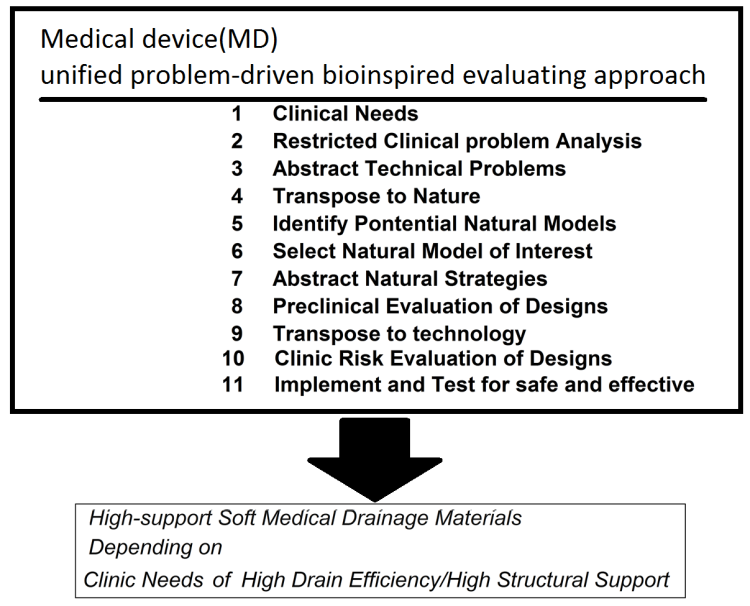
Further, the medical device (MD) unified problem-driven bioinspired evaluating approach was employed to the design of a high-support soft medical drainage material satisfying clinical needs of high draining efficiency and structural support for clinical applications of surgical drainage and negative pressure drainage system. The structural support would be the most important factor to provide the soft medical drainage material or drainage system with effectiveness, efficiency and safety. In particular, the soft medical drainage material was employed under negative pressure or muscle contraction of vagina, nasal cavity, and anus.
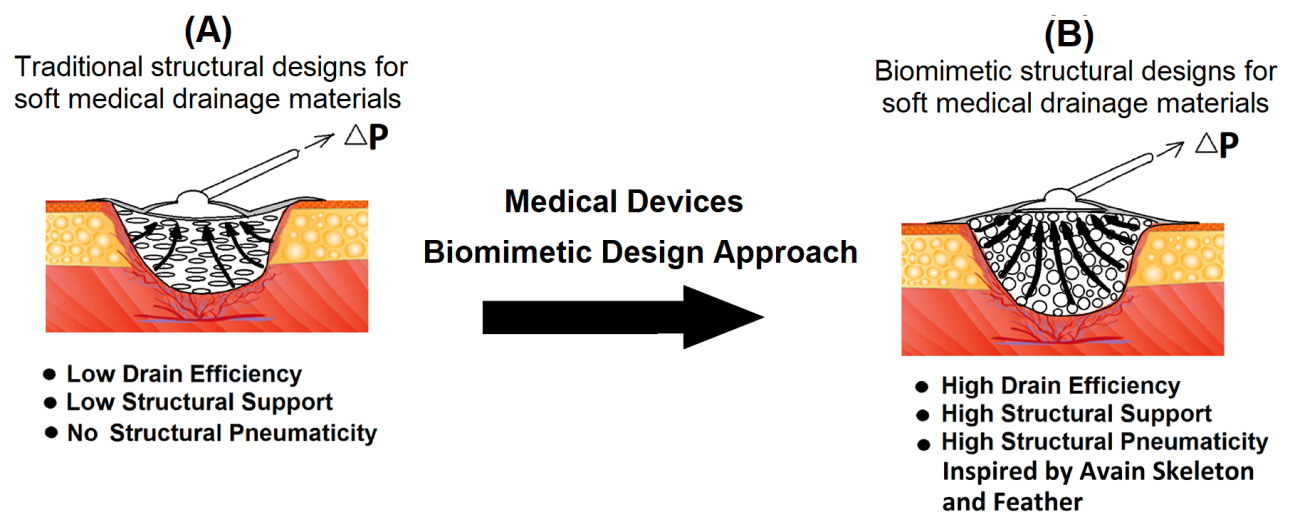
For design of a high-support soft medical drainage material, step 1 of clinical needs and step 2 of analyzing restricted clinical problem in the medical device (MD) unified problem-driven bioinspired evaluating approach must be considered. Traditional structural designs for medical devices/materials could only provide low draining efficiency and low structural support in clinical applications as shown in Figure 3A. High draining efficiency and high structural support are both clinical needs and restricted clinical problems for soft medical drainage materials in clinical applications. To overcome the problems, step 3 of abstracting technical problems was considered. Enhancing pore size, establishing open-cell miscrostructure, and building up the structural-supporting cavities would be the key technical problems. Following steps 4-7 as shown in Figure 2, the biomimetic soft materials with air cavities inspired by avian skeleton and feather rachises could be considered to build up fully open-cell miscrostructure and structural-supporting cavities to provide high structural pneumaticity. Traditional structural designs for medical devices/materials were prepared by using traditional starch foaming process and traditional air-assisted starch foaming process as Table 1. The addition of starch would be harmful to the cleanliness of the resulting soft medical drainage material containing residual starch. The residual starch would be hydrolysis with an increasing temperature. Also, the residual starch would enhance risks of occurring infection in clinical applications and risks of pollution in storage system.
For a clinical application, pre-clinic evaluation was carried to check the clinical risk, the safety the effectiveness and the efficiency of the resulting biomimetic design of soft medical drainage materials as following steps 8~11 shown in Figure 2. A new high-support soft medical drainage material was designed and obtained to satisfy clinical needs of high drain efficiency and high structural support in clinical applications of surgical drainage and negative pressure drainage system as shown in Figure 3B.
Identification of the New Biomimetic Design of Soft Medical Drainage Materials by Using Microstructural Morphological, Optical Fingerprint and Thermal Fingerprint Evaluations
A new high-support soft medical drainage material was designed and prepared to provide specific properties of high drain efficiency and high structural support for clinical applications of surgical drainage and negative pressure drainage system. The evaluated method must be further established to identify the materials with the biomimetic design of soft medical drainage materials. The microstructural morphological, optical fingerprint and thermal fingerprint evaluations were established by using SEM, FTIR, TGA and DSC, respectively.
Microstructural-Morphological Evaluations of New Biomimetic Design of Soft Medical Drainage Materials and the Corresponding Air Cavities Inspired by Avian Skeleton and Feather Rachises
Millions of years of biological evolution have brought effective materials and structures that are sources of inspiration to engineers. For biomimetic design of high support soft medical drainage materials, the microstructure of avian skeleton and feather rachises could be considered because some matrixes in feather microstructure were arranged in intricate ways to achieve specific combinations of stiffness and strength on the one hand and flexibility and elasticity on the other. This includes different foam-like structures as shown in Figure 4 [15]. In fact, the foam wall was observed not only in the avian feather but also in avian bone which would exhibit porosity, form a ‘‘foam-in-a-foam’’ microstructure and provide internal reinforcements [16].
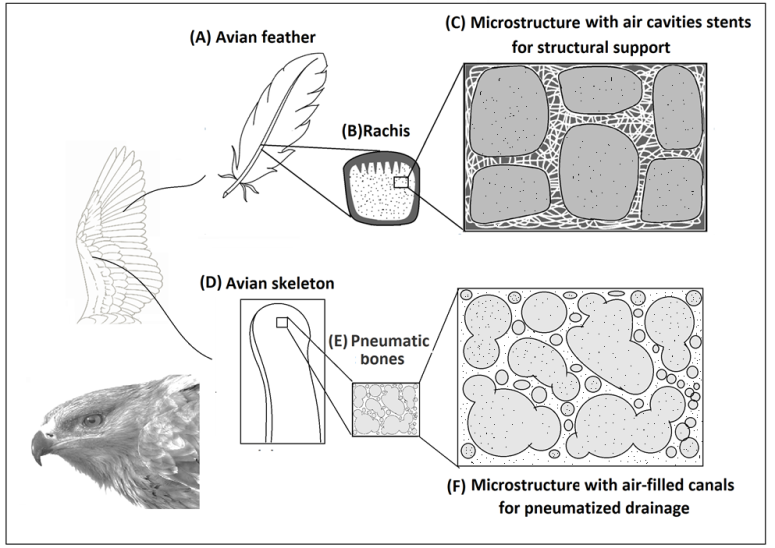
The traditional designs of medical drainage materials of polyvinyl alcohol foams were prepared by traditional starch foaming process or air-assisted starch foaming process. The medical drainage materials with fully open-cell microstructure could not be obtained. It is difficult to form air cavities to enhance draining efficiency and structural supporting strength because of the foaming process using starch as a foaming agent. To build up the stable air cavities, foam walls, and structural pneumaticity inspired by avian skeleton and feather rachises, the introduction of clean atmospheric flow in the foaming process of polyvinyl alcohol foams are important. The traditional starch foaming process or air-assisted starch foaming process could not provide enough driving force to form atmospheric flow which could promote formation of air cavities, foam walls, and structural pneumaticity. New biomimetic design of high support soft medical drainage materials with air cavities inspired by avian skeleton and feather rachises was obtained.
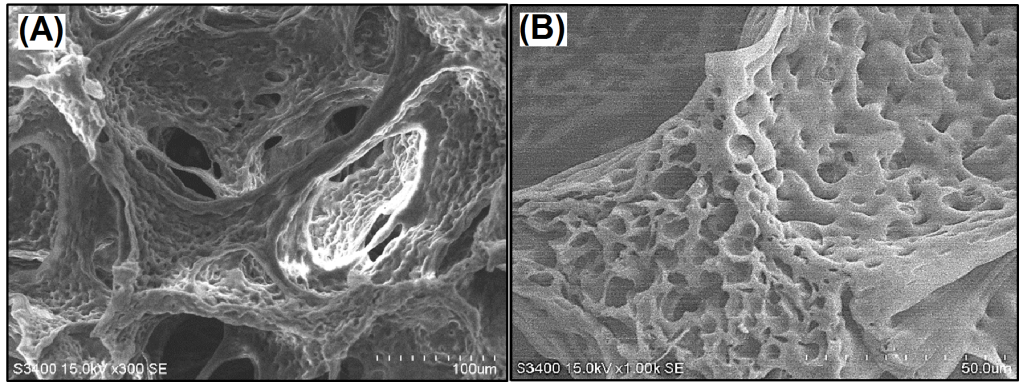
Furthermore, a microstructural-morphological evaluation of the resulting high support soft medical drainage material was carried by using SEM as shown in Figure 5. The resulting high support soft medical drainage material exhibited spongy structure with fully open-cell interconnecting porous network. Highly irregular and deformed macroporous structure with ≈100–150μm pore diameter was shown in Figure 5A. The foam walls with 3-10μm pore diameter were observed in Figure 5B.
Also, microstructural-morphological evaluations of the resulting traditional soft medical drainage materials, which were prepared by using traditional starch foaming process or air-assisted starch foaming process, were carried out as shown in Figure 6. The morphologies with fully closed-cell microstructure and partially-open cell microstructure were observed in SEM images of the resulting traditional starch- foaming soft medical drainage material and traditional air- assisted starch-foaming soft medical drainage material, respectively. Although the traditional air-assisted starch- foaming soft medical drainage material could provide partially-open cell microstructure, the partially-open cell microstructure would form a compacted structure with a weak structural support. The weak structural support would enhance the risk of clinical application and therapy, particularly, the treatment was carried out under pressure. Of course, the fully closed-cell microstructure could even provide a quite weak structural support which would seriously block and damage the clinical drainage during treatment and therapy.
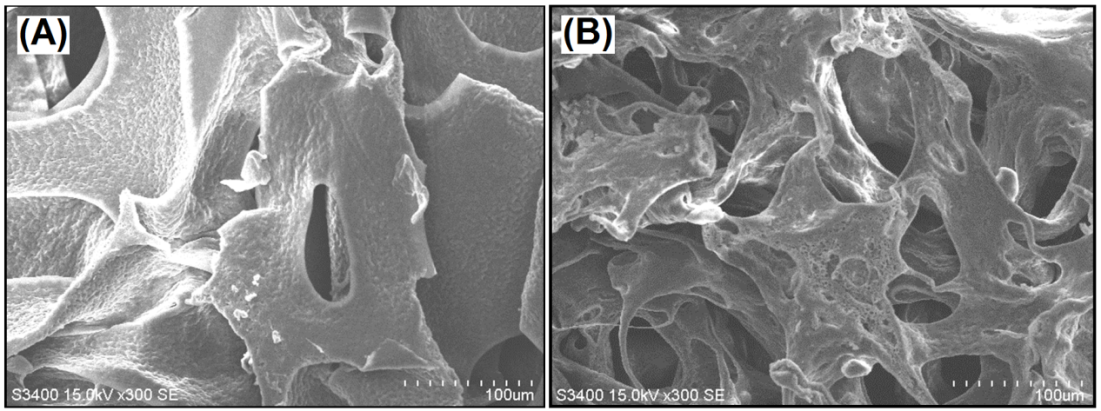
In this study, the microstructural morphological evaluations could identify the biomimetic design of high support soft medical drainage materials effectively. The high- support fully open cell microstructure with stable air cavities, foam walls, and structural pneumaticity of biomimetic high support soft medical drainage materials were observed and identified remarkably.
Optical Fingerprint Evaluations of New Biomimetic Design of Soft Medical Drainage Materials
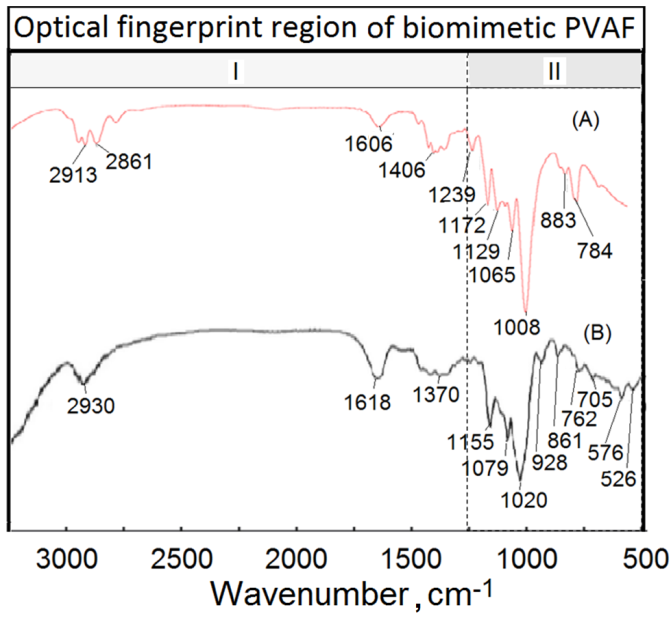
In this study, a novel biomimetic high support soft medical drainage materials derived from polyvinyl alcohol foam (PVAF) for drainage treatment was designed and prepared. A suitable optical-fingerprint evaluations of the resulting biomimetic design of soft medical drainage materials must be established. FTIR spectrum was employed to evaluate the optical-fingerprint. The high support soft medical drainage materials were derived from polyvinyl alcohol foam containing crosslinked polyvinyl alcohol molecules (Scheme 2). The molecular structure of PVAF was characterized by FTIR. The peaks at 3500-3400cm−1 are the -OH stretching vibration bands, which were weakened and shifted towards higher frequencies due to the cleavage of the intra- and intermolecular hydrogen bonding after acetalization which indicated the consumption of -OH (due to condensation reaction between PVA and formaldehyde) during the preparation of the PVA foams. The symmetric stretching vibrations of the alkyl CH2 absorption band appeared at 2952, 2913, 2861, and 2675 cm−1. The new peaks at 1008- 1239 cm−1 belongs to C-O-C formed during the condensation reaction process, typical of PVA foam [17, 18, 19, 20, 21]. The bands at 1239, 1172, 1129, 1065, and 1008 cm−1 are ascribed to -C-O- C-O-C- stretching vibrations while the C-O-C stretching was detected at 1008 cm−1, which confirm the formation of a formal structure as shown in Figure 6 and Table 2 [19, 22, 23]. The bands at 1239 and 1065 cm-1 would be attributed to the stretching vibration of C-O in C-O-H groups. Curving vibrations of -OH were also found at 942 cm−1. In addition Tao, et al. reported that five distinctive absorption bands at 1449, 1328, 1088, 836, and 610 cm−1 corresponding to C-H and O-H in-plane bending, C-O stretching, and C-H and O-H out-of-plane bending vibrations, respectively, were observed in the FTIR spectrum of the PVAF [24].
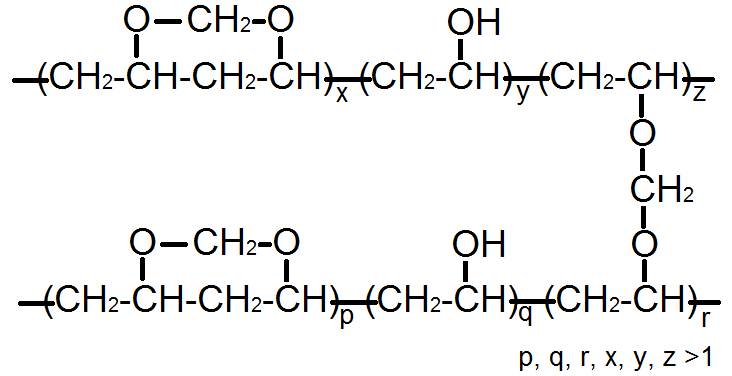
Scheme 2: The chemical structure of crosslinked polyvinyl alcohol molecules.
That is, a new optical-fingerprint evaluation combining regions I and fingerprint region II could be designed and employed to identify the purity and molecular structure of novel high support soft medical drainage materials containing biomimetic PVAF structure as shown in Figure 6. From the region I, peaks at 2913 cm-1~2861 cm-1 indicating –C-H stretching vibration were observed for identification of polyvinyl alcohol foam (PVAF). The fingerprint region II of new biomimetic design of soft medical drainage materials could identify the biomimetic super-clean air-foaming process different from those of traditional starch-foaming and ais-assisted starch-foaming. Apart from the significant differences in the fingerprint region II at wavenumbers 1400 to 400 cm-1, there were no other big striking differences, and each could be identified by its infrared spectrum. All the absorption bands exist in typical molecules containing saturated alkyl structure of PVAF. There were no remarkably characteristic infrared absorptions due to a specific functional group. Also, different kinds of starch showed similar spectra below 1000 cm-1, which is the fingerprint region of starch. This region exhibited the complex vibration mode due to the skeletal mode vibration of glucose pyranose ring as listed in Table 2.
Hence, the formation of biomimetic PVAF structure and residue of starch from traditional starch-foaming process could be easily identified by fingerprint region I and fingerprint region II of optical-fingerprint evaluations. The presence of absorption band at around 3300-3600, ~2900, ~1150, and 1000-1100 cm-1 in the Table 2 indicated that all kinds of starch possess an -OH, C-H, C-O-C, and C-O functional group, respectively. The C-O bending associated with the OH group would cause an absorbance peak at around 1648 cm-1. A band around 2925 cm 1 corresponding to the C–H stretching; [25] vibrational bands in the region of 1400–1300 cm 1 attributed to C–H bending and deformation; [26] 1150 cm 1 is related to vibrations of the glucosidic C–O–C bond [27]. The bands at 1080 and 1020 cm 1 are characteristics of the anhydroglucose ring O–C stretch [28]. The absorbance band at 925 cm-1 is assigned to vibrational modes of a skeletal glycoside bonds [27]. In addition, the characteristic C-O-C ring vibration on starch led to an absorbance peak at around 700-900 cm-1. The absorbance bands below 800 cm-1 were related to skeletal mode vibrations of the glucose pyranose ring [29]. Starch of corn, cassava, and potato showed similar results of absorption bands [30].
Before foaming process, the main peaks of pure PVA observed at 3280, 2917, 1425, 1324, and 839 cm−1 were also listed in Table 2. These peaks were assigned to the O-H stretching vibration of the hydroxy group, CH2 asymmetric stretching vibration, C-H bending vibration of CH2, C-H deformation vibration, and C-C stretching vibration, accordingly [31, 32, 33] (Figure 7).
| Assignment | Wavenumber, cm−1 (in literature) a) | Corn Starch a) | Cassava Starch a) | Potato Starch a) | Traditional | Bioimmic | ||
|---|---|---|---|---|---|---|---|---|
| SF-PVAFb) | ASF-PVAFb) | SCAF- PVAFb) | ||||||
| Starch | OH stretching | 3300-3600[29] | 3448 [29] | 3448 [29] | 3523 [29] | 3300-3600 | 3450 | |
| CH stretching | 2931[29] | 2929 [29] | 2930 [29] | 2927 [29] | 2935 | 2933 | ||
| C-O bending associated with -OH group(starch) | 1647[29] | 1647 [29] | 1646 [29] | 1645 [29] | 1648 | 1646 | ||
| CH symmetric 2 deformation | 1458[29] | 1437 [29] | 1437 [29] | 1437 [29] | 1437 | 1435 | ||
| CH symmetric 2 scissoring | 1415[29] | 1415 [29] | 1417 [29] | 1419 [29] | 1417 | 1417 | ||
| -CH symmetric bending | 1375-1385[29] | 1381 [29] | 1381 [29] | 1381 [29] | 1381 | 1382 | ||
| C-O-C asymmetric stretching | 1149[29] | 1157 [29] | 1157 [29] | 1157 [29] | 1172 | 1171 | ||
| C-O stretching/ | 800-1200 [29] | 993, 1027 | 993, 1018 | 993, 1027 | 995, 1012, | 860, 921 | ||
| anhydroglucose ring O–C stretching | (1020, 1079, 1155 [33, 34]) | 1067, 1136 [29] | 1130, 1171 [29] | 1067, 1136 [29] | 1087, 1151 | 10, 261, 121 | ||
| (937, 1023, 1116, 1162 [35-37]) | ||||||||
| glycosidic linkages and C–O–C stretch | 990(90-950[34]) | 993 [29] | 993 [29] | 993 [29] | 995 | 921 | ||
| C-O-C ring vibration of carbohydrate | 590, 758, 856, 920 [29] | 590, 763 | 590, 763 | 590, 763 | 590, 783 | 590, 793 | ||
| 860, 929 [29] | 860, 929 [29] | 858, 29 [29] | 860, 834, 935 | 860, 836, 935 | ||||
| PVA | C-C stretching vibration | 839[38, 39] | ||||||
| C-O stretching vibration | 1086 (1081[38, 39]) | - | - | - | 1091 | 1096 | ||
| CH deformation | 1324[38, 39] | |||||||
| CH bending 2 | 1430[38, 39] | |||||||
| CH and CH stretching 2 vibration | 2858-2943[38, 39] | - | - | - | 2861-2950 | 2865-2950 | 2861-2950 | |
| PVAF | C-O-C ring vibration formed by the crosslinking reaction | 833, 734[40] | 860, 836, 739 | 860, 836, 739 | 833, 734 | |||
| ether (C-O) and acetal ring (C-O-C) bands formed by the crosslinking reaction | 1000-1140[40] | 1007-1171 | 1008-1171 | 1008-1172 | ||||
| -C-O-C-O-C- stretching vibrations | 1060-1160 | - | - | - | 1067, 1091, | 1096, 1129, | 1065, 1129, | |
| (1251, 1165, 1128, 1079[41]) | 1171, 1238 | 11, 711, 243 | 11, 721, 239 | |||||
| C–O–C stretching | 1008 | 1007 | 1008 | 1008 | ||||
| C–O Stretching vibration in C–O–H | 1239, 1065 | 1238, 1067 | 12, 381, 096 | 12, 391, 065 | ||||
| C–H stretching vibration of the alkyl chain | 2935, 2859, 2784, 2685[41] | 2750, 2861, 2915, 2950 | 2750, 2865, 2913, 2950 | 2675, 2861, 2913, 2952 | ||||
| (2843-2943, 2778[42]) | ||||||||
| (2843-2943[43]) |
Table 2: Optical fingerprint lists for quality and identification of bioimmic medical drain PVAF materials.
A) In literature [29, 33, 34, 35, 37, 38, 39, 40, 41, 42, 43] and B) In this work. Table 2: Optical fingerprint lists for quality and identification of bioimmic medical drain PVAF materials.
Thermal Fingerprint Evaluations of New Biomimetic Design of Soft Medical Drainage Materials
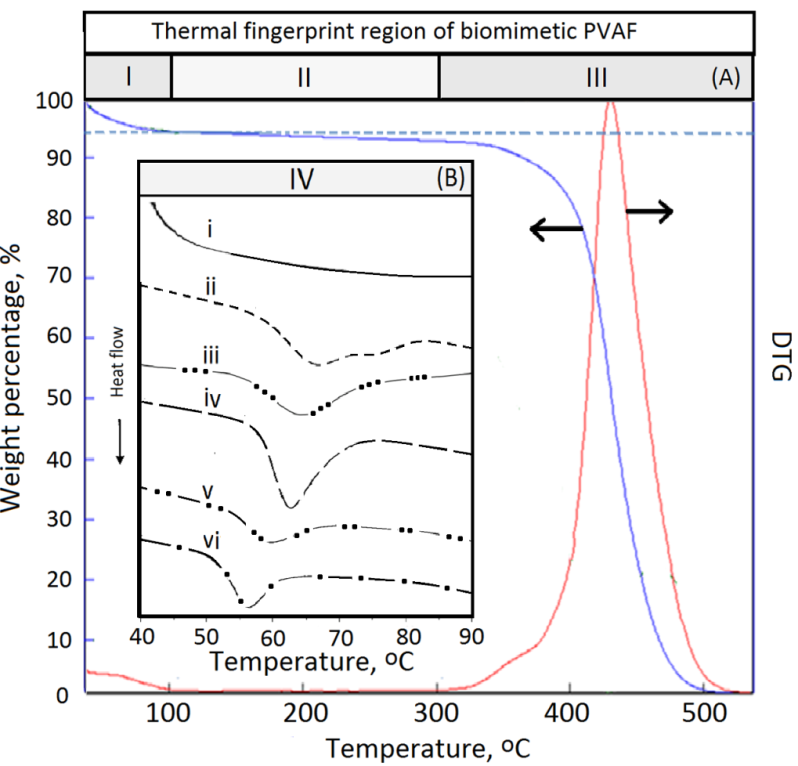
In this study, a novel biomimetic high support soft medical drainage materials derived from polyvinyl alcohol foam (PVAF) for drainage treatment was designed and prepared. Suitable thermal fingerprint evaluations of the resulting biomimetic design of soft medical drainage materials must be established for identification of thermal structural stability. Thermal results containing TGA, DTG, DSC spectra of biomimetic PVAF could be employed for the thermal fingerprint evaluations of high support soft medical drainage materials (Figure 8 & Table 3).
From region I(<100oC), region II(100oC~300oC), and region III(>300oC) of thermal fingerprint evaluations, weight loss curves obtained from thermogravimetric analysis (TGA) of biomimetic PVAF could provide different information such as small molecules, solvent, water, residual reagents, residual foaming agents, starch, weak structural molecules and prepolymeric molecules, to identify the thermal structural stability. First, TGA and DTG spectra of biomimetic PVAF in region I exhibited only water molecules escaping from the materials and a good water-absorption property. Second, TGA and DTG spectra of biomimetic PVAF in region II exhibited no thermal hydrolysis signal and a high thermal stable structure increasing with temperature. Third, TGA and DTG spectra of biomimetic PVAF in region III exhibited a high Tdmax value >420 oC and a narrow peak of DTG curve which indicated high thermal structural stability and an uniform crosslinked polymeric structure as shown in Figure 7A. Forth, DSC spectra of biomimetic PVAF in region IV (i) exhibited no peak below 100 oC. Further, some DSC results of different kinds of starchs such as rice starch (ii), cassava starch( iii), potato starch( iv), pea starch(v), and wheat starch (vi) were employed to identify the tradition starch-foaming process, which would form compacted and closed-cell microstructure as shown in Figure 7B and Table 3 [44, 45]. Each thermal characteristic (onset temperature [To], peak temperature [Tp], conclusion temperature [Tc]), was employed to identify specific soft medical drainage materials (Table 3).
| Thermal fingerprint signalsa) | |||
|---|---|---|---|
| Toa) , oC | Tpa) , oC | Tca) , oC | |
| SF-PVAF | 50 b) | 55, 65,115b) | 150 b) |
| ASF-PVAF | 50 b) | 68, 90 b) | 120b) |
| SCAF-PVAF | 50 b) | 90 b) | 110b) |
| Potato starch | 60.8[44](58.6[45])(66.1)c) | 66.6[44](63.0[45])(72.2)c) | 75.7[44](72.2[45])(79.5)c) |
| Pea starch | 53.5[45]c) | 59.8[45]c) | 66.9[45]c) |
| Rice starch | 60.4[44](59.7[45])c) | 68.3[44](67.8,75.3[45])c) | 79.0[44] (82.6[45])c) |
| Corn starch | 62.9[44]c) | 71.2[44]c) | 81.8[44]c) |
| Tapioca starch | 63.1c) | 69.9c) | 85.9c) |
| Cassava starch | 55.8c) | 65.1c) | 76.4c) |
| Maize starch | 71.9c) | 76.7c) | 81.7c) |
| Turkish bean starch | 57.7c) | 70.5c) | 110.0c) |
| Wheat starch | 56.5[44](51.5[45])(52.4c), | 61.8[44](56.2[45])(58.8c) | 70.7[44](61.6[45])(80) (75.5)c) |
| (62.3)c) | (68.2) c) |
Table 3: Thermal characteristics of new soft medical drainage materials.
Conclusion
Establishment of biomimetic biomedical inventive principles and a bio-inspired design-thinking method for innovative design of biomimetic medical devices and biomaterials were achieved. The medical device (MD) unified problem-driven bioinspired evaluating approach was established to guide biomimetic design of biomaterials and their corresponding medical devices for various clinic applications. A kind of novel biomimetic medical drainage materials from made of polyvinyl alcohol foam with air cavities inspired by avian skeleton and feather rachises was successfully designed and prepared by using air- foaming procedure in this work. Furthermore, a novel identification approach of the new biomimetic soft medical drainage materials was designed and established by using microstructural, morphological, optical fingerprint and thermal fingerprint evaluations. TGA, DTG, DSC, SEM and FTIR results of new biomimetic polyvinyl alcohol foam were employed to build up the effective system identification approach for biomimetic structure, stability, purity, safety, quality control and the effectiveness evaluation of target medical drainage materials for medical devices.
Acknowledgment
Authors would like to acknowledge the Taiwan PARSD Pharmaceutical Technology Consultants Ltd Company for financial and technical support. The authors also thank for technical assistances of Ms. Shyh-Jen Chen and Ms.Shih- Chuan Chen.
References
-
Liaw DJ, Huang CC, Lee WF, Borbély J, Kang ET (1997) Synthesis and Characteristics of the Poly(carboxybetaine) s and the Corresponding Cationic Polymers. J Polym Sci Part A Polym Chem 35: 3527-3536.
-
Liu YW, Huang CC, Wang YY, Xu J, Wang GD, et al. (2021) Biological Evaluations of Decellularized Extracellular Matrix Collagen Microparticles Prepared Based on Plant Enzymes and Aqueous Two-phase Method. Regen Biomater 8(2): rbab002.
-
Ribeiro CC, Barrias CC, Barbosa MA (2004) Calcium phosphate-alginate microspheres as enzyme delivery matrices. Biomaterials 25(18): 4363-4373.
-
Liaw DJ, Chen TP, Huang CC (2005) Self-Assembly Aggregation of Highly Stable Copolynorbornenes with Amphiphilic Architecture via Ring-Opening Metathesis Polymerization. Macromolecules 38(8): 3533-3538.
-
Liaw DJ, Huang CC, Sang HC, Kang ET (1999) Intramolecular Hydrophobic Aggregation of Amphiphilic Polysulfobetaine with Various Hydrophobic Groups in Aqueous Solution. Langmuir 15(16): 5204-5211.
-
Liaw DJ, Huang CC (1997) Dilute Solution Properties of Poly (3-dimethyl acryloyloxyethyl ammonium propiolactone). Polymer 38: 6355-6362.
-
Zhai G, Toh SC, Tan WL, Kang ET, Neoh KG, et al. (2003) Poly(vinylidene fluoride) with Grafted Zwitterionic Polymer Side Chains for Electrolyte-Responsive Microfiltration Membranes. Langmuir 19(17): 7030- 7037.
-
Chang YI, Cheng WY, Jang L (2014) A Novel Method of Making PVF Porous Foam Without Using the Pore Forming Agent. J Appl Polym Sci 132(1): 41270.
-
Lin HL, Zhang G, Huang CC (2019) Preclinical Evaluation of Designed Extra Permeable Anti-adhesion Protecting Membranes with Low Residual Formaldehyde Contents via Active Molecules Cleaning Process for Diabetic Foot Ulcer Wound Management. Basic & Clinical Pharmacology & Toxicology 125(1): 210-211.
-
Xia Y, Zhou H, Lei X, Zhang G, Huang CC (2019) Preclinical Evaluations of Novel Controlled Release Transdermal Delivery System Derived from High Permeability Cross- linked Polyvinyl Alcohol Foam with Fully Open-cell and Open-channel Microstructures for Diabetic Foot Ulcer Wound Managements. Basic & Clinical Pharmacology & Toxicology 125(1): 217-218.
-
Huang CC (2019) Good Water Absorption and Anti- adhesion Properties of Designed Extra Thin PVA Foam Membranes with Fully Open-cell Microstructures Derived from a Super Clean Air-foaming Process with Active Molecules for Minimally Invasive Surgery. Biomedical Journal of Scientific & Technical Research 15(2): 11219-11221.
-
Huang CC, Yang MJ, Chang IL (2019) Preclinical Evaluation and Characteristics of New Cross- Linked Polyvinyl Alcohol Extra Permeable Foam Dressings Derived from a combination of Super Clean Air foaming and Ultra Precision Machining Processes for Negative Pressure Wound Therapy. Basic & Clinical Pharmacology & Toxicology 124(3): 12.
-
Huang CC, Yang MJ, Zhang Z, Chang IL (2019) Preclinical Evaluation and Characteristics of New Designed Anti- Adhesion Extra Thin Polyvinyl Alcohol Foam Dressings Derived from a Super Clean Air- Foaming Process for Negative Pressure Wound Therapy in Orthopedics, Basic & Clinical Pharmacology & Toxicology 124(3): 15.
-
Huang CC, Yang MJ, Zhou H, Yang L (2019) Preclinical Evaluation and Characteristics of New Designed Polyvinyl Alcohol Foam Nasal Matrix Derived from a Super Clean Air- Foaming Process for Epistaxis Treatments. Basic & Clinical Pharmacology & Toxicology 124(3): 18.
-
Lingham Soliar T (2014) Feather structure, biomechanics and biomimetics: the incredible lightness of being. Journal of Ornithology 155: 323-336.
-
Bonser R (2004) The mechanical performance of medullary foam from feathers. Journal of Materials Science Letters 20(10): 941-942.
-
Pan Y, Wang W, Peng C, Shi K, Luoa Y, et al. (2014) Novel hydrophobic polyvinyl alcohol-formaldehyde foams for organic solvents absorption and effective separation. RSC Adv 4: 660-669.
-
Yin P, Dong X, Zhou W, Zha D, Xu J, et al. (2020) A novel method to produce sustainable biocomposites based on thermoplastic corn-starch reinforced by polyvinyl alcohol fibers. RSC Adv 10: 23632-23643.
-
Chetri P, Dass NN (1997) Preparation of poly(vinyl formal) of high acetalization. Polymer 38(15): 3951- 3956.
-
He M, Ou F, Wu Y, Sun X, Chen X, et al. (2020) Smart multi- layer PVA foam/ CMC mesh dressing with integrated multi-functions for wound management and infection monitoring. Materials & Design 194: 108913.
-
Mansur HS, Sadahira CM, Souza AN, Mansur AAP (2008) FTIR spectroscopy characterization of poly (vinyl alcohol) hydrogel with different hydrolysis degree and chemically crosslinked with glutaraldehyde. Mater Sci Eng C 28(4): 539-548.
-
Han D, Guo Z, Chen S, Xiao M, Peng X, et al. (2018) Enhanced Properties of Biodegradable Poly(Propylene Carbonate)/Polyvinyl Formal Blends by Melting Compounding. Polymers 10(7): 771.
-
Chetri P, Dass NN (2001) Preparation of poly(vinyl butyral) with high acetalization rate. J Appl Polym Sci 81(5): 1182-1186.
-
Tao TX, Wu ZC, Wang XQ, Li MS, Zhang JH (2006), Synthesis and spectra of compleses involving polyvinyl alcohol fiber ligands. Acta Polym Sin 3: 387-390.
-
Rodriguez AJ, Sotelo E, Martinez L, Huttel Y, Gonzalez MU, et al. (2021) Green synthesis of starch-capped Cu2O nanocubes and their application in the direct electrochemical detection of glucose. RSC Adv 11(23): 13711.
-
Fang JM, Fowler PA, Tomkinson J, Hill CAS (2002) Preparation and characterisation of methylated hemicelluloses from wheat straw. Carbohydr Polym 47(3): 285-293.
-
Kizil R, Irudayaraj J, Seetharaman K (2002) Characterization of irradiated starches by using FT- Raman and FTIR spectroscopy. J Agric Food Chem 50(14): 3912-3918.
-
Wajs J, Bańda M, Panek J, Nawrocka A, Frąc M (2020) Influence of storage under unfavourable conditions on the caking properties and fungal contamination of potato starch and wheat flour. Food Chem 34(2): 203-211.
-
Abdullah AHD, Chalimah S, Primadona I, Hanantyo MHG (2018) Physical and chemical properties of corn, cassava, and potato starchs. Earth and Environmental Science 160: 012003.
-
Kacurakova M, Belton PS, Wilson RH, Hirsch J, Ebringerova A (1998) Hydration properties of xylan- type structures: An ftir study of xylooligosaccharides. J Sci Food Agric 77: 38-44.
-
Kacurakova M, Wilson RH (2001) Developments in mid- infrared FT-IR spectroscopy of seleted carbohydrates. Carbohydr Polym 44(4): 291-303.
-
Rajan A, Prasad VS, Abraham TE (2006) Enzymatic esterification of starch using recovered coconut oil. International Journal of Biological Macromolecules 39(4-5): 265-272.
-
Huang CB, Jeng R, Sain M, Saville BA, Hubbes M (2006) Production, characterization and mechanical properties of starch modified by Ophiostoma spp. BioRes 1(2): 257- 269.
-
Goheen SM, Wool RP (1991) Degradation of polyethylene- starch blends in soil. J Appl Polym Sci 42: 2691-2701.
-
Ye M, Mohanty P, Ghosh G (2014) Morphology and properties of poly vinyl alcohol (PVA) scaffolds: Impact of process variables. Mater Sci Eng C Mater Biol Appl 42: 289-294.
-
Marcazzan M, Vianello F, Scarpa M, Rigo A (1999) An ESR assay for α-amylase activity toward succinylated starch, amylose and amylopectin. J Biochem Biophs Meth 38(3): 191-202.
-
Bhat NV, Nate MM, Kurup MB, Bambole VA, Sabharwal S (2005) Effect of γ-radiation on the structure and morphology of polyvinyl alcohol films. Nucl Instrum Methods Phys Res Sect B 237(3-4): 585-592.
-
Lee J, Isobe T, Senna MJ (1996) Magnetic properties of ultrafine magnetite particles and their slurries prepared via in-situ precipitation. Colloid Interface Sci 109: 490- 494.
-
Mansur HS, Sadahira CM, Souza AN, Mansur AAP (2008) FTIR spectroscopy characterization of poly (vinyl alcohol) hydrogel with different hydrolysis degree and chemically crosslinked with glutaraldehyde. Mater Sci Eng C 28(4): 539-548.
-
Pan Y, Shi K, Liu Z, Wang W, Peng C, et al. (2015) Synthesis of a new kind of macroporous polyvinyl- alcohol formaldehyde based sponge and its water superabsorption performance. RSC Adv 5(96): 78780- 78789.
-
Obanni M, Bemiller JN (1997) Properties of Some Starch Blends. Cereal Chem 74(4): 431-436.
-
Jacobs H (1995) Influence of annealing on the pasting properties of starches from varying botanical sources. Cereal Chemistry 72(5): 480-487.
-
Ratnayake WS, Otani C, Jackson DS (2009) DSC enthalpic transitions during starch gelatinization in excess water, dilute sodium chloride, and dilute sucrose solutions. Journal of the Science of Food and Agriculture 89(12): 2156-2164.
-
Beninca C, Colman TAD, Lacerda LG, Filho MASC, Demiate IM, et al. (2013) Thermal, rheological, and structural behaviors of natural and modified cassava starch granules, with sodium hypochlorite solutions. J Therm Anal Calorim 111: 2217-2222.
-
Hussain S, Alamri MS, Mohamed AA (2013) Rheological, Thermal and Textural Properties of Starch Blends Prepared from Wheat and Turkish Bean Starches. Food Sci Technol Res 19(6): 1141-1147.
- Origin, Evolution, and Functional Impact of Short Insertion- Deletion Variants in Human Genomes: A Review
- Harnessing Molecular Glues for Next-Generation Vaccine, Cancer and Cardiovascular Disease Drug Development: A Comprehensive Review
- Lateral Cervical Epidermal Inclusion Cyst in a Paediatric Patient: A Rare Case Report
- Malarial Plasmodium Falciparum with Hepatitis B and C Virus Infections among Blood Donors in Ife Central Local Government Area, Ile Ife, Osun State, Nigeria
- Withanolides and Withaferin A- What’s next in Ashwagandha Research
- Designing of Dual Pulse Photoacoustic Tomography for Imaging of Drug-Response and Tumor Growth