
Phytological Aspects of Fagonia Cretica Linn
Fagonia cretica L. is a potential desert plant that belongs to Zygophyllaceae family. The genus Fagonia comprises of 40 species that are found in Mediterranean, Saharo-sindian regions, subtropical regions of North & South America and South Africa. The genus is also known for distribution in warm arid regions of all continents except Australia. North Africa may also be considered as the center for the distribution of genus Fagonia to the Old World. The plants belonging to the genus Fagonia have valuable medicinal properties and are used in treatment of various health disorders in the traditional medicine practices. Therefore, the purpose of this review is to succinctly appraise the recent progress and all the phytological aspects of Fagonia cretica L. to assist the traditional medicines practitioners for its use in their current practices.
Introduction
The sun shines only one side of our planet for half a day while other side remains in the dark. The unevenness of earth’s surface receives uneven spread of sunlight. This condition and earth’s atmosphere produces varying climate on our planet. Our planet exhibits both kinds of atmospheres, extreme cold temperatures and extreme hot environments. Irrespective of climatic conditions, life started its existence in every environment. One of these is deserts. Some forms of life have learned to survive in deserts. These include both plants and animals. Camels and cacti are few good examples that have learned to bear the austerity of deserts. Deserts are home to a variety of plant species. Fagonia cretica L. is also a potential desert plant [1]. It (Figure 1) belongs to Zygophyllaceae family. The genus Fagonia comprises of 40 species that are found in Mediterranean, Saharo-sindian regions, subtropical regions of North & South America and South Africa [2]. The genus is also known for distribution in warm arid regions of all continents except Australia.
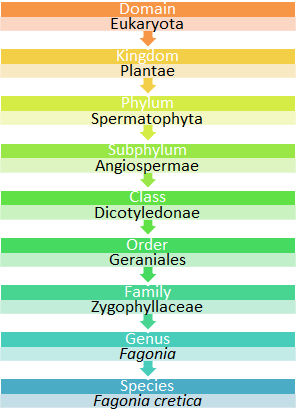
North Africa may also be considered as the center for the distribution of genus Fagonia to the Old World [3]. The plants belonging to the genus Fagonia have valuable medicinal properties [1] and are used in treatment of various health disorders in the traditional medicine practices. Therefore, the purpose of this review is to succinctly appraise the recent progress and all the phytological aspects of Fagonia cretica L. to assist the traditional medicines practitioners for its use in their current practices.
Lexicon
Fagonia cretica L. is popularly known as Dhamasa, Badavard, Sachchibooti in Urdu [4, 5, 6, 7]; Dama, Dhamah, Dhamaha in Punjabi; Shukai, Badavard, Umm Showeika, Sholib, UmmShok, Al-Shokaa in Arabic [8, 9, 10]; Bádávard in Persian; Abrojo de Creta, Rosal de la Virgen, Manto de la Virgen in Spanish; Fagone in French; Khorasan thorn, Virgin’s Mantle, and Fagonia in English.
Synonyms
Fagonia cretica L. is an accepted name of a species in the genus Fagonia [11]. In popular cultures, it is also known as:
- Fagonia viscosa Hochst. ex Boiss.
- Fagonia virens Coss. ex T. Anderson
- Fagonia hispanica L.
- Fagonia forskalii Pfund
- Fagonia erecta Mill.
- Fagonia elongata Salisb
- Fagonia deflexa Moench
- Zygophyllum creticum (L.) Christenh. & Byng
- Fagonia cistoides Delile ex T. Anderson
- Fagonia desertorum [11].
Phytography
F. cretica L. exhibits unpleasant odour and bitter taste [12]. F. cretica L. is a small shrub having thorns growing to a height of 1-3 feet in dry regions. The small branches are thick that bear nodules. The thorns present on plant are thick and strong. The morphological characteristics of this plant species are summarized in the Table 1. The leaves of F. cretica L. are isobilateral and comprise of single layered epidermis consisting of mostly tangentially elongated cells covered with thick cuticle. Both of epidermis exhibit anomocytic stomata and polygonal epidermal cells. There are 2 or 3 layered palisade cells present on both sides adjacent to the epidermis. In vascular bundles, xylem is present towards lower side and phloem towards upper side. Sclerenchyma tissue occurs as a bundle cap just above the phloem. Small lateral vascular bundles are also present in the leaf lamina. Total of 16-17 stoma are found on lower epidermis while 5 to 7 on upper [1, 2].
| Plant Part | Morphological Characteristics | Ref. |
|---|---|---|
| Leaves | Opposite; Compound; Trifoliolate on short petioles; Smooth and Spinescense stipules | [14] |
| Stem | Young – Green; Mature –Brown; Spiny; Slender; Bears 2 pairs pf spines at each node | [1] |
| Root | Tap root; brownish green; rough with longitudinal striations; core yellowish-green; fracture, fibrous | [1] |
| Seed | Flat rounded and brown in color | [1] |
| Flower | Small; pale rose or purple; solitary; 5 free mucronate sepals; 5 free clawed imbricate petals; 10 free stamens inserted on a disc; filaments filiform without appendages; 5-celled sessile ovary, 2 ovules at the base of each cell; 5-angled style persistent, simple stigma; septicidal capsule fruit, pentagonous, deeply 5-lobed, splitting along the axis into 5 carpals; carpals 1-seeded | [1,13] |
| Fruit | Pentagonous; Schizocarp composed of five compressed, two valved cocci; 10 mm broad & 7 mm long on short, thick, reflexed peduncles, with deciduous calyx | [1] |
Table 1: Morphological characteristics of _F. cretica L._
Transverse section of stem shows single layered epidermis with thick cuticle. The unicellular trichomes are occasionally present. The cortex consists of 7-10 layers of parenchymatous cells and narrow lumen sclereids. Both secondary xylem and phloem are composed of fibres, tracheids, vessels, and parenchyma cells. Three to four layers of vascular cambium are also present [1].
Transverse section of root shows outermost cork represented by 4-5 layers of small, narrow, tangentially elongated cells. The phelloderm is composed of 6-10 layers of tangentially elongated, thin walled parenchymatous cells. The secondary phloem consists of thick walled phloem fibres; and traversed seriate medullary rays [1].
Phytochemistry
Phytochemical investigation of the plant revealed the presence of alkaloids, flavonoids, terpenoids, saponins, tannins, coumarins, sterols, and glycosides in different polar and non-polar extracts of its parts [14, 15, 16]. Diosgenin, kryptogenin (Figure 2), lanosterol, beta-sitosterol, harmine, fagogenin and oleanolic acid are important chemical constituents found in F. cretica [17, 18]. Fruits are rich in ascorbic acid [7].
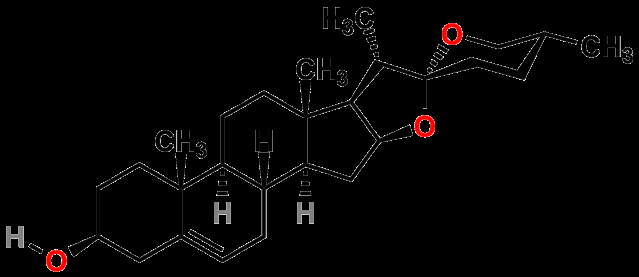
a. Diosgenin b. Kryptogenin Figure 2: Phytochemistry of F. cretica.
Pharmacological Actions
A number of studies have been carried out on F. cretica L. in recent years showing that it possesses diverse pharmacological effects.
Effects on Nervous System: F. cretica is effective in elevation of glutathione levels and expression of the gamma- glutamylcysteine ligase. It exhibits strong free radical scavenging properties against reactive oxygen and nitrogen species. In addition, the herb significantly diminishes the expression of iNOS gene after 48 hours which plays a major role in neuronal injury during hypoxia/ischemia [19]. Effects on Blood and Circulatory System: F. cretica possess potentials as haemorrhagic inhibitor against snake venom (Naja naja karachiensis spp.) at a dose of 15 µg per 1.5 µL phosphate buffer saline [20]. It also exhibits thrombolytic activity in animal studies [21]. F. cretica is very effective in Thalassemia Major at a dose of 120mg/kg of body weight [22]. Aqueous extract of F. cretica showed antipyretic effect in animal studies [23]. F. cretica L. plant and its two triterpenoids isolated from ethanol extract showed significant decrease in total leukocyte count in rabbit blood [24]. Effects on Digestive System: F. cretica exhibits a dose- dependent relaxant activity similar to that produced by standard adrenaline in animal models. Moreover, the extract shows less affinity to adrenoceptors than adrenaline. Its major chemical constituent, harmine, is a known monoamine oxidase A and B inhibitor that decreases the degradation of monoamine in the gut and increases their relaxation effect on the smooth muscle of the gut [25]. Effects on Musculoskeletal System: F. cretica L. down- regulates the expressions of COX2 (Cyclooxygenase) and vascular cell adhesion molecule (VCAM) genes, in animal studies while up-regulates vascular endothelial growth factor (VEGF) expression and inhibits platelet aggregation thus mediating the inflammation [26]. Effects on Reproductive System: Fagonia critica induces distortion in the regularity of the estrous cycle of the rats in which there is random omission of the heat period (estrous phase). It acts as an anti-implantation agent in the dose of 250mg/kg per oral. The drug suspension has significant androgenic activity as the weights of both seminal vesicles and ventral prostate is increased. It does not seem to possess any anti-androgenic activity [27]. Effects on Endocrine System: F. cretica saponins in 30 mg doses had significant decrease in prolactin and in the serum TSH levels in animal models. A significant increase in serum cortisol occurs with the crude drug in a 1g dose and with both saponins in 30 mg doses in animal studies. F. cretica is a common blood purifying agent in Pakistan and its aerial parts juice or decoction is used for treatment of diabetes. The water extract at dose of 500 mg/kg was effective in the management of diabetes, causing a 45% decrease in the plasma glucose level [28, 29]. Infections and Infestations: Various compounds isolated from F. cretica had antimicrobial activity against Bacillus subtilis, Shigella flexneri, Staphylococcus aureus, Escherichia coli, Pseudomonas aeruginosa, Salmonella typhi, Trichophyton longifusus, Candida albicans, Aspergillus flavus and Candida glabrata [14, 15, 30, 31, 32]. Miscellaneous: Significant cytotoxic activity of F. cretica was found against brine shrimps, while antitumor assay showed that the extract inhibited tumor induction on potato discs. F. cretica extract can induce cell cycle arrest and apoptosis via p53-dependent and independent mechanisms, with activation of the DNA damage response. It indicates that F. cretica aqueous extract contains potential anti-cancer agents acting either singly or in combination against breast cancer cell proliferation via DNA damage-induced FOXO3a and p53 expression [33, 34].
Drug Temperament
The temperament of Fagonia cretica Linn is cold and dry in the first order [35]. However, there is controversy for its temperament. One school of thought considers it as warm & dry in first order while other school confers it as warm in second and dry in third order [36].
Pharmacotherapeutics
Indications: It is bitter, astringent, antiseptic, tonic, blood- purifier, febrifuge and useful in dropsy, liver trouble, delirium and any disorder which is caused by poisoning. It is also useful in cough, fever, asthma, chronic fever, chronic bronchitis, spitting of blood, stomatitis, dysentery, skin diseases and as a cooling agent. Boiled residue of the plant in water is used for abortion. It is applied on abscesses, scrofulous glands and wounds; also given as a prophylactic agent against smallpox. Bark is used for dermatosis. Extract of aerial parts acts as an antiviral, anti-amphetaminic, and spasmogenic agent. Plant ash is given to children suffering from anemia. It is also used as deobstruent, diuretic, styptic, analgesic, antidote, stomachic, anti-hepatotoxic, antiemetic, stimulant, alterative, and anti-carcinogenic. Leaves of F. cretica are ground in lemon juice and applied as hair tonic, which prevents greying of hair [37, 38]. The leaves are beneficial in fevers, thirst, vomiting, boils, leucoedema, and biliousness [39].
Side Effects: F. cretica extracts were found to have anti-breast cancer activity devoid of side effects common to standard cytotoxic therapy [33]. However, it may cause harmful effects on lungs [11].
Posology
The recommended dose of F. cretica L. powder is 3-5 Grams. The decoction of whole plant (50-100 ml) is used in treatment of various diseases [35].
Pharmacognostical Evaluation
Conclusion
F. cretica L. has valuable medicinal properties and very less toxicity in nature. It has enormous health benefits. It is the need of the time to use this precious plant in daily common practices and standardize its dose for various defined disorders.
• Conflicts of Interest: Authors declare no conflict of interest.
References
-
Puri D, Bhandari A (2014) Fagonia: a potential medicinal desert plant. Journal of Nepal Pharmaceutical Association 27(1): 28-33.
-
Batanouny K, Batanouny M (1970) Autecology of common Egyptian Fagonia species. Phyton 14(1-2): 79- 92.
-
Porter DM (1963) The taxonomy and distribution of the Zygophyllaceae of Baja California, Mexico. Contributions from the Gray Herbarium of Harvard University 1963(192): 99-135.
-
(2008) The Unani Pharmacopoeia of India: Ministry of Health & Family Welfare, Government of India.
-
MH AH, Kitab Al Mufradat (1960) 2nd (Edn.), Sheikh Ghulam Ali & Sons, Lahore.
-
Kirtikar K, Basu B (1935) Indian medicinal plants. Indian Medicinal Plants pp: 1347-1348.
-
Khare CP (2008) Indian medicinal plants: an illustrated dictionary: Springer Science & Business Media.
-
Jahala OAM, Izzeldin OM, Abdalla RE (2014) Effect of Fagonia cretica linn ethanolic extract on different hematological parameters in albino rats in Sudan. The Pharma Innovation 3(8): 89.
-
Ali MAM, Hamadnalla HM (2020) Eco-taxonomic Study of the Weeds of Um Algura Area-Western Gezira State, Sudan. Research Reviews: Research Reviews: Journal of Ecology and Environmental Sciences 8(2): 11-16.
-
Abdel Halim R (2013) Medicine and Health in Medieval Arabic Poetry: An Historical Review. Int J Hist Philos Med 3: 1-7.
-
(2013) _Fagonia cretica L_.
-
Khan A, Mehmood S, Khan RA (2017) Ethnobotanical study of some wild herb medicinal Xerophytes of district Bannu, Khyber Pakhtunkhwa. Pakistan Journal of Wildlife and Ecology 1: 37-51.
-
Mehsud A, Mehmood S, Muhammad A, Khan RU, Khan SU, et al. (2013) Morphology and anatomy of some weeds from flora of District Bannu, Pakistan. Pakistan Journal of Weed Science Research 19(4): 437-445.
-
Dastagir G, Hussain F, Khan AA (2012) Antibacterial activity of some selected plants of family Zygophyllaceae and Euphorbiaceae. Journal of medicinal plants research 6(40): 5360-5368.
-
Sajid B, Alia E, Rizwana K, Uzma S, Alamgeer HM (2011) Phytochemical screening and antimicrobial activity of Fagonia cretica plant extracts against selected microbes. J Pharm Res 4(4): 962-963.
-
Eman A (2011) Morphological, phytochemical and biological screening on three Egyptian species of Fagonia. Acad Arena 3(1): 18-27.
-
Khalik SA, Miyase T, El Ashaal HA, Melek F (2000) Triterpenoid saponins from Fagonia cretica. Phytochemistry 54(8): 853-859.
-
Ali M, Hameed Z (1966) Triterpenoids I, the sapogenins of Fagonia cretica Linn.(Zygophyllaceae). Pak J Sci Ind Res 9: 41.
-
Rawal AK, Muddeshwar MG, Biswas SK (2004) Rubia cordifolia, Fagonia cretica linn and Tinospora cordifolia exert neuroprotection by modulating the antioxidant system in rat hippocampal slices subjected to oxygen glucose deprivation. BMC Complement Altern Med 4(1): 1-9.
-
Tahir Razi M, Asad MHHB, Khan T, Zabta Chaudhary M, Tayyab Ansari M, et al. (2011) Antihaemorrhagic potentials of Fagonia cretica against Naja naja karachiensis (black Pakistan cobra) venom. Natural Product Research 25(20): 1902-1907.
-
Prasad S, Kashyap RS, Deopujari JY, Purohit HJ, Taori GM, et al. (2007) Effect of Fagonia arabica (Dhamasa) on in vitro thrombolysis. BMC Complement Altern Med 7: 36.
-
Seyal RA, Tareen SM, Awan HM (2014) Efficacy of Fagonia cretica in Treating Hemolytic Anemias. Proceedings of the Pakistan Academy of Sciences 51(4): 301-315.
-
Nagaraj DS, Venkateswarlu B (2013) Antipyretic effect of aqueous extract of _Fagonia cretica L._ whole plant on brewer’s yeast induced pyrexia in wistar rats. Int J Pharmacol Toxicol 3: 39-42.
-
Saeed MA, Sabir AW (2003) Effects of _Fagonia cretica L._ constituents on various haematological parameters in rabbits. J Ethnopharmacol 85(2-3): 195-200.
-
Ahmed AA, Elsammani TO, Elfeil ME, Ahmed SK (2013) The pharmacological effects of Fagonia cretica Linn ethanolic extract on isolated rabbit intestine. Int J Pharmacol Toxicol 1(2): 91-98.
-
Rawal AK, Nath D, Yadav N, Pande S, Meshram S, et al. (2009) Rubia cordifolia, Fagonia cretica linn and Tinospora cordifolia exert anti-inflammatory properties by modulating platelet aggregation and VEGF, COX-2 and VCAM gene expressions in rat hippocampal slices subjected to ischemic reperfusion injury. Int J Appl Res Nat Prod 2(1): 19-26.
-
Abirami V, Khosa R, Dhar S, Sahai M (1996) Investigation on Fagonia cretica–its effect on hormonal profile and immunomodulation in rats. Anc Science Life 15(4): 259- 263.
-
Nazir I, ur Rahman N, Alvi Z, Rahman MH, Sendker J, et al. (2017) Antidiabetic activities of an LC/MS fingerprinted aqueous extract of _Fagonia cretica L._ in preclinical models. Planta Med 83(14-15): 1141-1148.
-
Kamran SH, Shoaib RM, Ahmad M, Ishtiaq S, Anwar R (2017) Antidiabetic and renoprotective effect of _Fagonia_ _cretica L._ methanolic extract and Citrus paradise Macfad. juice in alloxan induced diabetic rabbits. Journal of Pharmacy & Pharmacognosy Research 5(6): 365-380.
-
Anjum MI, Ahmed E, Jabbar A, Malik A, Ashraf M, et al. (2007) Antimicrobial constituents from Fagonia cretica. Journal of the Chemical Society of Pakistan 29(6): 634- 639.
-
Kouser R, Qureshi R (2013) Antimicrobial activity of Fagoniaindica from Thal Desert, Punjab, Pakistan. International Journal of Phytomedicine 5(1): 113.
-
Gehlot D (2000) Toxic effect of various plant part extracts on the causal organism of typhoid fever. Cur Sci 78(7): 780-781.
-
Lam M, Carmichael AR, Griffiths HR (2012) An aqueous extract of Fagonia cretica induces DNA damage, cell cycle arrest and apoptosis in breast cancer cells via FOXO3a and p53 expression. PloS one 7(6): e40152.
-
Lam M (2012) Cytotoxic activity of Fagonia cretica against human breast cancer cells: Aston University.
-
Kabiruddin HM (1937) Kitab al-Adviya Makhzan al- Mufradat, Delhi, India, Daftar Al-Masih.
-
Lubhya HR (2013) Bayanul Advia, Lahore, Pakistan: Idara Matbuat Sulemani.
-
Anis M, Sharma M, Iqbal M (2000) Herbal ethnomedicine of the Gwalior forest division in Madhya Pradesh, India. Pharm Biol 38(4): 241-253.
-
Muhaisen HM, Ab Mous MM, Ddeeb FA, Rtemi AA, Taba OM, et al. (2016) Antimicrobial agents from selected medicinal plants in Libya. Chin J Integr Med 22(3): 177- 184.
-
Das S, Choudhury MD (2012) Ethnomedicinal uses of some traditional medicinal plants found in Tripura, India. Journal of Medicinal Plants Research 6(35): 4908- 4914.
-
(2001) _Fagonia Cretica L._ The Ayurvedic Pharmacopoeia of India: Ministry of Health and Family Welfare Department of Ayush, Government of India.
-
(2008) _Fagonia Cretica Linn._ The Unani Pharmacopoeia of India: Ministry of Health And Family Welfare Department of Ayush, Government of India.
- Origin, Evolution, and Functional Impact of Short Insertion- Deletion Variants in Human Genomes: A Review
- Harnessing Molecular Glues for Next-Generation Vaccine, Cancer and Cardiovascular Disease Drug Development: A Comprehensive Review
- Lateral Cervical Epidermal Inclusion Cyst in a Paediatric Patient: A Rare Case Report
- Malarial Plasmodium Falciparum with Hepatitis B and C Virus Infections among Blood Donors in Ife Central Local Government Area, Ile Ife, Osun State, Nigeria
- Withanolides and Withaferin A- What’s next in Ashwagandha Research
- Designing of Dual Pulse Photoacoustic Tomography for Imaging of Drug-Response and Tumor Growth