
The Impacts of Excessive Screen Use on Child Neurodevelopment: Systematic Review
Introduction: The increase in the use of devices with screens among children has raised significant concerns. Excessive use of screens such as smartphones and tablets is linked to a series of problems in child development. Studies reveal that excessive exposure to these screens can negatively impact learning, concentration, language and motor skills. Furthermore, exchanging social interactions and physical activities for long periods in front of screens can result in behavioral problems, hyperactivity, impulsivity, in addition to adversely influencing the quality of sleep and mental health. Objectives: to gather and analyze evidence on the repercussions of excessive use of screens on children’s neurodevelopment. Methodology: This is a systematic review, conducted according to the Cochrane Handbook for Systematic Reviews of Interventions guidelines and reported in accordance with the Preferred Reporting Items for Systematic Reviews and Meta-Analyses (PRISMA) statement. The search strategy used the controlled descriptors contained in the Health Science Descriptors (DeCS) of the Virtual Health Library (VHL) and Medical Subject Headings (MeSH): “divorce”; “parents”; “children”; “emotional”; “behavioral” “mental disorder”, associated with the Boolean operators “AND” and “OR”. Results: A total of 6 articles were obtained in the final sample. Overall, the results highlighted the possible harmful impacts of excessive use of technology on ocular, mental, physical and social health as a result of this prolonged exposure. Conclusion: Thus, it is possible to state that the excessive use of devices with screens among children and adolescents is an issue that has been generating increasing concern in society.
Abbreviations
PRISMA: Preferred Reporting Items for Systematic Reviews and Meta-Analyses; VHL: Virtual Health Library; MeSH: Medical Subject Headings.
Introduction
The internet, since its emergence in the 1960s, has revolutionized the way we live, work, communicates and radically transformed our lives and interactions. The growing presence of digital technologies in everyday life, especially among young people and children, has given rise to a new concept: cyber childhood. The frequent use of devices such as smartphones, tablets and computers is generating intense discussions, with experts and guardians expressing concerns about the possible effects on children’s development [1].
The arrival of digital technologies and the constant presence of screens in modern life raise concerns about their effects on children’s growth. The excessive and early use of electronic devices has been linked to several adverse consequences for the cognitive, social and emotional development of children [2].
Intense and prolonged contact with electronic devices is linked to a series of difficulties, such as learning problems, sleep disorders, inappropriate behaviors and even impacts on brain development. Research indicates that excessive exposure to screen devices can hinder progress in areas such as language, concentration and fine motor skills [3, 4]. Scientific studies indicate that excessive use of digital devices may be related to behavioral issues, including hyperactivity, lack of control and challenges concentrating. Premature exposure to inappropriate material can result in the adoption of undesirable values and behaviors, in addition to increasing the likelihood of addictions emerging in adulthood [5].
Given the above, this study proposes the following guiding question: what are the consequences of excessive use of screens on child neurodevelopment? To this end, a systematic review of the literature was carried out, with the aim of identifying the main influences and fostering a comprehensive understanding of the phenomenon in question. In this context, the general objective of this analysis is to identify the impacts of excessive use of screens on children’s neurodevelopment.
Methodological Course
Study Design
The methodology adopted for this study refers to a systematic literature review conducted by the Cochrane Handbook for Systematic Reviews of Interventions (Higgns) and written in accordance with the statement Preferred Reporting Items for Systematic Reviews and Meta-Analyses (PRISMA) Page M, et al. [6]. Scientific evidence was sought about parental divorce and its repercussions on the emotional and behavioral lives of children.
Research Question
The guiding question of the present study was prepared based on the PICO acronym strategy (Stillwell), in which the components of the question followed the PICO strategy where (P) Population: children and adolescents; (I) Intervention: Excessive screen time, prolonged screen exposure, digital media use; (C) Comparison: Limited screen time, no screen use, guidelines-based screen time; (O) Outcome- Neurodevelopment, cognitive development, speech delay, emotional regulation, attention span. Given the above, the guiding question of this study elaborated in the PICO strategy presents the following question: “what are the repercussions of excessive use of screens on child neurodevelopment?”
Eligibility Criteria
The inclusion criteria adopted for the search were the following: original articles made available in full in the selected databases, with a time limit from 2010 to November 2024, without language restrictions and which described excessive use of screens in child neurodevelopment. Review articles, editorials, letters to the editor, news and comments were excluded.
Source of Information
The search for evidence was carried out in five different databases, namely: PubMed, Virtual Health Library (VHL), Web of Science, Science Direct and PsycInfo with studies published from 2010 to 11/30/2024. The search was carried out without restricting language, since the objective was to retrieve as many articles as possible.
Search Strategies
The search strategy used the controlled descriptors contained in the Health Science Descriptors (DeCS) of the Virtual Health Library (BVS) and Medical Subject Headings (MeSH): “child development”; “audio visual media”; “mobile apps”; “exposure time”; “screentime”, associated with the Boolean operators “AND” and “OR”. The descriptors related to the theme were selected based on the PICO strategy. Therefore, there were no language restrictions in the search for articles. After developing the search strategy, the articles were submitted to the Rayyan platform (https://www. rayyan.ai/) to remove duplications and read the studies.
Study Selection
After selecting the articles, in each database, duplicate publications were excluded. The Level of Evidence Assessment was carried out using the Agency for Health care Research and Quality categorization, in which level 1 is considered the highest strength of evidence, which includes meta-analyses of randomized controlled studies. Individual projects with an experimental design, such as randomized clinical trials, are considered level 2. At level 3, cohort, case-control and quasi-experimental studies, such as non-randomized studies. Studies with a non-experimental design, such as cross-sectional studies, receive level of evidence 4. Case reports are considered level 5, and opinions from reputable authorities based on clinical competence or the opinion of expert committees are at level 6.
Assessment of Methodological Quality
To assess the methodological quality of the included studies, the score proposed by Downs and Black (1998) was used. It consisted of a tool composed of 27 scoring items, which allow the evaluation of the internal and external validity and statistical power of the studies.
The answers are answered in “yes” and “no” and scored on a Likert scale, with only “yes” answers scored as “one”, only question five has a maximum score of two. The greater the number of “yes” answers, the higher the quality of the study. The scale is available in an indexed publication (jech.bmj. com/content/52/6). Five items referring to experimental studies were excluded. In total, 22 items were evaluated.
Extracted Data
After selecting the included articles, the following variables were collected: authors, year of publication, country, assessment of the level of evidence and quality, main results.
Results and Discussion
Figure 1 presents the PRISMA flowchart that illustrates the selection process of studies included in this review. The initial search in the databases resulted in 1,115 articles. After removing duplicates, 293 articles were evaluated based on titles and abstracts. Then, 22 articles were evaluated in full, and 6 studies were finally included in the analysis, as shown in the Flowchart (Figure 1).
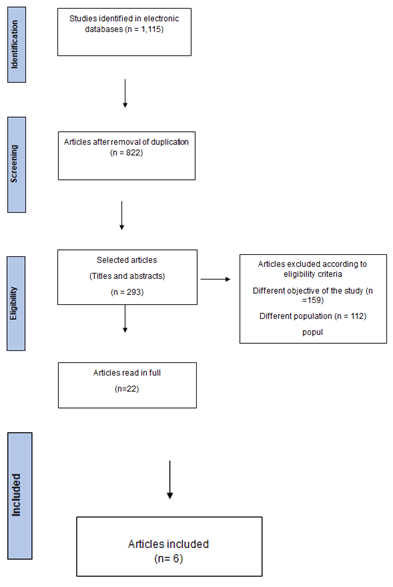
Source: Prepared by the authors adapted. Figure 1: Flowchart of selected studies included in this review according to the PRISMA guideline.
| Study design/Level of evidence (AHRQ) | Country | Characteristics of the population sample | Main results | |
|---|---|---|---|---|
| Thomas, et al. [7] | Cross-sectional study (4) | Australia | 236 students; median age of 12.9 years | It was observed that the main changes were in cognitive functions, especially in response time, which may be related to the increased use of cell phones over a period of one year. |
| Vrijheid, et al. [8] | Longitudinal study (4) | Espanha | Não descreveu | Although no evident trend was identified in relation to use, children who had contact with cell phones tended to show higher scores on the Bayley mental scale, while scores on the psychomotor scale were lower when compared to children who did not have this exposure. |
| Mcneill, et al. [9] | Cross-sectional study (4) | Spain | APA: 185 children; median age 4.2 years | Findings indicated that high exposure to programs (on television or other devices) at the beginning of the research was strongly correlated with an increase in externalizing behaviors and general difficulties after a 12-month period. Furthermore, children who used apps intensively (≥30 minutes per day) had significantly lower inhibition scores compared to those who used them for less time (1 to 29 minutes per day). Thus, research suggests that restricting the use of electronic applications to less than 30 minutes a day and limiting the viewing of media content may be positively related to the cognitive and psychosocial development of preschool children. |
| Fink, et al. [10] | Cross-sectional study (4) | Brazil | 23 children; age 4 to 6 years | The findings of this research indicated that 45.5% of the children analyzed had developmental delays. These delays occurred across a range of ages, but were particularly notable at age 4, where 100% of children showed some type of delay. The most affected areas included personal and social skills, gross motor skills and language. |
| Lin, et al. [11] | Cross-sectional study (4) | Taiwan | 161 children, average of | In summary, the research suggests that a longer period of time using devices with touch screens by young children is correlated with a greater likelihood of experiencing emotional problems, symptoms of anxiety/depression, physical complaints, signs of social isolation, attention difficulties and aggressive behaviors, but is not associated with delays in language development. |
| Suggate; Martzog [12] | Cross-sectional study (4) | Germany | 117 children, did not describe their age | The findings showed that the increase in media use, measured by the Media-Titles test and use for fun, was related to lower performance in tactile and fine motor skills. Unexpectedly, a higher Media-Titles score was associated with superior performance in visual figure discrimination, possibly due to the rapid visual processing of images presented on the screen, with this effect being less pronounced for media used for educational purposes. Active engagement with the media was also linked to better performance in visual figure discrimination. In summary, the study indicates that visual media, due to their sensorial focus on visual experiences, produce distinct effects: a benefit in the visual discrimination of figures, but disadvantages in fine motor skills and tactile skills, highlighting the particular impact of interactions over time. Screen in different sensory modes. |
Table 1: Information and characteristics of the included studies (n=.6).
Source: Prepared by the authors. Table 1: Information and characteristics of the included studies (n=.6).
Of the total number of studies selected, the greatest scientific production on the topic was identified in the PubMed database (n=546), followed by the Science direct databases (n=446), Web of Science (n=100), VHL (n =15) and, finally, from the PsycINFO database (n=08). Regarding the year of publication, there was variability in the periods without predominance between them, varying from (n = 2)
2010, (n = 2) 2019 and (n = 2) 2020 respectively each.
From a methodological point of view, the selected articles presented considerable heterogeneity among themselves in terms of bibliometric data. Regarding the level of evidence of the studies, their greatest occurrence was cross-sectional studies (n=6). Regarding the country of publication, the distribution occurred heterogeneously, with (n = 1) respectively in each of the following: Spain, Brazil, Germany and Taiwan and (n = 2) in Australia. With regard to research participants, the ages of children and adolescents ranged from 4 to 12.9 years old.
| Score | Classification | Observations | |
|---|---|---|---|
| Thomas, et al. [7] | 15 | Moderate | Limited sampling, no blinding of participants reported. |
| Vrijheid, et al. [8] | 15 | Moderate | Limited sampling, no blinding of participants reported. |
| Mcneill, et al. [9] | 19 | Moderate | Limited sampling, no blinding of participants reported. |
| Fink, et al. [10] | 19 | Moderate | Limited sampling, no blinding of participants reported. |
| Lin, et al. [11] | 18 | Moderate | Limited sampling, no blinding of participants reported. |
| Suggate; Martzog [12] | 18 | Moderate | Limited sampling, no blinding of participants reported. |
Table 2: Information and characteristics of the instrument used for Downs and Black’s methodological analysis of the included stu
Source: Prepared by the authors. Table 2: Information and characteristics of the instrument used for Downs and Black’s methodological analysis of the included studies (n=.06).
Table 2 demonstrates the description of the methodological analysis of the Downs and Black scale results. It was observed that the majority of included studies presented moderate methodological quality. The main limitations found were the lack of detailed description of the statistical analysis in some studies, which may compromise the validity of the results. Furthermore, the small sample size in some studies may limit the generalizability of the results. As well as not describing the blinding of participants, as the absence of this procedure can lead to biased results and compromise the reliability of the conclusions.
Our findings corroborate several studies [3, 4]. For example, in a cross-sectional survey involving 126 children with an average age of 85 months, it was observed that a considerable portion of them have access to media devices in their rooms, such as television (61.9%), video games (20, 6%) and computers (34.1%). This highlights a growing negative correlation between frequent exposure to screens and children’s psychomotor development. In addition, there has also been an increase in rates of obesity, depression, anxiety and sleep disorders among these young people [4].
Overall, the studies highlighted different approaches related to the excessive use of screens in children. Therefore, it is understood that, although digital age technology facilitates the search for information and the acquisition of knowledge, strict control over this use is essential, so that it does not cause harm to health. Furthermore, interventions that involve the family and school are essential, as well as pedagogical and pediatric guidance on the excessive use of these new technologies. It is essential that children and adolescents use these tools more consciously, taking into account the associated risks, such as sleep problems, obesity and sudden changes.
According to WHO (2019), children under 2 years old should not have access to TVs, tablets, smartphones or any type of audiovisual device. According to Camara, et al. [13] it is suggested that initial contact with these devices should only be made from the age of 5, with a daily limit of 60 minutes. Nations such as the United States, Australia and Canada establish similar guidelines, recommending that screen time for children aged 2 to 5 should not exceed 1 hour per day. However, a survey carried out with 52 parents of children aged 0 to 12 years indicated that 50% of them started using devices between 8 and 12 months of age Nobre J, et al. [14].
Screen exposure time, defined as the total period in which children are exposed to electronic devices, has increased. Many surveys reveal that the average time exceeds the advised guidelines. According to the literature, 75% of children aged between 2 and 3 years exceed the usage limit, which is in line with the guidelines of the American Academy of Pediatrics [15] on media consumption.
For children aged 2 to 5 years, it is recommended that the use of devices be restricted to 1 hour per day, under the supervision of parents or guardians, with assessment of the age rating of the programs. As for those over 6 years of age and teenagers, it is essential that screen time is also monitored, with a limit of 1 to 2 hours per day, always with supervision Twomey DM, et al. [16].
Furthermore, children and adolescents are more vulnerable to the use of cell phones, due to the fact that their nervous systems are still developing and the possibility of an increase in cumulative exposure to radio frequency (RF) throughout their lives Contrera M, et al. [17].
In addition to biological aspects, there are psychological, social and cultural issues that hinder a child’s ability to adequately filter and process the information received, increasing their susceptibility to risks, as well as the need for access to the virtual environment [17]. It has also been observed that increased exposures affect the child brain differently compared to the adult brain, and this vulnerability may impair nervous system development in adolescence [8].
Currently, the use of digital devices is considered one of the environmental factors that contribute to the emergence of myopia. Likewise, reducing time spent outdoors, which acts as a protective measure against myopia due to exposure to sunlight, is a growing trend. These lifestyle changes, driven by technological innovations, result in the so-called computer vision syndrome. This condition is characterized by blurred and/or double vision, dry and irritated eyes, and can lead, in the long term, to eye problems such as myopia Moreira L [18].
Excessive use of devices can also result in addiction, a phenomenon already noticeable in children and adolescents, which impacts their behaviors and cognitive abilities, often linked to habits established in the family environment and amplified during the isolation imposed by the pandemic. When using these devices, the brain’s reward system is activated, providing a sensation of pleasure comparable to that experienced in chemical dependencies. Experiencing this pleasant sensation means that, more and more, children and young people dedicate their time in front of screens Biernath A [19].
The strengths of this review are that it was carried out following the methodological guidelines of the Cochrane Group and written according to PRISMA. Regarding the limitations of the present study, one of the main ones lies in the limited sample size, consisting of only 6 articles. This restriction may limit the generalization of results to other populations and contexts. The scarcity of research in the area, especially on the topic and specific population, made it difficult to obtain a larger and more diverse sample. Despite these limitations, the results found in this study provide valuable insights into the topic Downs SH, et al. [20].
Although the number of studies included in this review is relatively small, the methodological quality of the selected articles is considerable. The choice for a smaller but more rigorous sample allowed an in-depth analysis of the results, identifying nuances and particularities that could go unnoticed in a more superficial analysis of a large number of studies Hirota T, et al. [21].
However, it is important to recognize that the results of this study must be interpreted with caution, considering the limitations of the sample. We suggest that future research investigate the topic with larger and more diverse samples to confirm and expand the findings presented here; also invest in: carrying out searches in additional databases and in different languages to increase the number of studies included; include studies with different methodologies and cultural contexts to expand results; carry out qualitative analyzes to deepen the understanding of the experiences of the population involved [22].
As limitations, we found methodological variability and participant characteristics, which represents a challenge for the comparability of studies and the generalization of results. This heterogeneity may, in fact, limit the strength of the conclusions we can draw from the review.
We believe that in-depth analysis of heterogeneity, combined with statistical tests and subgroup analyses, contributes to a more cautious and realistic interpretation of results. It is therefore suggested that future research carry out meta-analysis, subgroup analysis and statistical tests to assess the degree of heterogeneity between studies.
Another limiting factor refers to the scarcity of national research on the topic, which limits the generalization of results to the Brazilian reality. The absence of local studies prevents a deeper understanding of the cultural, social and economic factors that may influence results.
We believe that, by recognizing the limitations of the study and proposing solutions for future research, we contribute to the advancement of knowledge on the topic in the Brazilian context. The scarcity of national studies represents a challenge, but also an opportunity to stimulate new research and deepen the understanding of the Brazilian reality.
The lack of national studies is an important limitation, but the research carried out contributes to filling this gap and directs future investigations. By strengthening the discussion about the applicability of results and encouraging new research, we hope to contribute to the development of the area in Brazil.
As practical implications, this study provides a synthesis of evidence that highlights the importance of future investigations with broader, more diverse samples and more robust methodologies, including meta-analyses and subgroup analyses, for a deeper understanding of heterogeneity. Thus, identifying patterns, even in the face of limitations, can guide more targeted and effective interventions, taking into account the influence of cultural, social and economic factors on the excessive use of screens in children and its repercussions.
Although the sample has limitations and the amount of national research is scarce, this study offers a significant contribution by emphasizing the importance of future investigations that identify existing gaps. The lack of specific data from Brazil, for example, hinders a comprehensive understanding of the local phenomenon, making it difficult to formulate appropriate public policies and interventions. Thus, the clinical-practical implications of this work focus mainly on guiding future research, which should seek larger and representative samples, adopt more consistent methodologies and consider relevant contextual variables, with the aim of producing more solid evidence that aligns with to the Brazilian reality. This review, by recognizing its limitations, promotes the advancement of knowledge on the topic, creating opportunities for the development of more effective prevention and intervention strategies related to the repercussions of excessive screen use in children.
Conclusion
This systematic review, despite the limited sample and the lack of national research, addressed the excessive use of screens by children, highlighting the importance of strict control and interventions at family, school, pedagogical and pediatric levels. Research has revealed different perspectives on the issue, all emphasizing the associated risks, which include sleep problems, obesity and behavioral changes. Children’s susceptibility to the effects of screens is attributed to biological factors (such as the development of the nervous system and exposure to radiofrequency), psychological, social and cultural factors, in addition to potential repercussions on vision (such as myopia) and the development of addictions.
Despite the limitations, which include methodological variation between studies and the difficulties associated with generalizing results, this review offers significant contributions and points out directions for future investigations. It is recommended to carry out studies with broader and more diverse sample groups, encompassing different methodological approaches, such as qualitative research that explores children’s experiences in more depth, in addition to considering varied cultural contexts, with an emphasis on the Brazilian scenario, where the scarcity of information is evident. It is also suggested to apply rigorous statistical analyses, such as meta-analyses and subgroup analyses, to better understand the differences observed between studies. The analysis of contextual factors, such as socioeconomic and cultural issues, together with the assessment over time of the impacts of screen use on child development, is fundamental to the advancement of knowledge and the formulation of effective preventive and therapeutic interventions.
Despite the limitations, which include methodological variation between studies and the difficulties associated with generalizing results, this review offers significant contributions and points out directions for future investigations. It is recommended to carry out studies with broader and more diverse sample groups, encompassing different methodological approaches, such as qualitative research that explores children’s experiences in more depth, in addition to considering varied cultural contexts, with an emphasis on the Brazilian scenario, where the scarcity of information is evident. It is also suggested to apply rigorous statistical analyses, such as meta-analyses and subgroup analyses, to better understand the differences observed between studies. The analysis of contextual factors, such as socioeconomic and cultural issues, together with the assessment over time of the impacts of screen use on child development, is fundamental to the advancement of knowledge and the formulation of effective preventive and therapeutic interventions.
References
-
Santos RMS, Mendes CG, Sen B, Alcantara V (2023) The associations between screen time and mental health in adolescents: a systematic review. BMC Psychol 11(1): 127.
-
Boers E, Afzali MH, Newton N, Conrod P (2019) Association of screen time and depression in adolescence. JAMA pediatrics 173(9): 853-859.
-
Kerai S, Almas A, Guhn M, Forer B, Oberle E (2024) Screen time and developmental health: Results from an early childhood study in Canada.
-
Domingues S (2017) Clinical and psychological effects of excessive screen time on children. J Paediatr Child Health 53(4): 333-338.
-
Wang J, Yin XQ, Wang HZ, King DL, Rost DH (2024) The longitudinal associations between internet addiction and ADHD symptoms among adolescentes. Journal of Behavioral Addictions 13(1): 191-204.
-
Page M, McKenzie JE, Bossuyt PM, Boutron I, Hoffmann TC, et al. (2021) The PRISMA 2020 statement: an updated guideline for reporting systematic reviews. BMJ 372: n71.
-
Thomas S, Benke G, Dimitriadis C, Inyang I, Sim MR, et al. (2010) Use of mobile phones and changes in cognitive function in adolescentes. Occup Environ Med 67.
-
Vrijheid M, Martinez D, Forns J, Guxens M, Julvez J (2010) Prenatal Exposure to Cell Phone Use and Neurodevelopment at 14 Months. Epidemiology 21(2).
-
McNeill J, Howard SJ, Vella SA, Cliff DP (2019) Longitudinal Associations of Electronic Application Use and Media Program Viewing with Cognitive and Psychosocial Development in Preschoolers. Academic Ped 19(5).
-
Lin H, Chen K, Chou W, Yuan K, Yen S (2020) Prolonged touch screen device usage is associated with emotional and behavioral problems, but not language delay, in toddlers. Infant Behavior and development 58.
-
Fink K, Melo TR, Israel VL (2019) Tecnologias no desenvolvimento neuropsicomotor em escolares de quatro a seis anos. Cad Bras Ter Ocup 27(2).
-
Suggate S, Martzog P (2021) Children’s sensorimotor development in relation to screen-media usage: A two- year longitudinal study. J Applied Developmental Psychol 74.
-
Camara HV (2020) Main biopsychosocial damages in abusive use of child technology: parental perceptions. ID On line: Revista de psicologia 14(51).
-
Nobre J, Vinolas P, Santos J, Santos L, Pereira L, et al. (2024) Quality of interactive media use in early childhood and child development: a multicriteria analysis. Jornal de Pediatria.
-
(2019) Digital guidelines: Promoting healthy technology use for children. Am Academy of Ped.
-
Twomey DM, Wrigley C, Ahearne C, Murphy R, Haan M, et al. (2018) Feasibility of using touch screen technology for early cognitive assessment in children. Arch Dis Child 103(9): 853-858.
-
Contrera M, Schiavo S (2017) Exposicao de criancas a midia eletronica e processos mimeticos. Comunicacao e inovacao 18(38).
-
Moreira L (2024) Consequences of early screen time on child development. Brazilian J Development 7(10): 97125-97133.
-
Biernath A (2022) Como uso excessivo de celular impacta cerebro da crianca. BBC news.
-
Downs SH, Black N (1998) The feasibility of creating a checklist for the assessment of the methodological quality both of randomised and nonrandomised studies of health care interventions. J Epidemiol Community Health.
-
Hirota T, Takahashi M, Adachi M, Sakamoto Y (2020) Neurodevelopmental Traits and Longitudinal Transition Patterns in Internet Addiction: A 2-year Prospective Study. J Autism Dev Disord 51(4): 1365-1374.
-
(2020) Excessive screen use and gaming considerations during COVID19. World Health Organization (WHO).
- Editorial on Multimodal Analgesia
- Surgical Incision Site Local Anaesthetic Infiltration and Superior Hypogastric Plexus Block in Total Abdominal Hysterectomy Under General Anaesthesia- A Placebo-Controlled, Randomized Clinical Trial
- Supraglottic Airway Insertion in Semi Fowler Position Due to Severe Thoracic Hyperkyphosis: A Case Report
- Anaesthetic Management of Cardiac Myxoma Patient with Systemic Involvement: A Case Report
- Current Problems in Pulmonary Respiratory Distress Syndrome (Literature Review)
- Evolution of Perioperative Hemodynamic Monitoring from the Hand on Pulse to Hypotension Prediction Index