
Chronic Toxicity in Wistar Rats of Cytoreg, An Ionic Antineoplastic Therapeutic Mix of Strong and Weak Acids
Drugs are used for prevention, diagnosis and treatment of diseases of humans or other living things. The efficacy and safety of new drugs must be shown in order for the compounds to become marketable. In the research and development of drugs, it should be taken into account different types of pharmacological and toxicological tests. Among preclinical trials are chronic toxicity studies. Cytoreg® is a new formulation comprising a mixture of strong and weak acids having a concentration of hydrofluoric acid (HF) referred to by the supplier of 55 g/liter. Cytoreg® is being tested as an anticancer drug. We conducted a chronic toxicity study in rats using conventional Pharmacological methods. We used a dose of Cytoreg® at 0.49 ml / Kg., Orally for 9 months. It did not cause death in any of the animal subjects, and no clinical alterations of weight, food consumption, and hematology or blood chemistry. An increase in SGPT was observed, consistent with liver congestion. There was a low incidence of Intestinal inflammatory lesions in the first 5 months of treatment, and low incidence of liver congestion. The lesions observed are consistent with the compound irritating actions.
Introduction
Toxicity tests are today an important stage in the development of new drugs. In the development of new compounds, in order to take them to human consumption, stages of preclinical phases involving experimentation must be completed. In order to answer the question: Is the drug harmful or toxic to cells or organ systems?, research must be conducted using animals to find out if a drug, procedure, or treatment is likely to be useful.
Drugs are used for prevention, diagnosis and treatment of diseases of humans or other living beings; efficacy and safety of new drugs must be shown to in order for these become marketable. It is widely known that no drug is absolutely safe and that there is always risk of adverse reactions, but knowing advantages and disadvantages, therapeutic benefits along with the risks of complications, allow regulators to determine whether the drug should be or not permitted for human consumption.
Among the diseases that affect humans, cancer causes about 13% of all deaths. 7.6 million People died of cancer in the world during the year 2007 [1, 2]. In the research and development of new drugs, different types of pharmacological and toxicological tests must be performed, in order to validate. Among these are preclinical studies, which allow evaluating the safety of any drug under development [3]. In vivo animal testing is an important part of the preclinical phase that precedes the application of the drug in humans [4]. According to WHO experts [3], they recommend attention to three aspects: the drug, the animals used, and operating methods; with respect to the latter, it is proposed to use repeated dosing, which include chronic or long term toxicity studies (three to six months).
Test agent Cytoreg® (Cytorex de Venezuela, S.A.) is being studied as an antineoplastic agent, and has been described that this preparation inhibits the growth and proliferation of many cancer cell lines [7, 8]. It is presented in liquid form, with a mixture of strong and weak acids, with a concentration-HF Hydrofluoric Acid - reported by the supplier, at 55 grams/liter. Hydrofluoric Acid (HF) is the active compound in the acid balanced mix which also includes sulfuric acid (H2SO4), hydrochloric acid (HCl), phosphoric acid (H3PO4), oxalic acid (C2H2O4) and citric acid (C6H8O7). Concentrations of the test agent active compound Cytoreg®, which are referred in this work, are all in terms of hydrofluoric acid (HF). The Jesus RD, et al. Chronic Toxicity in Wistar Rats of Cytoreg, An Ionic Antineoplastic Therapeutic Mix of Strong and Weak Acids. Adv Clin Toxicol 2019, 4(4): 000170.
purpose of this study is to evaluate the chronic toxicity Cytoreg® as part of its preclinical evaluation.
Material and Methods
Animals: female Wistar rats outbred at the animal Vivarium at the University of Los Andes (Merida, Venezuela), 8 weeks old and with an average weight of 222.9 grams, in a range of 215-238 grams. The animals were housed in cubicles under sanitary barriers and sterilization of supplies and maintenance, with 12 hour light / dark, and access to food and drink at will. Material: Pharmacological Cytoreg® compound provided by Cytorex of Venezuela, .A. (a subsidiary of Cytorex International, Inc. ), supplied in liquid form, consisting of a mixture of strong and weak acids having a concentration of hydrofluoric acid (HF), with a concentration of 55 grams/liter, as referred by the supplier. Hydrofluoric acid is the active compound in the acid equilibrium mixture, which also includes 10% sulfuric acid (H2SO4), 10% hydrochloric acid (HCL), 3% phosphoric acid (H3PO4), oxalic acid 0.3% (C2H2O4) and 0.3% citric acid (C6H8O7).
Experimental Design
The animals were grouped into 2 cohorts: a control group (N = 5), and a treatment group (N = 20). Cytoreg® was placed daily in the drinking water of the animals which is calculated at 20 ml, which when ingested totally is equivalent to a dose of 0.49 ml /Kg. of the compound. This is the minimum lethal dose determined in a previous study which is equivalent to 26.95 mg/Kg.
The animals were observed daily to monitor their medical condition; the weight and weekly food consumption during the experimental period of 9 months were recorded. Body weight was determined individually on a scale for all animals, prior to first dosing and weekly until the study ended.
At the end of the third month of treatment, a first batch of the treated group, 5 rats taken at random (Rats 1, 2, 3, 13 and 14), as well as 1 control group rat were sacrificed. At the end of the fifth month of treatment a second batch of the treated group, 5 rats taken at random (6, 8, 11, 15 and 18 as well as 1 control group rat were sacrificed. At the end of seventh month of treatment a third batch of the treated group, 5 rats taken at random, (4, 7, 10, 16 and 19) as well as 1 control group rat were sacrificed. At the ninth month of treatment. 4 rats of the treated group (5, 9, 12 and 17) and 1 control rat were sacrificed. The 2 remaining treated rats were left non- sacrificed in order to study survival, remaining normal to twelve months. The sacrifice of rats was performed with sodium thiopental overdose (Penthotal®), for the purpose of practicing a macroscopic necropsy examination and sampling of liver, kidney, brain, lung, stomach, small Intestine, large Intestine and spleen, for microscopic study.
Laboratory Tests
Nine (09) rats of treated group (1, 2, 3, 6, 11, 13, 14, 15 and 18) and 2 rats in the control group we subjected to hematology testing at start, and every three months thereafter. These rats also tested for glutamic pyruvic transaminase (ALT - Alanine aminotransferase), glutamic oxalacetic transaminase (AST-aspartate aminotransferase) and serum creatinine at three months of starting treatment and again at six and nine months.
Pathological studies
The following organs were macroscopically and histologically processed: brain, lung, liver, kidney, stomach, small Intestine, large Intestine, heart, and spleen (one subject). Processing of the organs was performed by the method of paraffin, and the stain method used was hematoxylin-eosin. The analysis was performed in the Department of Pathology, University Hospital of Los Andes, Merida, Venezuela.
Results
Clinical Observations
At the end of the study animal survival was 100%, no animal showed detectable clinical manifestations presented, all showed normal physical state and the usual behavior of the species, including those that were not killed and survived until the end of the study (12 months).
Evolution of Food Consumption
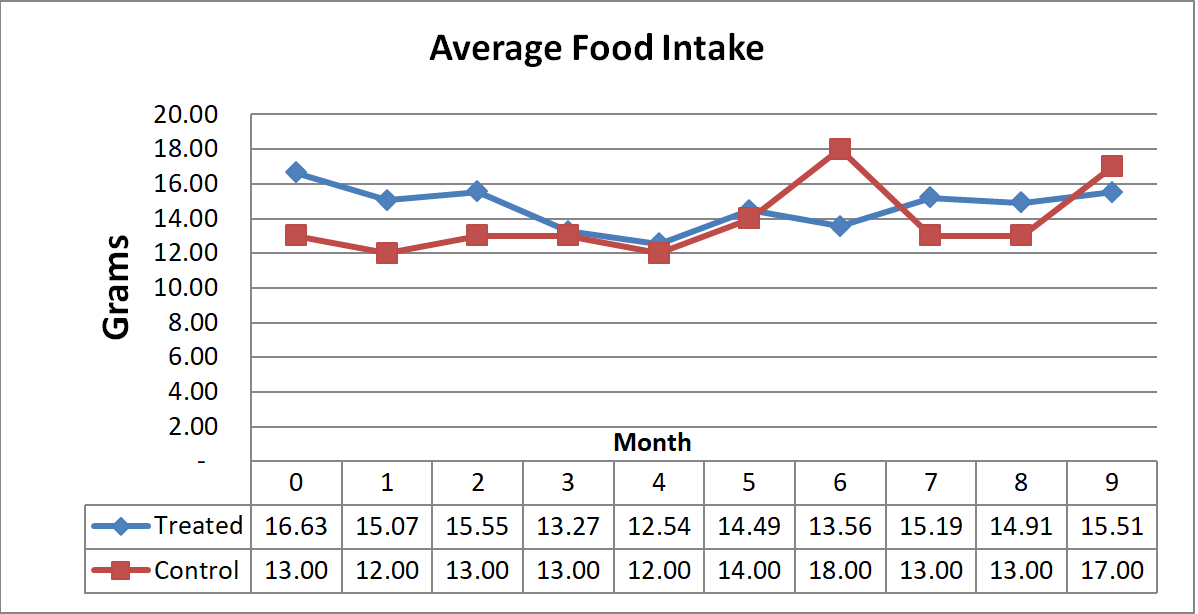
Food intake behavior remained discreetly irregular throughout the study. Figure 1 evaluates monthly consumption, and shows that in the treated group, in the first 5 months food consumption decreased, although not significantly, then increased progressively, with a tendency to stabilize in the last two months.
Jesus RD, et al. Chronic Toxicity in Wistar Rats of Cytoreg, An Ionic Antineoplastic Therapeutic Mix of Strong and Weak Acids. Adv Clin Toxicol 2019, 4(4): 000170.
Evolution of Weight
Although animal was weighted weekly, Figure 2 shows the evolution of weight taking the average of the last week of the month.
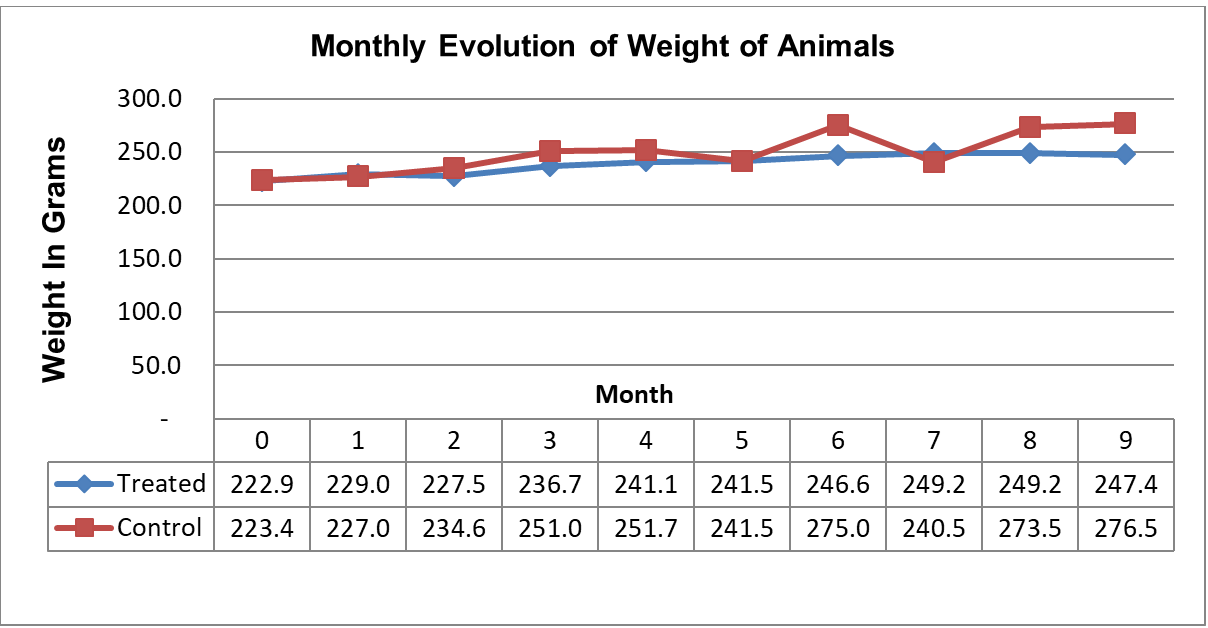
At the end of the study an increase in weigh was observed in the treated group, less than the control group. This intergroup increment was not statistically significant.
Laboratory Tests
Tables 1 & 2, show results of laboratory tests performed to randomly select. Rats of both the control and the treated groups.
| SGOT | SGPT | Creatinine | HT % | HB | WC | ||||||||||||||
|---|---|---|---|---|---|---|---|---|---|---|---|---|---|---|---|---|---|---|---|
| Rat/time of treatment | |||||||||||||||||||
| T1/month 3 | 22 | 23 | 1.7 | 39 | 16.1 | 4.1 | |||||||||||||
| T2/month 3 | 21 | 22 | 1.2 | 41 | 17 | 4.8 | |||||||||||||
| T3/month 3 | 23 | 22 | 1.3 | 40 | 15.8 | 8.25 | |||||||||||||
| T13/month 3 | 21 | 21 | 1.9 | 38 | 15.2 | 4.6 | |||||||||||||
| T14/month 3 | 21 | 21 | 1.5 | 41 | 26.5 | 3.9 | |||||||||||||
| T6/month 5 | 18 | 21 | 0.76 | 40 | 17.9 | 1.6 | |||||||||||||
| T8/month 5 | - | 21 | 1 | 41 | 15 | 5 | |||||||||||||
| T11/month 5 | 18 | 21 | 0.78 | 41 | 14.5 | 3.45 | |||||||||||||
| T15/month 5 | 20 | 22 | 0.76 | 32 | 18 | 1.35 | |||||||||||||
| T18/month 5 | 22 | - | 1 | 25 | 15.28 | 3.45 | |||||||||||||
| T4/month 7 | 28.7 | 57.7 | 1.1 | 30 | 12.62 | 4.65 | |||||||||||||
| T7/month 7 | 23.5 | 29.5 | 0.8 | 38 | 9.63 | 3.8 | |||||||||||||
| T10/month 7 | 22.5 | 25.1 | 1 | 32 | 11.02 | 4.25 | |||||||||||||
| T16/month 7 | 21.6 | 28.9 | 1 | 40 | 13.64 | 3.45 | |||||||||||||
| T19/month 7 | 22.5 | 27.3 | 0.9 | 38 | 9.97 | 3.95 | |||||||||||||
| T5/month 9 | 24 | 25.5 | 0.7 | 32 | 13.7 | 4.5 | |||||||||||||
| T9/month 9 | 23.8 | 59.1 | 0.9 | 42 | 12.3 | 4.35 | |||||||||||||
| T12/month 9 | 23.6 | 84.6 | 0.9 | 40 | 16.5 | 2.35 | |||||||||||||
| T17/month 9 | 24.9 | 100.9 | 1 | 40 | 16.9 | 3.95 | |||||||||||||
| Average | 22.93 | 43.78 | 0.9 | 35.83 | 13.67 | 3.63 | |||||||||||||
| Rat/time of treatment | |||||||||||||||||||
| C2/month 5 | 20 | 22 | 0.8 | 40 | 17 | 5 | |||||||||||||
| C3/month 7 | 21 | 22 | 1 | 30 | 11.23 | 5.05 | |||||||||||||
| C4/month 9 | 22 | 22 | 1 | 32 | 14.6 | 5.55 | |||||||||||||
| Average | 21 | 22 | 1.03 | 35.25 | 14.71 | 5.31 |
Table 1: Laboratory Tests Results of Experimental Groups (Treated Group).
Jesus RD, et al. Chronic Toxicity in Wistar Rats of Cytoreg, An Ionic Antineoplastic Therapeutic Mix of Strong and Weak Acids. Adv Clin Toxicol 2019, 4(4): 000170.
- T= Treated Animal, C= Control Animal, SGOT = serum glutamic-oxaloacetic transaminase, SGPT = serum glutamic-pyruvic transaminase, HT = hematocrit, HB = hem oglobin, WC = white blood cells.
- There were no statistically significant differences in mean laboratory tests of both groups, except for SGPT which is increased by month 9.
- The highest incidence was present the first 5 months of treatment with a decrease in months 7 and 9
- Rat/time of treatment
- Liver
- Kidney
- Brain
- Small Intestine
- Stomach
- Large Intestine
- Lung
- T1/3 months
- D&PVC
- ATN
- PH
- MCI
- PH
- PH
- IFN
- T14/3 months
- PH
- PH
- PH
- PH
- PH
- PH
- PH
- T6/ 5 months
- PH
- PH
- PH
- PH
- PH
- PH
- FEn
- T15/ 5 months
- -
- ATN (M)
- PH
- MCI(f)
- -
- MCI
- FEn
- T10/month 7
- PH
- PH
- MDGM(sg)
- MCI(f)
- PH
- PH
- IECI
- T19/7 months
- PH
- -
- PH
- MCI(f)
- PH
- MCI(f)
- IECI
- T2/month 9
- PH
- PH
- PH
- PH
- PH
- MCI
- IFN
- T9/month 9
- PH
- PH
- Rg
- PH
- PH
- -
- IFN
- Pathological findings
- The lesions observed are summarized in Tables 4-7.
Table 2: Synopsis of histological findings (Histological Diagnoses) found in animals, analyzed in detail (Treated Group).
| SGOT | SGPT | Creatinine | HT % | Hb | WC | |||||||||||||
|---|---|---|---|---|---|---|---|---|---|---|---|---|---|---|---|---|---|---|
| Treated | 22.93 | 43.78 | 0.9 | 35.83 | 13.67 | 3.63 | ||||||||||||
| Control | 21 | 22 | 1.03 | 35.25 | 14.71 | 5.31 |
Table 3: Summary of Laboratory Tests.
- Table 4: Synopsis of histological findings (Histological Diagnoses) found in animals, analyzed in detail (Treated Group).
- Rat T15/5 months of treatment.
- Spleen: Severe splenic congestion.
- Rat/Time of Treatment
- Liver Kidney Brain
- Small Intestine
- Stomach
- Large Intestine
- Lung
- C1/3 months
- PH
- PH
- PH
- -
- -
- -
- In
- C2/ 5 months
- PH
- PH
- -
- PH
- PH
- -
- In
- C3/month 7
- PH
- PH
- PH
- PH
- PH
- -
- In
- C4/month 9
- PH
- PH
- PH
- PH
- PH
- MCI
- In
Table 4: Synopsis of histological findings (Histological Diagnoses) found in animals, analyzed in detail (Control Group).
Jesus RD, et al. Chronic Toxicity in Wistar Rats of Cytoreg, An Ionic Antineoplastic Therapeutic Mix of Strong and Weak Acids. Adv Clin Toxicol 2019, 4(4): 000170.
| Organ | No. of Rats/Total | Percentage (%) | ||||||
|---|---|---|---|---|---|---|---|---|
| Kidney | 7-Jan | 14.28 | ||||||
| Lung | 4-Apr | 85.71 | ||||||
| Stomach | 4-Jan | 0 | ||||||
| Liver | 8-Feb | 25 | ||||||
| Large Intestine | 6-Feb | 33.33 | ||||||
| Small Intestine | 8-Apr | 50 | ||||||
| Brain | 8-Feb | 25 | ||||||
| Spleen | 7-Jan | 14.28 | ||||||
| Heart | 0/4 | 0 |
Table 5: ## Discussion
| Organ | No. of Rats/Total | Percentage (%) | ||||||
|---|---|---|---|---|---|---|---|---|
| Kidney | 0/4 | 0 | ||||||
| Lung | 4-Jan | 25 | ||||||
| Stomach | 4-Jan | 25 | ||||||
| Liver | 0/4 | 0 | ||||||
| Large Intestine | 4-Jan | 25 | ||||||
| Small Intestine | 0/4 | 0 | ||||||
| Brain | 0/4 | 0 | ||||||
| Heart | 0/4 | 0 |
Table 6: Number and percentage of lesions observed in the experimental groups* (Control Group).
Discussion
In the present study we tested a relatively high dose of Cytoreg®, which is the estimated minimum lethal dose obtained in previous acute toxicology experiment. Daily administration of these doses for 9 months did not cause the death of any animal [4, 7]. There was no weight loss or significant reduction of food intake in both groups of treatment. In the first 5 months, food consumption decreased, although not significantly. After 5 months, a slight increase was observed and it remained stable until the end of the experiment. Statistical analysis showed no differences between the control group and the treated group. This ascending behavior of discrete gain weight in both groups (Control and Treated). From baseline to 9 months occurred, regardless of the conditions to which the animals were subjected. This reflects that there are no adverse effects on this indicator by the daily administration of the compound Cytoreg® for 9 months [7].
When analyzing the behavior of all hematologic variables in the two groups, there was no difference in the mean values. In Table II we see the following values:
Jesus RD, et al. Chronic Toxicity in Wistar Rats of Cytoreg, An Ionic Antineoplastic Therapeutic Mix of Strong and Weak Acids. Adv Clin Toxicol 2019, 4(4): 000170.
hemoglobin 16.50 in the control group and 16.31 in the treated group; hematocrit of 39.0% in the control group and 38.5% in the treated group; and WBCs. 3.63 in the control group and 5.650 in the treated group.
The interpretation of the biochemical data. as well as the results of statistical analysis shows that there is no involvement of the indicators examined, by oral administration of Cytoreg® during 9 months. The existence of a stable performance shows. no evidence for a relationship between administration of the test substance and blood biochemical parameters. In the ninth month of treatment, we observed an increased alanine aminotransferase which is a sign of liver damage, which from the pathological point of view coincides with liver congestion. This would explain an increased transaminase, but without hepatic necrosis, since the levels of SGOT did not increase.
The pathological study revealed some alterations in the organs. Table IV shows the percentage of these injuries. In the stomach no abnormalities were observed, but injuries in the intestines there were a relatively high percentage; in the small intestine 33.33% and in the large intestine 50.00%, being primarily inflammatory, which is compatible with the acidic nature of the compound. These inflammatory lesions tend to disappear after 7 months of treatment. In the liver we observed the same percentage of lesions in both groups, 25%, mainly liver congestion, which seems an injury unrelated to treatment with the compound, because the untreated group has the same effect. In the lung, interstitial pneumonitis was observed in 85.71% of the treated group, however in the control group showed a 100% pneumonitis, so it seems to be a compound-independent factor to explain this interstitial pneumonitis.
Conclusion
• Cytoreg® used at relatively high doses and for 9
months produced no mortality in animals
- No changes were observed in hematology, but there was an increase of liver enzymes (SGPT) in 3 of 4 rats. In the ninth month of treatment, which could be due to liver congestion?
- In general, pathological lesions observed are consistent with the acidic nature of Cytoreg®, at the beginning of the treatment, but showing a tendency to disappear towards the end of the study.
References
-
Sociedad Americana de Cáncer (2011) [citado 2011 Enero] [alrededor 3p]. Obtenido: 27 Enero 2011 de.
-
Jermal A, Siegel R, Xu Jiaquan, Ward E (2010) Cancer Statistics. CA Cancer J Clini 60: 227-300.
-
OMS (Organización Mundial de la Salud) (1966) Principios aplicables a estudios preclínicos de la inocuidad de los medicamentos. Series de Informes técnicos, pp: 341.
-
Giráldez DA, Romero VA (2000) Cap. 18. Procedimientos experimentales en farmacología y toxicología, pp: 1-25. Jesus RD, et al. Chronic Toxicity in Wistar Rats of Cytoreg, An Ionic Antineoplastic Therapeutic Mix of Strong and Weak Acids. Adv Clin Toxicol 2019, 4(4): 000170.
-
AVECAL (2008) Manual para la produccion y uso ético de los animales de Laboratorio. Ministerio del Poder Popular para la Ciencia y la Tecnologia, Caracas-Venezuela.
-
MPPCT (Ministerio Del Poder Popular Para La Ciencia Y La Tecnologia E Industrias Intermedias). (2012) Normas para la utilización de animales en investigacion: en experimentación en el laboratorio. obtenidos en sus habitats. estudios de sus patologias y de su comportamiento natural- 7.
-
Kumi-Diaka J, Hassanhi M, Brown J, Merchant K, Garcia C, et al. (2006) Inhibits Growth and Proliferation of Human Adenocarcinoma Cells via Induction of Apoptosis. Journal of carcinogenesis 5: 1- 8.
-
Johnson MM, Kumi-Diaka KJ, Zoeller R, Graves BS, Merchant KT, et al. (2012) Therapeutic efficacy of Genistein-Cytoreg® combination in breast cancer cells. Functional Foods in Health and Disease 2(5): 137-150.
-
(2008) Manual Bioética y Bioseguridad. Cap. 3, pp: 33-35.
-
MPPCT (Ministerio Del Poder Popular Para La Ciencia Y La Tecnología E Industrias Intermedias) (2008) Normas para la utilización de animales en investigación: en experimentación en el laboratorio. obtenidos en sus hábitats. estudios de sus patologías y de su comportamiento natural- Manual Bioetica y Bioseguridad. Cap. 3: 33-35.
-
Díaz M, Bulus G, Pica Y (2004) Capítulo 5. Métodos Estadísticos para el Analisis de Resultados de Toxicidad. International Development Research Center, pp: 11.
- Evaluation of Skin Aging Preventive Effects of Cherry Blossom Petal Extracts Through Antioxidant and Anti-Glycation Activities
- Is Cell Death Responsible for False Positive Results of In Vivo Comet Assay?
- Pattern of Gonadal Hormones in Oral Testosterone-Supplimented Male Wistar Rats with Diabetes-Induced Hypogonadism
- Re-Evaluation of the Genotoxicity of Currently Used Food Dyes in Mouse Multiple Organs Via Continuous Administration by Drinking Using the Comet Assay
- Pharmacogenetics of Type 2 Diabetes Mellitus: Linking Genetic Variability to Drug Efficacy and its Cardiovascular Outcomes
- Exploratory Proteomic Profiling of SARS-CoV-2 Infected THP-1 Macrophages Reveals Alterations in Inflammatory Response and Cellular Metabolism