
Can Essential Oils be a Potent Alternative of Synthetic Antioxidants?
Aromatic plants and spice are well known for their beneficial properties on human health. A considerable amount of literature is present where the studies are mainly focused on the antioxidant and antimicrobial properties of the plant extracts. Essential oils are one of the plant extracts mainly consists of volatile and non-volatile parts having numerous applications in multiple industries. They are widely used in perfumery and pharmaceutical industries. Now days, they have a very high commercial value due to its therapeutic properties. The therapeutic properties are related to bioactive compounds present in these essential oils. Numbers of review articles have reported about their strong radical scavenging capacity and ability to inhibit lipid peroxidation, especially in food and cosmetic products. They are complex mixtures of volatile compounds such as terpenes (mostly monoterpenes and sesquiterpenes), phenolics and alcohols. However, the essential oils are highly complex and may include oxygenated compounds. The variability among their chemical composition reported in various studies made their comparison very difficult. The other main concern in interpretation of the published results is the variation found among the analytical methods used for the determination of antioxidant capacity of these Essential oils. These antioxidant assays differ from each other in terms of reaction mechanisms, oxidant and target species, reaction conditions. Therefore, a multipletest and a simultaneous chemical characterization must be taken into account whenever assays of these essential oils are performed. Furthermore, prooxidant property of essential oils is also reported which is related to proteins and DNA damage at cellular level. All these factors must be taken into account when the antioxidant properties of essential oils are considered. However, seeing the current trends towards green consumerism and results published in support of the antioxidant properties of these essential oils, it will be a potent alternative of synthetic antioxidants.
Introduction
Oxidation is one of the main causes of food degradation and raises major concern regarding food security. It is a multidirectional reaction causing undesirable changes in the organoleptic properties of food products. There is loss in nutritional values and sensory characteristics of food products. Oxidation can be observed through off-flavors, color change and bad odor. For prevention from these oxidation reactions, synthetic additives in the form of antioxidants are used. Antioxidants are those compounds which can prevent, alter and even end oxidative reactions at relatively low concentrations. In recent years, various studies reported the oxidative defects which are related to oxidative stress or imbalance in prooxidant and antioxidant molecules ratio in human body leads to various atherscelerosis, cancer, diabetes, cardiovascular, neurodegenerative disorders. Substances having antioxidant properties are able to delays, prevent or remove oxidative damage to the target molecule [1]. For retarding lipid peroxidation, synthetic antioxidants such as butylated hydroxytoluene (BHT) and butylated hydroxyanisole (BHA) have been used widely for many years, but recently concern has been raised about the safety issues related to these synthetic antioxidants [2, 3]. This concern forces scientific community to find alternative to theses synthetic antioxidants. Globally now the consumers are more aware about what they eat and how it processed which leads a significant increase in products and additives of natural origin. With this respect spices, herbs, Essential oils (EOs) and their derived constituents play an important role in exerting antioxidant activity. EOs are secondary metabolites of plants and define as a more or less volatile material isolated from an odorous plant of a single botanical species by a physical process. They are synthesized by all plant organs such as buds, flowers, leaves, stems, twigs, seeds, fruits, roots, wood or bark, and are stored in secretory cells, cavities, canals, epidermic cells or glandular trichomes [4]. These oils are mainly complex mixture of terpenes and their oxygenated derivatives such as aldehydes, ketones, alcohols, phenols, acids, ethers and esters [5]. Table 1 listed some of the major components present in EOs [2]. Many research groups have explored the efficacy of these essential oils derived from various plant families such as lamiaceae, apiaceae, cupressaceae, asteraceae, Myrtaceae and found very significant results with respect to antioxidant activity [6].
| Essential Oils from Various Sources | Major Antioxidant Compounds |
|---|---|
| Clove | Phenolic acids (gallic acid), flavonol glucosides, phenolic volatile oils (eugenol, acetyl eugenol), Tannins |
| Turmeric | Curcumin, 4-hydroxycinnamoylmethane |
| Ginger | Shogoal, gingerol |
| Mace | Myristphenone |
| Marjoram | Beta-carotene, beta-sitosterol, caffeic-acid, carvacrol, eugenol, hydroquinone, linalyl- acetate plant 3–17,myrcene, rosmarinic-acid, terpinen-4-ol |
| Nutmeg | Myristphenone, phenolic volatile oils, phenolic acid (caffeic acid), flavanols (catechin) |
| Oregano | Caffeic acid, p-coumaric acid, rosmarinic acid, caffeoyl derivatives, cavacrol, flavonoids |
| Red pepper | Beta-carotene fruit, beta-sitosterol plant, caffeic acid campesterol, camphene fruit, capsaicin fruit, capsanthin fruit, chlorogenic-acid fruit, eugenol fruit, gamma-terpinene fruit, hesperidin fruit, myristic acid |
| Rosemary | Carnosol, 12-O-methylcarnosic, rosmanol, caffeic acid, rosmarinic acid, caffeoyl derivatives, phenolic diterpenes (carnosic acid), carnosol, epirosmanol, flavonoids |
| Sage | Rosmanol, epirosmanol, phenolic acids (rosmarinic acid), phenolic diterpenes (carnosic acid), flavonoids |
| Thyme | Phenolic acids (gallic acid, caffeic acid, rosmarinic acid), thymol, phenolic diterpenes, flavonoids |
Table 1: Antioxidant constituents of some essential oils
Extraction Methods and Chemistry Involved in EOs
Various methods have been employed to extract the essential oils from plant matrices. Different methods can be used for this purpose; expression, distillation, solvent extraction and emergent methods such as microwave assisted extraction, ultrasonic assisted extraction and supercritical fluid extraction [7]. Steam distillation is one of the common processes of extracting essential oils. Once the oil extracted, techniques like Gas chromatography coupled with mass spectrometry is used to analyse the chemical composition of EOs [8]. There may be around 20 to 60 different bioactive components in each EO which makes the chemical composition of EOs more complex [9]. There are over 300 different variable numbers of polar and non-polar components at different concentrations [10]. The composition of EOs from particular species can differ widely according to the environmental, geographical conditions. The composition also depends on the part which has been used for extraction of the essential oils [11]. For example, dill (Anethum graveolens) EOs are chemically different when extracted from seeds than when extracted from leaves [12].
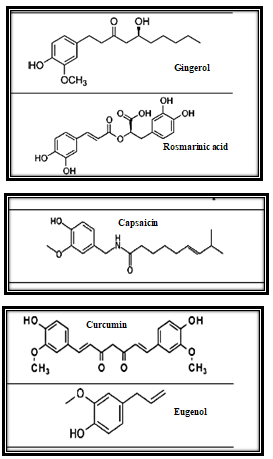
In coriandrum sativum, the percentage of major compound linalool was 70% in seeds EOs while it was limited to 26% in leaves EOs [13]. The drying process has increased the yield of essential oil from 94.0 to 98.4% along with increase in percentage of major component, that is, piperitinone oxide from 79.9 percentage to 88.5% in mint essential oil extracted from leaves [14]. Structures of some antioxidants components of EOs are shown in Figure 1 [2].
Antioxidant Assays and Discussion
For the determination of the antioxidant activity of EOs several analytical methods were employed. DPPH (2,2-diphenyl-1-picrylhydrazyl), FRAP 3 (ferric reducing antioxidant power), ORAC (oxygen radical absorbance capacity), total phenolics content, ABTS (2,2 OE-azino-bis(3- ethylbenzothiazoline- 6-sulphonic acid)), CUPRAC (cupric reducing antioxidant capacity), TRAP (total radical-trapping antioxidant parameter), TEAC (Trolox equivalent antioxidant capacity) are the most frequently used methods [2, 15, 16]. These methods may be classified as electron transfer (ET) and hydrogen atom transfer (HAT)-based assays on the basis of mechanism of the antioxidant action. ET assay includes the ABTS/TEAC, CUPRAC, DPPH, Folin-Ciocalteu and FRAP involves electron transfer reaction, whereas ORAC assay, radical-trapping antioxidant involve hydrogen transfer reaction. The antioxidant activities and antioxidant compounds obtained from EOs also depend on the analytical methods used. In many cases, solvent extractants and temperature have significant effect on the antioxidant activity of spices [17]. The critical evaluation of various antioxidant assays discussing the concepts and technical limits are also reported [18].
EOs obtained from traditional plants such as Achillea filipendulina, Galagania fragrantissima, Anethum graveolens, A. rutifolia, Hyssopus seravschanicus, Mentha longifolia, and Ziziphorac linopodioides are rich sources of oxygenated monoterpenes [10]. In addition, monoterpene hydrocarbons are the major chemical compounds in A. absinthium and A. scoparia and phenolic terpenoids, such as thymol or carvacrol in Ocimum tyttanthum and Mentha longifolia [10]. Indeed phenolic compounds (Figure 1), like thymol, eugenol, rosmarinic acid, gingerol, capsaicin and carvacrol, are the main potent antioxidant compounds in EOs as they can donate hydrogen atoms to free radicals and transform them to more stable products [19]. Linalool, 1,8-cineole, geranial/neral, citronellal, isomenthone, menthone, and some monoterpenes also play a key role in the antioxidant properties of EOs [20]. The report also suggested that there are several modes of direct or indirect antioxidant actions including prevention of chain initiation and free-radical scavenging activity [20]. Studies have reported the presence of phenolic compounds which are the major reason behind the antioxidant activity. It was suggested that Phenolic and other secondary metabolites bind with double bonds, which is responsible for the substantial antioxidant activity of EOs [10]. EOs of Origanum. majorana, Coriandrum sativum, Hedychium. spicatum, C. myrrha, and C. odorata were evaluated for their antioxidant activities through DPPH free radical scavenging and the β-Carotene/linoleic acid bleaching assay [21]. The antioxidant activity of H. spicatum is found to be lowest among the tested EOs due to lower percentage of phenolic content.
Conclusion
EOs is recognized as GRAS (generally recognized as safe) by agencies like FDA [22]. Although, there is a vast published results now available on the antioxidant efficacies of EOs and greater acceptance towards the usage of EOs has been increased recently but still, there are many areas are untouched by the scientific community. The variability in chemical nature and composition of EOs available in published results made their comparison and interpretation very difficult. Synergistic effects of more than one constituent made the interpretation of results not very clear. The second serious issue is the diversified analytical assays present to evaluate the antioxidant activities which make the interpretation of results more difficult. These assays have their own target molecule and different mode of action. A single-substance/single-assay produces relative results whenever a complex mixture is involved. Therefore, while performing assays on EOs, a multiple-assay and simultaneous chemical characterization must be taken into account. However the lipophilic nature of these EOs are easily penetrable through the cell membrane and reaches the target site. Furthermore, besides having antioxidant activity, the ability to behave as prooxidant in some cases should be taken into account before its wider application. Prooxidant property is a concentration dependent phenomenon and causes damage at cellular level such as DNA damage [23]. Thymol, carvacrol and γ-terpinene when present in high concentration increased DNA damage while when these components present in low concentration protected DNA from breakage. Standardization of investigating methods, complementary experiments in various in vivo biological systems should be done which validate the results related to the mode of action of these essential oils having antioxidant efficacies.
Acknowledgements
The authors are grateful to their respective Departments and Institutions for their unconditional support.
References
-
Halliwell B, Gutteridge JMC (2007) Free Radicals in Biology and Medicine; Oxford University Press Inc: New York.
-
Singh S (2021) Antioxidants properties of some spices with their chemistry and mechanism of action. MOJ Biology and Medicine 6(1): 33-35.
-
Abdulmumeen HA, Ahmed NR, Agboola RS (2012) Food: Its preservatives, additives and applications. Int J Chem Biochem Sci 1: 36-47.
-
Bassolé IHN, Juliani HR (2012) Essential Oils in Combination and Their Antimicrobial Properties. Molecules 17(4): 3989-4006.
-
Betts TJ (2001) Chemical characterization of the different types of volatile oil constituents by various solute retention ratios with the use of conventional and novel commercial gas chromatographic stationary phases. Journal of Chromatography A 936(1-2): 33-46.
-
Mimica-Dukic N, Orcic D, Jovin, E, Lesjak M, Sibul F (2016) Essential oils as antioxidants: Misconception or scientific facts? In Jeliazkov (Zheljazkov) and Cantrell; Medicinal and Aromatic Crops: Production, Phytochemistry, and Utilization ACS Symposium Series; American Chemical Society: Washington, DC.
-
Singh S, Chaurasia PK, Bharati SL (2021) Extraction methods and Chemical Characterization of volatile oils (essential oils). In Sunita Singh (Ed.) Volatile oils: Production, Composition and Uses, 1st (Edn.), Novascience publishers, pp: 1-30.
-
Adams RP (2017) Identification of essential oil components by gas chromatography/mass spectrometry. 5th online (Edn.), Texensis Publishing.
-
Bauer K, Garbe D, Surburg H (2001) Common Fragrance and Flavor Materials: Preparation, Properties and Uses. Wiley-VCH, Weinheim, pp: 293.
-
Bhavaniramya S, Vishnupriya S, Al Aboody MS, Vijayakumar R, Baskaran D (2019) Role of essential oils in food safety: Antimicrobial and antioxidant applications. Grain & Oil Science and Technology 2(2): 49-55.
-
Delaquis PJ, Stanich K, Girard B, Mazza G (2002) Antimicrobial activity of individual and mixed fractions of dill, cilantro,coriander and eucalyptus essential oils. International Journal of Food Microbiology 74(1-2): 101-109.
-
Singh S, Das SS, Singh G, Schuff C, lampasona MP, et al. (2017) Comparison of chemical composition, antioxidant and antimicrobial potentials of essential oils and oleoresins obtained from seeds and leaves of Anethum graveolans L. Toxicology Open Access 3: 119.
-
Falleh H, Jemaa MB, Saada M, Ksouri R (2020) Essential Oils: A Promising Eco- Friendly Food Preservative. Food Chemistry.
-
Singh S (2020) Effect of drying on the yield and chemical composition of essential oils obtained from Mentha longifolia leaves. MOJ Food Process Technology 8(2): 67-
-
Moon JK, Shibamoto T (2009) Antioxidant assays for plant and food components. Journal of Agriculture and Food Chemistry 257(5): 1655-1666.
-
Ereifej KI, Feng H, Rababah TM, Tachtoush SH, Al Udatt M, et al. (2016) Effect of extractant and temperature on phenolic compounds and antioxidant activity of selected spices. Food and Nutrition Science 7: 362-370.
-
Thippeswamy NB, Naidu A (2005) Antioxidant potency of cumin varieties-Cumin, black cumin and bitter cumin- On antioxidant systems. European Food Research and Technology 220: 472-476.
-
Schaich KM, Tian X, Xie J (2015) Hurdles and pitfalls in measuring antioxidant efficacy: A critical evaluation of ABTS, DPPH, and ORAC assays. Journal of Functional Foods 14: 111-125.
-
De Souza WFM, Mariano XM, Isnard JL, De Souza GS, Gomes ALS, et al. (2019) Evaluation of the volatile composition, toxicological and antioxidant potentials of the essential oils and teas of commercial Chilean boldo samples. Food Research International 124: 27-33.
-
Rodriguez Garcia I, Silva Espinoza BA, Ortega Ramirez LA, Leyva JM, Siddiqui MW, et al. (2016) Oregano essential oil as an antimicrobial and antioxidant additive in food products. Crit Rev Food Sci Nutr 56(10): 1717-1727.
-
Prakash B, Singh P, Kedia A, Dubey NK (2012) Assessment of some essential oils as food preservatives based on antifungal, antiaflatoxin, antioxidant activities and in vivo efficacy in food system. Food Research International 49(1): 201-208.
-
Kabara J (1991) Phenols and chelators. Food Preservatives, In: Russell N, et al. (Eds.), Blackie, Glasgow, pp: 200–214.
-
Aydin S, Başaran AA, Başaran N (2005) The effects of thyme volatiles on theinduction of DNA damage by the heterocyclic amine IQ and mitomycin C. Mutat Res 581(1-2): 43-53.
- Pattern of Gonadal Hormones in Oral Testosterone-Supplimented Male Wistar Rats with Diabetes-Induced Hypogonadism
- Re-Evaluation of the Genotoxicity of Currently Used Food Dyes in Mouse Multiple Organs Via Continuous Administration by Drinking Using the Comet Assay
- Pharmacogenetics of Type 2 Diabetes Mellitus: Linking Genetic Variability to Drug Efficacy and its Cardiovascular Outcomes
- Exploratory Proteomic Profiling of SARS-CoV-2 Infected THP-1 Macrophages Reveals Alterations in Inflammatory Response and Cellular Metabolism
- Study of Genotoxicity of Hepatocarcinogens in Multiple Organs in Mice by Feeding and Drinking Using the Comet Assay
- Spirulina Polypeptides Inhibit the Growth of Human Lung Tumor (H460) Cells