
Mycotoxins and Mycotoxigenic Fungi in Ready to Eat Spices and their Prevention
The study aimed at monitoring the effect of long storage of the daily-used spices under varying humidity on the development of mycotoxins and their producing fungi. The spices samples were analyzed for mycotoxins and their potential producing fungi. The results showed that Aspergillus, Eurotium, Fusarium, and Penicillium were the most frequent genera on spices. Aspergillus flavus, A. niger, A. niveus, Eurotium chevalieri, Fusarium oxysporum, F. verticillioides, Penicillium cyclopium, and P. waksmanii were detected as potential mycotoxin-producing fungi. The results exhibited the contamination of spices with aflatoxin B1 and G1, zearalenone, citrinin, and sterigmatocystin in high concentration (66.45µg/Kg, 12.64µg/Kg, 0.064µg/Kg, 0.065µg/Kg, and 0.065µg/Kg, respectively). The results proved that time were a key factor in development of fungi and their mycotoxins. After six months of storage under high RH% (75-80%), the total count of fungi was increased dramatically in some spices like as dill (9.1 x 10⁴ CFU/ g) and sumac (23.16 x 10² CFU/g). However, in the other spices, storage under moderate (50-55%) or natural humidity (10-45%) encouraged the development of fungi more than under high humidity %. The study recommends consumers to use dry fresh spices and not store them for more than two months.
Introduction
Spices from the plant species (seed, leaves, stem, or roots) contain aromatic or acrid substances that provide Investigation Paper flavor, perfume, and color to foodstuffs. Some spices are used as preservatives or they have antioxidant, anti-inflammatory, and anti-fungal effects. Cinnamon, cloves, dill, fennel, ginger, roselle, sumac, thyme, and mustard are among the popular and widely used spices and they are grown in tropical countries [1]. Spices are usually subjected to a relatively long time of storage, which could extend to a year or more, during which they are exposed to contamination with various microbes [2]. Spices are also exposed to extensive microbial contamination during cultivation in the fields or during processing, transportation, and storage [3].
At the time of collection from the fields, the primary source of contamination comes from the soil and air [1]. Fungi are the predominant microbial contaminants of spices [3, 4] which are potential inhabitants of the tropical climates—characterized by high temperatures, rainfall, and humidity [5]. The fungal genera of Aspergillus and Penicillium are foremost spice contaminants [6]. Some species of these genera are known to be responsible for the off-flavor of products and the production of mycotoxins [7]. Overall, fungal contamination of spices occurs when they are insufficiently dried or stored for long periods under humid conditions [3]. The relative humidity is a primary variable that affects spore germination and fungal growth, with subsequent production of mycotoxin being substantial if such conditions are not effectively controlled during storage [8].
Mycotoxins are natural fungal substances produced as secondary metabolites that are characterized by their low molecular weight. Mycotoxins vary in terms of their chemical structures, toxicity levels, target organs or biological effects [9, 10]. Given that mycotoxins are everyday contaminants and due to their direct effects on human health, spices contamination with these is considered to be a cause of considerable concern [11]. The mycotoxin level secreted by the fungi differs according to physical factors (moisture, relative humidity, and temperature), chemical factors (carbon dioxide, oxygen, and fungicide use), as well as biological factors (plant species) [3].
Even at limited levels, mycotoxins are recognized for their marked detrimental effect on human health. Aflatoxins (AFs)-including aflatoxin B1 (AFB1), aflatoxin B2 (AFB2), aflatoxin G1 (AFG1), and aflatoxin G2 (AFG2)-are a substantial category of mycotoxins prevalent in food crops [12]. Of these, AFB1 has been identified as being foremost in having the greatest toxicity. The International Agency for Research on Cancer (IARC) categorized certain Afs as carcinogenic to humans (Group 1), with this classification including both B-type Afs and G-type Afs [13]. Zearalenone (ZEA) is a mycotoxin secreted by certain species of the genus Fusarium. Its mechanism of action includes a capacity for binding to estrogen receptors, resulting in reproductive system problems [14]. On the other hand, Penicillic acid and citrinin (CIT) are produced by the majority of fungi that produce ochratoxin A (OTA). Despite extensive work that treated the contamination of seeds and plants with fungi and mycotoxins, spices got little attention from scientists [6].
We hypothesize that the incidence of mycotoxins and their potential producing fungi in spices as important food-additives must be monitored periodically to meet the requirements of global quality control based on the available new data. Therefore, our study aimed to evaluate the effect of relative humidity and duration of storage on the development of mycotoxins and their potential producing fungal species in nine common spices in Abha city, Asir region, Saudi Arabia. The study deals with the very important issue of the favorable time and humidity levels under which the spices could be stored with very low contamination of mycotoxin producing fungi. It could provide critical information to the producers and consumers about the factors that affect the development of mycotoxins in spices and the measures that should be adopted to keep the spices free from mycotoxins and their producing fungi.
Materials and Methods
Sampling
Samples of nine different spices were collected from the commercial markets in Abha, Saudi Arabia. The samples included a powdered and raw form of spices based on their nature of commercialization (Table 1).
| Latin Name | Family | Used Part | Spice Form | |
|---|---|---|---|---|
| Cinnamon | Cinnamomum zeylanicum (Nees) | Lauraceae | Stem bark | Raw/powder |
| Clove | Syzygium aromaticum (L.) (Merr. &L.M.Perry) | Myrtaceae | Buds | Raw/powder |
| Dill | Anethum graveolens (L.) | Apiaceae | Leaves and seeds | Raw |
| Fennel | Foeniculum vulgare (Mill.) | Apiaceae | Fruits | Raw |
| Ginger | Zingiber officinale (Roscoe) | Zingiberaceae | Fleshy rhizome | Raw/powder |
| Mustard | Brassica nigra (L.) (K.Koch) | Brassicaceae | Seeds | Raw |
| Roselle | Hibiscus sabdariffa (L.) | Malvaceae | Green leaves and the red calyxes | Raw |
| Sumac | Rhus coriaria (L.) | Anacardiaceae | Dried fruits | Powder |
| Thyme | Thymus vulgaris (L.) | Lamiaceae | Leaves and stem | Raw/powder |
Table 1: Names, families and the used parts of collected spices.
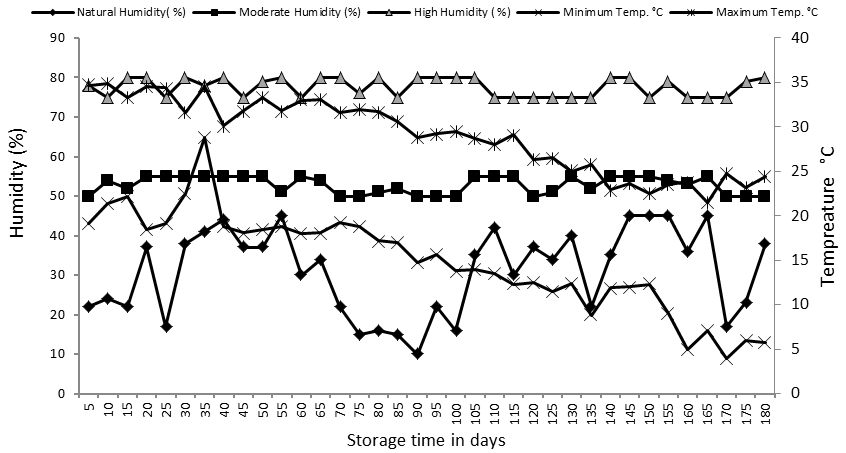
The samples (200 g per each) from the spices were placed in sterilized polyethylene bags and stored at 4°C until the mycological and toxicological analyses. From each sample, 100 g was used for the analysis of fungal load and natural mycotoxins’ occurrence. The other 100 g was used to evaluate the effect of storage conditions on the development of mycotoxin and their potential producing fungi. The experiment proceeded by storing the spices for six months under three levels of humidity at room temperature (5- 34.7°C). The three levels of humidity were; natural relative humidity (NH) ranging from 10% to 45%, moderate relative humidity (MH) ranging from 50% and 55%, and high relative humidity (HH) ranging from 75% to 80%. The fluctuation in temperature and humidity levels during the storage period was recorded 5-days intervals (Figure 1).
Materials
Czapek-dox agar (CDA) medium was brought from CDH Bioscience (P) Ltd., New Delhi (India), while HTC-2 Digital Hygrothermograph was purchased from Shenzhen Oway Technology Co., Ltd. (China). Chloroform, acetone, toluene, ethyl acetate, acetic acid, and formic acid used in the extraction and separation of mycotoxins were obtained from Atom Scientific Ltd., United Kingdom. Silica gel (SiO2), 60 GF254 was bought from Qingdao Kangyexin Medicinal silica gel desiccant Co., Ltd (China).
Aflatoxins B1 (AFB1) and G1 (AFG1), sterigmatocystin (STE), zearalenone (ZEA), and citrinin (CIT) standards were provided by the Department of Botany and Microbiology, Faculty of Science, Assiut University, Assiut, Egypt. The following solvent systems were used for the separation of the mycotoxins: chloroform: acetone (CA) at a ratio of 93:7 and 90:10; chloroform: methanol (CM) at a ratio of 97:3; Toluene: Ethyl acetate: Acetic acid (TEAc) at a ratio of 8:1:1, as well as Toluene: Ethyl acetate: Formic acid (TEFa) at a ratio of 6:3:1 and 5:4:1, for AFB1 and AFG1, CIT, STE, and ZEA, respectively [15].
Mycological Analysis of the Spices
The fungal species were isolated from the spice samples through a standard dilution plate [16] on a CDA medium, which had been sterilized in an autoclave at 121°C for 15 min. Ten g of each sample was transferred into a 250-mL screw-capped medicinal bottle, containing 90 mL of sterile distilled water, which was then subjected to mechanical homogenization for 15 min at a consistent speed (150 rpm) on a rotary shaker. Tenfold serial dilution were then prepared, after which 1 mL of suitable dilutions were used for inoculating the Petri plates containing 20 mL CDA medium amended with 0.5 mg chloramphenicol/mL. The plates were incubated at 27±1°C for 7 days. The emerging fungi were counted, with the results expressed in colony-forming units per gram of a sample (CFU/g). Identification of the fungal species was undertaken based on their morphological and microscopic feature using specific identification manuals [17, 18].
Relative Frequency of Fungal Contamination
The incidence of the fungal species contaminating the spices was determined by calculating the relative frequency (RF%) as mentioned by Gautam AK, et al. [19] according to the following equation RF% = (No. of contaminated samples / Total No. of the analyzed samples) × 100
The Relative Density of Fungal Contamination
The incidence of the fungal species contaminating the spices was determined by calculating the relative density (RD%) as mentioned by Gautam AK, et al. [19] according to the following equation RD% = (No. of the isolates of certain genus or species in a specific spice / Total isolates of all genera or species observed in the samples analyzed) × 100
Extraction and Qualitative Determination of Mycotoxins
The method of Kong W, et al. [6] was followed with a modification. From each sample, 10g was ground into a fine powder and mixed in 100 mL of chloroform. The sample- solvent suspension was shaken (150 rpm) for 24h, followed by filtration using Whatman paper No. 1. The filtrate was transferred to a new bottle and stored in a dark place for evaporation and form a concentrate of approximately one mL. For the qualitative estimation of the mycotoxins, thin layer chromatography (TLC) technique was adopted. Silica gel (SiO2), 60 GF254 of approximately 0.3mm thickness was prepared for TLC. The plates were air-dried and then incubated in an oven at 110°C for 2h. Subsequently, they were left to cool and then stored. Furthermore, solvent solutions were applied to separate the distinct mycotoxins.
Qualitative Determination of Mycotoxins in spice Samples
Ten μL of the crude extracts was spotted on the TLC plates, along with the standard. Cold airflow was applied to the plates to dry the spots, followed by their placement within a solvent chamber saturated with solvent system vapor. Once the solvent front attained a height of approximately 8cm above the origin, the developed plates were removed with the chromatogram and dried in the air, after which detection was conducted. The plates were viewed under shortwave (254 nm) and longwave (356 nm) ultraviolet radiation. The mycotoxins expressed a distinctive fluorescent color with specific retention flow under the longwave ultraviolet radiation, with the aflatoxins B1 and G1 respectively represented by blue and green colors, whereas CIT was illuminated as a lemon-yellow color. Additionally, STE and ZEA appeared as red-brown and blue-green, respectively [20].
Concerning the mycotoxin chemical confirmation, the desired band was sprayed with the reagent, while the plate’s remainder was covered with a plain glass plate. Once the band expressed the confirmative color, the covering plate was removed. Particular reagents were applied as a means of chemically confirming the mycotoxins: sulpho-ethanol for aflatoxins B1 and G1, expressing a yellow confirmative color at a wavelength of 365 nm; aqueous sulfuric acid for CIT, expressing a yellow-green confirmative color at a wavelength of 365 nm; AlCl3-ethanol for STE, expressing a yellow confirmative color at a wavelength of 257 nm, as well as AlCl3-acetic acid for ZEA, expressing a blue confirmative color at a wavelength of 257 nm [20].
Quantitative determination of mycotoxins (AFB1, AFG1, ZEA, STE, and CIT)
The concentration of mycotoxins was estimated quantitively using the spectrophotometric method in methanol at the relevant wavelength, followed by calculation based on the formula [21]: Mycotoxin concentration (μg/mL) = (A× Mwt× C× F)/ Є. Where A = Absorbance; Mwt = Molecular weight; C (cell) = 1; F = Dilution factor and Є = Extinction coefficient.
Statistical Analysis
All experiments were repeated twice, and each spice was represented by ten samples (n =10). Data represented here are means of the replicates. All data represent with their means. One-way analysis of variance (ANOVA) was used to identify statistically significant differences among the means of consumed and unconsumed sugar and ethanol production in scale-up experiments. The least significant difference (LSD) test was used at P < 0.05 to identify the significant differences between the means among the treatments.
Results and Discussion
The fungal incidence in spices’ samples
We found that the most prevalent fungal species isolated on the Czapek’s agar medium from the nine spices either in the raw or powdered samples belonged to four genera Aspergillus, Eurotium, Fusarium, and Penicillium. From 105 isolates, 61 belonged to Aspergillus, 20 belonged to Eurotium spp., 18 belonged to Penicillium, and only six isolates were identified as Fusarium spp. (Table 2). The powder samples of ginger had the highest incidence of fungal colonization, representing 17.14% of RD%, followed by raw fennel (14.25%), powdered cinnamon (10.48%), and powdered thyme (10.48%). The lowest incidence of fungal contamination was recorded in the powdered samples of either clove or sumac (0.95%), followed by a raw clove (1.90%). Moderate fungal contamination was observed in other spices where the RD% ranged from 4.76% to 8.75%. The highest number of isolates belonging to Aspergillus (12 isolates) was detected on the powdered ginger, however, Eurotium (4 isolates) was present in the case of powdered cinnamon and thyme. The highest number of isolates of Penicillium (4 isolates) was obtained from raw ginger and powdered thyme, however, Fusarium was represented by only two isolates as the highest incidence of this fungus on raw thyme.
| Strains of Fungal Isolates | No. of Isolates | Rd (%) | |
|---|---|---|---|
| Cinnamon (powder) | Aspergillus (6), Eurotium (3), Penicillium (2) | 11 | 10.48 |
| Cinnamon (raw) | Aspergillus (5), Eurotium (2), Penicillium (2) | 9 | 8.57 |
| Clove (powder) | Eurotium (1) | 1 | 0.95 |
| Clove (raw) | Aspergillus (2) | 2 | 1.9 |
| Dill (raw) | Aspergillus (4), Fusarium (1) | 5 | 4.76 |
| Fennel (raw) | Aspergillus (10), Eurotium (2), Fusarium (1), Penicillium (2) | 15 | 14.29 |
| Ginger (powder) | Aspergillus (12), Eurotium (3), Fusarium (1), Penicillium (2) | 18 | 17.14 |
| Ginger (raw) | Aspergillus (4), Eurotium (2), Penicillium (4) | 10 | 9.52 |
| Mustard (raw) | Aspergillus (4), Eurotium (2), Fusarium (1), Penicillium (1) | 8 | 7.62 |
| Roselle (raw) | Aspergillus (5) | 5 | 4.76 |
| Sumac (powder) | Aspergillus (1) | 1 | 0.95 |
| Thyme (powder) | Aspergillus (4), Eurotium (3), Penicillium (4) | 11 | 10.48 |
| Thyme (raw) | Aspergillus (4), Eurotium (2), Fusarium (2), Penicillium (1) | 9 | 8.57 |
| Total | Aspergillus (61), Eurotium (20), Fusarium (6), Penicillium (18) | 105 | 100 |
Table 2: Relative density % (RD%) of the fungal isolates contaminating the spices.
From the above results, we are of opinion that Aspergillus, Eurotium, Fusarium, and Penicillium are the main genera, involved in the contamination of spices. The results and assumptions were consistent with earlier reports stated fungal contamination of different examined spices [3, 4, 6]. Interestingly, almost all potentially mycotoxin-producing species belong to these four genera [22]. Based on this finding, our study considered the evaluation of RF% of the potential mycotoxin-producing fungi in the following section.
Mycotoxin Potential Producing Fungal species Contaminating spices
Among the potential mycotoxin-producing fungal species, A. flavus, A. niger, A. niveus, E. chevalieri, F. oxysporum, F. verticillioides, P. cyclopium, and P. waksmanii were isolated in a high relative frequency (Table 3) from the tested spices. A. flavus was recovered from 80% of the raw dill and raw mustard samples (RF% = 80). It was also recorded from raw roselle and raw thyme in 60% RF. A. niger was obtained in 20%-50% RF from all spices except sumac. A. niveus was recorded in fennel, ginger, roselle, and thyme, while E. chevalieri was recorded in 10%-20% RF in cinnamon, dill, and sumac. F. oxysporum was obtained only from ginger and mustard, whereas F. verticillioides was detected in most cases. P. cyclopium was obtained only from ginger. However, P. waksmanii was obtained from cinnamon, ginger, mustard, and roselle. All of these species were previously mentioned as mycotoxin-producing fungi [3, 22]. A. flavus and A. niger were approved as common fungi growing in different substrates [6, 14]. Also, these fungal species were frequently isolated from the stored seeds and spices under varying climate conditions [4, 23]. From the previous results and those of our study, the predominance of these spices as a main source of spices’ contamination under a wide range of climate and different ecological latitudes is confirmed.
| A. flavus | A. niger | A. niveus | E. chevalieri | F. oxysporum | F. verticillioides | P. cyclopium | P. waksmanii | |
|---|---|---|---|---|---|---|---|---|
| Cinnamon (powder) | 50.0 c | 30.0 c | 0.0 d | 10.0 b | 0.0 c | 20.0 d | 0.0 b | 25.0 a |
| Cinnamon (raw) | 40.0 d | 40.0 b | 0.0 d | 20.0 a | 0.0 c | 30.0 b | 0.0 b | 20.0 b |
| Clove (powder) | 10.0 e | 30.0 c | 0.0 d | 0.0 c | 0.0 c | 20.0 d | 0.0 b | 0.0 d |
| Clove (raw) | 0.0 f | 20.0 d | 0.0 d | 0.0 c | 0.0 c | 25.0 c | 0.0 b | 0.0 d |
| Dill (raw) | 80.0 a | 30.0 c | 0.0 d | 20.0 a | 0.0 c | 25.0 c | 0.0 b | 0.0 d |
| Fennel (raw) | 60.0 b | 40.0 b | 25.0 b | 20.0 a | 0.0 c | 20.0 d | 0.0 b | 0.0 d |
| Ginger (powder) | 60.0 b | 50.0 a | 0.0 d | 0.0 c | 30.0 a | 50.0 a | 0.0 b | 0.0 d |
| Ginger (raw) | 50.0 c | 30.0 c | 20.0 c | 0.0 c | 0.0 c | 0.0 e | 25.0 a | 20.0 b |
| Mustard (raw) | 80.0 a | 20.0 d | 0.0 d | 0.0 c | 20.0 b | 0.0 e | 0.0 b | 20.0 b |
| Roselle (raw) | 60.0 b | 40.0 b | 30.0 a | 0.0 c | 0.0 c | 20.0 d | 0.0 b | 10.0 c |
| Sumac (powder) | 10.0 e | 0.0 e | 0.0 d | 10.0 b | 0.0 c | 0.0 e | 0.0 b | 0.0 d |
| Thyme (powder) | 0.0 f | 20.0 d | 25.0 b | 0.0 c | 0.0 c | 0.0 e | 0.0 b | 0.0 d |
| Thyme (raw) | 60.0 b | 40.0 b | 0.0 d | 0.0 c | 0.0 c | 25.0 c | 0.0 b | 0.0 d |
Table 3: Relative frequency % (RF %) of potential mycotoxin-producing fungal species isolated from the tested spices.
Values followed by the same letter in the same column are not significant at P < 0.05. Table 3: Relative frequency % (RF %) of potential mycotoxin-producing fungal species isolated from the tested spices.
Mycotoxins Detected in Natural Contaminated spices
From the examined spices, five mycotoxins were detected as natural contaminants in considerable concentrations (Table 4). Aflatoxin B1 (AFB1) was the most frequent toxin, which was detected from dill, fennel, ginger, roselle, and sumac in 66.45µg/Kg, 65.12µg/Kg, 3.55µg/Kg, 39.25µg/Kg, and 41.94µg/Kg of spices, respectively. Aflatoxin G1 (AFG1) was obtained only from ginger (12.64µg/Kg); zearalenone (ZEA) only from cinnamon and clove in 0.051µg/Kg and 0.064µg/Kg, respectively; citrinin (CIT) from mustard (0.021µg/Kg) and thyme (0.065µg/Kg) and sterigmatocystin (STE) only from thyme (0.065µg/Kg). These mycotoxins and their potential producing fungal species (A. flavus, A. niger, E. chevalieri, F. verticillioides, P. cyclopium and P. waksmanii) were frequently recovered from spices from different countries [6, 11, 24, 25, 26]. Aflatoxins, citrinin, sterigmatocystin, and zearalenone were frequently recovered from cinnamon, clove, fennel, ginger, and mustard [27, 28].
| Spices | Aflatoxin B1 | Aflatoxin G1 | Zearalenone | Citrinin | Sterigmatocystin | |||||
|---|---|---|---|---|---|---|---|---|---|---|
| μg/Kg | RF% | μg/Kg | RF% | μg/Kg | RF% | μg/Kg | RF% | μg/Kg | RF% | |
| Cinnamon (powder) | - | - | - | - | - | - | - | - | - | - |
| Cinnamon (raw) | - | - | - | - | 0.051±0.005 b | 50 | - | - | - | - |
| Clove (powder) | - | - | - | - | 0.064±0.006 a | 80 | - | - | - | - |
| Clove (raw) | - | - | - | - | - | - | - | - | - | - |
| Dill (raw) | 66.451±5.26 a | 60 | - | - | - | - | - | - | - | - |
| Fennel (raw) | 65.117±6.23 a | 80 | - | - | - | - | - | - | - | - |
| Ginger (powder) | - | - | - | - | - | - | - | - | - | |
| Ginger (raw) | 3.548±0.85 | 40 | 12.642±2.96 | 60 | - | - | - | - | - | - |
| Mustard (raw) | - | - | - | - | - | 0.021±0.009 b | 50 | - | - | |
| Roselle (raw) | 39.25±2.36 c | 80 | - | - | - | - | - | - | - | - |
| Sumac (powder) | 41.944±2.39 b | 60 | - | - | - | - | - | - | - | - |
| Thyme (powder) | - | - | - | - | - | - | 0.107±0.025 a | 60 | 0.065±0.008 | 80 |
| Thyme (raw) | - | - | - | - | - | - | - | - | - | - |
Table 4: Natural contamination of spices with mycotoxins (μg/Kg) and their relative frequency (%).
Values followed by the same letter in the same column are not significant at P < 0.05. Table 4: Natural contamination of spices with mycotoxins (μg/Kg) and their relative frequency (%).
In agreement with our finding, Adebayo-Tayo and Samuel [29] reported the presence of AFB1 in roselle in the range of 1.57µg/Kg-17.8μg/Kg. Aziz NH, et al. [16] reported that AFB1’s maximum detected level within fennel samples was 160μg/Kg. The AFB1 levels identified in cumin samples ranged between 1.89µg/Kg and 4.64μg/Kg in Malaysia [30].
The coriander samples contained AFs at a mean of 1.7μg/ Kg in Bahrain [31]. The detected AFB1 level in turmeric samples in Pakistan was 6.54μg/Kg [32]. Indeed, our results showed that AFG1 was present in raw ginger at a level of 12.642μg/Kg whereas AFB1 was detected at a level of 3.548 μg/Kg. Moreover, thyme was found to be tainted by AF at low levels, potentially due to thyme’s essential oil having an inhibitory effect on the production of AF. Nevertheless, this research detected STC and CTN in powdered thyme at the respective level of 0.065μg/Kg and 0.107μg/Kg. AFB1 was detected in the Indian mustard samples. A recent review by Thanushree MP, et al. [3], who examined all available data about contamination of spices with mycotoxins, our study is the first report about the contamination of these spices with aflatoxin B1 and citrinin.
Effect of Storage of spices under Varying Humidity Levels on Development Mycotoxins and their Potential Producing Fungi
The effect of humidity on mycotoxin and their potential producing fungi were studied in the spices’ samples, which were stored under different humidity % for six months. The fluctuation in the humidity % and related temperatures were monitored in Figure 1. We used three humidity levels-natural humidity (10%-45%) to represent the actual humidity during the construction of the experiment. We used a moderate humidity (50%-55%) and high humidity (75%-80%) to study the effect of the expected humidity during all seasons of the year on the storability of the spices in the region where the experiment was constructed (Abha, Saudi Arabia).
The results showed that the storage of spices under a varying humidity level encouraged fungal propagation. The increase in the humidity percentage along with the time increased the fungal count and mycotoxin concentration (Table 5). The natural humidity (NH) and moderate humidity (MH) encouraged the development of fungi up to 2.2 x 10² CFU/g and 2.23 x 10² CFU/g, respectively after 6 months of storage, however high humidity (HH) had not a considerable effect on the development of fungi. The highest count in clove was detected after 6 months under NH as 0.3 x 10² CFU/g. The HH greatly increased the development of fungi in dell after 6 months and the total count was 9.1 x 10⁴ CFU/g. When fennel spice was stored under HH, the highest count of fungi was detected after one month (4.68 x 10³ CFU/g), after that the count decreased. In the case of both ginger and mustard, the highest count of fungi was detected after 6 months under NH (0.34 x 10² CFU/g and 2.03 x 10² CFU/g, respectively). The highest count of fungi in roselle was observed after 6 months under MH as 3.1 x 10² CFU/g. when sumac spice was stored under HH, the highest total count of developing fungi was detected (2.32 x 10³ CFU/g), however the highest count of fungi in thyme (7.46 x 10² CFU/g) was observed after 6 months when the spice was stored under MH.
| Spices | Natural humidity | Moderate humidity | High humidity | ||||||
|---|---|---|---|---|---|---|---|---|---|
| (10-45%) | (50-55%) | (75-80%) | |||||||
| 30 days | 90 days | 180 days | 30 days | 90 days | 180 days | 30 days | 90 days | 180 days | |
| Cinnamon | 0.03 e | 0.67 e | 2.20 d | 1.30 e | 1.40 d | 2.23 d | 0.50 d | 0.03 c | 0.67 d |
| Clove | 0.00 f | 0.13 g | 0.30 g | 0.00 h | 0.01 h | 0.04 g | 0.00 d | 0.01 c | 0.14 d |
| Dill | 1.35 b | 5.60 a | 13.40 a | 3.10 a | 2.90 a | 9.10 a | 124.0 a | 223.0 a | 910.0 a |
| Fennel | 0.11 d | 0.31 f | 1.03 f | 1.40 d | 2.30 c | 3.00 c | 46.80 b | 0.11 c | 0.31 d |
| Ginger | 0.09 d | 0.29 f | 0.34 g | 0.04 g | 0.10 g | 0.09 g | 0.02 d | 0.02 c | 0.09 d |
| Mustard | 0.34 c | 1.03 d | 2.03 e | 0.05 g | 0.34 f | 0.43 e | 0.03 d | 0.32 c | 0.38 d |
| Roselle | 2.70 a | 2.70 b | 2.80 c | 2.60 b | 2.70 b | 3.10 c | 2.70 c | 2.70 b | 2.80 c |
| Sumac | 0.30 c | 0.30 f | 0.33 g | 0.30 f | 0.30 f | 0.36 f | 0.33 d | 0.40 c | 23.16 b |
| Thyme | 1.41 b | 1.73 c | 7.46 b | 1.61 c | 1.03 e | 4.14 b | 0.03 d | 0.07 c | 0.10 d |
Table 5: Effect of storage of spices under varying humidity% on the total count of developing potential mycotoxins fungi (x102 CF
Values followed by the same letter in the same column are not significant at P < 0.05. Table 5: Effect of storage of spices under varying humidity% on the total count of developing potential mycotoxins fungi (x102 CFU / g).
During the storage period that was extended to 6 months, 5 mycotoxins were detected in the spices. Among which aflatoxin B1 was the most prevalent where it was detected in six spices (dill, fennel, sumac, roselle, ginger, and mustard (Figure 2). The highest concentration of this toxin was detected in dill spice (66.45-76.52µg/Kg), flowed by fennel (65.11-68.7µg/Kg). It was noticed that the humidity % has a conspicuous effect on the development of the toxins. In the other four spices, aflatoxin B1 was detected in concentration 2.37-52.5µg/Kg (Figure 2). Zearalenone was detected in 4 spices (fennel, roselle, clove, and cinnamon) and its concentration ranged from 0.006µg/Kg to 0.211µg/ Kg (Figure 3). Citrinin was determined in concentration
0.107-0.187µg/Kg from thyme, and in 0.021-0.17µg/Kg from mustard (Figure 4). Strigmatocystin was detected in dell and thyme in a concentration of 0.01-0.392 µg/Kg (Figure 5). Aflatoxin G1 was detected in ginger spice only in concentration from 12.64µg/Kg to 17.35µg/Kg (Figure 6).
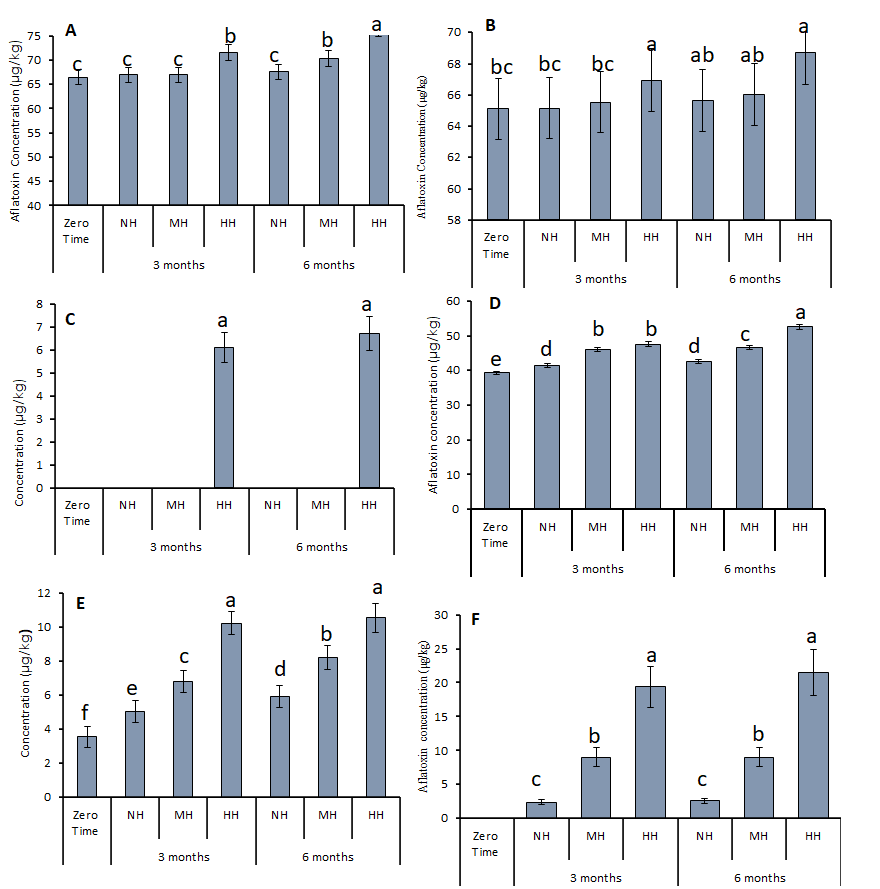
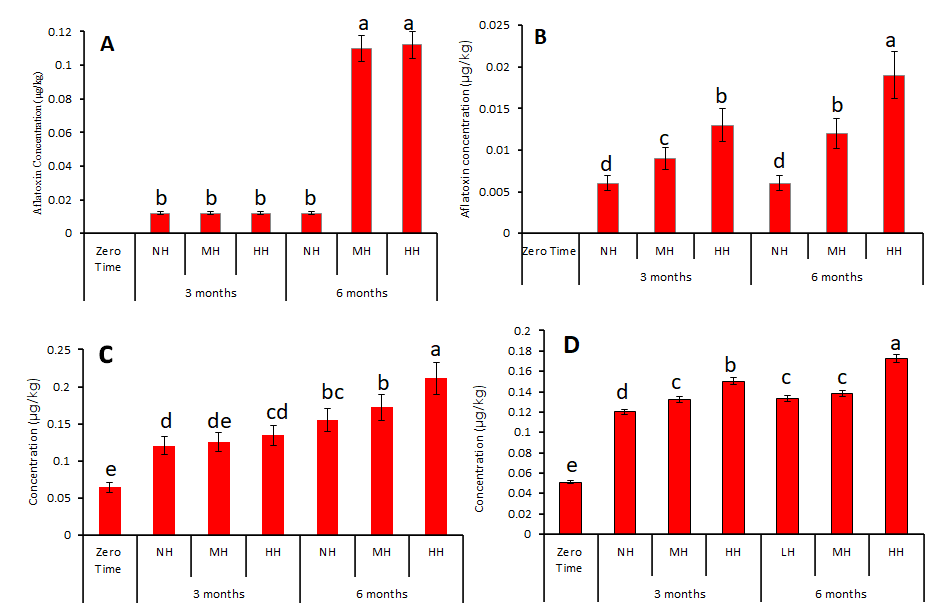
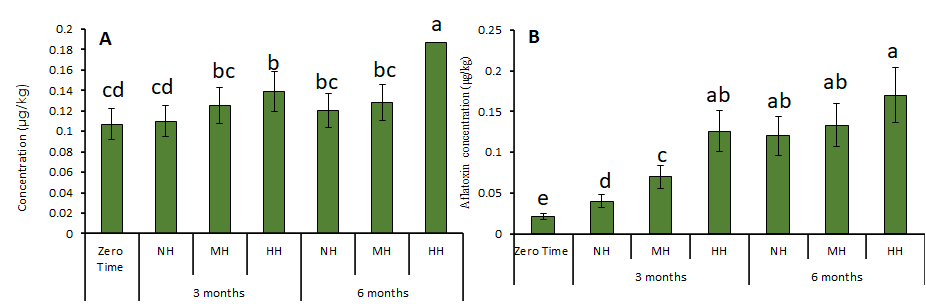
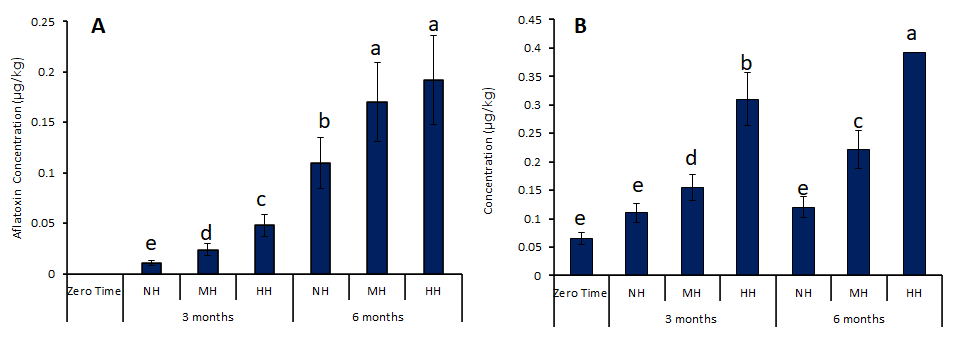
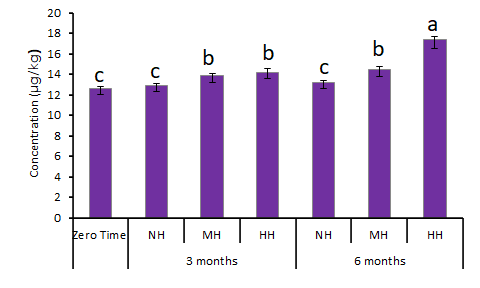
It was found the concentration of the detected mycotoxins increased with an increase in the time of storage and humidity %. Based on our findings, it is evident that the development of mycotoxins and their potential producing fungi were affected by the humidity level during storage. It can be considered that higher humidity levels while storing spices facilitated the development of mycotoxins as well as their producing fungi [33]. Temperature and humidity are the most influential abiotic factors that pronouncedly affect the development of mycotoxins in food and spices during the storage process [3]. Generally, a high relative humidity percentage (up to 95%) and a temperature between 25°C-30°C is favorable for fungal growth and are further associated with the production of mycotoxin [34, 35]. So, the tropical, warm, arid, and semi-arid regions comprise the optimum conditions for AF producing fungi and their growth [36]. Richard JL, et al. [37] reported that spices that are improperly dried, have moisture content more than 14%, and are stored at warm temperatures are more susceptible to be contaminated with AFs.
Our results confirm the hypothesis that fungal contamination of spices, combined with unregulated and unhygienic storage conditions, may result in serious consumer health risks. Particular microbial contaminants are known to have the ability to survive, even in low- moisture [38]. To ensure optimum storage quality of the spices, their moisture content must be maintained below 10% through hygienic conditions and adequate drying [34]. Moses JA, et al. [39] suggested that after harvest, spices must be cleaned from the physical impurities and dried to safe storage moisture levels to reduce contamination with fungi and eliminate the production of mycotoxins.
Because spices comprise the main additive of the daily food supply for humans, it is not acceptable for them to be contaminated with mycotoxins at any level. However, our results confirmed that most of the common spices are subjected to serious contamination with very dangerous mycotoxins such as aflatoxins, citrinin, sterigmatocystin, and zearalenone in considerable concentration as well as their producing fungal species. The development of these fungi and mycotoxins is significantly affected by the relative humidity and the duration of storage of a spice. For the reduction of the fungal contamination and mycotoxins in spices, we recommend the sterilization of spices soon after they are harvested using an appropriate method like as UV sterilization. Further, they should be sorted under dry- hygienic conditions that have a relative humidity under 10%. We also recommend the consumers to use fresh spices and not store them for over two months.
Acknowledgments
The authors are very thankful to King Abdul-Aziz City for Science and Technology (KACST) for the financial support of this work through grant number 1-17-01-010-0014. Also, the authors express sincere thanks to Dr. Ghada Mahmoud, Botany and Microbiology Department, Faculty of Science, Assiut University for her assistance in mycotoxins’ analysis, and providing us with the authentic samples.
Funding
The work was supported by King Abdul-Aziz City for Science and Technology (KACST) through grant number 1-17-01-010-0014.
Disclosure Statement
No potential conflict of interest was reported by the author(s).
Data Availability Statement
Due to the nature of this research, participants of this study did not agree for their data to be shared publicly, so supporting data is not available.
References
-
Elshafie AE, Al-Rashdi TA, Al-Bahry SN, Bakheit CS (2002) Fungi and aflatoxins associated with spices in the Sultanate of Oman. Mycopathologia 155(3): 155-160.
-
Vithu P, Moses JA (2016) Machine vision system for food grain quality evaluation: A review. Trends Food Sci Technol 56: 13-20.
-
Thanushree MP, Sailendri D, Yoha KS, Moses JA, Anandharamakrishnan C, et al. (2019) Mycotoxin contamination in food: an exposition on spices. Trends Food Sci Technol 93: 69-80.
-
Hashem M, Alamri S (2010) Contamination of common spices in Saudi Arabia markets with potential mycotoxin- producing fungi. Biol Sci 17(2): 167-175.
-
Nesic K, Milicevic D, Nesic V, Ivanovic S (2015) Mycotoxins as one of the foodborne risks most susceptible to climatic change. Proc Food Sci 5: 207-210.
-
Kong W, Wei R, Logrieco AF, Wei J, Wen J, et al. (2014) Occurrence of toxigenic fungi and determination of mycotoxins by HPLC-FLD in functional foods and spices in China markets. Food Chem 146: 320-326.
-
Nielsen PV, Rios R (2000) Inhibition of fungal growth on bread by volatile components from spices and herbs, and the possible application in active packaging, with special emphasis on mustard essential oil. Int J Food Microbiol 60(2-3): 219-229.
-
Kabak B, Dobson AD (2017) Mycotoxins in spices and herbs–An update. Crit Rev Food Sci Nutr 57(1): 18-34.
-
Arroyo-Manzanares N, Huertas-Pérez JF, García-Campaña AM, Gámiz-Gracia L (2014) Mycotoxin analysis: New proposals for sample treatment. Advced Chemisrty 1-10.
-
Martínez-Graciá C, González-Bermúdez CA, Cabellero- Valcárcel AM, Santaella-Pascual M, Frontela-Saseta C, et al. (2015) Use of herbs and spices for food preservation: advantages and limitations. Cur Opin Food Sci 6: 38-43.
-
Yogendrarajah P, Jacxsens L, Lachat C, Walpita CN, Kolsteren P, et al. (2014) Public health risk associated with the co-occurrence of mycotoxins in spices consumed in Sri Lanka. Food Chem Toxicol 74: 240-248.
-
Udomkun P, Wiredu AN, Nagle M, Müller J, Vanlauwe B, et al. (2017) Innovative technologies to manage aflatoxins in foods and feeds and the profitability of application- A review. Food Control 76: 127-138.
-
Wild CP, Miller JD, Groopman JD, Editors (2015) Mycotoxin control in low-and middle-income countries. Lyon (FR): International Agency for Research on Cancer.
-
Marin S, Ramos AJ, Cano-Sancho G, Sanchis V (2013) Mycotoxins: occurrence, toxicology, and exposure assessment. Food Chem Toxicol 60: 218-237.
-
Abdel-Hafez AI, Saber SM (1993) Mycoflora and mycotoxin of hazelnut (Corylus avellana L.) and walnut (Juglans regia L.) seeds in Egypt. Zentralbl Mikrobiol 148(2): 137-147.
-
Aziz NH, Youssef YA, El-Fouly MZ, Moussa LA (1998) Contamination of some common medicinal plant samples and spices by fungi and their mycotoxins. Bot Bull Acad Sin 39: 279-285
-
Houbraken JJC, Frisavad, Samson RA (2011) Taxonomy of Penicillium section Citrina. Stud Mycol 70(1): 53-138.
-
McClenny N (2005) Laboratory Detection and identification of Aspergillus species by microscopic observation and culture: the traditional approach. Med Mycol 43(S1): S125-S128.
-
Gautam AK, Sharma S, Bhadauria R (2008) Detection of toxigenic fungi and mycotoxins in medicinally important powdered herbal drugs. Internet J Microbiol 7(2): 1-8.
-
Hashem M, Zohri A (2003) Morphological, phytopathological, toxicological, enzymological characteristics and molecular variation of some strains of Fusarium graminearum and F. equiseti. African Journal of Mycology and Biotechnology 11(1): 1-20.
-
Trucksess MW, Pohland AE (2000) Mycotoxin protocols. Springer Science & Business Media 157.
-
Meulenaer D, Jacxsensa L, Pratheeb, Yogendrarajaha (2016) Risk Assessment of mycotoxins and predictive mycology in Sri Lankan Spices: Chilli and Pepper. Proc Food Sci 6: 326-330
-
Eltariki FEM, Tiwari K, Ariffin IA, Alhoot MA (2018) Genetic Diversity of fungi producing mycotoxins in stored crops. J Pure Appl Microbiol 12(4): 1815-1823.
-
Greeff-Laubscher MR, Beukes I, Marais GJ, Jacobs K (2020) Mycotoxin production by three different toxigenic fungi genera on formulated abalone feed and the effect of an aquatic environment on fumonisins. Mycology 11(2): 1-13.
-
Jacxsens L, Yogendrarajah P, De Meulenaer B (2016) In Risk assessment of mycotoxins and predictive mycology in Sri Lankan spices: chilli and pepper Elsevier Science 6: 326-330.
-
Salari R, Habibi NM, Boroushaki MT, Mortazavi SA, Fathi NM, et al. (2012) Assessment of the microbiological quality and mycotoxin contamination of Iranian red pepper spice. J Agri Sci Technol 14: 1511-1521.
-
Kim S, Lee S, Nam TG, Seo D, Yoo M, et al. (2017) Comparison of a newly developed liquid chromatography with tandem mass spectrometry method and enzyme- linked immunosorbent assay for detection of multiple mycotoxins in red pepper powder. J Food Prot 80(8): 1347-1354.
-
Akpo‐Djènontin DOO, Gbaguidi F, Soumanou MM, Anihouvi VB (2018) Mold infestation and aflatoxins production in traditionally processed spices and aromatic herbs powder mostly used in West Africa. Food Science and Nutrition 6(3): 541-548.
-
Adebayo-Tayo B, Samuel U (2009) Microbial quality and proximate composition of dried Hibiscus sabdariffa calyxes in Uyo, Eastern Nigeria. Malaysian J Microbiol 5(1): 13-18.
-
Reddy KR, Farhana NI, Salleh B (2011) Occurrence of Aspergillus spp. and aflatoxin B1 in Malaysian foods used for human consumption. J Food Sci 76(4): T99-104.
-
Musaiger AO, Al-Jedah JH, D’souza R (2008) Occurrence of contaminants in foods commonly consumed in Bahrain. Food Cont 19(9): 854-861.
-
Hussain A, Sohail M, Shafqatullah (2012) Aflatoxin contamination of spices sold in different markets of Peshawar. J Chem Soc Pak 34(5).
-
Lippolis V, Irurhe O, Porricelli ACR, Cortese M, Schena R, et al. (2017) Natural co-occurrence of aflatoxins and ochratoxin A in ginger (Zingiber officinale) from Nigeria. Food Cont 73(Part B): 1061-1067.
-
Lozano-Ojalvo D, Rodríguez A, Bernáldez V, Córdoba JJ, Rodríguez M, et al. (2013) Influence of temperature and substrate conditions on the omt-1 gene expression of Aspergillus parasiticus in relation to its aflatoxin production. Int J Food Microbiol 166(2): 263-269.
-
Schatzmayr G, Streit E (2013) Global occurrence of mycotoxins in the food and feed chain: facts and figures. World Mycotoxin J 6(3): 213-222.
-
Paterson RRM, Lima N (2010) How will climate change affect mycotoxins in food? Food Res Int 43(7): 1902- 1914.
-
Richard JL (2007) Some major mycotoxins and their mycotoxicoses-An overview. Int J Food Microbiol 119(1- 2): 3-10.
-
Schaarschmidt S, Spradau F, Mank H, Banach JL, van der Fels-Klerx HJ, et al. (2016) Public and private standards for dried culinary herbs and spices-Part II: Production and product standards for ensuring microbiological safety. Food Cont 70: 360-370.
-
Moses JA, Jayas DS, Alagusundaram K (2013) Resistance to airflow through bulk grains, oilseeds and other agricultural products-a review. J Agri Engin 50(4): 1-13.
- Pattern of Gonadal Hormones in Oral Testosterone-Supplimented Male Wistar Rats with Diabetes-Induced Hypogonadism
- Re-Evaluation of the Genotoxicity of Currently Used Food Dyes in Mouse Multiple Organs Via Continuous Administration by Drinking Using the Comet Assay
- Pharmacogenetics of Type 2 Diabetes Mellitus: Linking Genetic Variability to Drug Efficacy and its Cardiovascular Outcomes
- Exploratory Proteomic Profiling of SARS-CoV-2 Infected THP-1 Macrophages Reveals Alterations in Inflammatory Response and Cellular Metabolism
- Study of Genotoxicity of Hepatocarcinogens in Multiple Organs in Mice by Feeding and Drinking Using the Comet Assay
- Spirulina Polypeptides Inhibit the Growth of Human Lung Tumor (H460) Cells