
Toxicological Diagnosis of Severe Neutropenia Due to Levamisole
Introduction: Levamisole toxic syndrome may include several effects, such as bone marrow suppression, severe agranulocytosis, neurological symptoms, or cutaneous vasculitis.Methodology: This report emphasizes the importance of differential diagnosis in young patients with severe neutropenia by hair toxicological analyses. These analyses can reveal the presence of cocaine and his metabolites but also sometime levamisole, a synthetic drug, originally approved by the US Food and Drug Administration as an anthelmintic agent that is still encountered as one of the main contaminants of cocaine. Many physicians are not aware of this contaminant and do not take it into account when diagnosing cases of sudden severe neutropenia.Results: In cases of sudden otherwise unexplained neutropenia, the detection of levamisole in hair may represent the most efficient method for demonstrating the toxic effect of chronic levamisole exposure, because urine conventional drug testing often fails to identify the compound due to its rapid elimination (2-3 days).
Introduction
Levamisole represents the levo isomer of tetramisole. It was firstly introduced in 1966 as a broad spectrum anthelmintic both for veterinary and human purposes [1]; however, already few years later, in the 1970s, its immunomodulatory properties were discovered and were then extensively used to treat inflammatory conditions and cancer. Yet, by 1976, the important adverse effects of chronic administration of levamisole came to the light of the scientific community by the observation of numerous cases of levamisole induced leukopenia and agranulocytosis [2]. No levamisole’s short-term use as an anthelmintic in humans has been associated with significant side effects [3, 4], however it is not used for human consumption anymore in many European countries and North America. From the forensic point of view, it gained interest after it was found that levamisole was used as a cocaine adulterant in about 70% of seizures, mostly in a concentration of <5% of the bulk material [5] even if amounts as high as 10% have been found [6]. In fact, despite cocaine seizures display elevated purity in Europe (average 73%), levamisole is still the main adulterant frequently encountered in bulk material, followed by phenacetin, lidocaine and tetracaine [7]. In a study performed by the Brazilian Federal Police in the International Airport of Sao Paulo and mailing services during the year 2011, levamisole accounted in 56% of the total samples as adulterant of bulk cocaine with relative concentrations (weight/weight percentages) ranging from 0.7% to 23% [8]. The reason why levamisole is still used predominantly as adulterant notwithstanding the important pharmacological adverse effects can only be speculative but can be summarized as follows. On one hand it is cheap and readily available through international trade and export (since it is applied on a large scale in veterinary medicine) and it does not interfere with simple colorimetric tests for cocaine identification. On the other hand, the pharmacological enhancement of cocaine effects has been hypothesized, and two theories have been proposed by now. A direct synergistic effect of levamisole and cocaine through inhibition of monoamine oxidase and activation of nicotinic receptors that finally increases dopamine transmission (firs theory) or the conversion of levamisole into its psychoactive metabolite aminorex (second theory). Aminorex, an anorectic and stimulant drug by itself, might have the advantages of potentiating noradrenergic neurotransmission by inhibiting reuptake, by inhibiting MAO and/or COMT or by acting on ganglionic nicotinic receptors. In this paper we report a case of severe chronic intoxication of levamisole diagnosed by hair analysis. Though hair analysis is usually not considered of pivotal importance in clinical cases and is confined in forensic areas of application, here the analytical determination of levamisole in hair allowed diagnosing the aethiology of neutropenia proving helpful for the physician. Indeed, many clinicians are not aware of drug contaminants and do not take them into account when diagnosing cases of sudden severe neutropenia.
Case Report
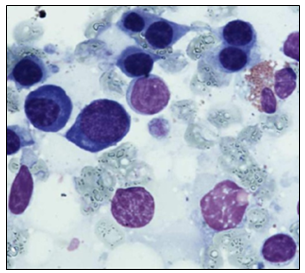
A 29-year-old man presented to the Emergency Department with diffuse vesicular lesions, intense headache, and high fever. A peripheral blood smear showed anaemia, severe absolute neutropenia, and high C-reactive protein levels. The physical examination was consistent with gingivostomatitis, dehydration and mild aortic valve regurgitation, and a bone marrow myelogram revealed severe hypoplasia of the granoblastic series (Figure 1). He denied having any tattoos, sick contacts, recent travel, or environmental or occupational exposure to alcohol and drugs.
Toxicological Data
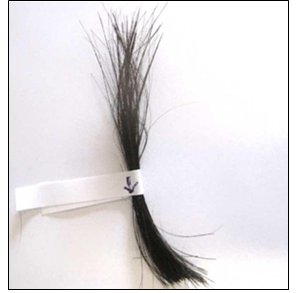
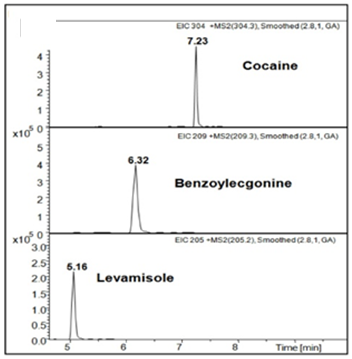
The clinical and toxicological screening performed on urine at the emergency department tested positive for cocaine and cannabinoids. Therefore, a forensic toxicological analysis was requested at the medicolegal section of the Department of Cardiologic, Thoracic and Vascular Sciences, University of Padua. GC-MS analysis on urine confirmed the presence of benzoylecgonine and THC-COOH at the concentration of 175 ng/mL and 60 ng/mL, respectively. A general unknown screening and library search by GC-MS did not highlight the presence in urine of any other xenobiotics. A specific search for levamisole and aminorex in urine gave negative results (LOQ 0.13 ng/mL). To retrospectively evaluate the exposure to levamisole, a hair sample (200 mg) from the occipital region close to the scalp (vertex posterior) was collected and submitted for toxicological analysis (Figure 2). The analysis of the proximal 3 centimetres revealed previous exposure to levamisole, which was present at the concentration of 2.5 ng/ mg (Figure 3). No segmental hair analysis was performed.
Discussion
Several toxic effects, such as bone marrow suppression, severe agranulocytosis, neurological symptoms, or cutaneous vasculitis, have been reported in cocaine users since 2008 [9, 10, 11, 12]. Nevertheless, to perform a differential diagnosis in cases of vesicular lesions, neutropenia, and hypoplasia of the granoblastic series, any other possible pathological state should be excluded. In many cases, self-report of substance abuse is often not significant, as patients frequently underestimate or, in most of the situations, deny any drug use [13]. In this case a urine toxicology analysis highlighted positive to benzoylecgonine and cannabinoids. Cannabinoids were not judged significative to define the pathological state, while the presence of benzoylecgonine was consistent with recent cocaine consumption.
The absence of cocaine itself and the presence of low amounts of its metabolite oriented for a last assumption of cocaine 12-72 hours before urine collection [14]. No levamisole or its main metabolite was determined in urine and for this reason a hair toxicological analysis was requested by the forensic toxicologist. The absence of any trace of levamisole in urine could be explained by the absence of this adulterant in the last consumed cocaine or by pharmacokinetic data. Regarding the latter, unfortunately, data for the nasal and inhalational routes of exposure, which are the routes mainly used for cocaine consumption, are not available. However, a large body of literature is available for levamisole oral consumption [15, 16, 17] and on this base some considerations can be expressed. After oral administration, levamisole is rapidly absorbed with a Tmax value of 1.5-2 h. Single oral doses of 2.5 and 5.0 mg/ kg body weight yielded mean peak plasma levels of 0.8 and 1.6 mg/L, respectively. A single 150 mg dose of levamisole gave a peak plasma concentration of 0.7±0.2 mg/L. After levamisole consumption it is extensively metabolized in the liver and the urinary recovery of unchanged drug is only 2-5% [18]. Aminorex has been demonstrated to be a metabolite of levamisole first in equine [19] and then in human urine [20]. Levamisole and aminorex could be detected in post administration urine samples up to 39 h and 54 h after ingestion, respectively. Concentrations in real urine samples ranged from 4-500 ng/mL and 1-6 ng/ mL for levamisole and aminorex, respectively [17]. All these data led to the conclusion that cocaine was lastly assumed days before urine collection and that any biological material different from hair could not be helpful in diagnosis. Toxicological hair analysis performed on the proximal 3 cm identified levamisole in hair at the concentration of 2.5 ng/ mg. No aminorex was found. A recent study demonstrates a strong prevalence of tetramisole/levamisole in the hair of cocaine users (87%) with concentrations ranging from below 3.5 to approximately 61,000 pg/mg, median: 260 pg/mg [21] or 0.2-0.8 ng/mg according to some authors [22]. In a recent Italian study levamisole was found in 38% of analysed hair, at concentrations lower than observed by other authors [22], suggesting that the Italian market might be quite marginal for levamisole adulteration. In this frame the evidence of a concentration of 2.5 ng/mg of levamisole in hair was supportive for chronic assumption of contaminated cocaine. For this reason, the clinical conclusion was neutropenia caused by the reiterated assumption of cocaine adulterated with levamisole. In cases of sudden otherwise unexplained neutropenia, in young people, the detection of levamisole in hair might represent the most efficient method for hypothesizing a causal link with a chronic levamisole exposure due to drug abuse, because conventional drug testing often fails to identify this compound in urine due to its rapid elimination.
Conclusion
In cases of sudden otherwise unexplained neutropenia in young patients, the detection of levamisole in hair might represent the most efficient method for hypothesizing the toxic effect of chronic levamisole exposure due to drug abuse, because conventional drug testing often fails to identify this compound in urine due to its rapid elimination. The results obtained in hair samples demonstrate that neutropenia in patient with cocaine intake, can be caused by the adulterant levamisole, that must be studied and documented with hair samples [23].
Conflicts of Interest
The authors certify that there is no conflict of interest with any financial organization regarding the material discussed in the manuscript.
Authors Contributions
All authors read and approved the final version of the manuscript.
References
-
Thienpont D, Vanparijs OF, Raeymaekers AH, Vandenberk J, Demoen JA, et al. (1966) Tetramisole (R8299), a new, potent broad spectrum anthelmintic. Nature 209(5028): 1084-1086.
-
Amery WK, Bruynseels JP (1992) Levamisole, the story and the lessons. Int J Immunopharmacol 14(3): 481–486.
-
Rosenthal M, Trabert U, Muller W (1976) Letter: leucocytotoxic effect of levamisole. Lancet 1(7955): 369.
-
Graber H, Takacs L, Vedrody K (1976) Agranulocytosis due to levamisole. Lancet 2(7997): 1248.
-
Schneider S, Meys F (2011) Analysis of illicit cocaine and heroin samples seized in Luxembourg from 2005-2010. Forensic Sci Int 212(1-3): 242-246.
-
Tallarida CS, Egan E, Alejo GD, Raffa R, Tallarida RJ, et al. (2014) Levamisole and cocaine synergism: a prevalent adulterant enhances cocaine’s action in vivo. Neuropharmacology 79: 590-595.
-
EMCDDA (2019) European Drug Report. Trends and development 2019. European Monitoring Centre for Drug and Drug Addiction, pp: 94.
-
Lapachinske SF, Okai GG, Santos AD, Bairros AVD, Yonamine M (2015) Analysis of cocaine and its adulterants in drugs for international trafficking seized by the Brazilian Federal Police. Forensic Sci Int 247: 48- 53.
-
Chang A, Osterloh J, Thomas J (2010) Levamisole: a dangerous new cocaine adulterant. Clin Pharmacol Ther 88(3): 408-411.
-
Bradford M, Rosenberg B, Moreno J, Dumyati G (2010) Bilateral necrosis of earlobes and cheeks: another complication of cocaine contaminated with levamisole. Ann Intern Med 152(11): 758-759.
-
Berto RB, Viel G, Cecchi R, Terranova C, Vogliardi S, et al (2012) Journals publishing bio-medicolegal research in Europe. Int J Legal Med 126(1): 129-137.
-
Jin Q, Kant S, Alhariri J, Geetha D (2018) Levamisole adulterated cocaine associated ANCA vasculitis: review of literature and update on pathogenesis. J Community Hosp Intern Med Perspect 8(6): 339-44.
-
Veer T, Pennings E, Tervaert JW, Korswagen LA (2015) Levamisole-contaminated cocaine: a hairy affair. BMJ Case Rep, 2015210970.
-
Baselt RC (2009) Disposition of toxic drugs and chemicals in man. 8th(Edn.), Foster City, CA: Biomedical Publications, pp: 349-353.
-
Reid JM, Kovach JS, OConnell MJ, Bagniewski PG, Moertel CG (1998) Clinical and pharmacokinetic studies of high dose levamisole in combination with 5-fluorouracil in patients with advanced cancer. Cancer Chemother Pharmacol 41(6): 477-484.
-
Luyckx M, Rousseau F, Cazin M, Brunet C, Cazin JC, et al (1982) Pharmacokinetics of levamisole in healthy subjects and cancer patients. Eur J Drug Metab Pharmacokinet 7(4): 247-254.
-
Hess C, Ritke N, Sydow K, Mehling LM, Ruehs H, et al (2014) Determination of levamisole, aminorex, and pemoline in plasma by means of liquid chromatography- mass spectrometry and application to a pharmacokinetic study of levamisole. Drug Test Anal 6(10): 1049-1054.
-
Wolford A, McDonald TS, Eng H, Hansel S, Chen Y, et al (2012) Immune-mediated agranulocytosis caused by the cocaine adulterant levamisole: a case for reactive metabolite(s) involvement. Drug Metab Dispos 40: 1067-1075.
-
Ho EN, Leung DK, Leung GN, Wan TS, Wong AS, et al. (2009) Aminorex and rexamino as metabolites of levamisole in the horse. Anal Chim Acta 638(1): 58-68.
-
Hess C, Ritke N, Broecker S, Madea B, Musshoff F (2013) Metabolism of levamisole and kinetics of levamisole and aminorex in urine by means of LC-QTOF-HRMS and LC- QqQ MS. Anal Bioanal Chem 405(12): 4077-4088.
-
Madry MM, Kraemer T, Baumgartner MR (2019 Cocaine adulteration with the anthelminthic tetramisole (levamisole/dexamisole): long-term monitoring of its intake by chiral LC-MS/MS analysis of cocaine-positive hair samples. Drug Test Anal 11(13): 472-478.
-
Fucci N, Gambelunghe C, Aroni K, Rossi R (2014) A direct immersion solid phase microextraction gas chromatography/mass spectrometry method for the simultaneous detection of levamisole and minor cocaine congeners in hair samples from chronic abusers. Ther Drug Monit 36(6): 789-795.
-
Favretto D, Stocchero G, Nalesso A, Vogliardi S, Berto RB, et al. (2013) Monitoring haloperidol exposure in body fluids and hair of children by liquid chromatography- high-resolution mass spectrometry. Ther Drug Monit 35(4): 493-501.
- Pattern of Gonadal Hormones in Oral Testosterone-Supplimented Male Wistar Rats with Diabetes-Induced Hypogonadism
- Re-Evaluation of the Genotoxicity of Currently Used Food Dyes in Mouse Multiple Organs Via Continuous Administration by Drinking Using the Comet Assay
- Pharmacogenetics of Type 2 Diabetes Mellitus: Linking Genetic Variability to Drug Efficacy and its Cardiovascular Outcomes
- Exploratory Proteomic Profiling of SARS-CoV-2 Infected THP-1 Macrophages Reveals Alterations in Inflammatory Response and Cellular Metabolism
- Study of Genotoxicity of Hepatocarcinogens in Multiple Organs in Mice by Feeding and Drinking Using the Comet Assay
- Spirulina Polypeptides Inhibit the Growth of Human Lung Tumor (H460) Cells