
Heavy Metals in Waterpipe Smoke and the Related Health Risks - A Review
Excessive intake of heavy metals has harmful effects on health and waterpipe smoking could be one of the intake routes. Regarding the growing trend of waterpipe smoking in the world, in this study the heavy metal exposure related to waterpipe smoke and the health risks were surveyed in the published literature. Science Direct, Google Scholar and PubMed databases were searched using the keywords of heavy metals, hookah, shisheh and waterpipe. The results showed high concentrations of heavy metals in waterpipe smoke, tobacco, and charcoal. Also, high levels of heavy metals are reported in blood and toenails of the waterpipe cafes’ employees and for the smokers. The expected cancer risk for Cd, Cr, Ni, and as was higher than 1×10⁻⁶, and non-cancer risk for Cr was greater than 1. Burning of tobacco and charcoal is source of heavy metals in waterpipe smoke.
Introduction
Todays, waterpipe widely is used around the world and the youths are the mainly users. The raised waterpipe smoking is seen in Africa, Middle East, and much more in Iran and Turkiye [1, 2]. WHO reported that around 8 million annually death related to tobacco smoking is occur [3]. Since the waterpipe smoke contains some carcinogens and unhealthy substances such as VOCs, PAHs, and heavy metals, it can threat the human health and can be cause of Oral, stomach and esophageal cancers, chronic obstructive pulmonary disease (COPD), cardiovascular and respiratory diseases [4, 5]. It is popular within the researchers that the heavy metals are ones with high atomic mass and with a density higher than 5 fold of the water’s. Cadmium (Cd), lead (Pb), arsenic (As), nickel (Ni) and cobalt (Co) are the heavy metals with significant risk for health. They are not environmentally degradable and gradually accumulate in some body tissues such as human bones and joints [6]. The International Agency for Research on Cancer (IRAC) classified cadmium, arsenic, and hexavalent chromium in group 1 as human carcinogens, and lead, cobalt, and nickel in group 2B as the possibly carcinogenic to humans [7]. It has also been confirmed the relationship between the exposure to arsenic and increased risk of skin cancer, cadmium and kidney damage, lead and mental retardation [8, 9, 10].
The Study Method
This systematic review was carried out by searching in the selected databases in time range from mid of July to the end of July for the articles published between years of 2014 - 2021 in English language. The applied search keywords were heavy metals, Hookah, Shisheh and Waterpipe in Science Direct, Google Scholar and PubMed databases. The searched phrases were shisheh OR hookah OR waterpipe and heavy metals in the PubMed database, the search phrases shisheh and heavy metals, hookah and heavy metals and waterpipe and heavy metals in the Science Direct database and the search phrases shisheh and heavy metals, hookah and heavy metals and waterpipe and heavy metals in the database of Google Scholar. In the further step, all the articles including “waterpipe”, “hookah”, “shisheh” and “heavy metals” in their title, abstract and keywords were selected. In this primitive search, 239 articles were found, after reviewing the articles, duplicate articles were removed. The including criteria for the found documents were the reporting the concentration of heavy metals in waterpipe smoke, the toxicity of heavy metals in waterpipe smoke, and studies of waterpipe smoke and tobacco in general. Finally, 7 articles were included in the study.
Results and Discussion
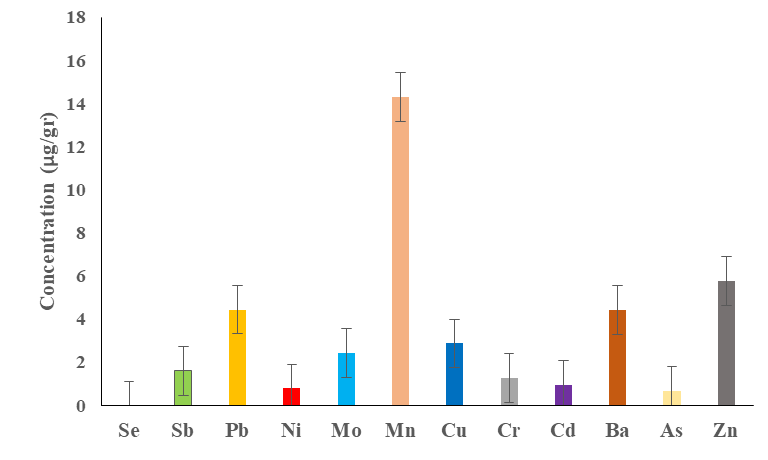
Screening of the resulted 239 articles showed that, 2 articles investigated the concentration of heavy metals in indoor air of waterpipe cafes, 3 articles for waterpipe tobacco, one article for the heavy metals in blood of the smokers, and one article for the accumulation of heavy metals in the toenails of employees. Regarding the results, notable concentrations of heavy metals is reported in the indoor air of waterpipe cafes, waterpipe tobacco, and blood and toenails of cafe employees. The reported heavy metals in indoor air of 50 waterpipe cafes in Ardabil are iron (35.36 ± 20.9 µg/m3), copper (11.22 ± 4.38 µg/m3), zinc (6.72 ± 2.87 µg/m3), nickel (5.52 ± 2.40 µg/m3), aluminum (5.32 ± 2.75 µg/m3) and strontium (2.19 ± 1.22 µg/m3) [11]. Another report is for indoor air of 14 waterpipe cafes in Tehran, where lead (0.488 ± 27.05 µg/m3), nickel (0.073 ± 9.66 µg/ m3), chromium (0.040 ± 4.26 µg/m3) and cadmium (0.021 ± 3.08 µg/m3) were reported as bounded to PM2.5 [12]. Also, the results show accumulation heavy metals of arsenic (0.48 µg/g), cadmium (0.82 µg/g), and lead (1.78 µg/g) in toenails of the employees [13]. A concentration of lead (47.9 µg/L) and cadmium (1.20 µg/L) is reported in blood of the cafe employees [5]. Presence of heavy metals of aluminum, copper, manganese, thallium, beryllium, molybdenum, barium, cadmium, nickel, arsenic, cobalt, lead, chromium, and zinc is reported in tobacco of waterpipe [14]. Figure 1 shows the mean concentrations of the heavy metals of tobacco. From this figure, the highest mean concentration is for manganese (14.31 µg/gr) and the lowest one is for selenium (0.015 µg/gr).
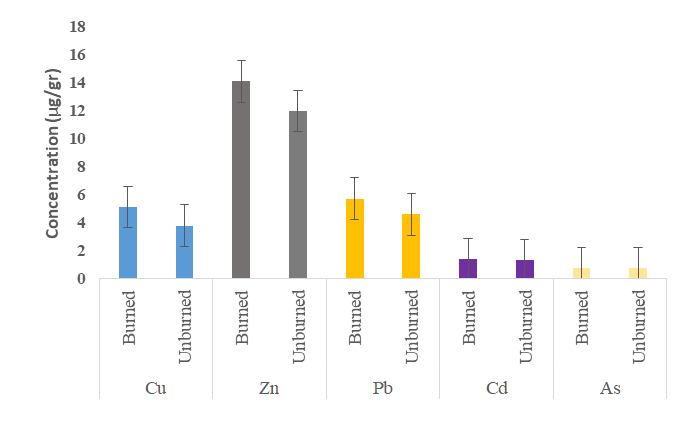
Different concentrations of heavy metals of copper, zinc, lead, cadmium and arsenic in raw (unburned) and burned tobacco is reported and their concentrations were higher in burned tobacco (Figure 2) [15, 16]. Respect to the results, the highest mean concentration is for zinc in the burnt tobacco (14.08 µg/gr) and the least is for arsenic (0.74 µg/gr) in the raw tobacco.
The results about health risk assessment for exposure of the cafes’ employees and waterpipe smokers indicated that the highest Lifetime Cancer Risks (LTCRs) was for chromium and the lowest was for the cadmium (Table 1). Moreover, the hazard quotient (HQ) index for chromium was greater than 1 (HQ=3.82) [11].
| LTCRs(Employees) | LTCRs(Smokers) | Elements | |
|---|---|---|---|
| - | 1.65 × 10⁻⁴ | 1.75 × 10⁻⁵ | As |
| - | 6.94 × 10⁻⁵ | 3.8 × 10⁻⁶ | Cd |
| 3.82 | 4.47 × 10⁻³ | 4.19 × 10⁻⁴ | Cr |
| - | 8.17 × 10⁻⁴ | 7.79 × 10⁻⁵ | Ni |
Table 1: Health risk assessment of heavy metals in indoor air of waterpipe cafes (11). The different concentrations of heavy meta
Table 1: Health risk assessment of heavy metals in indoor air of waterpipe cafes (11). The different concentrations of heavy metals, which were found in the tobacco, could be related to the various types of the tobaccos, the proximity of agricultural land to polluted areas, the processing method of tobacco, and the geographical region of tobacco cultivation. Nnormo declared that the concentration of heavy metals in different brands of tobacco depends on the geographical area of cultivation [17]. In this line of research, high absorption rate of heavy metals, namely cadmium, in the leaves of tobacco plants is reported [18, 19]. Furthermore, Schubert, et al., reported concentrations of heavy metal of chromium (0.567 ± 9.4 µg/ gr), copper (2.89 ± 1.8 µg/gr), zinc (5.07 ± 2.8 µg/gr), Nickel (1.5 ± 4.9 ug/gr), arsenic (0.0179 ± 13 µg/gr), cadmium (0.0493 ± 17 µg/gr) and manganese (306 ± 8.7 µg/gr) in the raw waterpipe charcoals, and chromium (3.54 ± 6.8 µg/ gr), copper (16.5 ± 5.8 µg/gr), zinc (29.6 ± 10 µg/gr), nickel (10.1 ± 4.5 µg/gr), arsenic 0.150 ± 7.9 µg/gr), cadmium (0.236 ± 56 µg/gr) and manganese (8.7 µg/gr) ± 1780) in the burned charcoals of waterpipe [14]. Given the stablished guidelines for the levels of heavy metals in tobacco, the mean concentrations of lead and cadmium in raw and burned tobacco were higher than the guideline of WHO (0.05 µg/gr). Exposure to high concentration of lead, can led to disorders in the functioning of the digestive system, nervous system and tonsil system. It disrupts the natural DNA transcription and causes problems in bone formation [20]. It is reported that, 40 to 60 percent of the inhaled cadmium in cigarette smoke, enters the bloodstream directly, and it can be cause of carcinogenesis in lung, prostate, kidney, bladder and pancreas [9, 21]. The results showed higher mean concentrations of lead and cadmium in blood of the cafe employees compared to the smokers. It could be due to the much exposure time of them to the waterpipe smoke [22]. High concentration of arsenic, cadmium and lead in the toenails of cafe employees indicates accumulation of them in the body tissues of them. It can lead to increase of cancer and non-cancer risk for them [13]. Risk assessment of exposure to the heavy metals by the employees and the smokers showed high levels of LTCRs. The permissible LTCR by WHO is 1 × 10⁻⁵- 1 × 10⁻⁶, and it is 1 × 10⁻⁶ for United States Environmental Protection Agency (USEPA) [11]. Given the results, the LTCRs for nickel, chromium, cadmium, and arsenic are higher than the permissible limits. The employees and smokers could be exposed to the metals through inhalation, ingestion, and skin which increase the risk of carcinogenesis for them. The reported HQ for chromium is also indicating high non- carcinogenic risk of the employer related to exposure to heavy metals.
Conclusion
Regarding the results, concentration of heavy metals related to the waterpipe smoking is overly higher than the established guidelines and resulted to increased expected cancer and non-cancer risk in the exposed people. The heavy metals in the tobacco smoke could be emitted from the polluted tobacco and the charcoal. There are high concentrations of heavy metals in tobacco and charcoal of waterpipe. It seems that more rigorous inspections and regulation needs to control the related health risks.
Acknowledgments
The authors are grateful to tank you of Semnan University of medical sciences to supporting this research, and thank you to Ms, Maryam Nabetee from student research committee of health school to contribution in searching.
References
-
WHO (2015) Advisory note: waterpipe tobacco smoking: health effects, research needs and recommended actions by regulators. World Health Organization.
-
WHO (2019) WHO report on the global tobacco epidemic, 2019: offer help to quit tobacco use. World Health Organization.
-
Hazrati S, Rostami R, Fazlzadeh M (2015) BTEX in indoor air of waterpipe cafes: levels and factors influencing their concentrations. Sci Total Environ 524-525: 347-353.
-
Bao X, Asgari A, Najafi ML, Mokammel A, Ahmadi M, et al. (2021) Exposure to waterpipe smoke and blood heavy metal concentrations. Environ Res 200: 111460.
-
Tchounwou PB, Yedjou CG, Patlolla AK, Sutton DJ (2012) Heavy metal toxicity and the environment. Exp Suppl 101: 133-164.
-
Viana GFdS, Garcia KS, Filho JAM (2011) Assessment of carcinogenic heavy metal levels in Brazilian cigarettes. Environ Monit Assess 181(1-4): 255-265.
-
Koutros S, Baris D, Waddell R, Freeman LEB, Colt JS, et al. (2018) Potential effect modifiers of the arsenic–bladder cancer risk relationship. Int J cancer 143(11): 2640- 2646.
-
Genchi G, Sinicropi MS, Lauria G, Carocci A, Catalano A (2020) The effects of cadmium toxicity. Int J Environ Res Public Health 17(11): 3782.
-
Cooper B, Helgason T (2021) Epidemiology and the prevention of mental disorders: Routledge.
-
Rostami R, Kalan ME, Ghaffari HR, Saranjam B, Ward KD, et al. (2021) Characteristics and health risk assessment of heavy metals in indoor air of waterpipe cafes. Building and Environment 190: 107557.
-
Masjedi MR, Taghizadeh F, Hamzeh Ali S, Ghaffari S, Ahmadi E, et al. (2020) Load characteristics, in vitro bioaccessibility and health risk assessment of PM2. 5-bounded heavy metals in indoor air of waterpipe and/or cigarette cafes compared to smoking-free cafes. Environmental Pollutants and Bioavailability 32(1): 56- 67.
-
Masjedi MR, Dobaradaran S, Keshmiri S, Taghizadeh F, Arfaeinia H, et al. (2021) Use of toenail-bounded heavy metals to characterize occupational exposure and oxidative stress in workers of waterpipe/cigarette cafes. Environ Geochem Health 43(5): 1783-1797.
-
Schubert J, Muller FD, Schmidt R, Luch A, Schulz TG (2015) Waterpipe smoke: source of toxic and carcinogenic VOCs, phenols and heavy metals? Arch Toxicol 89(11): 2129-2139.
-
Yousefinejad V, Mansouri B, Ramezani Z, Mohammadzadeh N, Akhlaghi M (2018) Evaluation of heavy metals in tobacco and hookah water used in coffee houses in Sanandaj city in 2017. Scientific Journal of Kurdistan University of Medical Sciences 22(6): 96-106.
-
Zazouli MA, Dehbandi R, Yazdani Charati J, Taheripour M (2020) Heavy metal content in cigarette and Hookah Tobacco in Iran. Journal of Mazandaran University of Medical Sciences 30(187): 95-106.
-
Nnorom IC, Osibanjo O, Nnorom CGO (2005) Cadmium determination in cigarettes available in Nigeria. African Journal of Biotechnology 4(10).
-
Moulin NL, Martin F, Krauss MR, Ramey PB, Rossi L (2006) Cadmium concentration in tobacco (Nicotiana tabacum L.) from different countries and its relationship with other elements. Chemosphere 63(7): 1074-1086.
-
Naalbandi H, Saeedi M, Moghanlou MO, Akbari J, Semnani KM, et al. (2016) Evaluation of heavy metal content of some lipsticks in Iran market. Pharmaceutical and Biomedical Research 2(3): 31-37.
-
Ara A, Usmani JA, Wani AL (2015) Lead toxicity: a review. Interdiscip Toxicol 8(2): 55-64.
-
Kazi TG, Jalbani N, Arain MB, Jamali MK, Afridi HI (2009) Determination of toxic elements in different brands of cigarette by atomic absorption spectrometry using ultrasonic assisted acid digestion. Environmental monitoring and assessment 154(1): 155-167.
-
Richter PA, Bishop EE, Wang J, Swahn MH (2009) Tobacco smoke exposure and levels of urinary metals in the US youth and adult population: the National Health and Nutrition Examination Survey (NHANES) 1999- 2004. Int J Environ Res Public Health 6(7): 1930-1946.
-
Goumenou M, Tsatsakis A (2019) Proposing new approaches for the risk characterisation of single chemicals and chemical mixtures: The source related Hazard Quotient (HQS) and Hazard Index (HIS) and the adversity specific Hazard Index (HIA). Toxicology Reports 6: 632-636.
- Pattern of Gonadal Hormones in Oral Testosterone-Supplimented Male Wistar Rats with Diabetes-Induced Hypogonadism
- Re-Evaluation of the Genotoxicity of Currently Used Food Dyes in Mouse Multiple Organs Via Continuous Administration by Drinking Using the Comet Assay
- Pharmacogenetics of Type 2 Diabetes Mellitus: Linking Genetic Variability to Drug Efficacy and its Cardiovascular Outcomes
- Exploratory Proteomic Profiling of SARS-CoV-2 Infected THP-1 Macrophages Reveals Alterations in Inflammatory Response and Cellular Metabolism
- Study of Genotoxicity of Hepatocarcinogens in Multiple Organs in Mice by Feeding and Drinking Using the Comet Assay
- Spirulina Polypeptides Inhibit the Growth of Human Lung Tumor (H460) Cells