
Poverty, Development and Wellbeing: Dimensions of Social Change
Poverty is often seen as having low income and inability to access standardized services for living. However, poverty measures have failed to measure the deprivations which are more detrimental in achieving the human well being. Accordingly, development goal is intended to achieve the benefit that are materially sufficient and disregards the resources, which are intrinsically important. Individual’s intrinsic capabilities are often undermined that function for their overall well being. The challenges are then to increase the individual’s capabilities with adequate freedom and choices for the responsible well being. Hence, it is critical to change the purview of development focusing on the human development and human well being rather than the growth that least addresses the issues of poverty and inequality.
Introduction
Development as defined by Sen [1] is removal of various unfreedom: “poverty as well as tyranny, poor economic opportunities as well as systematic social deprivation, neglect of public facilities as well as intolerance or over activity of repressive states”. Despite the unlimited growth of world’s wealth, it denies the elementary freedoms of massive poor who are the majority [2, 3, 4]. Lack of substantive freedoms sometimes relate to economic poverty that can rob people’s freedoms to have basic living conditions (e.g. food to satisfy hunger and to have sufficient nutrition, to obtain remedies to treat basic illness etc). On the other aspect, lack of social services such as education, organized health services, and other institutions to maintain the growth of civil society also restricts their social freedom [1, 4, 5].
Development constitutes a process of enlarging people’s choices; of enhancing participatory democratic processes for making decisions; of providing human beings with the opportunity to develop their fullest potential’ and of enabling the marginalized people to organize for themselves to work together [6]. Development is both means and goal and the goal of development is to enlarge the choices [6, 7]. In this sense, Sen’s approach of freedom coincides to the development, as freedom can be the principal ends of development as well the means of achieving the same. For instance, getting opportunities to receive basic education can be instrumental to development of individuals, while education provides further choices for them. Thus freedom involves both the processes that allow freedom of actions and decisions, and the actual opportunities that people have, given their personal and social circumstances. While, un freedom can arise either through inadequate processes (such as violation of basic rights) or through inadequate opportunities that some people have for achieving the minimum needs such as fulfilling basic hunger [1]. Human development is about promoting freedoms people want based on their reasoned agency that are valid both for present and future generations [8].
This paper analyzes a complex relationship between poverty and well being and how that affects on development as human freedom. Theoretical assertions are built up by assessing the work of previous scholars especially of Chamber’s and Sen’s views of development that are attentive to well being and the quality of lives rather than merely the economic growth. The theoretical concepts are then integrated with the findings of case studies of rural energy program in different villages of Nepal demonstrating how the individual agency is positioned within the historical and social context leading to their different level of freedom and wellbeing.
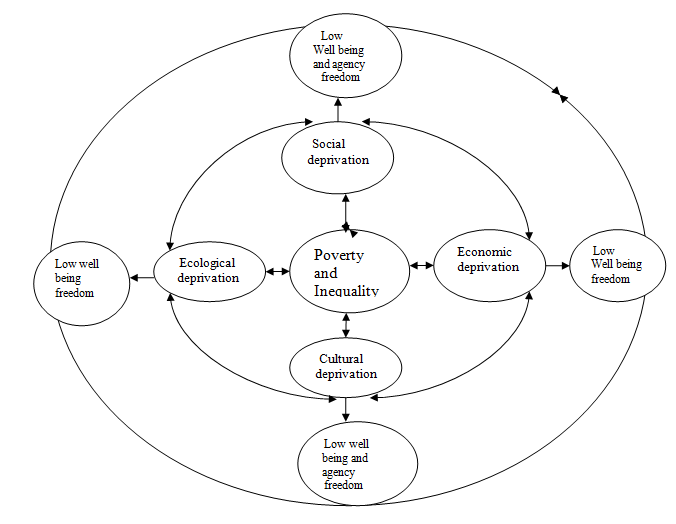
Gross Domestic Product (GDP) is often a measure of the wellbeing of countries that fails to incorporate social and human dimensions of development. However, economic output does not always predict social performance [11, 12]. For instance, when comparing poorer nations having about equal GNP per capita, eg. South Asia and Sub Saharan Africa, the average life expectancy and literacy rate were higher in later one. The following diagram helps to understand the poverty and well being framework.
Poverty and Wellbeing Framework
Poverty as an individual concept is described as a person living less than 1.25 $ per day. However, such individualization of poverty has a little meaning, unless it addresses the pervasive inequalities (such as power relations among gender and class) which are largely persistent in every society that contributes to the absolute poverty [9]. He further commented that “poverty is not a natural state of affairs but a function of deep inequities in the national and global systems” [9]. Sahlins argues that “poverty is not a certain small amount of goods nor is it just a relation between means and ends. Poverty is a social status. It is the invention of civilization and has grown up with civilization” (1997: 19) [10].
Poverty is created through multiple deprivations which reinforce each other. It is thus worth to examine poverty in terms of relative deprivations that create absolute poverty. Poverty can be seen as deprivation of basic capabilities, rather than merely low income. For instance, deprivation of elementary capabilities is reflected in premature mortality, significant under nourishment, widespread illiteracy and other failures [1]. Such deprivations ultimately harm the agency of individuals along with other social barriers, leading to further reduce their capabilities and thereby their well being.
Lately in 1990, the human development report acknowledged the multidimensional aspects of development moving from growth to promotion of the well being in terms of accomplishing economic, social, physical and psychological development of individuals. The HDI 1990 was based on Sen’s capability approach, which emphasized on the broad concept of human development incorporating the non monetary indicators. World Bank has also adopted the notion of “quality of the growth” and “pro poor growth” that reflect the non- monetary dimensions of wellbeing.
While the globalization is seen to be significantly contributing towards the development, its success is largely measured whether it diminishes poverty or inequality. The millennium development goals (MDGs) set by UN general assembly and World commission have also set the yardstick of legitimacy of globalization as to reduce the poverty and inequalities and increase the socio-economic security of poor countries [9].
Equity and Sustainability Perspectives
As pointed out by Chambers [13] development is about a good change and it must bring positive changes such as increase living standards, improve health and well being for all, and good achievement for society at large. Chambers in his development vision emphasizes two things: livelihood and capabilities as a means and as an end, and well being as an overarching end [14]. Livelihoods are basic for well being such as having enough food, clothes and so on, and capabilities are the means of well being. Capabilities are what people can do and be, which are intrinsic and not what they can consume [1, 14]. Chambers further commends that livelihood should be equitable and sustainable. in his alternative development approach focused on improving the conditions of people’s lives and livelihood that starts from the household. Development is more about empowering individuals, households and communities. It is thus a process of social change, in which the development agencies continue to make efforts to promote their own vision of development for empowering both individuals and households. A good leadership and vision is required to empower the people and thus a great cooperation and action is needed from the powerful and wealthy people for the responsible well being. The greatest challenge of development is for those with more wealth and power is to accept less and welcome it as a means of well being and to a better quality of life [13].
Development as emphasized in Human Development Report (1997) and World Development Report (1997) is to make the world better place especially for the poor with appropriate policies and actions [15, 13]. It is not only about examining the development agenda, but examining our own behavior “how we think, how we change and what we do and not do” (1997: 1744). The developmental paradigm in the past has been dominated by the idea that the role of the state or civil society is only to provide what poor people lack. i.e. material resources, however, undermines the resources in which “poor people often are rich: their own knowledge”. Development in last century has adopted poor as ‘resource poor people’ – “As if knowledge is not a resource, or as if poor people have no knowledge” [16].
Human development is the process of enhancing individual and collective quality of life in a manner that satisfies minimum basic needs, which are economically, environmentally and socially sustainable. And the people must have a considerable degree of control over the process through the access to the means of accumulating social power [3]. Accordingly, the aid agencies have made their shift in program development focusing on human side of development, such as education, health and other services [17]. However, aids have empowered the authorities instead of people in most of the third world countries. It is because the authorities are most of the time detached from rural areas having located centrally and the administrative cost is so high at central level leaving a minimum for program activities at grassroots [18]. The ethics of development mission is to ensure that development funds are symmetrically distributed and the hopes of poor are alive [2, 13]. Nevertheless, the disappointments are increasing largely as aids have often created inequalities between the very poor and the elites. As Black [2] commends that “credit is extended to mostly who do not need it”. The effectiveness of aid and development assistance has been a major issue in reducing global poverty Indeed, aid policies in last two decades are very project-centered rather than people- centered contributing to the poverty of thinking and the loss of ownership [3, 19]. It is often observed that poverty is likely to be continued unless there is a second view on designing the development policy for mainstreaming poverty [20]. The poor are often associated with certain inherited structural arrangements such as “insufficient access to productive assets as well as human resources, unequal capacity to participate in both domestic and global markets, and undemocratic access to political power” (2006:39). These structural features of poverty systematically exclude the poor from participating in the benefits of development. An unequal command over both economic and political resources within a society, and the unjust nature of social order perpetuates the inequities. views poverty in terms of absence of freedoms that restricts their capabilities and fail to participate in human society. It is very necessary to correct such structural injustice that perpetuates inequalities and poverty. A practical framework would be thus required to enhance the capacities of poor in order to enable them to participate and contribute equitably in the process of development and to ensure the sustainable development [3, 20].
Capabilities Perspective
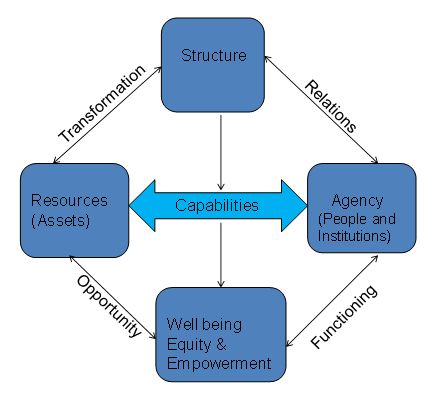
Sen [1] contends that well being is not represented by the possessions of resources but by their transformation into “functioning” which depends upon personal, social and environmental factors. Sen further argues that countries with high GDP per capita has not indicated in enrichment of the human lives and thus it cannot be a measure of human development. Hence, the well being measures should be based on other indicators that determine the improved live qualities of people such as improved health and income opportunities.
Sen [5] focuses on four components: commodities or resources and functioning or capabilities. Resources include all goods and services and capabilities represent the being and doings that functions out of the resources. Functioning is directly related to the achievement while the capabilities are the abilities to produce it and thus is based on the notion of freedom [1].
The well being of a person can be seen in terms of a person’s functioning and capabilities, “what he or she is able to do or be" (e.g., the ability to be well nourished, to avoid escapable morbidity or mortality, to read and write and communicate, to take part in the life of the community The capability of a person reflects the alternative combination of functioning the person can achieve, and from which he or she can choose one collection. Sen argues the importance of extension of human capabilities which are intrinsic and constitute of human freedom for well being and quality of life.
Sen further differentiates between well being and agency aspects, as well being is concerned with own well being of individual, and the agency may be related with other’s well being. Sen asserts that a person may have different goals and objectives, other than pursuing their own well being. And such others related pursuits are part of agency aspect of human. Provides a bridge between a well being and agency aspect of human. “The man who is himself at ease can best attend to the distress of others”. Sen also argues that human beings are not “rational fools” only to be motivated by production and exchange, but they could be equally moved by other regarded values of justices and fairness in the distribution [21]. This idea combines the agency and well being into one. Freedom is an end state, but without the self-development of actors and institutions from freedom to responsibility, there will be very little resources left to rescue human wellbeing [1].
Development Challenges: Experiences from Case Studies
Development in modern era has brought a radical paradigm shift as indicated in Human Development Report (cited in Chambers [14]. Unlike in the past, development symbolized an economic growth transforming the ‘underdeveloped to developed’ through industrial revolution, it focuses on human development permitting people to achieve their well being through overall economic, social, and cultural progress [8, 14]. Accordingly, social development has been a new theory of development emphasizing on development of social and human capital. Global policy (e.g. UN Convention, 1990) overwhelmingly emphasized on equalities and empowerment as a strategy for social development, however, the end practices are far from reality [14, 22]. Structural Adjustment policy initiated under neo- liberalism for instance, has cut off some social services in the less developed countries such as health that mostly disadvantaged women and children [22].
Although neo global policy encourages the social policy to focus on neo-development strategy, the process is still dominated by the capitalist system of development. For instance, the subsidies in public services like electricity and water supply are justified to help the poor however, disproportionately benefits the elites. In developing countries, the poor use kerosene or candles rather than electricity for lighting, rely on public standpipes rather than in house connection for water supply, and are infrequently served by sewerage systems. Nevertheless, countries like Vietnam and Uganda, have enormously gained through the private investment and public aids respectively.
General Observations on Case Study
With my PhD fieldwork and subsequent research work in Nepal in 2002 and 2008, I am not pessimistic about the performance on public services provided by different government and non government agencies in Nepal. For instance, rural energy development program (REDP) has been one of the successful programs in providing rural energy services especially through micro-hydro power in different villages of Nepal. There were a few micro hydro plants with processing mills in some villages, solar plants, and bio-gas plants installed in the houses of richer among the poor. These technologies have been enormous help to reduce the workload of women especially with the micro- hydro mill in agri-processing activities, for which women used to spend longer hours with exhaustive physical tasks. In one of my research village a house was partitioned for two brothers; first brother’s family has got solar plant and the second brother’s family could not afford to install the plant. The women and children without a solar lighting in the house were psychologically distressed that they had to work and study in dark light with kerosene while their fellow relatives in attached house would work and study with solar lights. It was a case not only in one household but in the whole village. For instance, only about 18% of the households have access to solar lighting even with 50% subsidies [23]. The similar cases were observed with biogas plants installation for cooking in mid hill areas of Nepal. Although the material subsidies were provided by Agricultural Development Bank, Nepal with support of Biogas Support Program (BSP), the majority of village population were unable to access such plants for being costly to install. This situation has created even more inequalities in the villages creating a large socio-economic gap within a small community. In addition, the social and technical aspects of technologies were rather neglected that has caused low adoptability of such technologies. A woman interviewed mentioned that “we cook with biogas, but if it goes wrong sometimes we do not know how to fix it. And there are no men around the house. So we better use the firewood”.
Gendered Wellbeing and Empowerment
Poverty has been largely feminized in the developing countries, as women are to be most affected by the poverty situations. A larger link is made between gender and poverty as poverty is equated with the poor women, and women from female headed households being more vulnerable. However, gender analysis of poverty is more than analysing the effect of poverty on men and women but how gender differentiates the social processes that leads to poverty [5]. A gendered understanding of poverty raises some questions whether it can be assumed or not whether it can be the kind of interventions that can strengthen the position of poor men are going to have much the same impact on poor women [24]. The development agencies in their effort to integrate gender into the policy most often overlook deeper and contextual understandings of poverty that is central to gender analysis. Jackson makes a critique that feminization of poverty means not that poverty is a gendered experience (as the gender analysis generally would suggest) but that the poor are mostly women [25].
Sen [20] elaborates that gender inequalities can be best viewed through capabilities approach of freedom. More than the income approach of poverty, it relates with the basic opportunities and functioning that enables men and women to act and achieve differently. For instance, intra household disparities are the indications of disparities in well being between men and women. Men
and women do not enjoy equal benefits from development services such as education, which leads to the deprivation of their basic capabilities [21]. The power relations between men and women restrict women to participate in different social and economic activities outside home that affect their wellbeing [26]. It is the responsibility of the States to create resources equally for men and women, since human capacities are dependent on the availability of resources such as education, health and employment that build capabilities and enlarge human choices. Access to such resources has a direct impact on women’s ability to create space for themselves in the socio-economic and political sector [24, 27].
Especially, in the developing countries women’s time and labor for household chores is discounted for not contributing to GDP, however largely contribute to the household economy [22, 23, 27]. In addition, women are less paid in workforce even when they have a chance to work outside home. Most often they have a least control over their own earnings. Women rarely hold ownership and tenure rights to land, trees, water and other natural resources, although women contribute most of the labor for agriculture [26]. In absence of ownership of land, women lack control over productive resources, that restricts them to access bank loans, which hampers their opportunities to improve their farm activities and earn cash incomes [28]. Micro credit is more accessible to women due to the replacement of traditional collateral with alternative arrangements, however the loans borrowed by women are found to be substantially used by men.
The heavy workload and numerous health problems encountered through the nature of work women perform have a huge impact on their capabilities for production and reproduction activities [23, 29, 30]. For instance, high infant and maternal mortality in Nepal has been reported as a result of domestic air pollution caused by the biomass burning for household cooking. It is thus critical to look at the process that leads to different level of well being between individuals.
It was observed that rural women in Nepal still walk 4-5 hours to collect a bunch of firewood and they were overburdened with the work related biomass cooking such as more time for cleaning utensils and house. More than 50% women reported that they had suffered from lung diseases, and 73% have got eye problems related to biomass cooking. There were cases where women have had miscarriages and prolapsed uterus although they were less identified by the participants themselves as the women were not aware of the association of these problems. Despite the above facts, cooking needs are often unaddressed in energy policies in Nepal, which have been the prime concerns for majority of rural women for improving their wellbeing.
Notwithstanding the effort of different agencies to create the gender awareness of local population, it was worrying to note that there was a little change on people’s attitude towards women’s wellbeing and empowerment. For instance, women have very little mobility as compared to men. Here I quote “Our husband talk nicely in front of outside people but never do so inside the house” when asking a question about their participation in village activities (personal observation, 2002). Even educated people like school teacher would restrict their wives to go for activities outside home. It was however, different among lower ethnic group. The men in this group would feel proud of their wives if they could participate together with the higher caste women. Especially among the low ethnic group, women often eat after men and they get inadequate food and not all varieties of food in many cases. Sometimes, women remain hungry whole day while doing the same household chores as they felt lazy to re cook with firewood that would take longer time (personal observation, 2008). Thus social and cultural barriers are found to be one of the leading indicators for prevailing gender equalities in Nepal.
As Chambers [14] sees development is also about changing attitude and behavior for the betterment of poor. It is a process of social change which requires a great vision and understanding of the people and authorities to be responsible for the wellbeing of the disadvantaged.
suggests three different aspects of empowerment: social power, as having access to ‘certain bases, such as information, knowledge, skills, participation in such organizations, and financial resources’, political power, as the access to decision making, in particular ‘those decisions that affect a person’s own future’, and psychological power, ‘as the individual’s sense of potency and self-esteem’, which may positively influence his/her access to social and political power.
Programs like REDP have been rather rhetoric in terms of participation and empowerment. For instance, installation of micro hydro plant has reduced women’s workload in terms of saving their time and labor for food processing however, such time is less visible for two reasons; first there are no opportunities for women to be involved in and second, they are always occupied with other household chores (e.g, child care, weaving mattresses etc) not really having leisure [23].
Although both men and women have been represented in village level energy programs through their involvement in community organizations (COs) from the very beginning, women’s participation in decision making is very negligible. For instance, location of plants where women perform major tasks in carrying dung and water is often decided by the household head i.e male. It was observed that women most often denied their roles in participation and decision making process, as they had little time for such purposes and they were less encouraged by the family members. They also undermined their knowledge for such participation. Especially, among high caste women (e.g. Brahmin/Chhetri), women have low levels of participation in household decision-making processes regarding the selection of alternative energy technologies as well as participation in social activities.
Women were active participants in community mobilization schemes like savings and credit, and other community activities such as contributing labor for the construction of canals, and community buildings. This indicated women’s potential to play more powerful roles in the planning and management of AETs as well as energy based small enterprises. However, there were few opportunities for women to start small productive enterprises that could lead to their empowerment. For instance, even with the availability of micro-hydro power at the village level, there was no viable scheme to reach poor women. Nor were there extension services to provide women necessary skills and knowledge they need.
Nevertheless, it was interesting to observe that there was a change in gender roles such as men have started light cooking such as preparing Nasta (day snacks), which was unusual with traditional stoves. However, this was truer in case of low ethnic group such as Tamang unlike with higher caste people, among which, women perform almost all household chores. In addition, among the higher caste group, there was a less work ethos and high gender disparities at household level as well as in community. The variation between high caste and low caste groups affected the benefits that women receive through AET initiatives.
Especially in rural areas, acceptance of women’s participation in activities outside the home represents a ‘big compromise’ with the family members, both men and women. Women are allowed to participate, only if they manage to complete all household chores by a certain time, and if their participation will lead to them earning some money that goes to the family. This is particularly true among the low-middle class families [23, 31]. In most societies in South Asia (e.g. Afghanistan and Pakistan,) women’s freedom of movement is restricted that limits their chances to involve in trade and business outside home [27].
Community forestry program in Nepal is considered as one of the successful programs for gender considerations as women have been successfully represented in forest users groups (FUGs). However, many observations indicate that their participation is more in terms of resource management than having access and control over the resources [24, 32]. Women users’ groups often lack information and exposure to pre and post-formation services available for forest users groups (FUGs) from the government and non government agencies that are helpful for building confidence and capacities for resource management. In addition, women user’s group has very little representation (only 5 %) in national federation of forest users across Nepal [32]. This indicates that women are sidelined not only at the local level within their communities but also more at strategic level. Women often pay a high price for such involvement [33].
Nevertheless, empowerment is a long-term process, which can only be achieved with a great effort of the development machineries to change their own and other people’s attitude towards empowerment of women, and a great sense of understanding and awareness by the local people. Empowerment in principle is providing power to the ‘people in needs’ and the ‘disadvantaged or weak’ however, the practice is such that the powerful take the power to control as there is a level of hierarchy in the process of empowerment.
Institutional Wellbeing
Change is hardly possible unless the people, institutions work together and become responsible for the wellbeing for all. Whether the government, civil society or aid agency, the shift has to be made in parallel with the personal, as each of them interact, and reinforce for the change to come [34]. If the institutions are committed for learning and change, and for being responsible, their people cannot be remained static [14]. As explained by sen and Nussbaum [1, 35] acts and choices of individuals largely depend on certain structures, in which they find themselves and how they react on them rather than their autonomous choices that are inherent to their inner self. In this sense, individual capability are not reliant on individual agency but to the collective agency or the social and historical agency/reality. Social historical agency concerns with the existing social arrangements upon which the individual agency is contingent on [35]. For instance, poor women in many parts of developing countries are often subject to the domestic violence and survive with the abusive relations as they have no social and legal assurances to escape such living. They often have to pay high prices for their participation in economic and social activities. Thus institutional change is necessary to achieve some normative ends such as free primary education for all. An institutional change requires a dynamic process that takes place in a certain historical context in a given society. One has to live with the possibilities in a given context upon which their capabilities are contingent on. For instance, a progressive human development in Kerala, India is a result of intentional political decisions and the public action after independence that arose from its colonial history. It is thus essential to examine how the social and historical contexts operate in relation to human choices and policy decisions.
It is often the case that institutions in developing countries both at national and local level are patriarch, and they too practice the patriarchal values in the processes of management and implementation [36]. Donors and aid agencies have made a good effort to have gender integration at policy level although such policies are often the lip services than real [34]. It is necessary to rebuild the structures that allow individual agency to address the human deprivations for their well being as well as for social development.
Rural energy policies in Nepal for instance, have very little gender integration despite the fact that women are the major producers and consumers of rural energy Energy policies are focused on delivering the better energy services such as electricity but neglecting the human side of development. It is well known that women are the most effected by rural energy crisis everywhere in the developing countries including Nepal as they have to walk long distances to carry firewood and suffer from numerous health problems and affected by the harmful emissions produced by the domestic air pollutions [37]. However, the energy policy makers in Nepal are least concerned with the biomass energy policy, which has a larger impact on human capabilities especially of women. Similar cases were observed in Srilanka as in other parts of South Asia. For instance, while provincial planning were focused on better energy services, the sectoral energy policies especially the cooking energy needs where biomass dominates was neglected.
In addition, the rural energy technologies implemented by different institutions are often taken as granted without considering the needs and priorities of rural population especially women [38]. The affordability, accessibility and reliability of such technologies have been almost neglected. Subsidy policies are not fair to have been equally benefited to every section of the society. Such policies in fact, have empowered the richer people while disadvantaging the poor [23, 39]. In addition, the services of rural energy have been less integrated with other sectors of development such as agriculture, education and health that could provide the opportunities for overall development of the community.
It was interesting to observe that REDP officials first look for the head of the household: that is the man, for disseminating any kind of information at the household level, while women just listen to the conversation in the background as also observed.
Development Implications for Social Change
Change is a good thing to happen but it does not come easily as there are many complexities in the processes. As explained earlier, the individual agency within the social and historical context cultivates the practices of individuals and institutions. It is more of attitude and behavior of people within institutions, society and community, which is hard to change within the rhetoric of social system. As mentioned by Chambers, it s a practice for helping the disadvantaged and weak, for which we need to be changed; our ideas, thoughts and behaviors [14]. The real dilemmas are not adding the resources for building infrastructures but changing personal roles and behaviors, methods and practices, values and beliefs that have been the hard hitting barriers in the process of development.
As emphasized by Chambers, change is not only about examining the development agenda, but examining our own behavior “how we think, how we change and what we do and not do” [13]. Hamelink also argues that “Development Ethics should confront those of us who belong to the lucky billion with a moral challenge to our personal behavior [40].
Kothari [41] challenges that, beyond social, ecological and political domains, there is a need to enlist human sensitivity on behalf of the poor at more basic levels. Kothari further argues that the ethical calling of poverty is part of a “larger reawakening and restructuring of civil society” that involves concrete interventions on our part (ibid.:166). Such an imperative is particularly urgent at present when “we seem to have arrived at a moment in history in which positioning ourselves vis-à-vis the poor has increasingly meant that leaving them out of the purview of the State and the development process is not only considered both economically and politically necessary but also legitimate . . .” (ibid.:171). The challenge is a challenge of cultivating humility and self- emptying process [42]. On the part of development professionals who have both knowledge and power. Similarly, the challenge is also to realize that “power hinders learning and thus uppers must make themselves vulnerable” [13, 43]. Changing behavior generates new experiences, reflections, learning and relationships, which in turn, lead to changes at other levels. Change cannot be static as it is a continuous process for improvement for the well being of impoverished. The real asset builds on “what changes and how it changes” [44, 45, 46, 47, 48, 49, 50, 51, 52, 53].
Conclusion
The development is not about economic growth but about the wellbeing of people and the good quality of life. No development takes places, if it is not the well being for all approached with equity and sustainability. For such development, capabilities are both ends and means; and wellbeing an overarching end. A secured livelihood is basic for well being, which is dependent on the capabilities as the means. Capabilities represent the functioning (doing and being) of individuals based on the opportunities and choices around them. It is thus pertinent to focus on both individual agency as well as social and historical agency that permit to build the human capabilities and their well being. Change is a process of social transformation, under which individuals and institutions act and reinforce each other to create a common space where individuals as well as institutions can demonstrate their potentials towards the wellbeing. Individual’s inherent qualities and capabilities could get towards their full potentials when the institutional change can become a part of the process with good social arrangements that enhances the possibilities for a good quality of life. Wellbeing when approached with equity and sustainability becomes responsible for all and by all.
References
-
Sen A (1999a) Development as Freedom, Oxford Press.
-
Black KJ (1999) Development in Theory and Practice: Paradigms and Paradoxes, Westview Press.
-
Simon D (1999) Development Revisited: Thinking about, Practicing and Teaching Development after the Cold War. In: Simon D and Narman A (Eds.), Development as Theory and Practice: Current Perspectives on Development and Development Cooperation. Pearson Education.
-
Morse S (2004) Indices and Indicators in Development: An Unhealthy Obsession with Numbers. Earthscan.
-
Sen A (1985) Commodities and Capabilities. Amsterdam: North Holland.
-
Crush J (1995) Power of Development, Routledge, London and New York.
-
Peet R, Hartwick E (1999) Theories of Development, The Gulford Press, New York and London.
-
Deneulin S (2005) The Capability Approach and The Praxis of Development Palgrave Macmillan, NewYork.
-
Vayrynen R (2005) Global Inequality Poverty and Justice: Empirical and Policy Issues. In: Cheru F, Bradford C (Eds.), The Millennium Development Goals: Raising the Resources to Tackle World
-
Poverty. Zed Books, London.
-
Sahlins M (1997) The Original Affluent Society. In: Rahnema M, Bawtree V (Eds.), The Post Development Reader, Zed Books London, pp: 3-21.
-
Simon D, Narman A (1999) Development as Theory and Practice, Longman.
-
Attwood WD, Bruneau CT, Galaty JG (1988) Introduction. In: Attwood WD, Bruneau CT, Galaty JG (Eds.), Power and Poverty, West View Press.
-
Chambers R (1997) Editorial: Responsible Well- Being-A Personal Agenda for Development. World Development 25(11): 1743-1754.
-
Chambers R (2005) Ideas for Development, Earthscan, London.
-
UNDP (1997) Human Development Report, New York.
-
Gupta A (2007) Anil Gupta and the Honey Bee Network. World Changing Model.
-
Mosse D (2005) Global Governance and the Ethnography of International Aid. In: Mosse D, Lewis D (Eds.), The Aid Effect Giving and Governing in International Development. London: Pluto Press, pp: 1-36.
-
Huntington R (1988) Memories of Development: The Rise and Fall of a Participatory Project Among the Dinka In: Attwood WD, Bruneau CT, Galaty JG (Eds.), Power and Poverty, West View Press.
-
Sobhan R (2001) Eradicating Rural Poverty: Moving From a Micro to a Macro Policy Agenda, IFAD/FAO/WFP Public Lecture Series, Rome.
-
Sobhan R (2006) Challenging the Injustices of Poverty: Rethinking Aid Strategies. In: Folke S, Nielsen H (Eds.), Aid Impact and Poverty Reduction, Danish Institute of International Studies Palgrave Macmillan.
-
Sen AK (1983) Rational Fools: A Critique of the Behavioural Foundations of Economic Theory. In: Sen AK (Ed.), Choice Welfare and Measurement. Oxford: Basil Blackwell Publisher, pp: 84-106.
-
Nelson J (2005) Rethinking Development and Globalization: Insights from Feminist Economics. The Good Society 14(3): 58-62.
-
Mahat I (2004) Integrating gender into planning, management and implementation of Rural Energy Technologies: The perspectives of Women in Nepal. Massy University, New Zealand.
-
Agrawal B (2001) Participatory Exclusions, Community Forestry and Gender: An Analysis for South Asia and a Conceptual Framework. World Development 29(10): 1623-1648.
-
Jackson C (1996) Rescuing Gender from the Poverty Trap. World Development 24(3): 489-504.
-
Agrawal B (1994) Gender and Command over Property: A Critical Gap in Economic Analysis and Policy in South Asia. World Development 22(10): 1455-1478.
-
Sakhi N (2007) Women in Leadership: Prospects and Challenges Women of the Mountain’s Conference, Utah Valley State College in Orem Utah United States, March 7-10 2007.
-
Sherpa D (2007) New Vulnerabilities for Mountain Women: A Different Light on the Greater Himalaya ICIMOD, Nepal.
-
Cecelski E (2000) The Role of Women in Sustainable Energy Development, National Renewable Energy Laboratory (NREL), Bolder, Colarado, USA.
-
Clancy J (2003) Gender and Household Energy: The International Context, 2003.
-
Bhattachan BK (2001) Sociological Perspectives on Gender Issues in Changing Nepalese Society. In: Manandhar KL, Bhattchan BK, (Eds.), Gender and Democracy in Nepal, Central Department of Home Science Women’s studies Program Tribhuvan University, pp: 76-94.
-
Buchy M, Rai B (2004) Do Women Only Approaches to Natural Resource Management Help Women? The Case of Community Forestry in Nepal. In: Resurrection BP, Elmhirst R (Eds.), Gender and Natural Resource Management, Earthscan, London, UK.
-
Jackson C (1999) Social Exclusion and Gender: Does one size fit all?. European Journal of Development 11(1): 125-146.
-
Gurung J, Groverman V (2001) Gender and Organisational Change. Training Manual, ICIMOD Nepal.
-
Nasbaum M (1997) Capabilities and Human Rights, Fordham Law Review 22(1).
-
Kabeer N (1998) The Conditions and Consequences of Choice: Concepts. Measures and Women’s Empowerment mimeo UNRISD, Geneva.
-
Parikh J (2002) Mainstreaming Gender and Energy in South Asia, Regional paper prepared for the World Summit on Sustainable Development Energia.
-
Skutch M (1995) Why Gender in Wood Energy Development? Wood Energy News 10(2): 3-4.
-
Dutta S (2003) Mainstreaming Gender in Energy Planning and Policies UNESCAP Project on Capacity Building on Integration of Energy and Rural Development Planning Draft background paper prepared for the Expert Group Meeting hosted by UNESCAP/UNDP.
-
Hamelink CJ (1997) Making Moral Choices in Development Cooperation: The Agenda of Ethics. In: Hamelink CJ (Ed.), Ethics and Development. The Netherlands, Ga Campen, pp: 11–24.
-
Kothari R (1993) The Growing Amnesia: Poverty and Human Consciousness. Delhi Penguin Books.
-
Wilfred F (1996) Leave the Temple: Indian Paths to Human Liberation. Trichy: Carmell Publications.
-
Habermas J (1994) Overcoming the Past: Conversations with Adam Michnik. New Left Review 203.
-
Berenger V (2007) Multidimensional Measures of Well-Being: Standard of Living and Quality of Life Across Countries. World Development 35(7): 1259- 1276.
-
Brainard L, Chollet D, Lafleur V, (2007) The Tangled Web: The Poverty-Insecurity Nexus In: Global Poverty, Conflict, and Security in the 21st Century, Brookings Institution Press, Washington D.C
-
De Soto GH, Dudwick N (2003) Eating from One Pot: Survival Strategies in Moldova’s Collapsing Rural Economy. In: Dudwick N, Gomart E, Marc A, Kuenhast K (Eds), When Things Fall Apart: Qualitative Studies of Poverty in the Former Soviet Union, The World Bank.
-
Goulet D (1995) Development Ethics. London: Zed Books.
-
Huntington R (1988) Memories of Development: The Rise and Fall of a Participatory Project Among the Dinka. In: Attwood WD, Bruneau CT, Galaty JG (Eds.), Power and Poverty, West View Press.
-
IFAD (2001) The Challenge of Ending Rural Poverty, Oxford University Press.
-
Najam A, Cleveland CJ (2003) Energy and Sustainable Development at Global Environmental Summits: An Evolving Agenda Environment. Development and Sustainability 5(1-2): 117-138.
-
NPC (2005) The Eleventh Plan (2008-2013) His Majesty Government, National Planning Commission, Kathmandu, Nepal
-
UNDP (2005) Energizing the Millennium Development Goals: A Guide to Energy’s Role in reducing Poverty, United Nations Development Program, New York.
-
UNDP (2004) Human Development Report, Nepal.
- The Indispensable Role of Informal Caregivers in Supporting the Aging Population
- Socio-Religious Significance of Kamakhya Temple in Guwahati, Assam
- Is Anthropology Possible?
- A Contribution to the History and Paleobiology of Harput/Elazığ Türkiye and Its Surroundings
- A Study on the Cowrie Shells of the Dimasas in Assam
- The Significance of International Organizations Cooperation in the Efficient Resolution of Global Conflict