
Tribes of India: India’s overall Demographic Scene and Demographic Features in Tribal Societies
The idea of “tribes” is particularly complex in the Indian subcontinent, where indigenous/primitive inhabitants were neither eliminated, nor quite absorbed, by the rising civilization in the course of history. It is plain enough that the demography of tribal people cannot loom large in India’s overall demographic scene (the former’s relative size being only a little more than 8%). But, as we will see, demographic features in tribal societies have often been distinct and/or rather distinguished both in historical and comparative perspectives. In particular, the chief object of the present paper is to evaluate the overall demographic features and their common sociocultural underpinnings in the aggregate tribal population, in comparison, particularly, with their closest counterparts, namely, the lower caste (officially known as scheduled caste (SC)) people and others. Apart from illuminating useful insights into the nature and strength of the well-known connection between sociocultural milieus and demographic behaviour, this paper throws fresh light on the Indian notion of the “tribe” and its comparative position vis-à-vis the mainstream since the late 19th century, especially in the contemporary context of development and globalization.
Introduction
One of the most controversial problems of studying ancient art is the interpretation of the semantics of certain objects or images. In recent decades, works have appeared where researchers introduce new materials on primitive art of small forms into scientific circulation, paying focusing on semantics. Unfortunately, the source analysis of the findings is usually absent.
Main Text
The image of a bear is the most numerous group of sculptural figures that M. A. Kiryak identified in Chukotka [6. P. 72-74]. The book in Russian was republished in the USA.
The most reliable figure is a product found on the surface without turf of the Tytyl III site (Figures 1-6). It is made on the obsidian knife-like blade. This figure really The Evidence does not Support Bear’s Images in Chukotka Figured Objects of Late Neolithic: A Critical Review has “legs” and “head”, and it represents an image of, possibly, a polar bear [1, 2, 3, 4, 5, 6, 7].
By zoomorphic images (bears) attributed figure product from the site Unenen near the village Nunligran [1]. These figures are determined M. A. Kiryak [7. P.64] as a antropo-zoomorphic. It is difficult to determine which image is represented by this figure - a bear or a man.
The flake of oval-shaped silicified slate was found at the site of Tytylvaam II (Figure 1). One side of the flake without processing has a rough surface. On the other side there are traces from previous withdrawals, but all of them are not design elements. According to M. A. Kiryak, the peculiarity of the figure is the presence of traces of secondary processing, which revealed the initial substrate of black color and, according to its assumptions, as a result of the refinement or design of the figure. The flake has been on the surface for a long time, as a result it has a patina. The thinnest parts from the edge turned out to be broken off as a result of not deliberate force action, and a Anthropol Ethnol Open Acc J
small irregular retouch along the edge was formed from numerous movements on the surface. It is believed that the bear's head was lost initially, but most likely, it was not at all. Such traces on flakes are typical from the people walking on the surface with flakes dispersed in it. The color of the inner rock (black color), which is visible in the exposed surface of the flake, indicates the modern chipped of the edge.
The obsidian flake was found on the surface of the shore terrace of Elgygytgyn Lake (Anadyr district) (Figures 1 & 3). It has traces of previous spalls. The burin spall at this artifact is not observed. Sections with irregular edge retouching are probably not a special processing. All the rest of the description of "brown bear" and "techniques" is a figment of imagination. There are no analogues of the supposed sculptural image [4. P.43].
Another “brown bear figurine” was found on the surface without turf of the Tytyl IV site (Bilibinsky district) (Figures 1 & 2) among the small pebble deposits, from which the hill base was folded. The hand-made article is a blade-like flake with a small retouch at the edges. One of the sides is covered with surface withdrawals that are left over from the blank and are not an “artistic method” for the transmission of the waviness or pomp of the animal's woolly cover. The “head” of the beast is absent, and it could not have been in this place, since it was from this edge that the blow was struck, as a result of which the bulb of percussion and the shell fracture were formed. Edge retouching could be formed from the utilitarian use of this artifact as a push-planet. Similar images on flakes in the Far East were not found [4].
A flake from a reddish-brown hornfels, representing, according to M. A. Kiryak (Figures 1 & 7), a bear figure, possibly white, was found at the Tytyl IV site (point 1) among the lifting material. A significant part of this flake does not have any special processing. The small retouching in the notched part could have been formed from work on the bone, and, therefore, this artifact should be viewed not as a figure, but as a push-plane with the traces of utilitarian retouching. It is unlikely that it was specially highlighted scales for the eye and the ear. Spalls could be random. Therefore, there is no certainty that this find is an artistic image.
In a small collection collected on the coastal terrace in the upper Velikaya River (Anadyr district), there is a flake of dark-gray hornfels, in which the researcher is determined the shape of a sitting bear by the contour profile (Figures 1 & 5). The crumbled flake edge, and only mainly on the one hand, a fuzzy profile, the absence of any expressive details, clearly indicate that it could not be a figurine, and the interpretation of this artifact is far- fetched. The cortical flake of gray tuffite with obvious crumbled traces along the edges was obtained from the excavation of the Tytyl IV site (point 3), and is presented as an image of a sitting bear (Figures 1 & 4). The description of the processing and details of the intended animal is largely subjective. Small alternate retouch, from which M.A. Kiryak speaks, is the usual crumbled thinner parts of the flake, which is formed by repeated contact with the sharp edges of the stones or among the same flakes. The researcher can even see the triangular “eye” and “lips” of this “beast”. Most likely, this flake does not have the imitative art.
Even more problematic artifacts are flakes with retouching, in which sculptural images of the bear's head are “seen”. Plate flake of obsidian was found on the surface without turf of the Verhnetytylskaya IV site (Figures 1 & 2). At the edges of the flake there is a tiny retouch, which indicates that this flake was used as a push-plane. Special processing flake to give shape is not observed. The smallest facets, which are defined as the eye, are random detachments, not decoration. The description of the figure, and all the more different perception as a sitting beast, if you turn this flake, is subjective and most importantly not provable.
A fragment of flake from obsidian with plate-like withdrawals was found in the lifting material of the Tytyl IV site, which was presented as an image of the bear's head (Figure 2). Chips and facets along the edges of this flake do not secrete any characteristic elements of the bear's head. At the same time, the author of this artistic image gives a description of such details as the mouth, nostrils, eyebrows, eyes, and nose. Flaking processing does not create an impression of the integrity of the object, and attribution as a sculpture of a bear’s head has no basis. Most likely, this find is an ordinary flake with faceted areas.
A figured artifact was found in the Chuvaygytkhyn IIA site (Eastern Chukotka, Providensky district) on a dispersed small rubbled surface near the stone ring from the Chukchi yaranga, which, according to N. N. Dikov [2], resembles the image of a tortoise or animal skin, maybe bear. M. A. Kiryak [7. P. 73] already considers this artifact only as an image of a bear skin, explaining this form of the handicraft as a skin without a head. And without this main element, one can only guess at whose skin and skin does it at all. Quite possibly, this artifact is an unsuccessful tool, the meaning of which was known only to the ancient craftsman.
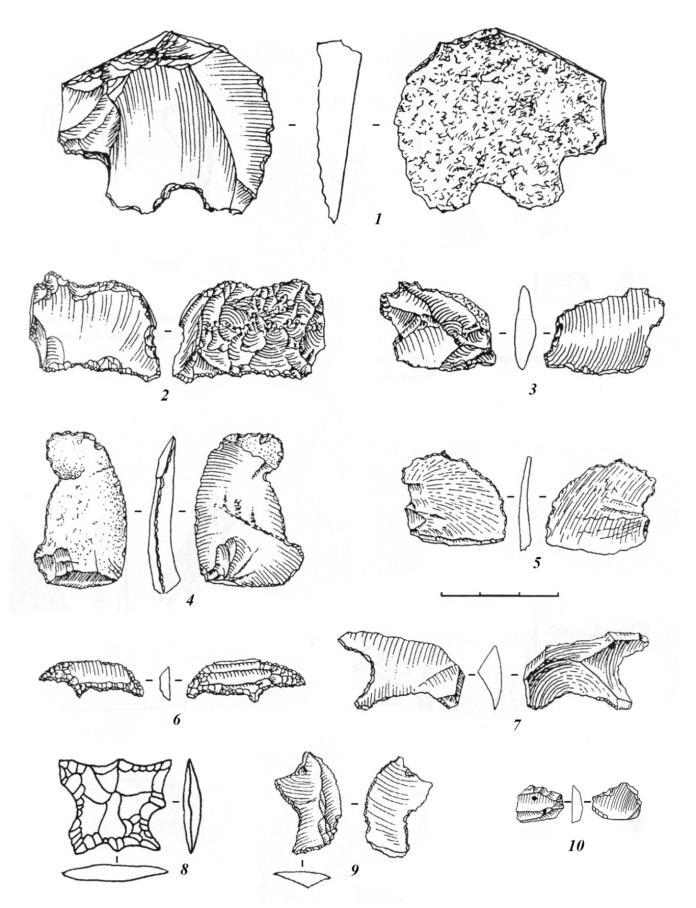
Figures 1-10: Figures of bears (1-7), Heads of bears (9,10) bear skin (8) from Chukotka sites (according to MA Kiryak 2003) [6].
Conclusion
One of the most controversial problems of studying ancient art is interpretation, especially subjective, in our opinion, the interpretation of images on flakes from Chukotka looks like. The only exception is the figure of a polar bear on an obsidian knife-like plate from the Tytyl III site. Simplicity of processing and schematism of images is explained by reduction, which does not give confidence in the reliability of conclusions and evidence. Necessary research procedures are omitted, there are no stable canons of the supposed artistic images. There are no direct analogies to these “bearish figures” either in the Far East or in Eastern Siberia. You cannot view these artifacts as artistic objects. Only a figure on a knife-like plate from Tytyl III site can be considered as a real image.
References
-
Gusev SV, Makarov IV (2008) Stone inventory of Unanan settlement in eastern Chukotka. In: Dikov V, (Ed.), Reading: the 80th Anniversary of the First Kolyma Expedition and the 55th anniversary of the formation of the Magadan Region: the Conference Proceedings (Magadan). Cordis, Magadan, pp: 77-80.
-
Dikov NN (1993) Asia at the junction with America in antiquity. Nauka, St. Petersburg.
-
Kiryak MA (1993a) Archeology of Western Chukotka in connection with the Yukagir problem. Nauka Moscow.
-
Kiryak MA (1993b) Miniature Stone Sculpture of Western Chukotka. In: Regional Notes. Magadan 19: 29-49.
-
Kiryak Dikova MA (2000) Ancient Art of the North of the Far East as a Historical Source (Stone Age). NEISRI FEB RAS, Magadan.
-
Kiryak Dikova MA (2003) Ancient Art of the North of the Far East as a Historical Source (Stone Age), 2nd (Edn.), Rev. and add. NEISRI FEB RAS, Magadan.
-
Kiryak MA (2009) Early Art of the Northern Far East (the Stone Age). National Park Service, Anchorage.
- The Indispensable Role of Informal Caregivers in Supporting the Aging Population
- Socio-Religious Significance of Kamakhya Temple in Guwahati, Assam
- Is Anthropology Possible?
- A Contribution to the History and Paleobiology of Harput/Elazığ Türkiye and Its Surroundings
- A Study on the Cowrie Shells of the Dimasas in Assam
- The Significance of International Organizations Cooperation in the Efficient Resolution of Global Conflict