
Interpretative Co-Management of Tourism in Mangrove Trekking Tour Management: Case Study on Kampung Laut Community, Segara Anakan, Cilacap, Indonesia
This paper argue a new perspective on the structural-functional approach in tourism studies. This new perspective called "interpretative co-management of tourism". In this perspective, that tourism is not only talking about economic motives, but also "good intentions" from the other stakeholders to improve and preserve nature. How does tourism also work, even though visitors are not charged ticket entry fees by the manager of tourism for the maintemance fees? This research is a qualitative study, with the fieldwork data collected through interviews and observation on Kampung Laut Community in Segara Anakan area, Cilacap, Central Java. The finding of this study is that Segara Anakan an area experiencing massive sedimentation that has caused a tenurial change from common to private property, results in the limited access for the individual community members to utilize the existing natural resources. Recognizing this difficulty, the people of Segara Anakan responded to this situation by establishing a mangrove tourist area. The new land from sedimentation that is privately owned still provides common benefits for the people as they maintain the land’s sustainability. The conclusion of this study that management of tourism with "interpretative co- management of tourism" support shared utilization of the natural resources for tourism by the people of Segara Anakan and others stakeholders. It can continue to be practiced along with the effort to maintain the sustainability of the nature that guarantees nature conservation
Introduction
This paper argue a new perspective on the structural- functional approach in tourism studies. This new perspective called "interpretative co-management of tourism". In this new perspective, that tourism is not only talking about economic motives, but also "good intentions" from the other stakeholders to improve and preserve nature. How does tourism also work, even though visitors are not charged ticket entry fees by the manager of tourism for the maintemance fees?
Studies on tourism have been studied extensively through business, industry and political-economic perspectives, which are driven by how to advance tourism in an area through the massive tourist visits [1, 2]. In the end, quantitative became the most dominant methodology used in tourism research. Burns made a critique by saying that the approach was too shallow because it only touched the surface of the analysis that could have been produced [1]. According to him, anthropology as a scientific discipline that uses qualitative methods can make an important contribution to the study of tourism, especially through its ethnographic approach. This paper is one of the contributions of anthropology in providing new insights into tourism studies.
Conceptually, tourism is a recreational activity that is synonymous with the movement of people to a place with the aim to enjoy, and not infrequently they stay in the place for a while [3]. This understanding identifies the characteristics of tourism namely, there is a relationship between tourists and local people which reveals the phenomenon that tourists are on vacation, while local people work at their service. In other words, it can be said that there are two categories in tourism, namely managers arranged in a particular organizational structure and tourists who get tourism services.
This perspective explicitly shows a structural- functional perspective. This perspective tends to look at social systems or structures that operate between individuals, groups, or institutions in social practice [4]. The structural-functional perspective itself adopts a model of a human organism [5]. Radcliffe-Brown associates social structure as an organism of the human body and social life is like the life of that organism. One body organism consists of body organs arranged in an integrated network of relationships. Each organ has and functions differently, but are interconnected with each other. That way, the life of the organism can run in balance.
This perspective also provides an understanding that the concepts of structure and function cannot be separated from one another. Individuals, groups, or institutions play a role like organs in a certain position or status in social practice. Through a structural-functional perspective, the phenomenon of tourism has components articulated through tourism managers and tourists as those who enjoy tourism services. Structural-functional perspective plays a role in seeing the structures and functions that operate between components in the operationalization of tourism so that tourism activities run well. The function of the manager is to manage tourism activities so that they can be enjoyed, while tourists play the role of enjoying tourism services and provide reciprocity in the form of money. The money is used by managers to manage tourism and keep it going well. One of the tourism management located in Kampung Laut is Mangrove Tourism.
Kampung Laut is a subdistrict in Cilacap, Central Java. The subdistrict is a unique area because the area has undergone landscape changes. Kampung Laut region was once a water area but changed into land due to the massive sedimentation process of the region. This happened because the area is where several rivers of Java disembogue. The damage of the watershed is also influenced by the level of sedimentation that flows is carried to Kampung Laut.
The landscape changes are also followed by changes in the social environment of the community. The people of Kampung Laut used to be fishermen, but with the emergence of the new land and can be utilized for agricultural activities, some people have changed their profession by working as farmers. Changes have also occurred in the resource management, where the resource that was previously managed as common property, which usually refer as common-pool resource or which Feeny, et al. [6] refer as communal property, the resource owned by known people who interdependent user, these users exclude people outside the community and make rules about resource usage. The resource management then considered as private property, which Feeny, et al. [6] refer as a right to exclude other people from resource usage and to organize resource usage for particular people or community. When Kampung Laut used to be water, people used the area to catch the fish freely as a common area, but when it transformed into the land, the area could be owned by individuals and thus turned into private property. The land was marked and blocked, indicating that the land is owned by a person or a group and can not be accessed by anyone. However, there is one tenure owned by a group of individuals, but the access is open freely for people outside the group, namely the mangrove trekking location.
The mangrove trekking tourism in Ujung Alang village is one of the tourist attractions in Kampung Laut, which belong to ecotourism, which has concern on biological diversity preservation, environmental promotion, cultural comprehension, poverty reduction, local benefit impact minimization on environment and culture of the host in Moreno [7]. This tourist spot is interesting because the managers do not set admission fees to visitors. The management of the trekking tour shows that the area is managed as a common area. The land is privately owned by a tourism management group but the manager provides what Ostrom [8] refers to as a right to access. The management of the tour, on one hand, is also a response to the stressor in the form of resource management change.
Why in the case above, the access rights can be given free of charge to tourists? Does the structure of "managing service and tourists being served by giving money in return" does not apply to mangrove trekking tourism in Kampung Laut? How can the tourism system in Kampung Laut continue to operate? And, is there any economic impact that is still felt by the surrounding community as a result of the actualization of tourism activities in general?
This research tries to find out about the reason for the managers of the mangrove trekking tour to manage the tourism without imposing a charge. This research also tries to explain about the possible economic impact for local people, mainly the people who involved in the tourism activity.
An interpretive co-management perspective is used to build the discussion in this paper. This perspective relates to stakeholder actions, social practices, and facts that are not related to a single meaning, which in this context is towards attractions. This perspective also does not require the privilege of a position because all stakeholders involved are considered equal. Stakeholders themselves are people who have rights and interests in a system. According to Meyers and IIED [9], stakeholders can be individuals, communities, social groups or organizations. Stakeholders refer to all parties who influence and/or are influenced by the policies, decisions, and actions of the system [10].
Studies through interpretive perspectives are carried out by following the meanings that have been exposed by stakeholders, while co-management is the pattern of management of stakeholders and resource-use actors (user groups) who share responsibility in management and resource utilization with the aim of realizing a balance of economic and social goals within the framework of ecosystem and fishery resource sustainability [11]. Thus, the interpretive co-management approach emphasizes stakeholder particularity, which is represented as several interrelated points forming a network of shared relationships and responsibilities centered on an interpretive object, one of which is a tourist attraction [12].
Methods
This research used a qualitative approach to understand the phenomenon which becomes a research focus. This research also uses ethnography method to understand Kampung Laut people, mainly in Desa Ujung Alang. Data collection activity held with the participatory observation by involving in local people’s daily activity. Data collection also held with an in-depth interview with key informants.
Results
Kampung Laut: A Village above the "Sea"
The Segara Anakan area is undergoing a massive sedimentation process caused by high erosion of silt deposits from the main rivers that lead to Segara Anakan, namely Citandui River, Cibereum River, Cikonde River, and Cimeneng River. This area is located between 7035 '- 7046 "S and 1080 45" - 1080 01 "E on the border between West Java and Central Java provinces. The overall area of the Segara Anakan area is around 24,000 hectares covering waters, mangrove forests, and mudflats formed by sedimentation. Laguna Segara Anakan is water located in the estuary area on the south coast of Central Java which is located on the border between Pangandaran Regency, West Java and Cilacap Regency, Central Java.
Resource Management in Kampung Laut
Kampung Laut is an area that undergoes a landscape change where the coastal area transformed into the land. This landscape change has brought implications for several things, such as the shifting of the people’s livelihoods from being fishermen to becoming farmers. Changes also occur in resource management.
The resource management in Kampung Laut also changed along with the change of the landscape. When the area had not transformed into the land the people use the area freely and there were no land barriers. The area was still open water and people could utilize these water without barrier. The people could freely fish here. When the area transformed into the land the situation changed slightly. The new land resulted from sedimentation could be owned privately. People get a share of the land and claim it to be theirs, or on a certain occasion, the government conducted a program to share the land to the people. Since then people can not use the land that was once used freely because it could be owned by someone. One needs to ask for permission if he or she wants to use a part of the land to the landowner. The land becomes restrictive to certain individuals or groups.
Kampung Laut Tourism
Kampung Laut has several tourism potentials that are quite interesting. Tourism activities in Kampung Laut have been operated although it is not as crowded as other tourist destinations in general. Kampung Laut has several tourist attractions such as mangrove trekking tour located in Ujung Alang, Maria Cave in Klaces and Masigit Sela Cave in Ujung Alang. These caves are usually visited for spiritual tourism. Visitors of Masigit Sela Cave can usually spend their time up to a week to meditate. This cave is often visited by people from other places. Even a celebrity from the capital city has visited the cave several times to meditate. Tourists can also visit the beaches that are located in Nusakambangan area, but since Nusakambangan is a prison island with limited access then not many people visit the beaches.
Mangrove Trekking Tour
The mangrove trekking tour is located in Lempong Pucung Hamlet, Ujung Alang. Here, the visitors can enjoy the view of mangrove forest and can also plant mangrove trees in the area of 6 Ha. Visitors can also enjoy a local dish like young coconuts provided by the tour management but they have to order first. This mangrove trekking tour is unique since the manager does not impose fees to the visitors.
According to the informants, the mangrove trekking tour was opened in 2012. But this tour had passed a long process before finally becoming a tourist site like today. In 1994 there was a massive land clearing for the manufacture of shrimp pond in Ujung Alang. The shrimp pond ran for about 4 years and stopped operating in 1998 because the pond was exposed to the disease commonly referred to as white spot. The pond eventually stopped operating and was closed in 1999. The dead pond was then abandoned in such state. The people then took the initiative to plant mangrove trees in the former pond. They invited some relatives and local residents to replant mangrove forest in the bare place. The planting activities were carried out continuously in hope that other parties, particularly the government, notice and provide aid. One informant said that he and his colleagues received mangrove tree seedlings as a form of aid from the government. The informant said the government had given seeds several times so that the people would plant mangroves on the area that used to be the shrimp pond and also in some areas of Kampung Laut. Support also came from one of the leading oil and gas companies operating in Cilacap. The company provided mangrove tree seedlings like the government. The informant said that since 2005 he and his colleagues made a planting group that now has turned to a formal group. They establish the group as Krida Wana Lestari Farming Group. The group then continues to conduct mangrove planting and mangrove seed production. The planting and the maintenance of mangrove were then also supported by several parties and received assistance, until finally in 2012 the government helped in developing the infrastructure. The assistance provides the current facilities of the trekking tour. They still receive infrastructural assistance for maintaining and repairing facilities have been damaged and also for building more facilities for the mangrove trekking tour.
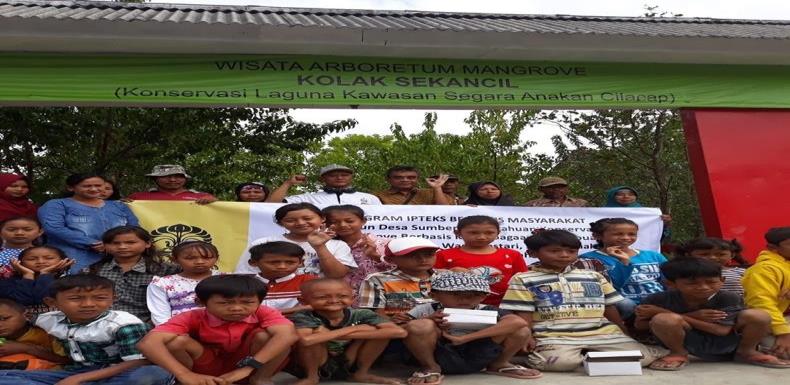
Krida Wana Lestari Farmer Group
Krida Wana Lestari Farmers Group is a farmer group that manages mangrove trekking tours in Ujung Alang. This group cultivates mangrove trees, starting from planting, growing, and producing seedlings. According to the informants, this group is specialized in mangroves only, and they do not wish to focus on other activities such as growing ricefields and so on. They said this farmer group belongs to the ‘bottom’ farmer group. The 'bottom' farmer group refers to the field they manage, that is, the mangrove trees that grow on water, or below (bottom) of the land, in contrast to ricefields and plantations that are grown on the land (top). According to them, this is the only farmer group that exists in the village.
Krida Wana Lestari Farmer Group operates hand in hand with the mangrove planting activity on vacant land in Ujung Alang. The informants said that this group was formed so that there would be a formal group with permanent members. Krida Wana Lestari Farmer Group was formed in 2005, but an informant who is the group secretary said that the group was 'officially' established in 2007. ‘Officially’ in this context means that they had met the formal administrative requirements of the group, such as a certificate from the notary, Taxpayer Identification Number (NPWP), and the certificate to grow mangrove seedlings, which, according to the informants is an important certificate because it allows them to produce seedlings to be sold to various regions. Krida Wana Lestari Farmer Group manages a mangrove seedlings business. The group receives demands for mangrove tree seedlings from various regions in Java. In order to be able to produce the seedlings and to meet the demands, the group has to have the certificate first.
The group manage the trekking tour as well as producing mangrove seedlings. Producing the seedlings is a response to the demands for seedlings from various regions of Java. The seedlings are usually delivered to other mangrove trekking tourisms and also for mangrove plantations in other areas. This task is done by the members of the group and also people who want to participate. This activity gives them additional income. Beside producing mangrove seedlings, the group also runs the management of the trekking tour. The group usually provides assistance to tourists, especially to tourist groups. For example, when the Board of the Community Health Center of Cilacap visited the place, the group accompanied them. The group also gives assistance to tourists who want to plant mangrove trees. The members of the group prepare the seeds to be planted and accompany the tourists to plant them in the places that have been provided. The group also offers the tourists consumption, but they have to order the group first.
The management of the mangrove trekking tourism is interesting because the group has not imposed fees to the visitors. According to the informants they have not set fees because they think the mangrove trekking tour is not ready. The site has not met the standard for tourism and so they have not asked the visitors to pay even though it seems that the condition is well enough for tourism. Besides, the informants also admit that the group has not decided to make a schedule for each member to assist the tourists at visiting time, as the number of visitors that visit the site is uncertain. In addition, if they ask personnel to guard the site, they will need to pay the operational costs while they think the tourism site has not earned enough to provide the facilities. According to them, it is fine to keep the tourism site in this way as long as it attracts visitors to come while they can still monitor the site. Nevertheless, the tour provides them revenue as visitors plant mangrove trees and is charged for performing the activity and also from the demand for consumption. They earn more when groups of tourists come to the site.
Discussion
Mangrove Trekking Tour Management in the Dynamism of the Resource Management in Kampung Laut
The mangrove trekking tour is one of the few tourist attractions in Kampung Laut. This tourist site is interesting since the visitors are not asked to pay to come. This phenomenon shows the dynamics of resource management in Kampung Laut. Kampung Laut is an area that undergoes a landscape change from being a coastal area to transforming into the land. The landscape change is followed by a change in resource management. When Kampung Laut was still a coastal area the place was used by the common, people could use the waters with no restrictions. People could fish anywhere. Now when it has transformed into the land the resources are managed privately, people can not freely utilize the land because it belongs to a person or a group and there are restrictions to pass the land. This is reinforced with the land tenure system in which the landowners have the rights to control their property. The land ownership certificate is issued by the government's program in 2004. The certificates are created for lands that are meant to be used for residential only. Land used for other purposes such as ricefields and tourist attractions is given SPPT (The Letter of Tax Notification) only. The letter is not a sign of ownership but it demands the management to pay tax. However, according to the informants the SPPT is often used as a sign of ownership. A person needs the permission of the landowner if he or she wants to use the resources of land, such as taking fruits from the trees on the land, and so on. Land becomes exclusive and not anyone can pass the land.
The mangrove trekking tour shows something different from the phenomenon that has been described. The resource management there have become private, but the management of the mangrove trekking tour shows is still run collectively. The managers have not imposed admission fees to the visitors and so they are free to come at any time. The managers practice this system so that the visitors can enjoy the trekking tour while they take care of the site. The managers deliberately gave what Ostrom [8] referred to as access right where visitors can enjoy the scenery but can not take resources such as the mangrove trees there. Imposing no admission fees does not mean that the management group does not earn any income from the tourist site. They always earn from providing consumption to tourist groups and also producing mangrove seedlings. A group visit usually requires one member to accompany them, and the group usually pay for the service voluntarily. They can also earn from the people participating in tourism activities. The informants said that in these activities not only the members of the Krida Wana Lestari farming group can be involved, but other people can participate as well.
Mangrove trekking tour yet has a massive impact on local people economy. This phenomenon was different from Archer [13] findings on the Bermuda community which tourism has enough impact on local people community. Mangrove trekking tour gives an alternative opportunity for Ujung Alang people. Mangrove trekking tour activity can become an additional job for people that still have the main job as a farmer.
Co-Management and Role of “Interpretative Co- Management Perspective” on Segara Anakan Tourism Practices
The centralized management model by reducing the role of local stakeholders who use resources makes Segara Anakan management inefficient. Such conditions lead to conflicts of interest in the utilization of mangrove and fishery resources in Segara Anakan. The imbalance in the distribution between the role of government and the role of other stakeholders that use resources is the reason for the importance of the co-management approach to improving the management system by integrating the recognition of rights and partnerships of all stakeholders [14].
According to Borrini-Feyerabend, et al. [15], co- management is a situation, in this case more than one party negotiating, defining and guaranteeing the division of roles in management and responsibilities among themselves over an area or resource system. The co- management institution was built by adopting the opinion of Ruddle [16] with the principles: (1) Resource boundary system, namely the mangrove zone which is possible in managing co-management in the Segara Anakan area. In this zone, the community is permitted to conduct resource use activities. (2) Rights system for resource users. Granting utilization rights to communities who use resources is an important requirement in the framework of co-management. One important condition in co- management is the clarity of rights and responsibilities for a territory or resource to be managed. (3) The rules system. The rules system are based on strategic issues and are priority in order to achieve common goals agreed by all stakeholders. It is necessary to regulate the use of resources based on the agreement of all stakeholders. The involvement of local institutions such as mangrove farmer groups in setting rules is needed related to the more adaptive and participatory management principles of Segara Anakan. (4) Sanctions and law enforcement systems. The mechanism for imposing sanctions against violations of law is regulated based on applicable laws and regulations. (5) Monitoring and evaluation system. The process of continuously improving co-management performance requires monitoring and evaluation activities to review progress or weaknesses in its implementation. Monitoring and evaluation activities are carried out regularly by involving all stakeholders involved with the goal of achieving better results through a shared learning process.
The Mangrove trekking as a vital tourist attraction in Segara Anakan keeps its own exoticism. This can be seen from the value offered. If tourism, in general, offers the value of pleasure then mangrove trekking besides fulfilling the value of pleasure through trekking facilities, viewing posts and fishing ponds, it also emphasizes the value of ecology-based education and self- reflection on nature, its power, and nature's relationship to society [3]. For this reason, this tourism area is able to cause multi- interpretations from a number of stakeholders to develop the Segara Anakan mangrove arboretum based on their respective interests and obligations.
Stakeholders involved in the development of the Segara Anakan mangrove trekking include the Krida Wana Lestari Farmer Group, tourists, the Kampung Laut Subdistrict government, Pertamina (local Oil and Gas Company), Universitas Indonesia and Dafam Hotel Group Company. As part of the Kampung Laut community, the Krida Wana Lestari Farmer Group has a major role in developing the conservation area as a representation of their obligation to preserve the natural environment in which they live. If they do not carry out that primary role, they will feel the direct impact of the occurrence of extreme flooding and extreme erosion.
As a tourist attraction, the presence of tourists takes the next role in developing mangrove trekking. Tourists are given free access to Segara Anakan mangrove trekking. In the trekking area, they are encouraged to know firsthand the types of mangroves and the role of mangroves for nature. When mangroves decrease, the “anger” of nature becomes a consequence that will be received. The goal is that tourists have a responsibility in preserving the natural environment and trying to live in harmony with nature.
Furthermore, the Kampung Laut Subdistrict government has a mission to prosper the community. Development programs are the main role that they must carry out. In this case, the role of the government is to develop the location of Segara Anakan mangrove conservation by providing free mangrove seeds and helping to distribute mangrove seeds developed by the local community, both within the Kampung Laut area and to other conservation areas outside Kampung Laut. One of them is the mangrove conservation area in Jakarta. In addition to maintaining ecological balance, Kampung Laut people also receive economic benefits from the sale of mangrove seeds.
Finally, as a company that carries out business activities in the vicinity of Kampung Laut, the Oil and Gas Company has an obligation to prosper the community around its business area. This obligation is applied in CSR programs. One of the CSR programs that they run is to provide facilities that support the development of the Segara Anakan mangrove trekking area. An example is road improvement on mangrove trekking and viewing post.
The interests and obligations of each stakeholder are called multi- interpretative towards the Segara Anakan mangrove trekking attraction. Because of the object interprets similarly, directly or indirectly, they are bound in a social network that functions to connect one stakeholder with other stakeholders. This network eventually contributed as an effective model for the preservation of natural resources, in this case, the conservation of the Segara Anakan mangrove. Visually, the model can be seen in the Figure below
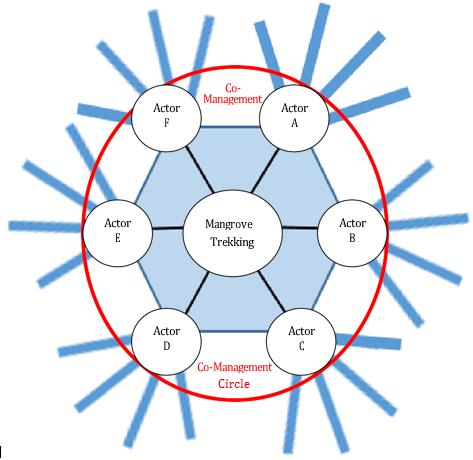
The scheme above illustrates the relationship of interpretive co- management between stakeholders involved. The small circle in the middle is mangrove trekking, while several other circles around the middle circle are stakeholders who have an interest in mangrove trekking. The black line connecting the stakeholders with mangrove trekking illustrates the relationship between the two.
There are interpretations made by stakeholders and applied through management actions. Blue lines in the shape of a six square show the inevitable interactions between stakeholders because of the interests of the same object, namely Segara Anakan mangrove trekking. For example, the relationship between the Krida Wana Lestari Farmer Group and tourists, the Kampung Laut Subdistrict government and the Oil and Gas Company (provision of facilities and seedling development), and so on. Uniquely, each stakeholder can certainly attract other stakeholders to collaborate together to develop the Segara Anakan mangrove trekking. For example, the Kampung Laut
Subdistrict government attracted other parties to buy mangrove seeds taken from the trekking area because of the publication of a program carried out by the government. In other words, if the social networks of each stakeholder function properly, they can develop Segara Anakan mangrove trekking areas more optimally.
This situation is a system of shared private property with clear boundaries regarding rights rules and utilization management [12]. This system, like all property regimes, "packs rights and obligations" from parties who have an interest. Rights and obligations are given and owned by each stakeholder to use and protect the resources together. Sanjatmiko’s [17] series of preliminary studies on common property indicate an effort to manage the fisheries on a common fishing ground in northern Java. In attempt to avoid a tragic outcome of the tragedy of the commons, the co- management of fishing activities plays a crucial role. The co-management of fisheries is a practice of management in which the government and the resource users share the responsibility in managing and utilizing fishery resources, with the goal of achieving balance between economic activities and preservation of the ecosystem and fishery resources.
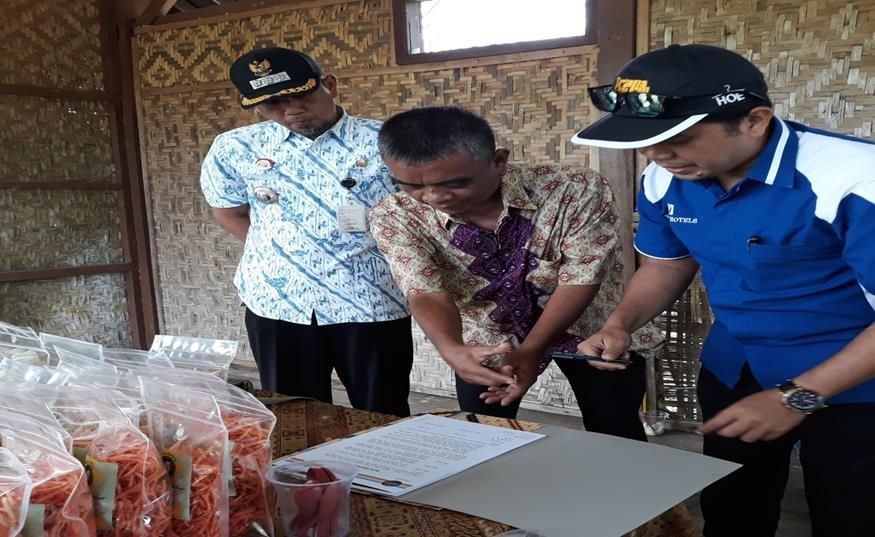
Co-management with stakeholders who use the resource (user group) share the responsibility in managing and utilizing resources to realize a balance of economic and social goals within the framework of an ecosystem and natural resource conservation. Previous studies such as Sanjatmiko [12, 18], Jhonson, et al. [19], Polasky, et al [20], Yandle [21], Berkes [22], Mulrenman [23], Pannel [24], Adrianto [25] have shown how the implementation of co-management in natural resource management has implications for the improvement of natural, socio-economic, and cultural resources.
Conclusion
Kampung Laut is an area that has experienced landscape change in which it used to be a coastal area now has transformed into the land. The landscape change also brings implications to the people’s socio-cultural environment, such as in the livelihoods of the people that used to work as fishermen now some of them have become farmers. Changes also take place in the resource management in which the area used to be common property when it used to be water territory now have become private property since the land was formed. The new land was now divided into the individuals as private property legally and each plot of land is given barriers so that not anybody can pass through it.
Recommendation
The phenomenon of mangrove trekking tourism in Kampung Laut is somewhat unique. The structural- functional approach to mangrove trekking tours is not single but rather is applied in their organizational structure. On the other hand, there is another approach that is more dominant, namely interpretative co- management.
The structure of tourism managers and tourists within the framework of serving and being served is no longer valid. That is because the tour manager, the Krida Wana Lestari Farmer Group, does not feel that it is serving, but rather invites the public at large to both learn and actually preserve the natural environment. Based on these principles, the Krida Wana Lestari Farmer Group encourages responsibility within the framework of the interpretation and co- management of the mangrove trekking area in the Segara Anakan area. That approach also makes visitors not need a fee to enter. Mangrove management operational costs come from the help of a number of stakeholders involved and boat services that are rented when going to the mangrove area. This phenomenon is a unique approach and is recommended to be applied in the world of tourism, especially ecotourism, with the aim of developing tourism.
Hopefully, this study has provided a deeper understanding of tenurial changes that happens in Indonesia, where uses of natural resources in line with the sustainability in management. The government and the involved parties should encourage the efforts to utilize natural resources collectively along with the sustainability of nature.
Acknowledgment
We thank you, to Kementerian Riset Teknologi dan Pendidikan Tinggi Republik Indonesia, Direktorat Riset dan Pengabdian Masyarakat Universitas Indonesia and Community of Kampung Laut who have supported so that this research can be completed.
References
-
Burns PM (1999) An Introduction to Tourism and Anthropology. Routledge, London, pp: 1-176.
-
Macleod DVL (2004) Tourism and Cultural Change. Channel View Publications, pp: 1-244.
-
Urry J (1990) The Tourist Gaze, Sage Publications, London, pp: 180.
-
Marzali A (2006) Struktural-Fungsionalisme. Antropologi Indonesia 30(2): 127-137.
-
Radcliffe Brown AR (1952) Structure and Function in Primitive Society. Cohen and West Ltd 23(1): 71-72.
-
Feeny D, Berkes F, Bonnie J, McCay, James M Acheson, et al. (1990) The Tragedy of the Commons: Twenty- Two Years Later. Human Ecology 18(1): 1-19.
-
Moreno PS (2005) Ecotourism Along The Meso- American Caribean Reef: The Impacts of Foreign Investment. Human Ecology 33(2): 217-244.
-
Ostrom E (2000) Private and Common Property Right. Center for the Study of Institutions, Population, and Environmental Change, Indian University, pp: 332-379.
-
Meyers J dan IIED (2005) Strength Analysis of Stakeholders. In: Suporahardjo, (Ed.), Bogor, Pustaka, Latin.
-
Grimble R dan, Man Kwun C (2005) Stakeholder Analysis for Natural Resource Management in Developing Countries. Bogor, Pustaka, Latin 19(2): 113-124.
-
Saifuddin AF (2006) Contemporary Anthropology: A Critical Introduction to the Paradigm. Jakarta, Kencana.
-
Sanjatmiko P (2017) Analisis Jaringan Sosial dan Perebutan Sumberdaya di Kawasan Segara Anakan. Department of Anthropology, FISIP University of Indonesia, pp: 88.
-
Archer B (1995) Importance of Tourism for the Economy of Bermuda. Annals of Tourism Research 22(4): 918-930.
-
Partomo, Sjafri M, Aida Vitayala SH, Luky Adrianto (2011) Co-management based lake management: the case of the swamp reel. Journal of Natural Resource Management and the Environment (1)2: 106-113.
-
Borrini Feyerabend G, Farvar MT, Nguinguiri JC, Ndangang VA (2000) Co-management of Natural Resources: Organizing, Negotiating and Learningby- Doing. Heidelberg, Kasparek Verlag, Germany, pp: 1- 95.
-
Ruddle K (1994) A Guide to The Literature on Traditional Community-Based Fishery Management in The Asia-Pacific Tropics. Rome: Food and Agriculture Organization of The United Nations, pp: 114.
-
Sanjatmiko P (2012) Kondisi Sosial Ekonomi Nelayan Artisanal di Pantai Utara Provinsi Jawa Barat. Makaira Printing Plus, Bogor 8(1): 83-91.
-
Sanjatmiko P (2018) A Critical Review of Hardin’s Tragedy of the Commons (1968) A Case Study on the Segara Anakan Community, Cilacap, Central Java. Antropologi Indonesia 39(1): 1-15.
-
Johnson KA, Nelson KC (2004) Common Property and Conservation: The Potential for Effective Communal Forest Management within a National Park in Mexico. Human Ecology 32(6): 703-733.
-
Polasky S, Tarui N, Ellis GM, Mason CF (2006) Cooperation in the commons. Economic Theory 29(1) 71-88.
-
Yandle T (2006) Sharing Natural Resource Management Responsibility: Examining the New Zealand Rock Lobster Co-management Experience. Policy Science 39(3): 249-278.
-
Berkes F (1986) Common Property Resources and Hunting Territories. Anthropologica 28(1) 145-162.
-
Mulrenman M, Scott CH, Moreno PS (2005) Co- management? An Attainable Partnership? Two Cases from James Bay, Northern Quebec and Torres Strait, Northern Queensland. Anthropologica 47(2): 197- 213.
-
Pannel S (1997) Managing the Discourse of Resource Management: the Case of Sasi from 'Southeast' Maluku, Indonesia. Journal Oceania 67(4): 289-307.
-
Adrianto L, Al Amin MA, Solihin A, Hartoto DI (2010) Konstruksi kelembagaan dalam pengelolaan perikanan di era desentralisasi. Pksplipb, Bogor.
- The Indispensable Role of Informal Caregivers in Supporting the Aging Population
- Socio-Religious Significance of Kamakhya Temple in Guwahati, Assam
- Is Anthropology Possible?
- A Contribution to the History and Paleobiology of Harput/Elazığ Türkiye and Its Surroundings
- A Study on the Cowrie Shells of the Dimasas in Assam
- The Significance of International Organizations Cooperation in the Efficient Resolution of Global Conflict