
Spear Attacks: Contact, War and Revenge in Yasuni National Park
The Waorani are family groups of recent contact that inhabit an extensive region of the Ecuadorian Amazon rainforest of more than two million hectares, called Yasuni. In the global imaginary they are recognized for their fascinating history contact and in the academic ethnographic tradition for being considered the human group with the highest homicide rate in the world. Waorani preserve characteristics of a tropical forest culture: • Have a low population density, • High mobility, • Basic social order, • Family clan groups or nanikabos, and, • Semi-permanent cyclical settlements of horticultural product. Arly ethnohistoric references, from the late nineteenth and early twentieth centuries, related both by their ethnic neighbors and by various actors from State institutions, called them aucas, a word that in the Kichwa language means wild, violent, uncivilized and which includes the vision of Amazonian otherness, framed within a scenario of intra-group and extra-group tribal violence. The word wao in his tededo language, means, man, human; and, Waorani, men or true human beings. This is how this group identifies itself and creates its ethnic boundaries in front of other groups, whom it calls cuwuri or non- Waorani. These symbolic borders that the Waorani built on the meaning of humans and non-humans, marked for a long time their warlike relations and contact with their ethnic neighbors, be these other indigenous groups (Kichwa, Shuar), mestizo settlers or workers of extractive companies, be they rubber, mining or oil companies.
Patricio Trujillo-Montalvo1* and Roberto Narváez-Collaguazo2
Waorani: Warriors in the Deep Jungle
The Waorani are an ethnic group of recent contact, who preserve characteristics of a tropical forest culture:
- Have a low population density,
- High mobility,
- Basic social order,
- Family clan groups or nanikabos, and,
- Semi-permanent cyclical settlements of horticultural product.
Their worldview and oral memory revolve around intra and extra group war events, building social relationships on complex kinship networks and situational leadership [1, 2, 3]. Early ethnohistoric references, from the late nineteenth and early twentieth centuries, related both by their ethnic neighbors and by various actors from State institutions, called them aucas, a word that in the Kichwa language means wild, violent, uncivilized [4], and which includes the vision of Amazonian otherness, framed within a scenario of intra-group and extra-group tribal violence. These clan groups of extended families inhabited an extensive region of the Ecuadorian Amazon jungle of more than two million hectares, called Yasuni, in the world imagination they are recognized for their fascinating history of contact and in the academic ethnographic tradition for being considered as the human group with the highest homicide rate in the world [2, 5, 6].
The word wao in his tededo language, means, man, human; and, Waorani, men or true human beings. This is how this group identifies itself and creates its ethnic boundaries in front of other groups, whom it calls cuwuri or non-Waorani. These symbolic borders that the Waorani built on the meaning of humans and non-humans, marked for a long time their warlike relations and contact with their ethnic neighbors, be these other indigenous groups (Kichwa, Shuar), mestizo settlers or workers of extractive companies, be they rubber, mining or oil companies.
The territory of mobility of the Waorani was located between two great rivers, the Napo, which was the northern limit, in the Wao language known as Doroboro, and the Curaray river, the southern limit, called Ehuengono, an extensive region controlled by four clan family groups, transhumants, known as: Guiquitariris, Piyemoiris-Nihuairis, Wepeiris and Bahuairis, who maintained a territorial use based on mobility dynamics related to the course or headwaters of the rivers; thus the: Iromenaniri; identified as the families that in a certain historical period occupied the headwaters of the rivers “from below”, and Enomenaniri, or the families identified with a dynamic of mobility that developed in the “rivers above”.
With an approximate number of 500 individuals, at the time of the contact that occurred in the 60s of the previous century, they lived isolated in these geographical headwaters and the middle courses between the Curaray river and its tributaries, as well as the Coca and Payamino rivers and between the headwaters and middle courses of the Tivacuno and Yasuní rivers [2, 7]. The violent contact with their ethnic neighbors and the accounts of their attacks date back to the beginning of the 20th century, when indigenous Kichwa people who worked as laborers, collectors, gunmen or guardians in several rubber estates located on the banks of the Napo, Arajuno, Curaray and Shiripuno rivers they were killed with spears. Historically, the Waorani were hunted and captured during the rubber trade era, from 1875 to 1925, and sold to the slave markets in Iquitos and Manaus [8, 9].
The hatred and fear of cuwuri or strangers is present in their oral memory and passed from generation to generation [7, 9, 10, 11]. This violent stage, also, reconfigured their territoriality, because to avoid being captured they sought refuge in the interfluvial hill areas, away from the main rivers that were their mobility areas. After rubber and in a second, but just as aggressive and violent, they are linked to the oil stage, where several attacks took place against workers from the Shell company who were beginning to explore vast resources in the Yasuni región [7, 9, 10, 12, 13, 14]. However, it is in 1955 where the recent history of this town begins and its formal contact with Western culture, since the Ecuadorian State, signed an agreement with the Summer Institute of Linguistics-Summer Institute of Linguistics (SIL) for the pacification of violent indigenous groups that inhabited the Amazon region, including the Waorani. Baptist Christian Missionaries.
Ethnography of Pikenanis, Memories of War and Violence
This article presents results on the contact, mobility and kinship relationships of Waorani clans with PIAV families, based on extensive ethnographic information, collected and systematized by the authors, in two decades of field work (2000 to 2020), on the one hand, within the “Amazonía” project, coordinated by the Fundación de Investigaciones Andino Amazónicas (FIAAM), and on the other, in investigations framed in ethnic territorial planning processes and in forensic expert investigations within judicial processes. During the aforementioned time, testimonies of 26 clan chiefs were analyzed, between traditional Waorani leaders known as Ahuenes, and Waorani warriors, called Pikenanis in their language, who have their zone of cyclical mobility or residence in the Yasuni region, composed of both the Yasuni National Park (PNY), the Tagaeiri-Taromenane Intangible Zone (ZITT). The Pikenani warriors were the ones who participated in the main contact events with SIL and in the massacres of the PIAV families, belonging to the Bahuairis, Wepeiris, Guiquitairis and Niwairis clans, carried out in 2003 and 2013: Ocata, Minkaye, Babe, Davo, Pego Enomenga, Araba, Ompure, Iniwa, Pego Wane, Kempery, Karayulle, Enqueri, Wane, Kaiga, Kawena, Meñewa, Awa, Menga, Tare, Nenkimo, Bay, Tiwe, Kay, Tementa, Orengo, Mingui. The interviews were carried out in different years, achieving the possibility of cross-examining them and comparing the answers to observe the changes in the speeches about the events that focused on: a) their relationship with the PIAV, b) the history of the two peoples (Waorani -PIAV), c) the meaning of the warrior code, war, alliances, nanikabos and contact, d) places of birth, rivers, territories and spaces of mobility; and e) kinship relations, alliances, marriages between the different groups. The identity forms in which the PIAV designate their neighbors and friendly groups: allies (waranis) and enemies (cuwuris) were also explored. Within the research process, several of the events incorporated the support of Waorani researchers, who collaborated as interpreters, and in other cases as informants.
The territory of mobility of the Waorani was located between two great rivers, the Napo, which was the northern limit, in the Wao language known as Doroboro, and the Curaray river, the southern limit, called Ehuengono, an extensive region controlled by four clan family groups, transhumants, known as: Guiquitariris, Piyemoiris-Nihuairis, Wepeiris and Bahuairis, who maintained a territorial use based on mobility dynamics related to the course or headwaters of the rivers; thus the: Iromenaniri; identified as the families that in a certain historical period occupied the headwaters of the rivers “from below”, and Enomenaniri, or or the families identified with a dynamic of mobility that developed in the “rivers above”. The formal contact with the western cultyre, was in 1955, since the Ecuadorian State, signed an agreement with the Summer Institute of Linguistics-Summer Institute of Linguistics (SIL) for the pacification of violent indigenous groups tha inhabited the Amazon region, including the Waorani. Baptist Christian Missionaries.
This article presents ethnographic results on the contact, mobility and kinship relationships of various Waorani clans with isolated families known as PIAV, based on extensive ethnographic information, collected and systematized in two decades of field work (2000-2020). The Waorani recognize the PIAVs, certain cultural rights as relatives by maternal line (uxorilocalidad), but also as enemies, since they have murdered relatives and rivals because they compete for resources (hunting, fishing, gathering) in the same territory.
Result: Death with Spears, Contact and Clan Alliances
In the Waorani tribal ethos, the social fact of establishing relationships has both individual and family purposes, being clan societies, where behavior responds to the primacy of an autarkic social order [10, 13] that maintains a form of subsistence based on the collection of resources in a wide territory where there is a mobility capacity that ensures autonomy. In this regard, the autarkic social order is marked by an autonomous capacity for subsistence, outside of any dependence on other groups, much less external factors. The areas comprised by the Tiputini, Tivacuno, Yasuní, Shiripuno, Cononaco, and Curaray rivers, in their interfluvial space, are territories where there are relationships of interrelation and interdependence, and where there have been multiple attacks by PIAV and Waorani, where the The presence of external actors has influenced these acts of death. The interaction spaces between PIAV and Waorani are hunting grounds, gathering areas, transit and mobility areas, for which encounters and sightings have been reported, without necessarily being intensive (Figure 1).
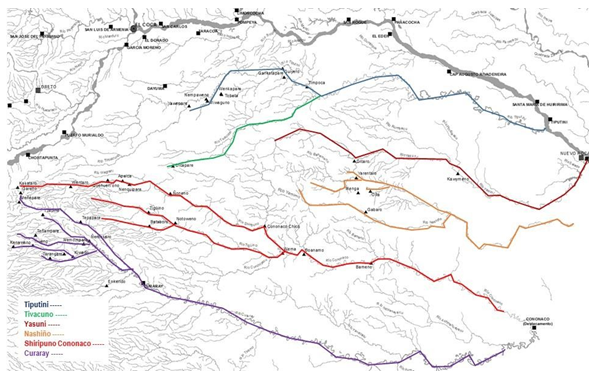
Fuente: Autores, 2021 Figure 1: Uso de ríos y relación espacial entre waorani y PIAV.
The rivers are a spatial reference for the Waorani culture, since they mark the space of cultural relations of exchange between nanikabos iromenane-enomenane (marriages, alliances, war) that is upstream and downstream, which are references of their places of origin and birth. In war events, the withdrawal and mobility will be towards the birthplace of the maternal line relatives. The iromenane, who were born downstream, must carry out their cyclical mobility downstream, and in the opposite direction those who were born inomenane. For its part, stationary mobility will be between intra-riparian spaces, in wide hunting areas, but mainly for gathering. These areas described above have the environmental characteristic of being riverside flood environments, where there is an abundance of palms, whose fruits are consumed by different species of animals. The main animals that frequent these areas are herds of Amazonian wild pigs, such as the huangana (Tayassu pecari), sahino (Pecari Tajacu), but also a highly appreciated seasonal product, charapa turtle eggs. Access to hunting wildlife is one of the motivations for mobility, and is part of the consolidation of territorial spaces of isolated peoples, that is, areas of habitation, access to resources and displacement, whether seasonal (seasonal) of fruiting chonta or cotton seasons) or related to mobility to areas of ancestral occupation (place where grandparents were born or died, place where ancestors left sowing chonta, or another aspect of importance and family value). There is an open conflict between PIAV and Waorani, despite the fact that, as has been highlighted in this work, each family group or nanikabo manages its own order, where actions are sustained by timely and independent or autarkic decisions. However, there are three contemporary war events that involve the four basic Waorani clan groups (Guikitairi, Nihuairi-Piyemoiri, Wepeiri and Baihuairi), and isolated family groups, the massacres of 2003, 2013 and 2016 being the latter an attack from the PIAVs. The attacks have generally been with spears and firearms, in direct confrontations or direct threats of the affected nanikabos, and of other families in isolation, to whom direct responsibility could not be attributed with the triggering of the cycle of wars and revenge.
Baihuairi and PIAV
The Baihuairi are a Waorani clan group that settle between the Keweriono (Shiripuno) and Menkaro (Cuchiyacu) rivers, and between the Dayuno and Cononaco rivers in their lower course. They have as a clan reference Baihua, Ima’s father, who in turn was the father of the two recent leaders Babe and Bai. Currently they occupy the territory that overlaps oil blocks 22 and 66, and the towns where they develop are Tihuino, Bataboro, Cononaco Chico, Omere, Boanamo, Omacaweno and Baameno, all in the upper and lower reaches of the Cononaco River. This territory maintains spaces of interrelation and interdependence with isolated family groups, which have between the Curaray River, Menkaro and Bataboro a space of traditional use, occupation and mobility, in seasonal and cyclical periods. In 2003, a PIAV family group was attacked by Baihuairi warriors, as part of an act of revenge for the death by spear of one of its members, in a previous war event with the PIAV. The attack was preceded by an incursion by Waorani Baihuairi in 1993, led by the clan chief Babe, who in the exercise of territoriality carried out an onslaught of war, seeking to impose his control over the territory of the attacked nanikabo. Failing to generate deaths, he captured a woman, Omatuki, who after negotiations carried out by the Vicariate of Aguarico for her return did so, and in that new entry they were attacked repeatedly, in their retreat, by PIAV warriors, Carlos Omene being thrown. , Babe’s nephew and who died days later at the El Coca hospital.
[…] My brother Babe made several war visits to where the Tagaeiri, we all know their taromes or hunting trails, we stole their handicrafts to sell in the cuwuri market, in their homes we hunted, they had a lot of bush meat, in One time he robbed a girl, he said her name was Omatuki, my wife’s name is also called Omatuki Enqueri, she said she was Tagaeiri, family, we had six days for her in her town of Tigüino, in Babe’s house, until the Capuchin priests told us to return it to avoid more deaths; but on their return they attacked them with spears, they chased them throughout the jungle and killed my nephew Carlos Omene ” [15] (Figure 2).
Ten years later and in a revenge action that fell on close relatives, Carlos Omene’s younger brother, and the deceased’s son, they would lead a raid that aimed to avenge his father’s death. In addition, the expedition leader’s brothers-in-law participated, in alliance with the clan leader Babe, accompanied by another clan leader Davo, who had already participated in several massacres. The party was joined by other younger Waorani who had pending conflicts with the Tagaeiri and who had the opportunity to initiate their practices of tribal warfare. Although relatives of the victim participated in this conflict, in a pending revenge exercise, he incorporated firearms and traditional weapons of war, including lances that were taken from the home of the victims themselves. As a result of the attack, there were at least 12 deaths in the attacked nanikabo, including 6 children. The assailants took various items from the victims, such as spears, sandwiches, hammocks and some pets (parrots) [17].
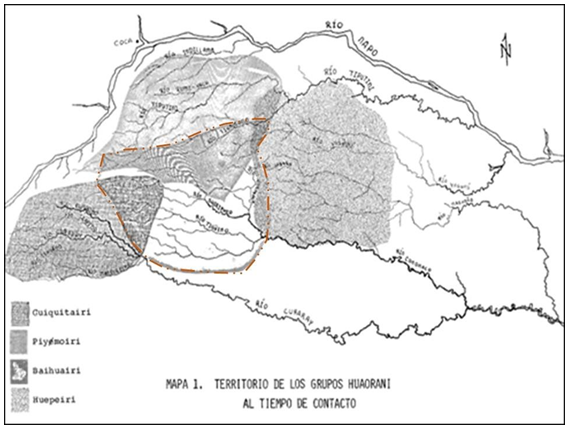
Fuente: Yost [16] Figure 2: Territorio tradicional Baihuairi.
Wepeiri and PIAV
Like the Bahuiris, the Wepeiri inhabit the north-eastern territory of the Yasuni, they are a group that has settled rapidly in the last 20 years, using all the oil infrastructure and formed towns that were concentrated along the so- called Maxus road. , or the highway that leads to the oil facilities of block 16 operated by the oil company Repsol-YPF, these towns are: Guiyero, Ganketapare, Timpoca, Dicaro, Yarentaro; and off the Maxus road: Kawymeno, Menga, Oña and Gabaro. Several Waorani and Nanikabos Wepeiri villages maintain a territory of interrelation and interdependence with the PIAV, there are certain towns where the relationship is more active, such as Timpoca and Ganketapare, where several families have reported an intermittent presence of PIAV in their farms or in their kewenkodes. In some cases, families have left farms for the use of PIAV families that surround their housing, hunting and gathering areas, thus maintaining open relationships where a basic exchange is established, since in several cases the isolated ones have left meat from mount to change. From early narratives to members of the Wepeiri group, he maintained a conflict with Nanikabo Tagaeiri, for the years 70-80 an attack by warriors of this group would have injured a Waorani of the Wepeiri clan, Ompure Omahuay and his son Tehuane. Both survived, and had a pending revenge, under the traditional parameters of the Waorani warrior code (Figure 3).
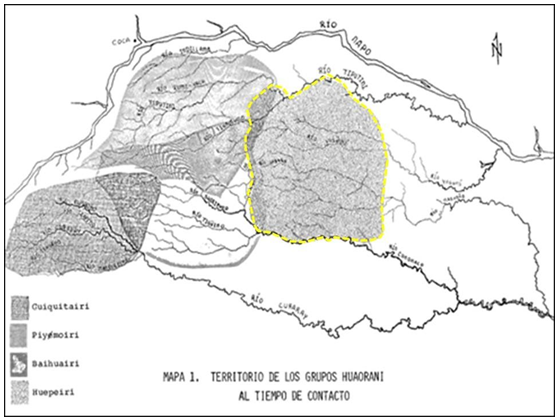
In 2013, Ompure Omehuay, and his wife Buganey Caiga, were killed in a spear attack by a group of PIAV warriors. The death of the elderly opened a cycle of revenge, which resulted in a massacre in the interior of the jungle, causing the death of a PIAV family group, but which was not linked to the death of the elderly. The revenge was organized by the sons of Ompure, Cahuime, Tehuane, Boca and Boyotai, and their brothers-in-law. The brother, nephew, brothers- in-law of Ompore, and others with whom there were family relationships. In total there were 17 attackers, from different towns on the Maxus highway: Dicaro, Yarentaro and Guiyero, and from the town of Kawimeno. In addition, a person with no relation to the attackers or from the Weperiri territory participated, but with whose participation he gained recognition in the Waorani ethos. The attackers in the event used firearms as the main element, with which they produced a significant impact, causing a greater number of deaths. As a result of the attack, there were approximately 25 fatalities, among adult men and women and several children. The assailants captured two girls, one about 3 years old, and the other about 10 years old, in addition to several spears and bodoqueras. With this antecedent, the immediate family of the murdered elders, in an exercise of Waorani tribal ethos, where revenge, the reaffirmation of kinship alliances, territoriality and the warrior code, entered the territory of interrelation with PIAV and generated a violent attack with the use of firearms, without being certain that this was the one that generated the attack against the Waorani elders of the Wepeiri group. One aspect that broke with the traditional practices of social order, war, and the application of the warrior code was the use of firearms, a situation that generated several victims, as there was an important technological advantage that allowed the attack to eliminate a greater number of individuals. Although in the traditional Waorani culture, a revenge action sought the extermination of the attacked group, this was increased with the incorporation of firearms.
The analysis of the president of the Waorani nationality, Gilberto Nenkimo, exposes a break with the tradition and the traditional warrior code of his people: More than fifty people died… the attackers… we surrounded the house… they said that they started shooting there. I told them: You surrounded and fired is a great advantage, if you went and faced it was different, but you surrounded and took great advantage. They said yes, we will continue to do so. I told them that gun is not our culture. Cultural is entering the house, looking at who provoked and one or two people died. It was not circle and shoot, that is already organized crime, something I want to kill directly [18].
Nihuairi and PIAV
The Nihuairi and Tagaeiri nanikabos come from the same parental trunk, one of their common ancestors being Kimontare, after whose death several clans split, which at the time of SIL’s evangelical contact decided to remain in isolation, and took refuge in the intra territory. -Ribereal located between the Shiripuno, Tihuino, Bataboro and Mencaro rivers. According to historiographic information, the split nanikabos were those of Tagae, Nampa, Nancamo, Huiahua, Huiñari [12] (Figure 4).
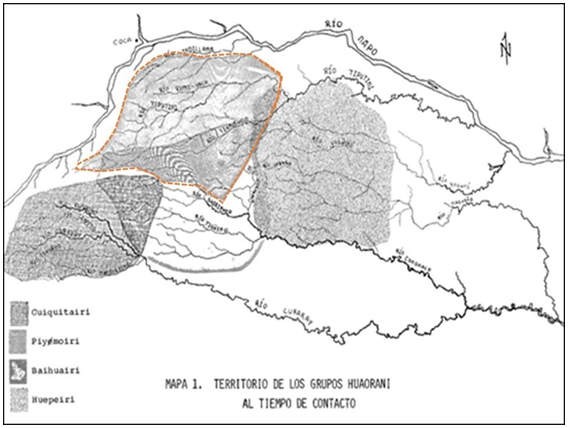
Fuente: Yost [16]. Figure 4: Territorio tradicional Nihuairi-Piyemoiri.
With the end of evangelical hegemony in the Waorani Protectorate, at the beginning of the 1980s, several Nihuairi Nanikabos left the Protectorate and moved back to their areas of origin, in an exercise of cyclical mobility, which led them to reoccupy the traditional territory. Forming the towns of Tobeta, Miwagono, Ñoneno, Nampaweno, Wenkapare, Dikapare. In general, kinship ties and common ancestry are recognized between the Nihuairi and nanikabos descendants of PIAV, which is due to the fact that they occupy the same territorial space and maintain areas of interrelation and interdependence. In these villages, a tense relationship is maintained by the nanikabo of Manuel Cahuia, clan chief of the Ñoneno settlement with PIAV family groups, specifically Tagaeiri, since in 1981 he was the victim of an attack where he was hit by a spear in his leg, without However, managing to escape alive. Since this event, there have been several violent encounters, maintaining tension and a condition of mutual mistrust in the shared territories [19, 20, 21].
Guikitairi and PIAV
The Guikitairi were the first Waorani nanikabos to be contacted by SIL, and from there began their sedentarization and concentration of the different family groups in what was called the Protectorate. The Guikitairi, by keeping their area with maternal territorial rights distanced from that recognized for the PIAV, has not created a risk condition for a conflict with these nanikabos in isolation. Despite this, in recent times, there has been evidence of mobility of at least one PIAV nanikabo to the head of the Shiripuno River, in a territorial space located between the Waorani towns of Quehueri-ono, Wentaro and Tepapare. The Waorani of these villages have both Nihuairi and Guikitairi ancestors, and they are common ancestors, those who have been identified by the PIAV nanikabos who have an impact on this territory. At the present time, and as a result of the fact that there are matrimonial alliances and marriages between men and women of different clans, that due to sedentarization, formal education and mobility within the villages, marriage between cross cousins no longer prevails, the fact The fact that Guikitairi women or men have marriages with Nihuairi or Baihuairi means that in the event of the activation of a time of war, they can join in attacks against family groups of PIAV [22, 23, 24] (Figure 5).
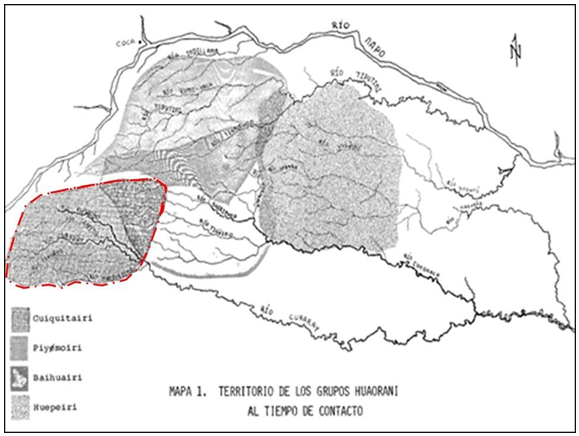
Fuente: Yost [16]. Figure 5: Territorio tradicional Guikitairi.
Conclusion
The family groups in isolation are separated from each other, in regional units, where several nanikabos live in onkos, grouped around a clan chief, who, as in the first period of Waorani contact, represented the best hunter and warrior or peacemaker, the latter implied the ability to interrelate or contact with strangers, whether due to war, alliances or other types of contact. The nanikabo as a form of social organization allowed each group to maintain independence and be self-sufficient, so the territory of a nanikabo is the vital space for both the Waorani and the PIAV, provider of the necessary resources for subsistence, for survival, and therefore the existing relationship with the jungle is active and interrelated. The latter is fundamental, since recent conflicts have been due to this cyclical return to the places of the grandparents, which, in this case, have been occupied by other actors (settlers, oil activities, loggers), which generates processes of violence that manifest themselves with attacks and spearings, and that imply a rupture in the interrelationship between PIAV and Waorani, generating conflicts, which have ended in massacres. In the Waorani tribal ethos, the social fact of establishing relationships has both individual and family purposes, as they are clan societies, where behavior responds to the primacy of an autarchic social order [10, 13] that maintains a form of subsistence based on the collection of resources in a wide territory where there is a capacity for mobility that ensures autonomy. In this regard, the autarchic social order is marked by an autonomous capacity for subsistence, outside any dependence on other groups, much less on external factors [25, 26, 27, 28].
References
-
Clastres P (1981) The question of power in primitive societies. In: Clastres P (Ed.), Research in political anthropology, Barcelona, pp: 109-116.
-
Yost J, Kelle PY (1992) Cultural considerations of the land: The Huaorani case. Ethnolinguistic notebooks 20. Quito: Summer Institute of Linguistics.
-
Rival LM (2015) Huaorani transformations: border, culture and tension. Quito: Simon Bolivar Andean University.
-
Montalvo PT (2006) The fascinating story of the Huaorani or ‘the true humans’. Acta Americana, The Swedish Journal of Anthropology 14(1): 69-74.
-
Robarchek C, Robarchek C (1992) Cultures of War and Peace: A Comparative Study of Waorani and Semai. In: Silverberg J, Gray JP (Eds.), Aggression and Peacefulness in Humans and Other Primates. New York and Oxford: Oxford University Press, pp: 189-213.
-
Beckerman S, Erickson P, Yost J, Regalado J, Jaramillo L, et al. (2009) Life Histories, Blood Revenge, and Reproductive Success among the Waorani of Ecuador. Proceedings of the National Academy of Sciences 106(20): 8134-8139.
-
Montalvo PT (2011) Boto Waorani, Bito Cowuri. The fascinating history of the Wao. Quito: FIAAM.
-
Tirdmarsh W (1945) Unarranged Notes on the Aucas of the Nushiño Basin. Mimeographed.
-
Blomberg R (2015) The Naked Aucas: A Review of the Indians of Ecuador. Quito: Abya Yala.
-
Narváez R (2018) Territoriality of family groups of indigenous peoples in isolation (PIA) in the Yasuní Region, Ecuadorian Amazon. Tipiti: Journal of the Society for the Anthropology of Lowland South America 16(1): 103-119.
-
Trujillo J (2019) The other in history: The Waorani before contact. Quito: Labaka Foundation, FEPP.
-
Cabodevilla M (1999) The Huaorani in the history of the peoples of the East. Coca: CICAME.
-
Narváez CR, Montalvo PT (2020) Times of war and times of peace, symbolic continuum of a recently contacted people: ethnographic case of the Waorani in the Ecuadorian Amazon. Field Notebooks 29(1): 38-52.
-
Montalvo PT (2018) Identification and dynamics of the Indigenous Peoples in Voluntary Isolation (PIAV) in Yasuní. Anthropology Bulletin 33(55): 271-296.
-
Pappalardo S, De Marchi M, Ferrarese F Y (2013) Uncontacted Waorani in the Yasuní Biosphere Reserve: Geographical Validation of the Zona Intangible Tagaeri Taromenane (ZITT). Edited by Dennis O’Rourke. PLoS One 8(6): e66293.
-
Yost J (1981) Twenty Years of Contact: The Mechanisms of Change in Wao (Auca). In: Whitten NE (Ed.), Cultural Transformations and Ethnicity in Modern Ecuador. Illinois: Urbana: University of Illinois Press, pp: 677-704.
-
Cabodevilla M (2004) Times of war: Waorani against Taromenane. Quito: Abya Yala.
-
Rivas Toledo A (2020) Anthropology, ecology and human rights: The Isolated Indigenous Peoples of the Amazon. The last groups of Yasuní. Madrid: Red Circle.
-
Boster J, Yost J, Peeke C (2003) Rage, Revenge and Religion: Honest Signaling of Aggression and Nonaggression in Waorani Coalitional Violence. Ethos 31(4): 471-494.
-
Gondecki P (2011) Between Forced Withdrawal and Voluntary Self-Isolation: Reflections on Isolated Indigenous Peoples and Avoidance Strategies in Conflict Management in the Western Amazon. Indiana 28: 127- 152.
-
Omene MI (2012) Waorani knowledge and Yasuní National Park: plants, health and well-being in the Ecuadorian Amazon. Quito: Yasuní Initiative ITT, pp: 118.
-
Macfarlan S, Erickson P, Yost J, Beckerman S, Regalado J, et al. (2018) Bands of Brothers and In-Laws: Waorani Warfare, Marriage and Alliance Formation. Proc Biol Sci 285(1890): 20181859.
-
Meirelles A, Maldi D, Ramos A (2007) Apoena: the man who sees far: memoirs of Apoena Meirelles, sertanista murdered in 2004. UCG Publisher, Texas, USA.
-
Narváez R (2016) Exchange, war and revenge: the launching of Ompure Omehuai and his wife Buganei Caiga. Anthropology Research Notebooks 16: 99-110.
-
Nenquimo I (2011) The origin of the Waorani: The four gods of the Waorani and the son of the sun. Quito: Ministry of the Environment of Ecuador.
-
Gobienro Del Ecuador (2009) Precautionary Measures Plan for the protection of Isolated Indigenous Peoples. Executive Report on the situation of Isolated Indigenous Peoples in the Armadillo-Los Reyes sector. Quito: Plan of Precautionary Measures for the Protection of Isolated Indigenous Peoples.
-
Toca A, Ima CO, Tiyane IMA W, Omene TG (2009) Tededanipa: The voices of women. Quito: Humanas Corporation, AMWAE.
-
Montalvo PT (2016) Warrior code: mobility, war and death with spears. Anthropology Research Notebooks 16: 85-98.
- The Indispensable Role of Informal Caregivers in Supporting the Aging Population
- Socio-Religious Significance of Kamakhya Temple in Guwahati, Assam
- Is Anthropology Possible?
- A Contribution to the History and Paleobiology of Harput/Elazığ Türkiye and Its Surroundings
- A Study on the Cowrie Shells of the Dimasas in Assam
- The Significance of International Organizations Cooperation in the Efficient Resolution of Global Conflict