
Shrine Visitation Rituals and Traditions in Wadi Mūsa and Buṣeirā Areas: El- Fugarā Tombs as a Model
This paper stands as a preliminary examination of el- Fugarā tombs in Wadi Mūsa. It discusses some aspects of the site and sheds light on the etymology, location, identity, and structure of a sanctuary known to the locals of the region as one of the celebrated religious attractions. The visitation rituals in the localities of Wadi Mūsa and Buṣeirā are also explored. Special emphasis has been placed on the rituals performed in Buṣeirā whose inhabitants also visit the site. The study draws on numerous resources including accounts of different travellers, interviews with elderly people, and various anthropological, historical, and religious sources.
Introductory Remarks
Besides being known as a modern town with many hotels and resorts, Wadi Mūsa is also famous for its rich cultural heritage and deep-rooted history which dates back to antiquity. The town lies in a valley named after Prophet Mūsa ibn Imran who struck the rock for his “asbāṭ” who were in need of water. As a result, the spring of Mūsa gushed out immediately for them [1]. Around and especially below the spring, the town now extends in its unique blend of modern and old sceneries. The town appears in the different accounts of many travellers, both Western and Arab [2]. The people who inhabit Wadi Mūsa are called al- Layāthneh [3]; being also mentioned by many researchers and travellers. In this rich cultural area, many sacred sites are still standing as a reminder of a glorious past. The tombs of el- Fugarā are no exception, forming one of these locations that have always enjoyed a remarkable religious reputation. Despite this fame, we do not find complete references to the site in the literature of visitation practices of the region; as many are rather brief or even incidental. It seems also that much basic information and detail about the site remains unknown to many in the area. This is probably because the descendants of those buried in the sanctuary do not live in Wadi Mūsa nowadays. This fact generates a motive for more investigation, analysis, and study. The present paper is therefore an attempt in this direction; trying to answer some of the questions and reveal some of the unknown facts the about the sanctuary.
Remarks on the Etymology
Whatever terms may be used to describe them, the tombs of el-Fugarā refer to a group of pious people who inhibited Ἁyn Amūn in the past [4]. The word “Fugarā” is the plural form of “Fagīr” which originally comes from “fagr” or poverty in Arabic [5, 6]. This meaning is by default very straightforward. A Fagīr in this sense refers to a pauper, who by his work cannot provide for his needs of existence [7]. Being derived from “fagr”, the term also implies “the breaking of the vertebrae” of the back of a person [8]. The Fagīr therefore signifies a man who has his back broken or one who has been afflicted by a calamity of some kind. Very often the word describes people who are unable to earn their living, in many cases due to some apparent physical mental defect or deficiency [9]. However, the term has other meanings, or more accurately, other shades of meanings which add special connotations in different times and settings. Many references to the term can be found in the Qur’an. An example of this is the verse: “And Allāh is the Rich, and ye are the poor” [10]. In the Bible one can also read the following: “Blessed are the poor in spirit: for theirs is the kingdom of heaven” [11]. It seems that one common usage of the term Fagīr describes a Sūfi or initiate in a Sūfi Order or “Ṭarīqah”. Here the term means to aspire to spiritual poverty or detachment, and in this sense it is an emptying of the soul for Allāh [12].
It should be stated that some people use “Miskīn” instead of “Fagīr”, confusing two words which are totally different. Miskīn are derived from “sakana” which means a state of becoming motionless. It therefore signifies a person who, though physically fit, possesses little power motivationto motion. He is unable to earn a living on account of poverty or lack of resources [9]. In this regard the Fagīr distinguishes himself from the Miskīn, whose poverty is aggravated by a dreadful and humiliating condition [7]. A Fagīr therefore finds what to eat, while a Miskīn does not [13]. In the terminology of el- Ghazāli, and many other mystics, the individual who renounces the world is a poor man or “Fagīr”; an ascetic or quiet who has obtained “an overwhelming consciousness of sin, combined with a dread of Judgment Day” [14].
In this case, poverty is positive as it is cultivating, refining, and enlightening. True poverty is not in this regard just a lack of money and wealth. A person can be rich in the common sense of the word, though spiritually he is the poorest of the poor. The best religious status that a Fagīr reaches is called “zuhd”; a state of being busy in the pleasure of worship and adoration of Allāh, and of being indifferent to all worldly losses and gains [15]. This state is simply defined as the renunciation of worldly delights or “zuhd fid- Donia” [16]. Ibn Islahi AA [17] however maintains that the concept of “zuhd” does not necessarily mean mere rejection of worldly pleasures. Prophets like Dāwūd and Suleimān were the most pious (zuhhād) people of their age in spite of having so much property and authority. This is true by extension for many of the Companions of Prophet Mohammad, such as Othmān ibn Ἁffān and Abdul- Rahmān ibn Ἁwuf. Apparently for the pious, “zuhd” is a state of mind which means purification from the lust for worldly things and from making them central in life. One can have this attitude despite all the riches, and one can also lack it even in poverty [17]. The ultimate virtue of this type of spiritual poverty and detachment paves the way for Allāh’s presence and attendance; an elevated state experienced only by His chosen prophets and awliā’ [12].
This leads us to consider an important feature of many Fagīrs, which is the state of being “majdhūbs”. Within the Sūfi traditions, a majdhūb can be defined as a person who has been suddenly and intensively attracted by Allāh. Therefore, majdhūbs do not have to travel along the path of hardships and self-discipline like the sālikīn or wayfarers [18]. The sālik (sing. of sālikīn) is a person who has to travel in the way of hardships and suffering in order to be selected as close or friend of Allāh. The majdhūb therefore is selected by Allāh without passing through hardships which gives him a more prestigious status than the sālik [19]. This is exactly the proper explanation of the well-known Sūfi statement which says: “Jadhbah min jadhbāt el- Ḥāqq tuwāzi ‘amal- ath- Thaqalain [20, 21]. So much absorbed in his state, the majdhūb abandons his outer condition and appears to the public as childlike, simple or even insane [22]. At any rate, we can find other contradictory views that consider the majdhūbs as far from being saints, but rather unfortunate people afflicted with defects, or even worse impostors [23].
More deviations nevertheless can be seen in the practices of other people who took advantage of the Fugarā spiritual state giving rise to shamanism [24]. In their practices shamans would assume the role of healers using magic and speaking to the spirits. In this sense, the shaman functions like the Indian Fakīr who uses magic to make money. Walter M, et al. [25] state that some nomadic people have shamanic mediumistic healing powers. They would use “tamā’im” by manipulating Qur’anic and other symbols into their spells [26]. Tamā’im consist of envelopes filled with papers in which magic symbols are written. They are covered with some hard material and hung or worn by people who suffer from different problems or illnesses [25]. Among these objects used as tamā’im are also bracelets and necklaces [27]. It is important to note that these practices find their way among the public as a profession. In many instances, people who are not Fagīrs are well versed in making spells and amulets, and use this as a way of making money. These practices are not allowed in true Islam, and might strengthen the negative connotations of the term Fakīr as a mendicant or conjurer.
In common Western understanding the word “Fakīr” has come to mean a public performer of stunts or magic, which is basically a deformation and distortion of the true was meaning [12]. In the Webster’s Complete Dictionary of English, it means an oriental religious ascetic or begging monk [28]. In other dictionaries it means either a Hindu
beggar regarded as a holy man or a religious mendicant, or indeed a devotee [29, 30]. At any rate, we can divide the “Fagīrs” into two classes: those whose conduct is in harmony with true Islam, and those who behave contrary to any religious creed [31]. The latter class can be largely seen in some parts of Asia, where they form wandering “Fakīrs” who live on alms, and who usually subject themselves to many unbelievable tortures and hazards [24]. In March of 1847, Wilson J [8] visited en- Nebi Hārūn and described the sheikh of the shrine who demanded a backshīsh in return for the services of the visit. Wilson says that he has seen “many devotees in the East, both in Hindu and Mohammadan, but few have succeeded so well in benumbing mental faculties as this poor deluded Fakir [15, 32]. This account reinforces the distorted view and adds even more negative connotations to the stereotypical image of the “Fakīr”.
Remarks on Identity and Genealogy
Probably the first Western traveller to mention the el- Fugarā tombs in relation to the religious expressions and cultural practices of Wadi Mūsa was Musil A [33] who cited the names of the holy shrines of the region. He remarks that al- Layāthneh pay holy visits to en- Nebi Hārūn on the summit of a mountain that bears the same name. They also visit holy sites like el- Hasnī in el- Gī, el- Fugarā in Ἁyn Amūn, es- Sa’edāt in Wadi Mūsa, Mūsa in the spring of Mūsa, abu Sleimān in Shoubāk, Sheikh Abdullah in Ma’ān, and Hutheifah and Hammād east of Buṣeirā [33].
Another early reference to the name el- Fugarā is made by Canaan when he visited the site in 1920 and described the tombs of the pious people from the tribe [34]. Freihat M, et al. [35] also mentions the name when they discuss the cultural expressions and religious rituals in the region of Petra. They point out that the tombs of el- Fugarā belong to a group of religious people whose visit would bring blessings, fulfilment of needs, and healing from many diseases [35]. In a related context, al- Nasarāt identifies the tombs as two, located between Ἁyn Amūn and Wadi Mūsa. He adds that they are visited by the local people in the area up to the present day. On that spot, people perform animal sacrifice and other related rituals [36]. Others also state that the spot refers particularly to el- Fugarā tribe who are visited especially for healing purposes [37].
Within the same context of al- Layāthneh, al-Salameen Z, et al. [13] mention that the area of Ἁyn Amūn was inhabited by al- Fugarā tribe, whose members were well known for curing diseases. They add that those people died because of drought and were buried in the area [13]. Al-Salameen Z, et al. [13] also provides a map of the sacred shrines and holy places of Wadi Mūsa which includes the el- Fugarā tombs as an example (See Maps 1-3). Bille M [38] suggests that the site is named after tombs belonging to a category of people known as “a Faqiir (plural/Fuqara)” associated with spirituality, poverty and blessing [38].
In a detailed study of the area, en- Nawāfleh surveys the religious sites of Wadi Mūsa and, according to his informants, asserts that Ἁyn Amūn was inhibited by the el-Fugarā tribe, who were known for being religious sheikhs and pious people. They used to cure the locals who suffered from many diseases and physical conditions. He adds that the tribe left for Ṭafīlah because of poverty and plague [39]. El- Gawābe’ah [40] provides a study of Ṭafīlah and its surrounding and points out that the el- Fugarā tribe whose members live currently in Buṣeirā and form one of its sub-tribes, comes originally from Ἁyn Amūn, which he identifies as an area between Wadi Mūsa and Ṭaybeh [41].
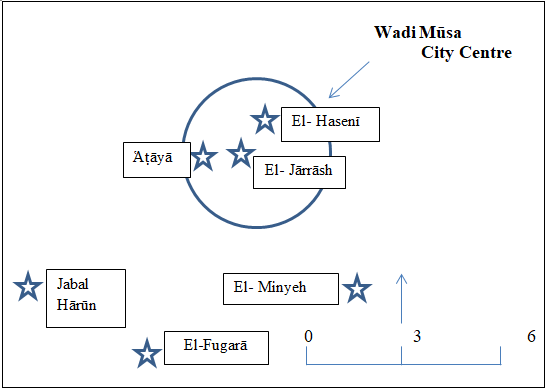
Map from al- Salameen and Falahat, 2009: 196 [13]. Map 1: Distribution of Shrines and Sacred Sites in Wadi Mūsa.
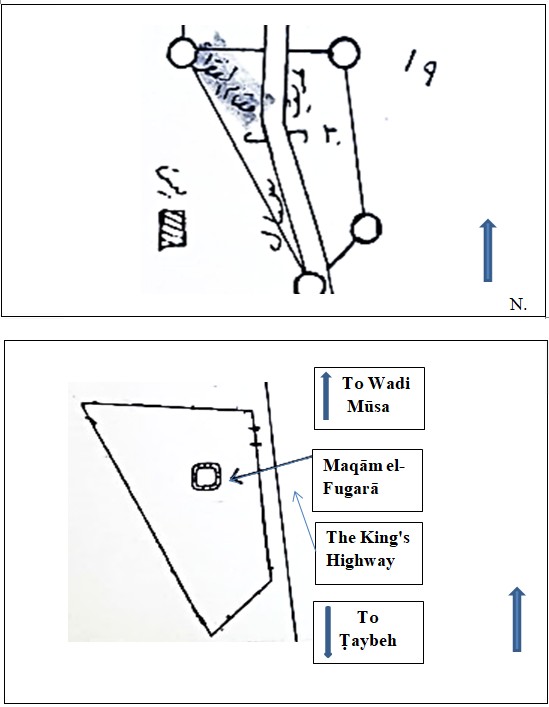
Governorate: Ma’ān; Directorate: Wadi Mūsa Lands; Zone: Barrāq: 17; Village: Wadi Mūsa (664); Plot No.: 20; Board No.: 51 Note: The road in the cemetery appears only on the map. It has not been laid yet. Based on index map, date: 14/8/1975. Department of Land and Survey. Map 2: An index map showing el- Fugarā tombs in Ἁyn Amūn with the following descriptions.
Based on index map no. 804416, date: 2/9/2013. Wadi Mūsa Lands and Survey Office. Map 3: Map of el- Fugarā site.
The locals of Wadi Mūsa including sheikhs, heads of tribes, neighbours of the tombs, and other citizens confirmed during interviews carried out in November 2013 that the tombs located in the area of “Barrāq” or Ἁyn Amūn belong to the el- Fugarā tribe who live currently in Buṣeirā. Members of the tribe itself also assert that the tombs belong to their ancestors. They are attached to the place and it lives in their subconscious that they frequently visit it today, but they do not perform any of the rituals they used to practice in the past. The place is also famous within their community of Buṣeirā as the tombs of el- Fugarā, or as exactly termed by the locals there “ahel eṣ- Ṣīreh”. It is also well known for being visited by different people from the tribes of Buṣeirā for the purposes of healing and obtaining Baraka [42].
According to the official papers and documents of the Jordanian Department of Lands and Survey which el- Fugarā Tribe Council of Buṣeirā keeps, dating back to the 14th of August 1975, the tombs are located in an area of (1donum [43] and 423 meters) in Barrāq Zone, Wadi Mūsa and are officially given the name “Maqām el- Fugarā” or el- Fugarā Shrine. The cemetery was registered as a charitable “wagf” [44] belonging to the Director of the Awqāf of Ma’ān on the 14th of May 1955 as Maqām el-Fugarā. Then on the 16th of February 1994, the land containing the cemetery became the property of the Ministry of Awqāf and Islamic Affairs. Thus, the cemetery, like other religious sites and maqāms in Jordan, became solely owned by the government.
For the purposes of reconstructing the cemetery and building a wall around it, the el- Fugarā Tribe Council addressed the Petra Development and Tourism Region Authority, the Directorate of Awqāf Ma’ān, and the Royal Committee for the Reconstruction of the Mosques and Shrines of the Sahābah and Martyrs in 2013 to help the tribe with renovating the cemetery. All of the previous documentation does not seem to contradict what the neighbours of the cemetery from al- Layāthneh, ash- Rūr family of “abu el- Ḥinna” report about the identity of the tombs. They agree that the tombs belong to the el- Fugarā tribe living now in Buṣeirā, some seventy kilometres north of Wadi Mūsa. It is important to note that Musil mentions ash- Rūr as living around the spring of Ἁyn Amūn when he visited the area at that time [33]. As a consequence, they are familiar with the area. One of the neighbours of the tombs, however, confirms that some Bedouin people used to bury their deceased ones in the cemetery in order to receive blessings. He adds that this was an old practice which no longer exists. The same practice can be confirmed by examining other holy sites of Jordan and Palestine. For example, the Bedouins of er-Rashāydiyeh used to bury some of their dead people around the sheiks of ed- Jarhīd in the Mount of Olives. Similarly, a common practice among many members of al-Odwān who lived in the Jordan Valley was carrying their dead to Nebi Mūsa in Jericho to be buried there [45]. Another interesting example can also be seen in al- Majdal of Palestine. In this location there is a sacred valley named “Wādi en-Namel” which includes many holy tombs. The local people hold an annual religious season by the name of “Arba’inīat Ayūb” in which they celebrate, and pray for the holy men buried there. It is a common belief that people who have the privilege of being buried in the valley will be blessed. Thus, it is customary for people to carry their dead relatives to be buried there and receive the blessings of the awliā’ and the approval of Allāh [46].
This practice might explain the presence of some tombs of people from other tribes in the cemetery; a habit confirmed by the neighbours of the tombs as we have seen earlier. This might also explain the “footnote” that Canaan adds in the second issue of the periodical about the topography and folklore of Petra indicating that the awliā’ buried at the sanctuary of el- Fugarā in Ἁyn Amūn “are also called el- Bauwat”. However, Canaan adds “I could not find an explanation for this expression” [47].
It might also explain a particular tendency of some of al- Bedūl, though not all, to associate the place with pious people from al- Uweināt of Ghor al- Ṣāfi [48]. This tendency might be explained by the fact that the descendants of the sheikhs buried in the tombs do not live in the area now, which makes room for many speculations and assumptions about the identity of the tombs. At any rate, it seems that the absence of the el- Fugarā tribe from the scene of Wadi Mūsa has led to the development of even more postulations which have eventually led some researchers to suggest that the name el- Fugarā does not refer to any specific tribe or family but more generally to a group of pious and religious people. It is very interesting, though, to see what Jaussen says about the origin of el- Fugarā when he asserts that it would be plausible to divide them into two categories. Those who receive the talent with paternal heritage, and those who want to initiate themselves, by themselves, into this curious existence. The first are really numerous, and the father teaches the son his different arts, skills, and knowledge. Those people would form small families, and as time goes by, they would multiply and eventually form a tribe [49].
Still others exaggerate the importance of the el- Fugarā site in Ἁyn Amūn and state that it is famous for being visited by people from all over Jordan, and even from Saudi Arabia [38]. It is worth mentioning that Crawford in 1907 alludes to people visiting Jabal Hārūn from Tabūk [36]. This might be correct within the context of that time, assuming the importance of the Hārūn shrine. It would be more accurate, however, to state that the el- Fugarā site enjoys a lesser religious status. Therefore, we can say that it is largely visited by the local people of Wadi Mūsa and the surrounding areas, by members of the el- Fugarā tribe from Buṣeirā, by members of the other al- Saūdi tribes known locally as “al- Saūdīn”, and by different people from some parts of the south of Jordan. The site, nevertheless, does not attract people from Saudi Arabia because visiting holy shrines is totally forbidden in the country. Actually, this practice disappeared after the Wahhabi movement came to religious power [50]. The movement is known to completely reject such practices and regard them as shirk in Allāh and bid’ah that distort the true Islamic religious traditions [51, 52, 53]. As can be seen, it is obvious that we have yet another fallacy confusing the country “Saudi Arabia” with the Jordanian tribe “al- Saūdi”, a matter that keeps us in the realm of wide misconceptions.
The exact identity of people buried in old shrines and cemeteries in many instances remains a matter of speculation, even in the case of more documented and more celebrated shrines such as that of Prophet Hārūn. Whereas Al-Nasarāt M [36] suggests that all Jewish, Christian, and Islamic resources relate the site to the Prophet [13], still others are reluctant to support this claim [35, 54, 55]. At any rate, in the memory and collective unconscious of the el- Fugarā tribe, there are some traditions and specific names that keep resonating in the site. The elderly of the tribe identify some of these names and associate them with specific tombs. The names refer to some pious forefathers of the tribe like “Ali el-Ashhab”, named so for his fair complexion. Other tombs also include that of Ibn Ghānem, al- Khubeibī, and the forefather of el- Musalamīn. As far as genealogy is concerned, members of the tribe state that they belong to a man named Khāled el- Khuzām. They came originally from Hijāz and inhibited a height between Wadi Mūsa and Ṭaybeh where they became neighbors to “al- Saūdīn”, mentioned by Burckhardt as the “Arab Saoudye” [56]. At that time, members of “al- Saūdīn” tribe were Fellahein living in a camp of about one hundred and twenty tents in Jibāl ash Sharāh area [2]. Because of tribal feuds with some Bedouin families, el- Fugarā departed to Palestine and then returned back to the area to rejoin “al- Saūdīn” in Buṣeirā. On that height in Wadi Mūsa, el- Fugarā left a cemetery which includes tombs that belong to righteous people from their tribe.
What seems to have preserved the tombs for a long time is the fact that they belong to holy men who have supernatural powers because of Allāh’s benevolence and will. This forces people to honour their tombs and preserve them [7]. It is important to mention that a minority group of the el- Fugarā tribe had been affected by the Sūfi traditions while they were briefly living in Palestine. From Buṣeirā they used to arrange group visits to the tombs and perform some religious and Sūfi rituals that we will consider later. This could probably be another factor which preserves the tombs in the memory of the people, and more specifically within the religious expressions and traditions of al- Saūdi tribe.
Remarks on the Location
The location of the cemetery of el- Fugarā is unique as it is situated on top of a mountain. Such a location has many manifestations in the religious thought of the area, which can be traced back to antiquity. In the history of humanity, it appears that mountains and hills indeed provide a perfect place for solitude, meditation, contemplation, and worship. In Greek mythology, the twelve great Olympian supreme gods lived in Olympus, the greatest holy mountain of Greece [57]. In Christianity, however, Jesus was tempted, transfigured, preached, prayed, and crucified on top of a mountain. Also he ascended to heaven from a mountain [45]. Many Christian monasteries and hermitages throughout Europe and in other places occupy locations on mountains, where religious people could escape the materialistic world and withdraw to live a strict “ascetic” life away from temptations [58]. In Judaism also, notice the image which the prophets used to represent and describe the future glory of their expected country and nation. The image includes statements like: “the mountain of the Lord’s house,”….” established on the tops of the mountains,”….”exalted above the hills,” and to which “all nations should go up” [59].
This same image, interestingly enough, was copied by John Winthrop in 1630 to encourage the Puritans to emigrate from England to the New World and establish a “city upon a hill” [60]. Back in history we can see that Prophet Aaron died on Mount Hor while Moses on Mount Nebo [24], both mountains being located in Jordan. In Islam, nevertheless, Prophet Mohammad isolated himself from the pagan society of Mecca and sought peace and solitude in a little cavern in the Mount of Ḥirā´ north of the city, where he received the Quran.
The shrines and tombs of prophets, saints, holy men, and “awliā´” are usually situated on an elevated place, like the top of a mountain, a hill or a small elevation which suggests a commanding position over all the neighbouring regions. The cemetery which contains the tombs of el- Fugarā is situated on an elevation between Ṭaybeh and Wadi Mūsa in an area called Ἁyn Amūn [35]. This particular spot which is also called “Barrāq” leads to Ṭaybeh. It overlooks the town of Wadi Mūsa and directly faces the shrine of Prophet Hārūn on Mount Hor, being located on the opposite westward side. This small archeological location enjoyed a considerable importance especially during the and early Islamic periods. It was considered as a relaxation site because of the presence of Ἁyn Amūn spring [1]. The location was mentioned by Musil A in 1908 [33], by Al- Falahat S [34] in 1929. In 1994, the Petra Archaeological Office carried out an excavation project which lasted for about three months in the site, and published a report that contained results of the excavations [37]. It seems appropriate in this context to state that Canaan estimates that about 32% of the total sanctuaries he visited are generally located in an area which contains some ruins, or which are near to ruins [45].
Adjacent to the tombs of al- Fugarā is the spring of Ἁyn Amūn which provides a permanent source of running water (Figure 1). It is a widely spread belief in many societies that springs and running water sources are usually inhabited or haunted. This feature is, however, not necessarily true of Ἁyn Amūn spring because not all water sources near shrines are haunted. Also not all shrines have springs or water resources around them. The spring of Ἁyn Amūn without doubt still forms an excellent source of water for the inhabitants of the area. People who visited the sanctuary used to perform activities related their rituals using this source of water, such as washing the meat of the slaughtered animals and performing ablution. Canaan in his study of haunted springs and water demons confirms that “we rarely find a holy shrine which is not directly attached to a tree, cave, spring or well” [35, 61].
Another important point to be mentioned in this context is that the tombs of el- Fugarā are located in an enclosure of stones called “eṣ- Ṣīreh” within a cemetery or “graveyard”. This fact seems to be also supported by what Canaan suggests when he says that the “shrines or graves of many “holy men” are situated in the midst of cemeteries or adjacent to them” [45]. The cemetery includes the tombs of other people from the el- Fugarā tribe who might enjoy a less religious status. It might also include the tombs of people from other tribes who were buried in the site.
According to informants from the tribe, before abandoning the site, the el- Fugarā buried many of their belongings in a cave in the western cliffs that are situated under the cemetery and headed to Palestine through the Jordan Valley. Some of the caves which lie close to holy tombs can be sacred, but this is a simple cave which is not sacred, though situated near the tombs. The anticipated location of the cave, nevertheless, could not be accurately identified nowadays. This adds another analogy that seems to support what Canaan postulates in his monumental work about Muslim saints and their sanctuaries when he says that they are usually located near caves [45, 62].
Remarks on the Structure
Travelling from Wadi Mūsa to Ṭaybeh, and immediately before reaching Ἁyn Amūn spring, one can easily identify the sanctuary of el- Fugarā which is located on the western side of the King’s Highway (Map No. 3). Some tombs are scattered in the area to the East of the road, which is outside the cemetery, with only few signs of old ashes resulting from burning incense from past visits. However, most tombs, including those in the enclosure, are found in the cemetery which lies on the western side. This side is more famous and more recognizable by visitors. The cemetery as a whole includes many tombs, but only few of them are considered as holy and honourable by the locals.
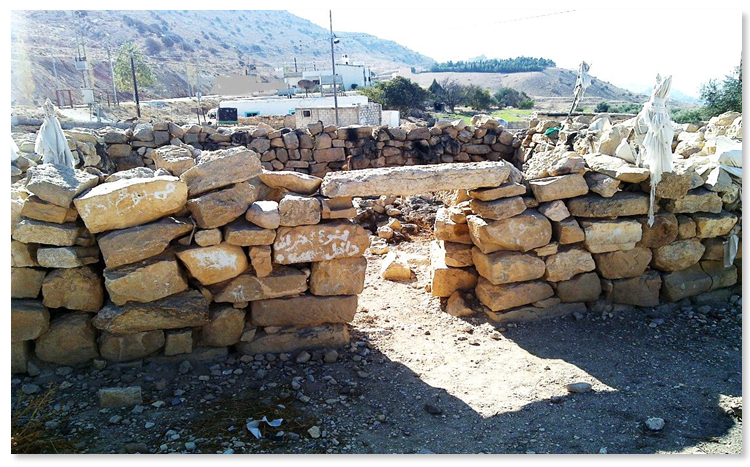
The stone enclosure that surrounds the sacred tombs is situated in this western part of the site, just below the road. The enclosure may be as high as one meter from all sides. The small gate, which is covered by a horizontal stone lintel, opens on the North direction. The low sides of the place and the lintel above force visitors to kneel down as they attempt to enter (Figure 2). The walls are thick because they are built from big stones. On the outward side of the western wall, there are two circulars, apparently grinding, stones (Figure 3) that members of the al- Fugarā associate with their “wasm” or tribal symbol.
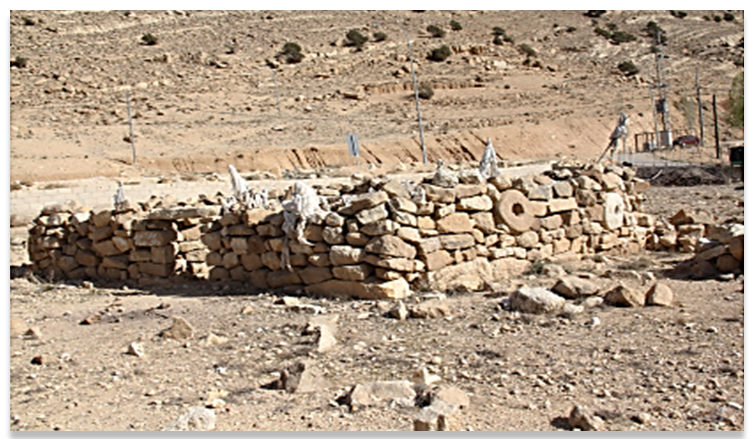
Photo by Bille M [38] (Being Bedouin around Petra). Figure 2: Another view of the site showing other tombs in the cemetery.
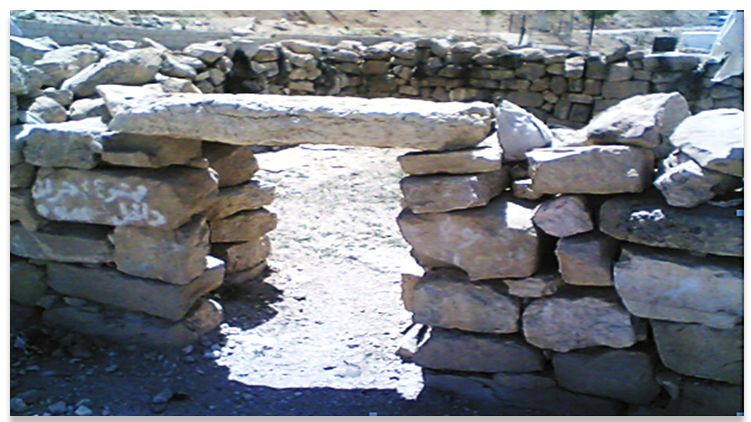
We can identify three tombs in the spot, though others identify only two [13, 36, 48]. The structure of the tombs is very simple. They lie inside a stone enclosure called in Jordan eṣ-Ṣīreh” which is used originally to refer to an enclosure for cattle [45]. The central one seems to be more important because its headstone is covered by thick layers of ashes as a result of burning candles and incense. The rest of the tomb is made up of small stones that are irregularly arranged on top. The other two tombs are situated on either side of the central one. They are even simpler and of them nothing appears except for two simple headstones. They do not seem to receive much considerations from the visitors because they contain no marks of incense. On the interior walls of eṣ- Ṣīreh, one can see the marks of burning candles and incense. Also white outworn rags are attached on different sides of the place, though one can also notice the presence of new pieces of white cloth and new candles which indicate that the site is still being visited. The orientation of the tombs inside the enclosure is from East to West. This apparently corresponds to the conventional religious orientation of all tombs of Muslims in this area. In this case, the dead are laid on their right side, with their heads to the West and their feet to the East. This particular burial position allows their faces to turn to Mecca or al- Qiblah [2].
Visitation Rituals in Wadi Mūsa
A large bulk of literature about the visitation behavior in Islamic shrines and holy sites can be found in countless studies related to the topic [13, 35, 36, 42, 48, 63, 64] to mention only a few). Visitation of holy sites or “ziyārah” and the related rituals have been preserved through the practices and traditions of many Muslim societies. Many of these rituals have also been reported in the narratives and accounts of both Western and local travellers. In the vicinity of Wadi Mūsa, one can easily find numerous traditions linked to many religious locations, of which Nebi- Hārūn’s tomb is probably the most celebrated.
The site of el- Fugarā is yet another sanctuary which still attracts many visitors from regions of Wadi Mūsa because it contains awliā’ who, within the common belief, act as mediators between Allāh and other people [63]. The visitation practice, which is usually accompanied by specific rituals that might sometimes lead to “shirk” in Allāh or association and “bid’ah” or innovation, used to be greater in the past. Some people nowadays, mostly the uneducated, tend to visit such places in times of problems, calamities and hardships. Doing so they seek the help and intercession of the weli who would act in their behalf [64].
The rituals that people perform in this cemetery are similar to those performed in other sacred sites in the region. These rituals include tying rags on the walls of the site. The rags are usually tied as a sign of having visited the tombs and fulfilled religious duties Sick people often tear pieces of their own clothes and tie them to act as a reminder that they have visited the site [45]. The rites also include lighting pieces of cloth or some candles, burning of incense, sacrificing of goats, and supplications. In the past, people used to light cloth on the stones of the tombs and the walls of the enclosure, by dipping white or green cloth in oil, butter or ghee, especially at the beginning of the annual animal season [9]. In addition to cloth, and quite more recently, people would also light candles. This practice can be seen nowadays in different places within the site. Al- Salameen Z, et al. [65] says that the women of al- Layāthneh used to visit the site once a year. The visitation might take place during the season of Prophet Hārūn or after a week [36]. The women used to take oil, some fat, and pieces of cloth. Then as they approached the site, they would gather themselves in a place within the cemetery. The cloth would then be dipped in the oil, lighted, and placed on the walls. After that, the women would start supplications and prayers asking for their specific special needs. When they finished the rituals, they would make bread and eat their meal right on the spot [13].
As a common ritual, some families bring their sick people to the site for the purposes of healing and getting Baraka. The sick are normally placed in the location, left alone and then taken on the following day. When they leave the place, they mention what they saw during sleeping there [13]. This practice links el- Fugarā site, which is located in Barrāq, to another site by the name of Barrāq also; the latter being located in Aleppo. People practice the same rite of placing the sick in the cemetery and asking them to sleep. In their dreams, they would then see pious people suggesting treatment or sometimes caressing the spot of pain [37]. Many years ago, a Bedouin family was reported to have come to the site with a sick child riding a camel, they placed the child in the Ṣīreh and performed rituals and supplications. The child’s health condition, having slept for three nights, improved greatly. Miraculously, he went home with his family on foot. After weeks, the family came back to visit the tombs with the child and slaughtered a goat for the awliā’ [11].
The site is described as a powerful place of “illusory forces” [38]. Many stories have been developed by the locals around the power of the sheikhs buried in the location. Legendary stories were normally narrated by the sick that were placed there. These stories are connected with the karamāt [64, 66] of those awliā’. Some of the people would not believe in these stories and as a consequence would be punished. The karamāt occur through or around the weli by divine agency. The weli in social practices is a source of baraka and power. In this respect, he has the power “to bless, to heal, to judge, to foresee, to transform, and also to curse and bring down the punishment” of Allāh [67]. One story in this regard is about a soldier who visited the el- Fugarā tombs to pray and read verses from the Qur’an. The man was accompanied by a friend who called the soldier ignorant for believing that reading and praying to some stones would help anyone in anyway. The friend’s son, sadly enough, died the next day. The man felt sorry, recognized the religious power of the awliā’, and returned to the tombs to slaughter a goat. En- Nawāfleh mentions that many families in the area stopped the habit of visiting the tombs. After a while, they encountered some hardships and problems, and as a result, they started the habit again [39].
Slaughtering an animal at the site with the intention of sacrifice is a very important relevant ritual. It is by no means the most sanctified ritual performed in these locations [19]. The animal is slaughtered and cooked or distributed to the poor people. This “feast” ritual is called “ghada el-Fugarā” or (el- Fugarā lunch) when served during the day, and when prepared at night, it is called “’asha el- Fugarā” or (el- Fugarā dinner). Such food would be given away for the souls of the awliā’ in order to receive baraka and blessing [35]. The practice of sacrifice in this manner has become occasional now because of the religious awakening in the area. For most people, this ritual leads to shirk because it is not allowed to mention the name of anyone other than Allāh when slaughtering an animal.
Another important ritual that was occasionally practiced in el- Fugarā cemetery is “Amm el- Geith” or the mother of Rain [36]. Obviously, people’s lives in the region depended mostly on agriculture because most of them were agro- pastoralists. When heaven held back its blessing of rain, people would try to get the help of the awliā’ to intercede for them with Allāh [7, 33, 68, 69, 70]. One way of doing this was by a special prayer rite called “Amm el-Geith”. This expression is used to describe a large primitively- made doll that might be carried all through the procession. The doll is made by fastening two pieces of wood to each other in the form of a cross and cover them with a dress in female attire. This custom is common among some tribes of Palestine. It is even more common among the Bedouins of Jordan (ibid 220) and the Ruwalah Bedouins of Syria [71]. Having made the doll, some elderly pious women and a group of children would stand in the cemetery at the beginning of the rainy season. Here the location provides a clear panoramic view of Jabal Hārūn which lies directly on the opposite side. Then the whole group would sing a lyric asking for rain. The following, reported by an elderly woman of the area, is typical of the lyric and custom in the region of Wadi Mūsa [36]:
Yamm el- Geith Ghīthīna Billi esh- Weishet rā’īna Rā’īna sahrid ‘anna Biddouh Ṭābaq Ḥenna Yamm el- Geith yā Daiem Billi zār’na an- Nāeim Yamm el- Geith yā Ḥādrag Khālli seilha yedrag. One final note is that many of these rituals have disappeared nowadays because many locals consider them unacceptable or deviations from true Islamic traditions. Al- Salameen Z, et al. [13] regards this ritual as a continuation of ancient pagan and Jewish habits (2007: 208). Without doubt, the site of al-Fugarā still represents a religious visitation attraction. At any rate, it would be evident for any passer-by in the area to notice the tracks of late visits, which indicate that the spot is still being used for saint intercession at least by some people [72].
Visitation Rituals in Buṣeirā
This is, as far as we know, the first study that deals mainly with el- Fugarā site. It is thus far the first to explore the religious expressions and practices within al-Saūdi tribe, often known as al- Saūdīn [73, 74, 75]. The first Western traveller to mention them, while they were living in Shawbak, was Burckhardt in 1812 [2]. The tribe is also mentioned after inhabiting Buṣeirā by many others [7, 33, 76]. It should be stated that the people of the al- Saūdi tribe used to visit some holy sites that they are well acquainted with, or that are located within their neighbourhood. More specifically, they would visit four religious sites that are all situated in the South. Two are located in the vicinity of Buṣeirā, while the other two are in Shawbak and Wadi Mūsa. The first site is situated in Buṣeirā and is not famous within the area nowadays. It is thought to be the tomb of Prophet Shīth or “Sheth”. Interestingly enough, by moving some twenty kilometres to the North, we can find another shrine of Prophet Shīth in Ṭafīlah [48]. Examining some historical resources, one can also find some more other famous, or even more recognized, sites of the Prophet elsewhere [76, 77, 78].
In the Qur’an we do not find any references to Shīth. In the Ḥadīth and Islamic traditions, however, there are some references which proclaim him a Prophet [79]. In Genesis we find a story of Shīth who was born after “Cain” had murdered “Abel”. Adam according to the Biblical accounts returned to his wife Eve, she became pregnant, and gave birth to a baby boy whom she called Shīth. The Hebrew for “Sheth” means “substitute” or “replacement” [80] and in Arabic the name means “the gift of Allāh” [81]. It seems that by having the new son, Adam started a more descend race than those of Cain through Shīth [82]. The site of Shīth or “Shīd”, as termed by elderly people in Buṣeirā was a simple shrine; a tomb in a simple room made of stone. The shrine was removed to open space for expanding the old mosque which is situated nearby. The site has now totally disappeared leaving only some vivid memories in the minds of some people. In any event, visitation rituals in this location were performed occasionally. They included tying rags and pieces of white cloth. They also included burning incense. Animal sacrifice was also a noticeable ritual that was performed there.
Another more famous religious site in Buṣeirā is Maqām Al- Ḥārith bin ‘Omeir al -Azdi, previously known by the inhabitants as “Ihtheifeh eu- Hammād” or (Hutheifah and Hammād). The site enjoys an excellent location alongside the King’s Highway. It is now a large building complex which includes many facilities such as a mosque, a library, a multi- purpose hall, etc [83]. Al- Ḥārith was one of Prophet Mohammad’s Companions who was sent as a messenger to the King of Baṣra. On the way, the man was intercepted and killed by the Ghassanid ruler of Mu’tah (ibid: 80), and his murder was the main reason of Mu’tah Battle later on [84]. Today his tomb stands as one of the most religious sites in Ṭafīlah. Being located in Buṣeirā, the shrine was visited by its people for baraka and intercession. In most cases, women would arrange group visits at certain times or occasions. In the site people used to sacrifice animals and stain the tomb with blood. They also use to pray and perform supplications in the place. Until recently they would even bring their newly- born babies to the site for blessing. The sick would also visit the shrine for healing purposes.
The tomb of “Eīd ibn Zeidān”, which lies on the tip of a slope in what is now a ruined region called ‘Erāq of Shoubāk, is another site that receives special attention within the al- Saūdi tribe. The tomb refers to a pious man from al- Zeidānīn; a subtribe of al- Saūdi who were living in the area before moving to Buṣeirā. Descendants of the man used to visit the tomb of their forefather and perform all types of rituals there. Also, different members of the al- Saūdi tribe used to pay visits to the site for Baraka and spiritual gains. Many visits were being arranged from Buṣeirā to the tomb when there was a need. This practice has only stopped years ago after the religious enlightenment that took place especially among the educated.
The last site that enjoys a considerable reputation as a place of religious visitation, and that was frequently visited by the al- Saūdi tribe, is el- Fugarā sanctuary in Wadi Mūsa. Despite the fact that the visit required moving a long distance from Buṣeirā to Ἁyn Amūn, the site attracted many people because of their belief in the sheikhs buried there. The people of Buṣeirā have always associated el- Fugarā with sanctity and holiness. This has been the case because of genuine experience and dealings with a tribe that includes many politely deferential members who have no animosity with others. These factors have portrayed a positive image for el- Fugarā in the cultural and social expression in Buṣeirā. The image was reflected on many cultural beliefs and religious practices, especially among women. Until recently, when the women of Buṣeirā intended to express fear of or anxiety over something, they would say: “Tastūr yahl eṣ- Ṣīreh” referring to the tombs of el- Fugarā in Ἁyn Amūn. The word “Tastūr” which comes to Arabic from the Persian “Dastūr”, means “a kind of bishop” or a high-ranking priest [85, 86]. In another context, the sociolinguistic connotation of the term implies asking for permission for a person to enter a maqām or shrine of a weli.
It was a widespread habit among many women of the area to call on el- Fugarā by making an oath in their names. The practice would be done using one, or both of the following formulas: “Wallāh il- ‘Athīm, wil- Fagarā, wahl eṣ- Ṣīreh» or “wil- Fagarā, wi- ‘Ayāl Eīd”. In the Pre- Islamic period, people would swear by the name of their fathers [51] or by the battle cry of their tribe as a sacred concept (ibid: 63). They would even swear by the “anṣāb” between which sacred blood of animal sacrifice is shed [81]. Such oaths also contain references to cult acts which took place by the tombs of the deceased (ibid: 217). This practice is also seen throughout Europe in the past as many people would swear by saints and swords [87, 88]. The notion of using the name of the tribe in social occasions exceeds this. At weddings, women used to sing folkloric lyrics asserting the importance of el- Fugarā as a source for blessing for the newly-wed. Women would gather themselves and stand on the doorsteps of the father of the bride’s house. In a ceremonial fashion they would then begin to take turns and sing as a choir praising Prophet Mohammad and el- Fugarā. After that they would praise the family of the bride asking for permission to enter the house. This kind of ritual could take minutes in the form of a “singing and walking sequence” that would lead the women to finally enter the house. This famous folkloric lyric in Buṣeirā would sound as follows: Afdhāl al- kullī thikrāk Nebīna… Afdhāl al- kullī Ballāh ya hthūrī sāllu ‘a Mhammād… Ballāh ya hthūrī Allāh ye’tīna khīrku ya heil eṣ- Ṣīreh… Allāh ye’tina el- khīrku Fārishku we- eghtāku wel- Jūkh al ālākhthar_... Fārishku we- _eghtāku. In the lyric, the women ask for the blessings and goodness of el- Fugarā, wishing the bride and groom a lifetime of love and happiness in the future. Notice that the green colour cloth mentioned in the lyric symbolizes the continuity of good life and prosperity [89]. In this sense, the awliā’ can indeed have a profound effect on the lives of people, and therefore can cause welfare and multiplicity. A story that implies this is about a widow who once borrowed a metal washing basin from a family of el- Fugarā so that her son, who would get married the next day, had a shower. Ironically, this might result in bringing Baraka and blessings. This is exactly what people mean when they say el- Fugarā “fāl hum kuwaiess”; in the sense that their company and neighbourhood brings benefits and good circumstances, unlike other people whose presence could be associated with bad omen or who might even invoke the evil eye.
A much more significant and even more important feature of el- Fugarā is their ability to function as healers. Being smitten with disease, people would visit specific members of the tribe for treatment, or they could visit the tombs in Wadi Mūsa. Some causes of these diseases could be psychological or even mythical, while others could be real. In the public subconscious, ghosts, spirits, and many other mythical creatures have filled and captured people’s imagination. Many of these creatures could cause harm to people, and that seems to be only cured supernaturally or metaphysically. Many women, for instance, complain of having frequent miscarriages or spontaneous abortions. The reason for this phenomenon is believed to be caused by “at- Tābi’ah” which is considered as a female Jinnīah that intervene between people and their good health, their fertility, children, property and even beauty [90, 91]. Many women therefore ascribe their infertility, miscarriages or having only delivered girls to this mythical creature. The “Tābi’ah” in some extreme conditions might even kill babies after being born; especially within the first few months [90]. Women who suffer from the problem would either visit one of the sheikhs of the tribe for treatment, or visit the tombs in Wadi Mūsa. Rituals of visitations focus on supplications and prayers and include other rites like candle and cloth lighting and burning of incense. People might also visit the place for treating different diseases including neurological and psychological disorders as well as many other physical diseases. One final incident that supports this healing- power belief was narrated by a man from el- Fugarā who reported that a neighbour old woman asked him, upon visiting her son at hospital, to recite some verses of the Qur’an with the intention of helping her son who had an appendectomy which led eventually to severe convulsions.
With reference to animal sacrifice, Jaussen cites a list of twenty-nine different types of offering or “thabīhah”[69]. Of great significance is the fact that the animal intended to be offered must be pure and perfect. In the Islamic sacrifice rituals faultless animals must only be selected. This was also the custom during Greek and Roman times [91]. In 1971 and as one of the group visits that used to be made from Buṣeirā to Wadi Mūsa, some families from the town hired a truck and brought their goats and other provisions. Having arrived in the site, and while the people were busy unloading their provisions, a goat escaped and went astray. The people started running after the animal as it went away. Then losing hope in catching the goat, they decided to leave it because it was believed to be haunted and therefore unacceptable as a sacrifice. Luckily they had other goats which they could offer instead. In this visit, the people slept for two nights and performed many rites including slaughtering their goats and staining the tombs with blood. Upon slaughtering, the person would turn the head of the animal towards el- Qiblah and say: “Bism Ellāh, Allāhu akbar, min Allāh wa ila Allāh, ‘an aruwāh el-Fagarā” [92].
The people would then skin their animals, wash the corpses with the water Ἁyn Amūn, and cook their meals eventually. Some of the meat would be distributed among the neighbours of the sanctuary. In this particular occasion also, some Sūfi rituals took place by some members of el- Fugarā tribe. Our informant reported that a green banner was being raised during a procession in the site. A sort of tambourine was also used with a rhythmic repetition of “Allāh, Allāh, and Allāh ḥāy”. In addition to this, prayers and supplications were performed. Many individual visits were also arranged by different people from Buṣeirā for sanctification and healing purposes. These visits are now rare because of the religious revival that has taken place recently. In the past, visits of al- Saūdīn and el- Fugarā were more frequent. This has led to the development of a strong relationship that still exists especially between the elderly of el- Fugarā and the family of abu el-Ḥinna whose land is adjacent to the cemetery [93, 94, 95].
Concluding Remarks
The religious rites in the area of Wadi Mūsa have been extensively studied as an exemplary of the rituals practiced in holy sites of Jordan. Most of the previous literature about the topic deals with Nebi Hārūn and describes the customs of visitation or “ziyārah” of other similar sites in the area as well. By contrast, the religious practices of the people of Buṣeirā, though rich, receives little attention. These practices, which are similar to practices performed in other locations, have been recorded in the subconscious of al- Saūdīn over time. In this part of the world, ziyārah is regarded as a common practice that people perform to the tombs of Prophets and righteous people to get Baraka and blessings. Many people nowadays oppose such practices and denounce them because they lead to “bid’āh” and “shirk”. It should be noticed that these practices still constitute a component of the traditions and customs of many people, though rejected by others within the norms of today. In any event, being acceptable or not, these practices are part of our cultural identity. This study has attempted to shed light on some of these rituals. Still many related customs in other places of the region need further study and examination.
References
-
Khuteimi AL, Ahmad (2008) Mu’jam Buldāniyat el- ‘Ordun. Ministry of Culture. Amman,
-
Burckhardt J (1822) Travels in Syria and the Holy Land. London, John Murray, Albemarle Street.
-
Millard D (1843) A Journal of Travels in Egypt, Arabia Petraea, and the Holy Land. Rochester: Erastus Shepard.
-
Stephenson J (1862) Incidents of Travel in Egypt, Arabia Petraea, and the Holy Land. Harper and Brothers Publishers, New York 2.
-
Lowth G (1855) The Wanderer in Arabia; or, Western Footprints in Eastern Tracks. Hurt and Blackett Publishers, London 2: 1-204.
-
Irby CL, Mangles J (1825) Travels in Egypt and Nubia, Syria, and Asia Minor. T Whyte and Co Printers, London.
-
Jaussen AJ (1908) Coustumes des Arabes au Pays de Moab. Paris, Gabalda.
-
Wilson J (1847) The Lands of the Bible Visited and Described. William Whyte and Co, Edinburgh 1: 1-28.
-
Ali M, Maulana (2009) The Religion of Islam, Ahmadiyya Anjuman Isha’a’t ‘at Islam. Lahore.
-
Canaan T (1929) Studies in the Topography and Folklore of Petra. Journal of the Palestine Oriental Society 9: 136- 218.
-
Rawādieh M (2008) Petra and its Surroundings: A Survey of the Accounts of Travellers and Land Registry Archives. Al- Arab 43(11-12): 806- 828.
-
Cyril G (2002) The New Encyclopedia of Islam, Alta Maria Press, A Division of Rowman & Littlefield Publishers, Lanham.
-
Zeyad AS, Falahat H (2009) Religious Practices and Beliefs in Wadi Musa between the Late 19th & Early 20th Centuries. Jordan Journal for History and Archaeology 3(3): 175-204.
-
Nicholson RA (1914) The Mystics of Islam, G. Bell and Sons LTD, London.
-
Hanif N (2002) Biographical Encyclopaedia of Sufis, (Central Asia and Middle East). Sarup and Sons, New Delhi.
-
Kinberg L (1985) What is Meant by Zuhd?. Studia Islamica 61: 27-44.
-
Abdul AI (1982) Economic Though of ibn al- Qayyim (1292-1350). International Centre for Research in Islamic Economy, King Abdulaziz University, Saudi Arabia.
-
Qudsi A (2018) The Concept of Jadhb and the Image of Majdhūb in Sufi Teachings and Life in the Period between Fourth/Tenth and Tenth/ Sixteenth Centuries. Journal of Royal Asiatic Society 28(2): 255-271.
-
Qudsi A (2011) Baina Sir (en) wa Tiar: al- Tandīr, Ḥayāt al- Jamā’ah, wa buna al-Mu’assasah. Tassauwf abi Ḥafs al- Sahrurdi. Dar el- Kotub al- Alamyyah, Beirut.
-
Hout ELM (1996) Asna al- Mātaleb fi Aḥadīth Mukhtālifat al- Marāttib. Dar el- Kutub al- Alāmieah, Beruit.
-
Kaiāli ALA (2013) Al- Wilayah wa al- Weli ind Assādah Assūfyyah. Books Publisher, Beirut.
-
Salim T (2009) Mountain against the Sea: Essays on Palestinian Society and Culture. Berkeley. Los Angeles. University of California Press, Landon.
-
Sara S (2014) Disability in the Ottoman World, 1500- 1800. Cambridge University Press, New York.
-
The Encyclopaedia Britannica (1920) In: 14th (Edn.), The Encyclopaedia Britannica Company Limited.
-
Walter M, Fridman E (2004) Shamanism An Encyclopedia of World Beliefs, Practices, and Culture. California, ABC, CLIO.
-
Porter V, Saif L, Smith SE (2017) Medieval Amulets, Talismans, and Magic. Blackwell’s Companion to Islamic Art and Architecture. In: Flood F, Necipoglu G (Eds.), John Wiley and Sons Inc.
-
Mikkel B (2019) Being Bedouin Around Petra. Life at a World Heritage Site in the Twenty- First Century. Oxford Berghahan Books, New York, USA.
-
(1866) Webster’s Complete Dictionary of the English. George Bell and Sons, London.
-
(1995) Oxford Advanced Learners Dictionary. Oxford University Press, Oxford.
-
Fowler HW, Fowler FG, Della T (1919) The Concise Oxford Dictionary of Current English. Oxford, The Clarendon Press, New York, USA.
-
The Encyclopedia Americana (1918) The Encyclopedia Americana Corporation. New York, USA.
-
Irby L, Mangles J (1825) Travels in Egypt and Nubia, Syria, and Asia Minor. London T. Whyte and Co Printers.
-
Alois M (1908) Arabia Petraea. Wien, Alfred Hölder.
-
Samyia AF (2001) Excavations at Khirbat Al- Mu’allaq. Majallat Munjazāt. Department of Antiquities 27.
-
Freihat M, Taieyh AA (2015) The Cultural Expressions and Religious Rituals: An Anthropological Research in Petra Area. Dirasāt wa- Abhāth 20: 187- 211.
-
Nasarat MA (2013) The Festival of Nebi (Prophet) Hārūn in Petra. A History of the Festival and Sanctuary. Jordan Journal for History and Archaeology 7(1): 110-152.
-
Farajāt S, Marahleh MA, Falahat HA (2002) Excavations at Khirbat Barrāq. Annual of the Department of Antiquities of Jordan 46: 21-30.
-
Mikkel B (2016) Dealing with Dead Saints. 1st (Edn.), In: Christensen D, Willerslev R (Eds.), Taming Time, Timing Death. Social Technologies and Ritual, pp: 136-157.
-
Mahmoud EN (2004) Liwā’ el- Batrā’: Al- Arth wal- Insān. Ministry of Culture.
-
Suleiman EG (1986) Ṭafīlah, its History and Geography. In: 2nd (Edn.), The National Press, Amman.
-
Shqiarat M (2018) Abandoning Shammakh: Historical Archaeology among the Villages of Southern Jordan and its Ethno-Archaeological And Modern Economic Potential. Journal of Anthropology and Archaeology 6(1): 1-18.
-
Erica F (2008) Islamic Saint Vernation: Iran. Unpublished Master’s Thesis, University of Denver, USA.
-
Katja H (2011) Integrated Water Resources Management as a Governance Challenge for Countries of the Middle East. Berlin, Logos Verlag.
-
Izzideen AT (2003) Islam and Contemporary Issues. Amman, Ministry of Culture.
-
Taufik C (1927) Mohammedan Saints and Sanctuaries in Palestine. Journal of the Palestine Oriental Society 5: 1-331.
-
Mustafa D (1973) Biladuna Filestīn. Beruit, Dar al- Tāli’ah.
-
Taufik C (1930) Additions to Studies in the Topography and Folklore of Petra. Journal of the Palestine Oriental Society 10: 178-180.
-
Päivi M (2013) Our Ancestors were Bedouins: Memory, Identity and Change. The Case of Holy Sites in Southern Jordan. Unpublished PHD thesis, University of Helsinki.
-
Paulus M (2001) Five Years in Trans- Jordan. Amman, Ministry of Culture.
-
Madawi AR (2002) A History of Saudi Arabia. Cambridge University Press, UK.
-
Ignāc G (1968) Muslim Studies. In: 1st (Edn.), Aldine Publishing Company, Chicago, USA.
-
Mohammad AG (2010) Within the Boundaries of Islam: A Study of Bid’āh. Islamic Book Trust.
-
Aydin B (2014) The Rise of Wahhabi Sectarianism and its Impact in Saudi Arabia. Atatürk Üniversitesi ilahiyat Fakülesi Dergisi. Sayi 42: 245-261.
-
Zaidun AM (2004) The Nabataean Civilization. Amman, Ministry of Culture Publications.
-
Shqiarat M (2008) The Archaeology of Water Control in the Nabataean and Roman-Byzantine Periods in Jordan: Overview and Case Studies from Key Sites. Cura Aquarum in Jordanien. Siegburg, pp: 21-45.
-
Akhbār M, Islāmiyah A (1972) Al-Quds, Wizārat al- Adyān, Da’rāt al- Shu’ūn al- Islāmyah.
-
Edith H (1942) Mythology. Boston, Little Brown and Company.
-
Mallarach J, Corcό J, Papayannis T (2016) Christian Monastic Lands as Protected Landscapes and Community Conserved Areas: An Overview. PARHS 22(1): 63-78.
-
Arthur S (1868) Sinai and Palestine in Connection with their History. London, John Murray, Albemarie Street.
-
Baym N, Gottesman R, Holland LB, Kalstone D (1989) The Norton Anthology of American Literature. New York, Norton.
-
Taufik C (1921) Haunted Spring and Water Demons in Palestine. Journal of the Palestine Oriental Society 1: 153-170.
-
Shqiarat M (2019) History and Archaeology of Water Management in Jordan Throgh Ages. Scientific Culture 5(3): 41-54.
-
Choudhary M (2010) Religious Practices of Sufi Shrines in the Punjab. Pakistan Journal of History and Culture 31(1): 1-56.
-
Mohammad E, Yun E (2017) Death, Resurrection, and Shrine Visitations: A Islamic Perspective. Religious 8(3): 34.
-
Salameen ZA, Falahat HA (2007) Jabal Haroun During the Islamic Period: A Study in the Light of Newly Discovered Inscriptions. Arabian Archaeology and Epigraphy 18: 258-264.
-
Gandhi M, Husain O (2004) The Complete Book of the Muslim and Parsi Names. Penguin Books, New York, USA.
-
Mack B, Boyd J (2000) One Woman’s Jihad: Nana Asma’u, Scholar and Scribe. Indiana University Press, Bloomington, USA.
-
Alois M (1928) The Manners and Customs of the Ruwala Bedouins. American Geographical Society, New York, USA.
-
Miettunen PH (2008) Jabal Haroun: History, Past Explorations, Monuments, and Pilgrimages. Ist (Edn), In: Fiema ZT, Frösén J (Eds.), Petra The Mountain of Aaron. The Church and the Chapel, Helsinki, Societas Scientairum Fennica, pp: 27-49.
-
Lahelma A, Fiema Z (2008) From Goddess to Prophet: 200 years of Continuity on the Mountain of Aaron near Petra, Jordan. The Finnish Society of Religion 44(2): 191- 222.
-
Mikkel B (2019) Being Bedouin around Petra. Life at a World Heritage Site in the Twenty- First Century. Oxford, Berghahan Books. New York.
-
Carl R (1866) The Comparative Geography of Palestine and the Saints. Edinburgh T & T Clark.
-
Jacobus DV (2012) The Golden Legend: Readings in the Saints. Princeton University Press, Princeton, USA.
-
Frederick P (1934) A History of Trans- Jordan and its Tribes. 2nd (Vol). Amman.
-
Mohammad V (2018) Islam Folklore Tales of Prophet Adam and Iblis from Jinn Race. Blurb Books, USA.
-
Guy LS (2014) The Medieval Islamic World. In: 1st (Vol), IB Tauris, London & New York,.
-
Sarah S (2000) Mosul before Iraq: Like Bees Making Five- Sides Cells. New York State University Press, USA.
-
Abdullah EBA (1992) Al- Masālik wal- Mamālik. Beruit, Dar el- Kutub al- Alāmieah.
-
Zen G (2017) The Great Contest II: Enmity between the Seed- Lines. Sacred Word Publishing.
-
Mohammad AR (2009) Tafsīr ibn Kathīr. Part 7. MSA Publication Limited, London.
-
John L (2013) The Great Second Ascent Movement: Its Rise and Progress. Teach Services, Inc. Publishers.
-
Mun’im AHA (2008) The Royal Reconstruction of the Mosques and Shrines of the Sahābah, Prophets, and Martyrs. The Royal Committee. Amman.
-
Mahmoud S (1978) At- Tārīkh el- Islāmi. 2nd (Vol). Beirut, Al- Maktab el- Islāmi.
-
Guides B (2009) The Britannica Guide to India. Encyclopaedia Britannica Inc, Robinson Publishing, London.
-
Masih Y (1990) A Comparative Study of Religion. Motilal Banarsidass Publishers. Private Limited, India.
-
Ian N (2011) Islam, Christianity, and the Mystic Journey: A Comparative Exploration. Edinburgh University Press.
-
William S (2005) Hamlet: Prestwick House literary touchstone classics series. Delaware, Prestwick House.
-
Amots D (2002) Why are Rags Tied to the Sacred Trees in the Holy Land?. Economic Botany 56(4): 315-327.
-
Silmane B (2005) At- Tasaour el- Islāmi li Ba’dh el- Kai’nāt fil- Jazā’r. Majallat el- Bāhith el- Ijtimā’I 7: 165- 176.
-
Mandhūr I, ed- Dīn J (2009) Lissān el- Ἁrab. 5th & 8th (Vol). Beirut, Dar Sadir.
-
Gunnel E (2014) Animal Sacrifice in Antiquity. In: Campbell GL (Ed.), The Oxford Handbook of Ancient Animals. Oxford: Oxford University Press, pp: 324-354.
-
William P (2007) Discovering Jesus in the Old Testament. Salem Publishing Solutions, USA.
-
Christina P (2007) An Encyclopedia of Shaman. In: 1st (Edn.), The Rosen Publishing Inc, New York, USA.
- The Indispensable Role of Informal Caregivers in Supporting the Aging Population
- Socio-Religious Significance of Kamakhya Temple in Guwahati, Assam
- Is Anthropology Possible?
- A Contribution to the History and Paleobiology of Harput/Elazığ Türkiye and Its Surroundings
- A Study on the Cowrie Shells of the Dimasas in Assam
- The Significance of International Organizations Cooperation in the Efficient Resolution of Global Conflict