
Kapherem: a Traditional Healing Through Chantings of the Karbis in Karbi Anglong, Assam
Every culture, irrespective of its simplicity and complexity, has its own beliefs and practices concerning diseases. Every culture evolves its own system of medicine in order to treat diseases in its own way. Sickness, diseases and their treatments were also prevalent before the advent of Western medicine. But how did they treat their sickness and diseases? It was done and is still practiced through their indigenous method of health care practices, traditional medicines and magico-religious healing, particularly in the simple societies. Northeast India and particularly Assam is a rich zone of ethnic diversity and the Karbis are the early settlers of Karbi Anglong. They have their own traditional cultural practices and indigenous knowledge of health care system. It has been noticed that, even in a number of cases if they do not have the accessibilities of western medical facilities, still they can redress their ailments through different medicinal plants which are available in their locality and forest, and also through rituals like se karkli and vur kamatha and also by an art of chanting known as kapherem. Kapherem is the process where they heal the illness like Gastritis, infection, fractures and also to ward off the malevolent effect by chanting. It is an oral tradition which is being carried forward through generations. The present paper will discuss on the importance of kapherem (chanting) related to various health issues and treatment of various malevolent effect of the Karbi people. Data were collected through empirical fieldwork by applying appropriate anthropological research methods. Application of the method had been recorded both from the individual cases as well as through the interviews as taken on the traditional healers. It had been found that the method was very successful to drove out the malevolent effect and to cure the patients from their ailments.
Introduction
Every culture, irrespective of its simplicity and complexity, has its own beliefs and practices concerning diseases. No culture works in a meaningless fashion in its treatment of diseases. Every culture evolves its own system of medicine in order to treat diseases in its own way. This treatment of disease varies from group to group. It has been noted that, in the rural areas, the belief in the interference of a supernatural agency is particularly strong in the context of health and disease. Most of their socio-cultural activities revolve around Gods and Spirits. They identify the supernatural powers with group of powerful forces and deities which control and influence the happenings in the community. It may be pointed out that disease and treatment, particularly in the simple societies cannot be properly understood in isolation. Health and treatment are very much connected with the environment, particularly the forest ecology. The health care system and traditional treatment are based on their deep observation and understanding of nature and environment [1].
Health, like happiness is an illusive concept. It has been defined in a number of ways. However, among such definitions the followings are widely accepted as mentioned below:
- Dubos R [2] defined health as, “a modus vivendi enabling imperfect men to achieve a rewarding and too painful existence, while they cope with an imperfect world” [3].
- World Health Organization 1948 defined Health as “a state of complete physical, mental and social wellbeing and not merely an absence of disease or infirmity” [3].
In recent years, a new philosophy of health have been acquired, as stated below:
- Health is a fundamental human right.
- Health is the essence of productive life and not the result of ever increasing expenditure on medical care.
- Health is inter-sectoral.
- Health is an integral part of development.
- Health is central to the concept of quality of life.
- Health involves individuals, state and international responsibility.
- Health and its maintenance is a major social investment.
- Health is a world-wide social goal.
The determinants of health are broad, extend from genetic influences to social, cultural and economic environment and include manifold pathways by which these various factors operate to influence health and disease status at both the population and individual level. Health is a social and cultural concept in addition to its fundamental biological characteristics. There are three basic sources of differences in the health of populations: Hereditary determinants, socio- economic circumstances, life style and other behavioural factors. Gender differences span all three domains and cultural, political factors also play an important part in determining the health of population. Particularly, the social and economic determinants of health refer to a wide range of factors that include occupational status, working conditions and security, educational attainment, housing environment and family circumstances [3]. As stated in the Universal Declaration of Human Rights on 10th December, 1948, Article 25 (1) categorically mentioned that, everyone has the right to a standard of living adequate for the health and well- being of himself and of his family, including food, clothing, housing and medical care. Further, Article 25(2) stated that, motherhood and childhood are entitled to special care and assistance [3].
Basically, “The Right to Health”, is associated with the underlying determinants and health care, along with Availability, Accessibility, Acceptability and Quality. The underlying determinants incorporate water, sanitation, food, nutrition, housing, healthy occupational and environmental conditions, education, information etc. Again, by Availability, the functioning of public health and health care facilities, goods and services as well as programmes in sufficient quantity are meant. By Accessibility, non-discrimination, physical accessibility, economic accessibility and information accessibility is meant. By Acceptability, it is meant that, all health facilities, goods and services must be respectful of medical ethics and culturally appropriate as well as sensitive to gender and life cycle requirements. By Quality, it is assumed that, the health facilities, goods and services must be scientifically and medically appropriate and of good quality. It can be represented through the following diagram.
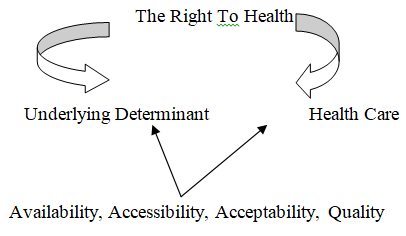
Source: www.who.int/mediacentre/factsheets/fs323-en. pdf
The concept of health, disease and treatment vary according to the culture of different communities and ethnic groups. Moreover a particular culture is guided by the traditional customs and every member of the culture is ideally expected to confirm to it.
The Anthropological perspective of health is mostly considered under the domain of Medical Anthropology. It takes up the analysis of health in the context of culture, social behavior, economic system and human biology. In Medical Anthropology, the examination of health issues extends to include knowledge, meaning, social behaviour and biology generally related to wellbeing, suffering misfortune, life cycle and survival [4]. The roots of Medical Anthropology are as ancient as the Anthropology itself. Medical Anthropology Quarterly, has defined it as a field that includes “ … all inquiries into health, disease, illness and sickness in human individuals and populations that are undertaken from the holistic and cross cultural perspective distinctive of Anthropology as a discipline- that is with an awareness of species, biological, cultural, linguistic and historical conformity and variation. It encompasses studies of ethno medicine, epidemiology, maternal and child health, population, nutrition, human development in relation to health and disease, health care providers and services, public health, health policy and the language and speech of health and health care” [1]. Health can be divided into three broad categories:
- Physical Health
- Mental health or Happiness
- Social Health or interaction between an individual with his society [5].
The relationships between ambient environmental conditions, socio-economic circumstances, demographic change and human health are complex and multidirectional. In most low income countries, a dual profile of health and disease is now emerging. It is certain that both poverty and environmental degradation, via independent pathways increase the risks to health. Meanwhile, the persistence of widespread poverty, lack of safe drinking water and sanitation, overcrowding ensures the continuation of infectious diseases. Human communities have for a long time continued to deplete natural resources and degrade local ecosystems. Often the local consequences have been the restriction or recession in human numbers and impairment of nutritional status, health and social viability. Over the past century or so the underpinnings of human health are being perturbed or depleted. The sustained good health of any population over time requires a stable and productive natural environment. For the human species, as a social animal in extremis, the stability of the social environment is also important to population health [5].
The 1986 Ottawa charter emphasized the role of factors outside the health care sector and in particular the social and economic determinants of population health status. Since the early 1990’s the population health model has received an increasing support. The central assertions of this model are as follows:
- The major determinants of human health status are cultural, social and economic factors at both the individual and population level.
- Societies that enjoy a high level and relatively equitable distribution of wealth enjoy a higher level of health status.
At the individual level, health status is determined by the social and economic environment and the way in which this environment interacts with individual psychological resources [5].
A Brief Note on the Present Study
The Karbi Anglong District is situated in the central part of Assam. It is bounded by Golaghat district in the east, Meghalaya and Morigaon district in the west, Nagaon and Golaghat district in the north and North Cachar Hill district and Nagaland in the south. The district, with dense tropical forest covered hills and flat plains were situated between 25033’ N to 26035’ N Latitude and 92010’ to 93050’ E Longitude. The population of the district is predominantly tribal. The major tribal ethnic groups of this district were Karbis, Bodos, Kukis, Dimasas, Hmars, Garos, Rengma Nagas, Tiwas, Man. Besides, a large number of non-tribals also lived together in this hill region. Karbi was a tribal group and they were the early settlers and numerically dominant ethnic group of the said region. To study the indigenous knowledge of health disease and treatment of the Karbi people, intensive field work was conducted in the selected villages of Karbi Anglong district. The studied areas were one of the oldest settlements of the Karbi people. The study was conducted among 300 families with a total population of 1653. Among them there were 852 males and 801 females.
Methodology
In this study Preliminary Census schedule was applied to collect data about their demographic composition, concept of health, disease, method of treatment and their result. Further, interviews were taken from the key informants to know about their traditional cultural practices particularly focusing on the issue related to their traditional health care practices. Thereafter, case studies were taken on the people who were suffering from different health problems. Case studies were also taken on their traditional method of treatment and in this concern the prime importance was focused on locally available medicinal plant, animal resources and their way of utilization by the studied people. Again, their consultation with the Lodep and his method of treatment were also studied [6].
The study was conducted during the period of January 2016 to December 2019. There were four divisions of the total field work. Two to three times of field work was done under each division as per the requirement.
- Division-1: Foremostly, the general observation of the village was done along with the completion of Preliminary Census Schedule (PCS) to know the demographic composition of the studied people.
- Division-2: Case studies were taken on the concerned people who were cured by the Lodeps. It was focused on the issues to know about the cause due to which the treatment conducted by traditional medicine man or magico-religious healer was unable cure the patient. Again it was focused to know about the fact that how Lodeps used to conduct the treatment through oracles.
- Division-3: Detailed open structured interviews were taken from the key informant, eldest person of the settlement, different traditional healers of the concerned society to know about the different methods of their traditional healing. It focused on the relevance of locally available floral and faunal resources in their traditional healing practices, concept about different benevolent and malevolent spirits related to their health aspects. Further, if the traditional medicine man or the magico- religious healers could not cure their patient then the role and significance of the Lodep was analyzed in detail.
- Division-4: The data was collected to find out the interaction between cultural, environmental and supernatural dimensions of health care practices among the Karbi people.
Objective of the Study
The present study is primarily focused on three important aspects:
- To know about the cultural and environmental dimension of traditional health care practices.
- To know about the utilization of different plant and animal resources in their traditional health care practices and the role traditional healers in this regard.
- To know about the importance of traditional healing through chantings among the Karbi people.
Traditional Karbi Notion of Illness
The Karbis believed in multiple Deities and regards all objects on earth as having divinity or possession of supernatural power and therefore worship hills, mountains, rivers etc. They further believed that diseases were caused by different malevolent spirits and by appeasing the benevolent spirits it could be redressed. Karbis regarded both binary spiritual concept as possessing divinity which can harm as well as bring peace and prosperity to the people such as good health, wealth, favourable weather, etc. They worshipped household Deities called Hem Angtar and these Deities were propitiated annually. The Deities which were propitiated as and when required are called Habit ase (non-household Deities).
The disease condition or the notion of illness was being referred by the Karbis as se kelong. When a person felt ill, for example, after coming from forest, the household members attributed the cause due to encounter of evil spirits and initiates propitiation of the spirits. In case the patient did not respond to normal traditional treatments, the household members sought the help of wise man to ascertain the cause of the illness [7]. The wise man through divination identified the spirit responsible for the illness and suggests certain rituals for recovery of the patient. This act of divination was called Sang Kelang. The practice was more prevalent in remote areas where modern medical facility is a far cry. Sickness, if long continued or severe, was frequently attributed to witchcraft (maja) and the patient was said to be maja kelong- witchcraft has got hold of him.
Traditional healthcare practices of the Karbis
Traditional healthcare practices of the Karbis included both local and oral applications, and rituals to cure host of diseases like anemia, muscular inflammation, pain (analgesia), etc. Keso or illness was also called se-kelong, a generic term for contacting illnesses and its treatment is called se-kelang. Se-kelang therefore, involved numerous sacred healing incantations, chants, prayers and rituals and in some cases administration of plant and animal products. The rituals might be widely divided into
- kapherem and
- karkli. In kapherem a cure for certain keso (pain or illness) was sought by performing healing chants involving external application of saliva of the mouth (kehi/kangthok) and mild blowing of air (kebut) on the afflicted portion of the body. Kapherem was performed for the cure of numerous pain or keso such as
- Ingki Angmi (toxins of caterpillars),
- Bap Ase,
- Ingthum (Boils/Furuncle),
- Methan Kekor (Dog bite),
- Pok Avur (epidemic of stomach disease),
- But Pharo (Acute Stomach ache),
- Chor Kedong (Thorn inflicted injury),
- Me Kapherem (Burn),
- Inghai (lymph adinitis),
- Han Kangri (Vegetable Poisoning),
- Sor Kapherem (Acute pain),
- Mek Avur (Epidemic of eye disease),
- Chainong a-But (Acute stomach pain),
- Thengkur (Poisoning) and
- Phurui Kangthok (Snake bite) etc. to cite a few. In kapherem, blood-sacrifice was generally not involved. In extreme cases when the keso did not respond to kapherem, blood-sacrifice or karkli was resorted to. Philosophically, therefore, in traditional Karbi healing system, blood-sacrifice was not the first option. In karkli, a priest resorted to reading of entrail and liver of sacrificed chickens, goats or pigs. This practice of divining, known since the time of ancient Etruscans, Romans, and the Mesopotamians was known as haruspicy, hepatoscopy or hepatomancy, the inspection of the entrails of sacrificed animals, especially the livers of sacrificed sheep and poultry. The practice was also known as ‘Extispicy (from Latin extispicium), the practice of using anomalies in animal entrails to predict or divine future events. Organs inspected include the liver, intestines, and lungs. The animal used for extispicy must often be ritually pure and slaughtered in a special ceremony.’ Besides the reading of the entrails and livers etc., the direction of the head and wings of the sacrificed chicken was also examined. Karbi people used a number of locally available plant resources to redress their different ailments. The collection of such resources, its purification and further the method related with the preparation of medicine from them, were the integral part of their cultural tradition, customs and taboo.
Kapherem: Healing Through Orality
The Karbis believe in many deities and regards all objects on earth as having divinity or possession of supernatural powers. They believe that the diseases are caused by different malevolent spirits and can be redress by appeasing the benevolent spitit. The disease condition or the notion of illness is being referred by the Karbis as se kelong, when a person falls ill, for example after coming from the forest the household members attributes the cause due to the encounter of evil spirits and initiates propitiations of the spirits. In case the patient does not respond to normal traditional treatments, the household members seek the advice of wisw man through divination identifies the deity/ spirit responsible for the illness and suggests certain rules of recovery of the patient, this act of divination is called sang kelang.
The knowledge or the ability to treat a person’s illness or sickness by chanting called as kapherem, which is a kind magico-religious healing. In kapherem, a cure for certain keso (pain or illness) is sought by performing healing chants involving external application of saliva of the mouth (kehi/ kangthok) and mild blowing of air (kebut) on the afflicted portion of the body. Kapherem is performed for the cure of numerous pain or keso. Kapherem is performed for the cure of numerous pain or keso such as they categorised it under the following heads:-
- Kelok Keleng: broken bones, sprains and fractures.
- Baap kecholong: consumption of poison or evil eye.
- Singjam Ramaha: Cough and cold.( Occurs mostly when bogori blossoms)
- Apok anat: Gastritis and stomach ache.
- Ingthuk: Urinary infection.
- Ingthum: Boils.
- Moklang kave: not having mother’s milk
- Ingki angmi: skin infections
- Mekber kebut: Eye infection, conjunctivitis
- Methan- meng Kekor (Dog-cat bite) Under those heads, the Kapherem is done by the practicer, which is based on rules and regulations which are to be maintained by both the healer and the sufferer (patient) which is called as Porom puthi. Again all the chants and intone are based on the origin and development of the creation myth called as keplang kephie.
When a person suffers from something, Kapherem is one of the ailments they sought for, they go to the practitioner and consult with him or her. Kapherem can be practiced both by the male and female; it is an oral tradition which is being passed down through generation. The words which they chant are called as porom. They may also use some other things like water, oil, mud, cowrieshell, thap (fermented rice cake), bamboo etc. to accompany with the chant. For kelok keleng, i.e for fractures and sprains they mostly use mustard oil, massages it gently on the affected area acompanied with the chant, For Mekber kebut the practices uised to blow air softly in the eyes by chanting the porom simultaneously, there is a very interesting story about how Jangreso treated the kings’s daughter, when none could cure the princess of her eye infection, thus winning her hand for marriage and becoming the king’s heir. Baap kecholong is the most feared ailments and the most cases found by the practicers, baap literally means grass, so it means consumption of grass, it is not the common grass that is found in the yard but it means poision, there are two types of Baap i.e the akethi (dead) and Akereng (live ones), it is said that Baap is a kind of poison which they feed to their enemies in order to kill them, some uses it for their persoanl gain, Teke angmum ( tiger’s whisker is considered to be the most dangeous one) and is said could be only treated with teke achulang. It was found that diseases like headache, stomachache, vomiting is supposed to be cured by arjang aphelo (alkali prepared from young stems of bamboo), injuries caused by cut through bamboo can be redressed through a charm called kaipho kapherem In order to treat skin infections i.e Ingki angmi (Caterpiller’s fur) the practicers uses Hilong arbi i.e. the vermicompost, they make a ball out of it and roll it on the infected portion accompanied by chats. They have different timings and duration for different ailments and different procedures, for curing same kind of disease, the procedure may be different, acoording to type they have learnt from the forefathers or Kuru. I found eight such cases mostly children below ten years of age. It was found that all of the people who had underwent this treatment have been cured successfully.
They do not charge any fees for this type of treatment, they only accept whatever is given to them by the patiet, it may be a small sum of money or a bottle of hor (country liquor) as a form of honour called as maan. The practicer learnt if from their kuru orally and for that they they must offer a banta which consits of five betelnut, 5 betel leaf, bongkorok and arak as a form of fees and a mark of respect. Some of the practicers inherit the art of Kapherem by birth, it is also believed that if a person whosw birth was a footling presentation (born from the leg first), then he or she is capable of healing sprain and fractures through his/her touch. The Karbi traditional healers have a variety of roles, including: providing strong spiritual and social support; determining the ultimate cause of a serious illness or injury and also to remove the evil influences causing illness. Like the others tribal groups in the world, the Karbi people has their own traditional healer are held in high regard. A traditional healer can be either male or female healer in Karbi society, healing is done by ‘Kurusar’ priest and ‘lunsepi’ female priest. The traditional healers have their own knowledge and power that can be cure to the people.
For ‘E bang- arpum’ body ‘Keso’ ailment or illness, a treatment was done through chanting like charms ‘Kapherem’ that involves the incantation of a holy verses to cure a physical and mental health ailment or illness. The following are some of the material objects used as medicines used by Karbis for the following ailment or illness. If in case a person is suffering from the infection of insect (Ingkiang mi), a traditional healer prepared from mud to accompanied with charm or ‘kapherem’ before applying to the patient. These objects are believed to have been placed in the person’s body by supernatural intervention (Table 1).
| Name of the ailment or illness | Part of the material used | Application | |
|---|---|---|---|
| 1 | Oso Ahop | Water, finger ring(made brass metal) and thread | Thread is tie on the neck of a baby |
| 2 | Birsi | Water and seeds(master oil) | Applied on the lip |
| 3 | Pok-vai | Seeds (Rice) | Eat |
| 4 | Haek- mesek | Water and seeds (rice) | Eat and drink |
| 5 | Chule pen chukhang | Seeds (Rice) | Applied on the breast feeding |
| 6 | Ingthum | Water or lime | Applied on the boil |
| 7 | Bangaram | Master oil | Applied on the injury |
| 8 | Barsopangthuk | Water | Drink |
| 9 | Sor | Ginger | Applied on the waist |
| 10 | A mek-keso | Blow | Eyes |
| 11 | Amek- a dukjangthot | Blow | Eyes |
| 12 | Ingkiangmi | Mud | Applied on the pain |
| 13 | Cherot- aak | saliva and blow | Applied on the wound |
| 14 | Ri- Kengchinglok | Seeds (Master oil) and stem of bamboo | Fracture |
| 15 | Tehang- keso | Powder (Ash) | Applied on the forehead |
| 16 | Pok-keso | Root (Turmeric) | Eat |
| 17 | Okangsu | Saliva and blow | Applied on the neck |
| 18 | Bab- kecholong | Rice, liquor, betel nut and betel leaves | Eat, drink |
| 19 | Ingsukedong | Master oil | Applied on the leg |
| 20 | Pokchokor (bot) | Water or cool | Apply on ribs |
Table 1: ** Different materials used in different ailments.
Source: Field work, 2016-2019. Table 1: Different materials used in different ailments.
Kapherem or charms has oral history called ‘tomo’ dealing to ailment or illness. Each ailment has a folk story that recalls the ancestors’ history ‘Temokangthum’or ‘porom, saabkangthum’ in order to cure the physical health and mental disturbing. The traditional healers being required the knowledge of charms or ‘kapherem_to deal with such ailment. After preparation of the material objects, the traditional healer involves the incantation of holy verses. Here is what’ traditional healers charms related to infection from insect ‘ingki_angmi through chanting_: _Urmi pen, durmi pen Ingkroi pen’ ingthe pen Saab kangthum e-g, phongingthum e-g Urmi a long nang dun, durmi along nang dun Ingkroi a long nang dun, ingthe a long nang dun Saab kangthum e-po, phongkangthum e-po Athokora, bathokhora, rolallibatot jai Lahelahe, maatipaiPinso along pinde le Baasikot, baagirong,arnisimaahade Varputisaapphongmaani
Porommaani, puthimaani Saab kangthum a phi, poromkangthum a phi, Puthikangthum a phi A bit chelutde,abaatchelut de A bit kangsam de, a baatkangsam de Nongve pen apara,saab pen a para Saab mani, porommani de After the completion of certain charms the traditional healer spit in the mud (made it in a round shape) and applied on the pained. Firstly, water is pour into the mud until it turn into soften. Secondly, the soften mud is used to make it in a round shape. This mud is applied on the patient physical pain.
Porommaani, puthimaani Saab kangthum a phi, poromkangthum a phi, Puthikangthum a phi A bit chelutde,abaatchelut de A bit kangsam de, a baatkangsam de Nongve pen apara,saab pen a para Saab mani, porommani de After the completion of certain charms the traditional healer spit in the mud (made it in a round shape) and applied on the pained. Firstly, water is pour into the mud until it turn into soften. Secondly, the soften mud is used to make it in a round shape. This mud is applied on the patient physical pain. 1. Use for male: In a day it is apply two times, that is morning and evening and each single time used ofmud was taken six (6) pieces. 2. Use for female: In a day it is apply two times, that is also morning and evening and each single time used of mud was taken five pieces. • Osoahop: Cotton thread is tied in the Finger ring (made from brass metal) or Arnanke et and that is kept inside the pot for a few minute while it is charm, after that the thread is tied on the neck of a new born child. A drop of water is applied on the waist, hand and wipe on the face. • Male: For male child it is used to wipe six times to cure such kind of illness. • Female: For female child it is used to wipe five times. • Birsi: This is also kind of boil on the lip ‘angtur- kangpoppap’ .Water along with the master oil is applied on the lip in order to cure the ailment. • Pok- vai: This is a kind of stomach ache, after her delivery lot of pain remain so in order to cure traditional healer takes little amount of rice and this rice is given to the patient to consume. • Haek-mesek(chest pain): The Karbis prescribes little amount of rice and sum amount of water is given to the patient. • Chule and Chukhang:Chule is the infection in the breast feeding mother, they prescribes little amount of rice to apply on the breast. • Ingthum(boil): the Karbis used either water or lime, that depend on the healer which they prescribes the best to cure the boil’ • Traditional healers of the Karbis have a number of characteristics which aid them in their healing roles: they share a common dialect with their patients about the ailment, there is an expectation of relief from the patient, the patient receives treatment and there is usually already a close relationship between the healer and patient with resultant faith in the healer.
Concluding Remarks
The Karbi people of the district and their traditional healing are still prevalent as a means of physical and mental health treatment. The Karbi people belief in this practices and this is still continuing and their belief system is also a part of religion and cultural practices in the society. They depend on the traditional healers for their concerned ailment or illness. The Karbi people used those material objects in accompanied with ‘Kapherem’ or charms which involves the incantation of a holy verses in order to cure the patient. Even today, the Karbi people still follow the traditional health treatment for a specific ailment. Chanting like charms is preserved by them and this kind of practice is transmitted to generation wise.
The concerned people had a strong faith on evil eye, evil wind and charming arrow. To redress the malevolent effect of such evil forces a number of magico religious healing practices were performed by the magicoreligious practitioners of the studied area. Even the elderly members of the concerned community also had the knowledge about different magico- religious healing practices. It may be said that Kapherem has a very important role in the concept of health and disease sof the Karbi people, they go to the practices for all major ailments. The art of unique treatment is indeed very effective and the Karbis have been practising it since ages. It is the magic in orality for which they could not only treat their diseases and ailments but is also preserving its stories and art of healing and also the genuinely is maintained. This remarkable chant has been passed from generation and generation orally. It is in this little tradition that keeps the Karbis trace the tales of their forefathers. But it is very sad to know that this art of Kapherem is silently dying as with the advent of modernization, globalization and availability of western medicine and modern healthcare facilities, the younger generation are no longer following this tradition, which is very saddening to know that if not presereved, it will just be another fragments of memory which will soon be diminished.
Acknowledgement
The author sincerely acknowledges to the Honourable Vice Chancellor Sir of Assam University, Silchar; The Honourable Pro- Vice Chancellor Sir of Assam University, Diphu Campus; Head, Department of Anthropology, Assam University, Diphu Campus; All the people of the studied area, for their inspiration and support.
References
-
Chaudhuri B (2003) Health, forest and development: the tribal situation. Inter India Publication, New Delhi, India.
-
Dubos R (1968) Man, medicine and environment. Pelican, Harmondsworth.
-
Park K (2000) Park’s Textbook of Preventive and Social Medicine. Banarasidas Bhanot Publishers, Jabalpur, India.
-
Millard AV (1992) The anthropological analysis of health. Medical Anthropology Quarterly 6(1): 3-5.
-
Banerjee BG, Jalota R (1988) Folk illness and ethnomedicine. Northern Book Centre, New Delhi, India.
-
Fabrega H (1971) Medical anthropology. In: Siegal BJ (Ed), Biennial Review of Anthropology Stanfort University Press, Stanfort, pp: 1-2.
-
Ministry of Environment and Forest (1999) Forest Survey of India. Government of India, Dehradun, India.
- The Indispensable Role of Informal Caregivers in Supporting the Aging Population
- Socio-Religious Significance of Kamakhya Temple in Guwahati, Assam
- Is Anthropology Possible?
- A Contribution to the History and Paleobiology of Harput/Elazığ Türkiye and Its Surroundings
- A Study on the Cowrie Shells of the Dimasas in Assam
- The Significance of International Organizations Cooperation in the Efficient Resolution of Global Conflict