
Deaf Art and Deaf Women Poets: Clippings of an Anthropological Path
Currently, given the constant demands of the deaf social movement, much is said about sign language acknowledgement, bilingual education for the deaf, linguistic accessibility in society spaces. But studies of artistic practices in deaf communities are still advancing slowly with research that especially emphasizes theater and literature as cultural elements of this social group. This article is part of an ongoing master’s investigation. The focus of this research is to understand the importance of art for the social movement of the deaf, mainly by disseminating in its production the identity and cultural markers of this social group, especially sign language and visual culture. We will understand this process as artivism, that is, an activism carried out through artistic practices. That way, this article will bring in an introductory way some notes about the visual arts and performing arts of deaf artists. Still during the master’s research, a greater interest in the artistic practices of deaf women emerged, especially analyzing the production of deaf women poets and their role as transforming agents of the social movement of the deaf. In this sense, some of the questions that guided the development of this research were: How do deaf women appropriate the internet space to promote their artistic expressions? Is it possible or desirable for them to separate ‘being a woman’ and ‘being deaf’ in their productions? How are issues such as violence against women portrayed in these poems? How do deaf women poets create possible dialogues between deaf movements and women’s movement? Thus, this research sought not only to outline the social movement of the deaf, showing how artistic expressions are inserted in the demands of this social group, but also to reflect on gender and feminism issues and their relationships with deaf women artists. In addition to the dissertation in progress as a product of this investigation, an ethnographic film was also produced, currently available on YouTube.
Introduction
My contact with the artistic practices of the deaf is not recent. I am what we call a ‘coda’ (Children of Deaf Adults), that is, a hearing person born to deaf parents. This classification is independent of both parents being deaf. Just one is and you are automatically considered coda. However, not only am I a coda, but my parents are also strongly involved in the deaf social movement. Thus, I grew up in a family environment permeated by issues peculiar to this movement. Before entering the research topic itself, it is necessary to situate my place as a researcher in a social group to which I belong. This becomes even more necessary because it is a research situated in the field of Anthropology. Velho G [1] warns that the social sciences, throughout their process of construction as knowledge, sought a path of objectivity when trying to adopt a “minimum distance” from their object. However, the author believes that an approximation between the social scientist and his research object is inevitable.
The fact that two individuals belong to the same society does not mean that they are closer than if they were from different societies, but closer together by preference, tastes, idiosyncrasies [...]. The fact is that the problem of more or less common, shareable experiences that allow a specific level of interaction is being discussed. Speaking the same language not only does not exclude that there are great differences in vocabulary, but that different meanings and interpretations can be given to apparently identical words, categories or expressions1 Thus, throughout my academic career, specifically during the undergraduate course in Museology, I came across many issues related to the accessibility of minority social groups to cultural spaces. I remember once when the professor took us to a museum and asked us to fill in a questionnaire about some general aspects, including expography and accessibility. Many students noted that there was no wheelchair accessibility, as there was no elevator and many elements of the exhibit were disproportionately high for this group; others that there was no accessibility for the blind, as there was no audio description, Braille or tactile flooring. Of course, there were these difficulties, but there was also an element not mentioned and that caused me some anguish: where is the mediation in the Brazilian Sign Language (LIBRAS)? When I mentioned this fact, everyone automatically realized that they had forgotten about the deaf and started correcting their answers. This question is understandable. You can identify a wheelchair user, a blind person too-by the use of a cane, for example. But what about the deaf? The deaf can go unnoticed in a crowd. The deaf is ‘invisible’. And if even accessibility-here placed in a general way in society – is neglected for ‘visible’ differences, what about the ‘non-visible’ ones? What voice does the deaf person have if society as a whole does not even understand their language?
To think about this, it is necessary to understand that the deaf are part of a linguistic community distinct from the hearings (individuals who hear through the ear canal). The majority language is the audio-oral language. Deaf people, on the other hand, use the so-called sign languages, whose
1 In the original: “O fato de dois indivíduos pertencerem à mesma sociedade não significa que estejam mais próximos do que se fossem de sociedades diferentes, porém aproximados por preferência, gostos, idios- sincrasias [...]. O fato é que se está discutindo o problema de experiências mais ou menos comuns, partilháveis, que permitam um nível de interação específico. Falar-se a mesma língua não só não exclui que existam grandes diferenças no vocabulário, mas que significados e interpretações diferentes podem ser dados a palavras, categorias ou expressões aparentemente idên- ticas”.
modality is gesture-visual. Deaf author2 Campello AR [2] says that, despite not hearing, it is possible to notice the adaptations from Deaf subjects to the sound world [...]. Deaf children grow up learning to make certain adjustments loaded with significant elements through visuals. Visually will fundamentally contribute to the construction of senses and meanings3. And this way of relating to the world directly interferes with their identity and culture. Anthropologist Garcia MIS [3] highlights that for many authors-inside and outside of anthropology – concepts such as community, culture, identity and others present serious problems regarding the possibility of explaining the different forms of human sociality to express itself_4. However, she adds that, in the case of studies aimed at the deaf, _there is reasonable insistence on the use of these terms even, we believe, as a form of territorial demarcation_5. Thus, deaf author Humphries T [4] points out that: _Without mentioning the word ‘culture’, Deaf people have historically maintained a discourse that was about themselves, their lives, their beliefs, their interpretations of the world, their needs, and their dreams. It is this internal process of ‘culture talking’, probably one of the strongest of cultural processes that forms the basis for both private and public expressions of what we know today as ‘Deaf Culture’. Deaf researcher Strobel KL [5] adds that the culture of the deaf encompasses the attitudes of the deaf, to see, to perceive and to change the world_6. In this sense, Strobel KL [5] emphasizes that _the deaf artist creates art so that the world knows what he thinks, to spread the beliefs of deaf people, to explore new ways of ‘looking’ and interpreting deaf culture_7. Nakagawa HEI [6] adds that themes such _as Audism, stories of Deaf struggles, oppressions, sign languages, Deaf customs, hands, eyes, facial expressions, visual experience, etc., are _commonly portrayed_8 in the works of deaf artists.
2 It will always be highlighted, throughout the article, if the individual is deaf, as it is considered a fundamental data in this research.
3 In the original: “dos sujeitos Surdos ao mundo sonoro [...]. As crianças Surdas crescem aprendendo a fazer certos ajustes carregados de elementos significativos por meio da visualidade. A visualidade contribuirá, de maneira fundamental, para a construção de sentidos e significados”.
4 In the original: “Para muitos autores – dentro e fora da antropologia – conceitos como os de comunidade, cultura, identidade e outros apresentam sérios problemas quanto à possibilidade de explicar as diferentes formas da socialidade humana se expressar”.
5 In the original: “há razoável insistência no uso desses termos até mesmo, cremos, como forma de demarcação territorial”.
6 In the original: “atitudes do ser surdo, de ver, de perceber e de modificar o mundo”.
7 In the original: “o artista surdo cria a arte para que o mundo saiba o que pensa, para divulgar as crenças do povo surdo, para explorar novas formas de ‘olhar’ e interpretar a cultura surda”.
8 In the original: “como audismo/ouvintismo, histórias das
When thinking about the artistic manifestations of the deaf, we can notice the strong political character of the cultural performances of this social group, since they bring in their own production the aspects mentioned by Nakagawa, that is, the use of sign languages, facial expressions and bodily and visual. Among these performances, we can mention theater, poetry, literature and dance. According to anthropologist Taylor D [7], it is important to emphasize that performances function as acts of vital transference, transmitting social knowledge, memory and a sense of identity _through reiterated behaviors_9.
Thus, these initial concerns were the triggering elements for me to be interested in carrying out this research in the Masters in Anthropology. Therefore, it is an investigation still in progress and the intention of this article is to present a brief initial context.
Initial Aspects about Deaf Arts
It is evident from the above that deaf and hearing people have different ways of apprehending their experiences. And how is this apparent in the arts? Deaf people include their identity markers in their works. We can mention the American painter Nancy Rourke who is known worldwide for her artivism. Its color palette is very reminiscent of neoplasticism, founded by Dutch artist Piet Mondrian. Below is a reinterpretation of the works of the Mexican painter Frida Kahlo, made by Rourke, and a detail of the work “Two Fridas”.
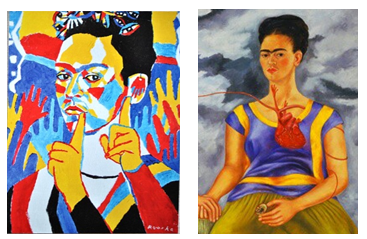
However, Rourke’s paintings are not just about taking famous artists and making “deaf versions” of their works.
lutas Surdas, opressões, línguas gestuais, costumes Surdos, mãos, olhos, expressões faciais, experiência visual, etc., são comumente retratados”.
9 In the original: “as performances funcionam como atos de transferências vitais, transmitindo conhecimento social, memória e senso de identidade por meio de comportamentos reiterados”.
Rourke carries out an artistic activism, as already mentioned, so the painter also addresses in her works the struggle of the social movement of the deaf for their rights, something that is also possible to notice in the works of other deaf artists. These ways of conceiving the art of the deaf refer us to the perception of this deaf art functioning as a form of activism for deaf communities, or as Raposo P [8] explains, as artivism: Artivism is a conceptual neologism still with unstable consensus both in the field of social sciences and in the field of the arts. It appeals to links, as classic as they are prolix and controversial, between art and politics, and stimulates the potential destinies of art as an act of resistance and subversion. It can be found in social and political interventions, produced by people or collectives, through poetic and performative strategies [...]. Its aesthetic and symbolic nature amplifies, sensitizes, reflects and interrogates themes and situations in a given historical and social context, aiming at change or resistance. Artivism is thus consolidated as a cause and social claim and simultaneously as an artistic rupture-namely, by proposing alternative scenarios, landscapes and ecologies for enjoyment, participation and artistic _creation_10.
In this way, we will seek to reflect on deaf theatrical practices through the notion of artivism by understanding that they bring with them markers present in the social movement of the deaf, such as sign language, deaf culture and deaf identity. Theater for the deaf is one of the oldest performing practices of this social group. Specifically in Brazil [9], in 1983, the ‘Grupo Silencioso’ appears, composed of actors Silas Queiroz, Carlos Alberto Góes, Ana Regina Campello, Lucia Severo and others_11. In addition, three years later the CIACS (Center for the Integration of Art and Culture of the Deaf) was created [10]: _It is a non-governmental organization, directed by both deaf and hearing people, and its main objective is to implement social projects aimed at the development of artistic and cultural activities for the deaf. Most of the members of CIACS are veteran deaf
10 In the original: “Artivismo é um neologismo conceptual ainda de instável consensualidade quer no campo das ciências sociais, quer no campo das artes. Apela a ligações, tão clássicas como prolixas e polémicas entre arte e política, e estimula os destinos potenciais da arte enquanto ato de resistência e subversão. Pode ser encontrado em intervenções sociais e políticas, produzidas por pessoas ou coletivos, através de estratégias poéticas e performativas [...]. A sua natureza estética e simbólica amplifica, sensibiliza, reflete e interroga temas e situações num dado contexto histórico e social, visando a mudança ou a resistência. Artivismo consolida-se assim como causa e reivindicação social e simultaneamente como ruptura artística – nomeadamente, pela proposição de cenários, paisagens e ecologias alternativas de fruição, de participação e de criação artística”.
11 In the original: “surge o ‘Grupo Silencioso’ composto pelos atores Silas Queiroz, Carlos Alberto Góes, Ana Regina Campello, Lucia Severo e outros”.
actors who, with their experience, convey through _their art the sense of the body in scenic expression_12.
From the CIACS, other theaters emerged such as Companhia Surda de Teatro (1993), Grupo Lado a Lado (1999), Companhia Teatro Absurdo (2001), Teatro Brasileiro de Surdos (2005) and Ponto de Cultura Palavras Visíveis (2008). Each of these groups used different techniques to express themselves and with that the theater of the deaf gained more and more strength [9]. Through the theatrical performance, we can perceive the transmission of identity aspects, as quoted by the Brazilian deaf actor Pinto ALL, et al. [9]: One of the reasons for creating a theater with deaf actors and that, therefore, uses only sign language, is implied in the fact that we have our culture, our way of thinking, our way of seeing the world, our vision of the world without the crossing of the hearing condition. In this way, putting together the show along these lines is a way for people to understand our worldview: _how we are and what we want_13.
Also relating theater with sign language and the construction of deaf identity, French deaf actress Sandrine Hermanse reports in an excerpt from the film I’m deaf and didn’t know her experience when watching, for the first time, a mixed theater of deaf and hearing people [11]: All used sign language. Why wasn’t it like that in society? That’s what gave me the courage to do theater with sign language. It allowed me to build my identity. I felt proud to show my language_14. American deaf poet Raymond Luczak believes that deaf artists inspire the deaf community to clearer expressions of themselves as a unique group15. A cultural manifestation that has emerged strongly among Brazilian deaf people in recent years is the practice of slam, which is a poetry competition similar to a rap battle. In this sense, the _Corposinalizante
12 In the original: “Trata-se de uma organização não governamental, dirigida tanto por surdos quanto por ouvintes e tem como principal objetivo a implementação de projetos sociais que visem o desenvolvimento das atividades artísticas e culturais de surdos. Grande parte dos integrantes do CIACS são atores surdos veteranos que, com sua experiência, transmitem através de sua arte o sentido do corpo na expressão cênica”.
13 In the original: “Um dos motivos para criarmos um teatro com atores surdos e que, portanto, utiliza somente a língua de sinais está implicado no fato de termos nossa cultura, nosso jeito de pensar, nosso jeito de ver o mundo, nossa visão de mundo sem o atravessamento da condição auditiva. Desse modo, a montagem do espetáculo nesses moldes, é uma maneira das pessoas entenderem nossa visão de mundo: como somos e o que queremos”.
14 In the original: “Todos usavam a língua de sinais. Por que não era assim na sociedade? Foi isso que me deu coragem de fazer teatro com a língua de sinais. Isso me permitiu construir minha identidade. Senti orgulho de mostrar minha língua”.
15 “If we don’t want our deaf artists to stop inspiring the deaf community to clearer expressions of themselves as a unique group, our insistence on labeling others within the deaf community has got to go”.
project of the Museum of Modern Art of São Paulo (MAM/ SP), started in 2008, proposed the first Slam do Corpo Surdo. According to Santos NJ [12]: The Body Slam opens possibilities for hearing people to understand the importance of inclusion in our society, to recognize deaf people within their multiple identities such as the black deaf, LGBTQI deaf, deaf woman, oralized deaf, implanted (as), knowledgeable or not of Libras, who also go through processes of social invisibility. In addition, this Slam promotes the circulation of deaf artists throughout the country, encouraging the creative production of these individuals and making other deaf people who are not necessarily artists feel politically, economically, _artistically represented_16.
In addition to the aforementioned possibilities, the differential of the demonstrations of the deaf slams, which today has been increasingly propagated, is the use of urban space, when they are held in museums17 and even in the open street, as the edition that took place under the Carioca/ Arcos da Lapa Aqueduct in Rio de Janeiro. In this way, deaf slams increasingly occupy spaces that were previously appropriated mainly by hearing performers. Due to the COVID-19 pandemic, several slams and soirees for the deaf were held on platforms such as YouTube and Instagram. In particular, the Slam do Corpo Surdo took place during the Festival Corpo Palavra, promoted by MAM/SP. The material was recorded through a Zoom conference restricted to a certain number of guests and its best moments were publicized through the video “Festival Corpo Palavra-Slam do corpo-melhores momentos da batalha em Libras e português [12]”, incorporated to the MAM/SP YouTube channel18. Therefore, it is necessary to point out that I did not have access to the event in its entirety. In fact, I don’t remember any open call being made at the time for us to participate, so I imagined it was an invitation really focused only on the best-known deaf slammers in the country: Edinho Santos, Gabriela Grigolom, Catharine Moreira, Nayara Silva, among others. Thus, my access to the event was restricted to the video, shared publicly, on the aforementioned YouTube
16 In the original: “O Slam do Corpo abre possibilidades para que as pessoas ouvintes possam compreender a importância da inclusão na nossa sociedade, possam reconhecer as pessoas surdas dentro das suas múltiplas identidades como o surdo negro, surdo LGBTQI, a mulher surda, surdos oralizados(as), implantados(as), conhecedores(as) ou não da Libras, que também passam por processos de invisibilidade social. Além disso, este Slam fomenta a circulação dos artistas surdos espalhados pelo país, incentivando a produção criadora destes indivíduos e fazendo com que outras pessoas surdas que não necessariamente sejam artistas, se sintam representadas política, econômica, artisticamente”.
17 In addition to promoting this event at MAM/SP, we can also mention editions at the Museu de Arte do Rio (MAR/RJ) and at the Centro Cultural Banco do Brasil in São Paulo (CCBB/SP).
18 See at: https://www.youtube.com/watch?v=D125Faou_68.
channel.
Another fundamental fact to consider is the fact that these are virtual performances, which differs significantly from a face-to-face slam. Thus, in the remote modality, poets need to restrict themselves to a given spatial limit that diminishes some poetic possibilities. One of the most basic reasons for this is that there are signs in LIBRAS that are performed on the lower part of the body, such as pants or an embassy, for example. Although most signs in LIBRAS are located above the trunk, this is one of the issues that should be considered by the deaf during videoconferences. From experience, I know that this is not a very easy framing. Of course, since most of the Slam members are experienced poets, this adaptation to the remote wasn’t all that difficult. I believe that the main harm of the online Slam is precisely the decrease in emotion, because in person, the audience boils, emotions are on edge and there is a tension in the air of who will be the poet to win the battle. In a face-to-face slam, it is clear how much the deaf slammer has a performance that dialogues with the audience in order to affect them, which permeates a power relationship, understanding here this power not as a controlling power, but a power of enunciation.
In contrast to the slam poetry, produced in sign language, we also have the deaf literature carried out through the Visual Vernacular expression (VV), which consists of the use of classifiers (CL) to compose the poem. Classifiers are small linguistic structures [13] responsible for the formation of most existing signs, as well as for the creation of new signs_19. Thus, Visual Vernacular [14] _is a way of leading hearings to have experience and knowledge about the deaf community, establishing a challenge between both cultures and contributing to the understanding and reflection of these _varied representations that the deaf identity promotes_20.
Brief Connections between the Production of Deaf Women Poets and Ideologies
As we have already said, when we think about deaf communities, words and categories such as culture, identity and language emerge with a meaning peculiar to this group. One can think of these categories as constitutive elements of a territory interspersed with power relations. We reinforce that talking about the concept of culture may already be a rather tired debate within the anthropological field. Despite this, Sahlins M [15] points out that:
19 In the original: “responsáveis pela formação da maioria dos sinais já existentes, assim como pela criação de novos sinais”.
20 In the original: “um modo de levar os ouvintes a terem vivência e conhecimento sobre a comunidade surda, estabelecendo um desafio entre ambas as culturas e contribuindo para o entendimento e a reflexão dessas variadas representações que a identidade surda promove”.
“Culture” does not have the slightest possibility of disappearing as the main object of anthropology- nor, incidentally, as a fundamental concern of all the human sciences. It can, of course, lose, and has already lost, some of the qualities of natural substance acquired during the long period when anthropology was fascinated by positivism. But “culture” cannot be abandoned, otherwise we fail to understand the unique phenomenon that it names and distinguishes: the organization of human experience and action by symbolic means. The people, relationships, and things that populate human existence essentially manifest as values and meanings-meanings that cannot be _determined from biological or physical properties_21.
The author’s perspective is interesting if we think about the deaf, because Sahlins points out that meanings should not be guided by biological/physical properties and what we see throughout the history of this social group is just the opposite. A history of imposition of the hearing perspective, prohibition of sign language and docility of deaf bodies. Deaf researcher Coelho LAB [16] points out that during this period: In the classroom, each one sought to help the others to try to understand what the teachers were saying and what they meant by it. There were no formal leaders. Most of the punishments were due to being caught signaling, so anyone could become a leader as long as they endured the inherent punishment. This seemed to be a manifestation of deaf culture. Resisting Oralism represented one of the factors of rebellion. Hearing aids were the main symbol of Oralism, which they revolted against, breaking or losing hearing aids and turning them off until they were caught by the teacher. The affliction of having an amplified noise hammering in his head throughout childhood even suggests the hypothesis that this helped to develop deaf children with bad tempers [...]. Pure deaf thinking is ‘I know I’m different, that I’m deaf. I accept my identity and I will not move.’ In this way, deafness was born and grew in different ways to reach a collective self, involved by small acts of rebellion and some small _victories_22.
21 In the original: “A ‘cultura’ não tem a menor possibilidade de desaparecer enquanto objeto principal da antropologia-tampouco, aliás, enquanto preocupação fundamental de todas as ciências humanas. É claro que ela pode perder, e já perdeu, parte das qualidades de substância natural adquiridas durante o longo período em que a antropologia andou fascinada pelo positivismo. Mas a ‘cultura’ não pode ser abandonada, sob pena de deixarmos de compreender o fenômeno único que ela nomeia e distingue: a organização da experiência e da ação humanas por meios simbólicos. As pessoas, relações e coisas que povoam a existência humana manifestam-se essencialmente como valores e significados-significados que não podem ser determinados a partir de propriedades biológicas ou físicas”.
22 In the original: “Em sala de aula, cada um buscava ajudar os outros Deafhood is a concept developed by deaf researcher Ladd P [17]. For the author, Deafhood encompasses the whole feeling of “being deaf”. Deaf communities encompass different social actors, not just deaf people with non-deaf people23. However, Deafness can only be perceived and felt by the deaf. Thus, through Michel Foucault’s and Pierre Bourdieu’s theories of power, the author reflects that we can observe that dominant groups maintain power and control, not simply through economic coercion, but also through the development of convincing ideologies, that is, belief systems_24. With this in mind, Foucault M [18] understands _ideology as a mark, the stigma of these political or economic conditions of existence on a subject of knowledge who, by right, should be open to the truth_25. In this sense, Žižek S [19] adds that: _We are within the ideological space itself at the moment and that this content [...] is functional to some relation of social domination (“power”, “exploitation”) in an intrinsically non-transparent way: to be effective, the logic of legitimation of the _domination relationship has to remain hidden_26.
These relationships of hidden domination that Žižek S [19] mentions can also refer us to the symbolic power in Bourdieu P [20] as the invisible power which can be exercised with the complicity of those who do not want to know that they _are subject to it or even that they exercise it_27. In this sense, a tentar entender o que os professores diziam e o que eles queriam dizer com isso. Não havia líderes formais. A maioria dos castigos se devia ao fato de serem pegos sinalizando, de modo que qualquer um podia tornar-se líder, desde que suportasse o castigo inerente. Isto parecia ser uma manifestação da cultura dos surdos. Resistir ao Oralismo representava um dos fatores de rebelião. Aparelhos auditivos eram o símbolo principal do Oralismo, contra os quais se revoltaram, estragando ou perdendo aparelhos auditivos e desligando-os até serem apanhados pelo professor. A aflição de ter um ruído amplificado martelando em sua cabeça durante toda a infância sugere mesmo a hipótese de que isto ajudou a desenvolver crianças surdas com mau temperamento [...]. O pensamento surdo puro é ‘Sei que sou diferente, que sou surdo. Aceito minha identidade e não vou me mudar’. Desse modo, a surdidade nasceu e cresceu de diversas maneiras para chegar até um eu coletivo, envolvido por pequenos atos de rebeldia e algumas pequenas vitórias”.
23 Term purposely used in opposition to the term “hearing”. The term “non-deaf” puts the hearing person in the place of the “different”.
24 In the original: “podemos observar que los grupos dominantes mantienen el poder y el control, no simplemente a través de la coerción económica, sino que también a través del desarrollo de ideologías convincentes, es decir, sistemas de creencias”.
25 In the original: “ideologia [como uma] marca, o estigma dessas condições políticas ou econômicas de existência sobre um sujeito de conhecimento que, de direito, deveria estar aberto à verdade”.
26 In the original: “Estamos dentro do espaço ideológico propriamente dito no momento e que este conteúdo [...] é funcional a alguma relação de dominação social (‘poder’, ‘exploração’) de maneira intrinsecamente não transparente: para ser eficaz, a lógica de legitimação da relação de dominação tem que permanecer oculta”.
27 In the original: “o poder invisível o qual pode ser exercido com cumplicidade daqueles que não querem saber que lhe estão sujeitos ou mesmo que o exercem”.
symbolic power in Bourdieu is related to disciplinary power in Foucault. Thinking about these powers of domination involved in the relationship between the deaf and the non- deaf [21]: In this perspective, the deaf build a stigma around themselves, assume positions of disabled/sick (which are confused), do not recognize themselves as normal, perceive an inadequacy in the family, later at school, because most hear and speak well, except they. The environment is strange to them, difficult to relate to and, not finding alternatives, they submit to the attitudes of those around them, resulting in self-rejection. Thus, he assumes a posture of not recognizing himself as deaf, of not feeling as such or of accepting himself, that he does not relate to other deaf people and that rejects them in his heart [...]. It seems that deaf people who are born into hearing families are more likely to take these attitudes in their education, since they are in direct contact with the hearing model and get almost or no reference from _their linguistic group_28.
Thus, something very important for the deaf is the encounter with other deaf people, their linguistic peers. With this in mind, the leaders of the social movement of the deaf express themselves on different fronts, including artistic practices. For Ingold T [22], a work of art is not an object but a thing – and, as Klee argued, the role of the artist is not to reproduce a preconceived idea, new or not, but to join and follow the forces and flows of materials that shape the work_29. Ingold T [23] emphasizes that _the implication that we hear not only with the ears, but with the whole body is of great significance _for understanding the sensory experience of the deaf_30. Thus, this research aimed to understand these subtleties in deaf art and, more than that, in deaf women artists. The role of women in society is also permeated by ramifications of
28 In the original: “Nesta perspectiva, os surdos constróem um estigma em torno de si, assumem posturas de deficiente/doente (que se confundem), não se reconhecem como normais, percebem uma inadaptação na família, posteriormente na escola, porque a maioria ouve e fala bem, exceto eles. O ambiente lhes é estranho, difícil de relacionar-se e não encontrando alternativas submetem-se às atitudes daqueles que os envolvem, tendo como conseqüência a auto-rejeição. Assim, assume uma postura de não se reconhecer como surdo, de não se sentir como tal ou de se aceitar, que não se relaciona com outros surdos e que os rejeita em seu coração [...]. Parece que surdos que nascem em famílias de ouvintes, são mais propensas a tomar essas atitudes na sua formação, visto que estão em contato direto como modelo ouvinte e não obtém quase ou nenhuma referência do seu grupo lingüística”.
29 In the original: “Um trabalho de arte, insisto, não é um objeto, mas uma coisa – e, como argumentou Klee, o papel do artista não é reproduzir uma ideia preconcebida, nova ou não, mas juntar-se a e seguir as forças e fluxos dos materiais que dão forma ao trabalho”.
30 In the original: “A implicação de que ouvimos não somente com os ouvidos, mas com o corpo todo é [...] de grande significado para entender a experiência sensória do surdo”.
power relations. Taking the hook of Foucauldian analysis, Tedeschi LA [24] reflects on the invisibility of women within historiography.
For Foucault (1979), there is nothing behind the curtains, not even under the ground we walk on. There are statements and relationships, which the discourse itself puts into operation. Analyzing the discourse would be to account for exactly that: of historical relationships, of very concrete representations, which are alive in the discourses, and which make women invisible. For example: analyzing the historical discourses about women, their life stories and the struggle for citizenship, in this perspective, will mean, above all, trying to escape the easy interpretation of what would be behind the documents, trying to explore the materials to the maximum, insofar as they that they are a historical, political production; insofar as words are also constructions; insofar as language is also constitutive of practices. It is in this perspective that the discourses (in the Foucaultian sense) and the representations (in the Chartier sense) are situated in a strategic field of power in the historical making. Discourses are located between power relations that define what they say and how they say it and, on the other _hand, power effects that they set in motion_31.
Although Tedeschi’s reflection is mainly situated in the analysis of historiography, I think that these power relations that make women invisible in the historiographical space can also be related to other areas of knowledge. Generally speaking, we know that most societies still have strong patriarchal roots with men being privileged in the world of work and women still relegated to a second-class role. This intensifies when we think about deaf women. In this regard, deaf social workers Araujo MA, et al. reflect [25]: From our professional experience and experience in the deaf community, we observed that there are several cases of deaf sterilization that occur in various socioeconomic contexts without their knowledge or with forced/manipulated consent. It is often the family that requests sterilization with the support of doctors, usually with a prejudiced conception loaded
31 In the original: “Para Foucault (1979), nada há por trás das cortinas, nem sob o chão que pisamos. Há enunciados e relações, que o próprio discurso põe em funcionamento. Analisar o discurso seria dar conta exatamente disso: de relações históricas, de representações muito concretas, que estão vivas nos discursos, e que invisibilizam as mulheres. Por exemplo: analisar os discursos históricos sobre as mulheres, suas histórias de vida e luta pela cidadania, nessa perspectiva, significará antes de tudo tentar escapar da fácil interpretação daquilo que estaria por trás dos documentos, procurando explorar ao máximo os materiais, na medida em que eles são uma produção histórica, política; na medida em que as palavras são também construções; na medida em que a linguagem também é constitutiva de práticas. É nessa perspectiva que os discursos (no sentido Foucaultiano) e as representações (no sentido de Chartier) situam-se num campo estratégico de poder no fazer histórico. Os discursos estão localizados entre relações de poder que definem o que eles dizem e como dizem e, de outro, efeitos de poder que eles põem em movimento”.
with negative stereotypes, with an ideology that the deaf woman is not able to educate and raise her child and/or that, if there is a possibility generation of a _deaf baby this should be avoided_32.
In other words, through these reports we can see that if the mechanisms of control over bodies are perpetuated among non-deaf women, this is intensified when thinking about issues involving deaf women. Even more so when dealing with black deaf women, who are mostly relegated to a peripheral condition of triple discrimination and, sometimes, quadruple discrimination if we think that most of them do not have a high income [26], because the poor and deaf black woman - within of the educational system – goes through processes of segregation, not obtaining equal opportunities in _relation to other people who make up the school community_33. Here we can relate to the concept of intersectionality for Crenshaw K [27].
Intersectionality is a conceptualization of the problem that seeks to capture the structural and dynamic consequences of the interaction between two or more axes of subordination. It specifically addresses the way in which racism, patriarchy, class oppression, and other discriminatory systems create basic inequalities that structure the relative positions of women, races, ethnicities, classes, and others. Furthermore, intersectionality deals with the way in which specific actions and policies generate oppressions that flow along such axes, _constituting dynamic or active aspects of disempowerment_34.
Revisiting the Slam do Corpo Surdo, one of the deaf women poets who was present in this edition was Nayara Silva or Nayuda, known for poetry with erotic content and/or profanity35. When I got to know Nayara’s work, I didn’t know
32 In the original: “Da nossa experiência profissional e vivencia na comunidade surda observamos que são diversos casos de esterilização de surdas que ocorrem em vários contextos socioeconômicos sem o conhecimento destas ou com consentimento forcado/manipulado. Muitas vezes é a família que solicita a esterilização contando com apoio dos médicos, geralmente, com uma concepção preconceituosa e carregada de estereótipos negativos, com uma ideologia de que a mulher surda não é capaz de educar e criar seu filho e/ou que havendo possibilidade de geração de um bebê surdo isto deve ser evitado”.
33 In the original: “a mulher negra pobre e surda – dentro do sistema educacional – passa por processos de segregação, não obtendo oportunidades igualitárias em relação as demais pessoas que compõem a comunidade escolar”.
34 In the original: “A interseccionalidade é uma conceituação do problema que busca capturar as consequências estruturais e dinâmicas da interação entre dois ou mais eixos da subordinação. Ela trata especificamente da forma pela qual o racismo, o patriarcalismo, a opressão de classe e outros sistemas discriminatórios criam desigualdades básicas que estruturam as posições relativas de mulheres, raças, etnias, classes e outras. Além disso, a interseccionalidade trata da forma como ações e políticas específicas geram opressões que fluem ao longo de tais eixos, constituindo aspectos dinâmicos ou ativos do desempoderamento”.
35 “Nayuda is a well-known poet on the Slam circuit, mainly for her her name, and when I asked another deaf poet about her, the answer was “Nayara is Edinho’s wife”. Edinho Santos is an extremely recognized deaf poet and, despite Nayara being equally talented, she is overshadowed by him being referred to as “Edinho’s wife”. It does not mean at all that this poet was belittling Nayara, but perhaps he was reproducing in his answer [28] the image of mother-wife and housewife as the main and most important function of women corresponded to what was preached by the Church, taught by doctors and jurists, legitimized by the State and publicized by the press_36. As Perrot M [29] says, if it was difficult for women to write, issues such as _painting, sculpting, composing music, creating art were even more difficult, this is because image and music are forms of creation of the world and women are unfit for that37. In this regard, Spence RS [30] highlights:
We often fail to notice that descriptions of literature have a subtle tendency to be male-dominated. Although women make up approximately 50% of humanity, they appear much more in sign language literature collections, in research on this literature and on social networks, where we find videos of literary productions. A survey of some anthologies, collections and some events shows a little of the current situation in the area of literature in Libras, where we see a historical inequality between the genres, but which seems to be decreasing nowadays in Brazil 38.
feminist, maternal and erotic genres. ‘I’m from Brasília, I moved to São Paulo 6 years ago and, at first, I didn’t know anyone, I didn’t have any knowledge of art. I came here just for Edinho, and he took me to the Slams, to museums and cultural institutions. He sent me poetry videos through WhatApps, I fell in love. But at first I thought poetry [in sign language] was a joke’, recalls Nayuda. And, even not liking the Slams, she always accompanied Edinho. Gradually, Nayuda was attending, meeting and falling in love with Slam. ‘Edinho says that once you start writing poetry, you’ll never stop... and he was right, after I started I never stopped’, she says. Nayuda had her poetry debut in 2018 at the Body Slam competition. During this same period, she began her study of the feminist movement. ‘I got engaged, I started to study more about the oppressions that we women suffer, and I got to know feminist deaf poetry, and I thought: I want to say something about what I like and what’s inside me’, she recalls. Thus, talking about eroticism is a form of resistance, and Nayuda, in 2019 at Casa das Rosas, held the first presentation of erotic feminist poetry. She reports that it was very difficult, because many people were against it, including Edinho”. Available in: https://www.sescsp.org.br/ online/artigo/14964_O+BEIJO+DE+LINGUAS +DE+EDINHO+E+NAYUDA.
36 In the original: “A imagem de mãe-esposa e dona de casa como a principal e mais importante função da mulher correspondia aquilo que era pregado pela Igreja, ensinado por médicos e juristas, legitimado pelo Estado e divulgado pela imprensa”.
37 In the original: “pintar, esculpir, compor música, criar arte foi ainda mais difícil [isto porque] a imagem e a música são formas de criação do mundo [...] e as mulheres são impróprias para isso”.
38 In the original: “Muitas vezes, não percebemos que as descrições de literatura têm uma tendência sutil de serem dominadas pelos homens. Apesar de as mulheres serem aproximadamente 50% da humanidade, eles aparecem muito mais nas coleções de literatura em línguas de sinais, nas pesquisas sobre essa literatura e nas redes sociais, onde encontramos vídeos das produções literárias. Um levantamento de algumas antologias, coleções e de alguns eventos mostra um pouco da situação atual da área da literatura em Libras, onde vemos uma desigualdade histórica entre os The author highlights that in the first edition of the International Festival of Deaf Folklore [30] of the six artists invited to give workshops and present a show of poems, five were men [...]. Fernanda Machado is the only woman_39. In the second edition, there was a joint effort by the organization of the event so that the number of men and women was not unequal. In this way, among Brazilian, British, South African, Swedish and American representatives, it was possible that the event achieved equality as expected [30]. Spence SR [30] also emphasizes that _the Brazilian deaf women have always been present in written texts of deaf literature, and have an even greater presence in autobiographical productions and in children’s and youth literature_40. It is worth mentioning two historically important data [30]: “The Death of Minnehaha” is the first poem in sign language that was recorded on video, being produced by the professor of the Michigan School for the Deaf, Mary Williamson Erd, in 1913; and _the first linguistic research on poetry of deaf origin in sign language (1979) analyzed poems created in ASL by a woman – Dorothy _Miles_41. Thus, it is possible to have a small dimension of the fundamental debate that is to understand the feminine perspective of the art of the deaf.
Conclusion
The present article tried to carry out a brief initial overview regarding the artistic manifestations of the deaf. It is ongoing research in the Master in Anthropology, but we hope that such collected data can contribute to promoting the importance of the deaf arts, mainly reflecting on the role of deaf women poets in this environment, as it is extremely important to [31] displace women from references and footnotes (where they were understood as a deviation from the masculine norm or as a ‘minority’) and incorporate them it to the body of the works, constituting it as the subject- _object of the studies_42. Currently, a category that has emerged with force is the Deaf Gain, which is a way of pointing out the contributions of the deaf culture in the majority culture that is, hearing [32]. An example of Deaf Gain is the circle of players made in American football to define strategies, gêneros, mas que parece estar diminuindo atualmente no Brasil”.
39 In the original: “dos seis artistas convidados para darem oficinas e apresentarem um show de poemas, cinco eram homens [...]. Fernanda Machado é a única mulher”.
40 In the original: “As mulheres surdas brasileiras sempre estiveram presentes nos textos escritos de literatura surda, e têm ainda uma maior presença nas produções autobiográficas e nas literaturas infantil e juvenil”.
41 In the original: “A primeira pesquisa linguística sobre poesia de origem surda em língua de sinais (por Klima e Bellugi, 1979) analisou os poemas criados em ASL por uma mulher – Dorothy Miles”.
42 In the original: “deslocar a mulher das referências e das notas de rodapé (onde ela era entendida como um desvio da norma masculina ou como ‘minoria’) e incorporá-la ao corpo dos trabalhos, [...] constituí-la como o sujeito-objeto dos estudos”.
usually headed by the quarterback. Paul Hubbard was a deaf quarterback and was the inventor of this form of organization used to this day. That is, it is the idea of a deaf being used by hearing athletes until today. So, it’s also very interesting to think about how deaf art affects majority art. Does it produce changes, gains? Does it introduce innovations that will be used by other artists? We hope that this and other research, especially those that have been developed by deaf artists themselves, can answer some of these questions.
References
-
Velho G (1987) Individualism and culture: notes for an anthropology of contemporary society. 3rd (Edn.), Jorge Zahar, Rio de Janeiro, Brazil.
-
Campello AR (2008) Aspects of visuality in the education of the deaf (Doctoral thesis). Federal University of Santa Catarina, Center for Education Sciences. Graduate Program in Education, Brazil.
-
Garcia MIS (2019) Power relations in the education of Brazilian deaf people. In: Gonzalez AO (Ed.), Inclusive Education Notebooks. Rethinking Social Justice and Inclusive Education. CELEI Editions, Santiago, Chile 3: 146-163.
-
Humphries T (2008) Talking culture and culture talking. In: Bauman D (Ed.), Open Your Eyes. University of Minnesota Press, Minneapolis, USA.
-
Strobel KL (2008) The images of the other about deaf culture. 2nd (Edn.), UFSC Publisher, Florianopolis, Brazil.
-
Nakagawa HEI (2012) Deaf cultures: what you see, what you hear. University of Lisbon, Portugal, pp: 1-142.
-
Taylor D (2013) Translating performance. In: Dawsey J (Ed.), Anthropology and performance: Napedra essays, Sao Paulo, Brazil, pp: 9-16.
-
Raposo P (2015) Artivism: articulating dissent, creating insurgencies. Notebooks of Art and Anthropology 4(2): 3-12.
-
All P, Cabral RG (2020) The history of theater for the deaf in Brazil. In: Garcia MIS (Ed.), Epistemic actions and the education of the deaf. Ediciones CELEI, Santiago, Chile, pp: 44-62.
-
Garcia MIS (2011) Social Movement of the Deaf: intersections, crossings and implications (Doctoral thesis).
-
Júnior A, Santos DS (2019) Theater in the body: drama and verbal art in the performances of the deaf in the Brazilian Sign Language. Federal University of Roraima, Brazil.
-
Santos NJ (2018) The Body Slam and the Representation of Deaf Poetry. Journal of Human Sciences 18(2).
-
Bernardino ELA (2012) The use of classifiers in Brazilian sign language. Revel 10(19): 250-280.
-
Abrahao BF (2017) Deaf Literature in Performance: Considerations on Vernacular Visual Art (VV). XV International Congress of the Brazilian Association of Comparative Literature, Brazil.
-
Sahlins M (1997) “Sentimental pessimism” and the ethnographic experience: why culture is not an “object” on the verge of extinction (PART I). Mana 3(1): 41-73.
-
Coelho LAB (2018) Knowing deafness. Espaco Magazine 50: 59-74.
-
Ladd P (2011) Understanding Sorda culture: in search of Sordedad. National Council for Culture and Arts; National Book and Reading Promotion Fund, Concepcion, Chile.
-
Foucault M (2011) The truth and the legal forms. Nau, Rio de Janeiro, Brazil.
-
Žižek S (2010) The Spectrum of Ideology. In: Žižek S (Ed.), A Map of Ideology. Counterpoint, Rio de Janeiro, Brazil, pp: 07-38.
-
Bourdieu P (1989) The symbolic power. Bertrand Brazil, Rio de Janeiro, Brazil, pp: 1-159.
-
Chaves EP (2001) Deaf Power and Hearing Power: Who else can, anyway?. In: Vasconcelos JG, Germano A, et al. (Eds.), Said (bad) said. LCR, Fortaleza, Brazil, pp: 187- 197.
-
Ingold T (2012) Bringing things back to life: Creative tangles in a world of materials. Anthropological Horizons 18(37): 25-44.
-
Ingold T (2008) Stop, Look, Listen! Vision, Hearing and Human Movement. Ponto Urbe 3: 1-52.
-
Tedeschi LA (2007) The making of history and the invisibility of women. OPSIS 7(9): 329-340.
-
Araujo MA, Hora M (2012) Deaf women in Brazil: an analysis of the main expressions of the social issue that affects this group. XIII National Meeting of Researchers in Social Work, Brazil.
-
Zago EM, Muniz HL, Wanzeler LA (2019) The black, poor and deaf woman: struggles and achievements. pp: 1-11.
-
Crenshaw K (2002) Document for the meeting of experts in aspects of racial discrimination related to gender. Feminist Studies Magazine 10(1).
-
Maluf M, Mott ML (1998) Secrets of the female world. In: Novais F, Sevcenko N (Eds.), History of Private Life in Brazil, Volume 3. Company das Letras, São Paulo, Brazil, pp: 367-421.
-
Perrot M (2009) My history of women. Context, Sao Paulo, Brazil.
-
Spence RS (2021) Literature in Libras. Arara Azul Publisher, Petrópolis, Brazil.
-
Louro GL (1996) In the networks of the concept of gender. In: Lopes M (Ed.), Gender & Health. Medical Arts, Porto Alegre, Brazil, pp: 7-18.
-
Martins FC (2013) Discourses and experiences of deaf subjects on Audism, Deaf Gain and Deafism (Masters dissertation).
- The Indispensable Role of Informal Caregivers in Supporting the Aging Population
- Socio-Religious Significance of Kamakhya Temple in Guwahati, Assam
- Is Anthropology Possible?
- A Contribution to the History and Paleobiology of Harput/Elazığ Türkiye and Its Surroundings
- A Study on the Cowrie Shells of the Dimasas in Assam
- The Significance of International Organizations Cooperation in the Efficient Resolution of Global Conflict