
“Tree Ritual”: The Magic of Nature-Phytomorphs in PNSC-PI
The present work aims to address the recurrences of phytomorphs in the Serra da Capivara National Park, located in southwest Piauí, in the Northeast region of Brazil. The main one of the work is related to the importance of the relationship between flora and human groups located in the place, being evidenced by the rock scenes found in the rocky walls. The objective of this work is to demonstrate the importance of the scenography of the ritual of the tree for the human societies that inhabited the place, the magic of nature may have been a religious power used by local leaders, as a way of maintaining control of their society and threatening your enemies. The methodology used in the development of this work was: 1st) bibliographic and documental research, based on publications that deal with the theme; 2nd) field research, based on investigations in archaeological sites in the Serra da Capivara National Park. Finally, the study of the magic of nature in the ritual scene of trees can contribute to the understanding of the religious aspects of human societies that inhabited the place in the past.
Introduction
The Park Serra da Capivara National- PNSC is delimited between the municipalities of São João do Piauí, Coronel José Dias, São Raimundo Nonato and Canto do Buriti, in the Southeast region of Piauí, comprising an area of almost 130,000 hectares and a perimeter of 214 km. Being created during the government of President João Baptista Figueiredo, in 1979 (Figure 1).
The painting traditions identified in the region were classified as Northeast, Agreste and Geometric. The engravings were the Itacoatiara do Oeste e do Leste [1].
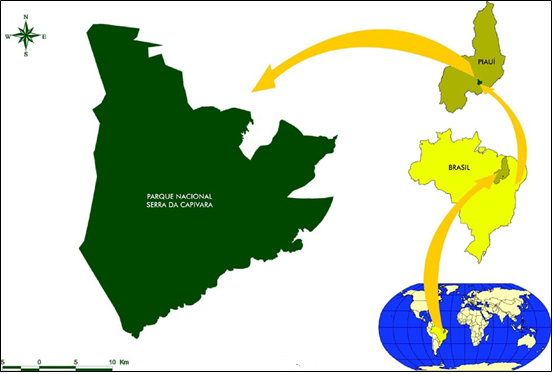
Source: FUMDHAM. Available at: <<www.fumdham.org. br>>. Access: Oct, 2013. Figure 1: The location of Serra da Capivara National Park.
Development
The recurrences of phytomorphs appear in smaller numbers compared to those representing zoomorphs and anthropomorphs, in the PNSC [2, 3]. In a survey of cave paintings from 48 archaeological sites recorded, photographed and measured, he presented the following table, excluding the sites already researched1 [4]. The zoomorphs have 2,080 figures representing the fauna and paleofauna of the region, with small and large animals having been recognized. The ideomorphs, on the other hand, totaled 1,778, images are difficult to interpret, and their shapes outline lines, dots, circles, squares, diamonds, zigzag lines and concentric shapes. While phytomorphs were found in 31 images, associated with tree scenes. Among these last representations there are some scenes of a possible association between human groups around a tree, akin to a kind of ritual scene or some kind of enchantment, more specifically, practicing the magic of nature, in search of their supernatural powers (Figures 1 & 2) [4].
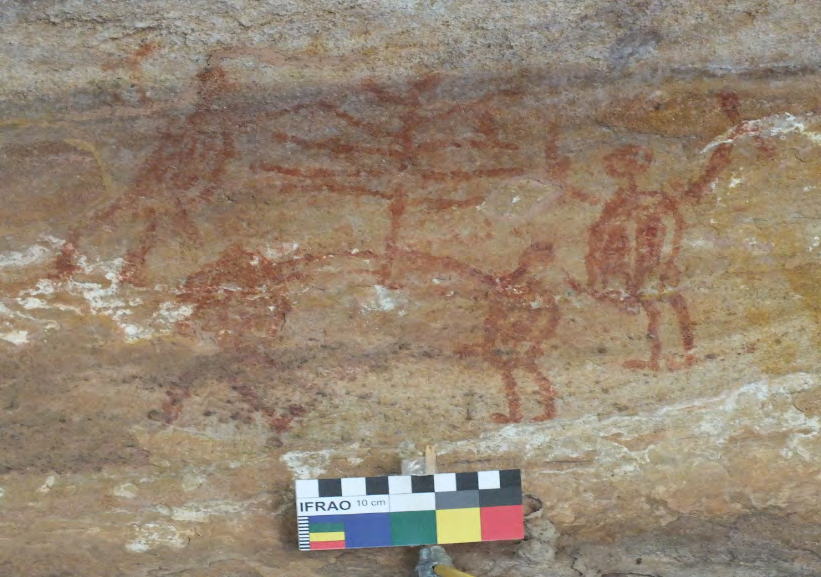
Source: Oliveira GF [4]. Figure 2: Tree ritual scene. Toca do Baixão das Mulheres I site. Serra da Capivara National Park.
According to Professor Medeiros G [5], the practice of the Jurema ritual has been known since Colonial Brazil. Jurema is a plant from which products such as drinks and infusions are extracted. The Jurema ritual allows the person who has ingested to carry out a trip and conversations with ancestors, being classified as a hallucinogenic species, and the effect may vary from person to person, depending on the organism, and a kind of how the tree ritual and its influence
1 This work refers to the doctoral work of Professor Gabriel Frechiani de Oliveira, where he carried out a quantitative and descriptive survey of a sample of 48 rock art sites in the Park Serra da Capivara National, thus providing a comparative basis between anthropomorphs, phytomorphs, ideomorphs and zoomorphs.
on the groups of the past, who inhabited the Park Serra da Capivara National. This demonstrates the power that a plant could have in the group and associated a shaman that would make the connection between the real world and the supernatural world (Figure 1).
It is worth mentioning and remembering that there are some productions by the native peoples of Brazil, as in the case of the Ticuna, the book of trees, the result of work carried out by the General Organization of Ticuna Bilingual Teachers-OGPTB. Created in 1986, it is part of the training program for indigenous teachers in Amazonas. This work records the relationship of the Ticuna ethnic group with the land, the forest and the trees. Indicating that the forest, in this specific case, the trees, would be the greatest wealth, pointed out by these indigenous people, whom we agree, which we will leave for our children, they say.
It also represents a record of the various species of flora and fauna, rituals, beliefs and legends, social organization, values and customs of this indigenous group, currently with approximately 32,000 people in its 100 villages. The drawings, marked by strong lines and bright colors, were created individually, while the texts were created collectively by the group. Through these many narrators who tell their true history with words and images, not only the child, but also the adult would need to read to know better an important part of the culture of their country (Figure 3).
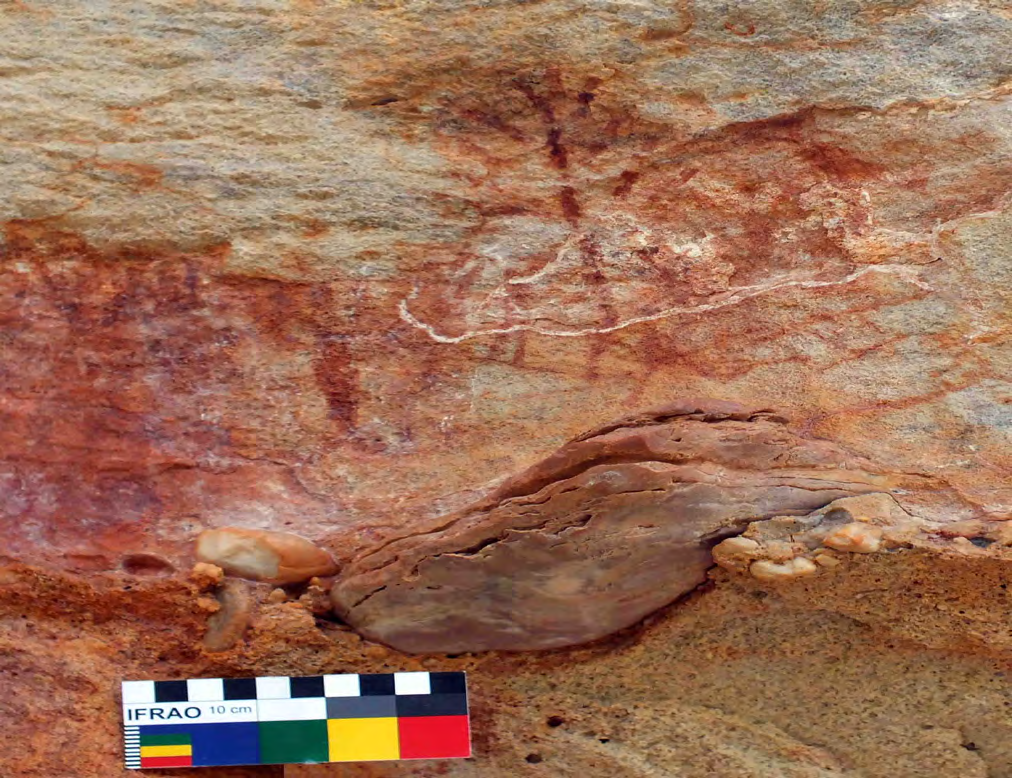
Source: Oliveira GF [4]. Figure 3: Toca do Estevo II. Serra da Capivara National Park.
Between 12,000 and 10,000 years ago, the rains began to decrease; causing the park region to enter the current semi-arid regime and the caatinga was already present as it is today, with commonly thorny vegetation and without herbaceous strata [6]. Several studies suggest that, around 8,450 years B.P., the paleoclimate would be more humid and mild, with much more vegetation than currently, with forest refugia [7]. There are, even today, in the region, some patches of marsh, vestiges of the old wet period. Palynological studies carried out in the municipality of Brejo do Piauí (PI) and the appropriate dating of the C14 of the core of the fluviolacustrine deposit of Lagoa Grande indicate that, in the vereda, there was a predominance of the Mauritia flexuosa palm [8]. During the last 5,000 years, there have been fluctuations in the distribution of botanical elements associated with vereda vegetation. For this reason, the rupestrian representations of arboreal ornamentation end up reflecting the environment that the past peoples of the region experienced (Figure 4).
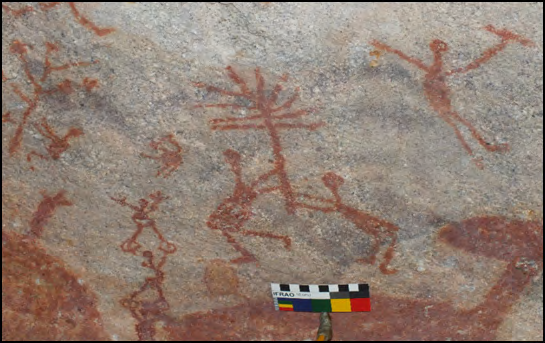
Source: Oliveira GF [4]. Figure 4: Burrow at the Entrance to Pajau. Serra da Capivara National Park.
The caves were places of ceremonies and considered sacred by members of indigenous tribes, where an introspective and self-knowledge ritual was developed, cave paintings could validate this supernatural perspective (Figure 4) [9, 10, 11]. The ethnographic investigations carried out by the researcher Reichel DG [12] showed that hallucinogenic compounds (yajé) were used in the form of a religious ritual, with the intention of experiencing altered states of consciousness in the Tukan tribe, in the Upper Rio Negro region, Brazilian Amazon.
In the literature on South American indigenous groups, there are references to this practice, which are contained in their cosmogonic and anthropogonial myths, as in the Tapirapé tribe, who are designated as sorcerers and being able to perform supernatural interventions [13, 14, 15] the sorcerers among the Krahó Indians are another example of the practice of shamanism; the religion of the Terêna, in the state of Mato Grosso, the Alto Xingu Region has archaeological remains attesting to more than a thousand years of occupation [16]. In that region, the main mortuary ritual is limited to a tree called Kwarup. In the homonymous myth “Kwarup”, it is stated that, after hours of sacralization, the trunk metamorphosed into human beings [17]. Furthermore, in several visits to the PNSC-PI, upper Xingu people inferred similarity between rock records and their rituals [18]; the Tampitáua also resort to shamanic practices [19]; the parakañas, in the state of Pará, also resort to this type of religious practice, demonstrating an extensive recurrence in Brazilian indigenous tribes (Figure 5) [20].
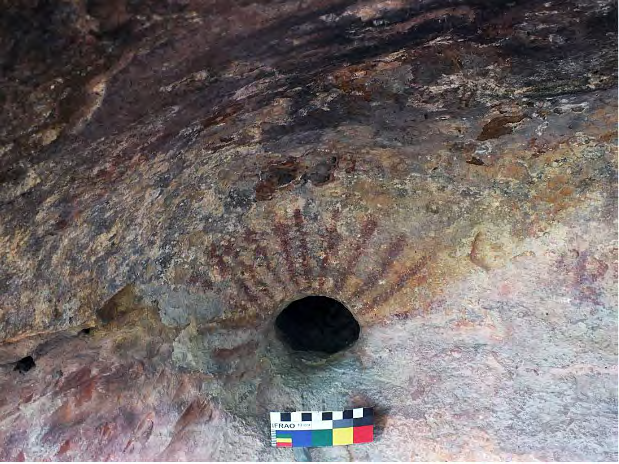
Source: Oliveira GF [4]. Figure 5: Hole in the rocky wall representing a passage. Site Toca da Roça do Sítio do Brás I, Serra da Capivara National Park, Brazil.
Final Considerations
The present text aimed to present some rock art scenes, especially those of paintings with representations of trees, in the PNSC, in the southwest of the State of Piauí, Brazil. These images seem to enrich our knowledge about the importance given by the ancestors to the surrounding environment, in their sociocultural constructions, such as the arts. This appreciation, as far as we know, was due to the realization that trees had essential functions in their lives. Generating food, protection, medicine, shadow. We point out that these same values and functions must continue to apply to life today. Ancestral message that we must follow.
References
-
Guidon N (1983) The rock art of Piaui in the South American context: A first proposal concerning methods and terminology. State Doctorate Thesis. University of Paris I, Paris.
-
Pessis AM (1987) Prehistoric rock art: first registers of staging. Doctorate of State Thesis.Université de Paris X, Nanteire, Paris.
-
Guidon N (1991) Prehistoric Paintings of Brazil: The Rock Art of Piaui. ERC, Paris, pp: 1-109.
-
Oliveira GF (2018) Similarities and differences in the Serra da Capivara stylistic complex of the northeast tradition of rock paintings in the Serra da Capivara- PI National Park: a case study. Doctoral Thesis in Archeology. Laranjeiras: Federal University of Sergipe, Brazil.
-
Medeiros G (2006) The ritual use of Jurema among the indigenous people of colonial Brazil and the dynamics of the territorial borders of the Northeast in the 18th century. CLIO Archeological Series 20: 123-150.
-
Chame M (2007) Water reservoirs and implications for the distribution of game mammals in the semiarid region: Contributions to the conservation of Serra da Capivara National Park, southeastern Piauí, Brazil. 180 f. Thesis (Doctorate) - Postgraduate Course in Biological Sciences, Department of the National Museum, Federal University of Rio de Janeiro, Rio de Janeiro, Brazil.
-
Melo PP (2004) The transition from the Pleistocene to the Holocene in the Serra da Capivara National Park - Piauí - Brazil : a contribution to the study of the antiquity of human presence in southeastern Piau. Federal University of Pernambuco, Brazil.
-
Santos JC (2007) The Quaternary of Serra da Capivara National Park, Piauí, Brazil: morphostratigraphy, sedimentology, geochronology and paleoenvironments. Thesis (Doctorate). Graduate Program in Geosciences, Federal University of Pernambuco, Recife, Brazil.
-
Beltrão MC (2000) Archeology essay: a transdisciplinary approach. Rio de Janeiro, Brazil.
-
Clottes J (2008) Cave Art. Phaidon Press Limited, London.
-
Lewis WD (2005) The mind in the cave. Akal Editions, Madrid, Spain.
-
Reichel DG (1976) The cultural context of an aboriginal hallucinogen: Banisteriopsis caapi. In: Coelho VP (Ed.), Hallucinogens and the symbolic world. EDUSP, São Paulo, Brazil, pp: 59-104.
-
Baldus H (1979) Essays on Brazilian Ethnology. National Edition, São Paulo, Brazil.
-
Schaden E (1959) The heroic mythology of indigenous tribes in Brazil. Ministry of Education and Culture, Rio de Janeiro, Brazil.
-
Schaden E (1969) Indigenous acculturation. Enio Matheus Guazzelli & cia ltda, São Paulo, Brazil.
-
Heckenberger M (2000) Structure, History and Transformation: Xingu culture in the longue durée. In: Heckenberger M, Franchetto B (Eds.), The Peoples of the Upper Xingu: History and Culture. UFRJ Publisher, Rio de Janeiro, Brazil, pp: 21-62.
-
Paiva L, Alberti A (2021) Dermatoglyphic traits of Central Brazil indigenous people and traditional body fights. Somanlu Journal of Amazonian Studies 2: 64-75.
-
Paiva L, Montardo DLO, Justamand M, Oliveira GFD, Almeida VJRD, et al. (2022) Rock scenes of body fights in Serra da Capivara National Park, possible interpretations. Urdimento-Journal of Studies in Performing Arts 1(43): 1-26.
-
Baldus H (1976) Shamanism in the acculturation of a Tupi tribe in Central Brazil. In: Readings of Brazilian Ethnology. Companhia Editora Nacional, São Paulo, Brazil, pp: 455-462.
-
Fausto C (2001) The Faithful Enemies: History, War and Shamanism in the Amazon. EDUSP, Sao Paulo, Brazil.
- The Indispensable Role of Informal Caregivers in Supporting the Aging Population
- Socio-Religious Significance of Kamakhya Temple in Guwahati, Assam
- Is Anthropology Possible?
- A Contribution to the History and Paleobiology of Harput/Elazığ Türkiye and Its Surroundings
- A Study on the Cowrie Shells of the Dimasas in Assam
- The Significance of International Organizations Cooperation in the Efficient Resolution of Global Conflict