
The Oil Amazon Subregion: Colonization, Conflicts, Extraction and Local Identities
The northern region of the Amazon of Ecuador is known as the oil subregion, an ecological space that represents the main development and modernity project executed by the State. Strategy that integrated vast areas of humid forests into a model of progress, modernity and global markets. This way of imagining the jungle and its inhabitants legitimized abusive intervention practices, forms of exploitation of nature and a chaotic territorial occupation, however, it determined a particular identity of the Amazonian settler-peasant. Competition for resources and territories has generated multiple social and environmental conflicts and violent encounters with native populations.
Introduction
The settlement of the Ecuadorian Amazon by the State had as its objectives the commercial exploitation of natural resources and the foundation of permanent settlements, through colonization. The logic of appropriation of the Amazonian space was governed by an essentially extractivist spirit that had its origin in the time of the Spanish conquest and the subsequent colony. From early times, the motivations to occupy the Amazon jungles were related to the search for mineral resources; for the Spanish, the myth of El Dorado or the city of gold became almost an obsession. As a consequence of these first penetrations into the Amazon space, routes were opened that connected the main cities of that time: Quito, Riobamba, Cuenca and Loja with pioneer settlements such as Baeza, Archidona, Ávila, in the north and Macas, Sevilla del Oro, Logroño, Valladolid, Loyola [1].
Starting in the 17th century, it was the Catholic missions that played the leading role in colonization in the Amazon, the evangelization of the native populations achieved flows of colonization and the founding of towns, but these were not consolidate. With the beginning of republican life, the changes in the Amazon region were not significant. The so-called Eastern Region Province was created, a space without major political importance that was formed under the General Directorate of the East, created in 1920 and that politically subdivided the Amazon into provinces following the geographical logic of the old colonial governorates. The governorate of Quijos was transformed into the provinces of Napo-Pastaza; the governorate of Macas, in the province of Morona-Santiago; and Yahuarzongo became the province of Zamora Chinchipe, later the province of Napo-Pastaza was subdivided into the provinces of Napo and Pastaza [2].
The Ecuadorian Amazon region took on relative administrative and commercial importance at the end of the 19th century with the exploitation of cascarilla or cinchona, however, due to the dispersed disposition of this plant in the humid forests, an economic activity profitable enough to consolidate was not achieved. Permanent populations. After cascarilla, the exploitation of rubber allowed a new attempt at sustained occupation of the Amazonian space, however, Ecuador was a secondary producer of this product since the variety that could be found in the Ecuadorian jungle was of lower quality if we compare it with the Peruvian or Brazilian.
Finally, since 1960 of the last century, the Ecuadorian Amazon region experiences an unprecedented economic resurgence that is related to the discovery and exploitation of oil that became the main articulating axis of the country’s economy and is still the axis on which the productive destiny of Ecuador is based. Under these conditions, since the beginning of the seventies, like few times in its history, Ecuador has fully entered the world market. Not because there had been a qualitative change in its status as a country that exports raw materials (bananas, cocoa, coffee, etc.), but rather because of the growing amount of income produced by oil exports. Agrarian extractivism would open space for oil extractivism, but it did not disappear [3].
The importance increased over the years until today, occupying a predominant place with high foreign investment and based on an economic model dependent on the needs of an external market that has conditioned its price. The national economy would be based on the exploitation of natural resources, becoming the main integrating strategy for progress and development of the Amazon region towards local and international economic markets. It is worth remembering that, in a previous historical stage, Ecuador was fundamentally a pre-capitalist agricultural country so the beginning of oil production produced a substantial increase in the national budget.
In Ecuador, the booms in raw material prices have marked changes not only in the economy, but also in the territorial, social and political organization. The so-called cocoa boom and then the banana boom marked the settlement patterns of the Ecuadorian coast and its form of organization, division of labour, generation of elites and a particular social class linked to agriculture. -export. The oil boom had a similar event in the oil subregion [4].
The oil companies became the integrating axis, both spatially and socially, of the native populations, towards a larger society. Hydrocarbon activities entailed three transformations in the Amazon space, the first corresponding to the seismic exploration-prospecting phase that began in the northern area of the Ecuadorian Amazon: Sucumbíos, Napo and Pastaza, with the company Leonard Exploration and Company and the oil company Shell, in the 1920s. The second has to do with the exploitation of oil and the constitution of a new space based on colonization areas enabled by land access routes; and finally, a third that is related to the construction of the infrastructure of the oil industry, camps, pumping stations, the transformation of the jungle ecology and the formation of populated centres where the main actor would be the settler-peasant.
Methodology
This article presents results on the oil subregion of Ecuador systematized on the basis of extensive ethnographic information, collected between the years 2003 to 2020 as part of the “Amazonia” project, coordinated by the Andean Amazonian Research Foundation (FIAAM). Techniques that privilege participatory actions were used to collect information by rapid ethnographic procedures: RAP (Rapid Anthropological Procedeures) and REA (Rapid Ethnographical Procedures). RAP and REA are rapid research procedures that use both qualitative and quantitative techniques. This methodology has been systematized and validated in Ecuador by FIAAM.
East the Land of Hope
The East or the Oriente, in local’s words, was imagined by the Ecuadorian State as an empty and uninhabited region, perfect for implementing a developmental policy that would generate progress and well-being for a large part of poor migrants who ventured to colonize the Amazon jungles.
The State delegated this administrative process to various actors: missionaries, oil workers, military, international cooperation, who defined the implementation of a development model for the Amazon space, understood from a purely extractives logic. This way of managing the region legitimized, for example, actions by international oil companies on the provision of: health, education, basic services, roads. The State thus avoided assuming its role and the latter had all the power to impose its presence, and implement the modernization and development proposals that, from neo-liberal logic, were implemented in the oil sub region.
The international companies developed an industry region that exploited resources without control, causing pollution and a definitive change in geography. The construction of roads, camps, and refineries connected the region with a complex infrastructure that contributed decisively to an unplanned colonizing settlement and to a proposal for a development model for the northeastern sub region, framing it in a clear nationalist project promoted, by the military dictatorship that governed Ecuador in the 1970s of the last century. In this context, the instrumentalization of the Ecuadorian East through colonization and resource extraction became the reference for the development project of a functional State to a neoliberal capitalist development proposal where the peasant was forgotten and theis lifes and culture forced to change.
The East was re-signified as a region where a particular form of identity was born, that of the settler-peasant linked with an image of the region of hope, since it would be a place where everyone could find work, land and a good life. Hope, too, because the East was a land to colonize. People could go there and obtain land freely and work in the fields, many poor Ecuadorians saw hope in the East, where they migrated to obtain a piece of land and start a new life.
An interesting ethnographic example was the town known as Lago Agrio, for many years it was imagined as the capital of the oil subregion. The name of the city was related to the first oil well that the Texaco company found in this region in 1970. This, despite the fact that the real name of the town was Nueva Loja (Loja is the original province from where most of the colonizers they came from). It is said that when the first family of settlers founded the town, its members decided to baptize the place with the name of their homeland to remember the place of their birth, reproducing their worldview, emotions and stories. In short, they wanted to reconstitute their cultural identity in a completely different ecosystem: the oil sub region [5].
With the migration and colonization to the northern area of the Ecuadorian Amazon, a sub region was formed that was called oil; and that had important characteristics, first, the formation of a particular identity of settlers- migrants (settlers-peasants); and, second, the appearance of towns distributed along the roads, wells and oil camps. Migration, mostly from mountain provinces (Loja, Bolívar, Azuay) and coastal provinces (Manabí, Esmeraldas) that had suffered prolonged droughts, especially in the 1970s of the 20th century, came to take possession of lands and mainly as labourers, salaried and unskilled labour of the Texaco oil company [1, 2, 3].
The Oil Sub Region: Settlers, Identity and Conflicts
In Ecuador, the identities of the various actors were historically permeated by colonial ways of categorizing the world and its populations. These marked the social, political and cultural relationship of the country and its heterogeneous regions. The word identity is present in our daily lives as a concept assumed by everyone, and identity is fundamental to be able to categorize our social world both in discourse and in practice. It has a polysemic dimension so it is difficult to establish a single conceptualization of its broad and complex meaning, since it maintains diverse and multiple interpretations which makes it difficult to grasp.
Etymologically, identity means the same thing; therefore, the first characteristic of this concept would be the correspondence: the same with respect to what or who? With regard to ethnic identity, for example, essentializing tendencies connect this correspondence either with human nature or with culture, since reference is made to a cultural being with its own, authentic and original cultural characteristics. Self-identification almost always tends towards primordialization, however, also from academic analysis; there are tendencies that naturalize identity [6].
Identity, therefore, is a kind of action, awakening, birth, self-affirmation in the face of others, and this self- recognition is strengthened by innumerable matrices that are apprehended in culture.
References of belongings are then generated, in which we could not create our ego or sameness without confronting or creating others, alter, or otherness. It is what Hanna Arendt (1958), in The human condition , calls the different levels of private and public spaces, all shared or inter-activated with each other by a semantic exercise of discourse, which, at the same time, becomes action (the actors, the world, the cultures and the others). Action and interaction enrolled in a specific cultural context that generates practices that build spaces of a society or a culture: something new is produced in every action, identity is a kind of new birth or recognition in Charles Taylor’s version [7].
The need to identify, however, is a social need, since we need recognition or understanding as something different from other objects and people in order to establish a relationship with them, therefore, another characteristic of Identity would be the relationship: I am in relation to something that confronts me and creates borders or other identifications. Identity is debated, then, between the cultural, the individual and/or group, between discursive practices, fields of power and symbolic relationships. Identity is a complex process that we invent as part of our tradition and social historical process, in this sense, for example, ethnic identity would depend on the ascription and self-ascription of groups and the borders that this relationship creates or reconstructs.
The oil sub-region began to take shape in the 1970s, with the construction by the Texaco oil company of the Quito- Lago Agro highway and the trans-Ecuadorian oil pipeline. All this new infrastructure marked the beginning of decisive transformations in the social, ethnic, political and economic configuration of the oil subregion that was characterized by a disorderly territorial occupation and above all by an extractive administration of nature that was the development mode implemented and endorsed by the State, where the administration of the populations and the provision of infrastructure and basic services such as health, education, roads was delegated to international oil companies.
Colonization in the oil sub-region was institutionalized in order to populate the northern area of the Ecuadorian Amazon, which the State imagined as no man’s land, vacant land. The first settlers-peasants settled along the roads opened by the oil industry, taking possession of land every 250 meters on both sides of the roads. This was called the first line of colonization, when the areas ended. Close to the road a second line began, third and so on. Colonization in the oil sub-region was mostly spontaneous, that is, the peasant- settlers took possession of vacant lands, forming farms, then pre-cooperatives and finally legalizing their lands. The first settlers-peasants faced several problems:
- Lands not suitable for intensive exploitation.
- Land legalization processes.
- The lack of credits and technological support; and finally.
- A weak social and political organization.
The legalization of the land was a complex legal process due to the prolonged dispute with nationalities of Amazonian indigenous people, who claimed the same lands, generating confrontations and violence.
This form of settlement generated high impacts on the forests due to excessive deforestation and the unplanned expansion of the agricultural frontier. The high population mobility towards the oil subregion caused a growth of 4.8% between the years of 1962 and 2010, higher than the national 2.51%. Demographic growth has not been constant, two peaks stand out, the first in the period 1962-1974 and the second, between 1982 and 1990, related to oil exploitation and colonization that they attracted residents mainly due to the job offer around the activities of the oil industry [8].
According to the 2010 population and housing census, the Amazon region had a population of 739,814, which represented 5.1% of the total population of Ecuador. The State avoided assuming its role and the legitimized oil companies had all the power to impose their presence, and implement the modernization and development proposals that were implemented in Ecuador from neo-liberal logic. Which caused, for the local populations, an insertion into the capitalist market model with many disadvantages, consolidating an enclave economy and social and power relations, which from a neoliberal logic excluded the majority. The natural resources were exploited, but neither the benefits nor the wealth generated returned, nor was it reinvested in the region. Liisa N, et al. [9] considers that it was the national elites who did not contribute to generating these spaces of redistribution, especially of land, which generated the proliferation of populations with high levels of poverty and inequality in the oil sub-region. This way of imagining the oil subregion and its inhabitants legitimized from the State a model of development and intervention practices that outlined new regulations and forms of planning, regarding the space and its populations The years of the oil boom were characterized by a high availability of resources that had heterogeneous consequences. Although the population benefited, not everyone received such benefit to the same extent. For Acosta, the paradox was that despite having the conditions to promote an industrialization process via import substitution, the modern capitalist sector did not have the capacity to absorb a workforce that had already experienced intense urbanization processes. The same conception of industrialization supported by capital-intensive activities and aimed at satisfying the demand of small groups in society, ultimately resulted in the low capacity for productive and social integration, structuring a growth model with very high levels of labour informality [3, 4, 5, 6, 7, 8, 9].
Oil Sub Region: The Region of Poverty
Liisa N, et al. [9] points out that in Ecuador, agrarian reforms failed, since they failed to transform the highly unequal structures of land and wealth distribution. Curiously, it was military governments that carried out these agrarian reforms, establishing the legal bases for a transformation of agriculture with a developmental and modernizing tinge. The first reform law was prepared in 1964 and decreed in the midst of a so-called banana export boom (1950s-60s); the second, in 1973, in the midst of another boom, the oil boom (1972-1982), generating colonizing processes, conflicts over access to and possession of land between native and peasant groups that for decades generated high levels of violence.
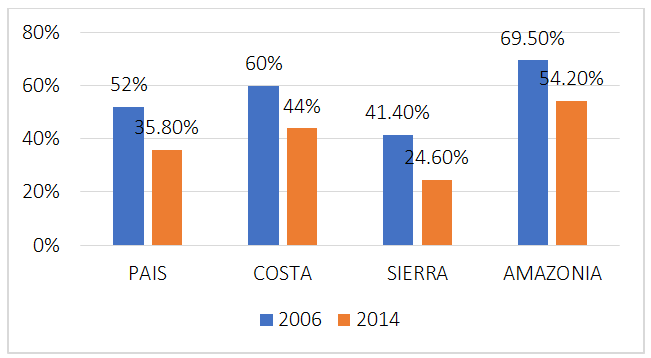
The Amazon region in Ecuador, despite being the main provider of wealth to the country, maintains the highest percentage of poverty both due to consumption and unsatisfied basic needs (UBN). Poverty measured by NBI evaluates the lack of services and basic needs of the population and includes: housing, health, education and employment. In the Amazon region, 54.2% of people lived under this condition (Figure 1) [8].
Along with the high poverty rates, in the Ecuadorian Amazon region, greater illiteracy is also evident when compared to the national average. The illiteracy rate is 6.49%, of this percentage 8.70% live in rural areas and 3.45% in urban areas (Figure 2).
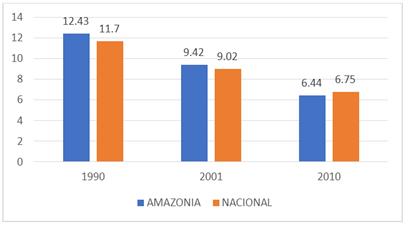
Decrease in the illiteracy rate can be observed, greater among men than among women. The provinces of the Ecuadorian Amazon with the highest illiteracy rates are: Morona Santiago, Napo and Pastaza, showing that the region is the one with the greatest inequality and the least redistribution [8].
The Famous Auca Road
In the last 30 years, in the Amazon provinces, a rapid process of urbanization has become.
The original matrix that was the pre-cooperative and rural cooperatives peasant settlers, no longer exist, giving rise to small urban settlements, which are now link cities and new forms of political organization, such as parishes, cantons and provinces. For example the via Auca, a road complex built by the oil company Texaco is known, which began in 1970 and ended in 1980 of the last century, with more than 120 km. road from the city of Coca to the Waorani community of Tiwino-Bataboro.
The oil infrastructure carried out by Texaco abruptly displaced Waorani families from the Niwairi group, who they had their territoriality within this entire area. The contact was violent and caused constant clashes between soldiers, oil company employees, Waorani warriors. The road divided the traditional Waorani territory, causing families from this ethnic group, who used this region as their space for mobility and socio-cultural reproduction, migrate towards the south- east, causing conflicts over territorial limits and especially over resource competition such as hunting.
“The city of Coca grew as a pole of oil development, from there towards the south-east there is a motorable road called Auca, is a long road of more than 120 kilometres that divides the Waorani territory. When traveling along this route you can observe the colonizing process that was developed since the 1970s with the support of the State, with the colonization law, lands vacant lands, in close relationship with the oil companies. Texaco was the company that developed the Cononaco and Auca wells, which when they entered production allowed industrial development oil in the area, the construction of access roads and the appearance of towns of both mestizo settler groups that arrived in search of land to produce (livestock, coffee) and other Amazonian indigenous groups (Kichwa and Shuar). Almost 40 kilometres from Coca, is the town of Dayuma, with a disorderly and chaotic growth, demonstrates how the matrix originality that was the pre-rural cooperative or the commune changed to nucleated settlements along along the multiple avenues in the sector, which is why many of the former pre-cooperatives and settler cooperatives no longer exist, giving rise to small settlements that have caused a rapid urbanization process with the creation of different neighbourhoods, precincts, communes, parishes, cantons and cities. Continuing a few more kilometres along the road towards Pindo wells you will find Davo, another Waorani warrior, son of Niwa, who will control this entire region. He and his wife Zoila live in the Pindo Y, they have a mixed manufacturing house and a large chain that tighten it when a car or a truck arrives, they must pay a toll to pass through their territory, says Zoila, who speaks Spanish. Payment of the toll can be in money, but also in food and frequently in Coca Cola. Further on follows the winding road built by Texaco, which was the beginning of the penetration of peasant settlers who settled according to the tracks go to wells and stations, coffee fields, pastures and many small pre-cooperatives and cooperatives that give a new shape to the Amazon region.
This was my dad’s territory, Davo says, Ñiwa the best Waorani warrior, he defended his territory from the cuwuris, the strangers, He had a large house in what is now the Cononaco camp, where I was born. Now, road ends in the area called Tiwino, which is the beginning of the Waorani territory, where a chain divides the two worlds, the Waorani and the settler. On the chain is Babe, tall and strong, next to a bottle Coca-Cola charges tolls from gringo tourists who go downriver to the company’s cabins tourist, following the road there are still 20 kilometres that have been covered by the jungle, they were built by Petro-Canada, the company that transported Babe and his entire family to this site called Tiwino, the project was to reach the Curaray river and thus complete a large area oil company, they couldn’t do it, according to what they tell me, it is a land where brave Indians live, the people tell them pata colorada, or the Tagueiri, they do not allow passage, kill with spears those who walk through this place” [10].
The opening of roads allowed a rapid entry of peasant settlers, who were taking possession of the properties next to the camps and roads16. The peasant settlers coming from Loja, Bolívar, Manabí, Pichincha and El Oro, as well as family groups from the Kichwa and Shuar nationality, settled preferably in areas near the banks of the Napo River and the extensive complex of carriage roads, built by oil companies. In this way, they entered the Auca road, an area declared by the national government as lands vacant lands, and therefore for agricultural use17 and quickly displaced its former inhabitants.
The aggressive clearing of the jungle is fundamentally caused by the same laws that governed the colonization, and that they requested work on more than 50% of the property in order to be awarded. The highway was the main entrance to areas of the Yasuni National Park (PNY), Waorani ethnic territory and the Tagaeri-Taromenane Intangible Zone (ZITT). Today it is a true regional complex, around the oil infrastructure, which combines an aggressive opening of the agricultural frontier, unplanned urbanization and development of the oil industry.
Conclusion
In the oil subregion, the distribution of land through colonization did not achieve well-being and progress among the populations, showing that not only the redistribution of land was necessary, but the presence of a new State model that changes the old structures. Of power and propose a whole series of policies (technology, credit) that will contribute to improving the quality of life of the residents. Oil became the articulating axis of all migration, however in the last 20 years; a rapid urbanization process has been generated in the oil subregion with the creation of different neighborhoods, precincts, communes, parishes, cantons and cities. The original matrix that was the pre-rural cooperative or the commune changed to settlements nucleated along the multiple roads that the oil industry built. The old pre- cooperatives and cooperatives no longer exist, they have given rise to small settlements and then towns. The urban and rural fabric, currently with better public services and communication routes, are now linked to large cities such as: Nueva Loja (Lago Agrio), La Joya de los Sachas, Shushufindi, Fransisco de Orellana (Coca), Tena , Puyo and new forms of political organization, are parishes, cantons and provinces that need more investment every day to solve the problems that urbanization entails such as: contamination of water sources, water, sanitation and basic services, garbage and waste management , urban planification.
The colonization and settlement of the sub-oil region meant the massive and commercial use of its natural resources with a very high impact on the tropical humid forests. The final and definitive result was the demographic, ecological and symbolic transformation of the region. The natives were colonized and made invisible, the forest was razed and transformed into large agricultural and urban areas. Currently, it is not only oil waste that pollutes rivers, but the exponential increase in sewage and garbage produced by cities. Aggressive urbanization without control or planning is the challenge to achieve a sustainable oil sub-region.
References
-
Trujillo P (2001) Savages, Civilized and Civilizing. The Ecuadorian Amazon, the Space of Illusions. FIAAM, Abya Yala, Ecuador.
-
Muratorio B (1998) Rucuyaya Alonso and the social and economic history of Alto Napo, 1850-1950. Abya-Yala.
-
Alberto A (2012) The Import Substitution Industrialization Model. Brief Economic History of Ecuador 3rd (Edn.), National Publishing Corporation, Ecuador, pp: 75-196.
-
Juan M (2012) The Incorporation of Ecuadorian Cocoa into the World Market: Between 1840-1925, According to Consular Reports. Ecuadorian Magazine of History 35(1): 67.
-
Patricio T (2009) Everyday Life on the Ecuadorian Putumayo Frontier. Looking at the other side. FIAAM, Ecuador.
-
Paul Little (1992) Political Economy of Cuyabeno. Abya Yala, Ecuador.
-
Arturo Escobar (2005) Post development as a Concept and Social Practice, in Daniel Mato (coord.), Economy, Environment and Society Policies in Times of Globalization. Caracas: Faculty of Economic and Social Sciences, Central University of Venezuela.
-
Ecorae Senplades (2015) Comprehensive Plan for the Amazon. Eco development Institute of the Amazon Region, National Planning Secretariat, Ecuador.
-
North L, Wade Kit, Robert BK (2008) Rural Land Conflicts and Human Rights Violations in Ecuador. Rural Development and Neoliberalism, Simon Bolivar Andean University (UASB), National Publishing Corporation (CEN), Ecuador.
-
Patricio T (2011) Boto Waorani, Bityu Cowuri. FIAAM, Ecuador, pp: 53.
- The Indispensable Role of Informal Caregivers in Supporting the Aging Population
- Socio-Religious Significance of Kamakhya Temple in Guwahati, Assam
- Is Anthropology Possible?
- A Contribution to the History and Paleobiology of Harput/Elazığ Türkiye and Its Surroundings
- A Study on the Cowrie Shells of the Dimasas in Assam
- The Significance of International Organizations Cooperation in the Efficient Resolution of Global Conflict