
The Participation between Indigenous Empowerment and State Normalization
The present work starts from a social and systematic anthropological perspective with its epistemological limitations and openings with a constant analytical and methodological deconstruction within the framework of critical and reflexive practices. We will seek to understand the dynamics and implications of the normative, historical and structural relations between the State and indigenous peoples in two working spaces: the Provincial Council of Indigenous Affairs (CPAI) located in La Plata, and the comanagement in Bariloche located within the National Parks Administration (APN). Therefore, we will investigate and analyze a heterogeneous corpus that includes legal and administrative materials composed of a particular language and logic of state bureaucracy. In this context, we will observe these dynamics and tensions through the legal personality as a case of analysis of such strategic uses by indigenous people to reaffirm themselves as communities and, at the same time, this process translated into a normative “waiting” as a control mechanism. This will allow us to understand the historical, normative and structural relations with the State and participation as the main dimension of work.
Introduction
The present work is based on a social and systematic anthropological perspective with its epistemological limitations and openings. It is the result of a series of historical, social, economic, political and cultural processes and contexts that have led to a constant analytical and methodological deconstruction within the framework of our roles as social scientists.
Starting from these anthropologies has implied a political, academic and professional stance. They were denied, non- existent persecuted or closed during the civil, military and Perspective clerical dictatorship, due to their non- functionality to the economic, political, social and cultural backgrounds resulting from a terrorist state [1].
This discipline has been the result of long processes of deconstruction, as well as of the struggle from the academy to distance itself from a series of anthropologies, originally classical and more positivist, and later with Malinowskian functionalism, whose contributions -with greater empirical predominance- were indispensable in the techniques of data collection: participant observation and field recording. Then, we sought to repair and/or politically counteract the symbolic and discursive consequences of the functional theories of state terrorism, such as phenomenology and cultural relativism.
Therefore, the tools provided by social, economic, legal and political anthropology, among other branches, allow us to carry out the field work and the subsequent analysis, where the dynamics and implications of the normative, historical and structural relationships of the State in the spaces of “co-decision” as the Provincial Council of Indigenous Affairs (CPAI) located in La Plata, and the Co-management in the region of Bariloche located within the National Parks Administration (APN) have been evidenced. This will allow us to investigate and analyze a heterogeneous corpus including legal and administrative materials composed of a particular language and logic of the state bureaucracy.
On the one hand, from a theoretical eclecticism, our analytical axis will focus on the theoretical line of Gramsci and Bourdieu, who allow us to understand the above mentioned in the framework of normative relations characterized by negotiation, debate and controversy, where active and confrontational agencies are witnessed, whose indigenous practices in their struggles and/or possible reproductions, will be developed in many cases from within the institutional formations, organizations and spaces of the state and civil society, of which they are part and coexist [2].
On the other hand, the semantic use of the word creative in this article is related to the category of “strategic” practices/uses and/or intentions of existing tools and resources. From these tensions between normalization and indigenous empowerment as strategically articulated categories, we seek to understand the efficiency and dynamics that occur in the spaces of participation, where fluid relationships and interplays between the various actors in question predominate. Whose indigenous participation disputes its exercise and respect to resist and re- exist their forms, values, and subjectivities in the hegemonic game of power, “the dominated know that they are dominated, they know by whom and how; far from consenting to that domination, they initiate all kinds of subtle ways of living with, talking about, resisting, undermining and confronting the unequal worlds and concentration of power in which they live” [vease 2].
In this context, we will observe the dynamics and tensions through the Juridical personality as a case of analysis of such strategic uses by indigenous people to reaffirm themselves as communities. This will allow us to understand the historical, normative and structural links with the State and participation as the main dimension of the work.
Indigenous Participation Challenged by the Law and the Judicial Field
Historically, we have seen a greater presence, progress and legal and juridical materialization of participation as a public policy in the political scenario and on the agenda of the States since the 1990s, in a context where the Indigenous Emergency and the integrationist role of the States became evident [3].
Previously, the conditions for the resurgence of this participatory boom were being created. However, it was seen as a national security problem during the Peronist era (the military coup of ‘55, the Frondizi government of ‘58 and the military government of ‘61). Then, with the military government of the “Argentine Revolution” in the 1970s, the political transformation of the indigenous communities began, together with the emergence of the first forms of ethnic organization and mobilization [4]. In short, it was not until democracy that the outlines of a legal and juridical framework began to be observed in relation to indigenous participation as a right. The first legislative advance in Argentina was articling 1 of Law 23.302 “Indigenous policy and support to aboriginal communities” in 1985.
Declaring of national interest the development and defense of the full participation of indigenous peoples in the socio-economic and cultural process of the Nation. During the interviews carried out in the framework of the fieldwork, the relevance of addressing the legal dimension and strategic uses of laws to confront hegemonic violations was reiterated. This has been remarked by several indigenous referents.
Participation has a legal leg (...) The law and the street go hand in hand with participation for the struggle (...) It is necessary to enter into the legal/institutional mechanisms to be heard because in order to make a claim you have to be legitimized (Personal interview with an indigenous official of the CPAI, December 2022).
We have to force the laws to adapt them to our needs (...) The legal system intervenes all the time, they enter the territory and you need a prosecutor (...) Without a lawyer they will not accept your complaint (...) You have to explain to the lawyers how it works, train them in indigenous law (...) In practice you end up training in the field of law with its respective language and procedures. (Personal interview with an indigenous reference person from OPINOA, May 2023).
In this context we then ask ourselves what we consider by law through Gramsci’s theoretical perspective. It will be conceptualized as a normative system that establishes rules and principles that govern a society and the relations between people used in a functional way to the economic, cultural and political interests of a dominant system. Therefore, such instrumentalization can be used in a hegemonic way to perpetuate inequalities and/or favor the interests of certain dominant groups. In turn, it can be reappropriated by various subaltern sectors to reaffirm their rights, their identity and their social, cultural and economic reproduction.
As with the State and indigenous peoples, Assies proposes heterogeneity within the judicial field through semi-autonomous subfields, which will be differentiated according to the predominant characteristic (rhetoric, bureaucracy and violence), thus forming a “pluralistic legal field”. Thus, the indigenous legal field will be defined by a high degree of rhetoric and low levels of violence and bureaucracy. Whose subfield of law will interact with other subfields such as the institutional/state, thus witnessing the complexity of the legal scenario.
This theoretical framework allows us to approach participation, taking into account the normative, historical and structural interplays that occur between the State and the various subaltern groups. Whose relations are asymmetrical and normative, so it will not be an equanimous field but “one structured by the relations of hierarchy and domination that explain the interactions between the different subfields” [5].
Therefore, aligned with Bourdieu’s theory of fields, disputes and negotiations are witnessed to compete for the resources of the field and the “frontiers” are constructed, in which the strategic uses of law are observed within the framework of the modern state, in other words, he is going to say that it is observed.
The qualitative “contamination” or “infiltration” of rhetoric by the dominant bureaucracy and violence. The mode of operation of a subfield characterized by the predominance of rhetoric may then change in the sense that arguments and reasoning come to depend on bureaucratic logic and discourse. Thus, the latter can be seen as expanding into rhetoric, as forms of argumentation and persuasion that become “bureaucratized” [...] Indigenous peoples themselves have also participated in codification. Thus, in response to the encroachment of state law and the ever-increasing presence of state-imposed authorities [5].
Therefore, to speak of participation cannot be dissociated from the action of power and disputes to reaffirm rights. In this way, certain complex dynamics are understood within the spaces of participation between the various subaltern groups and the State, where normative, historical and structural relations predominate between the two and within each group it.
According to Oakley, the common variable for the definition of social participation consists of consultation when making decisions about its development [6]. This dimension has been present in the accounts of various referents as a synonym of participation translated into a strategy or legislated resource that enables social and cultural reproduction at the local level. In turn, it is defined as a right both at the international and national level through the FPIC as the participation instance par excellence, regulated by Convention 169 of the International Labor Organization (ILO) and then subscribed nationally in the Constitution.
CPAI and Co-Management: State Spaces for Indigenous Participation
Based on a doctoral grant co-funded by CONICET and APN, the particularity of the present fieldwork consists in the characterization of two spaces of participation whose common factor lies in the presence of the State and its dynamics and bureaucratic forms at the time of linking with indigenous peoples and “participating” as a whole.
In 2006, the Indigenous Council of the Province of Buenos Aires (CIBA) was created, whose indigenous organization process, in 2007, became the Provincial Council of Indigenous Affairs (CPAI), an institutional co- decision body created in that year and regulated by Law No. 11.331 through Decree No. 3631. It becomes the highest body of indigenous policy in the province of Buenos Aires, under the Secretariat of Human Rights located in the center of the provincial capital. Its body is composed of four officials of the provincial State, and the Indigenous Council of the Province of Buenos Aires (CIBA), composed of two representatives for each native people living in the Province of Buenos Aires and having at least three to eight communities in the territory registered in the Provincial Registry of Indigenous Communities or in the National Registry of Indigenous Communities (REPROCI and RENACI).
Then, in 2012, the co-management area within the Nahuel Huapi National Park in the Bariloche region emerged, whose genesis was also located within contexts of conflicts and social disputes. Thus, the background of the scenario that will lead to the genesis of the aforementioned spaces in Bariloche begins.
During 2011, when the organization of the protected areas was formalized, the problems of rural populations with P.P.O.P. became the responsibility of a specific division called ‘Community Relations’, under the Department of Conservation and Environmental Education (...) This division should “intervene in all social problems related to the presence of indigenous communities, settlers and landowners in the National Park” (APN, 2011). The subordination of social problems to a Division of the Conservation Department brought many questions among the inhabitants, but particularly among the Mapuche Communities, who, after a conflict that became public knowledge7, achieved the inclusion in the organizational chart of the Intercultural Management Area, directly dependent on the National Park’s Intendant and including personnel belonging to the communities [7].
Both spaces arise as a state response to demands and claims located in particular social, political and economic contexts with the presence of conflict and disputes, which implies that these spaces arise from the organization and ethno-political struggle. However, it has also been possible because of the resources and instances of the State: “thanks to the guidelines of a national government - initiated by Néstor Kirchner in 2003 until 2007 and succeeded by Cristina Fernández until 2015 - that proclaimed to assume the participation of indigenous peoples as a ‘State policy’” [8].
The Spaces of Participation Traversed by Power
Within the framework of this scholarship, we take as a starting point the conceptual definition of “space” of which I will consider both the Provincial Council of Indigenous Affairs (CPAI) of La Plata, Bs As province and the Comanejo area of the Nahuel Huapi National Park, in Bariloche. Ergo, in this theoretical framework we take up the theory of the geographer Massey, who evidences the complex and normative relations that take place within these spaces.
Through the idea of “geometries of power”, we observe the political implications of the articulation between space and power, whose interconnections are indispensable for its functioning and understanding of the resulting dynamics. Consequently, it is going to rethink it as.
An interweaving of power relations that have their spatiality, and at the same time, the latter allow and are conditioned by the exercise of power. Consequently, the relational nature of space is understood as a “complexity of relations” of power, result and generator of practices, relationships, dialogues and disputes (Massey, 2003). Only in this way can the genesis and functioning of spaces of participation be understood on the basis of their relational and social character within the framework of these geographies of power [9].
She summarizes three fundamental features [10, 11, 12]. Result of relationships within the framework of hegemonic disputes. At the same time, a social essence persists due to its relational character. And finally, the idea of multiplicity, which will be a necessary condition for the existence of sociability through the coexistence of trajectories, identities, dialogues, negotiations, etc. Essential for its constitutive factor, interdependently linked to the two previous features. It grants the possibility of other thoughts, practices and identities, and necessarily requires relationships in constant interaction. In this way, the dynamic and open character of the spaces will be evidenced, as well as the processes of change open to the future.
In methodological terms, it should be clarified that we take into account the regional difference of the spaces to be worked, which allows us to take up this dimension through the idea of “spatial differentiation” of the Gramsci an theory taken up by Roseberry when analyzing the CPAI (Provincial Council of Indigenous Affairs) and the PNNH (Nahuel Huapi National Park), which allows us to rethink both spaces with their respective diverse and unequal social powers subscribed regionally (1994).
The Heterogeneity of the State with Its Internal Bureaucratic Logics and Timing
Having defined, in the previous section, the idea of spaces, and based on the characterization of these spaces, it is pertinent to reflect on the figure of the State, present in both spaces of participation.
This relationship between the State and indigenous peoples is historical, structural and normative, and their participation will require - whether from within the State structures or from outside - legitimacy and dialogue with the State apparatus with its language, procedures and requirements. This does not exclude or minimize the active role of the agencies and the struggles of the subjects involved, but normative interplays will persist in which the latter will seek to appeal to various strategies and uses of the legal framework to confront inequalities and violations. As well as exercising and (re)adapting resources and tools to their interests and needs [5, 13, 14]. From this framework, we will subsequently analyze the case of legal personality.
In summary, we start from a clear need to analyze the role of the State, whose forms of political domination are often carried out through the exercise of files, requests and bureaucratic and administrative requirements translated into strategies of subjection by the power structures. Consequently, we are faced with the challenges of incorporating a bureaucratic language and logic with their respective methodological implications. Therefore we retake the experience of Sarrabayrouse in his research on the judicial morgue (2015), which will analyze the bureaucracy and evidence the absence of methodological tools for fieldwork with normative documents. Possible risks involve falling into literal translations of manuals, regulations and/ or various normative documents; as well as the reproduction of a particular and complex language, among other methodological obstacles.
In this work we are aligned with the idea of anthropologically analyzing the normative documents and avoiding on the one hand any descriptive analytical approach from a reflective and critical stance and on the other hand, facilitate the understanding of the content of these normative documents that reflect the experiences of the subjects with their practices, procedures and relationships from an anthropological reading of the files [15]. At the same time, we retake the methodological triangulation, whose corpus composed of legal and normative documents, will be articulated with interviews and observations, taking up the word and point of view of the actors [16, 17]. As mentioned by Sarrabayrouse, whose emphasis is on bureaucracy, it consists of being a central piece of the State with its protocol logic and control technology. Assies defines bureaucracy in the framework of the legal field as “a form of communication or a decision-making strategy of an authoritarian order that depends on the mobilization of the demonstrative effect of regulated procedures and normative standards” [5].
In turn, in the framework of such dialogues between the State and the indigenous referents, Auyero will raise the functioning of bureaucracy through mechanisms and strategies of domination such as “waiting” as a mechanism of subjection of the State. Ergo, bureaucratic and/or administrative obstacles arise in which indigenous demands and claims are boxed in depending on state logics, times and decisions that are not always necessary to meet such demands and/or reaffirm their rights [18].
This is reflected in the account of a CIBA referent who listed the administrative and bureaucratic obstacles to carry out various proposals, from Wiphala assembly workshops, projects for the continuity of fairs - spaces that enable the sale of handicrafts and various artistic activities - to territorial claims for their economic, social and cultural reproduction. These instances of negotiation between the CIBAS and various provincial and/or national officials were characterized by the demand for countless documents, papers and long waiting times from the State, which came to nothing. Also, they have suffered rejection from the same ministries to consider them as adjudicated authorities for their condition of indigenous referents of CIBA due to the lack of a note that legitimizes them as such (Personal communication with indigenous referent of CIBA, June 2023).
In other words, the need for a structural and epistemic detachment is evident for the incorporation of indigenous participation in the State, which should not be based on consultation, but requires a transformation of the State in the framework of public policies within a State with other legal, administrative and budgetary structures [19]. Another characteristic of the State lies in the heterogeneity present within the State apparatus, composed of a complex set of relationships and disputes in terms of budgets, levels, hierarchies and subjects, as well as in the dialogues with indigenous peoples. This has been remarked as obstacles and challenges by CPAI officials when responding to the demands of indigenous referents due to a lack of budget (due to a change, displaced by the Ministry of Women in the budget dispute, with all the implications that this entails), as well as the challenges of dialoguing with their peers due to racism and prejudice of other officials, sectors and levels of the State (Personal interview, 2023). However, considering the state as a heterogeneous group of people has also allowed for greater access to files depending on the person in charge at the time.
We Obtained Juridical Personality because we are an Indigenous Community
Throughout this paper we have mentioned the disputes and strategic uses by indigenous peoples through ethno- political organization and struggle. One of the bureaucratic instances that has predominated in the framework of the CPAI as an indigenous claim and state officialization/ standardization has been the case of the Juridical personality as strategies and uses by the indigenous peoples.
This procedure consists of being one of the projects most highlighted by CPAI state officials, whose “Juridical personality” is a requirement that allows a supposed officialization of the existence of an indigenous community. What will it imply?
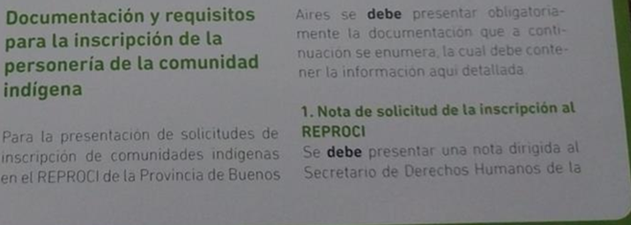
The agency defines it as “a legal document that shows the existence of an indigenous community (...) even if they do not have a document that so indicates. However, with the registration of the Juridical personality, the community can make certain rights effective” (Institutional Guide of the CPAI for registration in the REPROCI, 2023) states the need to register in the REPROCI (Provincial Registry of Indigenous Communities) to make “certain” rights effective, such as access to community title to land, to manage productive projects or to appear in court as a community.
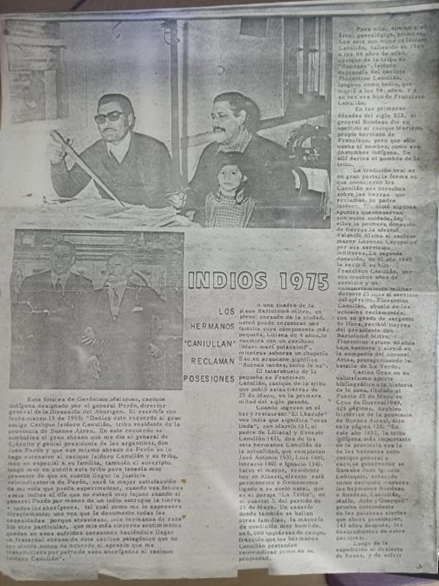
In this way, it is not explicitly stated as a mandatory requirement, but it ends up being translated into a regulatory mechanism that will grant possible benefits and facilities, since they will need it to carry out their social, cultural and economic reproduction by the indigenous peoples or even to make a claim or be recognized communally before the justice system. This is reflected in the testimony of an indigenous person who made his claim in 2012 through a note on the pending delivery of his land granted by Perón together with Maliqueo as General Director of the Aboriginal Directorate in 1953, corresponding to the area of 25 de Mayo, whose ancestral presence is supported by historical documents as shown in the following newspaper article.
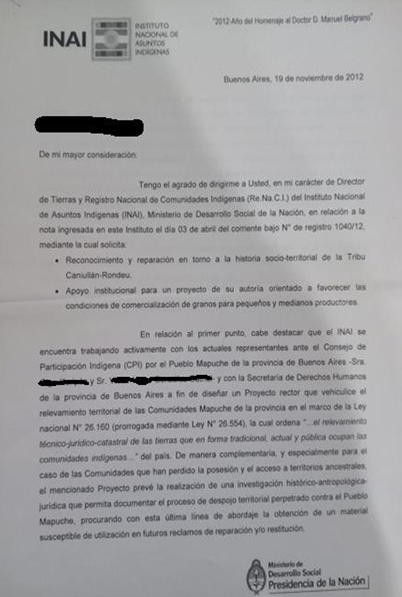
However, subsequently, the response from the State was that the delivery of lands will be carried out on the basis of a dialogue with Mapuche representatives of the Provincial Indigenous Council and the Secretary of Human Rights of the province and within the framework of a territorial, anthropological and legal survey. In other words, it will be a requirement to be ethnopolitically organized, as well as to present materials whose process is required to be officialized as a community through the granting of juridical personality, which translates into legitimacy in the eyes of the State, as shown in the institutional note after.
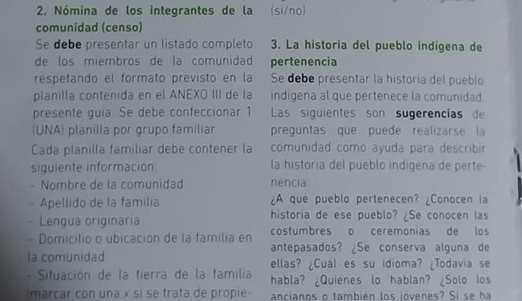
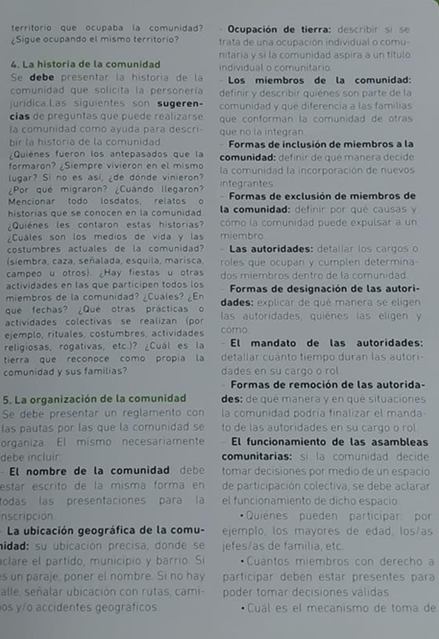
Next, we will look at the requirements to obtain juridical personality according to the indications of the CPAI institutional guide shown in illustrations 3, 4 and 5 of course; obtaining juridical personality involves more conditions than those observed in the selected images. A summary of these conditions is shown to understand the long bureaucratic process that requires access to information, resources, and legitimacy. This can be, in many cases, incongruent with the lives, experiences and trajectories of indigenous peoples who have been criminalized, excluded, stigmatized and/ or migrated to other areas for various structural and/or personal reasons, which can be affected to comply with the regulatory requirements of the State as well as the loss and/ or deterioration of historical roles.
As we have said up to this point, we observe the case of juridical personality as an example of state standardization through bureaucratic requirements and procedures. However, these requirements, forms, practices and normative logics are reappropriated and reused by the indigenous themselves to resist and re-exist within this same logic. For example, during a participant observation in the framework of a delivery of Juridical personality to communities located in the province of Buenos Aires, a CIBA referent expressed the official character of the present state procedure, which includes the internalization of such legal document and strategically appealed, since such indigenous participation had in mind the need to be recognized and/or “legitimized” by such apparatus in order to claim and/or negotiate. Therefore, to the question of why it requested the juridical personality, one of the CIBAS referents answered.
We understand today that it is necessary to obtain the juridical personality to be able to reaffirm ourselves as a community, it gives a structure to the indigenous organization, it recognizes you, legitimizes you and gives you presence as a community, here we are, and we got it because we are a community (CIBA referent, September 2023).
Final Thoughts
Despite ideological, cultural and political discrepancies with the bureaucracy, we understand the need for official recognition to reaffirm indigenous participation based on strategic uses of its tools and logics for indigenous empowerment. In this way, tensions and dialogues are produced between ethnic reaffirmation and normative officialization. They reaffirm themselves as indigenous communities, and the need to enter into this bureaucratic game persists in order to appeal to resources and procedures necessary for their social, cultural, economic and political reproduction, as well as the demand for symbolic and/or material reparations from the State for the persecution and criminalization that have violated their conditions.
From this place we understand the counter-hegemonic instrumentalization of the law, through the strategic use of laws by indigenous peoples to achieve true indigenous participation, making possible the exercise of their identity as well as cultural and material practices through ethno-political organization and alliances. Among the tools highlighted are Convention 169 of the International Labor Organization (ILO) and the Free, Prior and Informed Consultation (FPIC).
The latter consists of being one of the most important legal instruments that addresses everything related to human rights, defines territory and habitat as fundamental rights, as well as the recipients of this right, specifying who the indigenous peoples are. It promotes and supports the right to participate in decisions on matters that concern indigenous peoples, especially in terms of territory, natural and cultural assets. It is a right enshrined in a decree and then subscribed by Argentina and incorporated by National Law.
Such practices are not new, since the interpellation of the creation of the Nation State, they coexist with the need to respond to such logic and bureaucratic dynamics in order to coexist and re-exist. They are structural, normative and historical relations, where participation also requires the function of the State, in order to have someone to complain to. Therefore, we start from bilateral relations between normalization and the strategic uses of legal requirements and procedures. Therefore, in many cases the problem does not lie in the lack of legal frameworks, which have been achieved in hegemonic participations and disputes, but in their application.
References
-
Duhalde EL (1999) the Argentine Terrorist State. Fifteen years later, a critical look. Buenos Aires: EUDEBA.
-
Roseberry W (1994) Hegemony and the language of contention. In Everyday Forms of State Formation: Revolution and the Negotiation of Rule in Modern Mexico, pp: 355-366.
-
Bengoa J (2009) A Second Stage of the Indigenous Emergency in Latin America. Social anthropology Notebooks, 29: 101-122.
-
Serbin A (1981) Indigenous organizations in Argentina. Indian America, interamerican indigenist institute 45(3): 407-433.
-
Assies W (2001) The officialization of the unofficial: encounter of two worlds. Alterities, pp: 83-96.
-
Menendez EL, Spinelli H (2008) Introduction in Social participation: What for? E. Menendez. (cord.). Buenos Aires: Lugar Editorial, pp: 81-115.
-
Vazquez PLT (2021) rural settlers of Nahuel Huapi National Park. Family life strategies, actions and identities of resistance.
-
Engelman J (2019) Indigenous people in the city: articulation, strategies and ethnopolitical organization in the Metropolitan Region of Buenos Aires, Argentina. JHAAS 16(11): 86-108.
-
Chernavsky SC (2021) Space for Indigenous Participation and Intercultural Dialogue. Analysis on the Provincial Council of Indigenous Affairs. The National Institute of Latin American Anthropology 30(1): 156-171.
-
Massey D (2003) Place, identity and geographies of responsibility in a globalizing world. Works of the Catalan Society of Geography 57: 77-84.
-
Massey D (2009) Concepts of space and power in theory and in political practice and in political practice. Doc Anàl Geogr 55: 15-26.
-
Massey D (2012) Space, place and politics in the current conjuncture. Urban, pp: 7-12.
-
Gordillo G, Hisch S (2010) invisibilizations, state policies and indigenous emergencies and disputed identities in Argentina. La Crujia, pp: 15-38.
-
Guinazu S (2018) the interplay between state standardization and indigenous agency in the execution of the territorial survey of indigenous communities in Rio Negro, Argentina. Universidad Academia de Humanismo Cristiano. School of Anthropology.
-
Oliveira MS (2011) the case of the Judicial Morgue In is you too, doctoring? Complicity of judge’s prosecutors and lawyers during the dictatorship. Buenos Aires.
-
Oliveira MS (2022) Ethnographic work with records in the field of judicial bureaucracies. Contemporary Ethnographies 8(15): 138-160.
-
Kvale S (1996) the 1,000-page question. Qualitative Research 2(3): 275-284.
-
Auyero L (2023) Patients of the state. Eudeba.
-
Frites E (2011) the right of the indigenous people. UNDP- Rosa Guaru-INADI.
- The Indispensable Role of Informal Caregivers in Supporting the Aging Population
- Socio-Religious Significance of Kamakhya Temple in Guwahati, Assam
- Is Anthropology Possible?
- A Contribution to the History and Paleobiology of Harput/Elazığ Türkiye and Its Surroundings
- A Study on the Cowrie Shells of the Dimasas in Assam
- The Significance of International Organizations Cooperation in the Efficient Resolution of Global Conflict