
The Role of Diversity Inclusion in the Work Place, the Case of Shaggar City, Galan Sub-City
The main purpose of this study is to describe the Role of Diversity and Inclusion in the work place in Galan town. The study was conducted by using a purposive sampling technique via exploratory research design. Different categories of respondents were participated in this study. This study has employed a qualitative data. The purposive samples of 25 respondents who have ever experienced were interviewed and the total number of 20 participants with five groups of four members for each focus group discussion was participated in the study. To achieve the above objectives, the study collected primary data from different informants by employing qualitative data collection techniques through key informant interview, focus group discussions and observation. The secondary sources of data were obtained from different documents analysis. The main findings of this study revealed that there are impacts, limitations, challenges and gaps in creating awareness in implementation of effective Diversity and Inclusion in the study area. The other finding of this study also examines and capacitates the ability and role of Diversity and Inclusion was not successfully executed in the study area. Furthermore, the study indicated the role of Diversity and Inclusion in the study areas. Finally the study comes up by giving some conclusions on how the Diversity and Inclusion was examined. The study also recommended national recognition for the Diversity and Inclusion.
Introduction
Diversity and inclusion are critical issues that manifest in various environments within society. In today’s globalized world, these topics are frequently discussed, and their treatment varies significantly across different cultures. Understanding the historical context is essential for enhancing the role of diversity and inclusion in the future [1].
The primary role of diversity and inclusion is to increase employee participation and foster the involvement of individuals from diverse backgrounds and multiple generations. Recent researches by Martinez A [2] and Johnson A, et al. [3] have shifted the conversation from merely managing diversity to effectively leveraging it. They argue that simply adopting practices to manage a diverse workforce is insufficient; organizations must implement initiatives that capitalize on diversity to achieve and sustain higher performance.
Several recent studies have highlighted that contemporary diversity initiatives have given rise to the concept of inclusion [4, 5]. Consequently, the term ‘inclusion’ has increasingly been associated with diversity in recent years [6]. Therefore, it is essential to examine the concept of inclusion alongside diversity to address critical questions regarding how to leverage the potential of a diverse workforce. This exploration will provide researchers with a nuanced understanding of both diversity and inclusion.
Moreover, this study aims to analyze recent literature on diversity and inclusion from 2018 to 2023, enabling researchers and practitioners to gain insights into emerging research trends. To assess the volume of work done in this area, we utilized citation analysis to examine citations across various research publications. This analysis highlights research trends in diversity and inclusion in the workplace during this period.
According to Thompson, the significance of diversity and inclusion in the workplace has gained increasing recognition in recent years. Since 2018, the discourse around diversity has evolved to focus more on inclusion [7]. This shift is necessary, as diversity often emphasizes employee characteristics, whereas inclusion focuses on organizational traits, such as culture and climate, ensuring that individuals from diverse backgrounds are fully accepted and equitably rewarded. Inclusion aims to create an environment that fosters diversity.
Workplace diversity is essential for organizations seeking social, economic, and political advantages. Diversity encompasses recognizing, understanding, accepting, valuing, and celebrating differences among individuals related to age, ethnicity, gender, ability, race, sexual orientation, and more [8]. By effectively managing diversity, companies can engage with diverse cultures and clients, leading to increased creativity, productivity, innovative solutions, and improved market insights.
Failing to recognize the importance of diversity and inclusion can hinder organizations in attracting and retaining customers, employees, and partners necessary for thriving in an increasingly globalized workforce [9]. This literature review is designed to inform human resource professionals, management leaders, and policymakers about the critical role of diversity management in the workplace [8].
This study aims to address gaps in understanding the contributions, challenges, types, and outcomes of diversity and inclusion in the workplace. It examines how diversity and inclusion impact employers, addressing issues such as cultural segregation, discrimination based on race and gender, property destruction, workplace monopolies, poor communication, and low adherence to human rights principles, including dignity and equality. The findings will shed light on different employee perspectives within organizational environments, emphasizing the importance of diverse backgrounds and characteristics [3, 10].
The objective of this study is to describe the role of diversity and inclusion in the workplace in Galan Town.
Knowledge Exchange, Language, Obligations and Biases
The framework KLOB (knowledge exchange, language, obligations, and biases) is established to think about the effects and impact of barriers experienced by individuals in academic activities. Knowledge exchange depends on the economy of the country, education, and networking potential. Language is an important component because access to content and publication possibilities depends on language knowledge. Thirdly, obligations are responsibilities that prevent or limit an individual from accessing higher education. Biases prevent individuals from succeeding and reaching positions. This research is focused on the academic level but it can also be adjusted to the organizational level.
Behaviors That Support Leadership in Diversity and Inclusion Workplace
The Behaviors that support diversity and inclusion includes actively ensure team and workforce composition is as diverse as the communities we serve , model and enable workplace flexibility, raise awareness of and build capability to work with and manage diversity, inclusion, equity, equality and inter sectionalism, protect, promote and act in line with human rights including human dignity, equality and freedom, encourage others to learn and build inclusive practices and hold ourselves and others accountable for building a diverse and inclusive culture [4].
Inclusive Leadership
According to Roberson Q [14], People managers, leaders and executives need to model inclusive leadership behaviors. Inclusive leaders understand that practicing diversity and inclusion means recognizing and respecting that each person is unique and faces different and compounding barriers to workplace inclusion. They know how to equitably allocate the resources and opportunities each person needs to reach their full potential. To strengthen diversity and inclusion in workplace, leaders and managers must meet the expectations of our people. The expected behaviors and outcomes should be clearly articulated and supported in processes such as selection processes and performance and development planning included in our leadership and management development activities.
Diversity Council Australia has identified the following five mindsets of an inclusive leader as Identity aware to Believes diversity can significantly improve organizational performance and so learns about their own and others’ identities, Relational to Creates teams and networks where a diversity of people feels they belong and are valued and respected, Open and curious to curious about and open to new and different perspectives from a diversity of people. Flexible and agile to flexible about and responsive to a diversity of people and perspectives, Growth-focused to Challenges accepted practices and incorporates different perspectives into how business is done.
Evolution of Diversity and Inclusion
Two major studies by Johnson A, et al. [15] and Williams, et al. [16] highlighted the evolution of the term “diversity.” These studies revealed that very few articles on diversity were published before 1987; however, there was a sharp increase in practitioner journal articles on the topic following that year, peaking in 1993, and then gradually declining over the next three years. This trend was further supported by recent research from Chen Y, et al. [17], who argued that affirmative action (AA) should be reinstated, with a shift towards managing diversity as a priority. This perspective aligns with findings from earlier studies by Brown L, et al. [18] and Gracia R, et al. [19]. Additionally, a significant analysis of organizational behavior textbooks conducted by Thompson L [20] revealed a tendency to problematize differences among individuals while presenting diversity management as a solution. This marked the genesis of the term “diversity management” in the early 1990s.
By 2023, the number of publications on the topic of “inclusion” was comparable to that of equality. However, while interest in equality has remained stable, interest in inclusion has notably increased. According to Martinez A [21]. Miller was among the first to recognize the importance of diversity and inclusion in the workplace. Since 2010, the discourse surrounding diversity has shifted towards inclusion [4]. This transition is crucial, as diversity emphasizes individual characteristics, whereas inclusion focuses on organizational attributes such as culture and climate, ensuring that individuals from various backgrounds are fully accepted and equitably rewarded. Ultimately, inclusion aims to create an environment that nurtures diversity.
Diversity Inclusion on a Conceptual Level
Their guide elaborates on the privileges, biases, and stereotypes to enhance awareness [22]. Student perceptions of diversity and inclusion are significantly influenced by their social networks. Research by Lee J, et al. [7]. Identifies various factors that affect diversity and inclusion within student organizations.
Firstly, their analysis shows that different faculties have varying levels of common membership and participation in other organizations, which explains students’ engagement in social activities. They also measured participation in events, both at the organizational and individual levels, highlighting how connected students are to campus life. Finally, their research examines the social interaction networks across different physical locations, illustrating the degree of social engagement. Raising awareness and translating that awareness into practice will foster a natural commitment among students in their future personal and professional lives.
Diversity Inclusion on an Organizational Level
Diversity and inclusion are becoming an important part of organizations; many companies have a special department focusing on the management and development of diversity and inclusion. When creating strategies and policies, it is important to consider the legal framework [23]. Various aspects have to be considered to raise awareness about the diversity and inclusion management at companies for current and new employees which are discussed in this study. One of the first studies about diversity resulted in the Optimal Distinctive Theory; this theory stated that individuals feel the need for similarities and validation in a group. Most studies refer to early research from Barak ME, et al. [24] where one of the first measures concerning inclusion-exclusion is developed. The results of those two researches were one of the initial understandings on the different perspectives of employees within an organization environment focused on the different backgrounds and characteristics of the employees. An elaboration of the Optimal Distinctive Theory resulted in the inclusion framework [25], this framework has been created to provide an understanding of the different aspects and effects of inclusion.
The framework divides inclusion into two different aspects; belongingness and uniqueness. Those two aspects together define the level of inclusiveness within a company based on different factors. The main factors which define the inclusion environment are an inclusive climate (contribution value of the employees), inclusive leadership (show behavior where all employees are equally accepted and valued within the company), and inclusive practices (establish satisfaction of the employees to feel involved in the company). Shore LM, et al. [25] provide an update on the inclusion framework, they state that effort has been put into the prevention of discrimination concerning gender, age, and race by creating a more diverse team but there is a lack of pro-active behavior focusing on the inclusion of those employees once they join the company. Based on their research, a model of inclusive organizations is created with steps resulting in either management prevention orientation or management promotion orientation.
Being aware of the possible biases is an influential part of a diversity and inclusion strategies. Biases often occur during job interviews; research has been performed to highlight and understand the origin of the biases and who is affected most by them.
The study of Vinkenburg, et al. analyzed the differences between gender and race for both written job applications and in-person job interviews. Different aspects of the process are reviewed and the differences are highlighted with the focus on assumptions for the decision-makers. This study elaborates on specific job interview situations and provides recommendations focusing on the awareness (the impact of removing increasing (dis)advantages) with enactment awareness, accountability (the impact of all involved people on the decision making) by being aware of active participation, biased language (the influence of feedback and language usage) through considering the influence of confidence and standards, criteria by applying standard criteria and define vague criteria to prevent misunderstandings, structure (assure that evaluation takes place per criteria with the use of inclusion arguments for equal measurements) by asking the same questions, and time through spending an equal amount of time on each applicant during job interviews.
Furthermore, the study suggests that adding an external observer during the interviews, providing positive and negative feedback from the decision-makers, taking enough time for evaluation and consideration, and being aware of the chairperson’s role are all potentials to improve the structure. According to Shore LM, et al. [25] all provided recommendations can result in improved job interviews and decision-making without a major influence of possible biases, leading to more diversity and inclusion within a company.
Diversity and inclusion are becoming crucial components of organizations, with many companies establishing dedicated departments focused on their management and development. When formulating strategies and policies, it is essential to consider the legal framework [23]. This study discusses various aspects necessary to raise awareness about diversity and inclusion management for both current and new employees.
One of the foundational theories in diversity research is the Optimal Distinctiveness Theory [26], which posits that individuals seek both similarities and validation within a group. Early work by Martinez A, et al. [23] introduced one of the first measures related to inclusion-exclusion, contributing to our understanding of different employee perspectives based on their backgrounds and characteristics. An elaboration of the Optimal Distinctiveness Theory led to the inclusion framework developed by Shore LM, et al. [25], which aims to clarify the various aspects and effects of inclusion.
This framework divides inclusion into two main components: belongingness and uniqueness. Together, these aspects define the level of inclusiveness within an organization, influenced by several factors. Key factors include an inclusive climate (the perceived value of employee contributions), inclusive leadership (demonstrating behaviors that accept and value all employees), and inclusive practices (ensuring employee satisfaction and involvement) [25]. Update the inclusion framework, noting efforts to prevent discrimination related to gender, age, and race through diverse team formations. However, they highlight a lack of proactive strategies to ensure the inclusion of these employees once they join the organization. Their research culminates in a model of inclusive organizations that outlines steps leading to either management prevention orientation or promotion orientation.
Awareness of potential biases is a critical aspect of diversity and inclusion strategies [27]. Biases frequently emerges during job interviews, and recent studies have sought to explore the origins of these biases and their impact [27]. The study analyzed gender and racial differences in both written job applications and in-person interviews. It reviewed various aspects of the hiring process, emphasizing the assumptions held by decision-makers. Furthermore, the study suggests that incorporating an external observer during interviews, providing feedback from decision-makers, allowing sufficient time for evaluation, and being mindful of the chairperson’s role can enhance the interview structure. According to Patel et al. [26], these recommendations can lead to improved interview outcomes and decision-making processes, minimizing the influence of biases and promoting greater diversity and inclusion within organizations.
Conceptual Framework
Conceptual model is to increase the understanding of the influences of culture on diversity and inclusion management, a conceptual model is created for the establishment of an inclusive climate. This model considers different elements: cultural values of power distance, society levels, circumstances, masculinity and femininity, orientation, and indulgence. The last element, indulgence can be combined with cultural tightness-looseness to evaluate the effects of culture within an organization. This conceptual model supports the awareness creation of the needs and considerations to have an inclusive climate. The model suggests that the diversity and inclusion management will increase the inclusion climate which leads to an increment in organizational innovations. The conceptual model provides a systematic overview of cultural influences and the effects of national culture values based on various propositions. According to the research of Stoermer, et al. the model is limited by the literature perspectives on the definitions of the aspects and other factors such as legal and technology are not taken into consideration for this model. This model can be a useful basis for organizations to review their inclusion climate.
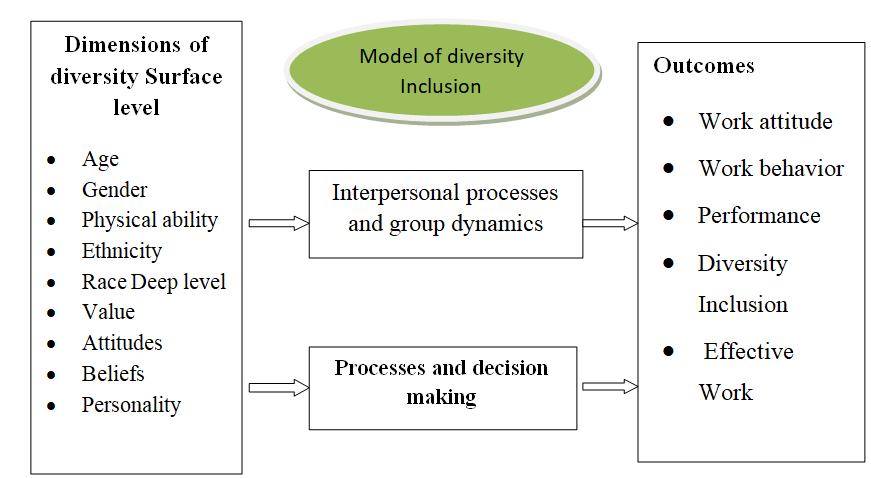
Methodology
This study employs an exploratory research design utilizing qualitative methods to analyze the role of leadership in promoting diversity and inclusion in Galan Town. Research design is defined as the arrangement of conditions for data collection and analysis. This study adopts an exploratory design with a survey method to examine the formulation of competitive strategies in organizations.
A qualitative research approach was chosen to gather detailed insights through interviews, allowing respondents to share their perspectives freely. This approach facilitates an understanding of social phenomena. The study focuses on Galan Town, selected based on the researcher’s prior experience in the area. Primary data was collected from key informant interviews, focus group discussions, and observations, while secondary data was obtained through document analysis.
Key Informant Interviews: Conducted with 20 informants, including local police officers, judges, religious leaders, and community elders, to gather diverse perspectives on diversity and inclusion in the workplace Observation: Employed to complement interviews and understand social dynamics, helping identify potential informants.
Focus Group Discussions: Five sessions with 25 participants from various backgrounds aimed to capture different views on leadership roles in conflict resolution and inclusion Document Analysis: Secondary data was gathered from books, journals, reports, and online sources to support primary findings.
Sampling Method
Purposive sampling was utilized to select knowledgeable informants from specific community segments, ensuring relevant insights into leadership roles in diversity and inclusion.
Target Population
The target population includes community members relevant to the study’s focus on leadership’s impact on diversity and inclusion, identified through purposive sampling.
Method of Data Analysis
Qualitative data was analyzed thematically, involving categorization and synthesis of information from interviews, observations, and focus groups. The analysis employed descriptive and qualitative approaches to interpret data and achieve research objectives.
Results and Discussions
Diversity Inclusion
Diversity is the full range of human differences and similarities and Inclusion is differentiate between behavioral inclusion includes inclusive mindsets, skillsets, and relationships, while structural inclusion focuses on equitable and transparent structures, practices, policies, and increasingly algorithms in any work place.
Diversity inclusion defined as the mixture of attributes within a workforce that in significant ways affect how people think, feel, and behave at work, and their acceptance, work performance, satisfaction, or progress in the organization. Diversity has also been described as the varied perspectives and approaches to work members of different identity groups bring. While demographic diversity may be a visible lead indicator, diversity of thought is seen as the end game.
According to the FGD proposed, they can vary from a negative view of diversity marked by resistance (diversity as a threat) to more positive approaches such as Discrimination and fairness perspective (differences problematized), Involves focus on justice and the fair treatment of all members, as a moral imperative, Access and legitimacy perspective (where differences are thought to create opportunities such as access to new markets or consumers): Based on the recognition that the organization’s markets and constituencies are culturally diverse and therefore matching the organization’s own workforce is a way of gaining access and legitimacy to those markets. Learning and integration perspective (seen as offering opportunities and providing sustained benefits in the long run): Premised on the belief that the skills, experiences and insights of diverse employees is a potentially valuable resource for learning and change, and is valued in the workgroup for attainment of its goals.
According to my Key Informants Inclusion is explained as one of the early descriptions of the term it is described as the extent to which individuals are allowed to participate and are enabled to contribute fully, the degree to which an employee is accepted and treated as an insider by others in a work system, a continuum of exclusion-inclusion, it has been discussed as the degree to which individuals feel a part of critical organizational processes. These processes include access to information and resources, connectedness to supervisor and co-workers, and ability to participate in and influence the decision making process. It is also seen as the removal of obstacles to the full participation and contribution of employees in organizations, the extent to which employees believe their organizations engage in efforts to involve all employees in the mission and operation of the organization with respect to their individual talents. Focused on the need for belongingness, some researchers define inclusion as when individuals feel a sense of belonging, and inclusive behaviors such as eliciting and valuing contributions from all employees are part of the daily life in the organization.
FGD Concerned as One of the most widely accepted, contemporary approach to viewing inclusion defines the degree to which an employee perceives that he or she is an esteemed member of the work group through experiencing treatment that satisfies his or her needs for belongingness and uniqueness. Inclusion is viewed both as a process and a condition. Defined as an active process of change or integration, as well an outcome, such as a feeling of belonging, inclusion is thought to incorporate both an active process of change (to include) and an emotional outcome.
The Role of Diversity Inclusion at Work Place
According to the views of Key Informant, Diversity Inclusion can provide many potential advantages to organizations. On one level it helps organizations to reach out to diverse customer groups and markets, and on another level by allowing for a variety of perspectives, it promotes innovativeness and superior work outcomes and performance. Diversity management alone is insufficient to improve performance. Diversity Inclusive workplaces characterized by supportive leadership and empowered employees is required to translate the gains. Diversity management strategies or approaches have also been criticized for not addressing the exclusion of people from different identity groups and their limited access and participation in the organization.
FGD linked diversity to negative outcomes such as personnel issues, costs due to harassment and discrimination, lower commitment, inhibited decision making and turnover. Demographic diversity has also been frequently associated with a few negative group outcomes such as higher levels of conflict, point to the inadvertent creation of distinct categories for the sake of diversity management. Intersections of multiple identities at work in organizations may be ignored, shows how typecast diverse employees have been placed in positions of lower power and status than those enjoyed by others in the organization. In other words, diversity has a flip side too and diversity management runs the threat of becoming a means for creating and perpetuating distinctions rather than seeking assimilation and integration. They have reported that female and racial ethnic-minority employees in work place are more supportive of organizational diversity initiatives than their male counterparts.
Role of Leadership in Diversity Inclusion
In addition, there is FGD views to show that certain Role of leader’s also foster inclusiveness more than others. Leadership plays an important role in creating and supporting inclusion in the workplace. There is evidence that inclusive leadership and inclusive practices can be viewed as experiences of inclusion. Compound most reflected self-sacrificing leadership. Personal humility, courage, and accountability closely followed empowerment as key indicators of altruistic leadership within all six countries surveyed. However in the study area Prejudice, discrimination and exclusion were prioritized by the majority leaders.
According to Key Informants argument the Characteristics of the inclusive leader have been identified as one who visibly champions diversity and initiatives linked to it, seeks out and values employees contributions, demonstrates a collaborative leadership style, has the ability to manage conflict, embodies merit based decision making, possesses cultural competency and creates a sense of collective identity. In some cultural contexts, leader behaviors were found to have a much stronger effect on employee innovation and team citizenship via inclusion where relatively stronger links existed between altruistic leadership, inclusion, innovation and citizenship.
Contributions of Diversity Inclusion within an Organization at Work Place
According to key Informants and FGD, the general contributions of diversity inclusion plays a crucial role in work place includes reduced costs, improved resourcing of talented personnel, better products and services, enhanced corporate image, improved creativity and problem- solving, better decision making, innovation, greater flexibility, increased productivity; improved organizational performance and efficiency, enhanced trust in relationships, satisfaction and commitment within the workforce and improved customer relations and service delivery.
More equitable representation of women and minorities could have benefits in terms of social justice considerations. However, at work place in the study area the Negative outcomes of diversity inclusion are found to include more absenteeism, weaker employee attachment, more conflict, poorer in role and extra role performance and more discrimination, leading to higher costs and losses for the employments.
There are conditions in which diverse teams operate impact on their performance; these include understanding and communication within the employment steam, leadership, societal/cultural attitudes; and the amount of time employments teams have worked together. Not promoting diversity and inclusion and allowing discrimination and bias to persevere can lead to lower organizational commitment, lower job satisfaction, higher work tension, absenteeism, high labor turnover, loss of talented employees, tribunals and the associated bad publicity.
Diversity management is important in determining if diversity will bring benefits; although there is no single approach which organizations can adopt to ensure diversity is beneficial. The development of a diversity mindset/ climate for inclusion are important for the positive effects of diversity, such as organizational commitment, intentions to stay or leave, satisfaction, engagement, trust in management, and firm effectiveness, to appear.
Emphasis on diversity focuses on the composition of work groups around factors that generally distinguishes one individual from the other, mostly in terms of observable demographic characteristics such as gender, race, ethnicity, or age, or in term of non-observable attributes such as education or socio-economic status. Some FGD argue that when diversity efforts focus more on visual identities such as race, gender, age or disability, without addressing hidden identities emergent from differences in values, beliefs, attitudes, cultures or needs, it may actually hinder development of inclusive cultures by overemphasizing differences rather than commonalties.
Gender
Key informants suggested as greater gender diversity in top positions outperform sector averages, suggesting a possible correlation between gender diversity and work performance; although this does not necessarily mean that diversity has had a direct causal impact on performance. Controls for work size and other variables may negate any positive correlation between board gender diversity and financial outcomes.
Key informant offering evidence that mixed gender teams can aid innovation and increased feelings of psychological security. FGD indicates that gender diversity had a significant, negative effect in majority of male occupational settings, but a positive effect in gender-balanced settings. Key informant justified as the positive relations between women on boards and corporate social responsibility, although they have varied in their ability to address causal relations.
Age
There are claims, not supported by empirical evidence, that older people are an unexploited source of labor and their skills and experience are essential for maintaining quality. On the other hand there are also worries that older workers will block the recruitment and career progression opportunities for younger workers. Small number of academic studies suggested that older workers cost more than younger workers as a result of increased absenteeism and workplace injury, although there were other benefits to employing older workers.
Ethnicity
According to FGD, the find that a review of evidence from the work place employments found positive correlations between board level and workforce ethnic diversity and firm profitability. In addition, a case study found increased their market share among ethnic minorities as a result of increasing the ethnic diversity of their work force.
As my key informants suggested Positive correlation between workforce ethnic diversity and productivity, in firms pursuing growth strategies. However, there is no relation between ethnic diversity and the likelihood that companies innovate, the level of ethnic diversity in their work place have been too low to identify an outcome. A racial diversity had a positive effect in majority occupations, but a negative effect in more balanced occupations.
Disability, Religion and Sexual Orientation
As data gained from workplace FGD And Key informants impacts of diversity inclusion at work place outcomes considering disability, religion and sexual orientation were appears to be mixed and inconclusive, discourse on diversity has moved away from equal opportunities and is now associated with exclusiveness, with misrecognizing, valuing and respecting differences.
The Types and Sources of Diversity and Inclusion
As data gained from respondents the types of Diversity and Inclusion includes Behavioral inclusion indicates all key internal stakeholders recognize the risks and impact associated with workplace harassment, bullying, and discrimination. The organization can see the transition from DI passion to DI competency and from unconscious bias to conscious inclusion. Inclusive behaviors are part of the company’s entire talent management lifecycle, inclusion and equity are guidelines in all people related decisions and actions. Leaders and employees demonstrate strong inclusion skills and leverage talent diversity for better decision making and team performance. Functional leaders and middle managers role-model inclusion and display inclusive leadership skills, deliberately putting together high-performing diverse-by-design teams for operational tasks and projects, and ensuring that teams operate in an inclusive manner. Reaching out to diverse customers is considered to be a key part of an organization’s brand. Leaders and employees recognize the need for cross cultural competency and actively seek to learn more and understand best practice.
FGD discussed as the organization approaches DE from a broad risk management perspective, as opposed to an HR issue. Senior leaders and the Board proactively monitor DI risks as part of broader organizational risks including the need for good reporting and whistleblower systems. There are clear consequences and processes for employees who don’t adhere to company DI policies and values, and all employees should feel comfortable reporting abuses.
As FGD classified, the second type of Diversity Inclusion Structural inclusion that enshrined as a top leadership priority and a core value. The company deploys robust and integrated DE&I governance and accountability, and metrics are established to measure progress. The company works towards external certifications in DI efforts. All employees are part of diversity and inclusion learning journeys and are recognized for DI achievements. Structural inclusion – DI talent strategies are fully aligned. Talent processes are reviewed to ensure biases are minimized. Leaders and employees are accountable for integrating DE&I into talent management, and robust DE&I analytics inform talent decisions. Structural inclusion – DI is embedded in sales, marketing, and customer service functions, while product testing, marketing campaigns, and clinical trials routinely use DI metrics.
Challenges Diversity and Inclusion within an Organization at Work Place
As FGD concluded Diversity is not a guarantee for inclusion, it is also applied in organizations to work on a sense of injustice to create a more diverse discrimination work environment. Research indicates that sometimes diversity at work has led to more favorable work outcomes, such as more absenteeism, weaker employee attachment, more conflict, poorer in-role and extra-role performance, and more discrimination. As a result, when diversity at work does not work, it may result in lower revenues due to missed business opportunities, higher costs in view of lower employee morale, and expensive lawsuits involving employment discrimination. It is suggested that the negative effects of diversity on work outcomes may be as a result of people preferring to work with others of a similar background.
Key informant interview suggested as the Negative outcomes included diversity leading to process losses through task conflict and decreased social integration; as well as the acknowledgement that increased diversity can lead to lower commitment, lower satisfaction, more perceived discrimination, misunderstanding and other negative behavioral and attitudinal outcomes.
The Key informant respondents were indicated factors on a scale the obstacles for accepting diversity in the workplace identified based on gender, nationality, job title, degree of education and length of professional experience in Prejudice, Ethnocentrism, Linguistic barriers, Stereotypes, Discrimination, Ignorance, Sexism and Lack of openness to inclusion.
Impact of Diversity Inclusion
The diversity is sometimes seen as distinct from the legal and moral case as it involves factors which can improve the economic performance and competiveness of firms.
The business case is often referred to in terms of managing diversity, while the moral case is often expressed in terms of Equal Opportunities, although they are hard to fully separate as equal opportunities legislation shapes the way in which diversity is managed. There are some arguments that the moral case is part of the business case. In addition, research finds that the discourse on diversity has moved away from equal opportunities and is now associated with inclusiveness, with recognizing, valuing and respecting differences.
As it was indicated by Key Informants, Diversity Inclusion recognizes and values heterogeneity in organizations with a view to improve organizational performance and has been more common in the private sector. If diversity is poorly managed in either workplace or team settings, there is potential for increased complain rather than benefits. There is no single approach that all works can adopt to ensure equality and diversity are beneficial, although to be effective such approaches need to be embedded in work strategy and not treated as an ad-hoc addition.
The connection between leadership and diversity inclusion in work place settings is one that has a direct impact on work and the success of staff alike. The people who come together to create an organizational culture in work place, and often times issues regarding diversity inclusion can be traced back to leadership.
The Result of Diversity Inclusion
To achieve Diversity and Inclusion at work place, organizations need to transform from their core. This takes time and effort, but the fundamentals of successful DI transformations are emerging. A successful DI corporate approach is generally data-driven, and focused on understanding what works and what doesn’t, and what the root causes are behind any lack of progress in DI efforts. Companies also need to proactively build inclusive leadership capabilities and intentionally shape both behavioral (mindsets, skillsets, relationships) and structural (structures, processes, practices) inclusion.
As companies seek a transformation-based approach to accelerate their DE&I journey, it is critical they understand where they are in terms of their DI maturity, where they want to be and how they are going to get there. A strategic roadmap helps organizations develop their DE&I processes and approach. FGD justified DI as maturity model provides a framework to help organizations understand where they stand in terms of their DI journey and how they can navigate towards improved performance. This maturity model assesses both behavioral and structural inclusion across five key DI dimensions (risk management; awareness; talent integration; operations integration; and market integration) and scores DI performance over four levels, ranging from basic up to leading edge.
Common Diversity Inclusion at work place Initiatives the most common diversity and inclusion initiative has been diversity training and several studies have tried to assess the impact and correlates of success for it. Gender diversity programs are one of the most common areas of focus, followed by programs focused on ethnicity, age, and race.
According to data assessed from the whole respondents at work place Diversity inclusion are thought to be driven by perceptions of unfairness, disrespect, lack of value/ belonging. In other words, when employees feel included, they would not treated fairly and respectfully, but also that their unique value is known and appreciated, and they belong to the group. Thus, a first level of inclusion is contingent on equality and participation, where employees look at other reference groups (male vs. female) to see if the organization treats them fairly in terms of pay and rewards. Being valued and feeling a sense of belongingness is the uniqueness element of inclusion. What this means is that employees are also constantly checking to see if their uniqueness is being affirmed and appreciated by the group and the organization, and whether they have a voice in decision making. This then represents the second level of inclusion - about having a voice and being connected.
As the FGD suggested about the result of Diversity Inclusion in the work place leads Threat to the self-concept, Lowered self-esteem, Anger, frustration and emotional denial, Cognitive impairment, Prejudice, discrimination and exclusion are seen as psychological processes that influence the inclusion of employees and exclusion in the study area.
Conclusion
In conclusion, this study highlights the critical role of diversity and inclusion within the workplace in Galan Town, revealing both the impactful benefits and significant challenges associated with their implementation. Utilizing a purposive sampling technique, the research engaged a diverse group of 25 respondents through qualitative methods, including key informant interviews, focus group discussions, and observational data collection. The findings indicate that while there is recognition of the importance of diversity and inclusion, gaps remain in effective execution and awareness within the community.
The study underscores the limitations and challenges faced in fostering a truly inclusive environment, suggesting that efforts have not been fully realized in practice. Moreover, it emphasizes the need for heightened awareness and strategic initiatives to enhance the effectiveness of diversity and inclusion practices in the region. Ultimately, the recommendations call for national recognition and support for diversity and inclusion efforts, which are essential for promoting a more equitable and productive workplace. These insights contribute to a deeper understanding of the dynamics of diversity and inclusion in Galan Town and offer pathways for future improvement.
References
-
Martinez A (2021) the Importance of Historical Context in Diversity and Inclusion Efforts. International Journal of Human Resource Studies 11(2): 50-65.
-
Johnson A, Lee H (2022) Leveraging Diversity for Organizational Performance. Journal of Business Management 45(3): 123-140.
-
Johnson L, Smith A, Brown K (2022) Exploring the Intersection of Diversity and Inclusion. Journal of Organizational Behavior 43(2): 123-145.
-
Roberson Q (2020) Diversity in the Workplace: A Review and Future Directions. Annual Review of Organizational Psychology and Organizational Behavior 7: 437-463.
-
Williams T, Chen M (2023) Diversity and Inclusion in the Workplace: A Comprehensive Review. International Journal of Human Resource Studies 13(1): 45-60.
-
Smith J, Turner R (2021) the Evolution of Diversity Initiatives: Inclusion in Focus. Human Resource Management Review 31(4): 567-580.
-
Lee J, Kim S (2022) Evolving Discourse: From Diversity to Inclusion. Journal of Organizational Psychology 22(3): 45-60.
-
Garcia R, Patel S, Lee H (2023) the Importance of Diversity in the Workplace: A Modern Perspective. International Journal of Human Resource Management 34(2): 112-130.
-
Martinez A, Green T (2023) Attracting Talent in a Globalized World: The Role of Diversity and Inclusion. Human Resource Development Quarterly 34(1): 67-85.
-
Thompson L (2021) Recognizing the Importance of Diversity in the Workplace. Business Horizons 64(4): 523-533.
-
Chen Y, Lee H (2023) Understanding Diversity: A Critical Perspective. Journal of Diversity Management 18(1): 25- 40.
-
Martinez A, Smith R, Johnson T (2022) the Role of Identity in Diversity Management. International Journal of Human Resource Studies, 12(3): 112-130.
-
Roberson Q, Johnson L (2021) Post-Structural Perspectives on Identity and Diversity. Journal of Organizational Behavior 42(5): 789-803.
-
Roberson Q (2022) Inclusion in the Workplace: A New Paradigm. Academy of Management Perspectives 36(2): 189-203.
-
Johnson A, Smith R (2021) the Rise and fall of Diversity Discourse. Journal of Organizational Behavior 42(6): 1123-1140.
-
Williams T (2022) Diversity Management in Contemporary Organizations. International Journal of Business Research 18(4): 105-120.
-
Chen Y, Lee H (2023) the Future of Diversity: Managing Differences in the Workplace. International Journal of Human Resource Management 34(2): 145-160.
-
Brown L, Taylor S (2021) Revisiting Diversity in Organizations: A Comprehensive Overview. Journal of Business Ethics 172(4): 789-804.
-
Garcia R, Patel S (2022) Diversity, Inclusion, and the Role of Affirmative Action. Human Resource Management Review 32(1): 23-35.
-
Thompson L (2023) Problematic Differences: A Historical Review of Diversity Management. Journal of Organizational Psychology 23(3): 78-95.
-
Martinez A (2023) Understanding the Shift from Diversity to Inclusion. Business Horizons 66(1): 55-67.
-
Johnson A, Smith R (2021) Understanding Privilege and Bias in Higher Education. Journal of Educational Psychology 113(4): 663-678.
-
Martinez A, Lee H (2023) Legal Frameworks for Diversity and Inclusion in Organizations. Journal of Business Ethics 176(2): 345-360.
-
Barak ME, Cherin D (2022) Measuring Inclusion- Exclusion: A New Approach. Journal of Organizational Behavior 43(5): 789-805.
-
Shore LM (2021) the Inclusion Framework: Understanding Belongingness and Uniqueness in Organizations. Academy of Management Perspectives 35(1): 214-230.
-
Patel S, Garcia R, Kim J (2022) Understanding Bias in Hiring: A Comprehensive Analysis. Human Resource Management Review 32(3): 211-226.
-
Hogg MA, Terry DJ (2021) Social Identity Processes in Organizational Contexts. International Journal of Management Reviews 23(1): 34-50.
- The Indispensable Role of Informal Caregivers in Supporting the Aging Population
- Socio-Religious Significance of Kamakhya Temple in Guwahati, Assam
- Is Anthropology Possible?
- A Contribution to the History and Paleobiology of Harput/Elazığ Türkiye and Its Surroundings
- A Study on the Cowrie Shells of the Dimasas in Assam
- The Significance of International Organizations Cooperation in the Efficient Resolution of Global Conflict