
Program Implementation of Occupational Therapy Group Interventions for Women with Addictions
Objective: To determine if occupational therapy group services were beneficial for women in an entry-level addiction recovery center by utilizing a comprehensive post intervention survey. Methods: Female residents enrolled in the entry phase of a long-term addiction center participated in occupational therapy (OT) group sessions led by OTA and MOT students from the University of Louisiana Monroe. At the end of the semester, participants of the group sessions autonomously completed a 5-point Likert scale survey of 10-statements to rate the potential benefits of the occupational therapy interventions. This quantitative study investigated survey results in a two-year period supervised and directed by the two authors. Results: The survey results proved that OT is beneficial and needed in addiction rehabilitation for women with substance abuse. Conclusion: This academic-based program displayed the importance of implementing occupational therapy group interventions for women with addictions to enhance meaningful daily activities. Peer-reviewed articles that directly addressed known occupational performance issues and limiting factors commonly found within this population were facilitated through evidenced-based group sessions. The 5-point Likert instrument used in this quantitative study revealed powerful findings supporting the benefits of occupational therapy intervention in the recovery process.
Background
Substance use disorder is a mental illness that could potentially affect an individual’s cognition, behavior, and physiological reactions due to the continued use of the desired substance despite serious problems [1]. In the United States, the number one reason for death between Program Implementation of Occupational Therapy Group Interventions for Women with Addictions the ages of 25- 64 is drug overdose resulting in a national epidemic [2]. Over time, there has been a rise in substance abuse and the rate of overdose with women especially [3]. Therefore, the American Occupational Therapy Association in recent years has emphasized the vital role of occupational therapy for clients with addictions [4]. Due to this mental health crisis OT schools have included Ann Physiother Occup Ther
addiction rehab facilities for psychosocial fieldwork placements to enhance student learning and potentially improve successful recovery for clients with substance use disorder.
Methods
This psychosocial intervention program was executed at a long-term residential addiction center for women who suffer from substance abuse and chemical dependency. Selected students from the Occupational Therapy Assistant (OTA) program and the Master of Occupational Therapy (MOT) bridge program at the University of Louisiana Monroe were assigned to the addiction center, Rays of Sonshine, for their level I fieldwork rotation under the direct supervision of a faculty member. Students carefully planned and implemented the evidence-based group sessions for a total of eight weekly sessions with OTA students and 3 four-hour sessions with MOT students on the weekends.
The group sessions varied in number depending on the location and scheduled doctors appointments. The weekly groups ranged from five to fifteen participants at the main center; however, the weekend groups were higher in number ranging from fifteen to twenty women, which was located at their group home. The women were from the ages of 18-65 years of age that were enrolled in the long-term addiction recovery program, primarily from the state of Louisiana.
Group Implementation
The mental health group sessions were focused on positive life choices and purposeful daily activities to decrease addiction-seeking behavior. Occupational performance issues were identified in the Occupational Therapy Practice Framework, which included leisure participation, social participation, and instrumental activities of daily living such as meal preparation, health management [5]. Leisure participation was encouraged in multiple sessions by teaching a leisure skill, which included but not limited to jewellery making, leatherwork, gardening, and scrapbooking. In 2012, five researchers in Sweden published significant findings from a questionnaire that concluded women who stated a decrease in leisure participation throughout their daily schedule were more likely to engage in substance abuse [6].
Next, we addressed social participation to improve appropriate verbal communication with peers, to enhance positive coping skills for group work, and ultimately to produce an increase in self-efficacy. Current research has proved that women with an addiction history will be more likely to succeed and decrease the chance of relapse if they possess the appropriate coping skills for environmental stressors and a positive self-worth [7]. The last area of focus was on health and wellness, prioritizing nutrition, exercise, and organization of daily activities. Clients participated in meal planning, cooking, and organizational activities to promote a health diet and positive lifestyle choices for not only themselves but for their families as well. All groups were focused on teamwork, critical thinking skills, self-reflection and self- esteem.
Results
After conclusion of the fieldwork rotation, clients who participated in occupational therapy (OT) group sessions were presented with an IRB approved informed consent that thoroughly explained the purpose of the survey. If the informed consent was approved, clients autonomously completed a paper survey, which included ten-statements to rate how each participant felt on a 5 point Likert scale. Twenty-three participants completed the survey between the years of 2018 and 2019. Figure 1 displayed the results of an initial question on the survey asked prior to the statements to identify the most commonly abused substance in the group.
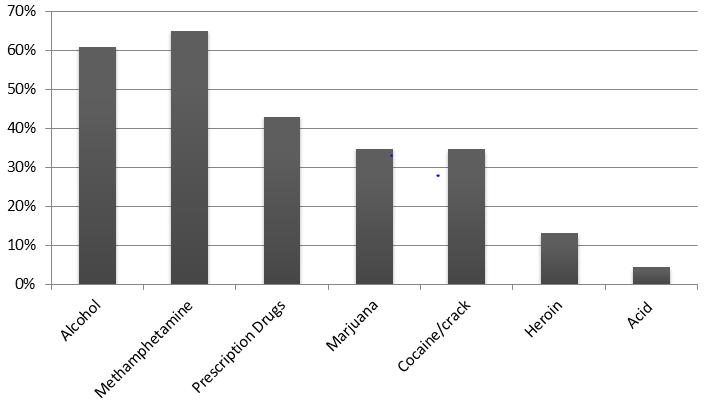
Gray area represents the percentile of participants in the program that used the following substance(s) in the past.
The survey results revealed that OT is beneficial and plays a vital role in addiction rehabilitation for women with substance abuse. All of the participants rated that the OT activities were meaningful to the recovery process at a score of five (highly agree) or a four (agree). An astonishing 95% of residents reported that the group sessions promoted positive choices for leisure and social participation, and enjoyment in learning new ways to improve health and nutrition. Seventy-eight percent of the residents rated a score of five (highly agree) to a statement about learning a new leisure activity that would be useful again in the future. Further results displayed in Figure 2 displaying the participants views of the occupational therapy group sessions.
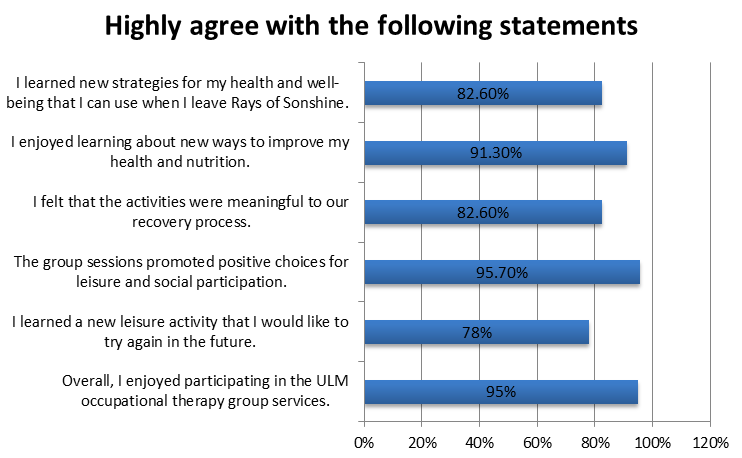
Colored area represents the participants that scored the statement as highly agree (5) on the 5 point Likert scale. In addition to the quantitative component, participants were provided an optional space at the end of the survey to describe the impact that these activities had on their recovery process. The following quotes were taken autonomously from the essay portion of the survey. Participant A reported, “I want you all to know I really enjoy it when you come, it gives me new craft ideas that I can use now that I’m not using drugs. I wish you could come more often.” Participant B stated, “Seeing that I can have fun and do things I really enjoy sober.” Participant C expressed, “It just helps me with my anger and my creative skills.”
Limitations
The authors would like to bring awareness to the following limitations of the study. The low number of participants in a two-year study was a hindrance to the data gathered. The students and faculty were only allowed to implement the OT groups with entry-level residents, which caused a decline in the number. A second limitation would be the time frame allowed into the facility. It was difficult to identify the impact of OT services for the clients over the entire recovery process. The third limitation would be the lack of a control group to monitor the success of OT services in a more rigid study.
Conclusion
In summary, our intent for this program and study was multi-faceted. Our goals were to expand awareness and provide further education on the OT interventions utilized in addiction recovery, to report the significant findings from the survey, and to empower students to advocate for the role of OT in mental health settings. This study’s finding yielded a powerful conclusion supporting the use of evidence-based occupational therapy group interventions implemented as part of a dynamic addiction recovery team.
Acknowledgements
The authors would like to thank the administration and the staff at Rays of Sonshine for their support of the ULM OT department.
References
-
American Psychological Association (2013) Diagnostic and statistical manual of mental disorders, 5th (Edn.), Arlington VA.
-
National Center for Injury Prevention and Control (2017) 10 leading causes of injury deaths by age group highlighted unintentional injury deaths. United States.
-
Center for Disease Control and Prevention (2017) Addressing the unique challenges of opioid use disorder in women. Public Health Grand Rounds.
-
Costa D (2016) Occupational therapy’s role in countering opioid addiction 22: 12-16.
-
American Occupational Therapy Association (2014) Occupational therapy practice framework: Domain and practice 3rd (Eds.), American Journal of Occupational Therapy 68: 1-48.
-
Andesson C, Eklund M, Sundh V, Thundal KL, Spak F, et al. (2012) Women’s pattern of everyday occupations and alcohol consumption. Scand J Occup Ther 19(3): 225-238.
-
Taylor OD, Williams-Salisbury E (2015) Coping skills and self-efficacy of substance-using women versus non-substance-using women. Journal of Human Behavior in the Social Environment 25(4): 351-359.
- Electrolyte Considerations for Athletes
- Comprehensive Rehabilitation in Adults with Diabetic Peripheral Neuropathy: A Literature Review on Frequency, Intensity, and Duration Parameters
- Exercise Duration and Its Association with ADHD Symptom Severity in Children and Adolescents: A Parent-Reported Survey Study
- Adaptation of the Adult Neurophysiology of Pain Questionnaire for Use in Pediatrics
- A Non-Pharmacological Multidisciplinary Pain Program within a Hospital Wellness Program: A Mixed Methods Study
- The Effect of Frenkel's Exercise with PNF on Functional Reach in Stroke Survivors: A Randomized Control Trial