
An Increasing Emphasis of Evidence-Based Practice in Children with Developmental Disabilities
Background: In response to demands of client care and constraints of limited healthcare resources, it is necessary to identify the precise nature of current research trends in occupational therapy in the United States. Objectives: The specific aim of this study was to explore the common themes of occupational therapy research over a ten-year period (2007-2016), and how this research has evolved. Methods: Articles published in the American Journal of Occupational Therapy from 2007-2016 were analyzed. Results: Majority of the studies focused on the improvement of behavior in children with developmental disabilities through various occupational therapy interventions. In addition, there was an increased focus on the generation of valid and reliable data promoting evidence-based practice. Conclusions: This study demonstrates that current research in occupational therapy is focused on interventions in children which aligns with the American Occupational Therapy Association’s Framework-III (2014) supporting interventions that promote healthy development in children.
Introduction
An emphasis on research in occupational therapy is receiving increasing and unprecedented attention in recent years [1]. The universal opinion among decision makers is that the occupational therapy profession can only develop and prosper only if an empirical research base that validates the efficacy and value of occupational therapy practice is established [2]. Hence, occupational therapists need to recognize the necessity to actively pursue research to establish their position in the hierarchy of healthcare providers [3]. Therefore, it is necessary to systematically identify the current research trends in occupational therapy to cater to client needs, and ensure efficient utilization of healthcare resources.
The practice of occupational therapy is concerned with maintaining an individual’s functional independence and well‐being from both preventative and treatment perspectives [4]. Due to the rising healthcare costs [5] clients are experiencing an increased financial burden [6]. Hence, clients are demonstrating more consumer-like behaviors McKenna, et al. [3] by researching treatment options [3] and providers Soto, et al. [7] prior to making a decision regarding their care. Thus, occupational therapists should devote significant effort to providing high-value care, which entails leveraging impactful touchpoints throughout a client’s course of care and beyond. Therefore, occupational therapists need to prioritize the outcomes of care as clients make their decisions based on the available evidence. This approach is referred to as evidence-based practice, which is defined broadly as the conscientious use of the current best evidence in making decisions about client care [8].
In relation to the utilization of healthcare resources, occupational therapists are under increasing pressure to justify the allocation of resources based on an analysis of the inherent value of their health programs and services [3, 9]. By engaging in research that specifically assesses the costs and outcomes of services, occupational therapists will be able to empirically demonstrate the value of their contribution to the health of clients [10]. In fact, studies of the cost-effectiveness of occupational therapy interventions have been identified as a universal priority area for future research by occupational therapists [11].
Thus, scientific studies in healthcare and the formulation of healthcare policies are mutually inclusive, and directed towards the common goal of improvement of the human condition [8]. Hence, the onus is on occupational therapists to emphasize their efforts to account for patient-consumers and better communicate their value to patients and other healthcare providers [12]. Thus, the demonstration of the efficacy of an intervention is no longer sufficient in the current healthcare environment with competing and increasing demands for limited resources [13]. Information on cost- effectiveness based on empirical evidence [3] is vital in order to demonstrate that occupational therapy interventions represent significant economic value for service providers and the public.
Considering the above issues, the broad objective of this study was to investigate the trends in occupational therapy research. This would determine whether they conform to the broad vision of enhancing education and research in the occupational therapy profession. It was aimed to accomplish this by systematically analyzing the titles of scholarly articles published in the American Journal of Occupational Therapy from 2007-2016. The American Journal of Occupational Therapy is the official publication of the American Occupational Therapy Association (AOTA). It is a peer-reviewed journal that focuses on research, practice, and health care issues in the field of occupational therapy and is one of the premier journals in this profession. Since its inception in 1937, it has published material related to occupational therapy that reflects the changing trends in the field and serves as an archive of its advances. It is considered one the most highly ranked occupational therapy journals, with the majority of the publications being from the United States [14]. Hence the publications in this journal are fairly reflective of occupational therapy research carried out in the United States [15].
An identification of the research trends in occupational therapy would assist educators in planning and evaluating appropriate professional and educational changes for the future.
Objectives
The specific aim of this study was to explore the most common themes of occupational therapy research based on articles published in the American Journal of Occupational Therapy over a period of ten years (2007-2016). The ultimate goal was to identify how these research trends have evolved and aligned with the broad goals of the profession.
Methodology
All articles published in American Journal of Occupational Therapy from 2007-2016 were retrieved from PubMed between July 15-31, 2018, using the search query “Am J Occup Ther.”, and parsed into the comma separated values (csv) file format. The PubMed® (https://www.ncbi.nlm.nih.gov/ pubmed), which is maintained by the US National Library of Medicine, National Institutes of Health, Bethesda, MD, is a free search engine that accesses the MEDLINE database of references and abstracts on life sciences and biomedical topics. The articles that were considered for this study included reports of original research, and reviews, and metasynthesis and previously published literature. A total of 943 articles were identified and categorized based on their individual years of publication.
A free, open access online platform (https:// wordcounter.com) was used to determine the most frequently occurring words in the abstracts of the articles that had been retrieved. For the purpose of this study, a word was defined as a set of letters that are separated by spaces, hyphens, and punctuation marks. All grammatical tools such as prepositions, conjunctions, articles, etc. along with the words “American”, “Journal”, and “Occupational Therapy” were excluded from analysis, due to their lack of importance in the study. A Natural Language Program Toolkit (NLPT), software program, available at http://nltk.org, was used for automatic summarization, language translation, part of speech tagging, parsing or grammatical analysis of published text in the journals.
Using the word counter online platform, the ten most commonly words occurring in the abstracts for each year were identified and compared with other years to recognize trends in their occurrence between the years. These findings were confirmed using the NLPT program. The changes in the frequency of words were calculated using the Statistical Package for the Social Sciences (SPSS) Version 26.0 software (https://www.ibm.com/analytics). A P-value of (p<0.05) was set for statistical significance.
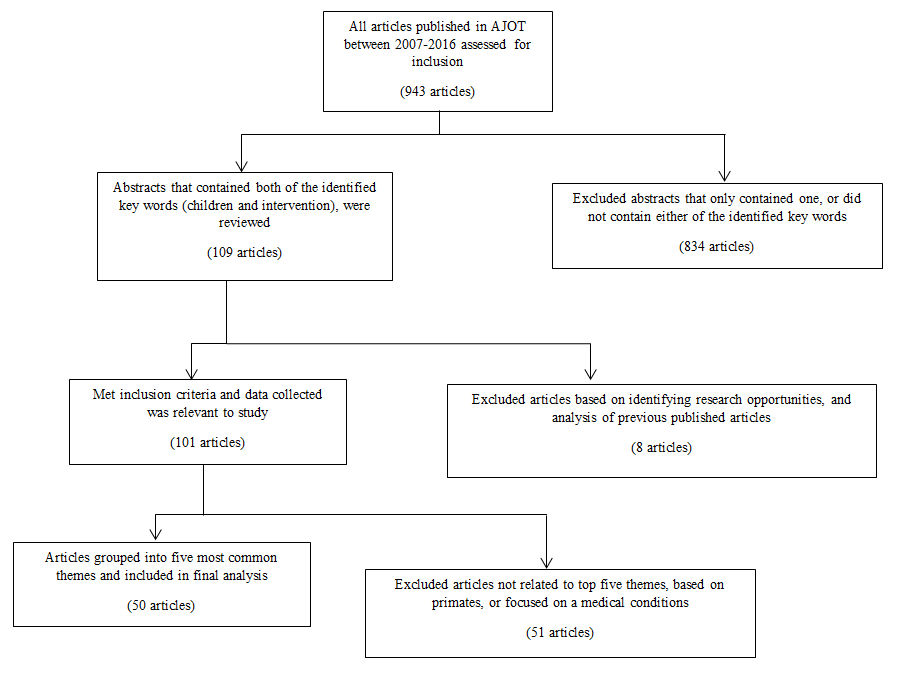
The two most commonly occurring words that were identified in the abstracts were, “children” and “intervention”. After identifying these two words of significance, the original 943 articles were sorted to identify articles that contained both of these significant words. This approach identified 109 articles containing both the words “children” and “intervention”. A total of 834 articles were excluded because they either only contained one, or neither of the two identified significant words. Furthermore, eight additional articles were excluded due to the fact they were focused on identifying additional research opportunities for other healthcare disciplines, therefore lacked relevance to this study.
Thus, only 101 articles were examined in their entirety to identify their specific research themes. This process yielded 31 themes, of which only the top five themes were examined further. This resulted in a total of 50 articles being included in the final analysis. The other 51 articles were excluded due to: (a) not being related to the top five identified themes, (b) being conducted on primates, or (c) focused on a medical condition, rather than an occupational therapy related approach. The categorization of the research themes of the articles was carried out independently by both researchers involved in the study, an outline of the methods adopted in this study have been presented in (Figure 1).
Results
A total of 943 articles published in the American Journal of Occupational Therapy from 2007-2016 were initially analyzed in this study. The nature of the articles was experimental studies (69.88%), systematic reviews (13.68%), descriptive studies (6.26%), pilot studies (5.62%), quasi-experimental studies (2.55%) and case studies (2.01%). The vast majority of articles (98.94%) had robust statistical information for valid and reliable assessment of results. In terms of authorship, 74.55% of articles had multiple authors, while 24.28% of articles had two authors, and the remaining 1.17% of articles was written by a single author.
As previously described, based on the overarching theme of assisting children to overcome their developmental disabilities, 50 articles were identified and examined in detail. A total of 34% of these articles were focused on children diagnosed with Autism Spectrum Disorders (ASD), while 12% articles were related to children with Attention-Deficit/ Hyperactivity Disorders (ADHD). In terms of geographical distribution, 92% of the studies were carried out in the United States, while the remaining studies were carried out in Australia, Canada, Israel and Taiwan.
The specific sub-themes of these articles included: sensory interventions designed to increase various areas of occupation and overall development (38%), school-based interventions that aimed to improve or increase social participation (18%), handwriting interventions (16%), physical activity/gross motor interventions to improve participation and behavior (14%), and cognitive-based functional interventions to improve behavior and enhance overall daily functioning (14%). While most of the articles were focused on interventions (74%), a limited number of articles were pilot studies (10%), assessments (8%), and systematic (6%) and scoping (2%) reviews.
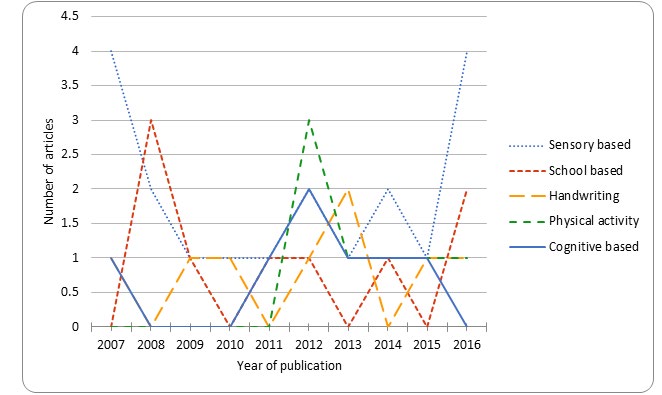
An analysis of the trends of publications showed that studies that focused on increasing overall occupation and development, school-based interventions and handwriting interventions did not show a significant change (p>0.05) during the time period of the study. However, studies related to physical activity or gross motor interventions and cognitive- based functional interventions showed a significant increase (p<0.05) in frequency in the last five years (2012-2016) of the study (Figure 2). The details of each of the specific sub- themes are presented in the succeeding sections.
Theme A: Sensory Interventions Designed to Improve Occupation and Overall Development
A total of 19 articles were focused on sensory interventions that were designed to increase occupational performance and enhance the overall development of children. Of these 19 articles, the majority of the articles (53%) were related to children with Autism Spectrum Disorders (ASD).
A total of seven articles were specifically focused on the utility of occupational therapy interventions. The first of the articles [16], explored the usefulness of a brief implementation of the Ayres Sensory Integration-Based intervention in children diagnosed with ASD. This intervention had a positive effect on transitions, socialization, compliance, and general behavior in these children during the treatment sessions, and subsequently in their home environment. The next article Hall L, et al. [17] aimed to investigate the effects of incorporating a therapeutic-listening program with a sensory diet on children with sensory processing disorders and visual–motor delays. The participants demonstrated a significant improvement in their behavior associated with sensory processing, and especially auditory processing, along with a modest improvement in motor functions. A subsequent study by Silva, et al. [18] aimed to describe the efficacy of Qiqong massage therapy, an approach that is based on the Chinese medicine concept of energy channels.
The objective of this study was to explore if occupational therapists educated in Western medicine could be trained to effectively deliver this intervention in children with ASD. The study concluded that all occupational therapists that had successfully completed the Qiqong training program were capable of effectively delivering this intervention. A quasi- experimental study Wuang YP, et al. [19], compared the effect of sensory integrative therapy, neurodevelopmental treatment, and perceptual–motor approach in children with mild mental retardation. The results indicated that these therapeutic interventions, when conducted on a regular basis, were beneficial in improving sensorimotor functions in school-age children. An isolated article Bellefeuille, et al. [20] presented a case report of a child with fecal incontinence and tactile over-responsivity. The results suggested that occupational therapy-based interventions could assist in the acquisition of age-appropriate toileting habits. In recognition of the need to enhance oral care in children diagnosed with ASD, a study Cermak, et al. [21] examined the implementation of a sensory adapted dental environment. The findings suggested that this intervention could be integrated into regular practice considering that though oral health is important for children’s psychological and physiological health, it is often neglected in many children with ASD. The most recent article in this category Blanche, et al. [22] was a retrospective study that aimed to evaluate the effectiveness of the Interdisciplinary Sensory Enriched Early Intervention (ISEEI) group program for children with developmental delays. The results indicated that children with sensory processing difficulties demonstrated significant improvement in all areas of development except fine motor skills. In children without sensory processing difficulties the ISEEI intervention showed significant improvement in language and cognition.
Three studies in this category aimed to investigate the utility of sensory integration (SI) in children. The first study May-Benson, et al. [23] demonstrated that a SI approach may result in positive outcomes in behavioral regulation and achievement of individualized goals that are sustained for a significant amount of time. This study was followed by a pilot study Pfeiffer, et al. [24] that aimed to obtain preliminary information on the effectiveness of SI interventions in children with ASD. The results of the study, though moderate, demonstrated significant improvements in autistic mannerisms, and progress toward individualized goals in areas of sensory processing, self-regulation, emotional function, and fine motor skills. The third article Koester, et al. [25] was a retrospective study that investigated the role of SI in children who had received cochlear implants. The study concluded that occupational therapists working with children with cochlear implants should examine sensory integration function in greater detail during assessments and while planning interventions.
Two studies examined the relationship between sensory over-responsivity and anxiety in children with ASD and ADHD. A qualitative study Freuler, et al. [26] aimed to conduct a retrospective analysis of infant home videos to identify some behavioral characteristics of ASD. This study was able to identify some early precursors of ASD that included hyporesponsiveness, hyper responsiveness, sensory repetitions and atypical motor postures. These findings are significant, considering that despite noticeable heterogeneity in sensory patterns in these children, the evidence suggested that hyper responsiveness may be a precursor for extreme sensory disruptions at later ages in ASD. Another study Lane, et al. [27] aimed to analyze the relationship between sensory over-responsivity and anxiety in children with ASD and ADHD. The authors concluded that the magnitude of physiological responses to sensations is influenced by the child’s baseline state of attention and arousal, which impacts the outcomes of anxiety and physiological responses. The authors also suggested that investigation on behavioral tools are necessary to measure sensory over-responsivity since current available tools rely are based on the perceptions of a child’s responses (Table 1).
| Number | Percentage | |
|---|---|---|
| Experimental studies | 659 | 69.88 |
| Systematic review | 129 | 13.68 |
| Descriptive studies | 59 | 6.26 |
| Pilot studies | 53 | 5.62 |
| Quasi-experimental studies | 24 | 2.55 |
| Case Studies | 19 | 2.01 |
Table 1: Categories of article published in AJOT (2007-2016).
Total articles: 943 Table 1: Categories of article published in AJOT (2007-2016).
A series of three articles were focused on the role of caregivers and parents in the management of children with mental disabilities. The first study Cohn, et al. [28] aimed to identify the expectations and concerns of parents of children, who were receiving occupational therapy based sensory interventions. The major expectations included self-regulation, participation in skilled motor activities, and enhanced self-confidence. In addition, parents and caregivers hoped that occupational therapy interventions would help their children to self-regulate their behavior in socially acceptable ways and transition into productive adults. A pilot study Kirby, et al. [29] described the development of the Caregiver Strategies Inventory (CSI), with a specific focus on cognitive-behavioral, sensory-perceptual, and avoidance strategies in children with ASD. The findings of the study supported the design and utility of the CSI as a measure of caregiver strategies that addressed sensory features during everyday activities, and measured the frequency of their usage. Lastly, a study by Bulkeley, et al. [30] explored a sensory-based, family-centered coaching approach for modifying sensory-related problem behaviors of young children with ASD. The results from the study suggested that this intervention was acceptable to all parents and caregivers since it addressed family priorities that were guided by the cultural standpoint of the participants.
Two studies aimed to delineate outcome measures in sensory programs designed to increase occupation were identified. The first study in this category Mailloux, et al. [31] explored the utility of the Goal Attainment Scaling (GAS) for evaluation of patient participation in goal-setting. The study concluded that this client-centered tool provided a valid and reliable means to identify functional and meaningful intervention outcomes that are specifically relevant to occupational therapy. The more recent study in this category Faller, et al. [32] recognized the need for a systematic process to guide occupational therapy practice with a focus on outcome measurement in children. The article described the application of the Data-Driven Decision-Making process to aid in the systematic selection of precise interventions and outcome measurements to support decision making.
The last two articles in this category were more isolated in their approach towards improving occupation and overall development. The only pilot study in this category Miller, et al. [33] outlined the steps involved in designing a randomized controlled study with a specific focus on occupational therapy research. It utilized a SI model of approach in children. While reporting positive results, this study also emphasized the need for pilot studies to guide the designing of randomized control trials, with a special emphasis on quantifiable outcomes that are sensitive to change. A systematic review Case-Smith, et al. [34] on children with ASD brought to the forefront the intervention themes that are relevant to occupational therapists in both direct service and supportive team roles. The authors concluded that research in occupational therapy was well aligned with the philosophical and conceptual basis of the management of ASD. However, several of the current approaches of greatest relevance to occupational therapists were at a low level of evidence, suggesting a need to enhance the level of scientific rigor of research [35].
Theme B: School-Based Interventions Aimed to Improve/Increase Social Participation
A total of nine articles, in three of which the target population was ASD, explored the role of school-based interventions that aimed to improve or increase social participation in children with developmental disabilities [36, 37].
Four articles with the specific aim of utilizing school- based interventions to improve and increase social participation were identified. The first article in this category Bundy, et al. [38] demonstrated that a random arrangement of materials, with no defined purpose, when placed on a school playground was beneficial for the mental development of children. Over a period of time, this approach increased the socialization, creativeness, and resilience in children and thus had potential to be used in children with developmental delays. Another study Bazyk, et al. [36], reported the utility of integrating occupational therapy services into the classroom curriculum in children with and without disabilities. The results showed statistically significant improvements in fine motor and emergent literacy outcomes in these children. The next study Golos, et al. [37] examined the effects of a school-based multidisciplinary and multimodal intervention program among preschool boys. The intervention was effective in improving skills and performance and participation in the preschool daily activities of both the children at risk and those with normal development. Lastly, the focus of a study by Kinnealey, et al. [38] was on the utility of classroom modifications in children with ASD. It was demonstrated that modifications such as soundproof walls and halogen lighting improved classroom performance and mood in these children. In addition, journaling themes recorded by students suggested that changes in the classroom environment generated a positive emotional response and improvement in handwriting, hearing, and thinking (Table 2).
| Number of authors | Number | Percentage |
|---|---|---|
| Multiple authors (more than 3) | 703 | 74.55 |
| Systematic review | 229 | 24.28 |
| Descriptive studies | 11 | 1.17 |
| Quasi-experimental studies | 24 | 2.55 |
| Case Studies | 19 | 2.01 |
Total articles: 943 Table 1: Authors of article published in AJOT (2007-2016).
In relation to the above theme, another study Hilton, et al. [39] aimed to identify the out of school activity of high-functioning children diagnosed with ASD. Using the Children’s Assessment of Participation and Enjoyment, the most significant finding was that these children participated in a more limited range of activities, with a smaller group of other participants, and within a narrower geographic area.
There were three articles that focused on the lack of preparation of occupational therapists in the implementation of school-based interventions that aimed to improve or increase social participation in children. A study by Myers, et al. [40], recognized that the majority of occupational therapists felt that their participation in assisting the transition of young children with special needs into preschool was not satisfactory. The identified barriers reported by occupational therapists included a lack of time and support, or not being included in the process of planning. On a similar note, another study Leigers, et al. [41] concluded that occupational therapists were lacking in their role in addressing social participation in schools for students with specific disability categories, such as handwriting, sensory processing, self-care, and general fine motor activities. The consensus was that occupational therapists had a limited understanding of their role in the process. The last study Glennon, et al. [42], examined the perceptions, preparedness, and practices of occupational therapists involved in designing supports for transitioning into college in students with ASD. Again, the majority of the therapists indicated the need for more institutional guidance and training in designing such support services.
The final article in this category Daunhauer, et al. [43], aimed to outline the distinct patterns of strengths and weaknesses of students with Down syndrome. The study concluded that children with Down syndrome demonstrated a distinct and pronounced pattern of assistance- and adaptation-related needs across various domains of school function that would benefit from a school-based education plan. Theme C: Interventions Designed to Improve Handwriting While a total of eight articles were broadly related to improving handwriting skills in children, the majority of those were directly related to specific interventions to improve handwriting.
The first study Ratzon, et al. [44] in this category aimed to test the efficacy of a short-term intervention in the improvement of visual–motor skills in first graders. Interventions such as threading beads, inserting pegs and guided play with coins demonstrated a significant improvement in the handwriting skills of these children. The next article Roberts, et al. [45] examined the role of kinesthetic writing interventions in young students. The study concluded that these interventions were effective in improving legibility, speed and personal satisfaction in students with handwriting challenges. Another study by Howe, et al. [46] reported that students exposed to traditional handwriting instruction that included intensive practice and repetition performed significantly better in legibility than the students exposed to other visual–perceptual–motor activities. Following previous reports, Pfeiffer, et al. [47] aimed to assess the utility of the Buktenica Developmental Test for Visual-Motor Intervention (VMI) as an outcome measure for handwriting interventions. The study reiterated the conclusions of previous studies regarding the validity of the VMI for the assessment of changes after a handwriting intervention. Another study Zylstra, et al. [48] examined the effectiveness of the Size Matters Handwriting Program, an occupational therapy-led handwriting intervention for special education and at-risk kindergarteners. The kindergarteners who participated in the intervention demonstrated considerably greater improvement in handwriting legibility, and thus providing initial support for its utilization in the training of kindergarten children. The most recent intervention approach in Palsbo, et al. [49], was a preliminary evaluation of the safety and efficacy of robotic- assisted, three-dimensional repetitive motion in children diagnosed with ASD and ADHD who faced challenges in their motor abilities. Through the haptic computer–user interface was designed to deliver a precise program of multisensory therapy; mixed success was observed in the improvement of handwriting skills (Table 3).
| Sensory program designed to increase occupation and overall development | School based interventions aimed to improve/increase social participation | Handwriting interventions | Physical activity/gross motor interventions | Cognitive based functional interventions to increase behavior and overall daily functioning | |
|---|---|---|---|---|---|
| 2007 | 4 | - | 1 | - | 1 |
| 2008 | 2 | 3 | - | - | - |
| 2009 | 1 | 1 | 1 | - | - |
| 2010 | 1 | - | 1 | - | - |
| 2011 | 1 | 1 | - | - | 1 |
| 2012 | 2 | 1 | 1 | 3 | 2 |
| 2013 | 1 | - | 2 | 1 | 1 |
| 2014 | 2 | 1 | - | 1 | 1 |
| 2015 | 1 | - | 1 | 1 | 1 |
| 2016 | 4 | 2 | 1 | 1 | - |
| Total | 19 | 9 | 8 | 7 | 7 |
| ASD (n=17) (34%) | 10 = 10/19 = 53% | 3 | 1 | 3 | 0 |
| ADHD (n=6) (12%) | 1 | 0 | 1 | 0 | 4 |
| Outside US (n-13) (26%) | Taiwan (A7) Indeterminate Australia (A17) | Australia (B2) Israel (B5) | Israel (C1) (Tel Aviv University) Israel (C2) (Haifa University) Canada (C3) (Alberta) Canada (C5) (Toronto) | (All are from same university-Hebrew University) Israel (E1) Israel (E2) Israel (E6) Israel (E7) |
Table 3: Breakdown of the Five Identified Themes by Year of Article Publication.
In keeping with the theme of handwriting, another study Engel Yeger, et al. [50] examined the perceived self- efficacy relationships and self-reports of children of their handwriting skills, and their actual handwriting process. This study concluded that the students included in the study were aware of their handwriting deficits and were able to report them accurately.
An isolated study Schwellnus, et al. [51] aimed to investigate the anatomical basis of handwriting in children, in relation to kinetics, speed and legibility. The results suggested that while there were no kinetic differences in the number of fingers on the writing instrument, the position of the thumb had a significant impact on handwriting skills. However, the study also emphasized that the focus of occupational therapy intervention should be on the improvements in the speed and formation of letters to enhance legibility rather than on alterations in the grasp patterns.
Theme D: Physical Activity or Gross Motor Interventions to Increase Participation and Behavior
A total of seven articles were focused on improving behavior and participation in occupations through physical activity or gross motor interventions. The first study in this category Gutman, et al. [52] aimed to improve social skills and participation through roleplay in children diagnosed with High Functioning Autism. The participants were trained in the appropriate use and interpretation of motor behaviors, facial expressions and body language. The results showed that these children were able to significantly improve their verbal and nonverbal behaviors. The second article in this category Bellows, et al. [53] focused on overall improvement of gross motor skills in all children through a short-term implementation of “The Food Friends: Get Moving’ With Mighty Moves program”. This program, developed in conjunction with experts in nutrition and exercise science, aimed to enhance motor skill performance and provide opportunities to increase physical activity in a preschool setting. The program demonstrated significant improvements in gross motor skills, without any significant improvements in levels of physical activity or weight status. A succeeding article Hilton, et al. [54] required participants to rapidly strike lighted targets with a ball in a Makato arena training arena. The authors reported a significant improvement in reaction speed, executive functioning, and motor performance in the participants. This study suggested that a longer implementation of this approach might be of significant benefit in children with and without ASD. In an attempt to increase physical activity, a study by Koenig, et al. [55] aimed to train students in the principles of the Get Ready to Learn classroom yoga program. Its aim was to train students in yoga techniques through visual instructions. Students who received these instructional materials showed a reduction in maladaptive behaviors and signs of irritability, lethargy, social withdrawal, and hyperactivity. The next study Silva & Schalock, et al. [56] was a follow up to a previous study Silva, et al. [18] that aimed to improve behavior in children with motor delays using the Qigong massage intervention. This study reported that Qigong massage delivered through a trained therapist and a parent, resulted in lasting improvement in motor skills in children diagnosed with Cerebral Palsy and Down syndrome, though no sensory improvement was observed. A systematic review of yoga interventions by Weaver, et al. [57] assessed the usefulness of yoga in reducing anxiety in children and adolescents of all ages. The review concluded that yoga- based interventions could have positive effects in reducing anxiety across a variety of populations. However, due to the heterogeneity of the studies, large-scale, randomized trials were still necessary to establish its utility.
This most recent article in this category was a scoping review Jirikowic, et al. [58] that aimed to address the lack of literature regarding health-promoting physical activity (HPPA) for children who use assistive mobility devices (AMDs). This review, accurately identified child, family, and environmental facilitators and barriers relevant to HPPA participation among children who use AMDs. The most significant of these barriers were the severity of disabilities and the financial constraints of parents.
Theme E: Cognitive-Based Functional Interventions to Increase Behavior and Overall Daily Functioning
A total of seven articles, of which four studies focused on children with ADHD, were related to increasing behavior and overall daily functioning through cognitive-based functional interventions.
The role of Cognitive-Functional (Cog-Fun) interventions that are based on the theoretical foundations of the Dynamic Interactional Approach was examined in children with ADHD, in the following four articles. The first study Hahn Markowitz, et al. [59] reported significant gains in the acquisition of executive skills, and improved performance on meaningful occupations, that were maintained at follow- up. The succeeding article Maeir, et al. [60], reiterated that Cog-Fun interventions improved occupational performance and executive functions in daily life in young children with ADHD. The role of Cog-Fun intervention for preschoolers diagnosed with ADHD was again investigated by Rosenberg, et al. [61]. It reported that this intervention improved daily functioning, executive function and social functioning in children diagnosed with ADHD. Within this category, a systematic review Clark, et al. [62] also concluded that Cog- Fun interventions resulted in early and sustained gains in early cognitive development in infants and preschool children with inconclusive gains in older children. The study summarized that educating parents of these children to be more sensitive and responsive in their interactions would increase cognitive outcomes in their children.
The aim of the two studies was to specifically examine assessments that could be used to measure strengths and weaknesses in cognitive function in children. The first study Katz, et al. [63] aimed to validate the Dynamic Occupational Therapy Cognitive Assessment (DOTCA-Ch) in children diagnosed with ASD. In addition, the study sought to identify potential areas of cognitive strength that may benefit from occupational therapy mediated learning in these children. This study concluded that the dynamic testing properties of the DOTCA–Ch tool were robust in enabling pediatric occupational therapists to plan intervention strategies for their clients. In recognition of the need for a reliable tool for occupational therapists, the aim of this study Weiner, et al. [64] was to establish a Weekly Calendar Planning activity (WCPA) as a performance-based measure of executive functioning. The study demonstrated that the WPCA could aid occupational therapy practitioners in training students, in cognitive strategies such as time use and self-awareness of performance particularly those at risk of failing high school.
An isolated study in this category Wells, et al. [65], examined the role of a group therapy intervention on children who had been exposed to alcohol in the prenatal period. This approach enabled affected children to recognize individual deficit areas and develop strategies to compensate for areas of weakness, and build on their existing skills and strengths.
Discussion
This is the only study that has examined the research trends in occupational therapy in the years 2007-2016, based on publications in the American Journal of Occupational Therapy. The most significant finding in this study was that the majority of studies were related to interventions in children with developmental disabilities, while a limited number of articles were based on assessments and reviews directly related to this issue.
Methodological Considerations
This study analyzed scientific publication in peer- reviewed journal over a ten-year research period, since it is considered the most impactful period across all healthcare disciplines [66]. This is primarily because the most effective translation of research findings to clinical practice has been reported to occur during this length of time [67]. The ten- year period is also the period when the clinical utility of these research studies and their role in the modulation of healthcare policies is rigorously tested [68]. Hence, the time period that was chosen for this study allows the optimum opportunity for an accurate scrutiny of the clinical significance of the direction of research trends in occupational therapy.
Peer-reviewed journal articles are important repositories of specialized knowledge since they provide the most meaningful information that defines a profession [1]. Considering the exponential growth in the quantity of unstructured research data in occupational therapy research Richards, et al. [14] it was necessary to make this data accessible, useful and relevant. However, language text in scientific articles can be confusing Pedrami, et al. [69] and ambiguous due to inconsistent syntax Wright, et al. [4] and semantics Haynes, et al. [70]. Hence, it is very challenging to minimize human bias during the analysis of such data Marc, et al. [1]. The method of text mining, also referred to as text analytics, involves the analysis of data contained in natural language text in a systematic manner to identify trends in text-based content Green, et al. [71]. This is a very rational approach as it is based on the transposition of words and phrases in unstructured data into numerical values Atakpo, et al. [72]. In this study, 50 curated articles containing the five common words were analyzed using a stringent and iterative approach to identify relevant terms within their context. In addition, the NLP tool was used to eliminate negative or unimportant terms. Thus, the approach that was used in this study has provided content-specific information regarding the future direction of research in occupational therapy [67].
Significance of Identified Research Themes
There is a paucity of literature that has examined the research trends in occupational therapy. The first of the studies Ottenbacher, et al. [73] on the analysis of research trends based on publication in American Journal Occupational Therapy revealed a significant change in the type of articles that appeared in the journal during 1970 to 1980. The study concluded that there was an increase in data-based articles in which an independent and dependent variable were explicitly identified and a statistical test of a hypothesis was conducted. In addition, there was an increase in quasi-experimental articles and a decrease in articles of purely descriptive types, particularly during the last two years of the study.
A succeeding article by Ottenbacher, et al. [74], examined articles published in the American Journal of Occupational Therapy between 1973 and 1983. The specific aim was to analyze the approaches that were utilized research articles published during the period. The study reported a striking increase in studies that reported valid statistical information along with an improvement in the quality and scientific rigor of the investigations. The study also noted a trend toward multiple authorship of articles over the ten-year period of the study.
The present study reiterated some of the findings of the previous studies. Most significantly, it was observed that the vast majority (69.88%) of articles were experimental in nature with only a smaller number being quasi-experimental (2.55%) or descriptive (6.26%) in nature. In addition, a significant number of systematic reviews (13.68%) were also published during this period. These studies were well designed and generated valid and reliable empirical data. The number of articles with multiple authors had also increased, suggesting collaboration of occupational therapists across multiple institutions. Finally, majority of the studies (92%) were carried out in the United States suggesting that the findings from this study are fairly representative of the research carried out in this country. Hence, in summary there has been an expansion in the quantity of a research literature in occupational therapy profession that has been paralleled by an emerging sophistication in the use of research designs and statistical analyses.
In terms of the inherent research theme of the articles published during the time period of the study, the major focus was on children with developmental disabilities. The largest number of studies was on ASD (34%) and ADHD (12%), which is encouraging since developmental disabilities are the most common (13%–20%) clinical condition among children in the United States Murray, et al. [75]. The spectrum of ASD represents a heterogeneous group of disorders that are characterized by impairments in social communication and the presence of restricted, repetitive patterns of behavior or interests Viner, et al. [76]. The condition of ADHD typically presents as age-inappropriate levels of attention, hyperactivity, and impulsivity that impair the normal development and functioning of an individual Heller, et al. [13]. Though outcomes are variable, children with both these conditions continue to experience problems with independent living, inequalities in employment, and mental health even in adult life [43]. In addition, this condition is further aggravated by the associated societal stigma Thapa, et al. [77], and limitations in the availability of healthcare resources to improve this condition Murray, et al. [75]. While there is evidence that pharmacological treatment may have a beneficial effect, nonpharmacological interventions such as psychoeducation programs, cognitive behavioral therapy and especially occupational therapy directed behavioral interventions and have been reported to exert a major beneficial effect in the management of core symptoms [75]. Thus, it is encouraging that occupational research is being directed towards the promotion of self- care, enhancing academic skills Glennon, et al. [42]; Leigers, et al. [41] and aiding students in their transition to college [40]. In addition, published studies indicate that efforts are being made to explore approaches for the early detection of ASD Freuler, et al. [26]; Lane, et al. [27]. This is encouraging as it presents an opportunity to identify unique windows of opportunity and vulnerability in these children. This is of great clinical since children are very amenable to behavioral interventions Lane, et al. [27] while being most susceptible to the acquisition of negative behavioral traits Daunhauer, et al. [43] during these periods. Hence, occupational therapy is adopting a multipronged approach that takes careful cognizance of environmental influences aimed at addressing behavioral issues related to ASD and ADHD.
Another encouraging finding in this study was that the role of the development of handwriting skills in children was being recognized by the occupational therapy profession. This is important considering that handwriting difficulties are observed in 10%–30% of school-age children with and without and other identifiable developmental disabilities [78]. Studies have reported that children experiencing handwriting impairments tend to have a lower academic performance Novak, et al. [79] and has been linked to reduced working memory capacity [80], leading to cascading negative effects on learning [81].
In addition, efforts are being made to understand the biomechanics involved in handwriting difficulties, along with the incorporation of technological advances Palsbo, et al. [49] to address some of these deficiencies. Thus, a contextualized approach is being initiated by the occupational therapy profession that is directed at enhancing developmental maturation in these children.
Based on the results of this study, another relevant observation was that occupational therapists are beginning to recognize the modulating effects of parents and caregivers in the management of a child with developmental disabilities. This is significant since developmental challenges in children have been reported to result in problems such as the loss of confidence and in extreme cases of even rejection of the child by the parent or caregiver. Thus, studies are being specifically designed to recognize the expectations [28, 29] and concerns of parents and caregivers Bulkeley, et al. [30]. Thus, there is an ongoing shift in occupational therapy practice from a client-centered service delivery model to a more family- centered model [31, 32] that recognizes that a development disability in a child has a significant impact on the entire family Bulkeley, et al. [30]. Thus, this contemporary approach will allow parents to integrate the needs of the child into family life and play crucial role in the management and social recognition of children with developmental disabilities.
Hence it can be surmised that the discipline of occupational therapy is actively promoting research directed at interventions and assessments to address developmental disabilities in children. This is supported by an increase in research on the training of parents and caregivers in efficient management strategies.
Thus, the results of this study demonstrate that the current research on behavior-based interventions in occupational therapy aligns with the American Occupational Therapy Association’s Framework-III (2014) that supports interventions on children that focus on health promotion, self-management, educational services, and environmental modification through the use of occupational therapy -based interventions.
Strengths and Limitations
There is a paucity of scientific literature related to the trends of research in occupational therapy. This is the first study that has investigated these trends over a ten-year period. The strength of this study lies in the rigorous approach that was adopted throughout the study, and the valid and reliable measures were used to assess the research trends. The use of text analytics extended beyond a superficial word- based analysis to a more detailed linguistic examination of the contents of the articles. Finally, the use the NLPT software program has eliminated the bias of semantics and language fragmentation, thus providing an accurate insight into the contents of the articles that were analyzed.
While it may argued that the initial identification of research themes was based on abstracts of articles, reports indicate that they are accurate representations of the contents of these articles. This is a standard requisite of almost all peer-reviewed journals including the American Journal of Occupational Therapy. In addition, the use of a structured format of abstracts of all the articles precluded any misinterpretation of their contents. However, as is typical of research investigations of this nature [67], this study also has its limitations.
The results of this study are based only on articles published in the American Journal of Occupational Therapy, one of the premier journals in occupational therapy. Hence, it is possible that other less impactful articles related to interventions or those that reported negative results that might not have been accepted for publication in this journal. This publication bias could have negatively impacted the ability to accurately analyze the research evidence. However, due to the constraints of time and resources, articles related to occupational therapy research published in other related journals could not be analyzed in this study. Hence, more studies are necessary to investigate the themes in occupational therapy articles that have been published in other peer-reviewed journals. Nevertheless, this study provides a valuable insight into research in occupational therapy in the United States [82].
Future Directions
Occupational therapy is currently at the crossroads of defining its role in the healthcare profession. Hence, students need to be exposed to valid scientific literature at an early stage in their professional education. Thus, an effort should be made to develop and integrate an attitude of critical inquiry in students so that they are able to recognize that research is vital to their clinical practice. As these changes occur, occupational therapy educators will be required to assimilate new information and develop the skills necessary to integrate it into their teaching. The American Occupational Therapy Foundation has initiated work in this area by sponsoring research-related workshops and supporting research activities designed for the clinical occupational therapists. In summary, the profession of occupational therapy needs to recognize that scientific research in healthcare and the formulation of health care policies are mutually inclusive, and directed towards the common goal of improvement of the human condition.
Conclusion
The research trends in the occupational therapy literature reported in the American Journal of Occupational Therapy suggest that a scientific data base is gradually being established to guide theory development and validate the clinical practice of occupational therapy. This indicates that this profession is responding to internal and external pressures of the health care field. Most significantly, this study demonstrates that the current research on behavior- based interventions in occupational therapy aligns with the American Occupational Therapy Association’s Framework- III (2014) that encourages interventions on children that focus on health promotion, self-management, educational services, and environmental modification through the use of occupational therapy-based interventions. It also supports the second mission statement of the American Occupational Therapy Associations’ Long-Range Plan “to support the development of research and knowledge bases for the practice of occupational therapy, and to promote the dissemination and sharing of such information”.
Acknowledgment
This study was supported by research grants from Husson University to my supervisor Dr. Joydeep D. Chaudhuri, Associate Professor of Occupational Therapy, Husson University, Bangor, Maine, 04401. Independent work. Not requirement of the course.
Funding
This study was supported by research grants from Husson University to Dr. Joydeep D. Chaudhuri, Associate Professor of Occupational Therapy, Husson University, Bangor, Maine, 04401.
Declaration of Conflicting Interests
The authors declare that there is no conflict of interest.
References
-
Marc D, Bulter HK, Dua P, Lalani K, Fenton SH (2019) Global Workforce Trends in Health Informatics & Information Management. Stud Health Technol Inform 264: 1273-1277.
-
Idri A, Benhar H, Fernandez AJ, Kadi I (2018) A systematic map of medical data preprocessing in knowledge discovery. Computer Methods and Programs in Biomedicine 162: 69-85.
-
Mckenna SP, Wilburn J (2018) Patient value: its nature, measurement, and role in real world evidence studies and outcomes-based reimbursement. J Med Econ 21(5): 474-480.
-
Wright B, Ricketts TC (2013) When Patients Govern: Federal Grant Funding and Uncompensated Care at Federally Qualified Health Centers. Journal of Health Care for the Poor and Underserved 24(2): 954-967.
-
Mascha EJ, Sessler DI (2019) Segmented Regression and Difference-in-Difference Methods. Anesth Analg 129(2): 618-633.
-
Pfarr C, Schmid A, Schneider U (2014) Using Discrete Choice Experiments to Understand Preferences in Health Care. Dev Health Econ Public Policy 12: 27-48.
-
Soto AJ, Zerva C, Batista NR, Ananiadou S (2018) LitPathExplorer: a confidence-based visual text analytics tool for exploring literature-enriched pathway models. Bioinformatics 34(8): 1389-1397.
-
Dill MJ, Pankow S, Erikson C, Shipman S (2013) Survey Shows Consumers Open To A Greater Role For Physician Assistants And Nurse Practitioners. Health Aff 32(6): 1135-1142.
-
Papadakos CT, Papadakos J, Catton P, Houston P, Mckernan P, et al. (2014) From Theory to Pamphlet: The 3Ws and an H Process for the Development of Meaningful Patient Education Resources. J Cancer Educ 29(2): 304-310.
-
Udeagu C, Huang J, Eason L, Pickett L (2019) Health department-HIV clinic integration of data and human resources to re-engage out of care HIV-positive persons into clinical care in a New York City locale. AIDS Care 31(11): 1420-1426.
-
Rajola F, Frigerio C, Parrichi M (2014) Financial Well- being in Active Ageing. Studies in Health Technology and Informatics 203: 69-77.
-
Page RJ, Kaufman W, Bleecker M, Norris J, Mccalmont K, et al. (2016) Addressing Social Determinants of Health in a Clinic Setting: The WellRx Pilot in Albuquerque, New Mexico. J Am Board Fam Med 29(3): 414-418.
-
Heller DJ, Hoffman C, Bindman AB (2014) Supporting the Needs of State Health Policy Makers through University Partnerships. Journal Health Politicy Law 39(3): 667- 677.
-
Richards LG (2018) State of the Journal. American Journal of Occupational Therapy 72(6).
-
Collins PM, Carr C (2018) Exposure to, Knowledge of, and Interest in Occupational Therapy and Physical Therapy as Career Options. The Open Journal of Occupational Therapy 6(2).
-
Watling RL, Dietz J (2007) Immediate Effect of Ayress Sensory Integration-Based Occupational Therapy Intervention on Children With Autism Spectrum Disorders. Am J Occupational Therapy 61(5): 574-583.
-
Hall L, Case Smith J (2007) The Effect of Sound-Based Intervention on Children With Sensory Processing Disorders and Visual-Motor Delays. American Journal of Occupational Therapy 61(2): 209-215.
-
Silva LMT, Ayres R, Schalock M (2008) Outcomes of a Pilot Training Program in a Qigong Massage Intervention for Young Children With Autism. American Journal of Occupational Therapy 62(5): 538-546.
-
Wuang YP, Wang CC, Huang MH, Su CY (2009) Prospective Study of the Effect of Sensory Integration, Neurodevelopmental Treatment, and Perceptual-Motor Therapy on the Sensorimotor Performance in Children With Mild Mental Retardation. Am J Occup Ther 63(4): 441-452.
-
Bellefeuille IB, Schaaf RC, Polo ER (2013) Occupational Therapy Based on Ayres Sensory Integration in the Treatment of Retentive Fecal Incontinence in a 3-Year- Old Boy. Am J Occup Ther 67(7): 601-606.
-
Cermak SA, Duker LIS, Williams ME, Lane CJ, Dawson ME (2015) Feasibility of a Sensory-Adapted Dental Environment for Children with Autism. Am J Occup Ther 69(3).
-
Blanche EI, Chang MC, Gutierrez J, Gunter JS (2016) Effectiveness of a Sensory-Enriched Early Intervention Group Program for Children with Developmental Disabilities. Am J Occup Ther 70(5): 1-8.
-
May BTA, Koomar JA (2010) Systematic Review of the Research Evidence Examining the Effectiveness of Interventions Using a Sensory Integrative Approach for Children. Am J Occup Ther 64(3): 403-414.
-
Pfeiffer BA, Koenig K, Kinnealey M, Sheppard M, Henderson L (2011) Effectiveness of Sensory Integration Interventions in Children With Autism Spectrum Disorders: A Pilot Study. Am J Occup Ther 65(1): 76-85.
-
Koester AC, Mailloux Z, Coleman GG, Mori AB, Paul SM, et al. (2014) Sensory Integration Functions of Children With Cochlear Implants. Am J Occup Ther 68(5): 562- 569.
-
Freuler A, Baranek, GT, Watson LR, Boyd BA, Bulluck JC (2012) Precursors and Trajectories of Sensory Features: Qualitative Analysis of Infant Home Videos. Am J Occup Ther 66(5): e81-84.
-
Lane SJ, Reynolds S, Dumenci L (2012) Sensory Overresponsivity and Anxiety in Typically Developing Children and Children With Autism and Attention Deficit Hyperactivity Disorder: Cause or Coexistence?. Am J Occup Ther 66(5): 595-603.
-
Cohn ES, Kramer J, Schub JA, May BT (2014) Parents’ Explanatory Models and Hopes for Outcomes of Occupational Therapy Using a Sensory Integration Approach. Am J Occup Ther 68(4): 454-462.
-
Kirby AV, Little LM, Schultz B, Watson LR, Zhang W, et al. (2016) Development and Pilot of the Caregiver Strategies Inventory. Am J Occup Ther 70(4): 1-6.
-
Bulkeley K, Bundy A, Roberts J, Einfeld S (2016) Family- Centered Management of Sensory Challenges of Children With Autism: Single-Case Experimental Design. Am J Occup Ther 70(5): 1-8.
-
Mailloux Z, May BTA, Summers CA, Miller LJ, Brett GB (2007) Goal Attainment Scaling as a Measure of Meaningful Outcomes for Children With Sensory Integration Disorders. Am J Occup Ther 61(2): 254-259.
-
Faller P, Hunt J, Hooydonk EV, Mailloux Z, Schaaf R (2016) Application of Data-Driven Decision Making Using Ayres Sensory Integration®With a Child With Autism. Am J Occup Ther 70(1): 1-9.
-
Miller LJ, Schoen SA, James K, Schaaf RC (2007) Lessons Learned: A Pilot Study on Occupational Therapy Effectiveness for Children With Sensory Modulation Disorder. Am J Occup Ther 61(2): 161-169.
-
Case SJ, Arbesman M (2008) Evidence-Based Review of Interventions for Autism Used in or of Relevance to Occupational Therapy. Am J Occup Ther 62(4): 416-429.
-
Bundy AC, Luckett T, Naughton GA, Tranter PJ, Wyver SR, et al. (2008) Playful Interaction: Occupational Therapy for All Children on the School Playground. Am J Occup Ther 62(5): 522-527.
-
Bazyk S, Michaud P, Goodman G, Papp P, Hawkins E, et al. (2009) Integrating Occupational Therapy Services in a Kindergarten Curriculum: A Look at the Outcomes. Am J Occup Ther 63(2): 160-171.
-
Golos A, Sarid M, Weill M, Weintraub N (2011) Efficacy of an Early Intervention Program for At-Risk Preschool Boys: A Two-Group Control Study. Am J Occup Ther 65(4): 400-408.
-
Kinnealey M, Pfeiffer B, Miller J, Roan C, Shoener R, et al. (2012) Effect of Classroom Modification on Attention and Engagement of Students With Autism or Dyspraxia. Am J Occup Ther 66(5): 511-519.
-
Hilton CL, Crouch MC, Israel H (2008) Out-of-School Participation Patterns in Children with High-Functioning Autism Spectrum Disorders. Am J Occup Ther 62(5): 554-563.
-
Myers CT (2008) Descriptive Study of Occupational Therapists Participation in Early Childhood Transitions. Am J Occup Ther 62(2): 212-220.
-
Leigers K, Myers C, Schneck C (2016) Social Participation in Schools: A Survey of Occupational Therapy Practitioners. American Journal of Occupational Therapy 70(5).
-
Glennon TJ (2016) Survey of College Personnel: Preparedness to Serve Students With Autism Spectrum Disorder. American Journal of Occupational Therapy 70(2).
-
Daunhauer LA, Fidler DJ, Will E (2014) School Function in Students With Down Syndrome. American Journal of Occupational Therapy 68(2): 167-176.
-
Ratzon NZ, Efraim D, Bart O (2007) A Short-Term Graphomotor Program for Improving Writing Readiness Skills of First-Grade Students. American Journal of Occupational Therapy 61(4): 399-405.
-
Roberts GI, Siever JE, Mair JA (2010) Effects of a Kinesthetic Cursive Handwriting Intervention for Grade 4-6 Students. American Journal of Occupational Therapy 64(5): 745-755.
-
Howe TH, Roston KL, Sheu CF, Hinojosa J (2012) Assessing Handwriting Intervention Effectiveness in Elementary School Students: A Two-Group Controlled Study. American Journal of Occupational Therapy 67(1): 19-26.
-
Pfeiffer B, Moskowitz B, Paoletti A, Brusilovskiy E, Zylstra SE, et al. (2015) Developmental Test of Visual– Motor Integration (VMI): An Effective Outcome Measure for Handwriting Interventions for Kindergarten, First- Grade, and Second-Grade Students?. American Journal of Occupational Therapy 69(4).
-
Zylstra SE, Pfeiffer B (2016) Effectiveness of a Handwriting Intervention With At-Risk Kindergarteners. American Journal of Occupational Therapy 70(3).
-
Palsbo SE, Hood Szivek P (2012) Effect of Robotic- Assisted Three-Dimensional Repetitive Motion to Improve Hand Motor Function and Control in Children with Handwriting Deficits: A Nonrandomized Phase 2 Device Trial. American Journal of Occupational Therapy 66(6): 682-690.
-
Engel Yeger B, Nagauker Yanuv L, Rosenblum S (2009) Handwriting Performance, Self-Reports, and Perceived Self-Efficacy Among Children With Dysgraphia. American Journal of Occupational Therapy 63(2): 182-192.
-
Schwellnus H, Carnahan H, Kushki A, Polatajko H, Missiuna C, et al. (2013) Writing Forces Associated With Four Pencil Grasp Patterns in Grade 4 Children. American Journal of Occupational Therapy 67(2): 218-227.
-
Gutman SA, Raphael Greenfield EI, Rao AK (2012) Effect of a Motor-Based Role-Play Intervention on the Social Behaviors of Adolescents With High-Functioning Autism: Multiple-Baseline Single-Subject Design. American Journal of Occupational Therapy 66(5): 529-537.
-
Bellows LL, Davies PL, Anderson J, Kennedy C (2013) Effectiveness of a Physical Activity Intervention for Head Start Preschoolers: A Randomized Intervention Study. American Journal of Occupational Therapy 67(1): 28-36.
-
Hilton CL, Cumpata K, Klohr C, Gaetke S, Artner A, et al. (2014) Effects of Exergaming on Executive Function and Motor Skills in Children With Autism Spectrum Disorder: A Pilot Study. American Journal of Occupational Therapy 68(1): 57-65.
-
Koenig KP, Buckley Reen A, Garg S (2012) Efficacy of the Get Ready to Learn Yoga Program Among Children With Autism Spectrum Disorders: A Pretest-Posttest Control Group Design. American Journal of Occupational Therapy 66(5): 538-546.
-
Silva LMT, Schalock M, Garberg J, Smith CL (2012) Qigong Massage for Motor Skills in Young Children With Cerebral Palsy and Down Syndrome. American Journal of Occupational Therapy 66(3): 348-355.
-
Weaver LL, Darragh AR (2015) Systematic Review of Yoga Interventions for Anxiety Reduction Among Children and Adolescents. Am J Occup Ther 69(6): 1-9.
-
Jirikowic TL, Kerfeld CI (2016) Health-Promoting Physical Activity of Children Who Use Assistive Mobility Devices: A Scoping Review. Am J Occup Ther 70(5): 1-7.
-
Hahn Markowitz J, Manor I, Maeir A (2011) Effectiveness of Cognitive-Functional (Cog-Fun) Intervention With Children With Attention Deficit Hyperactivity Disorder: A Pilot Study. Am J Occup Ther 65(4): 384-392.
-
Maeir A, Fisher O, Bar Ilan RT, Boas N, Berger I, et al. (2014) Effectiveness of Cognitive–Functional (Cog– Fun) Occupational Therapy Intervention for Young Children With Attention Deficit Hyperactivity Disorder: A Controlled Study. Am J Occup Ther 68(3): 260-267.
-
Rosenberg L, Maeir A, Yochman A, Dahan I, Hirsch I, et al. (2015) Effectiveness of a Cognitive–Functional Group Intervention Among Preschoolers with Attention Deficit Hyperactivity Disorder: A Pilot Study. Am J Occup Ther 69(3): 1-8.
-
Clark GJF, Schlabach TL (2013) Systematic Review of Occupational Therapy Interventions to Improve Cognitive Development in Children Ages Birth-5 Years. Am J Occup Ther 67(4): 425-430.
-
Katz N, Golstand S, Bar Ilan RT, Parush S (2007) The Dynamic Occupational Therapy Cognitive Assessment for Children (DOTCA-Ch): A New Instrument for Assessing Learning Potential. Am J Occup Ther 61(1): 41-52.
-
Weiner NW, Toglia J, Berg C (2012) Weekly Calendar Planning Activity (WCPA): A Performance-Based Assessment of Executive Function Piloted With At-Risk Adolescents. Am J Occup Ther 66(6): 699-708.
-
Wells AM, Chasnoff IJ, Schmidt CA, Telford E, Schwartz LD, et al. (2011) Neurocognitive Habilitation Therapy for Children with Fetal Alcohol Spectrum Disorders: An Adaptation of the Alert Program(R). Am J Occup Ther 66(1): 24-34.
-
Cohen J, Alan N, Zhou J, Hamilton DK (2016) The 100 most cited articles in metastatic spine disease. Neurosurg Focus 41(2): 10.
-
Chiriboga L (2019) The changing landscape of scientific publishing. J Histotechnol 42(3): 95-97.
-
Castagnetti M, Bagli D, Fossum M (2018) Reviewing scientific manuscripts. J Pediatr Urol 14(2): 133-134.
-
Pedrami F, Asenso P, Devi S (2016) Using Text Analytics of AJPE Article Titles to Reveal Trends In Pharmacy Education Over the Past Two Decades. Am J Pharm Educ 80(6): 104.
-
Haynes E, Garside R, Green J, Kelly MP, Thomas J, et al. (2019) Semiautomated text analytics for qualitative data synthesis. Res Synth Methods 10(3): 452-464.
-
Green SM, Callaham ML (2011) Implementation of a Journal Peer Reviewer Stratification System Based on Quality and Reliability. Ann Emerg Med 57(2): 149-152.
-
Atakpo P, Vassar M (2016) Publication bias in dermatology systematic reviews and meta-analyses. J Dermatol Sci 82(2): 69-74.
-
Ottenbacher K, Short MA (1982) Publications trends in occupational therapy. Occup Ther J Res 2: 80-88
-
Ottenbacher K, Petersen P (1985) Quantitative Trends in Occupational Therapy Research: Implications for Practice and Education. Am J Occup Ther 39(4): 240- 246.
-
Murray LK, Jordans MJD (2016) Rethinking the service delivery system of psychological interventions in low and middle income countries. BMC Psychiatry 16(1): 234.
-
Viner RM, Arkell EK, AsheM, Simpson M (2017) Responding to the changing burden of disease for children and adolescents in modern Britain: the RCPCH State of Child Health Report 2017. BMJ Paediatr Open 1(1): e000026.
-
Thapa DK, Visentin D, Kornhaber R, Cleary M (2018) Migration of adult children and mental health of older parents ‘left behind’: An integrative review. PLoS One 13(10): e0205665.
-
Kalman JL, Bresnahan M, Schulze TG, Susser E (2019) Predictors of persisting psychotic like experiences in children and adolescents: A scoping review. Schizophr Res 209: 32-39.
-
Novak I, Honan I (2019) Effectiveness of paediatric occupational therapy for children with disabilities: A systematic review. Aust Occup Ther J 66(3): 258-273.
-
Kaiser ML, Schoemaker M, Albaret JM, Geuze R (2015) What is the evidence of impaired motor skills and motor control among children with attention deficit hyperactivity disorder (ADHD)? Systematic review of the literature. Res Dev Disabil 36: 338-357.
-
Hoy MMP, Egan MY, Feder KP (2011) A Systematic Review of Interventions to Improve Handwriting. Can J Occup Ther 78(1): 13-25.
-
Hoorn JFV, Maathuis CGB, Hadders Algra M (2013) Neural correlates of paediatric dysgraphia. Developmental Medicine & Child Neurology 55: 65-68.
- Electrolyte Considerations for Athletes
- Comprehensive Rehabilitation in Adults with Diabetic Peripheral Neuropathy: A Literature Review on Frequency, Intensity, and Duration Parameters
- Exercise Duration and Its Association with ADHD Symptom Severity in Children and Adolescents: A Parent-Reported Survey Study
- Adaptation of the Adult Neurophysiology of Pain Questionnaire for Use in Pediatrics
- A Non-Pharmacological Multidisciplinary Pain Program within a Hospital Wellness Program: A Mixed Methods Study
- The Effect of Frenkel's Exercise with PNF on Functional Reach in Stroke Survivors: A Randomized Control Trial