
Black Plum Fruit Extract as a Substitute for Haematoxylin in Haematoxylin and Eosin Staining Technique
Natural dyes are employed for staining various histological tissues, which serve as a significant alternative source for synthetic dye, thereby reducing the burden of buying synthetic dyes and its impact on the environment. This study aimed to extract the black plum plant (syzigium cumin) using an aqueous solvent and investigate its staining properties in the albino rat kidney tissue section. The Extract was allowed to evaporate at 55⸰ C. The proportion of black plum is 3:1(black plum extract: solvent v/v) in two places, and a mordant was added to the first part. The rat kidney tissue was processed for paraffin-embedded at a thickness of 5 micron. The black plum dye was used to stain the section for 10 minutes with potassium alum as mordant and without potassium alum. The result revealed that the Extract of black plum stained the nuclei purple and the cytoplasm pink by the eosin when compared with the control hematoxylin and eosin staining technique. The optimal stain was from the mordant black plum dye. The findings suggest that Extract from black plum has dye properties that can serve as an alternative for Haematoxylin in Haematoxylin and eosin staining techniques.
Introduction
In histology, dyes are of two types, natural dye obtained from natural sources like plants and animals [1, 2] and the synthetic dye produced through chemical processes. However, most chemically-synthesized stains used in histological practices are expensive, hazardous to human and animal health, and threatening to the environment. Extraction of natural dye out of local plants have gained global interest and give promising tissue staining when outcomes are investigated [3]. Dyes and pigments can make the world beautiful [4]. These are being used since long time and find vide applications in various fields such as food, textile, artefacts and paper industries. With the increasing demand for food safety, the development of natural dyes becomes more and more attractive [4]. Turmeric (Curcuma longa), hibiscus (Hibiscus rosa sinensis), Heena (Lowsonia inarmis) are the potential natural alternatives for eosin in routine oral cytological procedure [5].
This has resulted in an extensive research on development of natural colorants from natural sources. The advantages of using natural colorants are manifolds as they are eco-friendly, safe, easily obtained from renewable sources soft, lustrous and soothing to the human eye [6]. Black plum - Dinya (Hausa), Oori nla (Yoruba) and Uche koro (Igbo) - is a very useful plant under extinction threat. The fruit is of the family Verbanaceae is widely spread in tropical West Africa and extending eastward to Uganda, Kenya, Tanzania and it is also grown throughout the world. It produces fruits which are sweet and edible with deep bluish appearance when fully ripened, having various medicinal properties. Natural dye extracted from black plum has been reported [7]. However, the use of black plum dye as a substitute for primary dye in Haematoxylin and eosin staining technique has not been investigated. In this study, the extraction of natural dye from black plum using an aqueous solvent will be examined as well as the staining properties of this dye on albino rat hepatic tissue.
Materials and Methods
Sample Collection
A ripened fruit was collected from Vwang, Jos South local government in Plateau State, Nigeria, in May 2023.
Extraction
The back of the freshly ripened black plum was removed carefully, and the fruit peel was then blended and placed in a beaker; 700mls of distilled water was added and mixed. It was then refrigerated for three days, after which it was filtered using a smooth mesh into a beaker to remove debris. The filtrate was then evaporated in an oven at 55⸰C to remove excess moisture and to concentrate the dye. Histological Investigation Hepatic tissue of albino rats was processed for histology using neutral buffered formalin, dehydrated, cleared, infiltrated, embedded in wax, and sectioned at a thickness of 5mm [6]. Three hepatic sections were stained. The first slide was stained with Haematoxylin and eosin staining technique, the second slide was stained with black plum extract with potassium alum and was used to replace the Haematoxylin (3:1 v/v) and the test slide black plum extract without mordant was used. The slides were observed under a light microscope at a magnification of 40, using a light microscope.
Result and Discussion
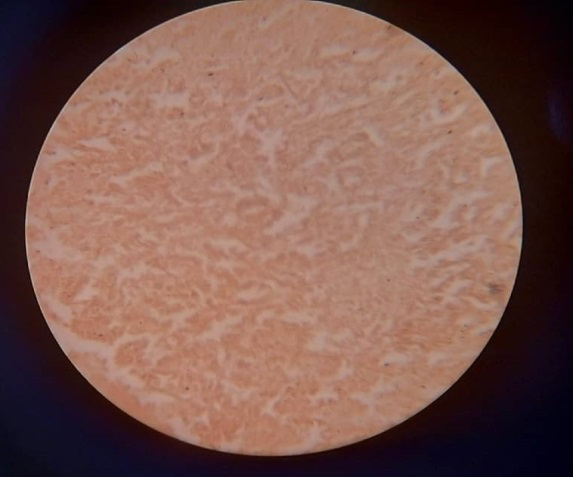
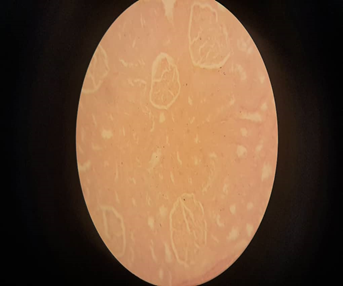
Aqueous extract of black plum fruit (fresh) stained the nucleus of the rat hepatic to purple colour when used as an alternative to Haematoxylin in a Haematoxylin and eosin staining technique, the intensity of the staining of the black plum extract was found to have a sharp contrast compared with the Extract without mordant.
Comparing the staining periods, it was observed that, at ten (10) minutes, the staining of the Extract was observed to be optimum when compared with the five (5) minutes in Haematoxylin and eosin staining techniques when Harris Haematoxylin was used.
The result suggested that a dye extracted from black plum fruits using an aqueous solvent can be used to stain tissue. Thus, agreeing with Suabjakyong P, et al. [6], who used aqueous and glacial acetic acid to extract dye from black plum fruit, in his investigation, it was observed that the extract from black plum fruit (syzigium cumin) stained the nucleus and cytoplasm with violet color with staining period of ten (10) fifteen (15) and twenty (20) minutes using 1% ferric iron as the mordant. Adisa JO, et al. [7] reported Aqueous or ethanolic extracts of henna is acidic and the use of 1% solution of the extract in water, when applied for 10 minutes on liver tissues as a cytoplasmic stain gave excellent result with nuclear and cytoplasmic staining intensity and clarity when compared with conventional haematoxylin and eosin. The ability of a dye to color certain tissue components depends on factors such as electrostatic attraction. Basic dyes will stain acidic structures (nucleus), while essential structure cytoplasm will be stained by acidic dyes [5]. In the case of this study, the black plum extract was used as the primary dye which served as the basic dye while eosin served as acidic dye, these work also agreed with the research of Uchejeso OM, et al. [8] which stated that, beetroot extract exhibit a good staining properties like haematoxylin, while eosin as an acidic dye stain basic structures pink colour. Hence, the purplish appearance of the nuclei and the cytoplasm appearing pinkish (Figures 1 & 2).
Conclusion
Black plum fruit aqueous extract has properties capable of staining the nucleus of rat hepatic tissue into a purple colour. The optimal staining duration of the aqueous fruit extract with Potassium alum was ten (10) minutes. Black plum fruits can be used as an alternative to hematoxylin in the hematoxylin and eosin staining technique.
Conflict of Interest
No conflicts of interest reported.
Acknowledgement
The study was supported by the Department of Histopathology, Federal College of Veterinary and Medical Laboratory Technology, Vom, Plateau state, Nigeria.
References
-
Avwioro OG, Aloamaka PC, Ojiaya NU, Oduola T Ekpo EO, et al. (2005) Extracts of Pterocarpus osun as a histological Stain for Collagen fibers. African Journal of Biotechnology 4(5): 460-462.
-
Carleton HM, Drury RAB, Wallington EA (1976) Histological technique. 4th (Edn.), Oxford University Press, London, pp: 432.
-
Bhuyan R, Saikia CN (2005) Isolation of colour components from natural dye-bearing plants in northeastern India. Bioresour Technol 96(3): 363-372.
-
Akinloye AJ, Illoh HC, Olagoke AO (2010) Screening of some indigenous herbal dyes for use in plant histological staining. Journal of Forestry Research 21: 81-84.
-
Avwioro OG (2002) Histochemistry and tissue pathology. 1st(Edn.), Claverianum press, Nigeria.
-
Suabjakyong P, Romratanpan S, Thitipramote P (2011) Extraction of natural histological dye from black plum fruit (Syzygium cumini). Journal of the Microscopy Society of Thailand 4(1): 13-15.
-
Adisa JO, Musa KK, Egbujo EC, Uwaeme IM (2017) A study of various modifications of Lawsonia inermis (Henna) Leaf extract as a cytoplasmic stain in liver biopsies. Int Jour Res Med Sci 5(3): 1058-65.
-
Obeta U, Dajok G, Ejinaka O, Deko B, Yusuf BN, et al. (2022) Beetroot and Turmric Beetroot and Turmeric as Alternative Dyes for Haematoxylin and Eosin in Histological Staining. Scientific Research Journal of Clinical and Medical Sciences 2(1): 54-58.
- Huddled and Preternatural- Atypical Lobular Hyperplasia
- Cytologic Surveillance Versus Immediate Referral to Colposcopy for Women with a Cervical Cytology Diagnosis of ASC-US and LSIL in the Absence of HPV DNA Test
- Callow and Vernal-Hepatoblastoma
- Critical Analysis of World Status of Research on the Development of High Yielding Strains of Jatropha Curcas L
- Non-Invasive Follicular Thyroid Neoplasm with Papillary-Like Nuclear Features: Pitfalls of Cytological and Histopathologic Diagnosis
- Melissopalynology in Some Regions of Kermanshah Province (West of Iran)